Disclosure: As an Amazon Associate I earn from qualifying purchases. If you click a link on this page and make a purchase, we may receive a small commission at no extra cost to you.
Choosing an air purifier gets harder when a product advertises both high airflow and very large room coverage. The KNKA APH4000 Air Purifier combines AHAM-verified CADR figures, dual 3-stage filters, a washable pre-filter, PET and ECO modes, and real-time air quality monitoring. Its strongest use case is a bedroom or living area where you want frequent particle filtration without much nighttime noise. The main limitation is room sizing: the advertised 1,695 sq. ft. maximum represents much slower air turnover than you get in a 350 sq. ft. room.
Quick Verdict
Rating: 8.8 / 10 (Recommended with caveats)
Best For: Pet households, bedrooms, living rooms, and spaces around 350 sq. ft. where you want frequent air changes.
Bottom Line: The KNKA APH4000 pairs strong verified CADR figures with dual filters, useful automatic modes, and quiet 22–24 dB Sleep Mode. Its 1,695 sq. ft. headline coverage should not be confused with the faster cleaning performance available in smaller rooms.
| Specification | Detail |
|---|---|
| Brand | KNKA |
| Model | APH4000 |
| Product Type | Portable HEPA air purifier |
| Dimensions | 8.15 in. D × 12.36 in. W × 17.09 in. H |
| Weight | About 9.7 lb. |
| Power | 45 watts |
| Smoke/Dust/PM2.5 CADR | 226 CFM (384 m³/h) |
| Pollen CADR | 244 CFM (415 m³/h) |
| Room Air Changes | About 4.8 per hour at 350 sq. ft.; about 1 per hour at 1,695 sq. ft. |
| Filtration | Dual 3-stage filters with washable pre-filter, high-efficiency/HEPA filtration, and activated carbon |
| Airflow Design | Front-and-back intakes with side outlets |
| Operating Modes | PET, ECO, Auto, and Sleep |
| Fan Speeds | 4 |
| Sleep Mode Noise | As low as 22–24 dB |
| Air Quality Monitoring | Real-time AQI display with color-coded indicators |
| Verification | AHAM Verifide CADR performance |
| Filter Replacement | Recommended every 3–6 months, depending on use |
| Colors Listed | White and black |
| ASIN | B0FNDG2TNK |
What Is the KNKA Air Purifier?
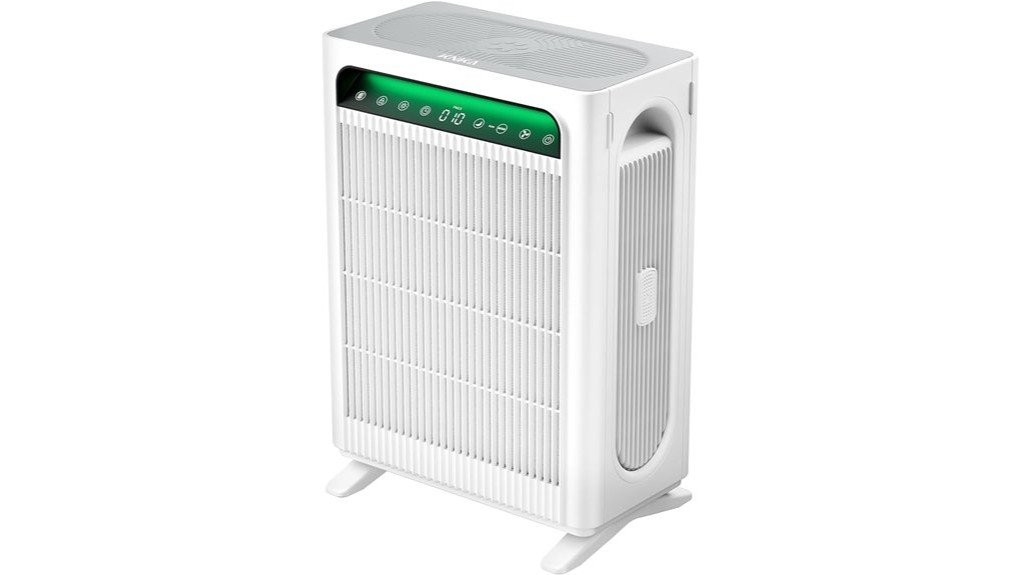
The KNKA APH4000 is a portable room air purifier designed to reduce airborne particles such as dust, pollen, pet dander, and smoke particles. Its airflow system uses front-and-back intakes, side outlets, and two filter cartridges rather than relying on a single filter surface.
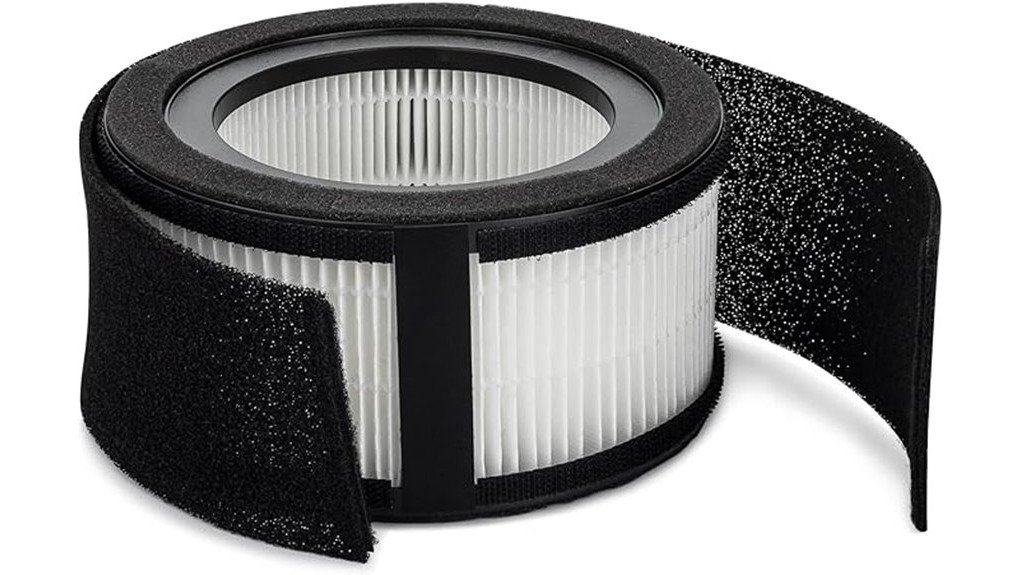
Each side uses a 3-stage design consisting of a washable pre-filter, a high-efficiency HEPA filtration layer, and activated carbon. The pre-filter catches larger debris before it reaches the main filter, while the particle filter handles finer airborne material. The carbon layer is intended to help with household odors and some gaseous pollutants, but it should not be treated as a substitute for ventilation or source removal.
The APH4000 also includes an onboard AQI display, automatic fan adjustment, PET Mode, ECO Mode, Sleep Mode, and four fan speeds. At about 17 inches tall and 9.7 pounds, it is better suited to the floor, a low stand, or another stable open location than to a small desktop.
Who Should Buy It?
Best For
- Pet households that want better control of airborne dander, fine hair, and everyday odors.
- Bedrooms and living areas around 350 sq. ft. where frequent air changes matter more than maximum advertised coverage.
- You want automatic air-quality response, a visible AQI reading, and quiet overnight operation without complicated setup.
Skip If
- You expect the full 1,695 sq. ft. area to receive the same rapid filtration available in a smaller room.
- You do not want the recurring cost and maintenance of replacing two main filter cartridges every 3–6 months.
- You need a tiny personal purifier that can sit unobtrusively on a crowded desk.
Key Feature Performance Breakdown
1. AHAM-Verified CADR Performance
CADR is one of the more useful numbers for comparing particle-removal performance because it measures the volume of filtered air delivered by the purifier. The APH4000 lists a Smoke/Dust/PM2.5 CADR of 226 CFM and a Pollen CADR of 244 CFM.
That matters more than a large coverage number by itself. A higher CADR allows the purifier to cycle a smaller room more frequently, which is useful when pollen, smoke, or pet dander is being introduced continuously.
2. Room Size and Air Change Rate
The KNKA listing states that the APH4000 can refresh the air about 4.8 times per hour in a 350 sq. ft. room. At the advertised maximum of 1,695 sq. ft., the listed rate drops to approximately one air refresh per hour.
This distinction is important when choosing where to use it. For everyday particle control in a bedroom or main living area, the smaller-room figure gives you a better picture of its stronger performance. The 1,695 sq. ft. number is more useful as a maximum circulation claim than as an indication of equally fast cleaning.
Pro Tip: Choose your purifier based on the air-change rate you actually want, not only the largest square-foot number on the listing. The APH4000’s 350 sq. ft. rating is the more useful reference when frequent filtration is your priority.
3. Dual 3-Stage Filtration
The APH4000 uses two filter cartridges, with each cartridge combining a washable pre-filter, a HEPA/high-efficiency particle filter, and activated carbon. This gives air more filter surface while allowing intake from the front and rear of the unit.
The washable pre-filter is useful in pet homes because it catches larger material before it loads the main filter. You still need to vacuum floors and upholstery, because an air purifier is much better at capturing material that becomes airborne than removing pet hair that has already settled.
The activated-carbon layer adds odor-control capability, but carbon filtration has limits. Strong cooking odors, smoke sources, and persistent chemical smells are better handled with source control and ventilation as well as filtration.
4. PET, ECO, Auto, and Sleep Modes
PET Mode raises airflow when you want faster circulation around shedding pets or after activity sends dander into the air. KNKA advertises a 30-minute air-refresh function in this mode, but actual clearing time will vary with room size, airflow, pollutant load, and placement.
ECO Mode allows the purifier to enter standby after it detects good air quality and restart when additional filtration is needed. This can reduce unnecessary fan runtime and filter loading during cleaner periods.
Auto Mode adjusts the fan according to the onboard air-quality reading, while Sleep Mode reduces fan noise to a listed 22–24 dB range. Four fan speeds are also available when you prefer manual control.
5. Real-Time Air Quality Monitoring
The built-in sensor feeds a real-time AQI display with color-coded indicators. This gives you a simple way to see when the purifier detects a change after dusting, cooking, opening windows, or other household activity.
Treat the display as a useful control and trend indicator rather than a complete assessment of everything in your indoor air. A particle sensor cannot tell you whether every odor, gas, allergen, or other contaminant has been removed.
What to Expect in Everyday Use
Daily Household Dust and Pollen
For routine use, Auto Mode is the most convenient setting. The purifier can increase airflow after the sensor detects a particle rise and then reduce fan speed as conditions improve. In a bedroom or similar-sized room, the stated 4.8 air changes per hour at 350 sq. ft. give it enough circulation to repeatedly process the room’s air.
Pet Dander and Shedding
PET Mode is most useful when grooming, playing, cleaning, or normal pet movement sends dander and fine hair into the air. The washable pre-filter gives you a first layer for larger debris, while the main filter addresses finer airborne particles.
Do not expect the purifier to replace vacuuming. Heavy fur on carpets, bedding, sofas, and floors needs physical cleaning, while the purifier works on material that reaches its airflow path.
Cooking Smoke and Odors
The HEPA filtration stage can help capture airborne cooking particles, and the activated-carbon stage can reduce some odor compounds. For heavy frying, persistent smoke, or grease, use your range hood or other appropriate ventilation first. An air purifier is a useful secondary control, not a grease extractor.
Overnight Bedroom Use
Sleep Mode is one of the APH4000’s more practical features for bedrooms. KNKA lists operation as low as 22–24 dB, and the lower fan setting reduces the chance that fan noise becomes distracting while you sleep.
If air quality is poor before bedtime, running the purifier at a faster setting first and switching to Sleep Mode later can give you more initial airflow without keeping the higher fan speed on all night.
Placement and Usage Guidelines
Airflow matters as much as the filter itself. Place the APH4000 where its front and rear intakes and side outlets have open space around them. Do not wedge it tightly between furniture, behind curtains, or inside a cabinet where the intake or exhaust path can be restricted.
Before first use, check the filter compartments and remove any protective plastic packaging from the filters. A purifier can run with packaged filters installed, but it will not filter correctly because air cannot pass through the media.
For ongoing care, inspect the washable pre-filter for visible dust and pet debris and clean it according to the product instructions. Replace the main filters when the replacement indicator calls for service or within KNKA’s recommended 3–6 month interval, depending on operating conditions.
Before You Buy: Do not choose the APH4000 solely because the listing says 1,695 sq. ft. At that size, KNKA states about one air refresh per hour. For substantially faster particle removal, plan around a smaller room or compare the CADR and air-change rate you actually need.
Cleaning and Filter Maintenance
The APH4000 has a washable pre-filter, which can reduce how quickly larger dust and hair reach the more expensive main filtration layers. Let the washable component dry as directed before reinstalling it, and do not wash filter layers unless the manufacturer’s instructions specifically identify them as washable.
KNKA recommends replacing the filters every 3–6 months and includes a replacement indicator. Homes with pets, frequent smoke exposure, high dust levels, or long daily runtimes may load filters faster than lightly used rooms.
The manufacturer recommends genuine APH4000 replacement filters. Correct fit matters because gaps around the filter can allow some airflow to bypass the filtration media.
Before You Use It
An air purifier is designed to supplement good indoor-air practices, not replace them. Continue to control pollutant sources, clean settled dust and pet hair, use kitchen ventilation when cooking, and follow the purifier’s operating and safety instructions.
The AQI display can help you follow particle changes in the room, but it should not be treated as a medical device or as proof that every indoor pollutant has been removed. If you are using an air purifier because of a specific health concern, follow appropriate professional medical guidance as well.
Pros and Cons
Pros
- AHAM-verified CADR figures give you a useful basis for comparing particle-cleaning performance.
- 226 CFM Smoke/Dust/PM2.5 and 244 CFM Pollen CADR provide strong airflow for a unit of this size.
- Dual 3-stage filters include a washable pre-filter plus HEPA/high-efficiency and activated-carbon stages.
- PET, ECO, Auto, and Sleep modes cover common household use without complicated controls.
- 22–24 dB minimum Sleep Mode noise is well suited to bedrooms and other quiet spaces.
Cons
- The 1,695 sq. ft. maximum corresponds to only about one air change per hour, so large-room cleaning is much slower.
- Two main filter cartridges require replacement roughly every 3–6 months, creating an ongoing ownership cost.
- At about 17 inches tall and 9.7 pounds, it is a floor or room purifier rather than a compact personal desktop model.
Check Current Price on Amazon →
Is It Worth the Price?
The KNKA APH4000 makes the most sense in the mid-range air-purifier category when you value measurable CADR performance, automatic controls, dual filters, and quiet bedroom operation. Its AHAM-verified performance is more useful for comparison than relying only on a large square-foot claim.
You should also budget for replacement filters every 3–6 months. That recurring cost matters more in homes where the purifier runs continuously or where pets, smoke, and high dust levels load the filters quickly.
It is worth considering if you want a high-airflow purifier for a bedroom or medium-sized living area. It is less compelling if your main goal is to clean a very large open floor plan rapidly with a single unit.
How It Compares to Alternatives
If app-based control and remote scheduling matter to you, the Levoit Core 400S-P and Blueair Blue Pure 311i Max are worth comparing. The Coway Airmega Mighty AP-1512HH is another established alternative if you want straightforward automatic particle control and replaceable filtration.
The KNKA APH4000’s main advantages are its dual-filter layout, dedicated PET and ECO modes, onboard AQI display, and verified 226/244 CFM CADR figures. Your choice should ultimately depend on room size, desired air-change rate, replacement-filter cost, controls, and noise rather than maximum coverage alone.
Frequently Asked Questions
How long do KNKA APH4000 filters last?
KNKA recommends replacing the main filters every 3–6 months for optimal performance. Actual life depends on runtime, dust levels, pets, smoke exposure, and how quickly the filters load.
Is the KNKA APH4000 really suitable for 1,695 sq. ft.?
The listing states that it can provide about one air refresh per hour in a 1,695 sq. ft. space. It provides much faster circulation in a 350 sq. ft. room, where the stated rate is about 4.8 air changes per hour.
Does PET Mode remove pet hair from furniture and floors?
No air purifier can replace vacuuming or physical cleaning of settled fur. PET Mode increases airflow to capture more airborne dander, fine hair, and particles that reach the purifier’s intake.
Can the APH4000 help with cooking smoke and odors?
Its particle filter can capture airborne smoke particles, while the activated-carbon layer can help reduce some odors. For heavy cooking smoke and grease, use a range hood or appropriate ventilation as the primary control.
Is the KNKA APH4000 noisy enough to disturb sleep?
KNKA lists Sleep Mode at approximately 22–24 dB at its quietest setting. Higher fan settings move more air and will be more noticeable, so Sleep Mode is the better choice when minimum nighttime noise is your priority.
Which part of the KNKA APH4000 filter is washable?
The product listing identifies the pre-filter as washable. Do not wash the HEPA/high-efficiency or activated-carbon layers unless KNKA’s current instructions specifically tell you to do so.
Do I need genuine KNKA replacement filters?
KNKA recommends genuine APH4000 filters for proper fit and filtration performance. If you consider another filter, verify exact APH4000 compatibility and make sure it seats correctly without gaps around the filter housing.
What is the most common setup mistake with this purifier?
One important mistake is leaving protective plastic around the filters before first use. You should also avoid blocking the front or rear intake and side outlets with furniture, curtains, or other objects.
The Bottom Line
The KNKA APH4000 is a strong choice if you want AHAM-verified CADR performance, dual 3-stage filters, useful automatic modes, and quiet bedroom operation. It is best suited to buyers who understand that its strongest performance comes in smaller and medium-sized rooms, while the 1,695 sq. ft. maximum provides much slower air turnover. Skip it if you want a tiny desktop unit or do not want recurring filter-replacement costs.