Affiliate disclosure: As an Amazon Associate I earn from qualifying purchases. This article contains affiliate links to Amazon, so we may earn a commission if you buy through them, at no extra cost to you.
The best home weather stations for 2026 include the Ambient Weather WS-2902, AcuRite Iris 5-in-1, Davis Vantage Vue, and Tempest Weather Station. Ambient Weather offers strong smart-home support and broad sensor coverage. AcuRite is easy to set up and tracks many data points. Davis Vantage Vue suits users who want detailed monitoring and alarms. Tempest stands out for low maintenance and fast updates. More details on choosing the right one follow.
Ambient Weather WS-2902 Wi-Fi Smart Weather Station
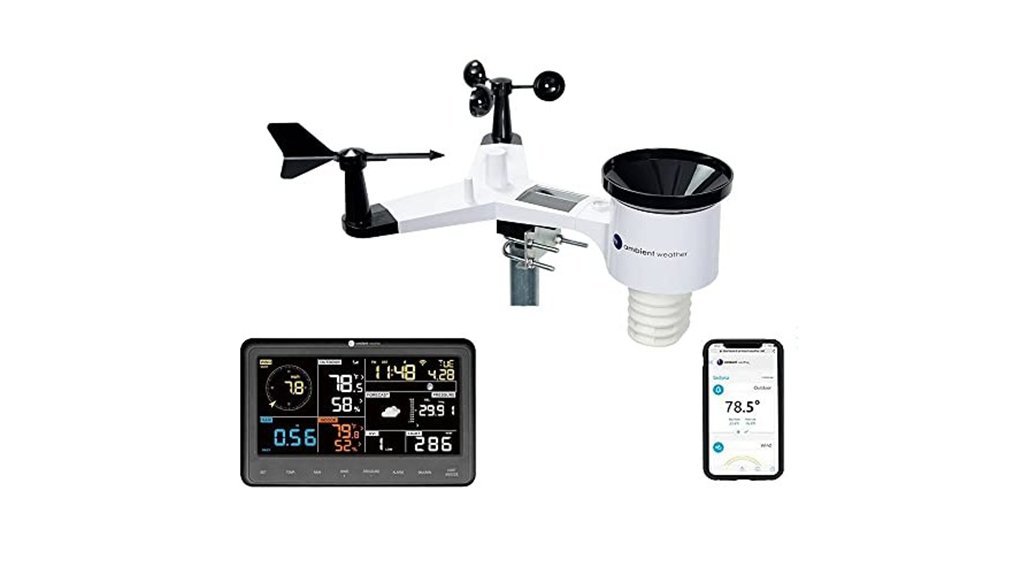
The Ambient Weather WS-2902 Wi-Fi Smart Weather Station is a strong choice for homeowners who want detailed, hyper-local weather data in an easy-to-read format. Its Osprey sensor array with rain cup tracks wind speed, direction, temperature, humidity, rainfall, UV intensity, and solar radiation. The bright LCD color display makes current conditions simple to review indoors. Wi-Fi connectivity supports alerts, remote access, and integration with IFTTT, Google Home, and Alexa. Users can share data through Ambient Weather Network, customize dashboards, and optionally join a wider weather station network for broader community use.
Best For: Homeowners who want a feature-rich Wi‑Fi weather station with hyper-local data, smart home integration, and an easy-to-read display.
Pros:
- Measures a wide range of weather metrics, including wind, temperature, humidity, rainfall, UV, and solar radiation.
- Offers Wi‑Fi connectivity with alerts, remote access, and compatibility with IFTTT, Google Home, and Alexa.
- Includes a bright LCD color display and support for Ambient Weather Network sharing and dashboard customization.
Cons:
- Setup may be more involved than a basic weather station.
- Some community/network features are optional and may require extra configuration.
- Best suited for users who will take advantage of its smart and connected features, which may be more than casual users need.
AcuRite Iris 5-in-1 Wireless Weather Station (01512M)
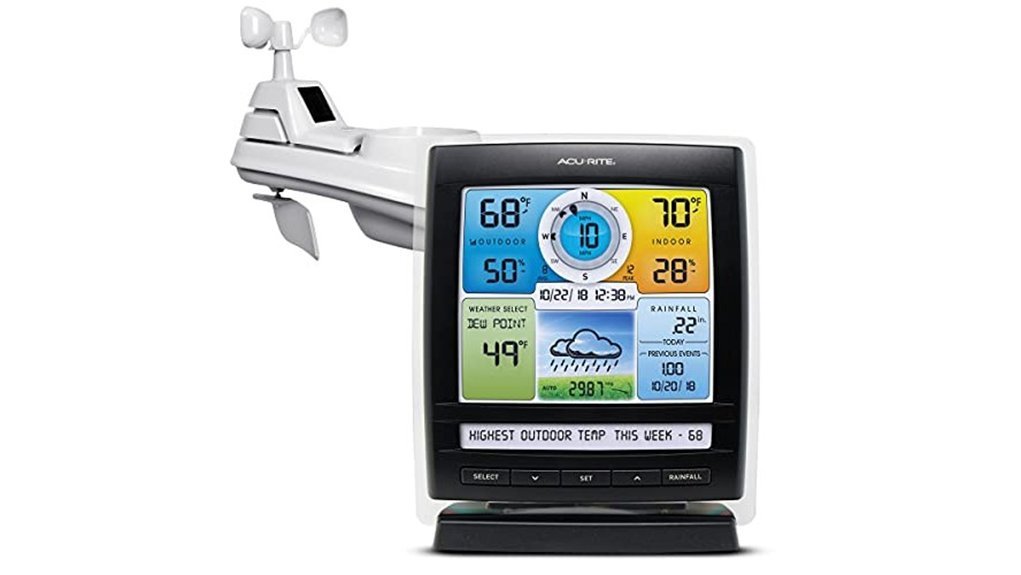
AcuRite Iris 5-in-1 suits users seeking hyperlocal forecasting with broad, real-time environmental tracking. It records more than 55 data points, including historical trends, heat index, dew point, feels-like temperature, and pressure changes. The station also reports indoor and outdoor temperature, humidity, wind speed and direction, barometric pressure, and rainfall. Setup is straightforward: install batteries, mount the outdoor sensor, and begin monitoring. A large color LCD shows time, date, and conditions, with an adjustable dimmer. Elevation and pressure data support a tailored 12-hour forecast. AcuRite’s long-standing reputation further strengthens its appeal.
Best For: Home weather enthusiasts and anyone wanting easy-to-use, hyperlocal forecasting with detailed real-time indoor and outdoor environmental data.
Pros:
- Tracks more than 55 data points, including historical trends, heat index, dew point, and pressure changes.
- Easy setup with a wireless outdoor sensor and large color LCD display with adjustable dimmer.
- Provides a personalized 12-hour forecast using elevation and barometric pressure data.
Cons:
- May be more feature-rich than casual users need.
- Requires battery installation and sensor mounting, which may still be inconvenient for some.
- Forecasting and readings are dependent on proper placement and local conditions.
Davis Vantage Vue Wireless Weather Station (6250)
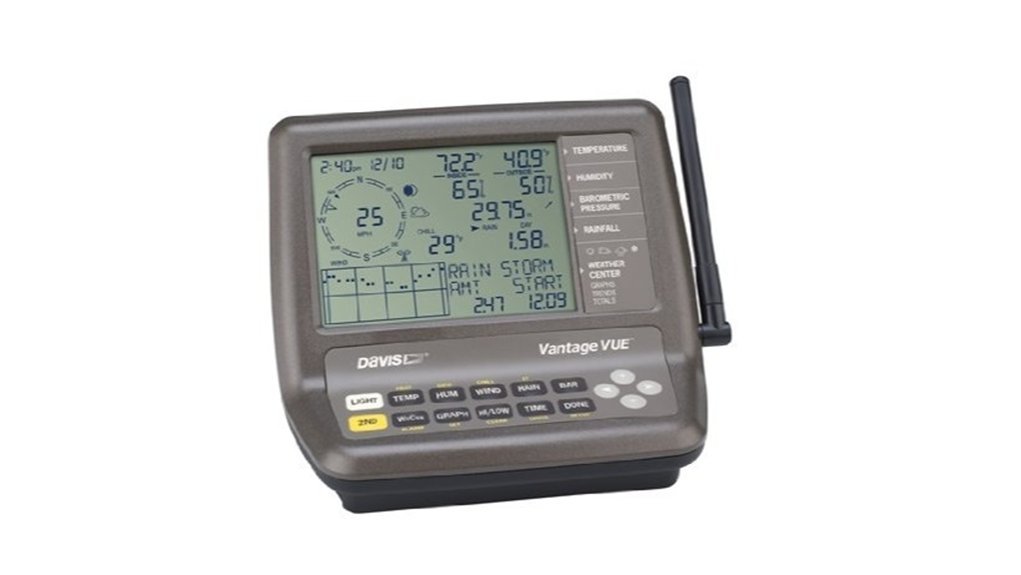
With 22 alarms and a clear LCD console, the Davis Vantage Vue suits serious home weather watchers. The Davis Instruments 6250 Vantage Vue Wireless Weather Station presents indoor and outdoor temperature, humidity, barometric pressure, wind speed, wind direction, and rainfall at a glance. Its glow-in-the-dark keypad improves nighttime use, while domed buttons add tactile feedback. Fifty on-screen graphs help compare current readings with past trends. The alarm system can warn of high winds and flooding. As an extensive monitoring setup, it offers broad environmental awareness for home users needing detailed weather tracking.
Best For: Serious home weather watchers who want a detailed wireless weather station with comprehensive environmental readings and alerting features.
Pros:
- Tracks indoor and outdoor temperature, humidity, barometric pressure, wind speed, wind direction, and rainfall.
- Includes 22 alarms for warning about conditions like high winds and flooding.
- Offers a clear LCD console, glow-in-the-dark keypad, and 50 on-screen graphs for trend comparison.
Cons:
- May be more feature-rich than casual users need.
- Requires attention to multiple readings and alarms, which can feel complex.
- No mention of smart-home integration or app-based remote monitoring.
Tempest Weather Station with Wind, Rain, Forecasts, Alexa Enabled
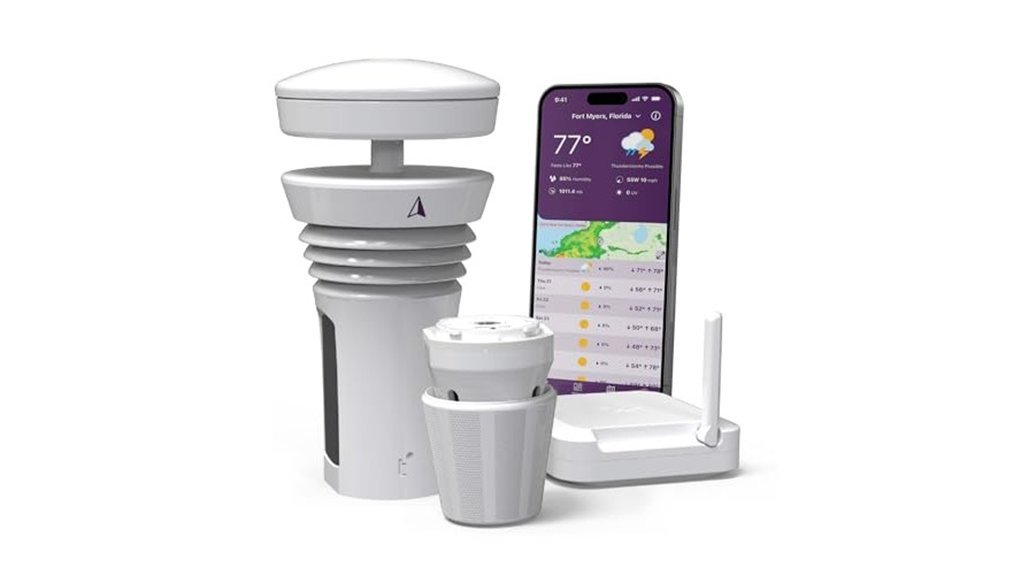
Tempest Weather Station suits homeowners who want hyper-local, real-time weather data with smart-home automation. WeatherFlow’s 2026 model tracks temperature, humidity, pressure, wind, dew point, solar radiation, UV, lightning, and rainfall. Its solar-powered outdoor sensor sends readings wirelessly over 1,000 feet and refreshes every three seconds. With no moving parts, it requires minimal upkeep and is built for long-term reliability. Alexa, Rachio, IFTTT, and other smart platforms support automation for lights, thermostats, and irrigation. Backed by expert praise and 90,000 users, it remains a trusted option.
Best For: Homeowners and smart-home users who want hyper-local, real-time weather monitoring with easy automation for lights, thermostats, and irrigation.
Pros:
- Tracks a wide range of weather data, including wind, rainfall, UV, lightning, and more.
- Solar-powered outdoor sensor with wireless range over 1,000 feet and updates every 3 seconds.
- No moving parts means very low maintenance and strong long-term reliability.
Cons:
- Higher-end feature set may be more than casual users need.
- Smart-home automation depends on compatible platforms and setup.
- Outdoor sensor performance can still be affected by installation location and environment.
Factors to Consider When Choosing Home Weather Stations 2026: Top Picks and Buying Guide
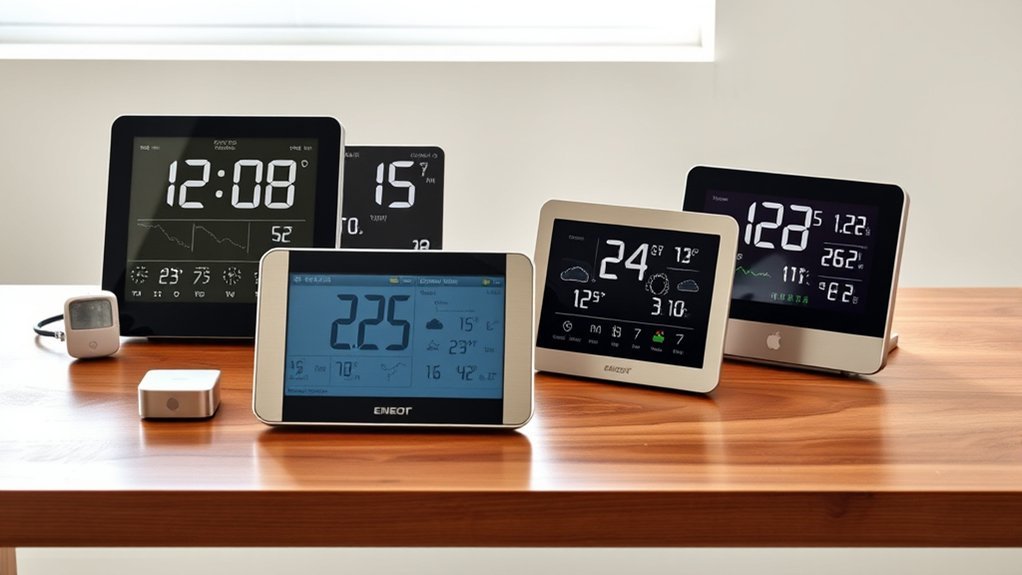
Choosing a home weather station in 2026 depends on sensor accuracy, data tracking depth, and how clearly the display presents readings. Smart home integration also matters for users who want alerts and controls through connected devices. Installation ease remains important, since a simpler setup can make the station more practical for everyday use.
Sensor Accuracy
Sensor accuracy is one of the most important measures of a home weather station’s value, since it determines how reliably temperature, humidity, wind, and rainfall readings reflect actual conditions. High-quality units typically use multiple sensors that work together to improve precision and capture conditions specific to a site. Calibration matters greatly, because poorly adjusted sensors can produce misleading results and weaken forecasts or environmental observations. Placement also affects performance: sensors perform best when kept away from heat sources, reflective surfaces, and direct sunlight. Regular maintenance helps preserve accuracy over time, reducing sensor drift and keeping measurements dependable. For buyers, accuracy should be treated as a core specification, not an optional feature, because it shapes the usefulness of every weather reading.
Data Tracking
Beyond accuracy, a home weather station’s value depends on how much useful data it can track and how quickly it delivers it. Strong systems measure temperature, humidity, wind speed and direction, rainfall, UV intensity, and solar radiation, giving a fuller picture of local conditions. More advanced models monitor over 55 data points, including historical records, heat index, dew point, and pressure trends, which can improve short-term forecasting. Real-time updates every few seconds help users react promptly as conditions shift. Built-in alerts for high winds, flooding, or other hazards add practical protection. Integration with smart home platforms can trigger automated responses, such as adjusting thermostats or blinds, improving comfort and energy efficiency while keeping weather data actionable.
Display Readability
Clear visibility matters as much as data quality when selecting a home weather station. A large color LCD display helps users scan current conditions and historical trends quickly, while high-resolution screens present graphs and readings with greater clarity. Adjustable brightness settings are useful because they reduce glare in bright rooms or direct sunlight. At night, backlit screens or glow-in-the-dark features keep information easy to read without strain. Customizable layouts also improve usability by placing the most important metrics front and center. When the display is well designed, interpreting temperature, humidity, rainfall, and other weather details becomes faster and more accurate. Readability should consequently be treated as a practical priority, not an optional extra, when comparing models for daily home use.
Smart Home Integration
Smart home integration has become a major advantage in modern weather stations, linking real-time weather data with platforms such as Alexa, Google Home, and IFTTT to support automated routines. This connectivity lets the station trigger practical responses, such as adjusting thermostats, activating irrigation, or dimming indoor lighting when conditions change. Remote access through smartphone apps also keeps readings available from nearly any location, which strengthens monitoring convenience. Alert functions add another layer of value by sending notifications for wind, rain, temperature, or other specific thresholds directly to phones or connected devices. Some models also include customizable dashboards for sharing hyper-local observations with community networks, improving broader weather awareness. In practice, these features make the station part of a coordinated home ecosystem rather than a standalone instrument.
Installation Ease
Installation ease can be a deciding factor for many buyers, especially when a weather station is meant to be up and running quickly. Models with straightforward battery insertion, simple mounting brackets, and clearly labeled components reduce setup time and frustration. Systems that need only basic tools, or none at all, are often better suited to users without technical experience. A user-friendly LCD display can also improve the first-time experience by presenting clear instructions and immediate readings. Detailed manuals and support resources further streamline the process, helping owners resolve questions without delay. When the installation process is uncomplicated, the station can begin delivering useful data sooner, making the purchase feel more practical and less intimidating for a broad range of households.
Wireless Range
Wireless range is a key factor in determining whether a home weather station can reliably connect its outdoor sensor to the indoor display unit. Many systems offer effective distances from 300 feet to more than 1,000 feet, but real-world performance often depends on the environment. Walls, trees, and other physical barriers can weaken the signal, while humidity and temperature shifts may slow transmission or cause brief delays. For this reason, the home’s layout and yard dimensions should be reviewed before purchase, since sensor placement affects accuracy and consistency. Modern stations increasingly use improved wireless technology to preserve a stable link over longer spans, making them better suited to larger properties or more complex installations. Choosing adequate range helps guarantee dependable data delivery.
Maintenance Needs
Maintenance needs can vary widely from one home weather station to another, especially when comparing models with moving parts to solar-powered designs that have no mechanical components. Stations with anemometers or other rotating parts often need cleaning, lubrication, or occasional replacement, while sealed solar units usually demand less attention. Wireless transmission can further reduce upkeep by limiting cable checks and physical adjustments. Durable housings and corrosion-resistant materials also help lower wear over time, particularly in exposed or harsh climates. Some models include weatherproofing or self-cleaning features that keep sensors operating longer between inspections. User reviews are useful for identifying common maintenance issues, such as debris buildup, battery access, or sensor recalibration. Choosing a low-maintenance design can save time and preserve measurement accuracy.
Frequently Asked Questions
How Often Do Home Weather Stations Need Calibration?
Home weather stations typically need calibration once or twice a year, though sensors may require checking after extreme weather, relocation, or noticeable drift. Low-cost units often benefit from more frequent verification against trusted references.
Can Weather Stations Connect to Smart Home Systems?
Yes, many weather stations can connect to smart home systems through Wi‑Fi, Bluetooth, or hubs, enabling automation and voice control. Compatibility depends on brand, protocols, and supported platforms, so buyers should verify integration first.
What Maintenance Do Outdoor Sensors Require?
Outdoor sensors need periodic tender care: cleaning, battery replacement, and inspection for corrosion or damage. They also benefit from recalibration and secure mounting. Neglected units often become slightly less truthful, then steadily unreliable.
How Long Do Weather Station Batteries Typically Last?
Weather station batteries typically last six months to two years, depending on sensor type, transmission frequency, temperature, and battery quality. Solar-assisted models can last much longer, while cold weather often shortens life.
Are Weather Station Apps Available for Multiple Users?
Like a shared umbrella in sudden rain, many weather station apps support multiple users. They often allow family accounts or shared logins, though permissions vary by brand, device, and subscription features.
Conclusion
To sum up, the best home weather station depends on the buyer’s balance of budget, breadth, and precision. Ambient Weather offers accessible accuracy, AcuRite delivers dependable daily data, Davis provides durable, detailed monitoring, and Tempest brings sleek smart sensing to modern homes. By comparing features, forecast functions, and installation needs, homeowners can choose with confidence. Careful consideration now leads to clearer, calmer, more controlled weather tracking for years ahead.