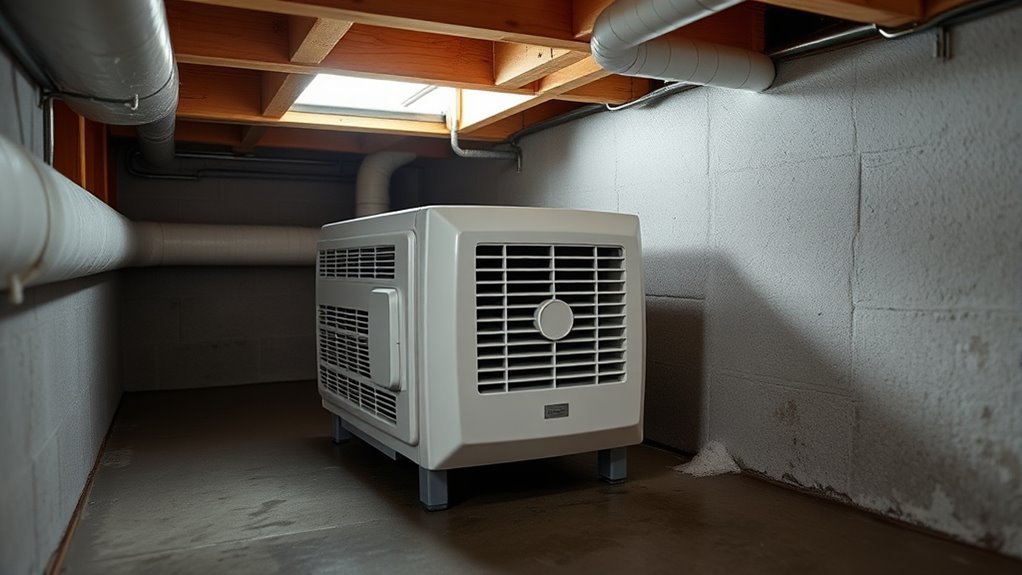
If your basement feels damp, smells musty, or never seems fully dry, the right quiet basement dehumidifier can make the space more comfortable without adding excessive background noise. For a full basement or a space that stays consistently humid, a compressor dehumidifier with meaningful pint-per-day capacity and continuous drainage is usually the better choice. Compact thermoelectric models can still be useful for a small finished basement room, storage nook, bathroom, or localized area with mild dampness, but they should not be treated as substitutes for higher-capacity basement machines. This guide compares quiet options for different moisture levels, room sizes, and drainage needs so you can choose based on real basement conditions rather than tank size or advertised coverage alone.
Affiliate Disclosure: This article contains Amazon affiliate links. If you buy through these links, we may earn a commission at no extra cost to you. Product specifications and availability can change, so check the current Amazon listing before buying.
Quick Verdict
For most genuinely damp basements, start with a compressor model. The PLUSCENT 32 Pint is the more balanced option for medium-to-large spaces, while the AEOCKY 4500 Sq.Ft model is better suited to buyers who want higher moisture-removal capacity and energy-focused operation. The ToLife, BEDRED 95 oz, and 106 oz compact models make more sense for a small finished basement room or mild localized dampness where low noise and portability matter more than maximum water removal.
Quick Picks for Quiet Basement Dehumidifiers
- Best overall for a typical damp basement: PLUSCENT 32 Pint Dehumidifier for Large Rooms
- Best high-capacity option: AEOCKY 4500 Sq.Ft Energy Star Dehumidifier
- Best quiet portable option for mild dampness: ToLife Dehumidifier for Home, 1000 sq.ft, 95 OZ Tank
- Best simple compact option: BEDRED 95OZ Dehumidifier for Home
- Best larger-tank compact option: Dehumidifier with 106 oz Tank for Home
Before You Buy Checklist
- Measure your basement: Know the approximate square footage, but do not rely on advertised coverage alone.
- Judge the moisture problem: Mild localized dampness is different from a basement that stays above your target humidity for hours or days.
- Compare pint-per-day capacity: For a full or consistently damp basement, moisture-removal capacity is more useful than tank volume.
- Plan drainage first: Continuous hose drainage can save substantial maintenance if the unit runs every day.
- Compare noise at the mode you will actually use: Sleep or low-fan specifications may be quieter than high-capacity operation.
- Check operating-temperature guidance: Cooler basements can affect dehumidifier performance, so follow the manufacturer’s operating limits.
Quiet Basement Dehumidifier Comparison
| Product | Best For | Capacity / Context | Quiet Feature | Amazon |
|---|---|---|---|---|
| PLUSCENT 32 Pint Dehumidifier for Large Rooms | Medium-to-large damp basements | 32 pints/day; listing states up to 2,500 sq. ft.; drain hose support | 39-42 dB listed operation | Check Price |
| AEOCKY 4500 Sq.Ft Energy Star Dehumidifier | Large or consistently humid basements | Up to 80 pints/day under stated high-humidity conditions; listing states 4,500 sq. ft. | 44 dB listed at lowest fan speed | Check Price |
| ToLife Dehumidifier for Home, 1000 sq.ft, 95 OZ Tank | Small finished basement rooms and mild localized dampness | 95 oz tank; seller advertises up to 1,000 sq. ft.; thermoelectric design | Under 30 dB listed sleep mode | Check Price |
| BEDRED 95OZ Dehumidifier for Home | Small basement room, storage nook, bedroom, or RV | 95 oz tank; seller advertises up to 1,000 sq. ft.; thermoelectric design | Sleep mode and thermoelectric operation | Check Price |
| Dehumidifier with 106 oz Tank for Home | Small enclosed basement spaces with mild dampness | 106 oz tank; seller advertises up to 1,000 sq. ft.; semiconductor design | Low-noise sleep mode | Check Price |
How These Picks Are Sorted
The compressor models lead because they better match the needs of a full or consistently damp basement. They offer measurable pint-per-day moisture removal, humidity controls, and easier long-term drainage. The compact thermoelectric models remain as secondary choices for small finished rooms, storage areas, or localized mild dampness where very low noise and portability matter more than maximum drying power.
PLUSCENT 32 Pint Dehumidifier for Large Rooms
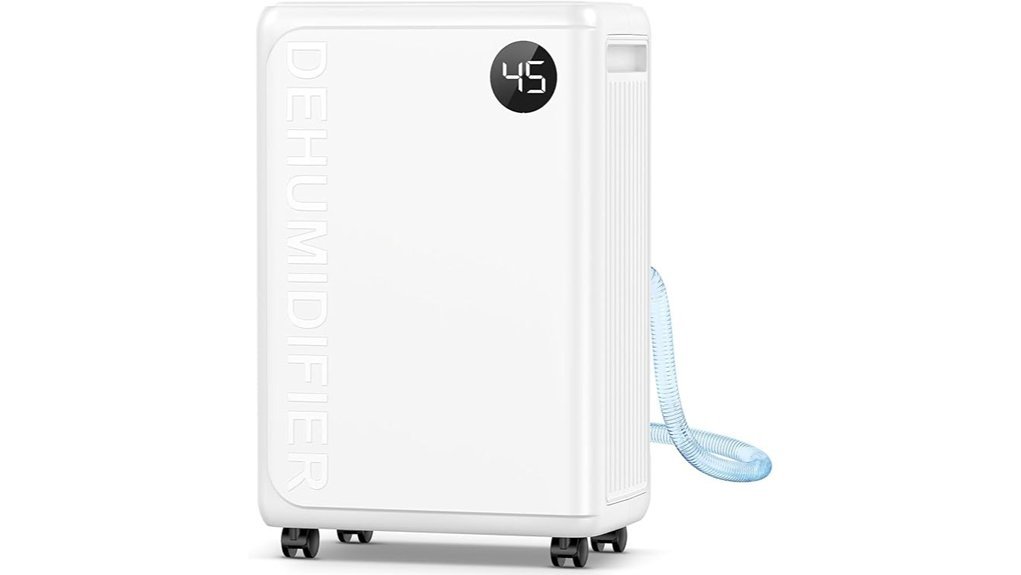
Best overall for a typical damp basement. The PLUSCENT 32 Pint Dehumidifier is a better match for basement humidity than a small thermoelectric unit when you need meaningful daily moisture removal. Its listing states up to 32 pints per day under specified high-temperature, high-humidity conditions and coverage up to 2,500 sq. ft. You can adjust humidity, use continuous operation for persistent dampness, or switch to a drying mode for laundry. A drain-hose option also makes long-running basement use easier than relying only on a small water tank.
Best For: Medium-to-large basements that need regular compressor-based moisture removal without stepping up to a much larger unit.
Why You’ll Like It: It balances basement-friendly capacity, continuous drainage, adjustable humidity control, and relatively quiet listed operation.
Why it works for basements: The combination of pint-per-day capacity and hose drainage is much better suited to persistent basement humidity than compact tank-only thermoelectric models.
Who should skip it: Skip it if you only need occasional moisture control in a tiny enclosed room, or if your basement has active leaks or standing water that must be repaired first.
Pros:
- Up to 32 pints/day under the manufacturer’s stated test conditions.
- Continuous drainage option reduces manual tank emptying.
- Adjustable humidity controls, timer, auto-defrost, and washable filter improve everyday usability.
Cons:
- The 2L tank can fill quickly in damp conditions if you do not use the drain hose.
- Actual moisture removal will vary with temperature and relative humidity.
- Gravity drainage requires a suitable drain location and hose routing.
Bottom Line: Choose PLUSCENT if you want a practical compressor dehumidifier for regular basement humidity control with both bucket and hose-drain options.
AEOCKY 4500 Sq.Ft Energy Star Dehumidifier
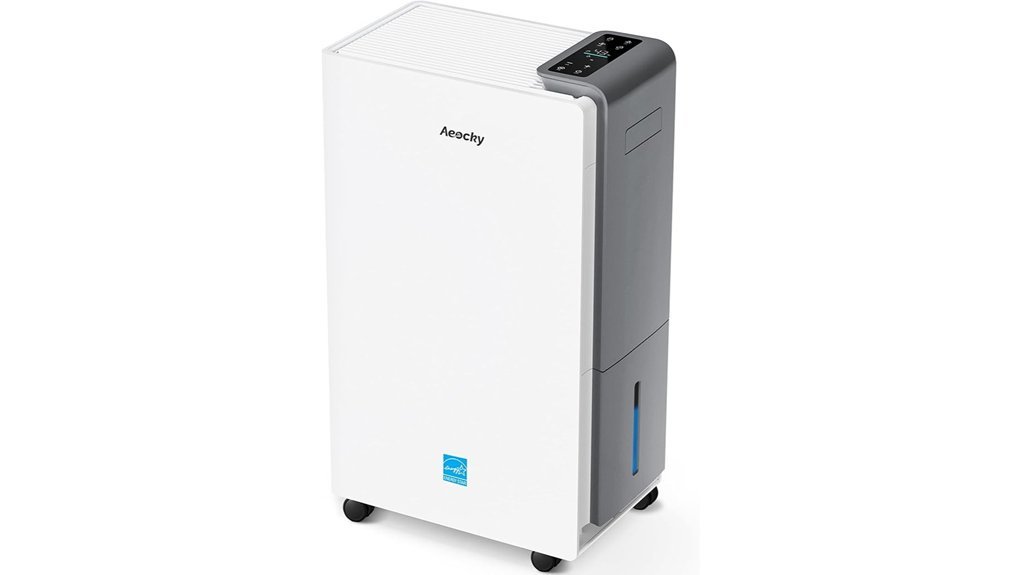
Best high-capacity option for large or consistently humid basements. The AEOCKY model is built for buyers who need substantially more moisture-removal capacity than a mini dehumidifier can provide. Its current listing states coverage up to 4,500 sq. ft. and up to 80 pints per day under high-humidity test conditions. It includes adjustable humidity control, a drain hose, timer, child lock, and multiple operating modes. The listing also states that its lowest fan setting operates at about 44 dB.
Best For: Larger basements or homes where the dehumidifier may run for long periods during humid weather.
Why You’ll Like It: It combines higher moisture-removal capacity with continuous drainage and automatic humidity management, reducing the need to constantly check the machine.
Why it works for basements: High-capacity compressor performance and drain-hose support make it better suited to persistent basement humidity than compact thermoelectric units.
Energy Note: The product listing states that this model received an ENERGY STAR Most Efficient 2025 designation. Because efficiency programs and product listings can change, check the current product page if certification status is important to your purchase.
Who should skip it: Skip it if your humidity problem is limited to a tiny finished room or you want an ultra-light portable unit that you move frequently between floors.
Pros:
- Up to 80 pints/day under the manufacturer’s stated high-humidity conditions.
- Drain hose, adjustable humidistat, timer, and automatic operating modes suit long-term basement use.
- 44 dB listed minimum noise level is relatively restrained for a higher-capacity compressor model.
Cons:
- Larger and heavier than compact thermoelectric units.
- Its maximum pint rating is based on demanding temperature and humidity conditions, so real-world extraction can be lower.
- May be more capacity than a small or only occasionally damp basement requires.
Bottom Line: AEOCKY is the stronger choice when your priority is sustained moisture removal in a large basement while keeping noise and energy use in consideration.
ToLife Dehumidifier for Home, 1000 sq.ft, 95 OZ Tank
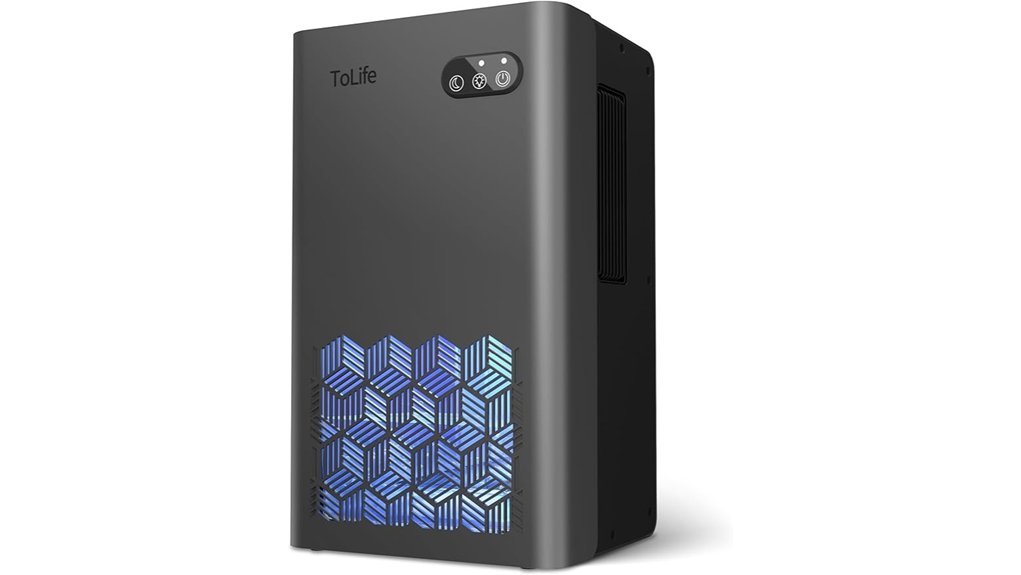
Best quiet portable pick for mild localized dampness. ToLife uses semiconductor condensation rather than a conventional compressor, which helps keep the unit compact and quiet. Its 95 oz tank, automatic shutoff, sleep mode, and carrying design make it convenient for a small finished basement room, hobby area, storage nook, bedroom, or bathroom. Although the listing advertises coverage up to 1,000 sq. ft., treat this as a compact light-moisture unit rather than a substitute for a 30-, 50-, or 80-pint compressor dehumidifier in a consistently damp full basement.
Best For: Small finished basement rooms where noise and portability matter more than high daily moisture removal.
Why You’ll Like It: It is easy to position near a desk, guest area, or storage space and does not require the footprint of a larger compressor machine.
Why it works for basements: It can help with mild localized moisture when the problem is limited to a small enclosed area rather than the entire basement.
Who should skip it: Skip it for persistent whole-basement humidity, wet walls, leak recovery, or any situation where you need substantial pint-per-day extraction.
Pros:
- Compact thermoelectric design suits noise-sensitive spaces.
- 95 oz tank with automatic shutoff helps prevent overflow when used correctly.
- Portable size makes it easy to reposition around a small finished space.
Cons:
- Much lower moisture-removal capability than compressor-based basement machines.
- Requires manual tank emptying.
- Advertised square-foot coverage should not be treated as equivalent to pint-rated compressor capacity.
Bottom Line: ToLife is a quiet convenience pick for a small basement room with mild dampness, not the first choice for a persistently humid full basement.
BEDRED 95OZ Dehumidifier for Home
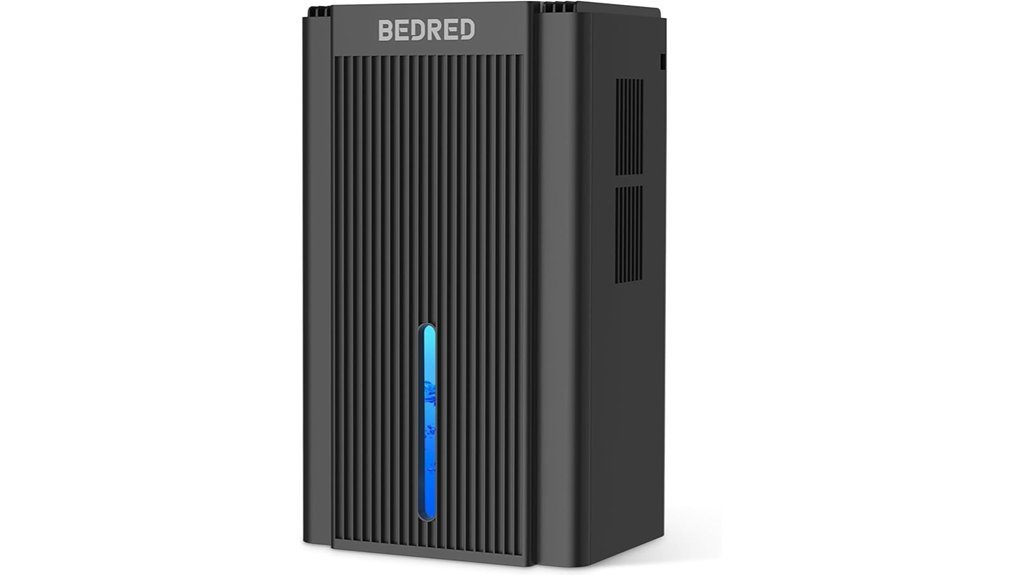
Best simple compact option for mild dampness. This BEDRED 95 oz model is another compact thermoelectric choice for buyers who prioritize low-noise operation, easy placement, and automatic shutoff. The product listing advertises use in spaces up to 1,000 sq. ft., but for basement buying purposes it is more realistic to view it as a localized moisture-control option for a small finished room, storage area, or similar enclosed space.
Best For: Buyers who want a small dehumidifier for occasional or mild moisture in a noise-sensitive basement area.
Why You’ll Like It: Its small footprint and simple tank-based setup make it easier to use where a larger compressor machine would feel excessive.
Why it works for basements: It can be useful when the basement problem is confined to one small area and you value quietness more than rapid moisture extraction.
Who should skip it: Skip it if your basement remains humid throughout the day, smells strongly musty, or requires continuous drainage.
Pros:
- Compact 95 oz tank design is easy to place in smaller rooms.
- Thermoelectric operation avoids a full-size compressor.
- Automatic shutoff adds convenience when the tank fills.
Cons:
- Not intended to compete with pint-rated compressor machines for heavy basement moisture.
- No continuous drain hose for unattended long-term basement use.
- Manual emptying may become inconvenient in humid conditions.
Bottom Line: Choose this model for a small, mildly damp basement area where compact size and low-noise operation are the main priorities.
Dehumidifier with 106 oz Tank for Home
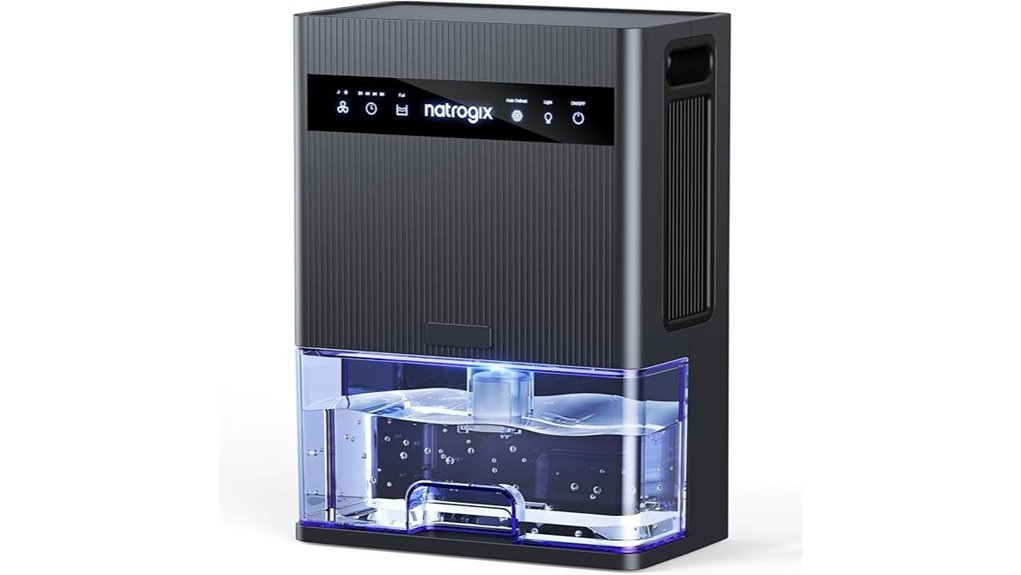
Best larger-tank compact option. This 106 oz model gives you slightly more tank capacity than the 95 oz mini units while retaining a compact semiconductor design. It includes automatic shutoff, sleep-oriented operation, timer controls, and a detachable tank. As with other compact thermoelectric models, the seller’s advertised 1,000 sq. ft. coverage should not be interpreted as equivalent to the moisture-removal capacity of a pint-rated compressor dehumidifier.
Best For: Small finished basement rooms and enclosed spaces with mild moisture where a slightly larger manual tank is useful.
Why You’ll Like It: The 106 oz tank can reduce how often you need to empty the unit compared with smaller compact designs under similar conditions.
Why it works for basements: It offers localized moisture control without taking up much floor space or adding a large compressor appliance to a finished room.
Who should skip it: Skip it if you need continuous hose drainage, significant daily water removal, or whole-basement humidity control.
Pros:
- 106 oz tank offers more storage capacity than many mini models.
- Compact semiconductor design is suitable for noise-sensitive areas.
- Automatic shutoff, timer controls, and detachable tank simplify routine use.
Cons:
- Still requires manual tank emptying.
- Not a replacement for a compressor dehumidifier in a consistently damp full basement.
- Actual moisture-removal performance depends heavily on temperature and humidity.
Bottom Line: This is the compact pick to consider if you want a little more tank capacity for a small basement room with mild dampness.
How to Choose the Right Quiet Basement Dehumidifier
Start with the moisture problem, not the product’s tank size or marketing photo. A compact thermoelectric dehumidifier can be useful for light dampness in a small enclosed room, but a full basement that stays humid usually needs a compressor model with measurable pint-per-day capacity. Also consider whether you can use continuous drainage, how cold the basement gets, how close the machine will sit to living areas, and how many hours per day you expect it to run.
Compact vs. Compressor Dehumidifiers for Basements
Compact thermoelectric dehumidifiers are lighter and generally quieter, but they are best treated as localized moisture-control devices for small rooms and mild dampness. Compressor dehumidifiers are the stronger option for persistent basement humidity because they provide rated daily water-removal capacity, adjustable humidistats, and often continuous hose drainage. If the whole basement stays humid after rain or during summer, prioritize a compressor unit.
Factors to Consider When Choosing a Quiet Basement Dehumidifier
A good basement dehumidifier has to be quiet enough for your space but powerful enough to actually control humidity. Compare pint-per-day capacity, noise, drainage, humidistat settings, energy efficiency, portability, and operating-temperature limits instead of choosing on a single number.
Noise Level Matters
Noise is especially important in a finished basement used as an office, bedroom, media room, or play space. Compare the manufacturer’s stated sound level, but also check which fan or operating mode the figure describes. A low or sleep setting may be quieter than the mode used for maximum moisture removal. Placement also matters because compressor vibration and fan noise can be more noticeable beside a desk, bed, or television.
Basement Size and Moisture Conditions
Square footage gives you a starting point, but it does not tell the whole story. A 1,000 sq. ft. basement with mild seasonal humidity needs less drying power than a similarly sized basement with seepage, wet laundry, poor ventilation, or high relative humidity. For compressor models, compare pint-per-day capacity along with the manufacturer’s recommended room size.
Moisture Removal Capacity
For a true basement dehumidifier, pints per day is one of the most useful comparison specifications. It describes how much moisture a unit can remove over 24 hours under defined test conditions. Actual extraction in your basement can be lower because temperature and humidity change throughout the day. A higher-capacity unit is generally more appropriate when the basement is larger or consistently damp.
Drainage Options
You can empty a collection bucket manually or use continuous drainage on models that support a hose. Continuous drainage is usually more convenient for a basement that requires daily dehumidification. Gravity-drain systems need the hose to run downward toward a suitable drain. If your drainage point is higher than the machine, you may need a model specifically designed with a pump rather than assuming a standard hose can move water upward.
Energy Efficiency
Energy use matters when a basement dehumidifier operates for many hours each day. Look for current ENERGY STAR information when available and compare capacity along with efficiency rather than buying solely on wattage. An automatic humidistat can also reduce unnecessary runtime by cycling the unit when the target humidity has been reached.
Auto Shutoff and Water Management
For bucket operation, automatic shutoff helps prevent the machine from continuing to collect water after the tank is full. Correct tank placement and routine cleaning are still important. If you use continuous drainage, periodically inspect the hose for kinks, loose connections, or blockages.
Portability and Placement
A compact unit can fit beside shelving or furniture, while larger compressor models benefit from wheels and handles. Whatever size you choose, leave the clearance recommended by the manufacturer around air intakes and exhaust vents. Restricting airflow can reduce performance and may increase operating noise.
Quiet Operating Modes
Sleep modes and lower fan settings can be useful when the basement is occupied. However, do not select a dehumidifier solely because its lowest mode has an impressive decibel number. The machine still needs enough capacity to reach and maintain your humidity target under normal operating conditions.
Pro Tips for Better Basement Results
- Use a separate hygrometer if you want to compare humidity away from the dehumidifier.
- Place the unit where air can circulate freely around its intake and exhaust.
- Keep exterior doors and windows closed when outdoor air is more humid.
- Use continuous drainage when persistent humidity causes the bucket to fill frequently.
- Clean the filter according to the manufacturer’s instructions because restricted airflow can reduce performance.
- Do not use a dehumidifier as a substitute for repairing plumbing leaks, seepage, foundation problems, or flooding.
Basement Safety Note
A dehumidifier can reduce excess humidity, but it cannot repair an active water source. Address leaks, seepage, standing water, damaged materials, and electrical hazards first. If you have visible mold or repeated water intrusion, correct the underlying moisture problem rather than relying only on a dehumidifier.
Frequently Asked Questions
How Do I Know the Right Dehumidifier Size for My Basement?
Measure the basement’s approximate square footage, then consider how damp it actually gets. For consistently humid basements, compare pint-per-day capacity rather than choosing by tank size alone. A larger or wetter space generally needs more moisture-removal capacity.
Can Quiet Dehumidifiers Run All Night Without Disturbing Sleep?
Many models are designed for extended operation and include lower-noise or sleep modes. Whether the sound is comfortable for you depends on the operating mode, placement, room acoustics, and your own noise sensitivity. Follow the manufacturer’s instructions for unattended or overnight operation.
Do Basement Dehumidifiers Need Continuous Drainage or Manual Emptying?
Either can work. Manual emptying is manageable for light use, while continuous drainage is much more convenient when a compressor dehumidifier operates daily. Make sure a gravity drain hose slopes correctly toward the drain.
What Humidity Level Should I Aim for in a Basement?
A common indoor target is roughly 30% to 50% relative humidity. Keeping humidity controlled can reduce conditions that favor mold and musty odors, but it does not guarantee that mold cannot occur. Leaks, condensation, wet building materials, and other moisture sources also need to be corrected.
Are Energy-Efficient Dehumidifiers Worth It?
They can be particularly useful when the machine runs for many hours during humid seasons. Compare current efficiency information, pint-per-day capacity, drainage features, and humidistat controls rather than assuming the most expensive unit will automatically cost less to operate.
Is a Small Dehumidifier Enough for a Basement?
It can be enough for a small finished room or localized area with mild dampness. For a full basement that stays humid, smells musty, or requires frequent water removal, a compressor model with meaningful pint-per-day capacity is usually the more appropriate choice.
Where Should I Place a Dehumidifier in a Basement?
Place it in an open area where air can circulate around the vents, following the manufacturer’s required clearances. If you use gravity drainage, choose a location that lets the hose run continuously downward toward a suitable drain without kinks.
Final Recommendation Box
For a typical medium-to-large damp basement: Start with the PLUSCENT 32 Pint because it combines compressor moisture removal, humidity controls, and continuous drainage without jumping to the highest capacity.
For a large or consistently humid basement: Consider the AEOCKY 4500 Sq.Ft model if higher pint-per-day capacity and long-run humidity management are priorities.
For a small finished basement room with mild dampness: Consider the ToLife, BEDRED 95 oz, or 106 oz compact model, while understanding that these thermoelectric units are not substitutes for a full-size compressor dehumidifier.
Final Verdict
The best quiet basement dehumidifier is not automatically the model with the lowest advertised decibel number. It must also remove enough moisture for your actual basement conditions. For persistent whole-basement humidity, the PLUSCENT 32 Pint and AEOCKY 4500 Sq.Ft compressor models are the stronger recommendations because they provide pint-rated moisture removal and drainage options. The compact ToLife, BEDRED, and 106 oz units are better reserved for small finished rooms and localized mild dampness where portability and quieter thermoelectric operation are more important than maximum capacity.
Conclusion
Start with the moisture problem, then choose the quietest model that still has enough capacity to solve it. A small thermoelectric unit can be convenient for a mildly damp basement room, but a consistently humid full basement usually calls for a compressor dehumidifier with a humidistat and continuous drainage. Whichever model you choose, monitor relative humidity, keep airflow around the unit clear, maintain the filter, and repair any underlying source of water intrusion instead of expecting the dehumidifier to solve structural moisture problems on its own.