Choosing an energy-efficient dehumidifier in New Zealand takes more than looking for a high extraction number or an overseas ENERGY STAR badge. You need a unit that suits your room, removes moisture efficiently in realistic local conditions, and is designed for New Zealand’s 230V, 50Hz electricity supply.
Last updated: August 2026. This guide explains how to compare dehumidifiers by extraction capacity, energy efficiency, rated power, noise, drainage, operating temperature, humidistat controls, warranty, and estimated running cost.
Editorial scope: This article does not rank specific Amazon.com models because their exact New Zealand voltage, frequency, plug, compliance, regional model number, local warranty, and service support could not be verified. Use the checks below to compare locally supplied models or overseas models whose exact regional specifications have been fully verified.
Important NZ electrical-safety check
Before buying any dehumidifier from an overseas marketplace, confirm that the exact model is rated and marked for New Zealand’s nominal 230V, 50Hz supply, often shown as 220–240V, 50Hz. It should also have an appropriate New Zealand plug and meet applicable electrical-safety requirements. A travel adaptor changes plug shape only. It does not convert a 115V or 120V appliance for safe use on 230V power.
Quick verdict
The best choice for an NZ home is not necessarily the dehumidifier with the largest advertised coverage or extraction figure. First verify 230V, 50Hz operation and the exact regional model. Then compare realistic litres extracted per day, energy used per litre removed, low-temperature performance, noise, drainage, humidistat control, and local warranty support.
For a bedroom or ordinary living area, quiet operation and accurate humidity control may matter more than maximum capacity. For a cold garage, under-house area, or other unheated room, operating temperature and low-temperature moisture removal deserve extra attention.
Quick Choice by Use Case
| Use case | What to prioritise | Main caution |
|---|---|---|
| Heated bedroom or living room | Low noise, accurate humidistat, efficient refrigerant/compressor operation, suitable capacity | Do not oversize purely from a large coverage claim |
| Cold garage or unheated space | Low-temperature extraction, minimum operating temperature, defrost behaviour, energy use | Some compressor models lose effectiveness as temperatures fall |
| Indoor laundry drying | Strong moisture removal, practical drainage, suitable fan speed, laundry or continuous mode where useful | Compare real extraction performance, not the headline litres-per-day claim alone |
| Connected open-plan areas | Adequate capacity, airflow, portability, humidistat, drainage | One portable unit cannot efficiently control several closed-off rooms |
Why This Guide Does Not Rank Unverified Overseas Models
Some Amazon.com dehumidifiers are marketed primarily for North American power systems and may be rated for 115V or 120V at 60Hz. New Zealand homes use a nominal 230V, 50Hz electricity supply, so those versions are not suitable for direct connection to a normal NZ outlet.
Other overseas listings do not provide enough information to confirm the exact regional model, frequency, plug, New Zealand compliance, local warranty, or service arrangements. Ranking those products as “best for NZ” could create unnecessary confusion and lead readers to order an incompatible appliance.
No product should be treated as suitable for a New Zealand home merely because it:
- Appears on Amazon.com
- Has an ENERGY STAR badge
- Includes a plug adaptor
- Uses the same brand name as a locally sold model
- Advertises a large room-coverage figure
- Claims low energy consumption without publishing comparable test data
Manufacturers can sell different electrical versions under similar product names. Always check the rating label and manual for the exact model number being supplied.
What “Energy Rating” Means for Dehumidifiers in NZ
New Zealand’s familiar Energy Rating Label is administered by EECA under the trans-Tasman Equipment Energy Efficiency programme. It applies to specified regulated product categories. Dehumidifiers are not currently listed as a regulated product category on EECA’s published E3 product list.
This means you should not expect a mandatory New Zealand star-rating label that lets you compare dehumidifiers in the same way as certain regulated appliances such as refrigerators, clothes dryers, or heat pumps.
An American ENERGY STAR certification can still provide useful information about the efficiency of a US-market dehumidifier under the relevant US test method. ENERGY STAR uses Integrated Energy Factor, or IEF, measured in litres of water removed per kilowatt-hour. A higher IEF represents greater efficiency under that test method.
However, an ENERGY STAR badge or IEF value does not confirm:
- Compatibility with New Zealand voltage and frequency
- An appropriate plug for New Zealand
- Compliance with local electrical requirements
- Local warranty support
- Local spare-part availability
- The actual cost of running the appliance on your electricity plan
For NZ buyers, a more useful comparison combines realistic extraction performance, efficiency data, rated wattage, operating conditions, supplier support, and electrical compatibility.
Official references: Review the EECA Energy Rating Label guidance, EECA’s current E3 regulated-product list, WorkSafe electrical product requirements, and ENERGY STAR dehumidifier efficiency guidance.
How to Choose an Energy-Efficient Dehumidifier in NZ
Do not choose a dehumidifier from advertised floor area alone. Room size matters, but moisture load, temperature, ventilation, construction, and how often doors are opened can have an even larger effect.
1. Verify Voltage, Frequency, and Plug
Check the product rating label, manual, packaging, and seller description. The exact model should be rated and marked for 230V, 50Hz; many suitable regional models show a range such as 220–240V, 50Hz. It should also be supplied with an appropriate New Zealand plug.
A listing that says only 110V, 115V, or 120V is not suitable for direct connection to a normal NZ wall outlet. A simple travel adaptor changes the plug shape only. It does not change voltage or frequency.
Be cautious when a seller:
- Does not show the electrical rating label
- Uses photos from several regional versions
- Cannot confirm the exact model number
- Offers only a travel adaptor
- Cannot provide a suitable English-language manual
- Cannot explain the warranty or return process for a New Zealand buyer
2. Compare Extraction Capacity in Litres
New Zealand retailers commonly describe dehumidifier capacity in litres per day. American listings often use US pints per day.
| US liquid pints per day | Approximate litres per day |
|---|---|
| 20 pints | 9.5 L/day |
| 30 pints | 14.2 L/day |
| 50 pints | 23.7 L/day |
| 70 pints | 33.1 L/day |
| 80 pints | 37.9 L/day |
A pint-to-litre conversion is arithmetic only. It does not make extraction claims directly comparable. Moisture removal changes substantially with temperature and relative humidity. A unit tested in hot, very humid air can show a much larger daily figure than the same appliance would achieve during a cool New Zealand winter.
Look for the test temperature and humidity beside the extraction figure, then compare products tested under similar conditions. Consumer NZ’s explanation of dehumidifier capacity claims shows why realistic local-condition testing matters.
3. Do Not Rely on Advertised Coverage Alone
Statements such as “covers 4,500 square feet” or a very large square-metre figure are usually manufacturer estimates. They do not guarantee that the unit will control humidity throughout a divided house.
A dehumidifier installed in one closed room cannot efficiently pull damp air through walls, closed doors, cupboards, and separate floors. Open-plan spaces and connected rooms with good airflow are easier to treat than several closed-off areas.
Consider:
- Actual room volume
- Number of doors and partitions
- Whether the area is heated
- Outdoor air entering the room
- Water leaks or rising damp
- Indoor clothes drying
- Bathroom and cooking moisture
- How quickly you need the room dried
4. Check Rated Wattage and Efficiency
A lower wattage does not automatically mean better value. A low-powered unit that runs continuously without reaching the target humidity can use more electricity than a more capable unit that reaches the target sooner and cycles off.
Compare rated input power alongside extraction capacity. When reliable standardized data is available, compare how many litres of water are removed per kilowatt-hour consumed. For ENERGY STAR dehumidifiers, this standardized measure is called Integrated Energy Factor (IEF). A higher L/kWh figure indicates better efficiency under the specified test method.
Do not compare a standardized IEF figure directly with a seller’s unsupported efficiency claim unless you know both figures were measured using comparable test procedures.
5. Estimate the Running Cost
Use the wattage on the appliance label and your own electricity tariff rather than relying on a generic running-cost claim.
Running-cost formula
Watts ÷ 1,000 × hours used × electricity rate per kWh
Example: A 300W dehumidifier running for eight hours uses approximately 2.4kWh. Multiply 2.4 by the per-kWh rate shown on your electricity bill to estimate that day’s energy cost.
Actual consumption can be lower once the humidistat starts cycling the compressor. It can be higher if the room remains very damp, outside air keeps entering, or the unit is too small for the moisture load.
6. Choose Between Compressor and Desiccant Technology
Refrigerant or compressor dehumidifiers are commonly efficient in warm or normally heated rooms. They cool air over a coil so moisture condenses and collects in the tank.
Desiccant dehumidifiers use a moisture-absorbing material and can remain effective in colder rooms, garages, storage spaces, or other unheated areas. They can also use more electricity and release warmer air into the room.
Consumer NZ’s current dehumidifier guidance notes that desiccant models generally perform better than refrigerant models at low temperatures, particularly below about 12°C. However, energy use can be substantially higher, so cold-room performance should be considered alongside running cost.
| Factor | Refrigerant/compressor | Desiccant |
|---|---|---|
| Best environment | Warm or normally heated rooms | Cooler or unheated rooms |
| Typical energy use | Often lower in suitable temperatures | Often higher |
| Air temperature | Usually adds a little heat | Usually adds more noticeable heat |
| Cold-room performance | Can lose efficiency or enter defrost cycles | Often remains more effective |
| Weight | Often heavier | Can be lighter |
For more detail, see Consumer NZ’s dehumidifier buying guide.
7. Consider the Operating Temperature
Check the manufacturer’s minimum operating temperature and, where available, extraction data at cooler temperatures. This is especially important for garages, under-house storage areas, caravans, holiday homes, and other spaces that may become cold.
A compressor model may pause for automatic defrost when its coils become cold. That feature protects normal operation, but frequent defrost cycles can reduce effective moisture removal.
8. Compare Noise at the Setting You Will Use
Noise specifications may be quoted at a low fan speed, while the unit can be noticeably louder in turbo, laundry, or continuous mode.
For a bedroom, office, or living area, check:
- Low-speed decibel rating
- High-speed decibel rating
- Whether the compressor produces noticeable vibration
- Whether the display can be dimmed or switched off
- Whether sleep mode reduces fan speed
- Whether compressor or fan restarts could disturb sleep
Placing the unit on a firm, level floor can help reduce rattling. Always leave the clearances required by the manufacturer’s instructions around the air intake and outlet.
9. Choose a Practical Drainage Method
Most portable dehumidifiers offer one or more of these options:
- Manual tank: Simple to set up, but requires regular emptying.
- Gravity hose: Allows continuous drainage when the hose can run downhill to a suitable drain.
- Built-in pump: Can move water upward or over a longer distance, subject to the manufacturer’s specified lift limit.
Check whether the hose is included, its diameter and length, and whether a separate adaptor is required. A poorly positioned gravity hose can stop draining if it rises, bends sharply, becomes pinched, or is blocked.
10. Look for an Accurate Humidistat
A humidistat lets the dehumidifier cycle on and off around a chosen relative-humidity setting. This is normally more practical and energy-efficient than running continuously after the target humidity has been reached.
Consumer NZ recommends approximately 30% to 50% relative humidity for dehumidifier use. Avoid automatically choosing the lowest setting, because removing more moisture than necessary can make the room uncomfortable. Adjust the target according to comfort, condensation, room temperature, the moisture problem, and the appliance manual.
A standalone hygrometer can help you check whether the dehumidifier’s displayed humidity reading is reasonably accurate.
See Consumer NZ’s guidance on dehumidifier placement, humidity settings, and maintenance.
11. Check Filter and Cleaning Requirements
A washable pre-filter helps protect airflow through the unit, but it does not automatically make the dehumidifier an air purifier. Do not treat a basic mesh filter as a replacement for a properly specified air cleaner.
Before buying, check how easily you can:
- Remove and wash the filter
- Clean the water tank
- Reach the drain outlet
- Inspect the float mechanism where accessible under the manual
- Clean dust from the air intake
- Order compatible replacement parts
12. Check Warranty and Local Support
A manufacturer’s warranty has limited practical value if the appliance must be shipped overseas for inspection. Consumer Protection states that the Consumer Guarantees Act applies when you buy from a business trading in New Zealand. New Zealand consumer law can also apply to overseas businesses offering goods to New Zealand consumers, but resolving problems and enforcing your rights can be more difficult.
Ask the seller:
- Who handles warranty or consumer-law claims in New Zealand?
- Where is the nearest authorised service agent?
- Who pays return freight if the product is faulty?
- Are replacement tanks, filters, hoses, and other parts available?
- Does the manufacturer’s warranty cover the way you intend to use the appliance?
- Is proof of purchase from a particular authorised seller required for the manufacturer’s warranty?
Read Consumer Protection’s guidance on online-shopping rights before ordering from an overseas retailer.
Before You Buy Checklist
| Check | What to confirm | Why it matters |
|---|---|---|
| Exact model | Full regional model number on the appliance or manual | Similar product names can hide different electrical versions |
| Electrical rating | 230V, 50Hz, often marked 220–240V, 50Hz | Prevents buying an incompatible overseas model |
| Plug | Appropriate NZ plug | A travel adaptor does not convert voltage |
| Extraction | Litres per day plus the test temperature and relative humidity | Allows a more meaningful comparison |
| Efficiency | Comparable L/kWh or standardized IEF data where available | Shows how much moisture is removed for the electricity used |
| Power | Rated watts | Helps estimate running cost |
| Temperature | Minimum recommended operating temperature and low-temperature performance | Important in cold and unheated rooms |
| Noise | Low- and high-speed dB figures where published | Helps judge bedroom and office suitability |
| Drainage | Tank, gravity hose, or pump | Determines how often you must empty it and where it can operate |
| Warranty and rights | Seller identity, NZ claim process, service location, and return arrangements | Reduces repair and return difficulties |
Ways to Reduce Dehumidifier Running Costs
- Close outside doors and windows while the unit is operating unless ventilation is specifically needed.
- Fix leaks, blocked gutters, plumbing faults, and water entry where possible.
- Use extractor fans when cooking or showering.
- Dry clothes outdoors when practical, or manage indoor drying moisture deliberately.
- Clean the filter according to the manual.
- Leave enough clearance around the air intake and outlet.
- Use the humidistat instead of continuous mode when appropriate.
- Choose enough capacity to reach the target humidity without running endlessly.
- Use continuous drainage where appropriate if tank-full shutdowns frequently interrupt operation.
- Keep internal doors open only when you genuinely want to treat connected rooms and there is enough airflow between them.
Pro tip
Use a separate hygrometer to measure the room before, during, and after dehumidifier operation. This helps you see whether the appliance is actually reaching the target humidity, how quickly it gets there, and whether it needs to run for as many hours as expected.
Frequently Asked Questions
Do Dehumidifiers Have NZ Energy Rating Labels?
Dehumidifiers are not currently listed as a regulated category on EECA’s published E3 product list requiring New Zealand’s Energy Rating Label. Some overseas products carry the American ENERGY STAR certification, but that is a different programme and does not confirm NZ electrical compatibility.
Can I Use a 115V Dehumidifier in New Zealand?
Do not plug a 115V or 120V dehumidifier directly into a normal New Zealand outlet. New Zealand household supply is nominally 230V at 50Hz. A travel plug adaptor changes only the physical plug connection and does not convert the voltage or frequency.
A step-down transformer can introduce additional considerations involving compressor startup demand, transformer capacity, frequency, earthing, protection, heat, warranty, and electrical compliance. For most homes, buying the correct 230V, 50Hz regional model is simpler than trying to adapt a North American appliance.
What Size Dehumidifier Do I Need?
Choose capacity based on room volume, moisture severity, temperature, ventilation, and how quickly you want the space dried. A modest bedroom with condensation needs less moisture-removal capacity than a large garage, under-house area, or laundry space with persistent moisture.
Do not depend entirely on advertised square-metre or square-foot coverage. Compare litres per day under similar temperature and humidity test conditions.
What Humidity Level Should I Set?
Consumer NZ recommends approximately 30% to 50% relative humidity. Avoid automatically setting the unit as low as possible. Adjust the target according to comfort, condensation, room temperature, the moisture problem, and the appliance manual.
Can a Dehumidifier Stop Mould?
A dehumidifier can help reduce damp conditions that support mould growth, but it does not remove an existing mould problem or repair the source of moisture. Leaks, poor ventilation, water entry, insulation problems, and contaminated materials may need separate attention.
Can I Run a Dehumidifier Overnight?
Run a dehumidifier overnight only when the manufacturer’s instructions allow the intended operation and the appliance is correctly set up with an intact power cord, proper clearances, a functioning tank-full shutoff or suitable drainage, and any other safety features required by the manual.
Use a model designed for New Zealand power, keep the air paths clear, and avoid damaged extension leads or overloaded power boards.
How Often Should I Clean the Filter?
Follow the manufacturer’s instructions and inspect the filter regularly. Checking it every few weeks can be a useful starting point during regular use, but dusty homes, pets, renovations, and continuous operation may require more frequent cleaning.
Is a Desiccant Dehumidifier Better for Cold Rooms?
It can be. Desiccant models often maintain stronger extraction in cooler environments, while refrigerant or compressor models can become less effective or spend more time defrosting. Consumer NZ notes that desiccant models typically perform better below about 12°C, but they can use considerably more electricity. Compare cold-temperature extraction and power use together.
Does a Larger Dehumidifier Always Use More Power?
A larger unit may draw more power while running, but it may also reach the target humidity faster and switch off sooner. The more useful comparison is how effectively it removes moisture in your conditions for the electricity consumed, not wattage or advertised capacity alone.
Where Should I Place a Dehumidifier?
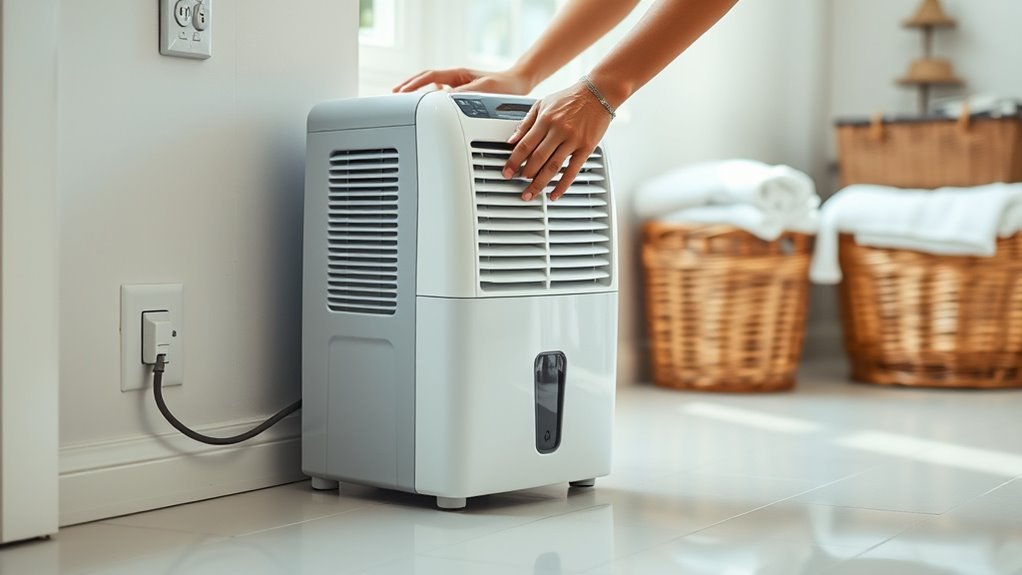
Place it on a stable, level surface with the clearances required by the manual. Keep the intake and outlet away from curtains, furniture, and walls. For general room drying, good airflow around the appliance matters. When targeting a particular moisture source such as indoor laundry, position the unit where it can treat that damp air effectively without exposing it to direct splashes or other prohibited conditions.
Final Recommendation
What NZ buyers should prioritise
- The exact regional model number
- Verified 230V, 50Hz operation, often marked 220–240V, 50Hz
- An appropriate New Zealand plug and applicable electrical compliance
- Extraction capacity stated in litres per day
- Published extraction test temperature and humidity
- Comparable efficiency data such as L/kWh or standardized IEF where available
- Rated wattage and a realistic running-cost calculation
- Suitable performance at the room’s normal temperature
- Useful drainage and humidistat controls
- Manageable noise at the fan speed you expect to use
- A clear seller identity, warranty process, service pathway, and return arrangement
An overseas efficiency badge should be treated as one comparison point, not proof that a dehumidifier is suitable for New Zealand. Confirm the exact regional model before ordering, especially when buying from Amazon.com or another overseas marketplace.
For additional guidance, read Consumer Protection’s advice on buying electronics and appliances. A locally supplied, correctly rated model with clear support arrangements will usually be easier to assess and resolve problems with than an unverified imported appliance.