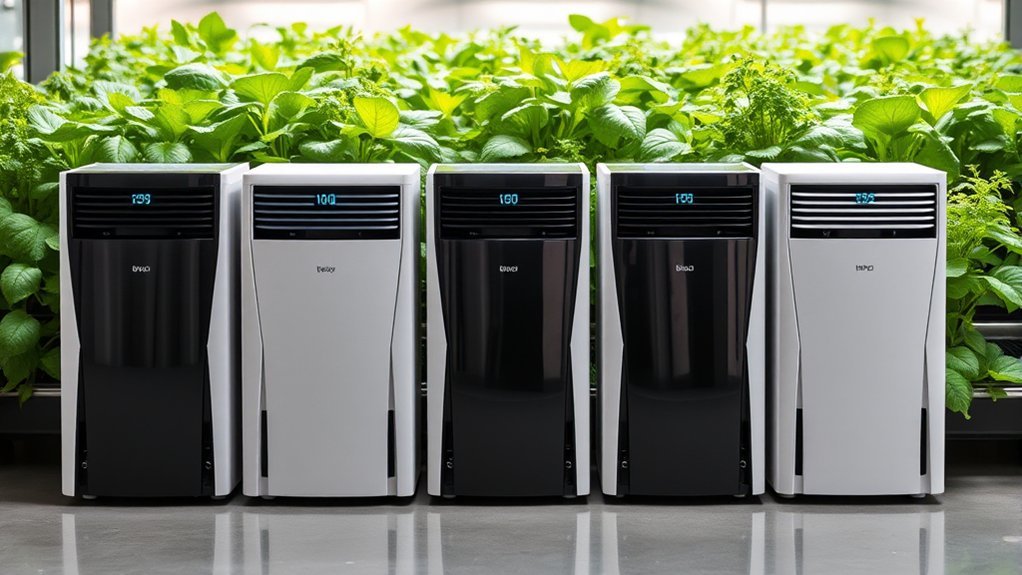
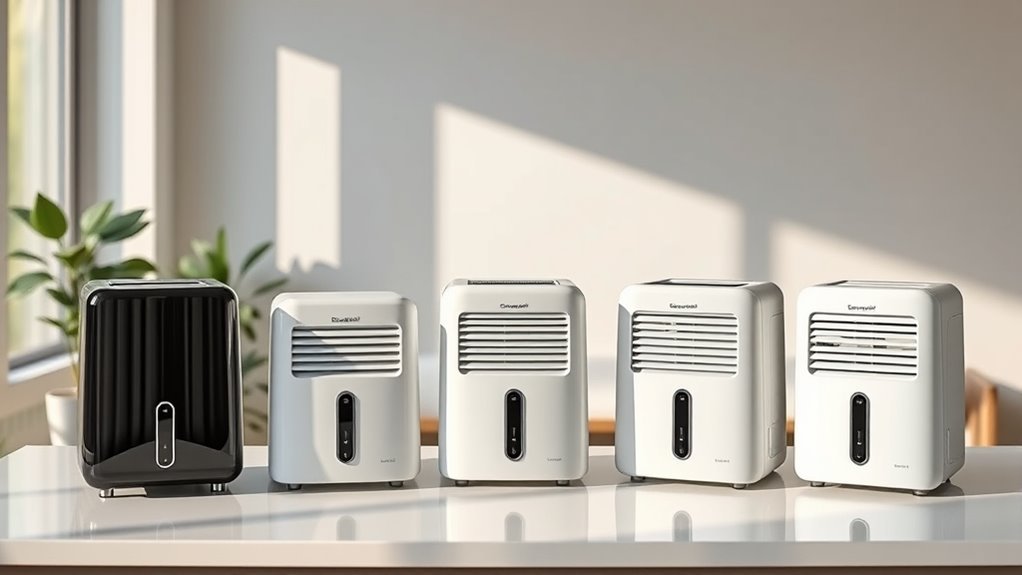
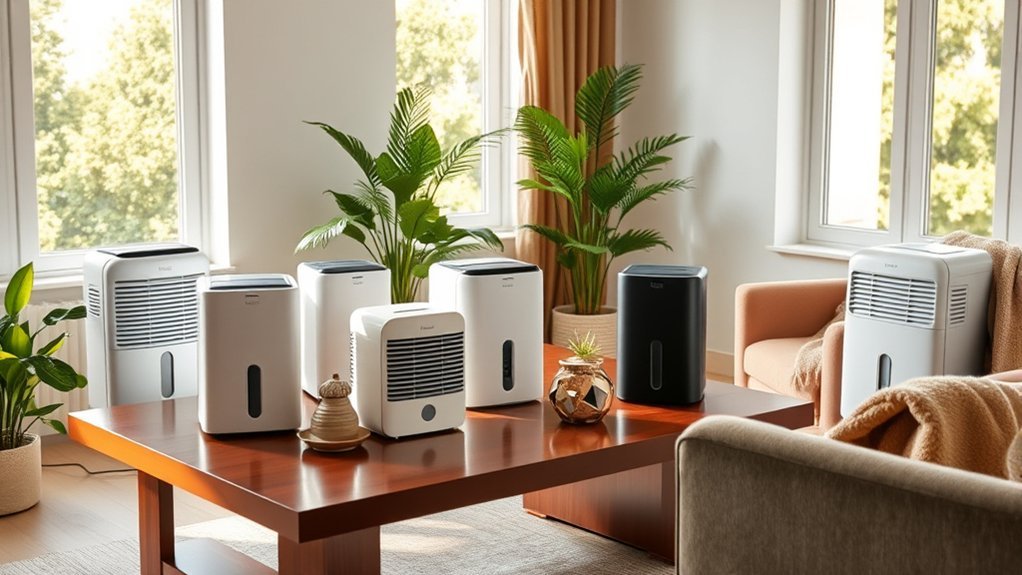
A dehumidifier with a removable bucket gives you portable moisture control without requiring permanent plumbing. The right model depends on two separate measurements: how much moisture it can remove in 24 hours and how much water its bucket can hold before the machine stops. You should also compare drainage options, room temperature, noise, portability, energy efficiency, and whether you need genuine Wi-Fi control.
This 2026 guide compares five relevant compressor dehumidifiers for bedrooms, basements, bathrooms, laundry areas, RVs, garages, and larger living spaces. We compared disclosed moisture-removal ratings, bucket volume, gravity-drain support, humidistat controls, portability, cold-room features, and the quality of the available product information. Manufacturer square-foot claims are treated as rough estimates rather than guaranteed room sizes.
Quick Verdict
Best overall for large spaces: The AEOCKY Rhea-001 combines a higher standardized moisture-removal rating with verified ENERGY STAR efficiency and automatic humidity control.
Best bucket design and smart control: The Midea Cube stands out for its large 12-liter removable bucket, Wi-Fi app control, voice-assistant support, and space-saving nested design.
Best large manual bucket: The Ludatido offers a 6.5-liter tank and continuous gravity drainage for buyers who want more water storage without app features.
Best mid-size value: The BANABIE combines a 2.5-liter tank, automatic humidity control, portability, and hose drainage for everyday rooms.
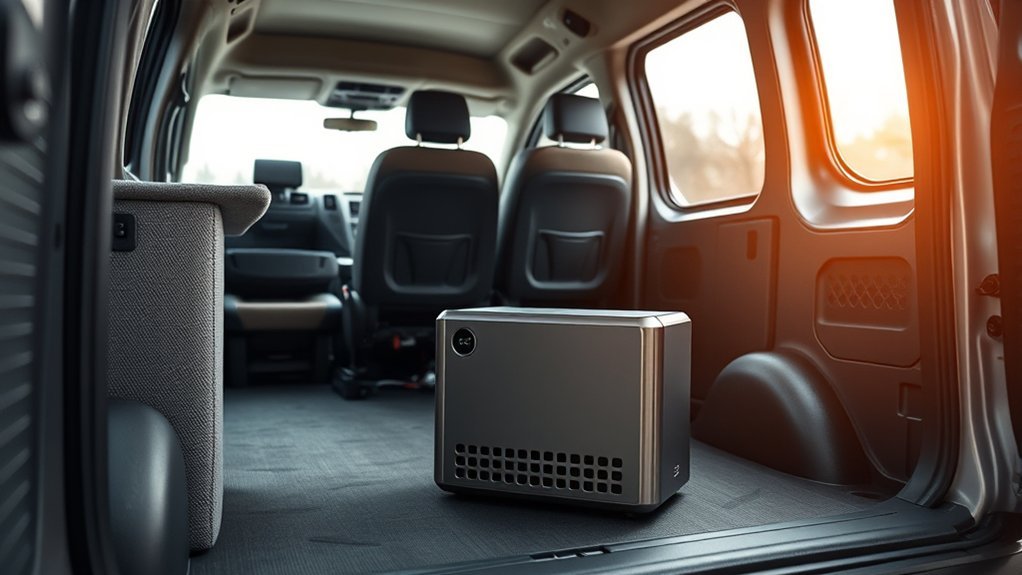
Best compact option: The AIUSEVO AS280 is easier to place in bedrooms, laundry areas, RVs, and moderately damp smaller spaces.
Quick Comparison of the Best Dehumidifiers With Buckets
| Product | Best For | Capacity Information | Bucket and Drainage | Controls | Details |
|---|---|---|---|---|---|
| AEOCKY Rhea-001 | Large rooms and efficiency-focused buyers | About 44.34 pints/day under DOE Appendix X1; up to 80 pints/day in hotter, very humid conditions | Removable bucket plus gravity-hose drainage; verify current tank size | Humidistat, timer, automatic operation, and multiple modes | Check on Amazon |
| Midea Cube 20 Pint | Large bucket, smart control, and fewer emptying trips | 20 pints/day | 12-liter/3.2-gallon removable bucket plus included gravity-drain hose | Wi-Fi, SmartHome app, Alexa, and Google Assistant | Check on Amazon |
| Ludatido 80 Pint | Large manual bucket and damp open areas | Seller-listed maximum of up to 80 pints/day under high-humidity conditions | 6.5-liter bucket plus gravity drainage; verify whether a hose is included | Digital controls, timer, child lock, and operating modes | Check on Amazon |
| BANABIE 2500 Sq. Ft. | Bedrooms and medium-size everyday spaces | Seller-listed maximum of up to 32 pints/day | 2.5-liter bucket plus included drain hose | Automatic humidity control and 24-hour timer | Check on Amazon |
| AIUSEVO AS280 | Bedrooms, laundry areas, smaller basements, and RVs | Up to 21 pints/day at 95°F and 90% relative humidity | 2-liter bucket plus included gravity-drain hose | Automatic humidistat, timer, and three operating modes | Check on Amazon |
Capacity note: Daily moisture removal and bucket volume are different measurements. DOE Appendix X1 ratings are produced under standardized conditions, while some seller listings use hotter and more humid conditions that generate larger numbers. Square-foot figures are estimates and do not account for ceiling height, air leakage, closed doors, room temperature, seepage, or other moisture sources.
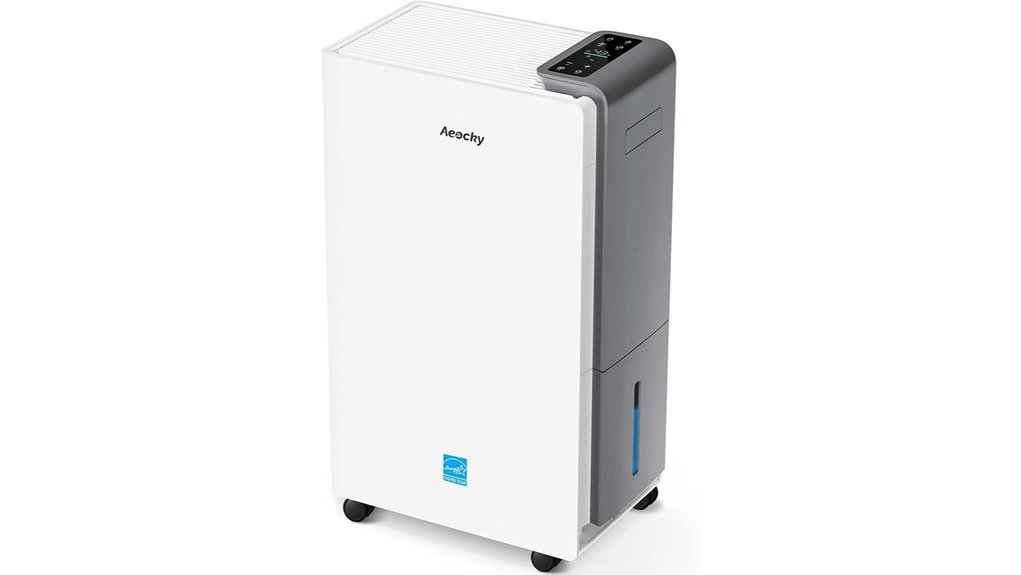
AEOCKY 4500 Sq.Ft Energy Star Dehumidifier
Best Overall for Large Spaces
The AEOCKY Rhea-001 is the strongest choice in this group for buyers who need higher moisture-removal capacity and expect to run the machine regularly. Its current ENERGY STAR information reports approximately 44.34 pints per day under DOE Appendix X1 conditions. The brand also advertises up to 80 pints per day at 95°F and 95% relative humidity, but that hotter-condition figure should not be compared directly with standardized ratings.
The unit includes an automatic humidistat, timer, drain-hose support, automatic defrost, and operating modes for routine humidity control and laundry drying. Its verified efficiency is a more useful reason to choose it than the largest square-foot number printed in the listing.
Why You’ll Like It: It combines stronger standardized moisture removal with automatic control and an ENERGY STAR efficiency advantage.
Best For: Large living areas, basements, garages, and buyers who expect frequent or seasonal operation.
Who Should Avoid It: Buyers with only a small bedroom, bathroom, or closet where a lighter and less powerful appliance would be easier to place.
Pros:
- Higher standardized capacity than the smaller models in this guide.
- ENERGY STAR efficiency information is independently listed.
- Includes automatic humidity control, defrost, timer functions, and gravity-drain support.
- The brand lists three-year warranty coverage, subject to its current terms.
Cons:
- The advertised 80-pint maximum is based on much hotter and wetter conditions than DOE Appendix X1 testing.
- The current bucket volume is not clearly documented across the available product information.
- It requires more floor space than compact 20- or 21-pint options.
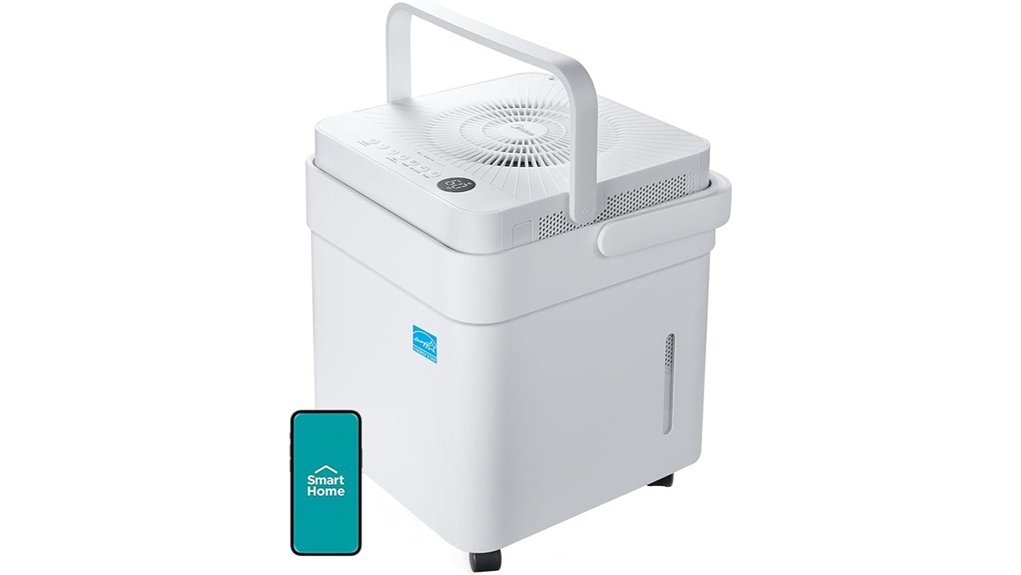
Midea Cube 20 Pint Dehumidifier with Smart Control
Best Smart Bucket Design
The Midea Cube MAD20S1QWT is the clearest match for buyers who care more about bucket convenience and remote control than maximum extraction capacity. It removes up to 20 pints per day under its rated conditions and has a 12-liter, or approximately 3.2-gallon, removable water tank. That unusually large tank can reduce emptying frequency in a moderately damp room.
The lift-and-twist design allows the upper section to operate in an extended position or nest inside the bucket for storage. Midea also includes SmartHome app control, support for compatible Alexa and Google Assistant devices, automatic restart, a washable filter, and a gravity-drain hose. It does not have a built-in condensate pump, so the hose must drain downward into a suitable floor drain, sink, or other approved outlet.
Why You’ll Like It: The oversized removable bucket and genuine Wi-Fi controls make routine monitoring and emptying more convenient.
Best For: Bedrooms, living rooms, garages, and moderately damp basements where a 20-pint unit is appropriately sized.
Who Should Avoid It: Buyers with a very wet large basement, active seepage, or a drain point above the unit that would require pump-assisted drainage.
Pros:
- Large 12-liter/3.2-gallon removable water bucket.
- Wi-Fi app control and compatible voice-assistant support.
- Space-saving nested design with a built-in handle.
- Included hose supports continuous gravity drainage.
Cons:
- Twenty-pint capacity may be undersized for very wet or large open areas.
- No built-in condensate pump.
- A full 12-liter bucket can be heavy to lift and carry.
- The listed limited warranty is one year.
Ludatido Upgraded Dehumidifier, 80 Pint/Day, 5000 Sq.Ft
Best Large Manual Bucket
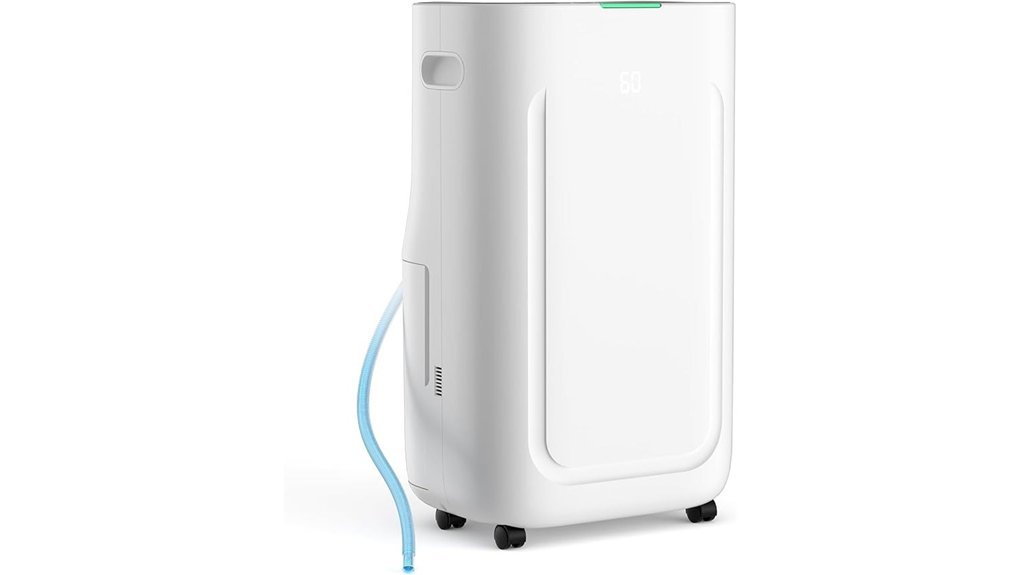
The Ludatido FDD25-525AV1R5 targets basements, garages, apartments, and open living areas where a small two-liter tank would fill too quickly. Its seller-listed maximum is up to 80 pints per day under high-humidity conditions, but a comparable DOE Appendix X1 capacity was not available for verification. Use the 80-pint figure as a maximum marketing rating rather than a direct comparison with Midea’s standardized 20-pint number.
The removable tank holds 6.5 liters, or approximately 1.72 gallons. The unit also offers adjustable humidity control, automatic shutoff, automatic defrost, a timer, child lock, washable filter, and continuous gravity drainage. Available listings conflict over whether the drain hose is included, so check the current Amazon package contents before ordering an additional hose.
Why You’ll Like It: Its 6.5-liter tank stores more water than the smaller BANABIE and AIUSEVO buckets, while the drain connection supports longer operation near a suitable floor drain.
Best For: Larger damp rooms where bucket size matters and app control is not a priority.
Who Should Avoid It: Buyers who require a verified DOE capacity, Wi-Fi monitoring, a built-in pump, or extensive manufacturer documentation.
Pros:
- Large 6.5-liter removable water tank.
- Continuous drainage, automatic shutoff, and automatic defrost.
- Child lock, timer, multiple modes, and washable filter.
- Portable design for moving between residential rooms.
Cons:
- The 80-pint figure is a seller-listed maximum rather than a verified Appendix X1 rating.
- Package information is inconsistent about whether the drain hose is included.
- No built-in condensate pump or verified app control.
- Manufacturer support and warranty information are less clearly documented than Midea’s.
BANABIE 2500 Sq.Ft Dehumidifier with Smart Humidity Control
Best Mid-Size Value
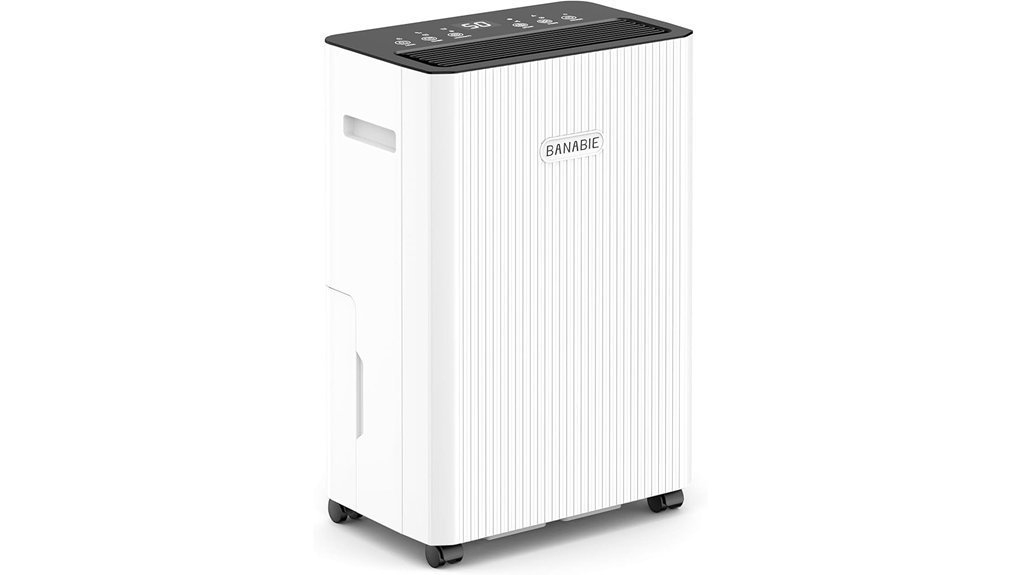
The BANABIE dehumidifier is positioned between the compact AIUSEVO and the larger AEOCKY and Ludatido options. Its listing states a maximum moisture-removal capacity of up to 32 pints per day and coverage up to 2,500 square feet. Because a standardized DOE rating was not available for confirmation, buyers should treat both figures as seller estimates and size the unit according to actual dampness.
It offers automatic humidity control, a 24-hour timer, a 2.5-liter removable bucket, full-tank shutoff, a drain hose, washable filter, handles, and wheels. It is marketed for lower-noise operation, but readers should still expect normal fan and compressor sound, especially at higher settings or when the unit is placed near a wall that can reflect vibration.
Why You’ll Like It: It combines manageable size, automatic control, and two drainage methods without the bulk of the larger models.
Best For: Bedrooms, home offices, laundry areas, and moderately damp medium-size rooms.
Who Should Avoid It: Buyers with severe basement moisture, active water intrusion, or a need for a large bucket during unattended operation.
Pros:
- Portable design with wheels and carrying handles.
- Automatic humidity control and 24-hour timer.
- Includes a 2.5-liter bucket and continuous-drain hose.
- Washable filter reduces routine replacement needs.
Cons:
- The 2.5-liter tank may fill quickly during humid weather.
- The 32-pint and 2,500-square-foot figures are seller claims rather than verified DOE comparisons.
- The low-noise claim should not be interpreted as silent operation.
- Automatic humidity control does not mean the unit has Wi-Fi or app access.
AIUSEVO AS280 1500 Sq. Ft Dehumidifier
Best Compact Value Pick
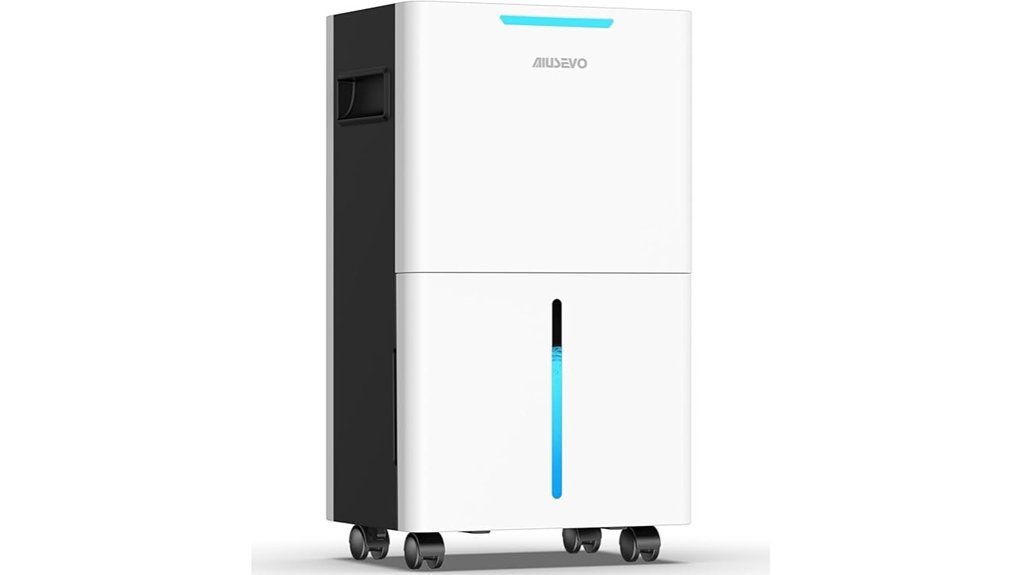
The AIUSEVO AS280 is advertised to remove up to 21 pints per day at 95°F and 90% relative humidity. Those warm and humid test conditions produce a larger number than the unit would normally collect in a cooler basement. It remains a practical option for bedrooms, laundry areas, RVs, and moderately damp smaller spaces where portability matters more than maximum extraction power.
Its three modes cover standard dehumidifying, laundry drying, and continuous operation. The unit also includes an adjustable humidistat, 24-hour timer, 2-liter removable tank, full-bucket shutoff, automatic restart, automatic defrost, and a gravity-drain hose. Available documentation lists a humidity-control range of approximately 30% to 80% and a minimum operating temperature around 41°F, but buyers should confirm these limits in the manual supplied with the current unit.
Why You’ll Like It: It gives smaller rooms useful automatic controls and hose drainage without the weight and footprint of a high-capacity model.
Best For: Bedrooms, laundry areas, RVs, smaller basements, and moderately damp small-to-medium rooms.
Who Should Avoid It: Buyers with a large persistently wet basement, major seepage, or a requirement for Wi-Fi app control.
Pros:
- Three operating modes and a 24-hour timer.
- Compact design with bucket and gravity-hose drainage.
- Automatic shutoff, restart, and defrost functions.
- Adjustable target-humidity control.
Cons:
- The 2-liter bucket may require frequent emptying.
- The 21-pint figure is based on hot, highly humid conditions.
- Not intended for severe moisture loads or large open basements.
- “Intelligent humidity control” does not mean Wi-Fi or voice control.
Factors to Consider When Choosing a Dehumidifier With a Bucket
A bucket dehumidifier should match the room’s moisture load rather than only its floor area. Compare standardized extraction capacity, tank volume, drainage, room temperature, noise, energy use, portability, and how often you are willing to empty the tank.
Coverage Area and Dampness
Square-foot coverage is a rough marketing guide, not a performance guarantee. A warm open room with moderate humidity is easier to manage than a cool basement with seepage, closed doors, wet laundry, or outside air entering through gaps. Choose more capacity when the space remains musty, develops condensation, has damp surfaces, or stays above the selected humidity level for long periods.
Moisture-Removal Capacity
Daily capacity measures the amount of water a dehumidifier can collect in 24 hours under stated test conditions. DOE Appendix X1 ratings use standardized conditions intended to make comparisons more meaningful. Some seller listings instead advertise output at temperatures around 86°F to 95°F with extremely high relative humidity, producing much larger numbers.
Compare standardized ratings whenever possible. As a general guide, a 20- to 30-pint standardized model can suit a smaller or moderately damp room, while a higher standardized capacity is more appropriate for a large, very damp, or wet space.
Bucket Size and Full-Tank Shutoff
Bucket size does not indicate how powerful the dehumidifier is. It only determines how much collected water the machine can store before full-tank shutoff stops operation. Published bucket sizes among the models in this guide range from 2 liters for the AIUSEVO to 12 liters for the Midea Cube.
A larger tank means fewer trips to the sink, but it also becomes heavier when full. Look for a clear full-bucket indicator, a sturdy handle, splash protection, and automatic shutoff. Empty and clean the tank before stagnant water or residue develops.
Gravity Drainage and Pump Drainage
Manual bucket collection works anywhere the appliance can be used safely. Continuous drainage is more convenient in basements and laundry rooms, but the models in this guide use gravity drainage. The hose must remain free of kinks and slope continuously downward to an approved drain.
A built-in condensate pump is different because it can move water upward or across a route that lacks a continuous downward slope. Do not assume that a product includes a pump simply because it comes with a drain hose.
Noise Level Considerations
Compressor dehumidifiers produce both fan and compressor sound. Seller decibel ratings may reflect the lowest fan setting and ideal test conditions. For a bedroom or office, select a low-fan or sleep setting where available and place the unit on a solid, level surface away from loose objects that may vibrate.
Wi-Fi Control vs Automatic Humidity Control
Wi-Fi control allows you to monitor or adjust settings through an app. Automatic humidity control is different: a built-in humidistat turns dehumidification on and off around a selected target. Midea offers genuine app and compatible voice control, while the other models primarily use controls on the appliance.
Energy Efficiency Ratings
ENERGY STAR certification helps compare products that remove moisture using less electricity than similar standard models. Also check the Integrated Energy Factor when it is available. Avoid fixed savings promises because electricity cost changes with local rates, room temperature, humidity, target setting, filter condition, and daily runtime.
Cold-Room Performance and Defrost
Cool basement air can cause frost to form on a compressor dehumidifier’s coils. Automatic defrost helps the machine pause and clear frost, but it does not remove the model’s minimum operating-temperature limit. Confirm the current manual before using any unit in an unheated basement, garage, workshop, or seasonal property.
Portability and Design
Wheels and handles help when moving the machine between rooms. Check the dimensions, appliance weight, cord length, bucket access, and the weight of the full tank. Leave the clearance specified in the manual so furniture and walls do not obstruct the intake or exhaust.
Safety and Placement
Useful features include full-bucket shutoff, automatic defrost, overheat protection, child lock, and power-outage restart memory. Plug the dehumidifier directly into a properly grounded outlet and keep its cord, plug, and controls dry.
When using a dehumidifier near a bathroom or laundry area, keep it outside shower, tub, sink, and other splash zones. Never operate it in standing water. A dehumidifier can help manage airborne humidity, but it cannot repair leaking plumbing, foundation seepage, flooding, or another active source of water.
Before You Buy
- Measure the room and decide whether it is slightly damp, very damp, or wet.
- Compare DOE Appendix X1 or ENERGY STAR capacity ratings when available.
- Do not confuse daily moisture-removal capacity with bucket volume.
- Check how heavy and awkward the bucket will be when full.
- Confirm whether the drain hose is included with the current package.
- Make sure a gravity hose can slope downward for its entire route.
- Check the minimum operating temperature, warranty, filter access, and customer-support information.
- Repair leaks and active water intrusion instead of relying only on a dehumidifier.
Frequently Asked Questions
How Often Should I Empty the Dehumidifier Bucket?
Empty the tank whenever the full-bucket indicator activates. A two-liter bucket may fill once or more per day in humid conditions, while a larger tank can operate longer. Check the bucket daily during the first week so you can learn how quickly it fills in your room.
Does a Larger Bucket Mean a More Powerful Dehumidifier?
No. Bucket volume measures water-storage space, while pint-per-day capacity measures how much moisture the appliance can remove in 24 hours. A 20-pint dehumidifier can have a larger bucket than a more powerful model.
Can Dehumidifiers With Buckets Operate Continuously?
They can cycle automatically around a selected humidity target, but operation stops when the bucket is full. For longer unattended use, connect the approved hose to a suitable gravity drain. Test a new drainage setup while you are present and confirm that every connection remains leak-free.
What Humidity Setting Should I Use?
A target around 45% to 50% relative humidity is a practical starting point for many homes. Indoor conditions and seasonal needs vary, so use a separate hygrometer when you want to confirm the machine’s reading. Avoid making the room unnecessarily dry.
Are There Energy-Efficient Dehumidifiers Available?
Yes. Look for a current ENERGY STAR certification and compare standardized capacity and Integrated Energy Factor information. Correct sizing also matters because an undersized machine may run continuously without reaching the selected humidity.
Do Dehumidifiers Reduce Allergens in the Air?
A dehumidifier is not an air purifier and does not directly capture pollen, pet dander, smoke particles, or fine dust. Maintaining lower humidity can make the environment less favorable for mold growth and dust mites. Existing mold, wet materials, and water leaks still require proper cleanup and repair.
What Maintenance Is Required for Bucket Dehumidifiers?
Empty and rinse the bucket, clean the washable filter according to the manual, keep the intake and exhaust clear, and inspect the drain hose for clogs, kinks, or leaks. Unplug the appliance before cleaning and allow the tank to dry before long-term storage.
Can I Use a Dehumidifier in a Cold Basement?
Only when the basement remains within the model’s listed operating-temperature range. Automatic defrost helps manage coil frost, but it does not make every compressor dehumidifier suitable for near-freezing conditions.
Can I Use a Dehumidifier in a Bathroom?
A portable dehumidifier may help with humidity after showers, but it must remain outside wet and splash-prone areas and be connected to a suitable grounded outlet. Follow the manufacturer’s placement and electrical-safety instructions. Use an exhaust fan when available and repair any plumbing leak separately.
Conclusion
Final recommendation: Choose the AEOCKY Rhea-001 when standardized capacity and energy efficiency are the main priorities for a larger space. Choose the Midea Cube when you want the largest verified bucket in this group, genuine app control, and a space-saving design. The Ludatido is a practical large-tank alternative for buyers comfortable relying on seller-listed capacity information.
The BANABIE offers a useful middle ground for everyday rooms, while the AIUSEVO AS280 is easier to place in a bedroom, laundry area, RV, or moderately damp smaller space.
Whichever model you choose, compare ratings measured under similar conditions, confirm the bucket and drainage setup, check the minimum operating temperature, and verify the current Amazon listing and manufacturer manual before purchasing.