Affiliate disclosure: This article contains Amazon affiliate links. We may earn a commission from qualifying purchases at no extra cost to you.
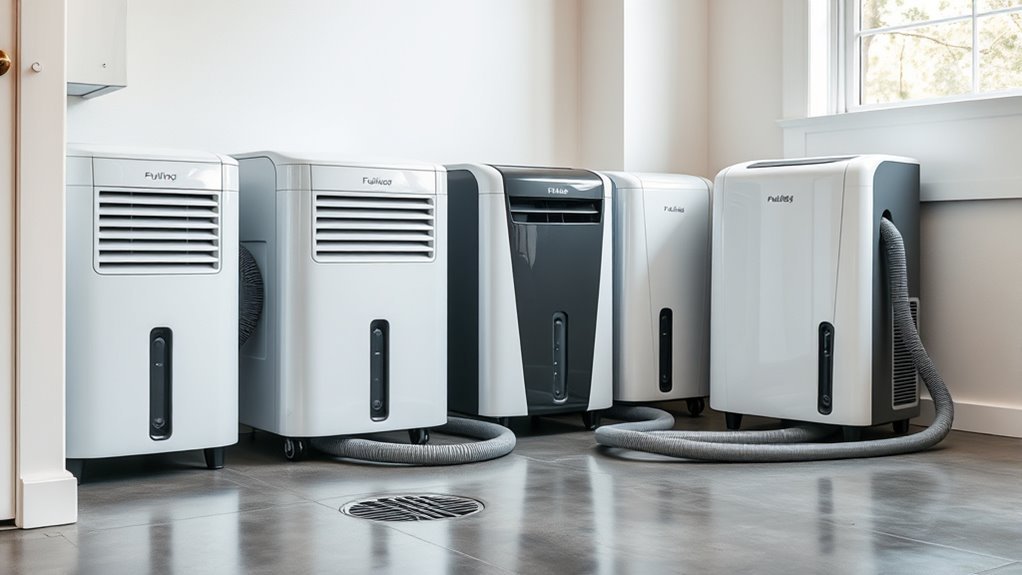
A dependable Frigidaire dehumidifier drain hose lets your unit empty continuously without relying on the water bucket. The right choice depends on your dehumidifier’s exact drain outlet, the distance to your floor drain, and whether you prefer a threaded garden-hose connection or a clamp-on adapter.
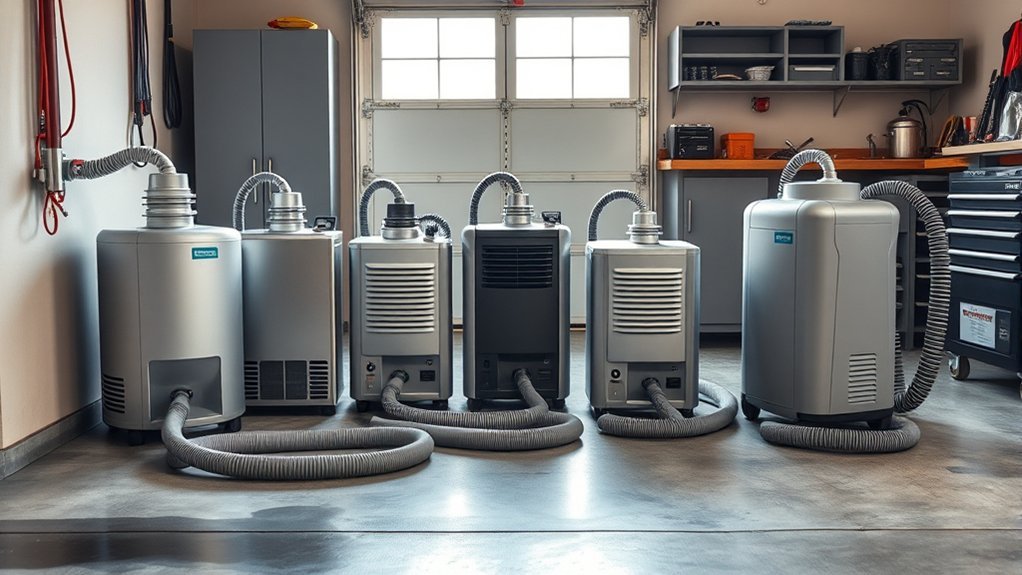
Among the three options reviewed here, the Saillong 6.5-foot hose offers the most flexible adapter-and-clamp connection, while the six-foot 3/4-inch FHT hose is the simpler choice for a compatible male threaded outlet. The 13-foot adapter hose kit gives you more reach when the entire route can stay below the drain outlet. Always check your Frigidaire model manual before ordering because drain connections can vary.
Quick Verdict
Choose the Saillong hose when your outlet can accept a measured clamp-on adapter. Choose the six-foot FHT hose when your dehumidifier has a compatible male garden-hose-style outlet and you want the simplest direct connection. Use the 13-foot kit only when the hose can maintain a continuous downward slope without coils, raised sections, or crushed areas.
Compatibility note: Do not buy by brand name alone. Confirm your dehumidifier’s model number, outlet shape, connector size, and minimum recommended hose diameter. “3/4-inch FHT” describes a female hose-thread connection; it does not guarantee fit with every Frigidaire drain outlet.
Key Takeaways
- Match the connector first: threaded hoses need a compatible male outlet, while adapter hoses need a secure overlap and clamp fit.
- Choose the shortest practical length so the hose can stay straight and continuously downhill.
- Test the connection and hose route before leaving the dehumidifier to drain unattended.
Quick Comparison of Frigidaire Dehumidifier Drain Hoses
| Product | Length | Connection | Best For | Important Limitation | Amazon |
|---|---|---|---|---|---|
| Saillong Drain Hose Best Adapter Option |
6.5 feet | Cuttable rubber adapter and clamp | Buyers who need connection flexibility | Requires careful sizing and clamp adjustment | Check Price |
| 3/4-Inch FHT PVC Hose Best Threaded Option |
6 feet | Female garden-hose thread | Frigidaire models with a compatible male threaded outlet | Will not fit every model or unthreaded outlet | Check Price |
| 13-Foot Adapter Hose Kit Best Long-Reach Option |
13 feet | Cuttable rubber adapter and clamp | Drains located farther from the unit | Long routing increases the risk of dips and pooling | Check Price |
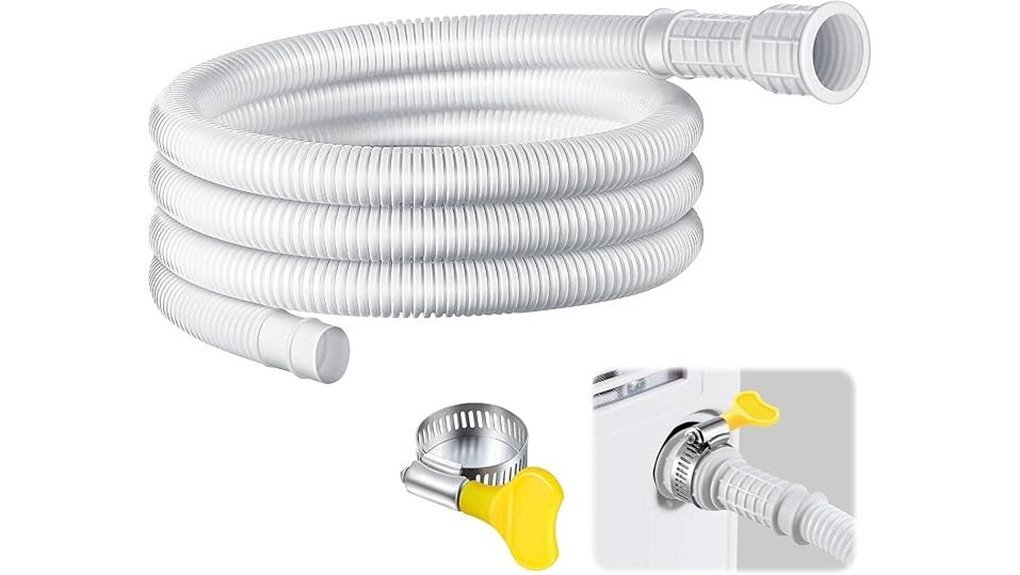
Saillong Dehumidifier Drain Hose, 6.5FT, 3/4 Inch
Best Overall Adapter Option
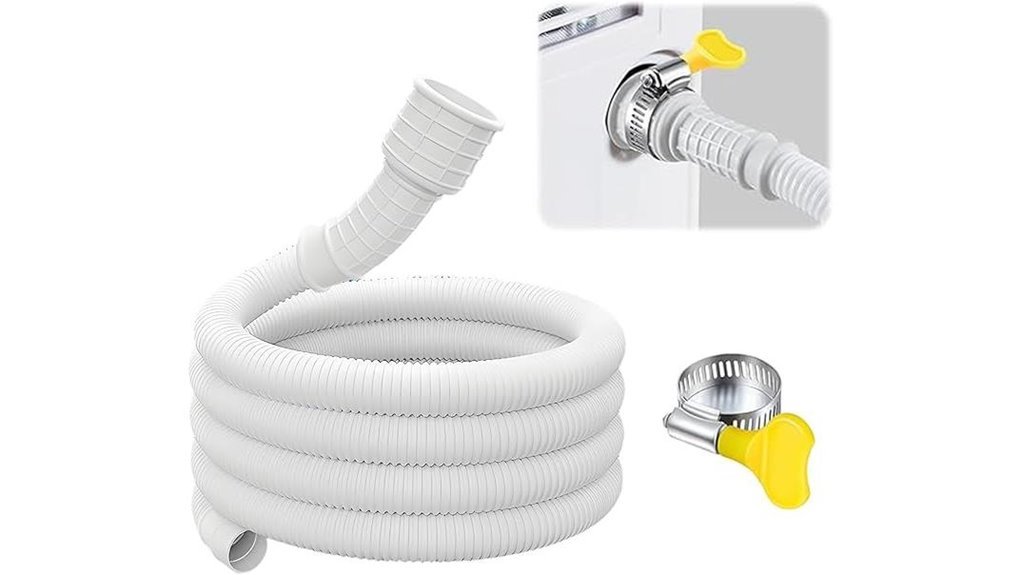
The Saillong drain hose is the most adaptable connection option in this comparison. Its corrugated PVC hose comes with a cuttable rubber adapter and connecting clamp, giving you more fitment flexibility than a fixed threaded fitting. The larger adapter section is intended for outlets around the common 3/4-inch size, while the smaller section can be trimmed for certain narrower drain ports. Measure before cutting because the change is permanent.
Why You’ll Like It: The adapter-and-clamp system can help when a standard female garden-hose fitting does not match your outlet. Its 6.5-foot length is also manageable for many basement, laundry-room, and utility-room layouts.
Best For: Frigidaire owners who have confirmed that a clamp-on rubber adapter can seal securely around their dehumidifier’s drain outlet.
Who Should Avoid It: Skip it when your manual specifically requires a threaded female garden-hose connection or when the rubber adapter cannot sit fully and evenly on the outlet.
Pros:
- Cuttable dual-size adapter supports more than one outlet style.
- Clamp helps secure the connection and reduce accidental slipping.
- Corrugated PVC design offers useful flexibility around obstacles.
- Moderate length is easier to keep sloped than an extra-long hose.
Cons:
- Proper fit depends on the exact shape and diameter of the drain outlet.
- Cutting the adapter is permanent and should be done only after measuring.
- Over-tightening the clamp could deform the adapter or plastic outlet.
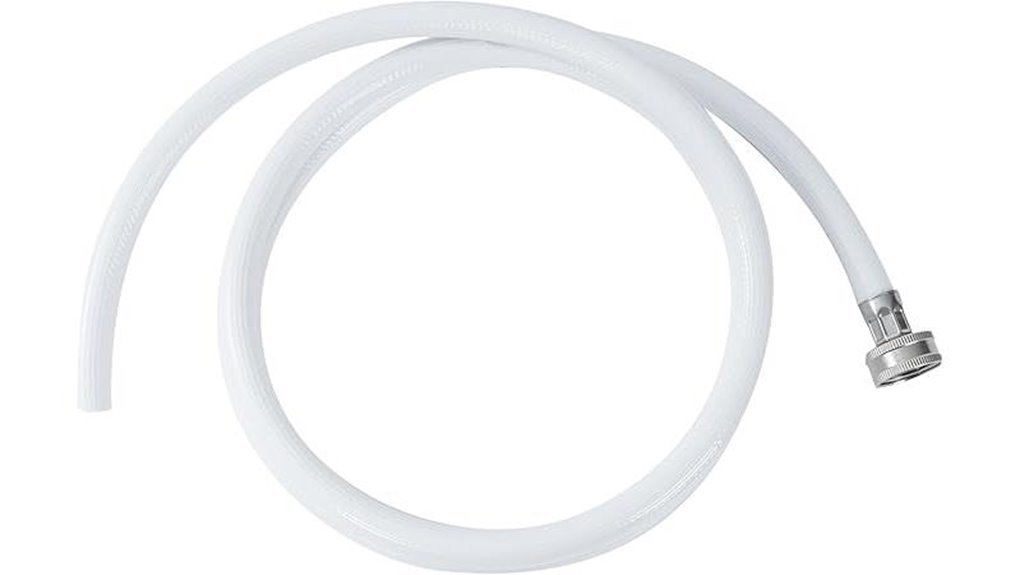
Dehumidifier Drain Hose 3/4" FHT, 6FT, Thick PVC
Best Simple Threaded Connection
This six-foot hose has a 3/4-inch female hose-thread (FHT) connector. That means the hose end must screw onto a compatible male garden-hose-style drain outlet on the dehumidifier. Its thick PVC body and threaded fitting provide a straightforward connection without cutting an adapter or tightening a separate clamp.
Why You’ll Like It: Installation is simple when the thread matches. Place the gasket inside the female fitting, screw the hose onto the dehumidifier by hand, route the other end downhill, and test for leaks.
Best For: Frigidaire models with a male garden-hose-style drain connector and a nearby floor drain.
Who Should Avoid It: Do not choose it for a smooth, barbed, narrow, or otherwise incompatible drain outlet. Do not force the connector if the threads do not engage easily.
Pros:
- Direct threaded connection requires no cuttable adapter.
- Six-foot length suits many common gravity-drain layouts.
- Thick PVC construction is designed to help resist flattening and sharp bends.
- Included gasket supports a tighter seal at the connector.
Cons:
- Thread size and outlet shape must match your dehumidifier.
- Six feet may be insufficient when the drain is across the room.
- A threaded fitting can leak if cross-threaded or installed without a sound gasket.
13-Foot Portable Dehumidifier Drain Hose Kit with Adapter and Clamp
Best Long-Reach Option
This 13-foot kit is designed for installations where the drain sits farther from the dehumidifier. It combines a corrugated PVC hose with a cuttable rubber adapter and clamp, allowing it to connect to certain outlet styles when the measurements match. Treat “universal” as a marketing description, not a fit guarantee.
Why You’ll Like It: The extra reach can eliminate the need to join multiple short hoses. A single continuous line generally creates fewer potential leak points than several connected extensions.
Best For: Rooms where a compatible floor drain is several feet away and the hose can still travel continuously downhill.
Who Should Avoid It: Do not choose a long hose when the route includes upward sections, deep dips, door thresholds, or furniture that will crush the line. Extra length does not help if gravity cannot carry the water to the drain.
Pros:
- Thirteen-foot reach supports more flexible dehumidifier placement.
- Rubber adapter can be trimmed to match certain outlet sizes.
- Clamp helps secure the adapter after fitment is confirmed.
- Corrugated body is easier to route than rigid pipe.
Cons:
- Longer hoses are more likely to develop low spots where water collects.
- Adapter fit must be measured carefully before installation.
- Excess unused hose can reduce drainage reliability if it is left coiled.
Factors to Consider When Choosing a Hose for a Frigidaire Dehumidifier
The safest way to choose a drain hose is to start with your dehumidifier’s model number and manual. After confirming the required connector, compare the hose length, material, bend resistance, seal, and intended drainage route.
Frigidaire Model and Outlet Compatibility
Frigidaire dehumidifiers do not all use an identical drainage setup. Some accept the female threaded end of a standard garden hose, while others use a drainage joint or another connection arrangement. Locate the drain cap, inspect the outlet, and read the continuous-drainage section of your model manual before ordering.
Check all of the following:
- Whether the outlet is threaded, smooth, barbed, or used with an included drainage joint.
- The outside diameter of the outlet.
- The minimum hose diameter recommended for the model.
- Whether the manufacturer requires a gasket, adapter, or clamp.
- Whether the unit uses gravity drainage or a built-in pump system.
Threaded Versus Clamp-On Connections
A female garden-hose fitting is usually the simplest choice when it matches the threaded drain connector. The gasket sits inside the fitting, and the hose screws directly onto the dehumidifier.
A rubber adapter and clamp can offer more flexibility for certain smooth or differently sized outlets. However, the adapter must overlap enough of the outlet to remain secure. It should not be cut until you have measured the connection carefully.
Never force mismatched threads, stack loose adapters, or rely on tape to compensate for a fundamentally incorrect connector.
Length and Gravity Slope
Choose the shortest hose that reaches the drain without tension. A gravity-drain hose must remain below the dehumidifier’s outlet and slope continuously downward. Raised sections, deep dips, coils, and sharp bends can trap water and cause it to back up into the bucket.
- A six-foot to 6.5-foot hose fits many ordinary room layouts and is usually easier to keep sloped.
- A 13-foot hose offers more placement freedom but requires more careful routing.
Do not leave unnecessary hose coiled behind the appliance. Trim only when the product is designed to be cut and doing so will not remove the required connector.
Material and Kink Resistance
PVC is lightweight and easy to route, but thin tubing can flatten under furniture or bend too sharply. Corrugated and thick-wall designs may hold their shape better around moderate curves, yet they still need support so storage bins, furniture, or door thresholds do not pinch the line. Treat “kink-resistant” as a design feature, not a promise that the hose cannot kink.
Leak-Resistant Connections
A leak-resistant installation depends on both the hose and the connection. For threaded fittings, inspect the rubber washer before installation and replace it if it is cracked, flattened, or missing. Start the fitting by hand to avoid cross-threading.
For adapter-style hoses, slide the rubber connector fully onto the outlet and tighten the clamp only enough to hold it securely. Excessive force can distort the adapter or damage a plastic drain fitting.
After installation, run the dehumidifier and inspect the connection, hose path, and drain end. Recheck the area after the unit has collected enough moisture to begin draining.
Gravity Drain Versus Pump Drainage
A standard drain hose does not push water uphill. On a gravity-drain model, the receiving drain must sit lower than the dehumidifier outlet.
Some Frigidaire models have a built-in pump that can move water to a higher sink or another elevated outlet. Pump connections and hose requirements may differ from the standard garden-hose connection, so follow the instructions for the exact model. Do not assume a gravity hose can be used as a pump-discharge hose.
Before You Buy Checklist
- Write down the complete Frigidaire model number.
- Read the continuous-drainage instructions in the model manual.
- Identify whether the outlet is threaded or requires an adapter.
- Measure the route from the dehumidifier to the drain.
- Confirm the entire hose can slope downward.
- Check whether a gasket, drainage joint, or clamp is required.
- Avoid an extra-long hose unless the added reach is necessary.
- Plan a test run before leaving the unit unattended.
How to Install a Frigidaire Dehumidifier Drain Hose
- Turn off and unplug the dehumidifier.
- Place the unit on a stable, level surface above the receiving drain.
- Locate the continuous-drain outlet and remove its cap or cover.
- Install the drainage joint first if your model requires one.
- Attach the hose using the correct threaded fitting or adapter.
- Make sure the gasket or clamp is seated correctly.
- Route the hose continuously downhill with no kinks or raised sections.
- Place the open end securely in a floor drain or another approved outlet.
- Restart the dehumidifier and inspect the complete route for leaks.
- Check the bucket later. Water collecting in it may indicate a blocked or poorly routed hose.
Pro tip: Take a photo of the drain outlet and model-number label before shopping. Comparing those details with the product connector is more reliable than choosing a hose based only on the Frigidaire brand name.
Frequently Asked Questions
How Do I Know Which Hose Fits My Frigidaire Dehumidifier?
Find the complete model number on the appliance label and check the continuous-drainage section of its manual. Confirm whether the outlet accepts a female garden-hose fitting, uses a drainage joint, or requires another adapter. Match the connector shape and diameter rather than relying only on the brand.
Why Is the Bucket Filling When a Drain Hose Is Attached?
The hose may be kinked, clogged, raised above the outlet, or sitting in a low loop where water collects. The connection may also be loose or improperly installed. Turn off the unit, empty the bucket, straighten and flush the hose, and make sure the entire route slopes downward.
Can I Extend a Dehumidifier Hose Without Reducing Drainage Performance?
You can extend it when the fittings seal securely and the complete line maintains the same usable diameter and a continuous downward slope. Every extra joint creates another potential leak or blockage point, so a single hose of the correct length is usually the cleaner solution.
What Does 3/4-Inch FHT Mean on a Dehumidifier Hose?
FHT means female hose thread. The female connector is on the hose and must screw onto a matching male garden-hose-style outlet. It describes the connector standard, not guaranteed compatibility with every dehumidifier or the hose’s usable inside diameter.
Are Clear Hoses Better for Spotting Clogs Than Black Hoses?
Clear tubing makes standing water and internal buildup easier to see. However, visibility does not compensate for an incorrect diameter or connector. An opaque purpose-made hose with the proper fitting is a better choice than undersized clear tubing that requires an improvised adapter.
How Do I Clean a Dehumidifier Drain Hose?
Disconnect the hose and flush it with clean water to remove dust, sludge, and loose debris. Inspect the fittings and gasket before reinstalling it. Clean the hose whenever drainage slows, the bucket begins filling unexpectedly, or visible buildup appears.
How Often Should I Replace a Frigidaire Dehumidifier Drain Hose?
There is no universal replacement schedule. Replace the hose when it becomes cracked, stiff, flattened, discolored from material deterioration, persistently clogged, or unable to seal at the fittings. Inspect it at the beginning of each heavy-use season and after moving the dehumidifier.
Can a Gravity Drain Hose Run Uphill to a Sink?
No. A gravity-drain hose must run downhill from the dehumidifier to the receiving drain. To move water upward, you need a dehumidifier with a compatible built-in pump or a separately approved condensate-pump setup.
Can I Use a Hose With a Built-In Shutoff Valve?
An unrestricted hose is generally the safer choice for continuous gravity drainage. A closed or partly closed valve can block the flow and send water back toward the bucket. Use only a valve arrangement specifically permitted by the dehumidifier manufacturer, and keep it fully open during operation.
Conclusion
The best hose for a Frigidaire dehumidifier is the one that matches the exact drain connector and reaches the drain while maintaining a continuous downward slope. For the most adaptable setup, the Saillong 6.5-foot hose provides a cuttable adapter and clamp. For a compatible threaded outlet, the six-foot 3/4-inch FHT hose offers a simpler direct connection.
Choose the 13-foot adapter hose kit only when you need the additional reach and can prevent dips, coils, crushed areas, and uphill sections. Whichever option you select, confirm the model instructions, test the seal, and inspect the hose regularly for dependable continuous drainage.
Final Recommendation
Start with your Frigidaire manual, not the product label. The six-foot threaded hose is the cleanest choice when the outlet matches; the Saillong adapter is more flexible when a measured clamp-on connection is appropriate; and the 13-foot kit is useful only when gravity can move water through the full route.