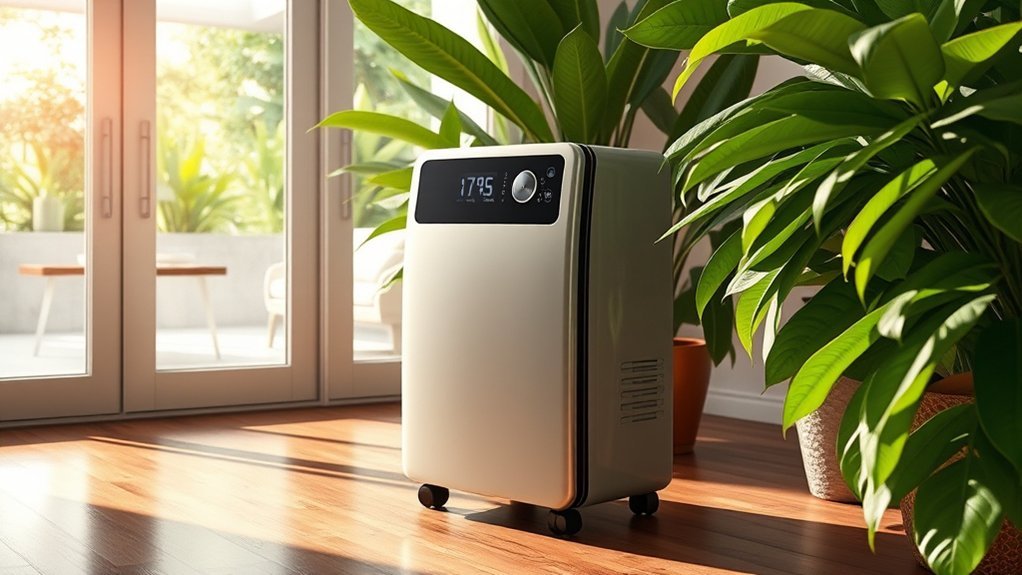
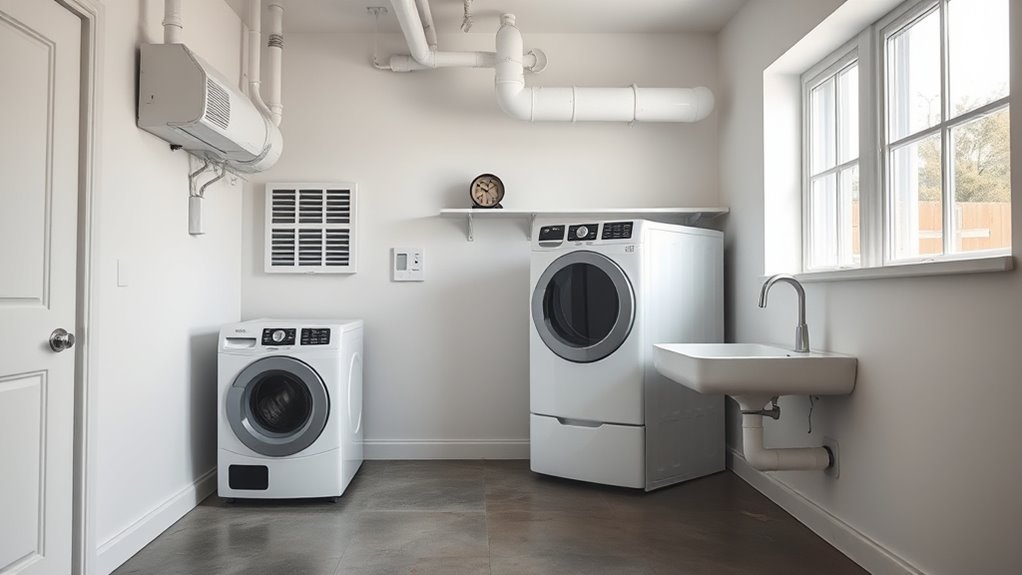
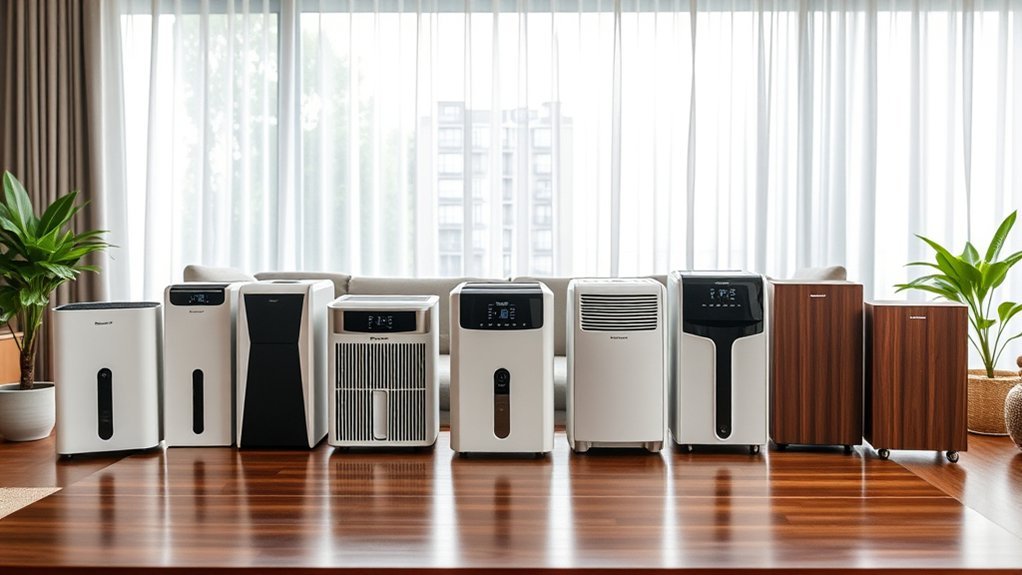
Choosing the best dehumidifier for home humidity control starts with the amount of moisture in the room—not just the largest square-foot claim on the box. Compressor dehumidifiers are usually the right choice for basements, laundry rooms, and large living areas. Compact semiconductor models are quieter and easier to place, but they are better for small enclosed spaces with mild humidity. The six options below cover large-capacity moisture removal, smart controls, continuous drainage, energy-efficiency signals, compact sizing, and quiet small-room use.
Quick verdict
- Best overall for a large damp space: AEOCKY RHEA-001 4500 Sq.Ft Dehumidifier
- Best smart controls: GoveeLife H7151 Smart Dehumidifier
- Best for the largest advertised coverage: hOmeLabs 7,000 Sq Ft Wi-Fi Dehumidifier
- Best value compressor model: Amazon Basics 35-Pint Dehumidifier
- Best compact smart compressor model: Midea 22-Pint Smart Dehumidifier
- Best for a small quiet room: ToLife TZ-C2
Quick Comparison
| Model | Best for | Type | Capacity claim | Drainage | Standout feature | Amazon |
|---|---|---|---|---|---|---|
| AEOCKY RHEA-001 4500 Sq.Ft | Large basements and open rooms | Compressor | Lower standardized figure plus an 80-pint maximum claim | Bucket or included drain hose | Efficiency-focused large-space design | Check Current Amazon Availability |
| GoveeLife H7151 | Smart-home humidity control | Compressor | 50-pint class | 2-gallon bucket or hose drainage | App, voice, and humidity alerts | Check Current Amazon Availability |
| hOmeLabs 7,000 Sq Ft Wi-Fi | Very large residential areas | Compressor | 50 pints/day; 120-pint maximum claim | Bucket or gravity drain; confirm hose bundle | Wi-Fi and high-capacity operation | Check Current Amazon Availability |
| Amazon Basics 35-Pint | Value-focused basement use | Compressor | About 35.5 pints/day | Bucket or continuous-drain connection | Simple controls and reusable filter | Check Current Amazon Availability |
| Midea 22-Pint Smart | Bedrooms, offices, and medium rooms | Compressor | 22 pints/day | Bucket or gravity drain | Compact cabinet and app control | Check Current Amazon Availability |
| ToLife TZ-C2 | Small bedrooms, bathrooms, closets, and RVs | Semiconductor | Up to about 1 liter/day in favorable conditions | 95-oz removable tank | Quiet sleep mode | Check Current Amazon Availability |
Coverage, sound, and daily moisture-removal figures are manufacturer or certification claims measured under specific conditions. Real performance changes with temperature, starting humidity, airflow, ceiling height, room layout, and whether doors and windows stay closed.
AEOCKY RHEA-001 4500 Sq.Ft Dehumidifier
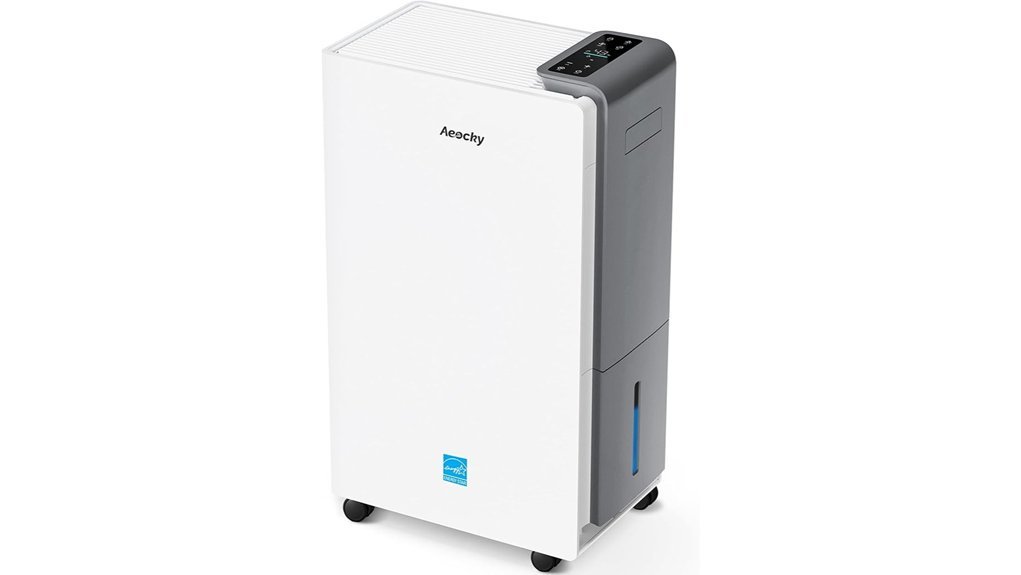
The AEOCKY RHEA-001 is the strongest all-around choice here for a large basement, living area, or open floor plan. It combines compressor-based moisture removal, an adjustable humidistat, automatic defrost, a child lock, and hose drainage. The listing separates its headline 80-pint maximum from a lower standardized figure, so compare the lower figure—not the maximum—with other compressor models. Its main appeal is a large-space, efficiency-focused design without app-dependent operation.
Best For: Homeowners who want a capable compressor dehumidifier for a large, consistently damp area.
Why You’ll Like It:
- Automatic humidity control helps the unit cycle around a selected target.
- Continuous drainage can reduce daily bucket emptying when a suitable lower drain is available.
- The included hose and garden-hose adapter make the drainage setup more flexible.
Who Should Avoid It:
- The 80-pint headline is a hot-and-humid maximum, not a directly comparable standardized rating.
- It is larger and more expensive than compact room units.
- Annual ENERGY STAR Most Efficient labels are time-specific, so confirm the current certification and warranty details for the exact RHEA-001 listing.
GoveeLife H7151 Smart Dehumidifier for Home
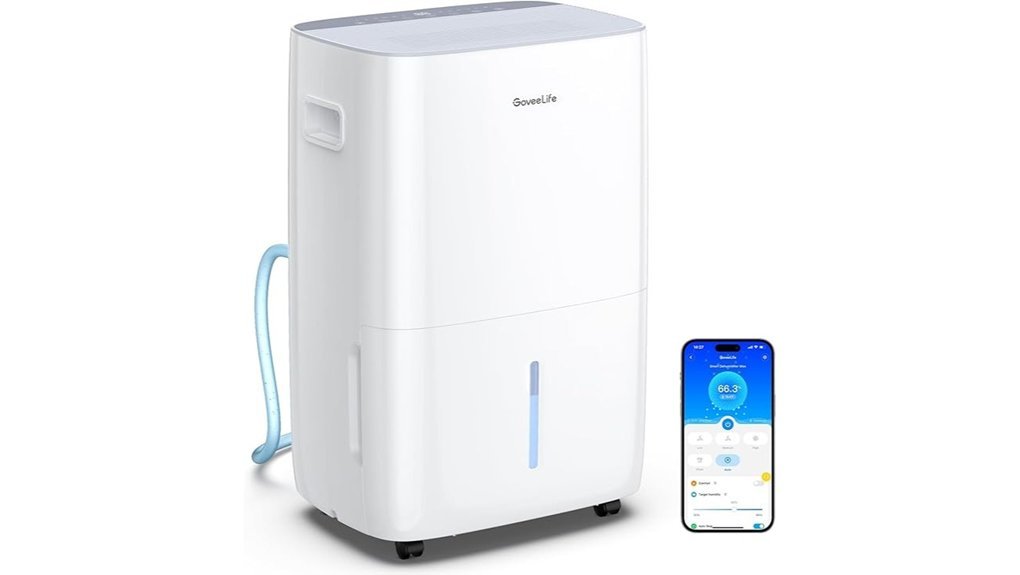
The GoveeLife H7151 is the best fit for buyers who want remote monitoring and automation. It is a 50-pint-class compressor dehumidifier with app, voice, and touch controls, a 2-gallon bucket, automatic full-tank shutoff, built-in humidity sensing, and hose drainage support. Its large-space coverage should be treated as a maximum recommendation, while its roughly 53 dB sound specification makes it better suited to basements and living areas than silent bedrooms.
Best For: Large rooms, basements, or garages where app control, scheduling, and humidity alerts matter.
Why You’ll Like It:
- Works with the Govee app and supported voice assistants.
- The 2-gallon tank can reduce bucket trips compared with many compact models.
- Built-in sensing supports automatic humidity management and remote alerts.
Who Should Avoid It:
- Full smart functionality depends on compatible 2.4 GHz Wi-Fi.
- At about 39 pounds, it is movable but not lightweight.
- Its compressor and fan will be noticeable in a very quiet sleeping area.
hOmeLabs 7,000 Sq Ft Wi-Fi Dehumidifier
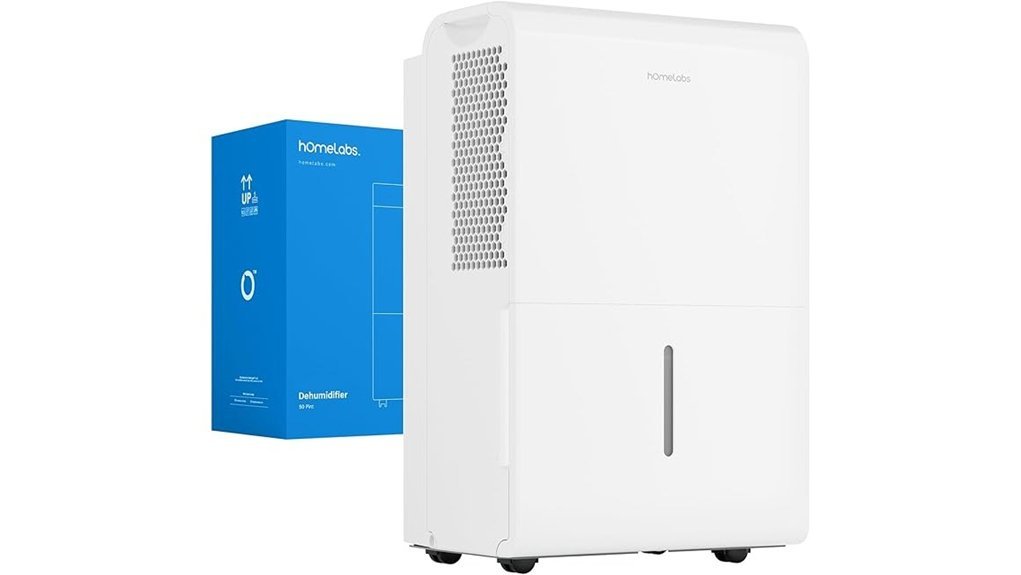
This hOmeLabs unit is designed for very large residential spaces. The brand lists 50 pints per day at its standard condition and a 120-pint maximum under much hotter, wetter conditions. Wi-Fi control, adjustable humidity, automatic shutoff, turbo mode, wheels, and handles make it convenient for basements and open-plan homes. hOmeLabs sells both pump and non-pump versions, so the exact ASIN must be checked before assuming water can be lifted upward.
Best For: Very large residential areas where a high-capacity Wi-Fi compressor model is preferred.
Why You’ll Like It:
- Strong 50-pint-class moisture removal for severe household humidity.
- Remote humidity adjustment, modes, and scheduling through Wi-Fi.
- Bucket or gravity-drain operation gives buyers two basic water-removal options.
Who Should Avoid It:
- The non-pump version requires a continuously downward hose route.
- Current brand copy has shown inconsistent wording about whether the drain hose is included, so confirm the exact bundle before ordering.
- The large cabinet needs more floor and storage space than a 22- or 35-pint model.
Amazon Basics 35-Pint Dehumidifier for Home
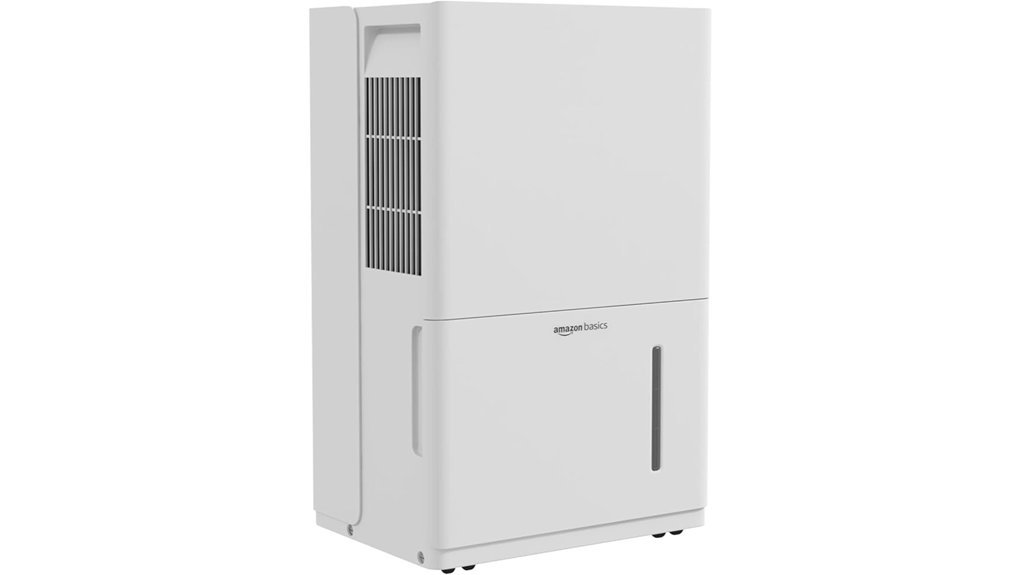
The Amazon Basics 35-Pint model is a straightforward compressor dehumidifier for buyers who value simple controls over app features. Current certification records list about 35.5 pints per day, while the product is marketed for rooms up to 2,500 square feet. Auto defrost, auto restart, overflow protection, a timer, and a reusable filter cover the essentials, but independent testing has also identified noticeable operating noise.
Best For: Basements and large rooms where value and basic controls matter more than smart features.
Why You’ll Like It:
- Comparable 35-pint-class capacity makes it easier to size than products that emphasize only maximum-condition claims.
- A reusable filter and familiar control layout simplify routine maintenance.
- Auto restart, auto defrost, and full-bucket protection support regular use.
Who Should Avoid It:
- It can be louder and warmer-running than smaller-capacity alternatives.
- There is no app or voice control.
- The bucket still needs regular emptying unless a suitable continuous-drain setup is installed.
Midea 22-Pint Smart Dehumidifier
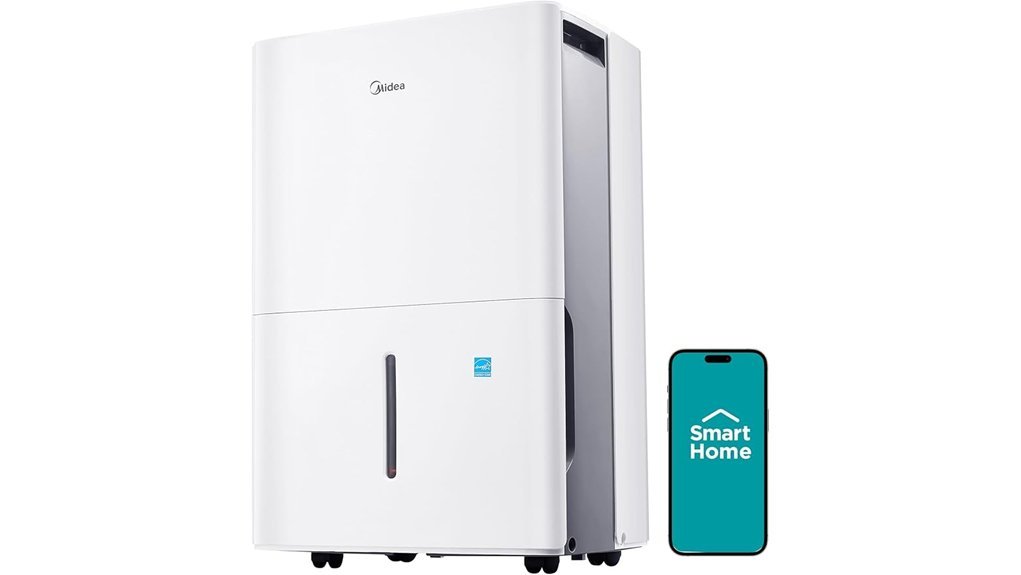
The Midea MAD22S1AWWT is a compact compressor model rated to remove 22 pints per day in spaces advertised up to 1,500 square feet. It offers app and supported voice control, adjustable humidity settings, four operating modes, two fan speeds, a 24-hour timer, wheels, and a side-access bucket with a splash guard. Its smaller capacity suits bedrooms, offices, bathrooms, and moderately damp basements better than severe whole-basement moisture problems.
Best For: Buyers who want a smaller smart compressor dehumidifier for a bedroom, office, or medium-size room.
Why You’ll Like It:
- The 22-pint rating is directly useful when comparing it with other current compressor models.
- App and voice controls support remote adjustments and scheduling.
- A compact footprint, wheels, and splash-guard bucket make room-to-room use easier.
Who Should Avoid It:
- The smaller bucket and capacity can be limiting in very damp conditions.
- It does not include a built-in pump.
- The listed one-year warranty is shorter than some competing coverage periods.
ToLife TZ-C2 Dehumidifier for Home
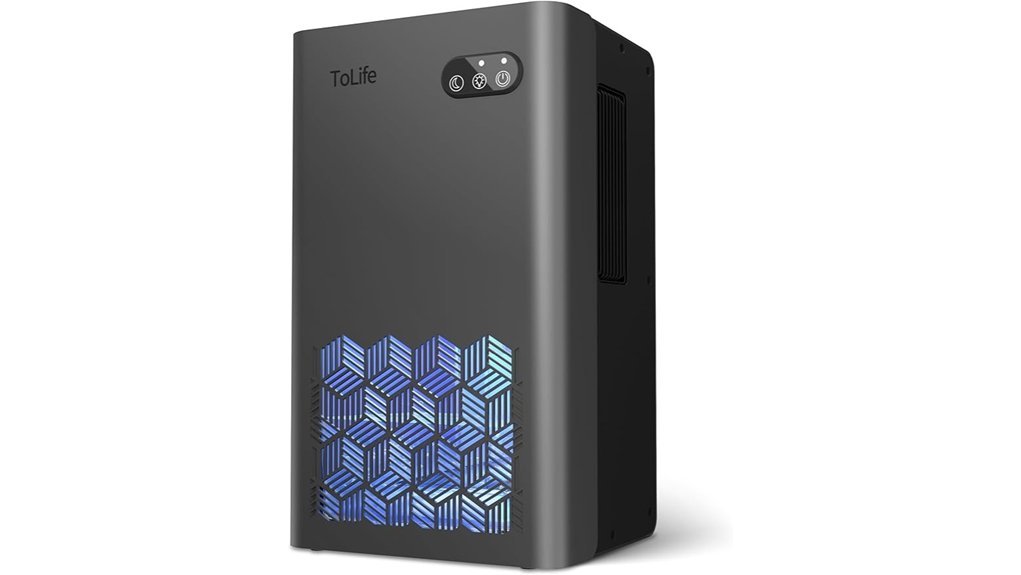
The ToLife TZ-C2 uses semiconductor condensation instead of a refrigerant compressor. It has a 95-ounce tank, two operating modes, automatic full-tank shutoff, sleep mode, and seven-color lighting. The model documentation lists moisture removal up to about 1 liter per day under favorable warm and humid conditions. Treat it as a quiet small-room appliance—not as a substitute for a 20- to 50-pint compressor dehumidifier.
Best For: Small bedrooms, bathrooms, closets, RVs, and other enclosed spaces with mild humidity.
Why You’ll Like It:
- Quiet sleep mode is easier to live with at night than a cycling compressor.
- The 95-ounce tank is relatively large for a compact semiconductor design.
- Simple controls, automatic shutoff, and ambient lighting make it easy to use.
Who Should Avoid It:
- It removes moisture too slowly for a wet basement or large open floor plan.
- Semiconductor performance drops as room temperature falls.
- The advertised 1,000-square-foot coverage should not be treated as realistic for severe humidity.
Factors to Consider When Choosing a Dehumidifier for Home Humidity Control
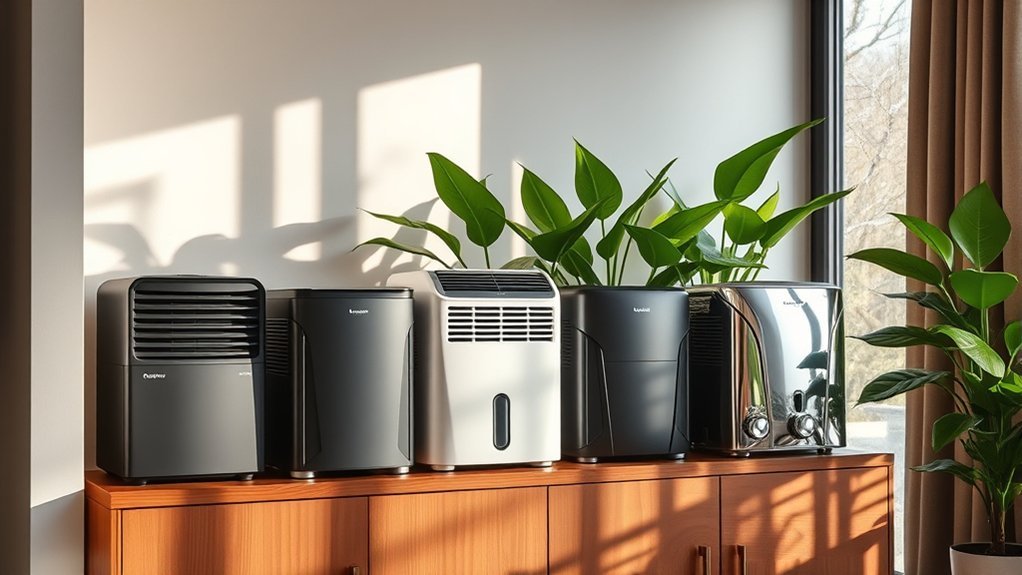
The right dehumidifier should be sized by moisture-removal capacity, room dampness, drainage access, and operating temperature. Square-foot claims alone can be misleading, especially when comparing a mini semiconductor unit with a full compressor model.
Compressor vs. Semiconductor Dehumidifiers
Compressor dehumidifiers remove much more water and are usually the correct choice for basements, laundry rooms, and large living areas. Semiconductor or thermoelectric models are quieter and lighter but work best in warm, small, enclosed spaces with mild humidity.
Room Size and Dampness
Match the unit to both floor area and moisture severity. A slightly damp room may need less capacity than a smaller space with wet walls, seepage, or frequent indoor laundry drying. ENERGY STAR guidance recommends sizing by the untreated room condition as well as room size, and it generally favors oversizing rather than undersizing.
Moisture Extraction Capacity
Compare pints per day under the same test standard. Some listings show a current standardized rating plus a much larger maximum measured at higher temperature and humidity. Those numbers are not interchangeable. For a wet basement, choose a compressor model with enough standardized capacity instead of relying on a mini unit or a square-foot claim alone.
Energy Efficiency Ratings
ENERGY STAR certification and Integrated Energy Factor information are more useful than vague statements such as “uses almost no electricity.” Also consider the humidistat: a properly sized unit that cycles off near the target humidity can be more practical than an undersized model that runs continuously.
Noise Level Considerations
Noise figures are usually measured under controlled conditions. Compressor cycling, fan speed, floor vibration, and room acoustics can make a unit sound louder at home. For bedrooms, look for lower fan settings or sleep mode and enough capacity to reach the target without running at full speed all night.
Drainage Options Available
Bucket drainage is simple but requires regular emptying. Gravity drainage needs a hose that slopes continuously to a lower drain. A built-in pump can move water upward, but do not assume a product has one merely because a similar version does. Check the exact ASIN, model name, and included accessories.
Humidity Target and Placement
A practical target for many homes is about 30% to 50% relative humidity. Use a separate hygrometer to verify the room level. Keep air inlets and outlets clear, close doors and windows while the unit runs, and place the appliance on a stable, level surface.
Operating Temperature
Cooler air contains less moisture, and compressor coils may frost in cold rooms. For a basement or garage, verify the model’s minimum operating temperature and automatic-defrost feature. Semiconductor models also become less effective as temperatures fall.
Safety and Maintenance
Look for full-tank shutoff, automatic defrost for cooler spaces, a washable or replaceable filter, and a child lock where relevant. Follow the exact product manual for electrical setup, clearance, cleaning, and upright positioning. A dehumidifier controls airborne moisture but does not repair plumbing leaks, foundation seepage, or existing mold.
Frequently Asked Questions
What Is the Ideal Humidity Level for My Home?
Many homes are comfortable between 30% and 50% relative humidity. Keeping indoor humidity below 60% is especially important when condensation or dampness is present. A separate hygrometer can help confirm whether the dehumidifier’s built-in sensor is close to the actual room level.
How Do I Choose the Right Pint Capacity?
Start with the room’s dampness, then consider floor area. A wet basement needs more capacity than a slightly humid bedroom. Compare products using a standardized pint-per-day rating, not only a “maximum” figure measured under hotter and wetter conditions.
Is a 50-Pint Dehumidifier Always Better Than a 35-Pint Model?
No. A 50-pint model may remove moisture faster in a large or very damp room, but it is usually larger, heavier, and potentially noisier. A 22- or 35-pint model can be the better fit for a smaller room with moderate humidity.
Can a Mini Dehumidifier Dry a Basement?
Usually not. Semiconductor mini models are best for small enclosed areas with mild humidity. A damp or wet basement normally needs a compressor dehumidifier selected by standardized pint capacity and room conditions.
Can I Use a Dehumidifier in Winter?
Yes, if the room temperature stays within the model’s operating range. In a cool basement, choose a compressor model with automatic defrost. Semiconductor units also become less effective as temperature drops.
Should I Use Continuous Drainage?
Continuous drainage is useful when the unit runs daily. Gravity drainage requires a downward slope to a suitable drain. A pump model is needed when water must travel upward, and the exact pump version should be confirmed before purchase.
How Often Should I Clean My Dehumidifier?
Check the filter and bucket every few weeks during heavy use, or follow the manufacturer’s schedule. Washable filters must be fully dry before reinstalling, and the bucket should be cleaned if it develops residue or odor.
Do Dehumidifiers Use a Lot of Electricity?
Energy use varies by capacity, efficiency, temperature, and runtime. A properly sized model with automatic humidity control may cycle off after reaching the target, while an undersized unit may run much longer. Compare ENERGY STAR status and efficiency information for the exact model.
Can a Dehumidifier Fix Mold or Water Leaks?
No. A dehumidifier can reduce airborne moisture, but it cannot stop plumbing leaks, groundwater seepage, roof leaks, or active mold growth. Fix the moisture source and address existing mold with the appropriate cleanup or professional remediation method.
How Long Do Dehumidifiers Typically Last?
Service life depends on build quality, operating hours, room temperature, filter care, transport, and drainage maintenance. Rather than relying on one fixed lifespan, protect the unit with regular cleaning, clear airflow, correct upright setup, and prompt attention to icing, leaking, or unusual noise.
Conclusion
Final recommendation: Choose the AEOCKY RHEA-001 for an efficiency-focused large-space solution, the GoveeLife H7151 for the strongest smart-control experience, or the hOmeLabs 50-Pint Wi-Fi model when you need the largest advertised coverage and can verify the exact pump and hose configuration. The Amazon Basics 35-Pint is the straightforward value choice, while the Midea 22-Pint is the better compact smart compressor option. The ToLife TZ-C2 is suitable only for a small bedroom, bathroom, closet, or RV with mild humidity.
Whichever model you choose, verify the exact current listing, prioritize standardized pint capacity over maximum-condition claims, use a separate hygrometer, provide a safe drainage path, and fix any leaks or water intrusion causing the humidity problem.