Updated August 2026.
The best dehumidifier for indoor growing depends on the moisture load, grow-space temperature, ventilation rate, drainage access, and the level of humidity control you need. For compact grow tents, the VIVOSUN AeroDrain D12 and AC Infinity HYDRONE 5 provide grow-focused controls and ducting options. For a larger grow room or the room surrounding a tent, the VEAGASO VG380 offers higher stated capacity and continuous drainage.
Quick verdict
- Best overall for a compact grow tent: VIVOSUN AeroDrain D12
- Best for precise, adjustable drying: AC Infinity HYDRONE 5
- Best for a larger grow room or lung room: VEAGASO VG380
Important: Dehumidification ratings are measured under specific temperature and humidity conditions. Do not compare headline liters or pints without checking the test conditions and your actual moisture load.
Quick Comparison
| Product | Best For | Stated Moisture Removal | Control and Drainage | Main Limitation | Amazon |
|---|---|---|---|---|---|
| VIVOSUN AeroDrain D12 | Compact grow tents and app-based monitoring | Up to 12 L/day at warm, humid test conditions; output falls in cooler or drier air | External probe, app control, tank or continuous drain | Tent-size guidance varies by conditions, so size by moisture load | Check Price |
| AC Infinity HYDRONE 5 | Two to three plants, ducted setups, and fine drying control | Manufacturer lists a 4 L real-world draw rate that is not directly comparable with compressor ratings | Ten drying levels, reservoir or gravity drain, optional smart-controller integration | Wi-Fi automation requires a compatible controller | Check Price |
| VEAGASO VG380 | Larger grow rooms or the conditioned room outside a tent | Up to 34 pints/day at 95°F and 90% RH | Built-in humidistat, three modes, tank or gravity drain hose | Headline capacity is a warm, high-humidity maximum, not a typical-room guarantee | Check Price |
VIVOSUN AeroDrain D12 Smart Dehumidifier for Grow Tents
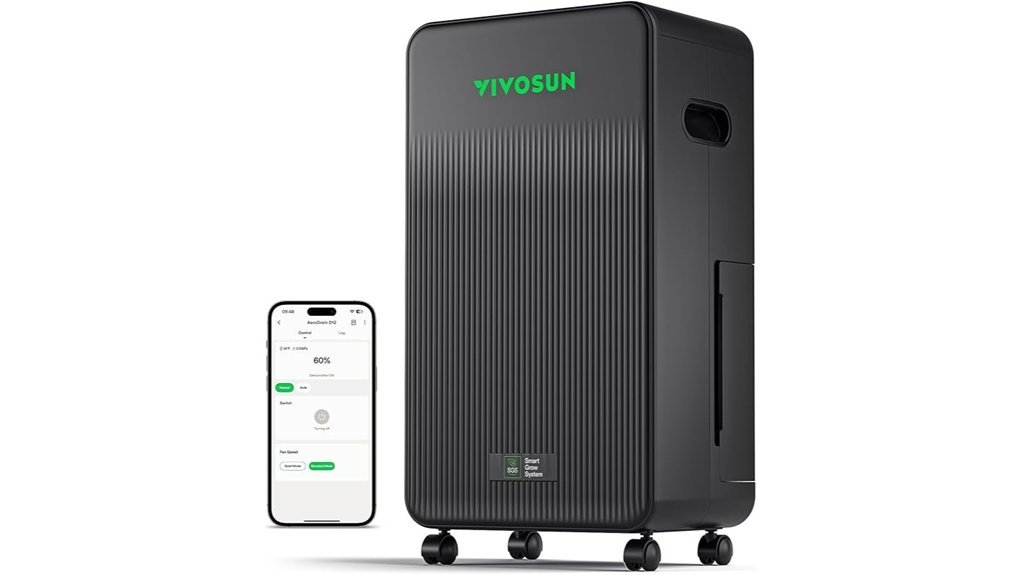
The VIVOSUN AeroDrain D12 is the strongest all-around choice here for a compact grow tent because it combines compressor-based moisture removal with a separate temperature-and-humidity probe, app control, ducting accessories, and two drainage methods. Its published maximum is 12 liters per day under warm, humid conditions, while the manufacturer’s manual shows lower output as temperature and relative humidity fall.
Why you’ll like it: The probe can be positioned near the canopy instead of relying only on a sensor inside the machine. The unit can also work with the VIVOSUN app and Smart Grow System for remote monitoring and automation. Tank collection is available, but continuous drainage is the more practical option for an active grow.
Best for: Growers who want a purpose-built dehumidifier for a compact tent, remote control, and flexible duct placement.
Who should avoid it: Growers choosing only by a “5×5” coverage label. Current manufacturer materials present different tent-size guidance, and actual performance changes with temperature, humidity, ventilation, and plant transpiration.
Pros:
- Grow-focused external sensor for temperature, humidity, and VPD monitoring.
- App control and integration with the VIVOSUN Smart Grow System.
- Tank collection, continuous drainage, power-loss restart, handles, and caster wheels.
Cons:
- The 2-liter tank can fill quickly when the unit is removing substantial moisture.
- Maximum extraction figures are based on warm, humid test conditions.
- At up to roughly 42 dBA, it is not as quiet as a small thermoelectric unit.
AC Infinity HYDRONE 5 Precision Plant Dehumidifier
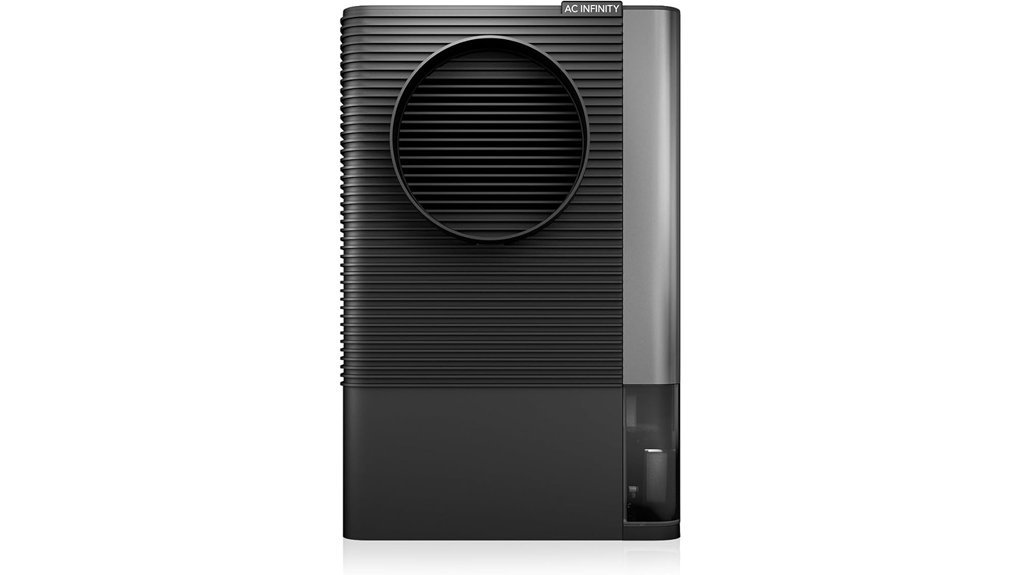
The AC Infinity HYDRONE 5 is designed for growers who want more control than a basic on-or-off dehumidifier provides. Its rotary drying system offers ten output levels, and the manufacturer recommends it for setups with two to three plants. Dual 6-inch duct ports support open-loop or closed-loop configurations, which can help keep the appliance outside a crowded tent while delivering dry air where it is needed.
Why you’ll like it: The HYDRONE 5 is built for adjustable drying across a wide operating-temperature range. It includes an internal reservoir and a gravity-drain option. It can also connect to compatible AC Infinity controllers for app access, humidity or VPD automation, charts, and alerts.
Best for: Small plant counts, ducted grow-tent layouts, colder grow environments, and users already invested in the AC Infinity controller ecosystem.
Who should avoid it: Anyone expecting built-in standalone Wi-Fi or enough capacity for a large, heavily transpiring room. Smart features require a compatible controller, and the manufacturer says its 4-liter real-world draw rate should not be directly compared with compressor ratings.
Pros:
- Ten drying levels provide finer adjustment than a single-speed mini unit.
- Dual duct ports support flexible inside-tent or outside-tent placement.
- Reservoir and continuous gravity-drain options reduce maintenance.
Cons:
- Recommended for only two to three plants.
- Compatible smart controller is needed for Wi-Fi automation.
- Power draw varies by drying level, so low wattage should not be assumed.
VEAGASO VG380 34-Pint Dehumidifier with Drain Hose
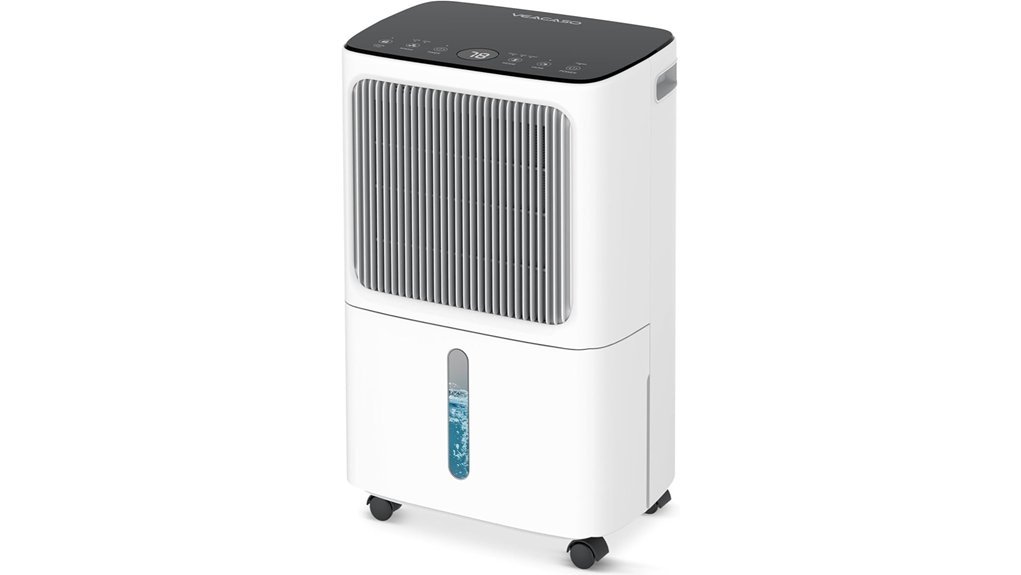
The Amazon link in this article corresponds to the VEAGASO VG380, a general-purpose compressor dehumidifier that can be useful in a larger grow room or “lung room” surrounding one or more tents. It has a stated maximum of 34 pints per day at 95°F and 90% RH, three operating modes, two fan speeds, a 2-liter tank, and a drain-hose connection for continuous gravity drainage.
Why you’ll like it: Unlike a basic mini dehumidifier, the VG380 has an adjustable humidity setting and enough stated capacity for a meaningful room-level moisture load. The DEHU, DRY, and CONT modes provide options for normal target-humidity operation, faster moisture removal, or continuous running.
Best for: A larger indoor garden, basement grow room, or conditioned room outside a tent where you need more capacity and easy continuous drainage.
Who should avoid it: Growers who need canopy-level VPD automation, a grow-system app, or a ducted compact-tent appliance. Its square-foot claim and maximum pint rating should not be treated as guarantees in cooler or less humid conditions.
Pros:
- Higher stated capacity than the two grow-tent-focused models.
- Adjustable humidistat with DEHU, DRY, and CONT modes.
- Manual tank collection or continuous drainage through the included hose.
Cons:
- The 34-pint figure is measured at very warm, humid conditions.
- The 2-liter tank is small relative to the maximum extraction claim.
- No dedicated grow-system probe, VPD automation, or built-in app control.
Factors to Consider When Choosing a Dehumidifier for Indoor Growing
Choose a dehumidifier by the moisture it must remove and the control system your plants need—not by tank size or advertised square footage alone. Plant type, growth stage, temperature, irrigation, leaf area, tent exhaust rate, and the humidity of the surrounding room all affect the result.
Set a Crop-Appropriate Humidity Target
There is no single relative-humidity setting that is ideal for every plant or growth stage. Use crop-specific guidance and consider vapor pressure deficit (VPD), which combines temperature and humidity. An independent hygrometer or canopy-level probe is useful for checking whether the dehumidifier’s built-in sensor reflects conditions around the leaves.
Size by Moisture Load, Not Coverage Claims
Advertised floor-area or tent-size numbers are only rough guides. Compare the unit’s water-removal capacity, the conditions used for that rating, and the amount of water entering the air from irrigation and plant transpiration. If your current unit collects several liters per day, a small-capacity model is unlikely to keep up. Some extra capacity is helpful because extraction falls in cooler or drier air.
Decide Between Tent and Lung-Room Placement
A fast exhaust fan can replace tent air before a small dehumidifier has time to treat it. In many setups, it is more effective to condition the room feeding the tent. A grow-specific ductable model can also sit outside the tent and move dry air through ducting, saving floor space and reducing heat near the canopy.
Account for Heat Output
Dehumidifiers release heat while operating. That heat may be useful in a cool room but can increase cooling demand in a warm grow space. Check operating temperature limits, leave the required clearance around the intake and exhaust, and do not aim hot discharge air directly at foliage.
Choose Practical Drainage
Continuous drainage is usually the best choice for an active indoor garden. Confirm that the hose can run downhill to a suitable drain or collection container because the retained models use gravity drainage unless a separate pump is added. Keep the hose free of kinks and check regularly for leaks or biofilm.
Compare Sensors and Automation
A basic humidistat can cycle the unit around a selected RH target. Grow-focused systems may add a remote probe, VPD control, app monitoring, data history, and alerts. Verify whether those features are built in or require a separate controller before buying.
Evaluate Real Energy Efficiency
Low wattage alone does not prove that a dehumidifier is economical. A low-power unit that runs continuously while removing little water may be less useful than a larger model that reaches the target and cycles off. Compare removal capacity, power draw, operating conditions, and—when available—an integrated energy factor or recognized efficiency certification.
Consider Noise and Maintenance
Noise matters when the grow is near a bedroom, office, or shared living area, but it is not a substitute for capacity. Also check filter access, tank cleaning, drain-hose maintenance, and the clearance needed around the unit. A clogged filter or blocked duct can sharply reduce moisture removal.
Before you buy
- Measure temperature and RH during the wettest part of the light and dark cycles.
- Estimate how much water the space must remove each day.
- Confirm the published capacity test conditions.
- Plan a safe continuous-drain route.
- Check whether smart features require an extra controller.
- Allow room for airflow, service access, and heat discharge.
Frequently Asked Questions
What Humidity Should an Indoor Grow Room Have?
The target depends on the crop, growth stage, leaf temperature, and disease risk. Avoid treating 40% to 60% RH as a universal rule. Use crop-specific guidance, monitor VPD where appropriate, and verify conditions at canopy level rather than relying only on a wall-mounted sensor.
Should the Dehumidifier Go Inside or Outside the Grow Tent?
Either can work. A compact ductable model may be installed outside the tent and connected with ducts, while a room dehumidifier often works best in the lung room that supplies the tent’s intake air. Inside-tent placement uses valuable floor space and adds heat, so check airflow and temperature before deciding.
How Much Dehumidifier Capacity Do I Need?
Start with the space’s actual water load. Consider irrigation volume, plant transpiration, standing runoff, outside-air exchange, and how much water an existing unit collects in 24 hours. Choose enough capacity to handle peak conditions, not only the average daytime reading.
Is Continuous Drainage Worth It for Indoor Growing?
Usually, yes. Continuous drainage prevents the unit from stopping when a small tank fills during a high-humidity period. Confirm that the drain route slopes downward, secure the hose, and inspect it regularly for clogs or leaks.
Does a Dehumidifier Replace Grow-Room Ventilation?
No. A dehumidifier removes water from the air, while ventilation and circulation manage heat, carbon dioxide, and air movement. The systems should be planned together so the exhaust rate does not work against the dehumidifier.
Can a Mini Thermoelectric Dehumidifier Handle a Grow Tent?
A mini thermoelectric unit may help with light moisture in a very small, enclosed propagation cabinet, but it is usually a poor match for an actively transpiring grow tent. Many lack an adjustable humidistat and remove far less water than a compressor or grow-specific dehumidifier.
What Maintenance Does a Grow-Room Dehumidifier Need?
Clean the filter and air openings, wash the tank, inspect the drain hose, and keep the humidity sensor free of dust or direct spray. Unplug the unit before cleaning and follow the manufacturer’s schedule and instructions.
Conclusion
Final recommendation
Choose the VIVOSUN AeroDrain D12 for the best balance of grow-tent capacity, canopy-level sensing, app control, and drainage flexibility. Pick the AC Infinity HYDRONE 5 when fine drying levels, ducted placement, and controller-based automation matter most. For a larger room or lung-room setup, the VEAGASO VG380 offers the highest stated capacity of the three, but its warm-condition pint rating should be interpreted carefully.
Whichever model you choose, verify humidity with a separate meter, plan for heat and drainage, and size the unit for the wettest conditions your indoor garden produces. Good humidity control comes from matching the dehumidifier, ventilation, irrigation, and plant stage—not from relying on a single coverage number.