Updated August 2026. Product capacities below are seller- or manufacturer-stated and may use different test conditions.
The best dehumidifier for hydroponics depends on more than the advertised room size. A grow room can release substantial moisture through plant transpiration, open reservoirs, irrigation, and temperature changes. Focus on moisture-removal capacity, continuous drainage, humidistat control, operating temperature, airflow, and the humidity or VPD target for your crop.
Our strongest options are the AEOCKY RHEA-001 for larger humidity loads, the Waykar 80 Pint for spacious grow areas, the compact AEOCKY ARION-001 for tight equipment layouts, and the KNKA 34 Pint for moderate loads where quieter operation matters. These are portable home dehumidifiers rather than crop-specific commercial units, so size them by actual moisture load, not square-foot claims alone.
We prioritized compressor-based moisture removal, continuous-drain support, adjustable humidistats, practical placement, seller or manufacturer documentation, and honest limitations for hydroponic use. We did not treat advertised coverage as a reliable sizing method for a planted grow room.
Quick Verdict
Best Overall: AEOCKY RHEA-001
Best for Larger Grow Rooms: Waykar 80 Pint
Best Compact Option: AEOCKY ARION-001
Best Quiet Value: KNKA 34 Pint
Hydroponic Dehumidifier Comparison
| Product | Capacity Context | Best For | Drainage | Main Consideration |
|---|---|---|---|---|
| AEOCKY RHEA-001 | Up to 80 pints/day under the seller’s high-temperature, high-humidity test conditions; current product materials also show a lower standard-condition figure | Larger grow rooms and efficiency-focused buyers | Tank or drain hose | Higher capacity and larger body than compact options |
| Waykar 80 Pint | Up to 80 pints/day at the manufacturer’s stated hot, humid test condition; selected variants may show a lower rating under less extreme conditions | Large rooms needing flexible humidity settings | Tank or drain hose | Verify the selected Amazon variant and standardized rating |
| AEOCKY ARION-001 | Up to 50 pints/day at 95°F and 95% RH; the manufacturer also lists lower removal under more typical humid conditions | Smaller grow rooms and tight equipment areas | Tank, drain hose, or compatible garden-hose connection | Use the verified model capacity and room readings rather than the coverage claim |
| KNKA 34 Pint | Up to 34 pints per day as advertised | Moderate humidity loads and noise-sensitive rooms | 3-liter tank or drain hose | May run longer in heavily planted rooms |
Important: Advertised square-foot coverage is only a starting point. A compact hydroponic room with many mature plants can create a greater moisture load than a much larger ordinary room.
AEOCKY RHEA-001 Dehumidifier
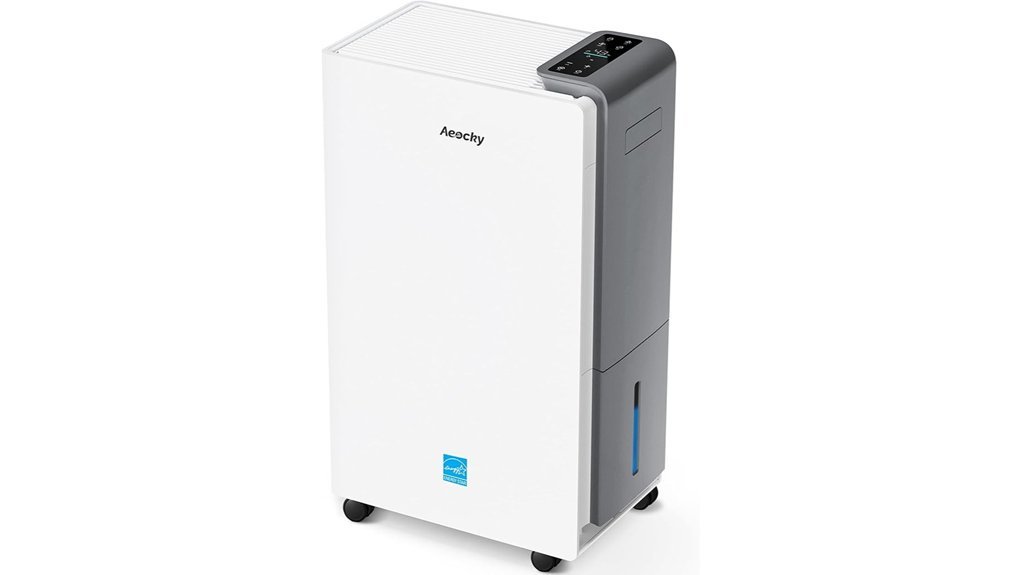
The AEOCKY RHEA-001 is a strong option for a larger hydroponic room that regularly experiences high humidity. Product materials advertise up to 80 pints per day under hot, very humid conditions and also show a lower standard-condition capacity. It includes a drain hose, adjustable humidistat, automatic defrost, and automatic operating modes.
The main advantage is its balance of capacity, continuous-drain support, automatic humidity control, and relatively compact footprint for its class. It is better suited to a demanding grow area than a small thermoelectric unit, but buyers should not size it from the 4,500-square-foot claim alone. Confirm the exact model label and current ENERGY STAR listing because capacity and certification details can vary by variant.
Why You’ll Like It
- Higher advertised moisture-removal capacity for larger humidity loads.
- Efficiency-focused design, with current certification details best checked against the exact model number.
- Drain-hose support for continuous operation.
- Automatic humidistat helps reduce unnecessary compressor runtime.
- Seller-listed noise is in the low-to-mid 40 dB range, depending on operating mode.
Best For: Larger grow rooms, heavily planted spaces, and buyers who expect the unit to operate for long periods.
Who Should Avoid It: Growers with a very small tent, a low moisture load, or insufficient floor space for a larger compressor unit.
Pros:
- High advertised extraction capacity.
- Continuous-drain capability reduces tank-emptying work.
- Automatic humidity control supports more consistent operation.
- Automatic cycling can reduce unnecessary runtime after the target humidity is reached.
Cons:
- The maximum pint figure is based on the seller’s stated high-temperature, high-humidity test condition.
- It may be unnecessarily large for a lightly planted room.
- Drain-hose routing still requires a suitable lower drain or a separate condensate pump.
Waykar 80 Pint Energy Star Home Dehumidifier
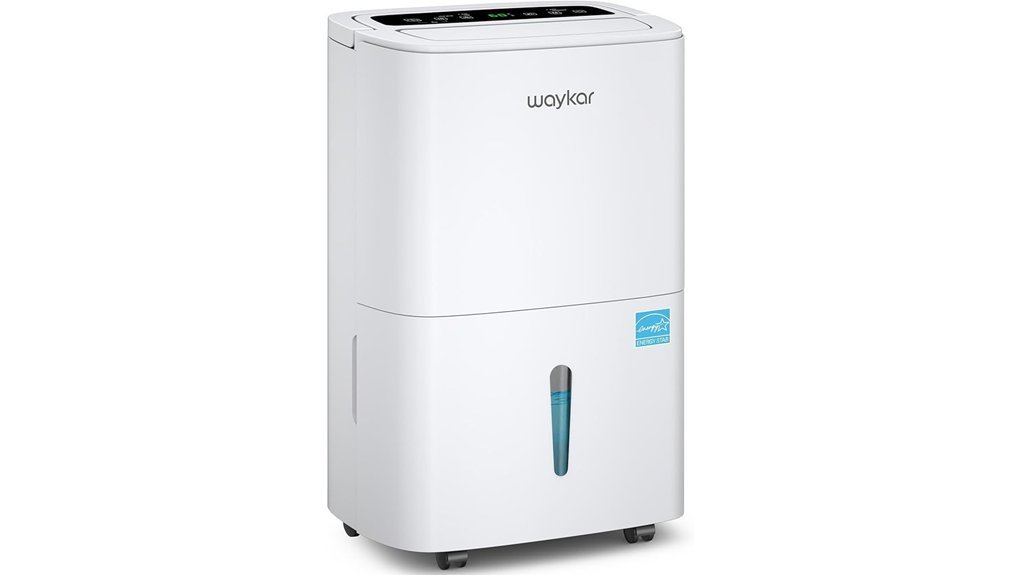
The Waykar 80 Pint Energy Star Home Dehumidifier is designed for buyers who need flexible humidity control across a larger indoor area. The selected product is advertised to remove up to 80 pints per day under hot, humid test conditions and includes a drain hose, auto defrost, self-drying, handles, and rolling casters.
For hydroponics, its most useful features are the adjustable humidistat, gravity-drain support, and portable design. The casters make it easier to reposition the unit when plant layouts or airflow patterns change. Treat the 5,000-square-foot and 80-pint figures as marketing or maximum-condition references, and verify the exact Amazon variant before ordering.
Why You’ll Like It
- Suitable for larger grow rooms and multi-zone indoor growing areas.
- Adjustable humidity control allows the target to be changed with crop stage.
- Drain-hose support is useful for unattended or overnight operation.
- Casters and handles simplify repositioning.
- Auto-defrost support can help when the room operates at cooler temperatures.
Best For: Growers managing larger rooms, multiple racks, or a moisture load that overwhelms a smaller 30- to 35-pint model.
Who Should Avoid It: Buyers with minimal floor space or a small grow tent that needs only occasional dehumidification.
Pros:
- High advertised maximum capacity.
- Portable design with casters and handles.
- Continuous drainage and automatic controls.
- Adjustable humidity controls for changing crop-stage needs.
Cons:
- May consume more power than necessary when oversized for the room.
- The internal bucket can fill quickly during severe humidity if a hose is not connected.
- The Amazon listing may present several capacity variants, so verify the selected option before ordering.
AEOCKY 50 Pint Dehumidifier with Drain Hose
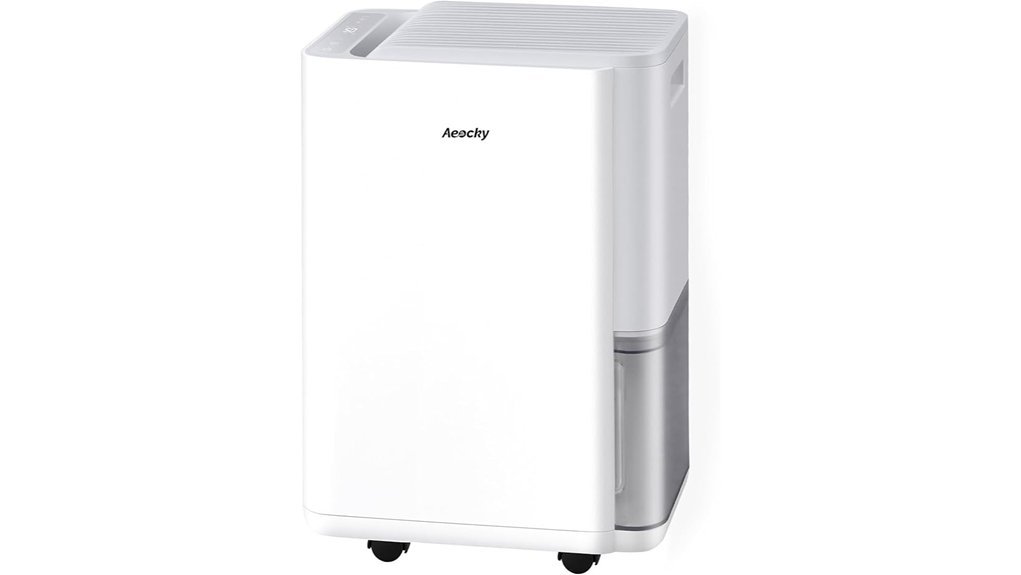
The AEOCKY ARION-001 offers a more compact alternative to the larger 80-pint models. The manufacturer advertises up to 50 pints per day at 95°F and 95% relative humidity, with a lower stated output under less extreme conditions. It includes a drain hose, a garden-hose adapter, adjustable humidity control, fan-speed control, a timer, and a child lock.
This model is attractive for smaller hydroponic rooms because its narrow body can fit beside shelving, reservoirs, or ventilation equipment. Coverage wording varies across listings, so size it from the exact model capacity, observed room humidity, and actual moisture load rather than a square-foot number.
Why You’ll Like It
- Compact body is easier to place in crowded equipment areas.
- Advertised 50-pint maximum provides more capacity than many entry-level models.
- Includes a drain hose and garden-hose adapter.
- Adjustable controls support changing crop and growth-stage needs.
- Automatic drainage can reduce daily maintenance.
Best For: Small to medium grow rooms that need compressor-level moisture removal without the body size of a larger unit.
Who Should Avoid It: Buyers with a very large, heavily planted room or anyone who cannot provide a continuously downward gravity-drain route.
Pros:
- Compact dimensions for restricted spaces.
- Useful drainage accessories are included.
- Multiple operating controls improve flexibility.
- Good middle-ground capacity between 34-pint and 80-pint options.
Cons:
- Coverage wording varies across seller and manufacturer materials.
- The half-gallon tank is relatively small if continuous drainage is not used.
- Maximum extraction depends on temperature and relative humidity.
KNKA 2500 Sq.Ft Dehumidifier with Drain Hose
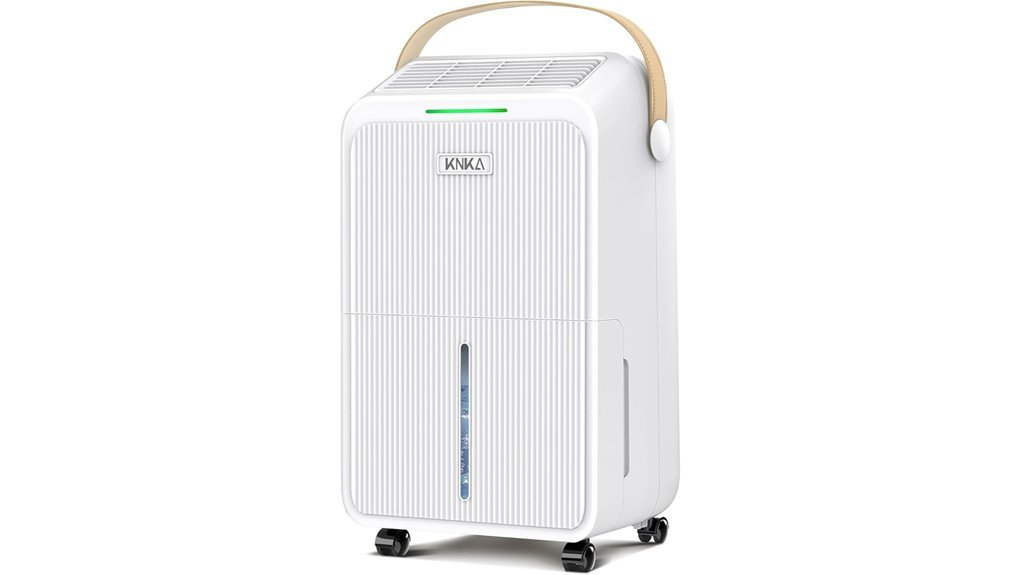
The KNKA dehumidifier is an appealing choice for a smaller hydroponic room or moderate humidity load. It is advertised to remove up to 34 pints of moisture per day, includes a 3-liter tank, and supports continuous drainage through a hose.
The seller and manual list an operating noise level of 37 dB, which may appeal to growers working near bedrooms, offices, or shared living areas. Its controls include adjustable humidity, operating modes, timer functions, a humidity display, auto defrost, and automatic shutoff. Actual sound will vary with fan speed and room acoustics. A 34-pint model may need to run for longer periods in a dense grow room, so monitor its ability to reach the desired target during the most humid part of the full light cycle.
Why You’ll Like It
- Lower advertised noise than the larger compressor models in this guide.
- Continuous drainage reduces the need to empty the tank.
- Digital humidity display helps with basic monitoring.
- Multiple modes and timer controls improve daily usability.
- Casters make it easier to adjust placement.
Best For: Smaller grow rooms, moderate plant loads, and buyers who place a high priority on quieter operation.
Who Should Avoid It: Growers with high-density mature plants, large open reservoirs, or repeated humidity spikes that require more capacity.
Pros:
- Advertised 34-pint moisture-removal capacity.
- Seller-stated 37 dB operation.
- Three-liter tank and continuous-drain support.
- Automatic humidity adjustment and timer controls.
Cons:
- May be undersized for a large or heavily planted grow room.
- The tank may require frequent emptying without a hose.
- Advertised noise can vary with fan speed, placement, and room acoustics.
Portable dehumidifiers are not designed to sit in standing water or receive nutrient splashes. Use a grounded outlet, keep the plug and cord dry, maintain the manufacturer’s airflow clearances, and follow the manual for extension-cord, drainage, and operating-temperature limits.
Factors to Consider When Choosing a Dehumidifier for Hydroponics
A hydroponic dehumidifier must handle the moisture produced by plants, reservoirs, irrigation, and temperature changes. Compare the following factors before relying on a manufacturer’s square-foot estimate.
1. Coverage Area and Moisture Load
Advertised coverage can help you compare broad product classes, but it does not measure the actual moisture generated by your hydroponic system. A small room filled with mature plants may require more dehumidification than a larger, lightly occupied basement.
Consider the number and size of plants, exposed water surfaces, irrigation frequency, room temperature, air-conditioning runtime, fresh-air exchange, and the highest humidity observed during both lights-on and lights-off periods. When possible, select a unit with enough reserve capacity that it does not need to run continuously under normal conditions.
2. Moisture-Removal Capacity
Pint-per-day capacity is one of the most useful comparison points, but only when the test conditions are understood. A seller may advertise the maximum amount collected at very high temperature and humidity, while a standardized rating may be lower.
Compare like-for-like ratings whenever possible. A 30- to 35-pint model may suit a small room with a moderate plant load, while a 50- to 80-pint option gives more reserve capacity for larger rooms, mature crops, open reservoirs, or frequent humidity spikes.
3. Energy Efficiency
A hydroponic dehumidifier may operate for many hours, making efficiency an important long-term consideration. ENERGY STAR certification provides a more useful efficiency signal than unsupported promises about fixed dollar savings.
Also compare wattage, expected runtime, humidistat accuracy, fan settings, and whether the compressor cycles off after reaching the target. An oversized unit can cost more upfront, while an undersized unit may run almost continuously. The best choice balances capacity with the actual moisture load.
4. Continuous Drainage
Continuous drainage is highly valuable in hydroponics because a small internal tank may fill during an overnight humidity spike. A gravity hose must maintain a continuous downward slope and end at a safe drain below the outlet.
Do not allow the hose to kink, rise above the drain port, or sit in standing water. When the available drain is higher than the dehumidifier, use a compatible condensate pump rather than expecting gravity to move water uphill.
5. Humidity and VPD Control
There is no single relative-humidity setting that is ideal for every hydroponic crop. The appropriate target changes with plant species, growth stage, temperature, airflow, and vapor-pressure deficit.
Use a separate temperature and humidity monitor near plant-canopy height. Avoid sustained condensation and follow crop-specific VPD guidance rather than relying only on the dehumidifier’s built-in sensor. The sensor measures air near the unit, which may differ from conditions inside a dense canopy.
6. Noise Level
Noise matters when the grow room is near a bedroom, office, nursery, or shared living area. Advertised decibel figures are useful for comparison, but actual sound can change with fan speed, floor vibration, wall distance, and room acoustics.
Place the unit on a stable, level surface and prevent the drain hose or housing from touching objects that can vibrate. Sleep or low-fan modes can reduce noise, although they may also reduce moisture-removal speed.
7. Airflow and Placement
A dehumidifier needs clear intake and exhaust airflow. Do not push it tightly against shelving, plant trays, walls, fabric tent sides, or stored supplies unless the manufacturer specifically allows that placement.
Use circulation fans to reduce damp pockets within the canopy, but avoid directing hot exhaust air continuously at sensitive plants. Keep the unit away from nutrient splashes, leaking fittings, wet floors, and any location where water could reach the electrical components.
8. Controls and Power-Restart Behavior
Timers, automatic restart, digital humidistats, and clear mode controls can simplify monitoring, especially in a separate grow room. The built-in sensor should still be checked against an independent hygrometer at canopy height.
Before buying, confirm the adjustable-humidity range, timer behavior, compressor restart delay, and whether the selected settings return automatically after a power interruption.
9. Portability and Design
Casters, handles, compact dimensions, and front-access filters make maintenance easier in a crowded growing area. Measure the available space and allow extra clearance for airflow, hose connections, filter removal, and tank access.
Remember that a portable unit still needs a level surface. Moving a dehumidifier while its tank contains water can cause spills, so empty the bucket and disconnect the hose before repositioning it.
10. Maintenance
Plant material, dust, and mineral residue can reduce performance. Clean the washable filter according to the manufacturer’s instructions, inspect the intake and exhaust, and check the drainage hose for algae, buildup, or kinks.
Clean spills promptly and inspect the reservoir, tubing, fittings, and floor around the unit. A dehumidifier should support good grow-room management, not compensate for an active plumbing leak or uncontrolled standing water.
- Record the highest and lowest humidity during a complete light cycle.
- Estimate whether the plant load will increase within the next few months.
- Confirm that a safe gravity drain or condensate-pump location is available.
- Measure the installation space and required airflow clearance.
- Check the standardized pint rating and test conditions on the current listing.
- Verify the exact model, warranty terms, and included drainage accessories.
Frequently Asked Questions
How Many Pints Do I Need for a Grow Room?
There is no dependable pints-per-square-foot formula for hydroponics. Start with the room’s highest measured humidity, plant density, exposed reservoir area, temperature, ventilation rate, and the amount of water added to the system. A smaller 30- to 35-pint model may suit a modest room, while a 50- to 80-pint maximum-condition model provides more reserve for mature plants and stronger humidity spikes. Compare ratings under similar test conditions.
How Do Dehumidifiers Help Hydroponic Plants?
Dehumidifiers remove water vapor released by plant transpiration, irrigation, and exposed reservoirs. Better humidity control can reduce condensation, help maintain a suitable VPD, and make the growing environment more consistent. The unit should be used with adequate airflow, ventilation, temperature control, and sanitation.
Can Dehumidifiers Prevent Mold in Hydroponic Systems?
A dehumidifier can reduce conditions that encourage mold and mildew, but it cannot guarantee prevention. Dense foliage, poor circulation, wet surfaces, leaks, contaminated plant material, and unsuitable temperatures can still create disease problems. Combine humidity control with circulation fans, clean equipment, plant spacing, and prompt removal of damaged leaves.
What Humidity Level Is Ideal for Hydroponics?
No single humidity percentage is ideal for every crop or growth stage. Seedlings, leafy greens, flowering plants, and fruiting crops can have different requirements. Use crop-specific temperature and VPD guidance, monitor conditions at canopy height, and avoid prolonged condensation or extremely high humidity.
Where Should I Place a Dehumidifier in a Grow Room?
Place it on a level, dry surface where the intake and exhaust remain unobstructed. Keep it away from reservoir splashes, leaking irrigation lines, and wet floors. Air should be able to circulate through the room without the unit’s warm exhaust blowing continuously onto one group of plants.
Is Continuous Drainage Worth Using?
Yes, especially when humidity rises at night or while you are away. A gravity hose must slope continuously downward to a safe drain. Use a condensate pump when the discharge point is higher than the dehumidifier or too far away for reliable gravity drainage.
How Often Should I Empty the Tank?
Empty it whenever the full-tank indicator appears and inspect it daily until you understand how quickly it fills in your room. A heavily planted space may fill a small tank in less than a day. Continuous drainage is usually more practical for regular hydroponic operation.
Does a Dehumidifier Replace Grow-Room Ventilation?
No. A dehumidifier removes moisture but does not replace fresh-air exchange, heat removal, carbon-dioxide management, or circulation within a dense canopy. Many successful rooms use dehumidification, air conditioning or ventilation, and circulation fans together.
Are Energy-Efficient Dehumidifiers Available?
Yes. ENERGY STAR certified models meet defined efficiency requirements. Actual energy cost still depends on the unit’s capacity, wattage, runtime, room temperature, humidity load, electricity rate, filter condition, and target setting.
Does Every Hydroponic Room Need a Dehumidifier?
No. A small system with effective ventilation and a low plant load may remain within its target humidity range without one. A dehumidifier becomes more useful when humidity remains above the crop target, condensation appears, ventilation cannot keep up, or lights-off humidity rises sharply.
Final Recommendation
Choose the AEOCKY RHEA-001 when you need the strongest overall combination of advertised maximum capacity, continuous drainage, and automatic humidity control.
Choose the Waykar 80 Pint for a larger growing area where portability, gravity drainage, and flexible controls are priorities.
Choose the AEOCKY ARION-001 when equipment space is limited but you still want more reserve capacity than a typical 30- to 35-pint model.
Choose the KNKA 34 Pint for a smaller grow room where quieter seller-rated operation and straightforward controls matter most.
The correct dehumidifier is the one that can maintain your crop-specific target during the room’s most humid period without constant tank emptying or nonstop operation. Measure conditions through a full lights-on and lights-off cycle, provide safe continuous drainage, maintain good canopy airflow, and confirm the exact Amazon model and capacity test conditions before making your final decision.