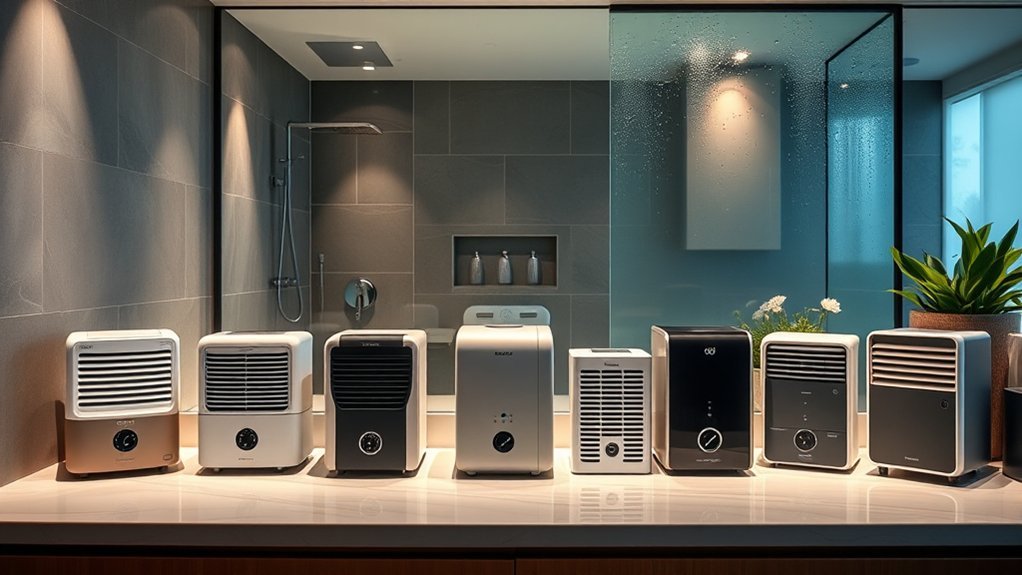
Portable commercial dehumidifiers can provide supplemental moisture removal in some small indoor pool rooms, spa areas, equipment-adjacent spaces, or temporary drying situations. However, they are not direct replacements for a purpose-built natatorium dehumidification and ventilation system. Indoor pool humidity loads depend on pool surface area, water temperature, room temperature, activity, covers, ventilation, outdoor air, and building construction—not square footage alone.
Important indoor-pool note: ASHRAE guidance generally places indoor pool relative humidity in the 50% to 60% range. A pool HVAC professional should calculate the evaporation and ventilation load, check condensation risk, and confirm that equipment and nearby materials are suitable for the corrosive pool atmosphere.
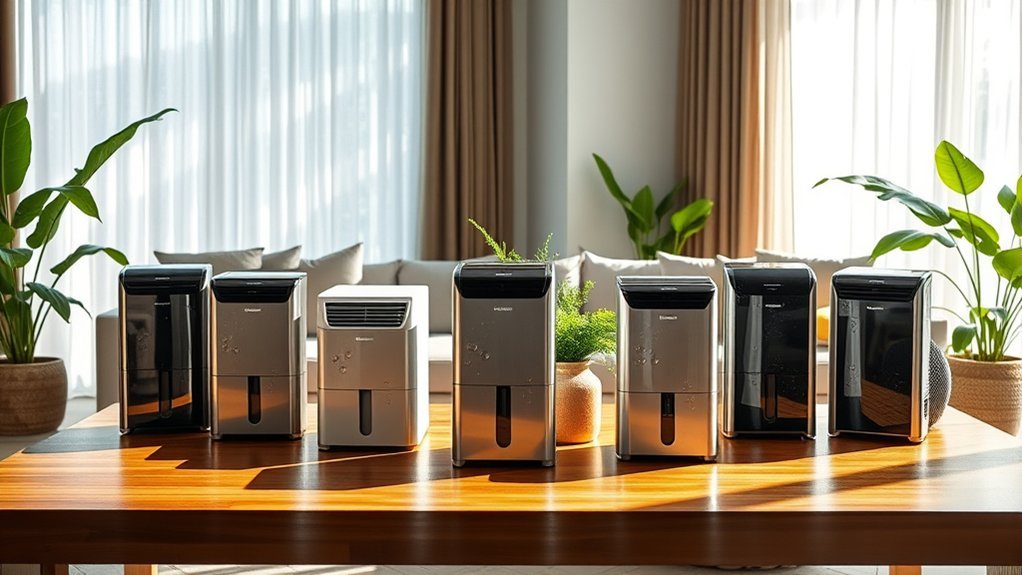
The three portable units below are best treated as supplemental, temporary, or backup options. Confirm electrical placement, drainage, operating temperature, corrosion limitations, and warranty terms before installation.
Quick Verdict
- Best overall portable option: Moiswell VP240 for strong airflow, pump drainage, and a balanced commercial design.
- Best for mobility and flexible drainage: Waykar 216 Pints Commercial Dehumidifier with large wheels, a removable handle, pump drainage, and gravity drainage.
- Best for temporary high-load drying: MOUNTO 310 Pints LGR Commercial Dehumidifier, especially for restoration-style drying or a short-term moisture spike.
Quick Comparison
| Product | Published Capacity | Airflow | Drainage | Best Use Here | Amazon |
|---|---|---|---|---|---|
| Moiswell VP240 | Up to 240 pints/day at hot, highly humid test conditions; lower at typical room conditions | 370 CFM | Built-in pump with 16-ft hose | Supplemental continuous moisture removal | Check Details |
| Waykar 216 Pints | Up to 216 pints/day at 95°F and 90% RH; lower at typical room conditions | 306 CFM | Pump and gravity drain | Portable supplemental control where drainage flexibility matters | Check Details |
| MOUNTO 310 Pints LGR | Up to 310 pints/day at saturation; 165 pints/day at AHAM conditions | Confirm current listing | Built-in pump with 15-ft lift | Temporary high-load drying and restoration-style use | Check Details |
Capacity note: Maximum pint ratings are not directly comparable unless the temperature and relative-humidity test conditions are the same. Use performance data near your expected room conditions and obtain a pool evaporation-load calculation before relying on any portable unit.
Moiswell VP240 Commercial Dehumidifier with Pump
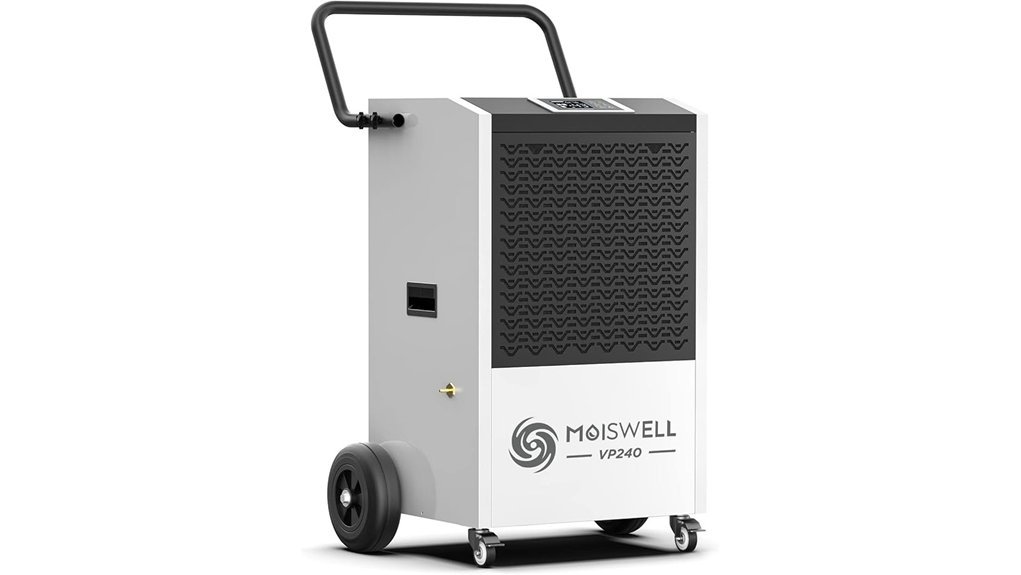
The Moiswell VP240 is the strongest all-around choice in this narrowed list for supplemental indoor-pool moisture control. The manufacturer lists a maximum removal rate of 240 pints per day in hot, highly humid conditions, along with 370 CFM airflow, a programmable humidistat, automatic restart, auto defrost, and a built-in pump with a 16-foot drain hose.
The important limitation is that the headline capacity is a maximum-condition rating. Published manual data shows substantially lower removal as temperature and humidity fall, so the VP240 should be selected from its condition-specific performance—not the 240-pint label or advertised square-foot coverage alone.
Best For: Small pool rooms, spa-adjacent spaces, or temporary moisture-control situations where a portable commercial unit can supplement an existing ventilation or HVAC strategy.
Why You’ll Like It:
- Strong airflow: The 370 CFM rating helps move moist air through the unit.
- Automatic drainage: The pump reduces the need for manual water handling when a suitable drain route is available.
- Commercial mobility: Wheels and a handle make repositioning easier than with a fixed pool HVAC system.
Who Should Avoid It: Buyers seeking a permanent whole-natatorium solution, integrated ventilation, heat recovery, corrosion-rated ductwork, or guaranteed control of a large active pool.
Pros:
- High maximum moisture-removal rating for a portable unit.
- Built-in pump, automatic humidity control, auto defrost, and restart memory.
- Manufacturer specifically lists indoor pools and spa areas among possible applications.
Cons:
- The 240-pint figure applies only under hot, extremely humid test conditions.
- Large and heavy compared with residential dehumidifiers.
- No evidence in the listing that it replaces an engineered pool dehumidification and ventilation system.
Waykar 216 Pints Commercial Dehumidifier
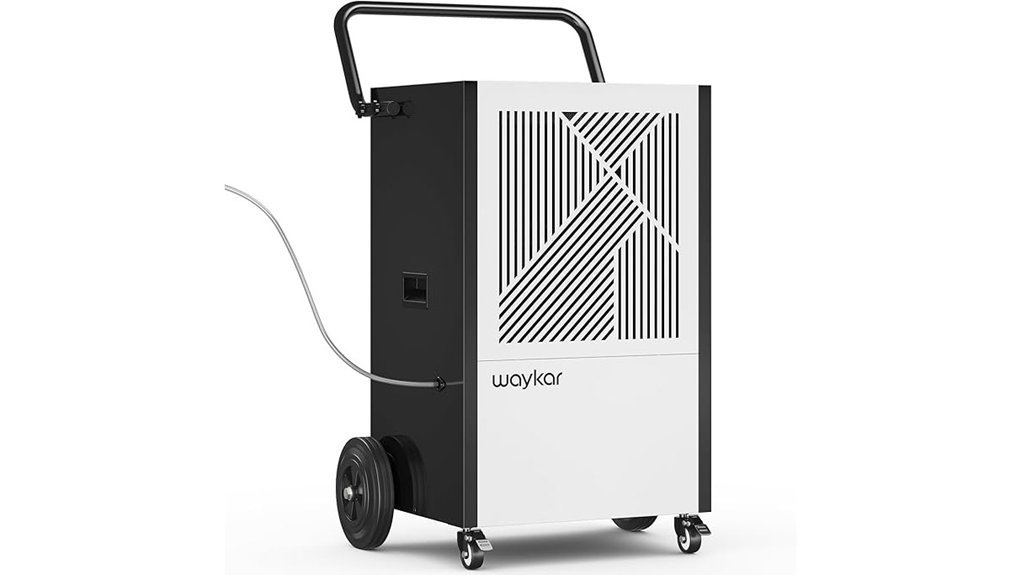
The Waykar 216 Pints Commercial Dehumidifier is a practical portable option when you need both pump drainage and gravity drainage. Waykar lists the 216-pint figure at 95°F and 90% relative humidity, with 306 CFM airflow, automatic defrost, a washable filter, large wheels, and a removable handle.
At more moderate conditions, output is lower: published manual data lists 115 pints per day at 80°F and 60% RH and 72 pints per day at 65°F and 60% RH. Those figures are more useful than the maximum label when comparing the unit with a real pool-room load.
Best For: Supplemental moisture control where the unit may need to be moved, where a floor drain is not directly beside the unit, or where both pump and gravity drainage are useful.
Why You’ll Like It:
- Flexible setup: Pump and gravity-drain options make placement easier.
- Mobile commercial frame: Large wheels and a removable handle support repositioning.
- Automatic operation: Humidistat control, restart memory, and auto defrost reduce routine intervention.
Who Should Avoid It: Anyone sizing from the advertised 8,500-square-foot coverage alone or expecting a freestanding unit to provide ventilation, negative pressure, air distribution, or heat recovery for a natatorium.
Pros:
- Useful combination of pump drainage and gravity drainage.
- Condition-specific performance data is available for better comparison.
- Heavy-duty wheels and handle improve portability.
Cons:
- The 216-pint rating is measured at extreme humidity and temperature.
- Published sound information should be checked before placing it near relaxation or viewing areas.
- Warranty coverage may require registration, so confirm current terms before purchase.
MOUNTO 310 Pints LGR Commercial Dehumidifier with Pump
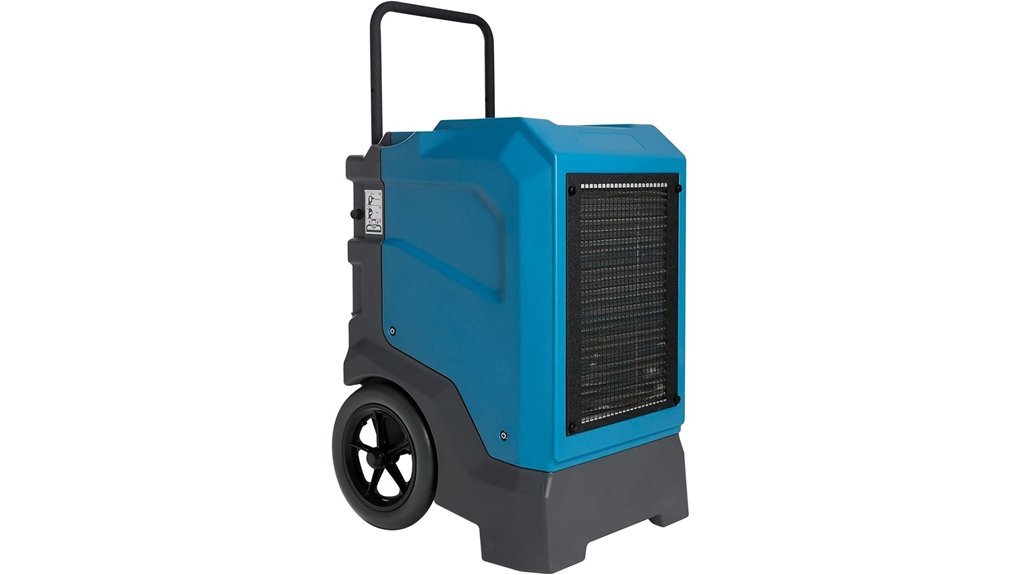
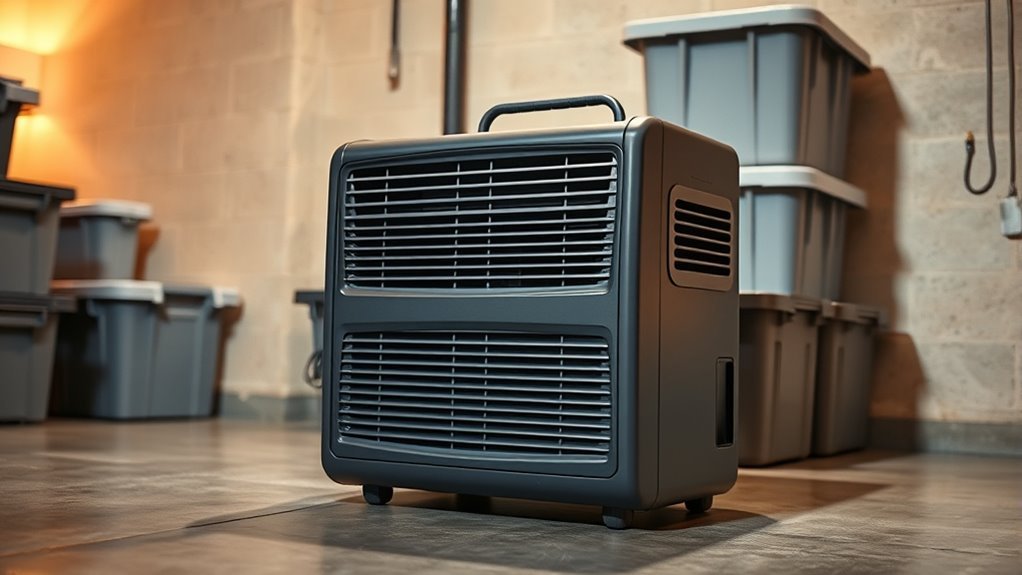
The MOUNTO 310 Pints LGR Commercial Dehumidifier is primarily a restoration-style machine. Its published specifications distinguish between up to 310 pints per day at saturation and 165 pints per day at AHAM conditions. That distinction makes it more transparent than presenting 310 pints as an everyday pool-room output.
A built-in condensate pump with a 15-foot lift, automatic humidistat control, real-time inlet and outlet readings, and restart memory make it useful for temporary drying after a moisture event or during a short-term humidity surge. It is less convincing as a permanent primary pool-room system because the product is designed around restoration and general commercial drying rather than integrated natatorium climate control.
Best For: Temporary drying, water-intrusion response, renovation work, or short-term supplemental use in a pool-adjacent space.
Why You’ll Like It:
- Clearer capacity comparison: Both saturation and AHAM ratings are published.
- Continuous drainage: The pump supports unattended water removal when installed correctly.
- Restoration controls: Inlet and outlet readings help track drying progress.
Who Should Avoid It: Buyers who need quiet operation, permanent architectural integration, pool-water heat recovery, or a corrosion-designed natatorium system.
Pros:
- High output under restoration conditions.
- Built-in pump and automatic restart support continuous operation.
- Published AHAM capacity gives a more realistic comparison point.
Cons:
- Heavy-duty restoration design may be bulky and noisy in a recreational pool area.
- Not presented as a purpose-built natatorium dehumidifier.
- Current stock and seller warranty terms should be confirmed before ordering.
Factors to Consider Before Using a Portable Dehumidifier Near an Indoor Pool
A portable dehumidifier should be selected only after you understand the pool room’s actual moisture load and the limitations of freestanding equipment. These are the most important checks.
1. Condition-Specific Moisture Removal
Do not compare products only by the largest pint number printed in the title. Manufacturers may publish maximum output at conditions such as 95°F and 90% RH, while actual removal at 80°F and 60% RH can be much lower. Ask for performance data near the temperature and humidity you expect to maintain.
2. Pool Evaporation Load
Indoor pool sizing depends on water-surface area, water temperature, room-air temperature, target relative humidity, swimmer activity, wet deck area, water features, pool covers, outdoor-air ventilation, and operating schedule. A square-foot coverage claim for a basement or warehouse does not calculate this load.
3. Humidity and Condensation Control
Indoor pool guidance commonly targets roughly 50% to 60% relative humidity, but the correct setpoint must also prevent condensation on windows, walls, roof assemblies, and other cold surfaces. Lowering humidity too far can increase pool-water evaporation and energy use, while allowing it to remain too high can increase condensation and building-damage risk.
4. Corrosion Resistance
Pool atmospheres can be hard on metal, coils, fasteners, electrical components, and nearby HVAC materials. Confirm whether the manufacturer permits long-term use in a chlorinated or saltwater-pool environment and what corrosion protection is provided. A general commercial or restoration rating is not the same as a natatorium corrosion specification.
5. Ventilation and Air Distribution
A portable dehumidifier recirculates local air; it does not automatically provide the outdoor-air ventilation, exhaust strategy, pressure control, or perimeter air distribution that a pool enclosure may need. Poor air distribution can leave condensation on windows or cold surfaces even when a nearby humidity sensor looks acceptable.
6. Drainage and Service Access
Continuous drainage is essential for high-moisture applications. Check pump-lift limits, hose routing, freeze or blockage risks, access for filter cleaning, and whether the unit can be serviced without entering a splash zone or obstructing pool circulation paths.
7. Electrical and Placement Safety
Keep equipment away from splashing and standing water, follow the manufacturer’s required clearances and electrical instructions, and have placement reviewed by a qualified electrician or pool-HVAC professional. Do not use extension cords unless the manual expressly allows them.
8. Noise and Operating Schedule
Commercial units can be much louder than residential machines. Check the model-specific sound rating, consider vibration isolation, and decide whether the unit can run during unoccupied hours without allowing humidity to rebound.
- Obtain or estimate the pool evaporation load.
- Compare pint ratings at the same test conditions.
- Confirm long-term suitability for the pool atmosphere.
- Plan continuous drainage and safe electrical placement.
- Check noise, operating temperature, filter access, warranty, and service support.
- Confirm whether the portable unit is supplemental, temporary, or part of a professionally designed system.
Frequently Asked Questions
Can a Portable Dehumidifier Replace a Pool HVAC System?
Usually not. A purpose-built indoor-pool system may need to control humidity, temperature, ventilation, air distribution, pressure, condensation, and sometimes heat recovery. A portable commercial unit can be useful as a supplement, backup, or temporary drying tool, but it should not be assumed to replace engineered natatorium equipment.
What Size Dehumidifier Do I Need for My Pool?
Size the system from the evaporation and ventilation load rather than using a simple pints-per-square-foot rule. Pool surface area, water and air temperatures, target humidity, activity, covers, water features, wet deck, outdoor air, and operating hours all affect the answer.
What Humidity Level Is Best for an Indoor Pool?
A common design range is about 50% to 60% relative humidity. The final target should also keep interior surfaces above the room dew point and avoid unnecessary evaporation, so local climate and building construction matter.
Why Do Pint Ratings Vary So Much?
Moisture-removal capacity rises as air becomes warmer and more humid. A model advertised at 216, 240, or 310 pints per day may produce far less under ordinary room conditions. Always compare ratings measured at the same temperature and relative humidity.
Are Portable Dehumidifiers Suitable for Saltwater or Chlorinated Pools?
Only when the manufacturer confirms the intended environment and corrosion limitations. Salt, chlorides, disinfectant by-products, and persistent condensation can shorten equipment life. For permanent use, ask specifically about coated coils, cabinet protection, service intervals, and warranty exclusions.
How Often Should I Maintain a Commercial Dehumidifier?
Follow the model’s manual. In a pool-adjacent environment, inspect the filter, drain hose, pump, coils, air inlets, and corrosion-prone surfaces frequently—often every few weeks at first—then adjust the schedule based on dust, operating hours, and actual conditions.
Final Recommendation
Choose the Moiswell VP240 when you need the best-balanced portable unit in this group for supplemental moisture removal and pump drainage. Choose the Waykar 216 Pints when mobility and dual drainage options matter most. Choose the MOUNTO 310 Pints LGR for temporary restoration-style drying or a short-term high-moisture event.
For a permanently enclosed pool, large active pool, water-feature-heavy room, or any space with ongoing condensation, use these products only after a pool-HVAC professional has completed a load calculation and confirmed that a portable unit is appropriate.
Reference: For broader design considerations, review the ASHRAE indoor swimming pool guidance.