
Choosing the best dehumidifier for a warehouse requires more than comparing the largest pint number or square-foot claim. Warehouse ceiling height, outdoor-air infiltration, loading-dock activity, room temperature, stored materials, drainage access, and the required humidity level all affect real-world performance.
For demanding moisture removal and restoration work, the MOUNTO 310 Pints Commercial Dehumidifier and Moiswell 260 Pints Commercial Dehumidifier offer the highest advertised maximum capacities in this list. The Moiswell 200 Pints and ALORAIR 180 PPD models provide a more balanced mix of commercial construction, portability, and pump drainage. Smaller crawl-space-style units such as the Airecoler GT-X5 and ALORAIR 120 PPD are better for enclosed warehouse zones than for an entire high-bay building.
Important capacity warning
Commercial dehumidifier titles often show a maximum or saturation rating measured in very hot, humid conditions. That number may be much higher than the unit’s standardized output at approximately 80°F and 60% RH. Compare AHAM or similarly measured capacities whenever possible, and do not size a warehouse from the headline PPD number alone.
Quick verdict
- Best Overall High-Capacity Pick: Moiswell 260 Pints Commercial Dehumidifier
- Best for Restoration Crews: MOUNTO 310 Pints Commercial Dehumidifier
- Best Balanced Commercial Pick: Moiswell 200 Pints Commercial Dehumidifier
- Best Compact Restoration Unit: ALORAIR 180 PPD Commercial Dehumidifier
- Best Ductable Option: Waykar 158 Pints Crawl Space Dehumidifier
- Best Compact Gravity-Drain Pick: Airecoler GT-X5
How these products were compared: Product fit was assessed using commercial-use design, advertised and standardized capacity where available, airflow, pump or gravity drainage, portability, defrost capability, maintenance access, and suitability for an open warehouse or an enclosed warehouse zone. Manufacturer coverage claims are included only as rough reference points, not guaranteed sizing results.
Quick Comparison of Warehouse Dehumidifiers
| Product | Advertised Maximum | Drainage | Best Use | Amazon |
|---|---|---|---|---|
| Moiswell 260 Pints | Up to 260 PPD | Built-in pump | Large humid warehouse zones | Check Details |
| MOUNTO 310 Pints | Up to 310 PPD | Built-in pump | Restoration and rapid drying | Check Details |
| Moiswell 200 Pints | Up to 200 PPD | Built-in pump | General commercial moisture control | Check Details |
| ALORAIR 180 PPD | 180 PPD saturation; about 85 PPD AHAM | Built-in pump | Compact restoration work | Check Details |
| Waykar 158 Pints | Up to 158 PPD at hot, humid conditions | Built-in pump | Ducted or segmented areas | Check Details |
| Yaufey 155 Pints | Up to 155 PPD | Built-in pump | Mobile warehouse moisture control | Check Details |
| Airzentti 155 Pints | Up to 155 PPD | Built-in pump | Large enclosed commercial areas | Check Details |
| EUHOMY 160 Pints | Up to 160 PPD maximum | Pump-assisted linked variant | Portable floor operation | Check Details |
| COSTWAY 163 Pints | 163 PPD at 95°F/90% RH | Tank or gravity hose | Areas with a nearby floor drain | Check Details |
| Airecoler GT-X5 | 125 PPD maximum; about 58 PPD at 80°F/60% RH | Gravity hose; no pump | Small enclosed warehouse zones | Check Details |
| ALORAIR 120 PPD | 120 PPD saturation; about 55 PPD AHAM | Built-in pump | Low-clearance storage and utility zones | Check Details |
Moiswell 260 Pints Commercial Dehumidifier with Pump
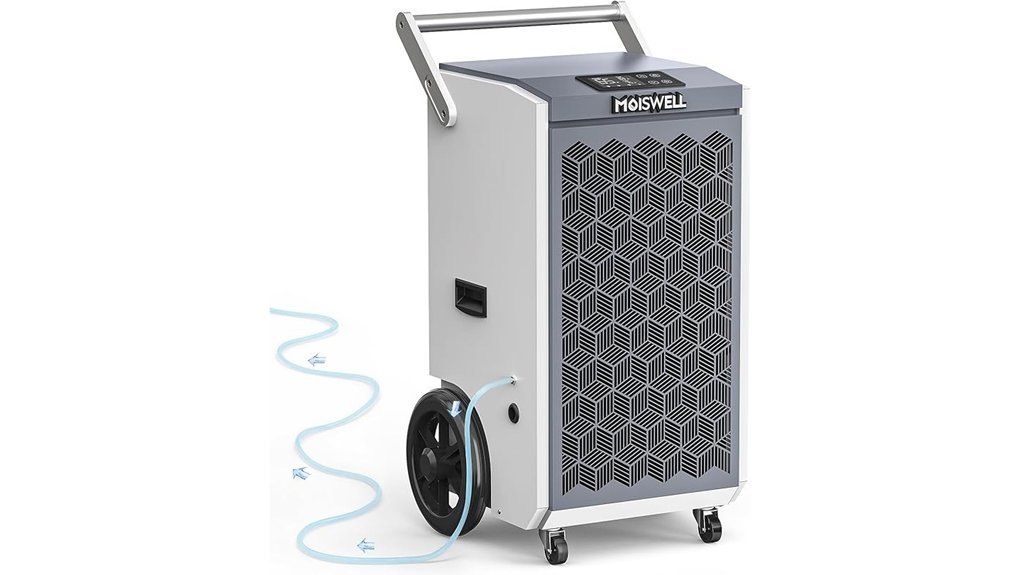
The Moiswell 260 Pints Commercial Dehumidifier is the strongest all-around option here for a large, persistently humid warehouse zone. Its manufacturer-listed maximum extraction is up to 260 pints per day, and the built-in condensate pump can move collected water to a suitable drain without relying on a continuously downward-sloping gravity hose.
The large wheels and handles are useful when the machine must move between storage areas, production zones, or restoration locations. Adjustable humidity control, automatic defrost, continuous operation, and automatic restart can also reduce routine intervention.
Best For: Large enclosed warehouse zones, workshops, basements, and commercial areas with high moisture loads and limited gravity-drain access.
Why You’ll Like It: It combines high advertised extraction, pump drainage, portable commercial construction, and straightforward humidity controls.
Who Should Avoid It: Buyers with a small storage room, limited electrical capacity, or no practical route for the pump hose may be better served by a smaller unit.
Pros:
- High advertised maximum moisture-removal capacity.
- Built-in pump supports more flexible condensate routing.
- Large wheels and handles improve job-site mobility.
Cons:
- The maximum PPD figure should not be compared directly with standardized AHAM ratings.
- A heavy commercial unit may require two people for stairs or loading.
- Warehouse-wide sizing may require multiple units or professional load calculations.
MOUNTO 310 Pints Commercial Dehumidifier with Pump
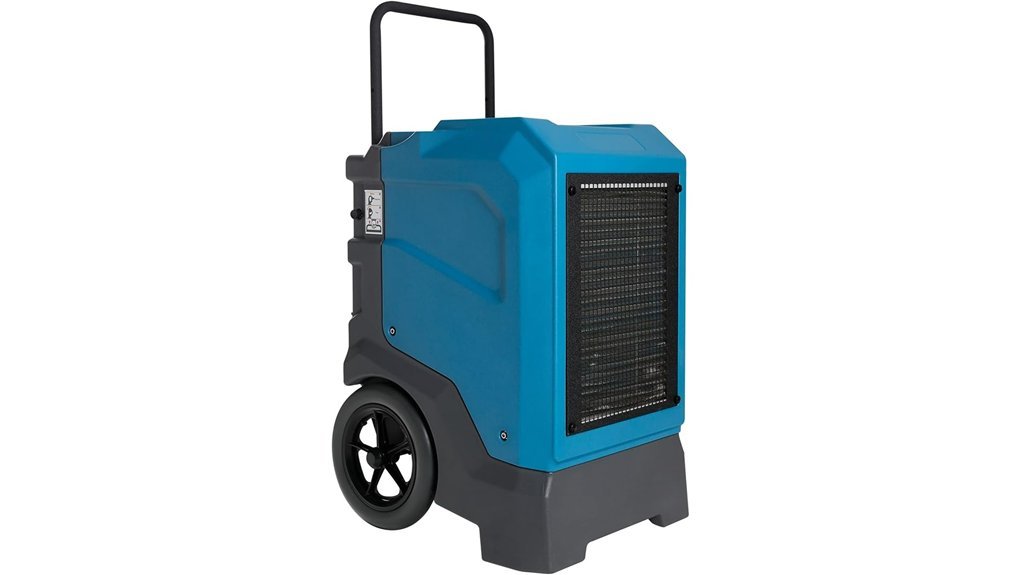
The MOUNTO 310 Pints Commercial Dehumidifier targets water-damage restoration, construction drying, carpet cleaning, and other high-moisture commercial jobs. Its headline capacity is an advertised maximum, so it should be evaluated alongside its airflow, operating-temperature range, power draw, and output under realistic warehouse conditions.
A built-in pump, digital humidity monitoring, large wheels, and a heavy-duty cabinet make it more suitable for demanding commercial work than a residential portable dehumidifier. Its size and weight are trade-offs for that construction.
Best For: Restoration companies, construction teams, flood cleanup, and rapid drying in a controlled warehouse section.
Why You’ll Like It: It is designed around mobility, continuous condensate removal, and demanding commercial drying rather than bedroom-style operation.
Who Should Avoid It: It is excessive for mild seasonal humidity or a small stockroom and may require more electrical and storage planning than a compact model.
Pros:
- Very high advertised maximum extraction.
- Built-in pump supports continuous drainage.
- Commercial wheels and digital controls suit restoration work.
Cons:
- Heavy construction reduces one-person portability.
- High-output operation may increase electrical demand.
- Not a substitute for correcting leaks or standing-water entry.
Moiswell 200 Pints Commercial Dehumidifier with Pump
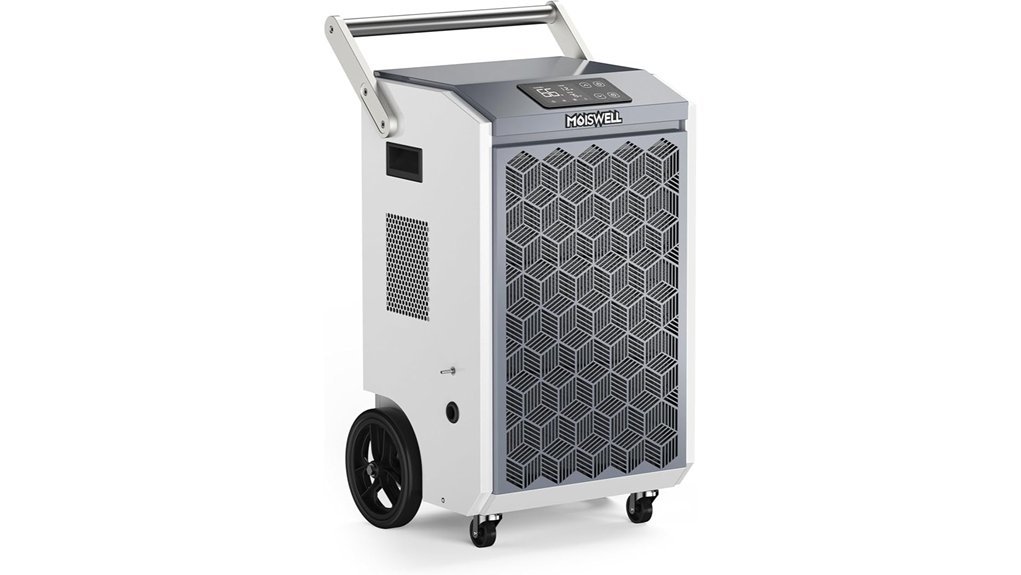
The Moiswell 200 Pints Commercial Dehumidifier is a practical middle ground between compact crawl-space units and the heaviest restoration machines. Its built-in pump can simplify continuous drainage, while large wheels and detachable handles make it easier to reposition across a warehouse floor.
The control panel allows the operator to select a humidity target instead of running continuously without feedback. This is useful for routine inventory protection, although actual capacity still depends heavily on temperature and incoming moisture.
Best For: Medium-to-large warehouse sections that need pump drainage, mobility, and more extraction than a compact commercial unit.
Why You’ll Like It: It offers a strong mix of capacity, pump drainage, transport features, and uncomplicated controls.
Who Should Avoid It: A buyer who needs duct connections, remote sensing, or a documented standardized capacity should confirm those details before ordering.
Pros:
- High advertised maximum output for commercial moisture control.
- Automatic pump drainage reduces manual water handling.
- Wheels and handles support movement between work areas.
Cons:
- Its maximum rating is not necessarily its everyday warehouse output.
- The unit may be difficult to carry on stairs.
- Power consumption should be checked against the available circuit.
ALORAIR 180 PPD Commercial Dehumidifier with Pump
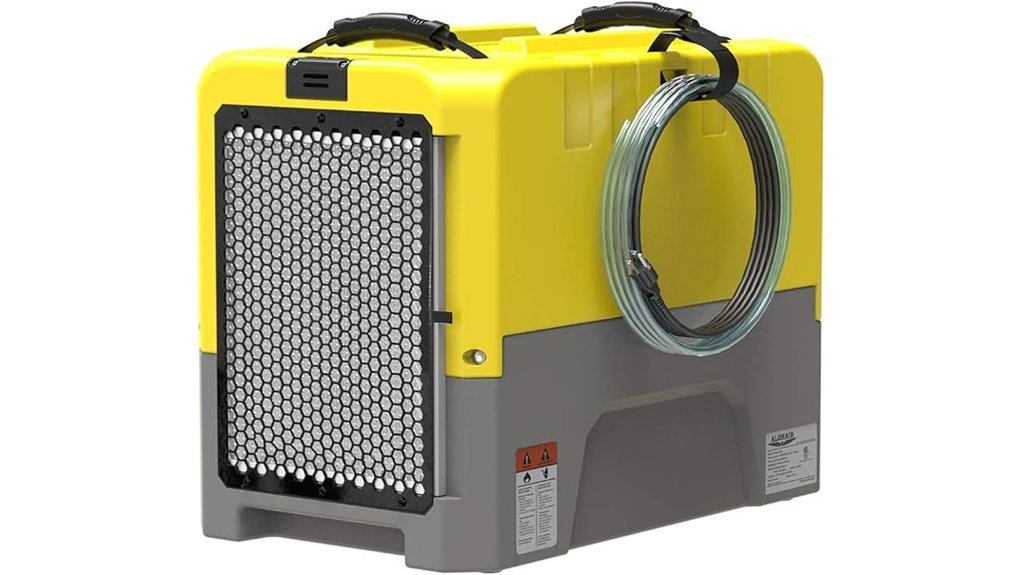
The ALORAIR 180 PPD Commercial Dehumidifier provides one of the clearest capacity comparisons in this roundup: the 180-pint figure is a saturation rating, while output under AHAM conditions is approximately 85 pints per day. That standardized figure gives buyers a more realistic basis for comparing it with other machines.
Its compact commercial format, approximately 210 CFM airflow, automatic pump drainage, auto restart, and defrost function make it useful for restoration jobs, basements, storage areas, and defined warehouse zones. It is not intended to control an unlimited open warehouse based only on its advertised coverage.
Best For: Restoration crews and warehouse operators who need a compact pump-equipped machine with a disclosed AHAM rating.
Why You’ll Like It: The compact footprint is easier to place than a tall floor unit, while the pump supports unattended drainage.
Who Should Avoid It: Very large or highly infiltrated warehouses may require several units or a permanently installed industrial system.
Pros:
- Standardized AHAM capacity is available for a fairer comparison.
- Built-in pump supports continuous condensate removal.
- Compact commercial body suits confined work areas.
Cons:
- Its 180-pint saturation number can be misleading without the AHAM figure.
- It remains heavy enough to require care during transport.
- Warranty terms should be verified for the exact seller and model.
Waykar 158 Pints Crawl Space Dehumidifier with Pump
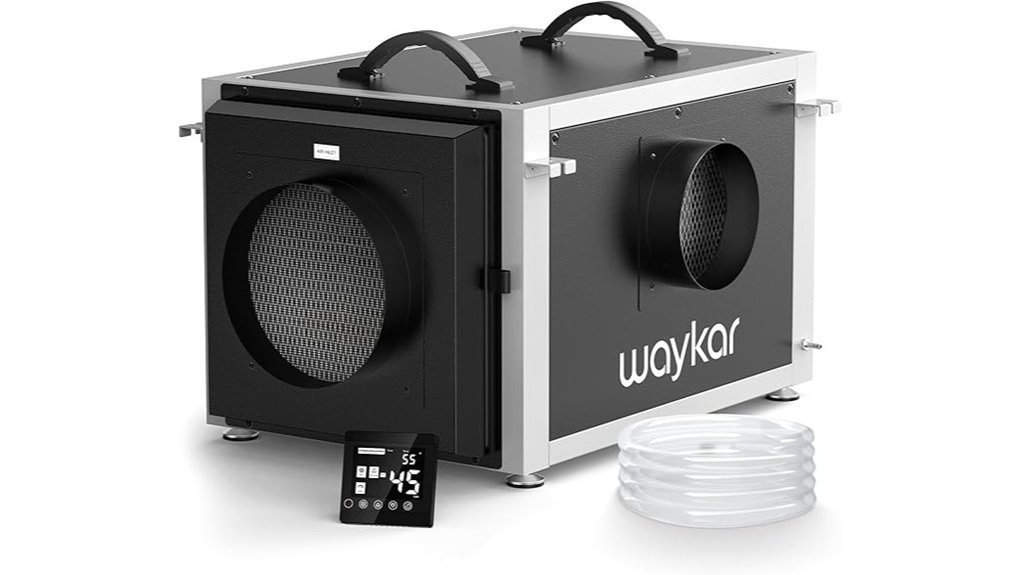
The Waykar 158 Pints Crawl Space Dehumidifier is useful when moisture control needs to reach a defined storage area through ducting rather than relying only on open-air placement. Its dual-duct arrangement, built-in pump, remote control, automatic restart, and defrost functions can support more flexible installation.
The 158-pint figure is measured under hot, humid conditions and should be treated as a maximum rather than an everyday warehouse rating. The large advertised coverage also assumes favorable conditions and does not account for high ceilings or frequently opened loading doors.
Best For: Segmented warehouse areas, low-clearance spaces, remote utility rooms, and installations that benefit from supply or return ducting.
Why You’ll Like It: Duct compatibility can improve air distribution and allow the machine to operate outside the protected zone.
Who Should Avoid It: Buyers who need a simple roll-around restoration unit may not benefit from the extra ducting and installation complexity.
Pros:
- Dual-duct design supports flexible air distribution.
- Built-in pump simplifies elevated or distant drainage.
- Remote controls can reduce visits to a difficult installation area.
Cons:
- The headline capacity is based on hot, humid test conditions.
- Ducting adds installation work and airflow resistance.
- It may be unnecessarily complex for a small open stockroom.
Yaufey 155 Pints Commercial Dehumidifier with Pump
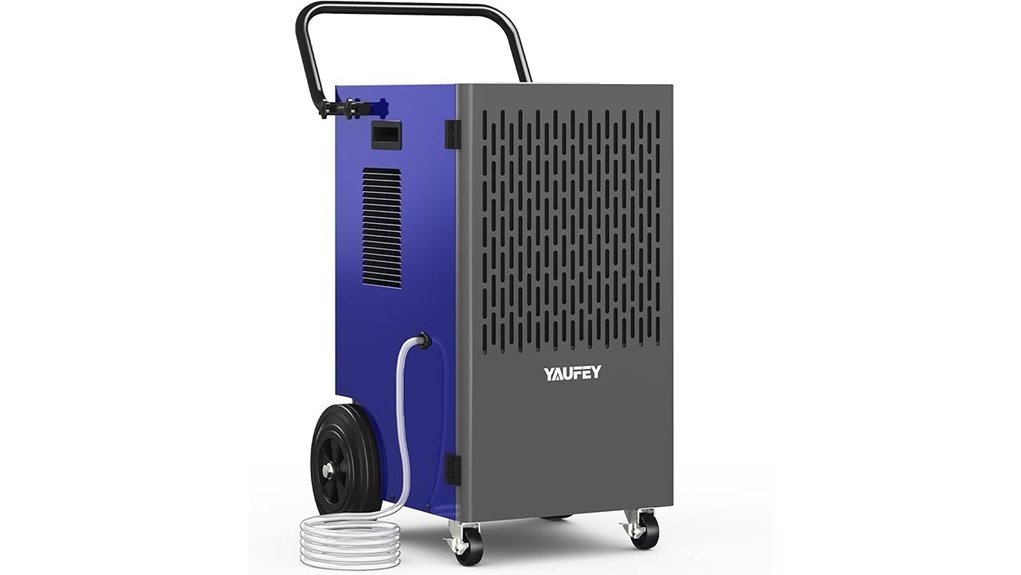
The Yaufey 155 Pints Commercial Dehumidifier combines a built-in pump with wheels, adjustable humidity control, automatic defrost, a timer, and removable filters. This makes it a convenient choice when the machine must move between multiple enclosed warehouse sections.
The linked listing presents the unit as suitable for commercial and industrial use and includes both pump and gravity-drain accessories. Its 155-pint rating and 8,000-square-foot claim should still be treated as manufacturer figures rather than guaranteed warehouse performance.
Best For: Businesses that want a mobile floor unit with pump drainage and simple digital controls.
Why You’ll Like It: The included drainage choices make it easier to adapt the unit to temporary or permanent placement.
Who Should Avoid It: Buyers requiring a published AHAM capacity, duct connections, or building-management integration should verify those specifications first.
Pros:
- Built-in pump and gravity-drain accessories provide flexibility.
- Wheels improve movement across a level warehouse floor.
- Washable filters and automatic functions simplify routine use.
Cons:
- Standardized moisture-removal capacity is not clearly stated.
- Large coverage claims do not account for warehouse ceiling height.
- Operational noise may be noticeable near offices or workstations.
Airzentti 155 Pints Commercial Dehumidifier with Pump and Hose
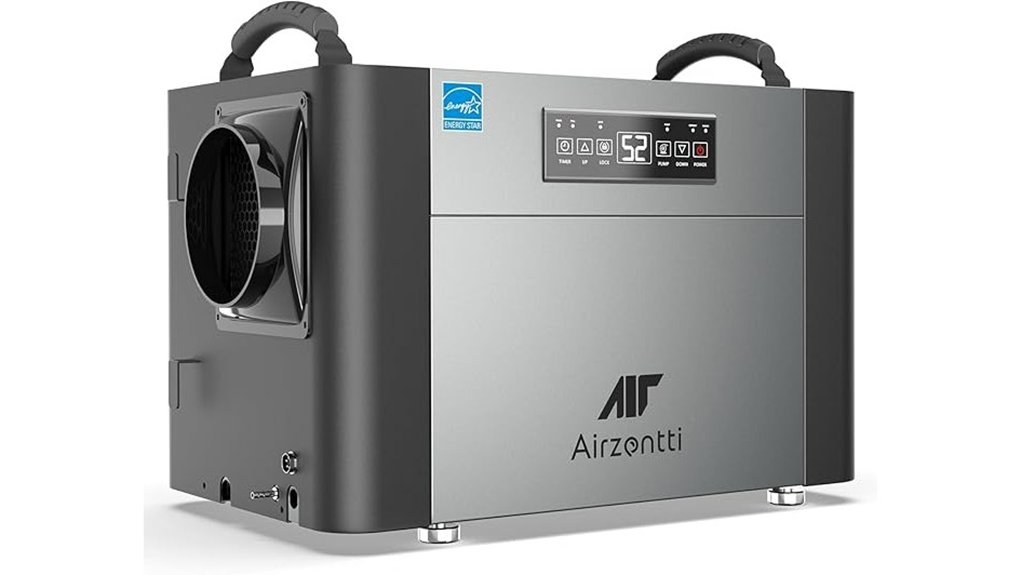
The Airzentti 155 Pints Commercial Dehumidifier is designed for basement, crawl-space, garage, industrial, and water-damage applications. Its built-in pump is the main warehouse benefit because it can discharge condensate when a suitable drain is not directly below the machine.
The listing also describes adjustable humidity settings, automatic defrost, multiple operating modes, and a compact commercial form. The exact model number should be checked against any claimed ENERGY STAR certification before energy savings are used in a purchase decision.
Best For: Enclosed commercial storage areas that need automatic pump drainage and basic humidity controls.
Why You’ll Like It: The pump and automatic functions support less hands-on operation than a tank-only unit.
Who Should Avoid It: Buyers who cannot confirm the exact standardized capacity, certification record, or service support should compare the listing carefully before ordering.
Pros:
- Built-in pump supports flexible drain placement.
- Adjustable humidity control helps avoid needless continuous running.
- Commercial-use listing covers several damp-space applications.
Cons:
- The headline PPD and coverage figures are not enough for warehouse sizing.
- Exact certification should be verified by model number.
- Service and replacement-part availability should be checked before purchase.
EUHOMY 160 Pints Commercial Dehumidifier with Pump
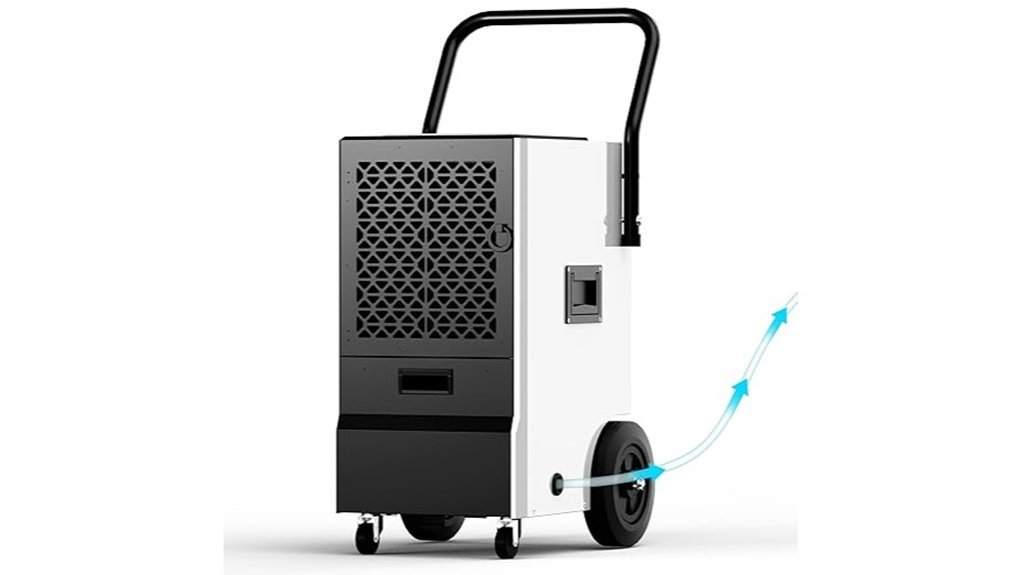
The linked EUHOMY 160 Pints Commercial Dehumidifier is presented as the pump-equipped version of the DH-01 platform. It offers adjustable humidity control, continuous operation, automatic defrost, a timer, wheels, a transport handle, and a washable filter.
Its 160-pint headline output is a maximum rating measured under hot, humid conditions. Buyers should confirm that the Amazon selection specifically says “with pump,” because similar EUHOMY variants may use only a tank and gravity-drain hose.
Best For: Portable commercial operation in workshops, warehouse sections, construction areas, and flood-repair projects.
Why You’ll Like It: The upright design, wheels, controls, and pump-equipped variant make it approachable for operators who do not need ducting.
Who Should Avoid It: It is not the best choice for tight crawl spaces, overhead suspension, or applications that require a documented building-level performance calculation.
Pros:
- Portable upright design with wheels and a handle.
- Automatic defrost and memory functions support unattended use.
- Pump-equipped linked variant reduces tank-emptying work.
Cons:
- Variant names and drainage descriptions should be checked carefully.
- The maximum rating is higher than output under normal conditions.
- The filter may require frequent cleaning in a dusty warehouse.
COSTWAY 163 Pints Commercial Dehumidifier
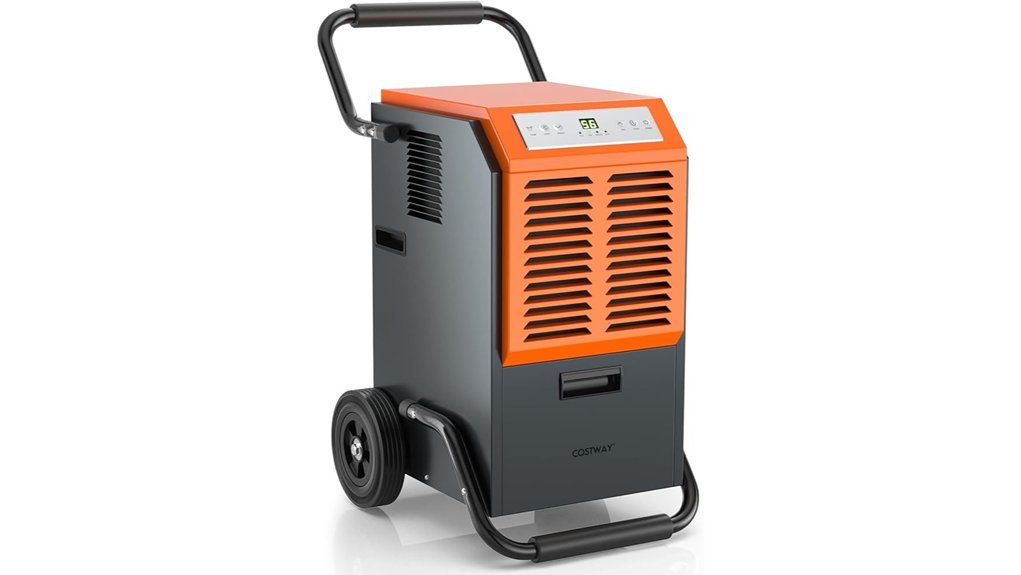
The COSTWAY 163 Pints Commercial Dehumidifier is a mobile upright option for warehouses, construction areas, workshops, and water-damage cleanup. Its manufacturer information lists 163 pints per day at 95°F and 90% RH, 128 pints at 86°F and 80% RH, and substantially less extraction in cooler, drier conditions.
This model uses a tank or continuous gravity hose rather than depending on a built-in pump. The drain hose must run continuously downhill to a suitable drain. Its wheels, handles, adjustable humidistat, timer, defrost function, and removable filter improve day-to-day usability.
Best For: A level warehouse area with a nearby floor drain and no need to pump condensate upward.
Why You’ll Like It: The listing provides capacity figures at several conditions, making the drop in cooler environments easier to understand.
Who Should Avoid It: Locations where water must travel uphill or across a flat floor should choose a verified pump-equipped model.
Pros:
- Commercial upright design with wheels and handles.
- Continuous gravity drainage avoids routine tank emptying.
- Multiple published test-condition outputs improve transparency.
Cons:
- No built-in pump on the verified gravity-drain configuration.
- Extraction falls substantially in cooler and less humid conditions.
- Nameplate electrical requirements need careful confirmation.
Airecoler GT-X5 125 Pints Commercial Dehumidifier
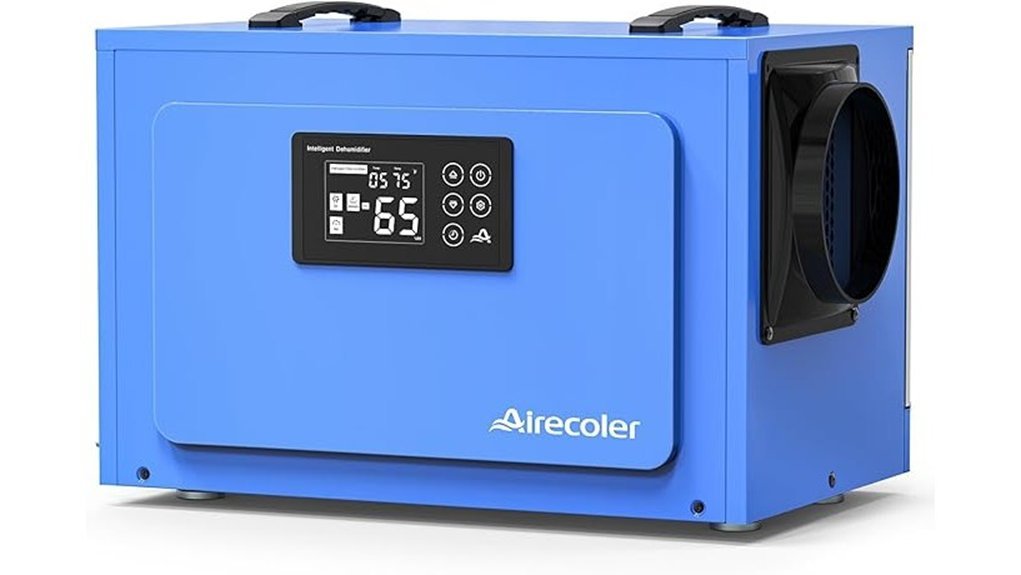
The Airecoler GT-X5 is a compact commercial crawl-space dehumidifier that can also serve a small, enclosed warehouse storage room or equipment zone. Its maximum rating is 125 pints per day, but the manufacturer lists approximately 58 pints per day at 80°F and 60% RH. That lower figure is the more useful comparison for many normal indoor conditions.
The unit provides approximately 265 CFM airflow, a washable filter, automatic restart, automatic defrost, a timer, and continuous gravity drainage. The linked GT-X5 is the version without a built-in pump.
Best For: Small enclosed stockrooms, utility areas, low-clearance zones, and locations with a nearby lower drain.
Why You’ll Like It: Its compact horizontal shape can fit where a tall restoration unit cannot.
Who Should Avoid It: It should not be selected as the only dehumidifier for a large high-bay warehouse based on the 6,000-square-foot marketing claim.
Pros:
- Compact design fits low-clearance or confined areas.
- Standard-condition output is disclosed for better comparison.
- Washable filter and gravity hose simplify basic maintenance.
Cons:
- The linked model does not include a condensate pump.
- Actual standardized capacity is far below the 125-pint maximum.
- Gravity drainage requires a continuously downward hose route.
ALORAIR 120 PPD Commercial Dehumidifier with Pump
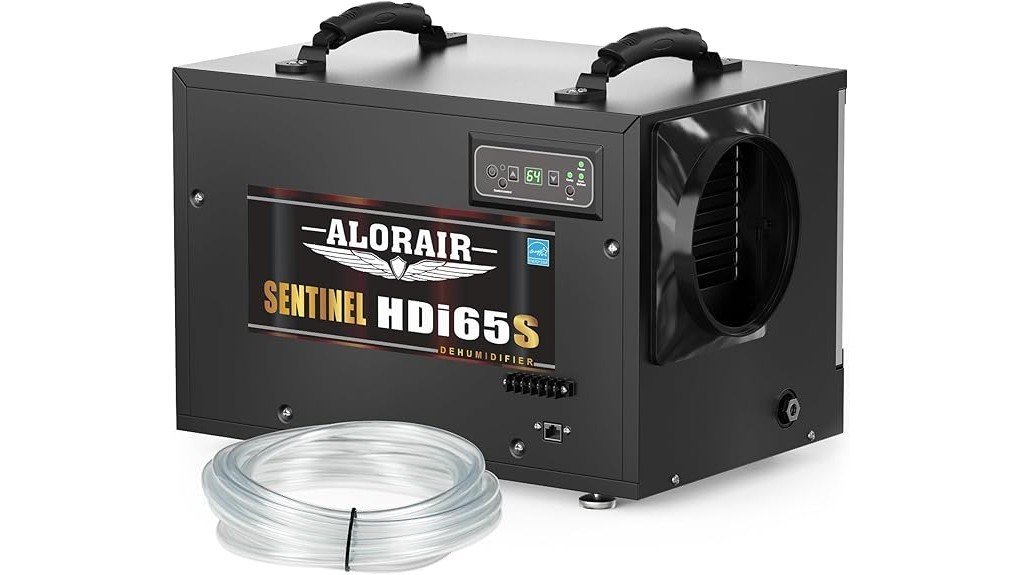
The ALORAIR 120 PPD Commercial Dehumidifier is another compact option whose headline number requires context. It removes approximately 55 pints per day under AHAM conditions and up to 120 pints at saturation. Its pump, compact metal enclosure, automatic defrost, and restart function make it useful in an enclosed storage or utility area.
This unit is better viewed as a targeted-zone machine than a whole-warehouse solution. Its compact size can be an advantage under shelving, in a mezzanine utility area, or near a moisture-prone wall where a large upright unit would obstruct operations.
Best For: Small sealed storage areas, utility rooms, low-clearance zones, and locations that require pump drainage.
Why You’ll Like It: It pairs a compact body with automatic condensate pumping and a disclosed standardized capacity.
Who Should Avoid It: Large open warehouses, active loading bays, or high-moisture restoration jobs need considerably more total capacity.
Pros:
- Compact commercial enclosure fits restricted spaces.
- Built-in pump offers more drainage flexibility than gravity-only models.
- AHAM output is available for realistic comparison.
Cons:
- Only about 55 PPD under AHAM conditions.
- Limited as a stand-alone solution for large warehouse volumes.
- Installation must preserve intake and discharge airflow clearance.
Factors to Consider When Choosing a Warehouse Dehumidifier

A warehouse dehumidifier should be selected as part of a complete moisture-control plan. The machine must match the building volume, moisture entering the space, operating temperature, drainage route, electrical supply, and sensitivity of the stored inventory.
1. Compare Standardized and Maximum Capacity
Start by identifying the conditions used for each pint-per-day rating. A saturation or maximum figure measured near 90–95°F and 90% RH can be far higher than output at 80°F and 60% RH. Compare AHAM ratings, integrated energy factor, and performance at your expected temperature whenever those figures are available.
2. Size by Volume and Moisture Load
Calculate the warehouse’s cubic volume by multiplying length, width, and average ceiling height. Then consider outside-air leakage, open dock doors, ventilation, wet products, concrete moisture, cleaning processes, and the desired reduction time. Square footage alone cannot account for these loads.
Professional sizing is especially important when:
- The warehouse contains corrosion-sensitive, paper, textile, food, pharmaceutical, or electronic inventory.
- Ceilings are high or loading doors remain open frequently.
- The space is cold, unconditioned, or affected by seasonal condensation.
- The goal is structural drying after a leak or flood.
- A humidity failure could cause expensive inventory loss.
3. Choose an Appropriate Humidity Target
For general moisture and mold control, keeping indoor relative humidity below 60% is a common starting point, with approximately 30% to 50% often preferred where practical. However, the correct target depends on the stored material. Wood, paper, food, chemicals, electronics, and metal components may each require different limits.
4. Check Airflow and Distribution
Capacity does not help if dry air cannot circulate through shelving and stacked inventory. Compare CFM, intake and discharge direction, duct compatibility, and required clearance. Long aisles, partitions, shelving, and separate rooms may require ducting, circulation fans, or several smaller dehumidifiers instead of one machine.
5. Choose Pump or Gravity Drainage
A gravity hose is simple and reliable, but it must slope downward from the machine to the drain. A built-in pump is useful when condensate must travel upward to a sink, through a window, or across an area without a nearby floor drain. Confirm the maximum pump lift, total hose length, and required maintenance.
6. Consider Temperature and Defrost Performance
Refrigerant dehumidifiers remove less water as temperature and humidity fall. In cool warehouses, frost can form on the evaporator. Check the rated operating-temperature range and automatic-defrost system. A desiccant dehumidifier or engineered industrial system may be more suitable for very cold conditions.
7. Verify Energy Efficiency by Exact Model
Do not rely on an ENERGY STAR logo shown in a generic listing image. Match the exact model number with the current ENERGY STAR Product Finder. Compare integrated energy factor, standardized capacity, rated wattage, and expected operating hours. A correctly sized efficient unit may cost less to operate than an undersized machine that runs continuously.
8. Verify Electrical Requirements
Check the physical rating label for voltage, frequency, amperage, plug type, and required circuit. Avoid undersized extension cords and do not assume every commercial dehumidifier can share a circuit with other warehouse equipment. Ask a licensed electrician to evaluate the installation when required.
9. Review Portability and Physical Protection
For temporary drying, look for large wheels, balanced handles, cord storage, and a cabinet that can tolerate job-site handling. For permanent installation, prioritize secure mounting, service clearance, drain access, vibration control, and protection from forklifts or inventory movement.
10. Plan for Maintenance and Support
Warehouse dust can clog filters and coils quickly. Inspect the filter frequently, keep the intake and discharge clear, flush or inspect the drain system, and check the pump reservoir if fitted. Before buying, confirm replacement filters, pump parts, technical support, service locations, and the written commercial-use warranty.
11. Know When Multiple Units Are Better
Several smaller units can provide better distribution, redundancy, and zone control than one oversized machine. Multiple units are especially useful when the warehouse has separate rooms, long aisles, temperature differences, or moisture entering from more than one location.
Moisture-source warning
A dehumidifier cannot repair roof leaks, plumbing failures, groundwater entry, damaged vapor barriers, or wet insulation. Correct the source of water first and dry wet materials promptly. Persistent mold, structural dampness, or major water damage may require professional assessment and remediation.
Before You Buy: Warehouse Checklist
- Measure the warehouse’s cubic volume, not only square footage.
- Record temperature and RH at several locations for at least a few days.
- Identify moisture sources and how often dock doors open.
- Compare standardized capacity rather than headline maximum PPD alone.
- Confirm whether the selected variation includes a pump.
- Plan the complete drain-hose route and maximum lift.
- Verify voltage, amperage, circuit, plug, and nameplate information.
- Check filter access, replacement parts, and commercial warranty terms.
- Decide whether one unit, several units, or a ducted system is appropriate.
Frequently Asked Questions
How Do I Size a Dehumidifier for a Warehouse?
Measure the warehouse’s cubic volume and evaluate current RH, target RH, temperature, outside-air infiltration, dock-door activity, internal moisture sources, and the required drying time. Manufacturer square-foot claims are only rough references. A mechanical contractor or industrial drying specialist should perform a load calculation for valuable inventory or large buildings.
Can One Portable Dehumidifier Handle an Entire Warehouse?
Sometimes, but not usually in a large, high-bay, or frequently opened warehouse. One machine may work for a sealed stockroom or defined zone. Large facilities often need multiple units, ducted air distribution, added circulation, or a permanently installed industrial system.
What Humidity Level Should a Warehouse Maintain?
A general moisture-control goal is to remain below 60% RH, with approximately 30% to 50% often preferred where practical. The correct limit depends on the inventory. Follow the storage requirements for food, pharmaceuticals, paper, wood, electronics, chemicals, and corrosion-sensitive metal products.
Can a Dehumidifier Prevent Mold in a Warehouse?
Lower humidity can make mold growth less likely, but the machine cannot correct leaks, wet insulation, standing water, or contaminated materials. Repair water entry, dry wet materials quickly, maintain drainage and ventilation, and use professional remediation when needed.
Do I Need a Built-In Condensate Pump?
Choose a pump when water must travel upward or when no lower floor drain is available. Gravity drainage is simpler when the hose can maintain a continuous downward slope. Confirm pump lift height, hose length, cleaning requirements, and overflow protection.
How Often Should a Commercial Dehumidifier Be Maintained?
Inspect it frequently during continuous warehouse operation. Dusty environments may require filter checks every week or two. Keep coils, grilles, hoses, drains, and pump components clean, and follow the exact maintenance schedule in the manufacturer manual.
Will a Refrigerant Dehumidifier Work in a Cold Warehouse?
Its output normally decreases as temperature falls, and frost may form on the coil. Automatic defrost helps, but very cold warehouses may need a low-temperature refrigerant unit, a desiccant dehumidifier, supplemental heat, or a professionally designed system.
How Can I Reduce Dehumidifier Energy Use?
Fix leaks, seal unnecessary air infiltration, limit open-door time, improve air distribution, clean filters, use an accurate humidistat, and select capacity using standardized data. Verify ENERGY STAR certification by exact model number rather than relying on a brand-level claim.
Final Recommendation
Best choice for most high-moisture warehouse zones: The Moiswell 260 Pints Commercial Dehumidifier offers the strongest overall combination of high advertised capacity, built-in pump drainage, controls, and floor mobility.
Best for restoration and rapid drying: Choose the MOUNTO 310 Pints Commercial Dehumidifier when heavy-duty construction and maximum drying output matter more than size or weight.
Best compact commercial option: The ALORAIR 180 PPD provides a useful 85-PPD AHAM rating, pump drainage, and a smaller restoration-oriented body.
Best for a small enclosed zone: The Airecoler GT-X5 is compact and transparent about its approximately 58-PPD standard-condition output, but it requires gravity drainage and should not be treated as a whole-warehouse machine.
The right warehouse dehumidifier is the unit—or combination of units—that can maintain the required RH under the building’s real operating conditions. Compare standardized capacity, plan air distribution and drainage, verify the electrical installation, and correct all sources of water before relying on a dehumidifier to protect inventory.

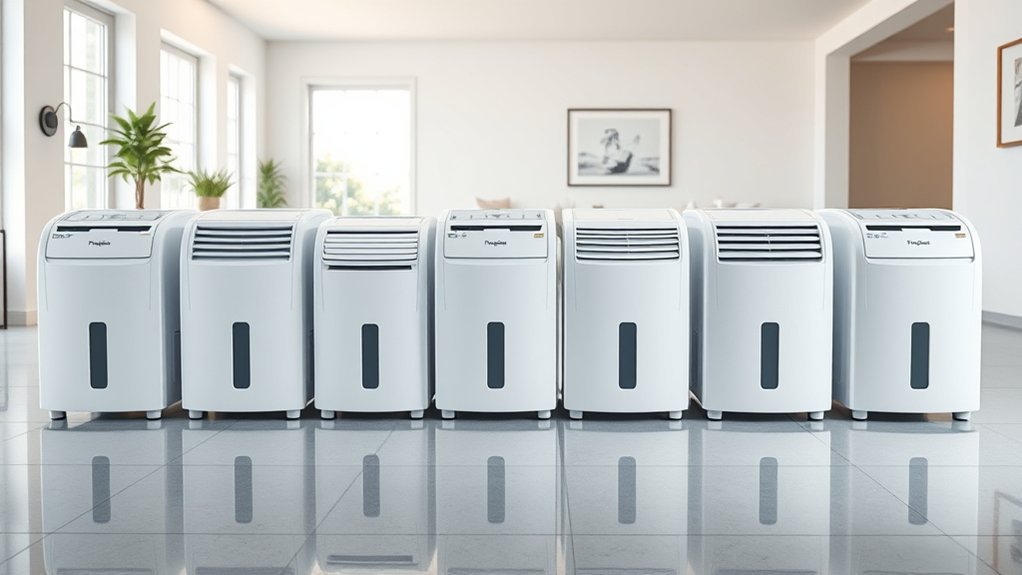
[…] or collecting that water. It is usually a strong choice for warm, enclosed rooms, basements, warehouses, production areas, and other spaces where you need steady humidity control at normal room […]