Affiliate disclosure: As an Amazon Associate I earn from qualifying purchases. This does not affect the price you pay.
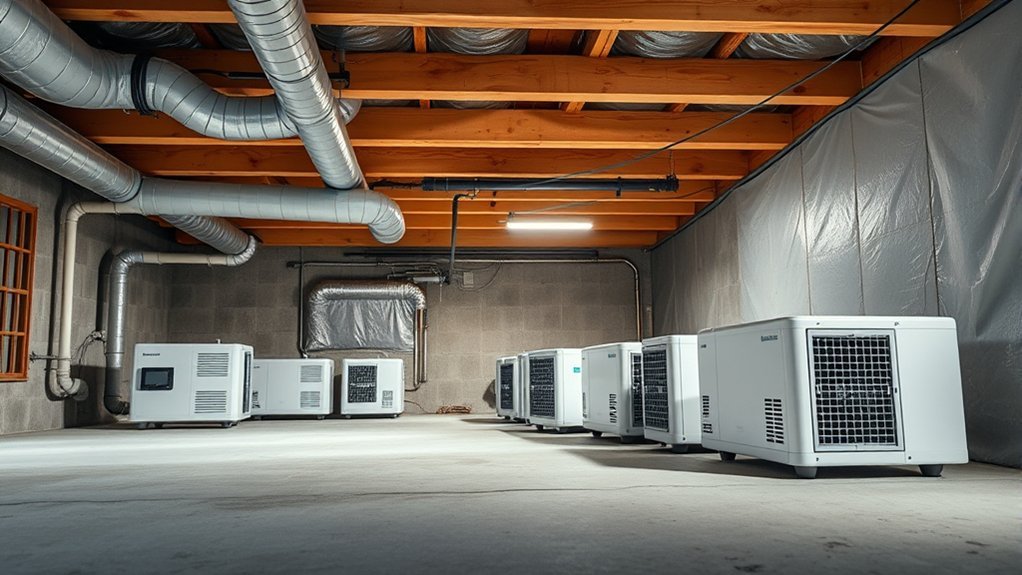
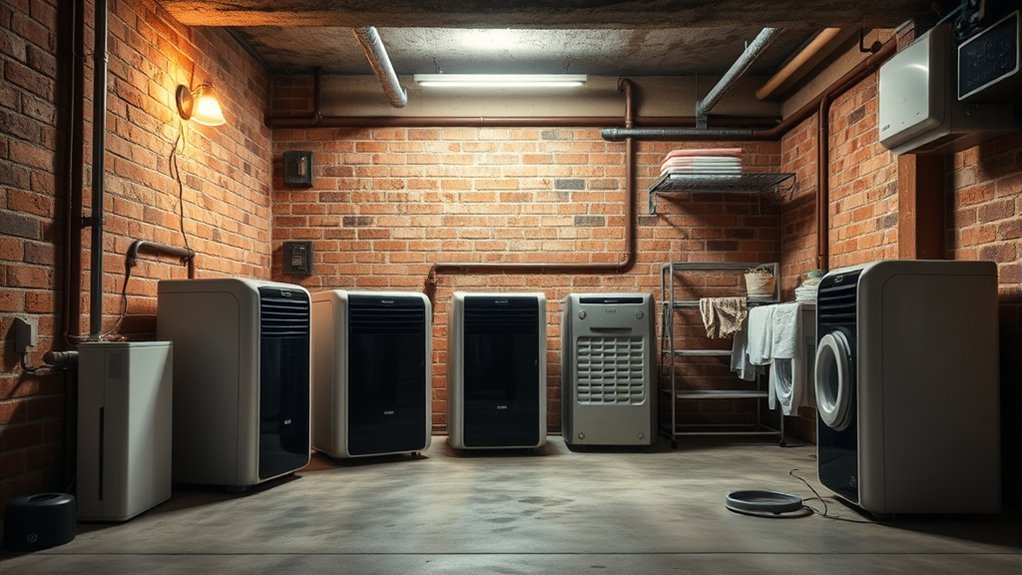
Metal buildings rapidly develop condensation—often called “metal building sweating”—when warm, humid indoor air touches cool steel panels, purlins, tools, vehicles, or concrete slabs. Choosing the best dehumidifier for a metal building depends on the structure’s total cubic volume, insulation, air leakage, winter indoor temperature, door-opening frequency, and moisture sources—not floor area alone.
Among the models evaluated here, the Airecoler GT-X5 is the strongest commercial-style choice for an enclosed metal garage, workshop, crawl space, or storage building. The Waykar 6000 Sq. Ft model is the best large portable option on wheels, while the AEOCKY RHEA-001 suits a medium-sized, insulated room where ENERGY STAR efficiency and automatic humidity control matter most. The compact Waykar 2000 Sq. Ft model should be reserved strictly for a small conditioned office, tool room, or enclosed storage closet inside the structure.
When comparing dehumidifiers, pay close attention to capacity test conditions. Many manufacturers headline a “maximum” pints-per-day figure measured at 95°F and 90% relative humidity (RH)—saturation conditions rarely seen inside a usable workshop. That promotional number can be two to three times higher than the unit’s standardized output under moderate AHAM (80°F and 60% RH) or US Department of Energy / ENERGY STAR (65°F and 60% RH) test conditions.
Quick verdict
- Best overall commercial-style option: Airecoler GT-X5 (58 pints/day at 80°F/60% RH; 125 pints/day max; 265 CFM airflow)
- Best large portable option: Waykar 6000 Sq. Ft (up to 120 pints/day at 95°F/90% RH; wheeled room-style cabinet with tank and gravity drain)
- Best energy-efficient automatic-control option: AEOCKY RHEA-001 (24.5 pints/day ENERGY STAR / DOE rating; 80 pints/day max)
- Best for a small conditioned metal room: Waykar 2000 Sq. Ft (up to 34 pints/day at 95°F/90% RH; compact 65 CFM unit for enclosed offices or tool rooms)
How these products were evaluated
These recommendations prioritize suitability for enclosed metal buildings, transparent moisture-removal data across different temperature and humidity standards, continuous drainage design, operating-temperature limits, airflow (CFM), portability, automatic controls, and realistic limitations. Manufacturer square-footage claims were treated only as loose starting points because a tall, uninsulated, or leaky steel building requires substantially more dehumidification capacity than a drywalled residential room with the same footprint.
Quick Comparison
| Product | Best For | Capacity & Airflow Context | Main Limitation | Amazon |
|---|---|---|---|---|
| Airecoler GT-X5 Best overall commercial-style option |
Enclosed metal garages, workshops, crawl spaces, equipment bays, and fixed drainage setups | 125 pints/day max; ~58 pints/day at 80°F & 60% RH (AHAM-style); 265 CFM | Weighs ~50 lbs and uses gravity drainage rather than an internal condensate pump | Check Price on Amazon |
| Waykar 6000 Sq. Ft Best large portable option |
Large enclosed garages, insulated shops, laundry zones, and multi-area storage buildings | Up to 120 pints/day at 95°F & 90% RH (saturation max); confirm standardized rating for exact listing variant | Residential-style plastic housing is not built for heavy commercial restoration abuse | Check Price on Amazon |
| AEOCKY RHEA-001 Best efficient automatic-control option |
Medium-sized enclosed workshops, offices, climate-controlled storage rooms, and interior bays | 80 pints/day max (hot/humid); 24.5 pints/day under US DOE / ENERGY STAR test conditions (65°F & 60% RH) | “Smart” refers to automatic humidistat logic—not Wi-Fi or smartphone app connectivity | Check Price on Amazon |
| Waykar 2000 Sq. Ft Best small-room option |
Conditioned offices, enclosed tool rooms, tack rooms, hobby spaces, or compact storage closets | Up to 34 pints/day at 95°F & 90% RH; ~65 CFM airflow and 0.6-gal tank (PD160B-PRO version) | Far too small for an entire open metal garage, pole barn, or high-ceiling warehouse | Check Price on Amazon |
Important capacity note: Maximum saturation (95°F / 90% RH), AHAM-style (80°F / 60% RH), and current US DOE / ENERGY STAR portable ratings (65°F / 60% RH) are not interchangeable. A dehumidifier rated for 24 to 30 pints per day under DOE rules often advertises 70 to 90+ pints per day under saturation conditions. Always verify the test temperature, relative humidity, and exact model number before comparing two machines.
Airecoler GT-X5 125-Pint-Max Commercial Dehumidifier
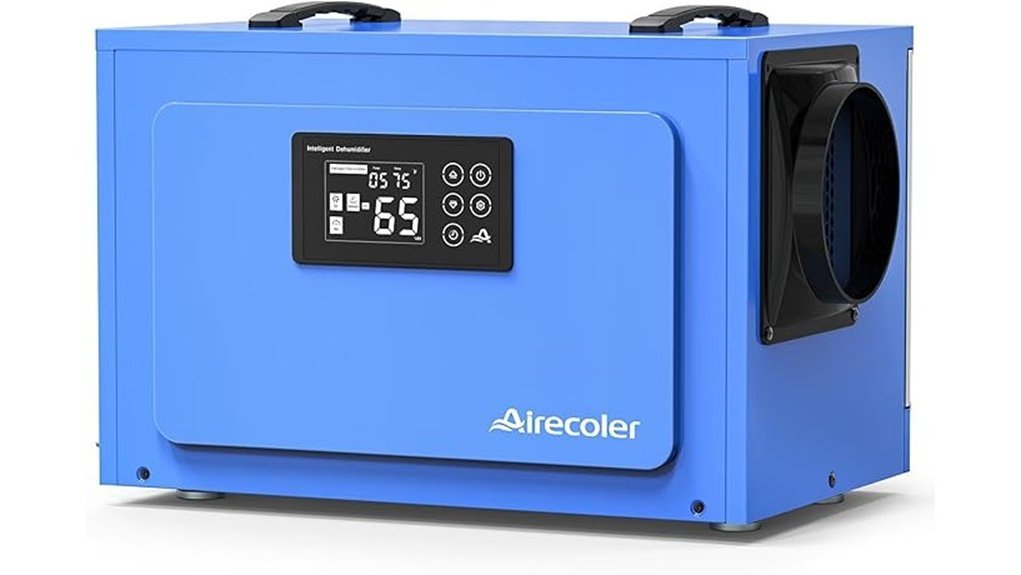
Best overall commercial-style option. The Airecoler GT-X5 is the strongest fit in this roundup for an enclosed metal garage, workshop, equipment bay, crawl space, or storage building. Unlike upright plastic household units, its horizontal metal housing fits under workbenches or on heavy shelving, while its higher airflow pushes dry air across wider shop floors.
The manufacturer lists moisture removal of up to 125 pints per day under saturated hot-and-humid conditions and approximately 58 pints per day at 80°F and 60% RH. That 58-pint AHAM-style benchmark is far more realistic when sizing the machine for normal warm-weather shop conditions. Its 265 CFM fan helps break up stagnant damp pockets around stored machinery, and its stated operating temperature range starts at approximately 41°F.
Measuring 19.2 x 12.2 x 13.4 inches and weighing around 50 pounds, the GT-X5 is designed for stationary continuous drainage rather than daily bucket emptying. It includes a gravity-drain hose, automatic defrost, auto-restart memory after a power outage, continuous mode, a washable filter, and an adjustable digital humidistat. Because it relies on gravity drainage, the drain hose must slope continuously downward below the unit’s outlet unless you pair it with an external condensate pump.
Key Specifications:
- Moisture Removal Capacity: ~58 pints/day at 80°F & 60% RH; up to 125 pints/day max
- Airflow: 265 CFM
- Minimum Operating Temperature: ~41°F (with auto defrost)
- Drainage Type: Continuous gravity drain (hose included; no internal bucket or pump)
- Dimensions & Weight: 19.2 x 12.2 x 13.4 in.; approx. 50 lbs
Why you may like it: It pairs a rugged low-profile enclosure and 265 CFM airflow with transparent moderate-condition capacity figures—making it much better suited to an open workshop bay than standard living-room portables.
Who should buy this: Owners of enclosed metal garages, workshops, or storage buildings who have a floor drain, sump pit, or downhill drain route, a grounded 115V outlet, and a moderate-to-heavy moisture load.
Who should avoid this: Buyers who need an internal condensate pump to lift water up into a utility sink, smartphone app control, whisper-quiet office acoustics, or moisture removal in below-freezing winter structures.
Pros:
- Transparent reference capacity: Publishes both its 125-pint maximum claim and a realistic 58-pint/day output at 80°F and 60% RH.
- High 265 CFM airflow: Circulates air much more effectively across open bays and around tool cabinets than 65–120 CFM room units.
- Compact 13.4-inch height: Slides under heavy-duty shop shelving, workbenches, or mechanical platforms.
- Set-and-forget shop controls: Auto defrost, power-outage restart memory, and continuous gravity drainage support unattended operation.
Cons:
- No built-in condensate pump: The drain line must run downhill unless you add an external condensation pump.
- Heavy to reposition: At roughly 50 pounds without caster wheels, it is meant for semi-permanent placement.
- Tiered warranty terms: Buyers should check which warranty years cover the full unit versus the sealed refrigeration system only.
- Not for freezing shops: Like all refrigerant dehumidifiers, it cannot run effectively when indoor shop temperatures drop below 41°F.
Bottom Line: If you want a dedicated, high-airflow dehumidifier for an enclosed metal workshop or garage and have a floor drain available, the Airecoler GT-X5 is the most capable workhorse in this group.
Waykar 6000 Sq. Ft 120-Pint-Max Dehumidifier
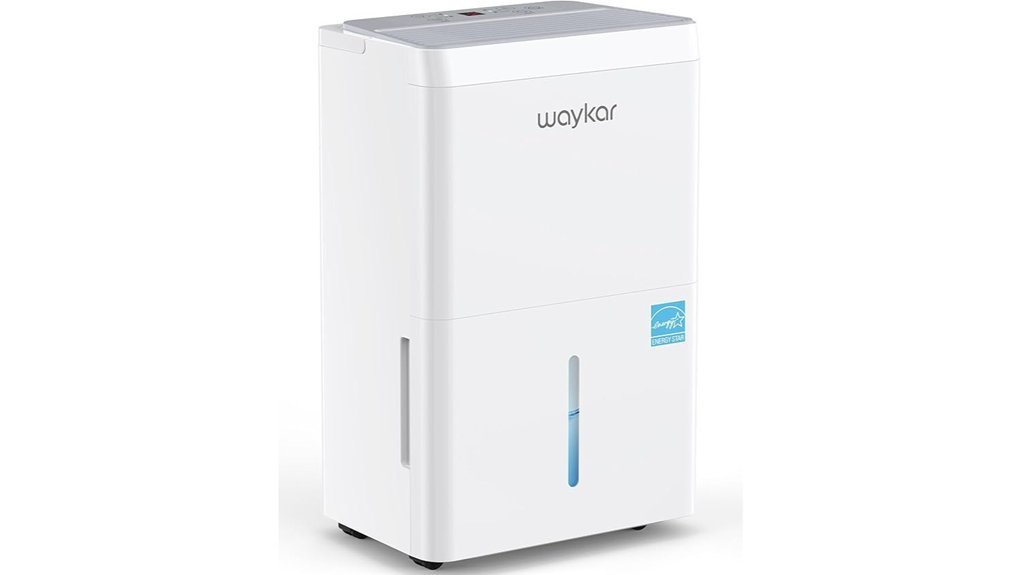
Best large portable option. The Waykar 6000 Sq. Ft model is the most practical choice if you need higher moisture removal than a small bedroom dehumidifier can deliver, but still want caster wheels, an internal collection bucket, and upright room-style controls. It suits an enclosed, insulated metal garage, workshop, laundry area, or multi-room storage building with moderate air infiltration.
The manufacturer rates this model at up to 120 pints of water removal per day at 95°F and 90% RH. Because that figure represents hot, saturated conditions, expect daily extraction under normal 65°F to 80°F shop temperatures to be roughly half of the maximum rating. Even so, it offers substantially greater capacity than compact 30- to 50-pint-max portables.
This unit provides an adjustable humidistat, automatic defrost, continuous gravity-hose drainage, a removable water tank with full-tank auto shutoff, and rolling casters. While product marketing cites a minimum noise figure around 40 dB for one variation, actual sound levels inside a bare-walled steel building will be louder at high fan speed due to acoustic reflections off metal panels and concrete floors.
Key Specifications:
- Moisture Removal Capacity: Up to 120 pints/day at 95°F & 90% RH (saturation max)
- Advertised Coverage: Up to 6,000 sq. ft. (ideal residential conditions; smaller in tall or uninsulated metal structures)
- Drainage Options: Removable internal bucket with auto shutoff + continuous gravity drain hose connection
- Mobility & Controls: Upright cabinet with caster wheels, handles, digital humidistat, auto defrost, and power-loss restart
Why you may like it: It bridges the gap between small household portables and heavy commercial boxes, letting you roll the unit between a vehicle bay and a woodworking zone or run it temporarily on its internal bucket where no floor drain exists.
Who should buy this: Owners of enclosed, reasonably insulated metal garages or multi-purpose workshops who want a high-output wheeled dehumidifier with both bucket and gravity-hose drainage.
Who should avoid this: Buyers dealing with standing water, active roof leaks, uninsulated pole barns with constant overhead-door traffic, freezing winter temperatures, or heavy industrial dust and abuse.
Pros:
- High portable output: Delivers much stronger extraction potential than entry-level room units while plugging into a standard outlet.
- Dual drainage flexibility: Runs continuously through a gravity hose or collects water in its internal tank when used away from a drain.
- Easy to roll between zones: Built-in wheels and handles make it simple to move across smooth concrete slabs.
- Automated daily operation: Digital humidity targets, auto defrost, and auto restart minimize manual intervention.
Cons:
- Saturation-based headline rating: The 120-pint rating is measured at 95°F and 90% RH, so real-world output in cooler air is lower.
- Residential cabinet construction: Its upright plastic shell is less impact-resistant than a steel commercial housing.
- No internal lift pump: Continuous drainage still requires a downward hose slope unless you purchase an external condensate pump.
- Optimistic square-footage label: The 6,000 sq. ft. rating assumes standard ceiling heights and tight residential insulation—not a leaky 16-foot-tall steel shop.
Bottom Line: When you need strong moisture removal in an insulated metal garage or shop and want the convenience of wheels and a backup water tank, the Waykar 6000 Sq. Ft model is the top portable contender.
AEOCKY RHEA-001 4500 Sq. Ft Dehumidifier
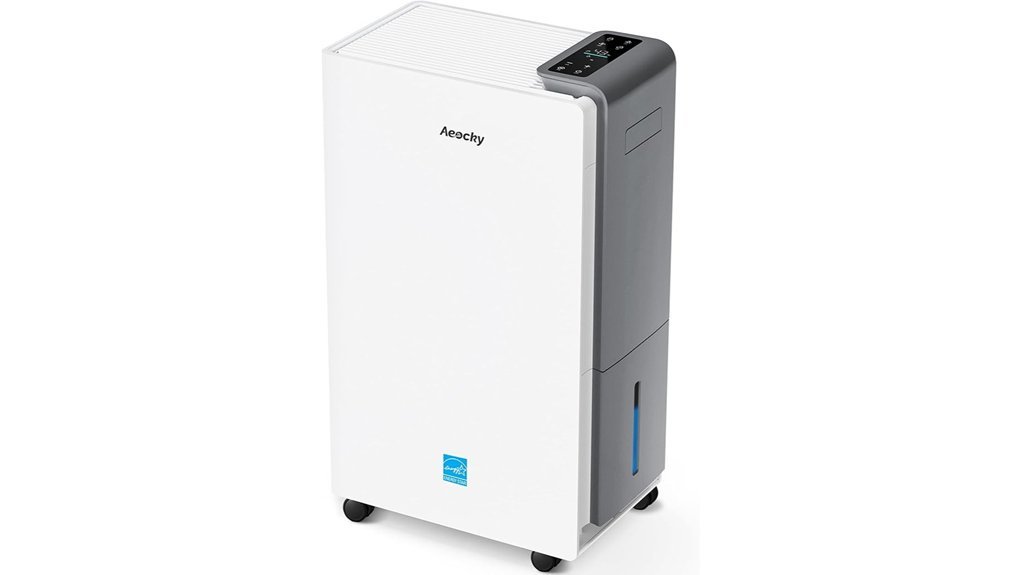
Best energy-efficient automatic-control option. The AEOCKY RHEA-001 is well suited to a medium-sized, insulated workshop, finished shop office, equipment room, or enclosed storage bay where verified electrical efficiency and steady humidistat control matter more than industrial-strength airflow.
This model is also a textbook example of why buyers should check standardized testing records. The manufacturer advertises up to 80 pints per day under hot, saturated conditions, while the official ENERGY STAR certification record for the RHEA-001 family lists a standardized capacity of 24.5 pints per day under the US Department of Energy test procedure (65°F and 60% RH). Knowing both figures lets you compare it fairly against other ENERGY STAR portables without being misled by saturation marketing numbers.
The unit includes an adjustable digital humidistat, continuous operation mode, programmable timer, gravity drain-hose connection, removable water bucket, and automatic defrost. Although promotional copy uses the word “smart,” the ENERGY STAR database lists the RHEA-001 family without connected functionality—so buyers should expect intelligent onboard humidity regulation rather than Wi-Fi, smartphone app alerts, or voice-assistant integration.
Key Specifications:
- Moisture Removal Capacity: 24.5 pints/day (verified US DOE / ENERGY STAR rating at 65°F & 60% RH); up to 80 pints/day max
- Efficiency Certification: Listed in the ENERGY STAR database (RHEA-001 family)
- Drainage Options: Removable collection tank + continuous gravity drain hose port
- Controls: Onboard automatic humidistat, continuous mode, 24-hour timer, auto defrost, and power-outage auto restart (non-Wi-Fi)
Why you may like it: It offers documented ENERGY STAR efficiency and reliable automatic humidity cycling in a manageable upright cabinet that won’t overwhelm a medium-sized conditioned shop room.
Who should buy this: Buyers controlling dampness in an enclosed, insulated, medium-sized metal workshop, studio, or storage area with moderate humidity and a convenient gravity-drain path.
Who should avoid this: Buyers who require remote Wi-Fi monitoring via smartphone app, ducted installations, an internal condensate pump, high commercial CFM airflow, or cold-weather operation in an unheated barn.
Pros:
- Verified ENERGY STAR record: Appears in the official ENERGY STAR database, helping keep electricity costs in check during long summer runs.
- Clear standardized benchmark: Having both the 24.5-pint DOE figure and 80-pint max figure removes guesswork when sizing.
- Hands-off humidity regulation: Automatically cycles the compressor and fan to maintain your target RH percentage.
- Easy placement in occupied rooms: Suits finished shop offices, hobby rooms, and clean assembly areas better than industrial floor units.
Cons:
- No Wi-Fi or app control: Despite “smart” marketing labels, it does not offer remote smartphone monitoring.
- Moderate real-world extraction: At 24.5 DOE pints/day, it is sized for enclosed medium areas rather than cavernous multi-bay buildings.
- 4,500 sq. ft. claim is optimistic for metal structures: Tall ceilings and overhead-door air exchange will substantially reduce effective coverage area.
- Standard compressor temperature limits: Requires a heated or mild space to prevent frequent coil defrosting in winter.
Bottom Line: For an insulated, enclosed metal workshop or interior room where power efficiency and automatic humidity control are top priorities, the AEOCKY RHEA-001 is a smart, verifiable pick.
Waykar 2000 Sq. Ft 34-Pint-Max Dehumidifier
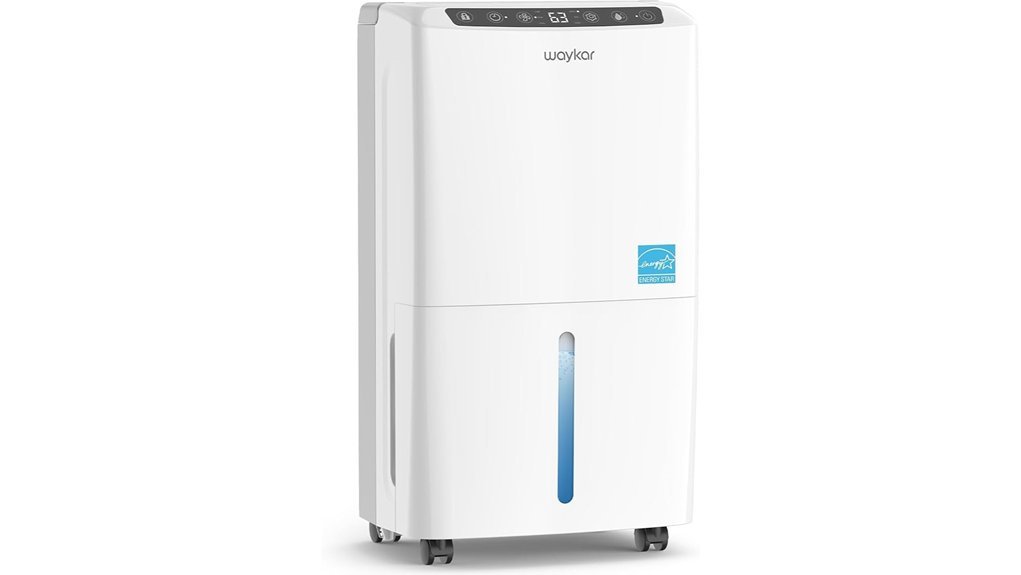
Best for a small conditioned metal room. The Waykar 2000 Sq. Ft model (referenced in the PD160B-PRO version) is designed for a small partitioned room inside a metal building—such as an insulated shop office, enclosed tool crib, gun/gear room, tack room, or bathroom—rather than an entire open steel building. It can also handle a compact, tightly sealed single-bay garage where the doors stay closed and moisture loads are light.
The manufacturer rates the PD160B-PRO version at up to 34 pints per day at 95°F and 90% RH, paired with approximately 65 CFM of airflow and a 0.6-gallon (4.8-pint) internal water tank. Under typical 65°F to 75°F indoor conditions, daily water extraction will be much lower than 34 pints, and 65 CFM of airflow is only enough to circulate air within a small, enclosed room.
Because the 0.6-gallon bucket holds just 4.8 pints of water, it can fill up two or more times per day during humid weather. Connecting the included gravity drain hose to a floor drain—or draining it into a larger external container—is strongly recommended if you do not visit the room daily. Standard features include an automatic humidistat, auto defrost, power-outage restart memory, a timer, and a washable air filter. Treat the advertised 33 dB minimum noise rating as a best-case low-fan measurement.
Key Specifications:
- Moisture Removal Capacity: Up to 34 pints/day at 95°F & 90% RH (PD160B-PRO version)
- Airflow: ~65 CFM
- Internal Tank Size: 0.6 gallons (4.8 pints) with full-bucket shutoff + continuous gravity drain port
- Best Realistic Metal-Room Size: 150 to 500 sq. ft. enclosed, insulated interior room
Why you may like it: It is compact, lightweight, quiet enough for a desk area, and avoids wasting electricity or floor space when you only need to protect a small enclosed tool room or office inside a larger barn.
Who should buy this: Buyers protecting precision tools, electronics, documents, or gear inside a small, insulated, temperature-stable interior room with closed doors.
Who should avoid this: Anyone trying to dry an open metal garage, multi-car shop, uninsulated pole barn, wash bay, or high-ceiling warehouse.
Pros:
- Compact footprint: Fits easily inside cramped tool cribs, closets, or shop offices without eating up workspace.
- Complete automatic controls: Includes target humidity sensing, auto shutoff, defrost, timer, and power-loss restart.
- Continuous gravity drain port: Lets you bypass the small 0.6-gallon bucket when positioned above a drain.
- Simple upkeep: Slide-out washable filter and removable bucket take seconds to clean.
Cons:
- Too small for whole-building use: 65 CFM airflow and 34-pint max capacity cannot keep up with an open metal building.
- Tiny 0.6-gallon (4.8-pint) bucket: Requires frequent manual emptying unless hooked up to a continuous drain hose.
- Saturation-rated capacity: Output drops noticeably in cool 60°F–68°F rooms.
- Misleading 2,000 sq. ft. label: In a metal structure, restrict this unit to small, sealed rooms under 500 sq. ft.
Bottom Line: Do not buy the Waykar 2000 Sq. Ft model for a whole pole barn—instead, use it as an affordable, quiet dehumidifier for an enclosed office or dedicated tool room partitioned inside your building.
Factors to Consider When Choosing a Dehumidifier for a Metal Building
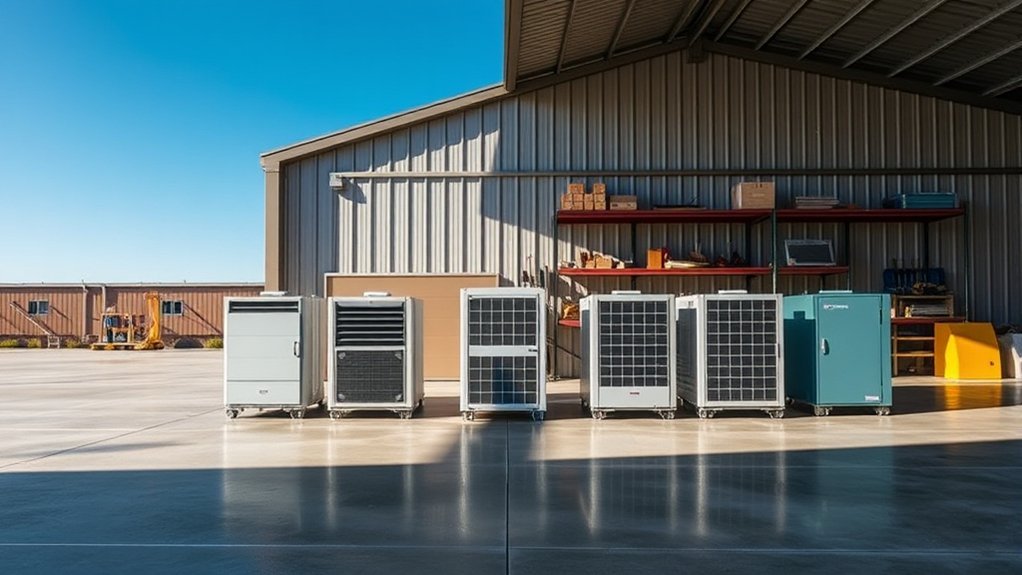
Dehumidifying a steel building is much more demanding than drying a residential basement or bedroom. Steel panels conduct heat rapidly and have virtually no moisture-buffering capacity. When outdoor temperatures drop at night, uninsulated metal roof and wall sheets chill quickly; as soon as the metal surface temperature falls below the indoor air’s dew point, airborne moisture condenses into liquid droplets that drip from purlins and rust tools. Use the factors below to size and install the right equipment.
1. Calculate Cubic Volume and Moisture Load
Never size a metal-building dehumidifier by square footage alone. Residential coverage ratings assume an 8-foot ceiling and tight drywall construction. Multiply length × width × average ceiling height to calculate your building’s true cubic volume, then factor in insulation quality, rib/eave air gaps, wet vehicles, curing or unsealed concrete slabs, washdown water, and how often roll-up doors open.
For example, a 2,000 sq. ft. shop office with an 8-foot ceiling holds 16,000 cubic feet of air, whereas a 2,000 sq. ft. metal shop with a 16-foot eave height holds 32,000 cubic feet—double the air volume—and exchanges massive waves of humid outdoor air every time an overhead door opens.
| Metal Space Type | Typical Envelope Condition | Recommended Dehumidifier Approach |
|---|---|---|
| Partitioned Shop Office or Tool Room (150–500 sq. ft., 8–9 ft. ceiling) |
Insulated, weather-stripped door, conditioned temperatures | Compact portable room unit (e.g., Waykar 2000 Sq. Ft) or efficient mid-size unit |
| Medium Enclosed Workshop or 2-Car Metal Garage (500–1,200 sq. ft., 9–12 ft. ceiling) |
Insulated panels/vapor barrier, closed doors, moderate humidity | Mid-to-large ENERGY STAR portable (e.g., AEOCKY RHEA-001 or Waykar 6000 Sq. Ft) |
| Large Enclosed Shop, Multi-Bay Garage, or Storage Building (1,200–2,500+ sq. ft., 10–16 ft. ceiling) |
Enclosed envelope, moderate-to-heavy moisture load, floor drain available | High-airflow commercial-style unit (e.g., Airecoler GT-X5) + auxiliary circulation fans; larger or divided bays may require 2+ units |
| Uninsulated / Open-Vented Pole Barn or Unheated Freezing Shop | Open ridge/eave vents, bare cold steel, winter temperatures below 41°F | Seal air leaks and add insulation/vapor barrier first; use a desiccant dehumidifier or auxiliary heat for sub-41°F winter operation |
2. Compare Capacity Under the Same Testing Standard
Dehumidifier listings frequently mix three completely different rating standards on the same retail page. Because warm air holds exponentially more water vapor than cool air, a compressor dehumidifier removes far more water in a 95°F test chamber than in a 65°F garage. Use the table below to translate manufacturer numbers:
| Rating Standard | Test Temperature & Humidity | What It Means for Buyers |
|---|---|---|
| Saturation / “Max” Rating | ~95°F (35°C) and 90% RH (sometimes 86°F / 80% RH) | Extreme sauna-like condition used in marketing headlines (e.g., “80–125 Pints Max”). Never expect this daily output in a normal building. |
| AHAM Condition Rating | 80°F (26.7°C) and 60% RH | Standard commercial benchmark representing a warm, humid summer shop (e.g., the Airecoler GT-X5’s 58 pints/day rating). |
| Current US DOE / ENERGY STAR Portable Standard | 65°F (18.3°C) and 60% RH | Mandatory federal test for portable residential units since 2019 representing cooler basements/garages (e.g., the AEOCKY RHEA-001’s 24.5 pints/day rating). |
3. Check the Lowest Operating Temperature (Compressor vs. Desiccant)
All four models reviewed in this guide are refrigerant (compressor) dehumidifiers, which work by drawing damp air across cold evaporator coils to condense moisture. As shop temperatures fall below 65°F, moisture extraction drops and frost begins forming on the coils, forcing the compressor to pause periodically for defrost cycles:
- Above 65°F: Standard portable and commercial compressor dehumidifiers operate at peak efficiency.
- 41°F to 60°F: Output declines substantially; commercial-style units with robust hot-gas or fan defrost systems (like the Airecoler GT-X5, rated down to ~41°F) handle cool air better than basic household units, though runtime increases.
- Below 41°F (Unheated Winter Buildings): Refrigerant coils freeze solid and drain hoses can ice shut. If your metal building stays near or below freezing in winter, either maintain minimum shop heat above 45°F–50°F or use a desiccant dehumidifier, which adsorbs moisture chemically using a heated silica-gel rotor without relying on cold coils.
4. Consider Airflow (CFM) and Building Layout
A dehumidifier can only dry the air that actually reaches its intake grille. High-airflow commercial machines (200+ CFM) project dry air farther across open bays, promoting air mixing that keeps damp air from stagnating behind toolboxes, vehicles, and pallet racks. Always maintain the manual’s required clearance around intake and exhaust grilles.
In long metal buildings, L-shaped shops, or spaces with loft mezzanines, run ceiling fans or high-velocity shop fans on low speed to sweep air across cold steel walls and push damp air back toward the dehumidifier.
5. Choose the Right Drainage Method and Prevent Hose Freeze-Ups
Continuous drainage is essential in a metal building so the machine never shuts down with a full bucket during a humid weekend. All four models reviewed here use gravity drainage, meaning the drain hose must slope continuously downward from the outlet port to a floor drain or sump pit without upward loops or kinks.
If you lack a floor drain and need to push water upward into a utility sink, overhead drain line, or plumbing standpipe, connect the gravity hose into an external automatic condensate pump (typically capable of 15 to 20 feet of vertical lift). Avoid routing a thin drain tube directly through an exterior steel wall if winter temperatures drop below freezing, as frozen standing water in the hose will back up into the machine; also seal any wall penetration tightly to block rodents and humid outdoor air.
6. Confirm Electrical Requirements and Shop Safety
Verify the unit’s voltage (typically 115V), running amperage, compressor startup surge, and circuit load before plugging it in. Use a dedicated or lightly loaded grounded receptacle, and follow the manufacturer’s instructions regarding GFCI outlets and power cords.
Never run a dehumidifier on an undersized extension cord, which can overheat under continuous compressor draw. Elevate the machine slightly off the concrete slab on level blocks, a dedicated stand, or a shelf so floor washdown water, melting snow from vehicles, or roof drips cannot reach the electrical components.
7. Evaluate Efficiency Using the Exact Model Number
When checking the ENERGY STAR database for efficiency (measured in Integrated Energy Factor, or liters per kilowatt-hour), search by the exact alphanumeric model number on the spec plate rather than the general brand title. Amazon product pages frequently bundle multiple pint capacities and hardware generations under a single parent listing.
Remember that the cheapest kilowatt-hour is the one your dehumidifier never has to run: sealing gap leaks at roll-up door thresholds, installing closure strips along corrugated metal ribs, and adding closed-cell spray foam or faced fiberglass insulation with an intact vapor retarder will dramatically cut dehumidifier runtime.
8. Treat Noise Ratings Cautiously in Bare Steel Interiors
Bare steel wall panels and concrete slabs reflect sound waves, amplifying compressor hum and fan noise by several decibels compared to a carpeted room. Manufacturer dB figures are usually measured in anechoic test chambers on the lowest fan setting.
If you spend hours working at a bench or desk, position high-CFM commercial units toward the storage end of the building and set the unit on anti-vibration rubber pads (ensuring bottom vents are never blocked).
9. Plan for Shop Dust Maintenance and Corrosion Control
Woodworking dust, grinding grit, pollen, and exhaust soot in a workshop will clog a dehumidifier’s filter and coat wet evaporator coils much faster than household dust. Inspect and wash the removable air filter every two to four weeks during active shop work, flush the drain line periodically to clear algae or sludge, and verify the onboard humidistat against an independent digital hygrometer placed on the opposite side of the bay.
Metal-building sizing tip: Stop outdoor air infiltration first
If your metal building has open ridge vents, unsealed eave flutes, or daylight showing around overhead doors, a dehumidifier will essentially be trying to dry the entire neighborhood. Before buying a larger dehumidifier, install foam closure strips, bottom door seals, and weather stripping, and fix roof fastener leaks or poor exterior grading that lets rainwater seep under the slab.
Before you buy checklist
- Measure floor length, width, and average ceiling height to calculate total cubic feet.
- Check whether roof/wall panels have insulation and a vapor barrier, or exposed cold steel.
- Record the lowest normal indoor temperature during fall, winter, and spring.
- Identify internal moisture sources: wet vehicles, unsealed concrete, wash bays, or standing water.
- Note how frequently large overhead or sliding doors open each day.
- Plan a continuous downward gravity-drain path or budget for an external condensate pump.
- Confirm 115V outlet location, circuit amperage, and elevation off wet floors.
- Compare pints-per-day ratings under identical test conditions (65°F/60% RH DOE vs. 80°F/60% RH AHAM vs. 95°F/90% RH Max).
- Verify the exact model number, ENERGY STAR status, warranty terms, and included drain hose diameter.
- Ensure the filter is washable and easy to access in a dusty workshop environment.
Frequently Asked Questions
What Humidity Level Is Best for a Metal Building?
Aim for 45% to 55% relative humidity in most metal garages, workshops, and storage buildings. Keeping relative humidity below 50% helps prevent surface rust on cast-iron machinery, hand tools, and vehicle parts, while staying below 55%–60% inhibits mold and mildew. Avoid setting the humidistat below 40% RH, which forces the compressor to run nonstop without solving cold-panel condensation caused by missing insulation.
Can One Small Dehumidifier Control an Entire Metal Building?
No—a small 30- to 35-pint-max portable dehumidifier lacks both the moisture extraction capacity and the CFM airflow needed for an entire tall, uninsulated, or multi-bay steel building. Reserve compact units (like the Waykar 2000 Sq. Ft model) for an enclosed, insulated office or tool closet inside the structure, and use high-airflow commercial units or multiple zoned dehumidifiers for the main shop floor.
Why Is My Dehumidifier Collecting Less Water Than Advertised?
Headline capacity ratings (such as 80, 120, or 125 pints per day) are typically measured under extreme saturation conditions of 95°F and 90% RH. In a 65°F to 75°F workshop at 60% RH, the same machine will naturally extract roughly 30% to 50% of its maximum claim. Clogged air filters, iced evaporator coils, blocked grilles, or short cycling can also reduce daily water output.
Will a Compressor Dehumidifier Work in an Unheated Metal Building?
Compressor dehumidifiers work well in mild weather (above 65°F) and can operate at reduced capacity down to about 41°F if equipped with effective auto-defrost controls. However, below 60°F their efficiency drops sharply, and below 41°F the coils will ice over and drain hoses can freeze. For unheated metal buildings that drop near or below freezing in winter, use auxiliary shop heat or switch to a desiccant dehumidifier.
Do I Need a Drain Pump?
You do not need a pump if the dehumidifier can sit higher than a floor drain or sump pit so the gravity hose slopes continuously downward. You do need an internal or external condensate pump if the water must travel upward into a utility sink, cross a walkway overhead, or discharge to any point higher than the dehumidifier’s drain outlet.
How Do I Maintain My Dehumidifier in a Workshop?
Unplug the unit before servicing, wash or vacuum the removable air filter every two to four weeks (more often when sawing or sanding), keep at least 12 to 18 inches of clearance around the air grilles, and flush the gravity drain hose periodically so dust and biofilm cannot clog the line. Check the evaporator coils seasonally for dust buildup or frost.
Are Dehumidifiers Safe Around Electrical Equipment?
Yes, when installed according to the owner’s manual. Plug the dehumidifier directly into a properly grounded outlet without an extension cord, elevate the machine slightly off the concrete floor so water cannot pool around the power cord, and route the drain hose safely away from electrical panels, welders, and floor cords.
Can a Dehumidifier Prevent Mold in a Metal Building?
Maintaining indoor relative humidity below 50%–55% helps prevent dormant mold spores from growing on stored cardboard, upholstery, lumber, and drywall inside a metal building. However, a dehumidifier cannot kill existing mold colonies or stop water intrusion from leaking roof screws, unsealed slab edges, or wet insulation—those structural issues must be repaired directly.
How Noisy Are Commercial Dehumidifiers?
Commercial dehumidifiers typically produce between 50 and 60+ dBA because they use high-output compressors and 200+ CFM blower fans inside rigid metal housings, and bare steel walls echo that sound. Place commercial units away from desks or quiet workbenches, and use rubber anti-vibration pads under the feet to dampen floor resonance.
Conclusion
Final recommendation
For most enclosed metal garages, workshops, equipment rooms, and crawl spaces, the Airecoler GT-X5 is the strongest overall choice in this lineup. It pairs a durable low-profile enclosure and 265 CFM airflow with continuous gravity drainage and transparent capacity ratings (~58 pints/day at 80°F and 60% RH; 125 pints/day max).
Choose the Waykar 6000 Sq. Ft model if you prefer a wheeled upright cabinet with both an internal bucket and a gravity hose for an insulated garage or shop. Pick the AEOCKY RHEA-001 (24.5 DOE pints/day; 80 pints/day max) for a medium-sized conditioned room where verified ENERGY STAR efficiency and automatic humidistat control come first, and reserve the compact Waykar 2000 Sq. Ft model strictly for a small enclosed office or tool room inside the building.
Before ordering, seal obvious air leaks around doors and eaves, compare moisture removal under matching test conditions, and confirm the exact model number, minimum operating temperature, drainage path, and electrical circuit requirements for your building.