Affiliate disclosure: As an Amazon Associate, we may earn from qualifying purchases. This does not affect which products are included or how they are evaluated.
Humidity can make a garage gym feel sticky, leave metal equipment damp, and create musty conditions around mats and storage. The best dehumidifier for a garage gym is usually a compressor-based unit with enough standardized pint capacity for the actual moisture load, a reliable humidistat, and a continuous-drain option.
This updated 2026 guide compares five compressor dehumidifiers that fit garage-gym use better than low-output desktop models. Products were evaluated by standardized moisture-removal capacity when available, maximum listing capacity, drainage, controls, operating-temperature information, documentation, and suitability for different humidity levels. This is an editorial comparison and does not claim hands-on testing.
Important capacity distinction: A product advertised as “80 pints” at 95°F and 90% or 95% relative humidity may remove only about 25 pints per day under the current standardized test. The comparison below separates standardized capacity from hot-condition marketing figures whenever verified.
Quick verdict
Best overall smart pick: GoveeLife H7151. Best established-brand and cold-garage option: Frigidaire FHDD5034Y1. Best efficiency-focused mid-capacity pick: AEOCKY Rhea-001. Best mid-capacity airflow alternative: Waykar JD025CE-80. Best for a small, mildly damp garage: Waykar PD160B.
Quick Comparison
| Product | Best for | Verified capacity context | Drainage | Key advantage | Amazon |
|---|---|---|---|---|---|
| GoveeLife H7151 | Large or persistently damp garage gyms | About 50 standardized pints/day | Tank or gravity hose | App, scheduling, and voice control | Check Amazon |
| Frigidaire FHDD5034Y1 | Large, damp, or seasonally cool garages | 49.71 standardized pints/day | Tank or gravity drain | 41°F operation and 2.7-gallon bucket | Check Amazon |
| AEOCKY Rhea-001 | Efficiency-focused moderate humidity control | 24.5 standardized pints/day; up to 80 at hotter conditions | Tank or gravity hose | ENERGY STAR Most Efficient model | Check Amazon |
| Waykar JD025CE-80 | Moderately damp garage gyms | 24.93 standardized pints/day; up to 80 at 95°F and 90% RH | Tank or gravity hose | Automatic swing airflow | Check Amazon |
| Waykar PD160B | Small, warm, mildly damp garage gyms | 9.81 standardized pints/day; up to 34 at hotter conditions | Tank or gravity hose | Compact footprint and simple controls | Check Amazon |
How to compare capacity: Give more weight to standardized pint ratings than square-foot headlines or maximum ratings measured in saturated summer air. You can review additional sizing and efficiency guidance on the ENERGY STAR dehumidifier page.
GoveeLife Smart Dehumidifier H7151
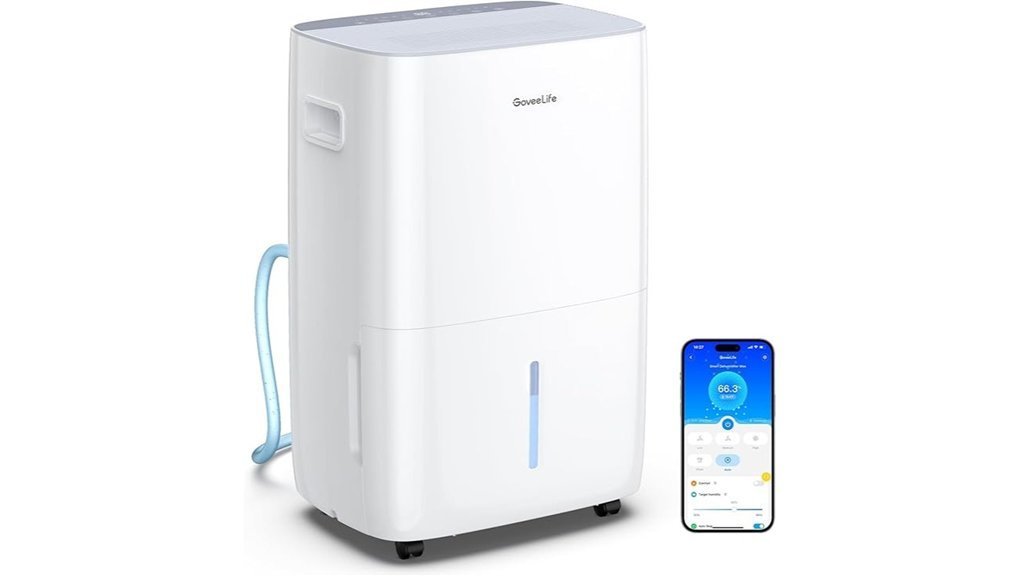
Best overall smart pick. The GoveeLife H7151 combines approximately 50 pints per day of standardized moisture removal with a 2-gallon bucket, continuous drainage, automatic humidity control, and connected features. It is the strongest all-around choice for a large or persistently damp garage gym when remote monitoring is useful.
The Govee Home app lets you check settings, create schedules, and operate the unit without entering a detached garage. Alexa and Google Assistant compatibility add voice control, while the built-in humidistat can cycle the compressor around the selected target instead of running continuously.
Why you may like it: It combines true high-capacity moisture removal, a relatively large bucket, smart monitoring, and hose drainage in one unit.
Who should avoid it: Buyers with a small, only mildly damp garage or a circuit that cannot comfortably support a full-size 850-watt appliance alongside gym equipment.
Pros:
- Approximately 50-pint standardized daily capacity.
- App, scheduling, Alexa, and Google Assistant support.
- Automatic humidity control, auto restart, and auto defrost.
- 2-gallon tank and continuous gravity-drain connection.
Cons:
- Higher electrical demand than the mid-capacity choices.
- Full-size compressor and fan operation will be audible.
- The 4,500-square-foot headline should not replace moisture-based sizing.
Frigidaire 50-Pint Dehumidifier with Wi-Fi
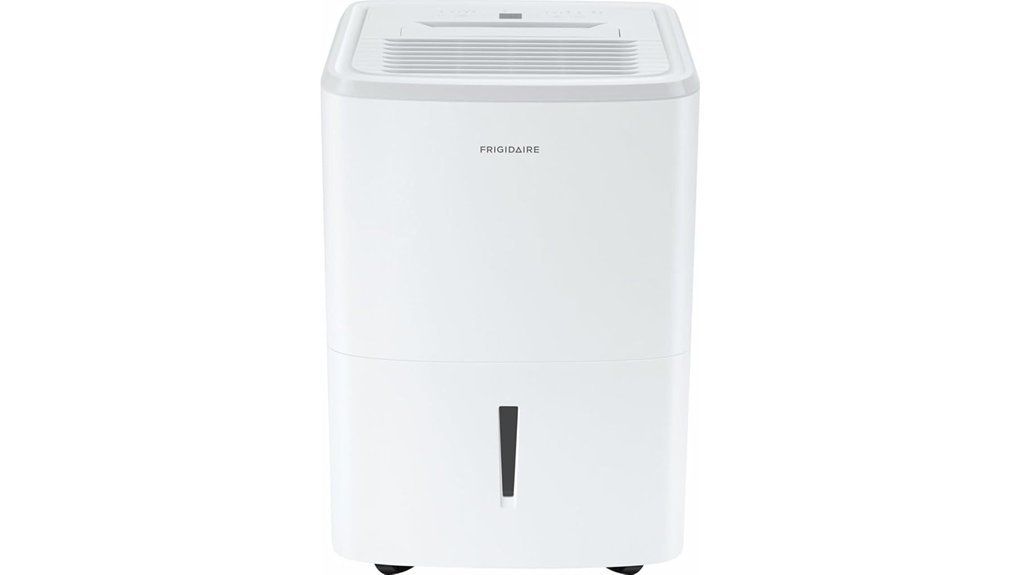
Best established-brand and cold-garage option. The Frigidaire FHDD5034Y1 has a standardized capacity of 49.71 pints per day, marketed as a 50-pint model. It also provides Wi-Fi control, three fan speeds, continuous drainage, and a larger 2.7-gallon bucket.
Its documented ability to operate at temperatures down to 41°F gives it an advantage in garages that become cool during fall or winter. Frigidaire lists sound levels from 47 to 51 dBA depending on fan speed, so buyers can make a more informed noise comparison than they can with poorly documented marketplace models.
Why you may like it: Verified high capacity, a large bucket, documented noise levels, Wi-Fi control, and support from an established appliance manufacturer.
Who should avoid it: Buyers with very limited floor space or those who only need occasional light-duty humidity control.
Pros:
- 49.71-pint standardized daily capacity.
- Designed for low-temperature operation down to 41°F.
- Wi-Fi control through the Frigidaire app.
- 2.7-gallon front bucket and continuous-drain option.
- Three fan speeds and documented 47–51 dBA sound range.
Cons:
- At 41 pounds, it is heavier than the smaller models.
- Its compressor and fan may be distracting during quiet workouts.
- It does not include a built-in condensate pump for uphill drainage.
AEOCKY Rhea-001 Energy-Efficient Dehumidifier
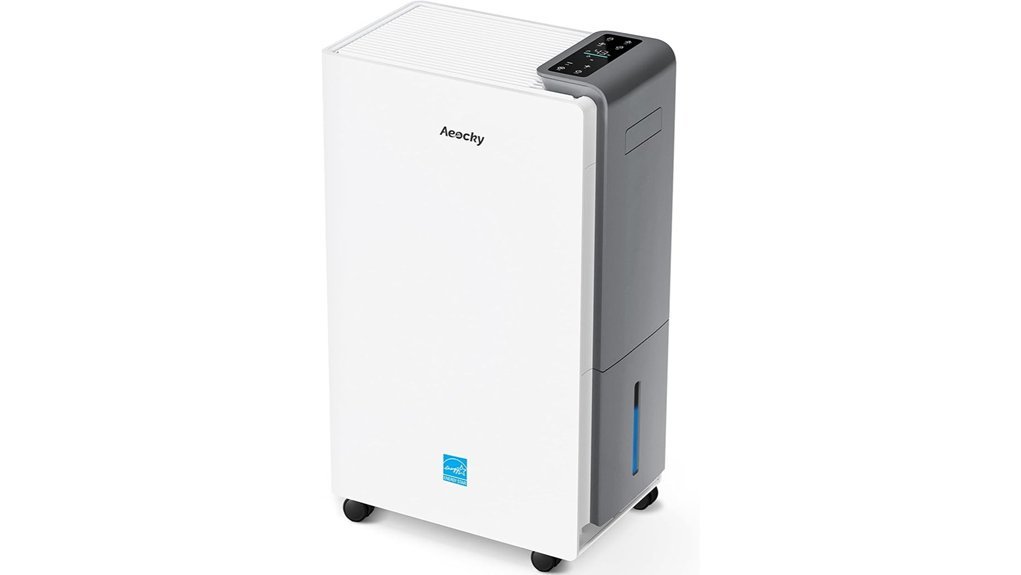
Best efficiency-focused mid-capacity pick. The AEOCKY Rhea-001 is associated with an ENERGY STAR standardized capacity of 24.5 pints per day. Its much larger 80-pint headline applies to hotter and more humid conditions, so it should not be compared directly with the standardized 50-pint GoveeLife or Frigidaire models.
The Rhea-001 remains relevant for a moderately damp garage gym because it combines an intelligent humidistat, automatic cycling, washable filter, drain-hose connection, and ENERGY STAR Most Efficient recognition. It is most attractive to buyers who prioritize efficiency over maximum standardized extraction.
Why you may like it: Its verified efficiency credentials, automatic controls, and continuous drainage suit regular humidity management without moving up to a full 50-pint class.
Who should avoid it: Buyers with a large garage that remains very damp or anyone assuming the 80-pint maximum is equivalent to a standardized 80-pint rating.
Pros:
- 24.5-pint standardized moisture-removal capacity.
- ENERGY STAR certified and recognized as Most Efficient.
- Humidistat, timer, automatic cycling, and multiple operating modes.
- Gravity-drain support for longer unattended operation.
Cons:
- The 80-pint maximum can be mistaken for its standardized capacity.
- Less standardized extraction than the GoveeLife and Frigidaire models.
- Buyers should confirm current warranty registration requirements.
Waykar JD025CE-80 Energy Star Dehumidifier
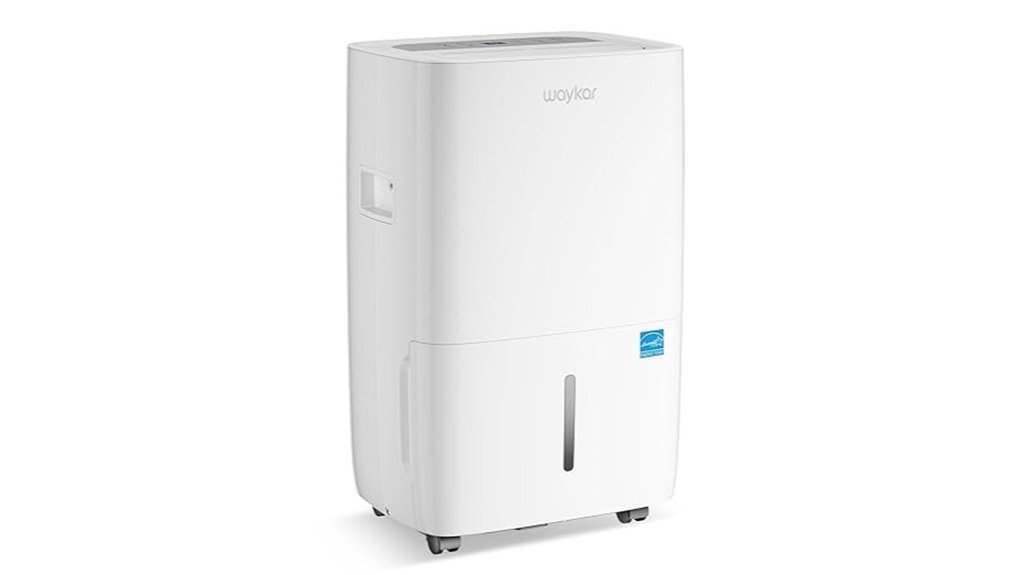
Best mid-capacity airflow alternative. The Waykar JD025CE-80 is advertised to remove up to 80 pints per day at 95°F and 90% RH, but its ENERGY STAR standardized capacity is 24.93 pints per day. That places it in the mid-capacity class rather than alongside standardized 50-pint units.
Its automatic swing outlet can help distribute dry air around racks, benches, cardio equipment, and storage areas. It also includes automatic humidity control, auto defrost, a removable bucket, and continuous gravity drainage.
Why you may like it: Swing airflow, portable construction, and automatic controls make it useful in a moderately damp garage with an open floor plan.
Who should avoid it: Owners of a large or very wet garage who need the standardized extraction of a true 50-pint model.
Pros:
- 24.93-pint standardized daily capacity.
- ENERGY STAR certified.
- Automatic swing outlet helps distribute the conditioned air.
- Automatic defrost, timer, restart, and humidity control.
- Tank and continuous gravity-drain choices.
Cons:
- The 80-pint headline is measured under hot, humid conditions.
- Not equivalent to a standardized 50- or 80-pint dehumidifier.
- Gravity drainage requires a continuously downward-sloping hose.
Waykar PD160B Energy Star Dehumidifier
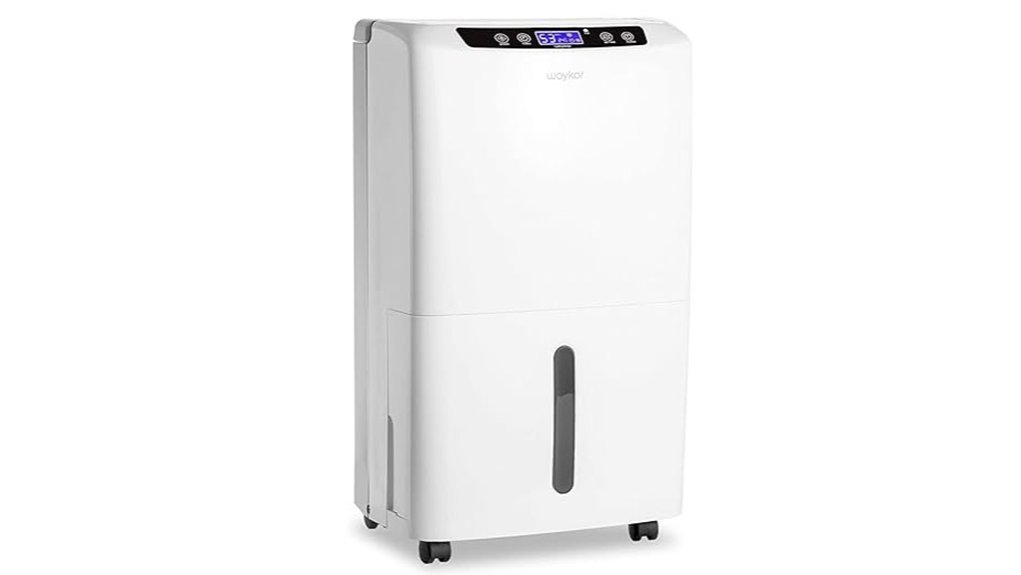
Best for a small, mildly damp garage gym. The linked Waykar PD160B is marketed as a 34-pint model under hot-condition testing, but its ENERGY STAR standardized capacity is 9.81 pints per day. That makes it suitable for light seasonal humidity rather than persistent condensation or water intrusion.
Its compact cabinet, casters, adjustable humidity setting, removable tank, and included drain hose can work well in a small workout area where floor space matters. The hose is the more convenient option during humid weather because the 0.66-gallon bucket is relatively small.
Why you may like it: It is easier to place around gym equipment and can handle mild humidity without the size and power demand of a 50-pint machine.
Who should avoid it: Owners dealing with frequent condensation, RH readings above 65% for long periods, a large two-car garage, seepage, or standing water.
Pros:
- Compact design for crowded garage gyms.
- 9.81-pint standardized capacity for light-duty moisture control.
- ENERGY STAR certified.
- Automatic and continuous modes.
- Removable tank and included gravity-drain hose.
Cons:
- The 34-pint headline greatly exceeds its standardized capacity.
- Undersized for a large or persistently damp garage.
- Small bucket can require frequent emptying without hose drainage.
- Compressor performance will decline as garage temperature drops.
Factors to Consider When Choosing a Dehumidifier for a Garage Gym
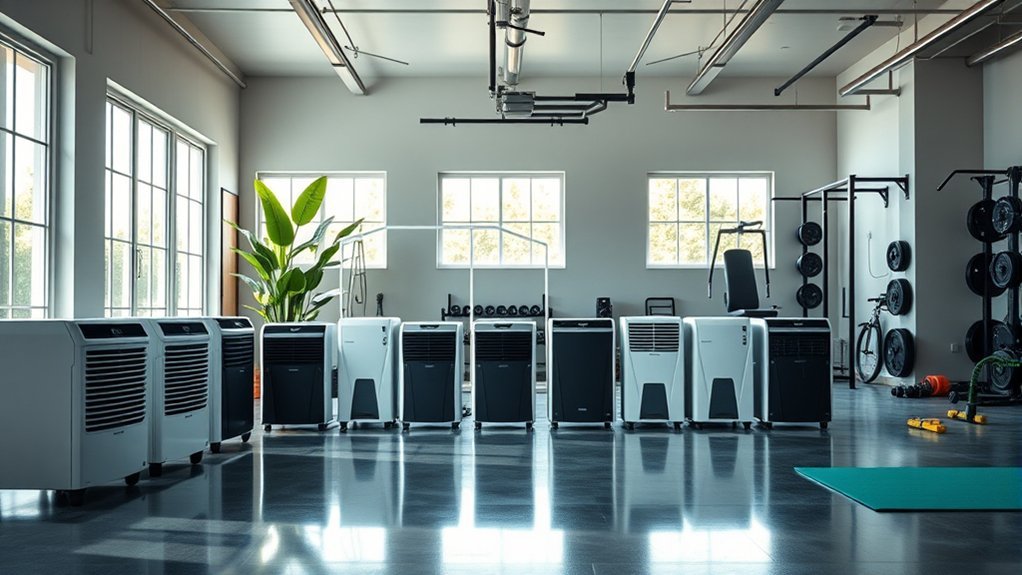
A garage gym creates a different moisture problem from a bedroom. Garage doors leak outdoor air, temperatures fluctuate, concrete can release or transmit moisture, and workouts add heat and perspiration. Use the factors below to select a unit that can maintain stable humidity without wasting electricity or blocking the workout area.
1. Measure the Space and Record Its Humidity
Measure the floor area and ceiling height, but also record relative humidity with a separate hygrometer during wet weather. A small garage with seepage can need more capacity than a larger garage that is merely humid for a few hours each day.
2. Compare Standardized Pint Capacity
Standardized capacity provides a more useful comparison than a maximum figure measured at 95°F and 90% or 95% RH. In this guide, the two verified 50-pint products offer roughly twice the standardized extraction of the AEOCKY and Waykar JD025CE-80 models.
3. Match Capacity to the Moisture Problem
A small, warm garage with mild seasonal humidity may need only a light-duty unit. A larger garage that regularly stays above 60% RH, shows condensation, or receives humid outdoor air whenever the door opens is better matched to a standardized 40- to 50-pint model. Active leaks and standing water must be repaired rather than treated as a sizing problem.
4. Balance Noise with Your Workout Style
Compressor dehumidifiers produce fan, refrigerant, and compressor sounds. This may be unimportant during strength training with music but distracting during yoga, coaching calls, or early-morning workouts. Place the unit on a level, stable surface to reduce vibration.
5. Check Certification and Automatic Controls
ENERGY STAR certification and integrated energy factor are more meaningful than isolated wattage or savings claims. A reliable humidistat, automatic cycling, timer, and correctly sized compressor can prevent unnecessary operation.
6. Plan the Drainage Route Before Buying
A gravity hose must run continuously downhill from the dehumidifier to a drain. Avoid loops, kinks, and raised sections that trap water. When the available drain is above the appliance, use a compatible condensate pump or select a dehumidifier with a built-in pump.
7. Protect the Intake and Outlet
Leave the clearance specified in the manual around the air intake and outlet. Keep towels, resistance bands, clothing, gym bags, chalk dust, rubber debris, and storage boxes away from the airflow path. Clean the filter more frequently in a dusty garage.
8. Decide Whether Smart Controls Add Value
Wi-Fi is useful for a detached garage, pre-workout scheduling, and remote humidity checks. It does not increase moisture-removal capacity. A basic model with an accurate humidistat and continuous drain may offer better value when remote operation is unnecessary.
9. Confirm the Minimum Operating Temperature
Standard compressor dehumidifiers lose performance in cold air and may enter defrost mode frequently. Frigidaire documents operation down to 41°F for the FHDD5034Y1. For every other model, check the current manual rather than assuming that an auto-defrost feature guarantees effective winter performance.
10. Set a Practical Humidity Target
The U.S. EPA recommends keeping indoor relative humidity below 60% and ideally between 30% and 50%. For many garage gyms, approximately 45% to 50% RH is a practical starting point. Confirm the room reading with a separate hygrometer placed away from the dehumidifier’s discharge air. See the EPA moisture and mold guidance for additional information.
11. Check the Electrical Setup
Use the grounded outlet and circuit arrangement required by the manufacturer. Do not place the dehumidifier on a power strip or use an extension cord unless the manual specifically permits it. Consider the combined electrical load when the same garage circuit also powers a treadmill, freezer, space heater, air conditioner, or power tools.
Before you buy
- Measure the garage and record its highest RH reading.
- Compare standardized pint capacity before maximum marketing figures.
- Confirm the model’s minimum operating temperature.
- Plan a downhill drain-hose route or condensate-pump setup.
- Check available floor space and airflow clearance.
- Confirm that the electrical circuit can support the appliance.
- Verify the current seller, warranty, certification, and included accessories.
Frequently Asked Questions
What Size Dehumidifier Do I Need for a Garage Gym?
A small, warm, mildly damp garage may be manageable with approximately 10 to 25 standardized pints per day. A larger or persistently damp garage is better matched to a standardized 40- to 50-pint model. These are starting points rather than guarantees because temperature, ceiling height, air leakage, drainage, and the moisture source all affect performance.
Is an “80-Pint” Dehumidifier Always More Powerful Than a 50-Pint Model?
No. An 80-pint maximum measured at 95°F and very high humidity may correspond to only about 25 pints under the current standardized test. Compare test conditions and standardized capacity before deciding which model removes more water in a typical garage.
How Often Should I Empty the Dehumidifier Tank?
Empty it whenever the full-tank indicator activates. A small bucket may fill more than once per day during humid weather. Continuous drainage is usually the more dependable garage-gym setup because it prevents the appliance from sitting idle after the tank fills.
Can I Use a Dehumidifier in Winter?
Yes, but only within the model’s rated temperature range. Compressor units remove less moisture in cold air and may frost or spend more time defrosting. Check the manual for minimum operating temperature and defrost behavior before relying on one in an unheated winter garage.
What Noise Level Should I Expect?
Full-size compressor units are clearly audible because a fan and compressor operate together. The Frigidaire model in this guide is documented at 47 to 51 dBA depending on fan speed. Real-world sound can seem louder when the cabinet vibrates against an uneven concrete floor or sits close to a reflective wall.
Where Should I Place It?
Place it upright on a level surface with the intake and outlet unobstructed. Keep it away from direct splashes, vehicle traffic, loose towels, chalk clouds, and lifting areas where equipment could strike it. Position the hose so it does not cross a walking or workout path.
Can I Run It During a Workout?
Yes, provided the unit has safe clearance and does not create a cord or hose hazard. Expect some warm discharge air and compressor noise. Scheduling a smart model before the workout can reduce the amount of time it needs to operate while the gym is occupied.
How Do I Maintain It?
Clean the washable filter according to the manual, inspect the tank and drain hose, remove dust from the intake, and make sure the hose continues to slope downward. Keep the unit upright when moving it. If it was transported on its side, follow the manufacturer’s waiting instructions before powering it on.
Are Energy-Efficient Dehumidifiers Available?
Yes. Look for a current ENERGY STAR certification and compare integrated energy factor when available. Correct sizing and automatic humidity control also matter because an undersized unit may run continuously while an unnecessarily large model may add more heat, noise, and electrical demand than the room requires.
Will a Dehumidifier Stop Mold?
A dehumidifier can reduce the humid conditions that support mold, but it cannot repair leaks, remove existing contamination, or dry concealed structural damage by itself. Fix the moisture source first and obtain professional help for extensive mold, sewage contamination, or significant water damage.
Conclusion
For most large or persistently damp garage gyms, the GoveeLife H7151 offers the strongest combination of approximately 50-pint standardized capacity, smart control, and continuous drainage. The Frigidaire FHDD5034Y1 is the better choice for buyers who prioritize established manufacturer support, a larger bucket, documented noise levels, and operation down to 41°F.
The AEOCKY Rhea-001 and Waykar JD025CE-80 are more accurately treated as mid-capacity options despite their 80-pint maximum headlines. The Waykar PD160B is a compact light-duty choice for a small, warm garage with mild seasonal humidity.
Final recommendation: Start with standardized pint capacity, actual RH readings, garage temperature, and the drainage route. Choose app features, swing airflow, or compact size only after confirming that the unit has enough verified capacity for the moisture problem.
Important: Product specifications, seller details, certifications, warranties, and availability can change. Confirm the current Amazon listing, ENERGY STAR record, and manufacturer documentation before purchase.