Affiliate disclosure: As an Amazon Associate I earn from qualifying purchases. This article contains affiliate links to Amazon, so we may earn a commission if you buy through them, at no extra cost to you.
The 9 best oven thermometers for 2026 include the Taylor Precision Products Large Dial Thermometer, Admetior Kitchen Oven Thermometer, Cooper-Atkins Stainless Steel Oven Thermometer, AcuRite 00620A2, CDN ProAccurate®, OXO Good Grips Oven Thermometer, Rubbermaid Stainless Steel Thermometer, and KT THERMO Oven Thermometer. These picks stand out for durability, clear dials, and reliable heat monitoring across ovens, grills, and smokers. Each model suits different cooking needs and accuracy levels. More details follow below.
Taylor Precision Products Large Dial Thermometer, Silver
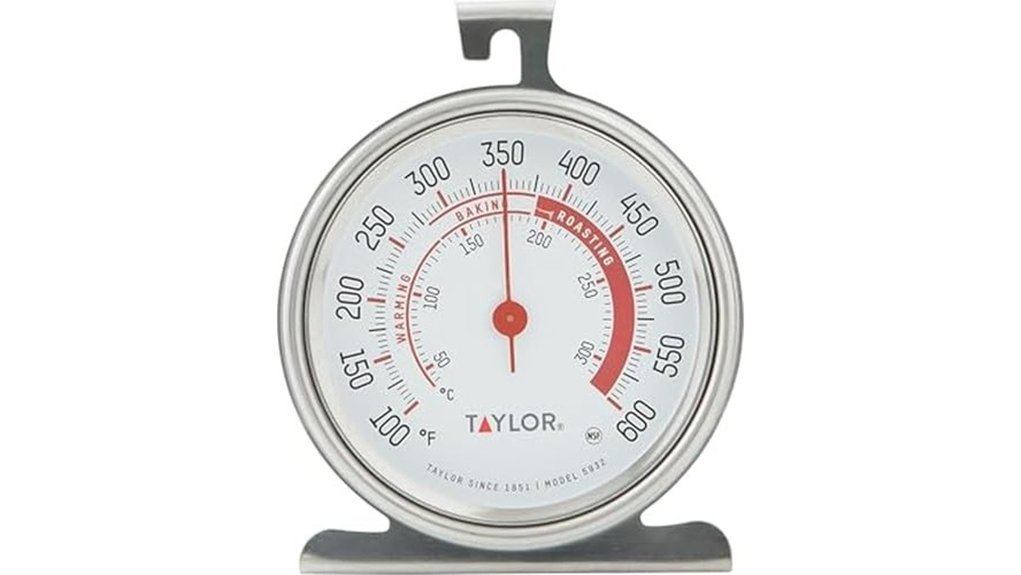
The Taylor Precision Products Large Dial Thermometer, Silver is a practical choice for home cooks who want an easy-to-read, reliable oven thermometer without extra complexity. Its extra-large 3-1/4-inch dial uses a glass lens and red pointer to make temperatures visible at a glance. The stainless steel body adds durability and corrosion resistance, while the NSF certification supports quality and cleanability. It reads from 100 to 600 degrees Fahrenheit, covering most oven needs. The design can hang from a rack or stand independently, giving flexible placement in busy kitchens.
Best For: Home cooks and bakers who want a simple, easy-to-read oven thermometer with a wide temperature range and durable stainless steel construction.
Pros:
- Large 3-1/4-inch dial with a glass lens and red pointer makes readings easy to see.
- Stainless steel build offers durability and corrosion resistance.
- NSF certification and flexible hang-or-stand design add convenience and confidence.
Cons:
- Only measures temperatures from 100 to 600°F, so it may not suit all specialized uses.
- No digital display or advanced features like alarms or timers.
- Silver dial style may be less visible in low-light kitchen settings.
Admetior Kitchen Oven Thermometer
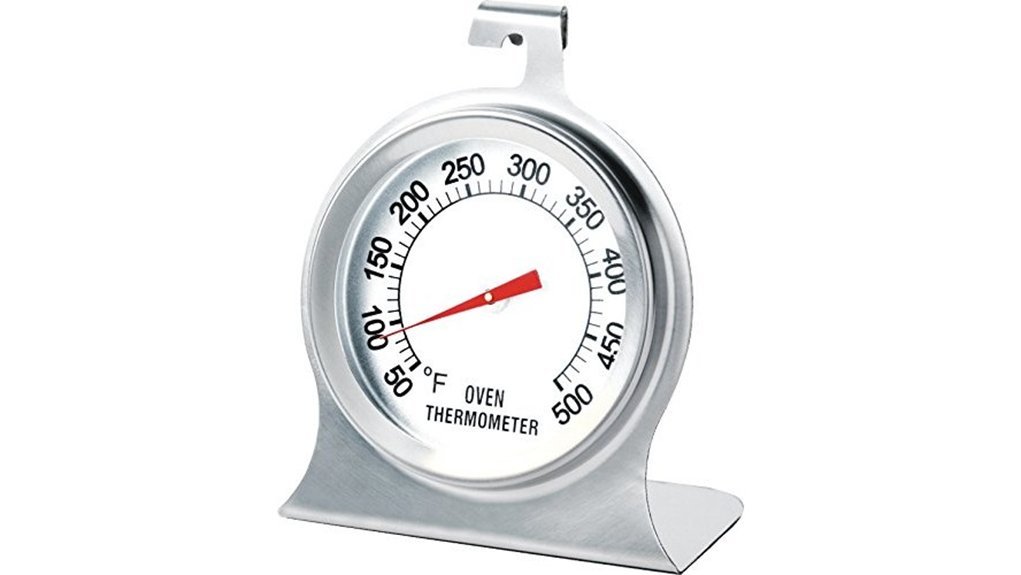
Admetior’s compact stainless-steel dial suits cooks who want a simple, oven-safe temperature check. The Admetior Kitchen Oven Thermometer, model T803BH, uses 18/0 stainless steel in a silver finish and keeps a modest 1.7-inch dial. Its 50°F to 500°F range covers common baking and roasting temperatures, while the oven-safe build supports continuous use inside the appliance. A hanger and stand add placement flexibility, letting it rest on a rack or sit upright. As a kitchen-category tool, it emphasizes straightforward function over complexity.
Best For: Home cooks and bakers who want a simple, oven-safe thermometer for quick temperature checks in standard baking and roasting ranges.
Pros:
- Oven-safe design supports continuous use inside the oven.
- Hanger and stand provide flexible placement options.
- 50°F to 500°F range covers most common cooking temperatures.
Cons:
- Small 1.7-inch dial may be harder to read at a glance.
- Lacks advanced features or digital precision.
- Basic design may not suit users wanting extra functionality.
Cooper-Atkins Stainless Steel Oven Thermometer 100-600°F
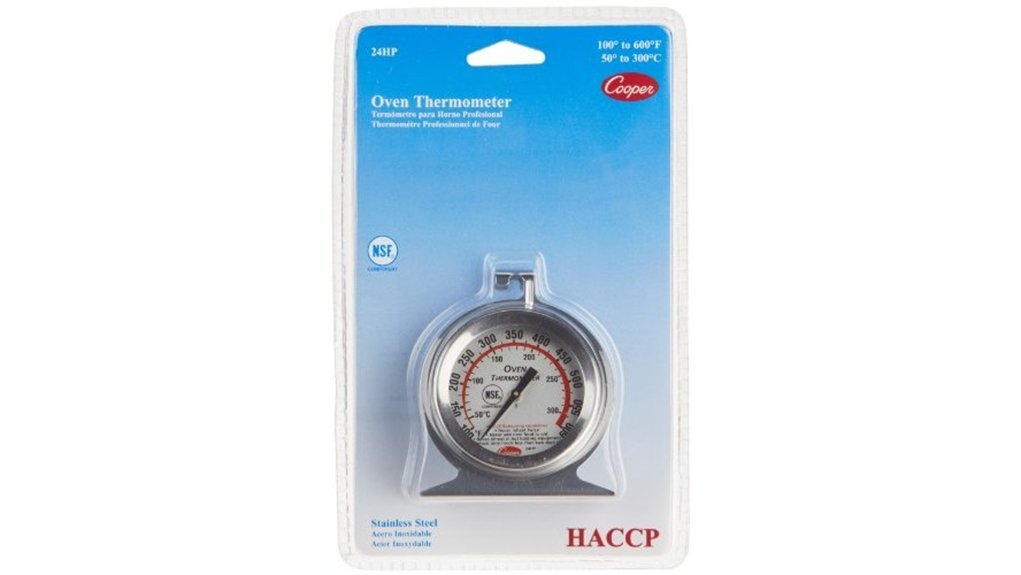
Built for dependable high-heat readings, the Cooper-Atkins 24HP-01-1 suits serious home cooks and commercial kitchens alike. This stainless steel bi-metal oven thermometer measures from 100 to 600°F, or 50 to 300°C, making it useful for a wide range of baking and roasting tasks. Its glass lens and stainless steel housing support durability in demanding environments. The dial follows HACCP reference standards, and NSF approval adds credibility for food-service use. With an accuracy of +/- 25°F, it offers practical monitoring rather than precision calibration, but remains a solid, easy-to-read choice.
Best For: Home cooks and food-service users who need a durable, easy-to-read oven thermometer for monitoring high-heat baking and roasting.
Pros:
- Wide temperature range from 100 to 600°F (50 to 300°C)
- Stainless steel housing with glass lens for durability
- NSF approved with HACCP dial reference for kitchen use
Cons:
- Accuracy of +/- 25°F is not ideal for precision work
- Bi-metal design may respond more slowly than digital thermometers
- Best suited for monitoring oven temperature, not exact food temperature
AcuRite 00620A2 Stainless Steel Oven Thermometer (150°F to 600°F)
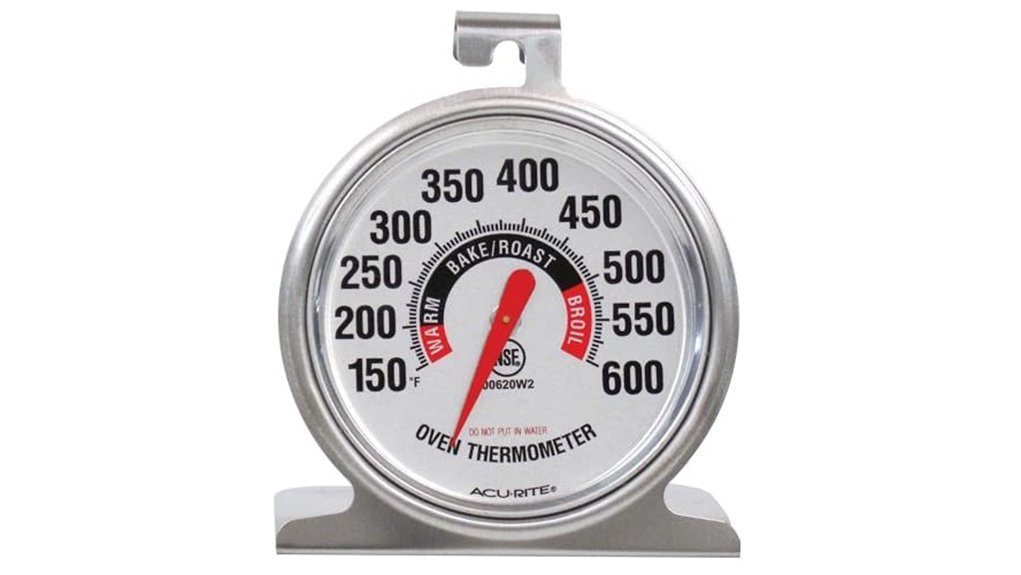
AcuRite’s 00620A2 suits cooks needing a rugged, leave-in thermometer for ovens and grills. Its stainless steel body and protective glass lens are built for repeated exposure to high heat, while the 150°F to 600°F range covers most baking and roasting tasks. The unit can hang from a rack or stand upright on its base, giving it flexible placement inside the cooking cavity. This simple analog design focuses on durability and straightforward monitoring rather than added features, making it a practical option for kitchens that value reliability and versatile, high-temperature performance.
Best For: Home cooks and bakers who want a durable, leave-in oven or grill thermometer with simple, reliable temperature monitoring.
Pros:
- Stainless steel construction and protective glass lens help it withstand high heat and repeated use.
- Wide 150°F to 600°F range works well for baking, roasting, and grilling.
- Can hang from a rack or stand upright for flexible placement.
Cons:
- Analog design lacks advanced features like alarms or digital readouts.
- No remote monitoring or smart connectivity.
- Basic functionality may be less precise than higher-end digital thermometers.
CDN Oven Thermometer ProAccurate® with 2″ Dial
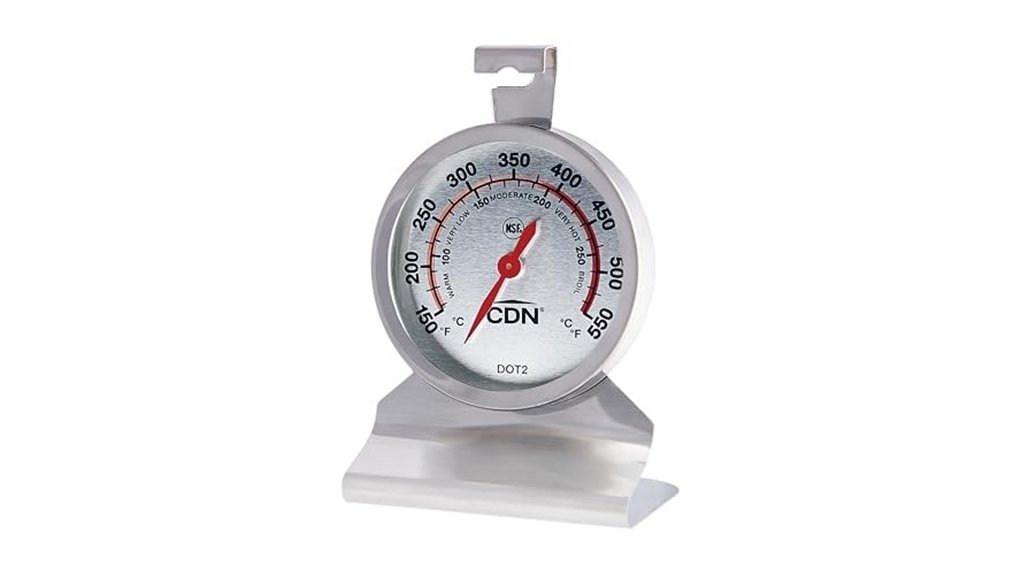
The CDN ProAccurate® suits bakers and roasters who need dependable, precise oven readings. Its 2-inch dial covers 150 to 550°F, with clear WARM-to-BROIL zones that help maintain accurate cooking temperatures. The stainless steel housing and laboratory glass lens are built for ovenproof durability, while the silver design remains practical and unobtrusive. Two mounting options, stand or hang, add placement flexibility. NSF certification supports confidence in its professional-grade reliability. As a CDN Model DOT2, it also helps verify oven thermostat calibration for consistent results.
Best For: Bakers, roasters, and home cooks who need a reliable, easy-to-read oven thermometer for maintaining accurate cooking temperatures and checking oven calibration.
Pros:
- Clear 2-inch dial with WARM-to-BROIL zones for easy temperature reading
- Ovenproof stainless steel housing and laboratory glass lens for durability
- Two mounting options, stand or hang, for flexible placement
Cons:
- Analog dial may be less precise than digital temperature displays
- Small 2-inch size may be harder to read from a distance
- Designed specifically for oven use, so it has limited versatility
Winco 3″ Dial Clear Oven Thermometer
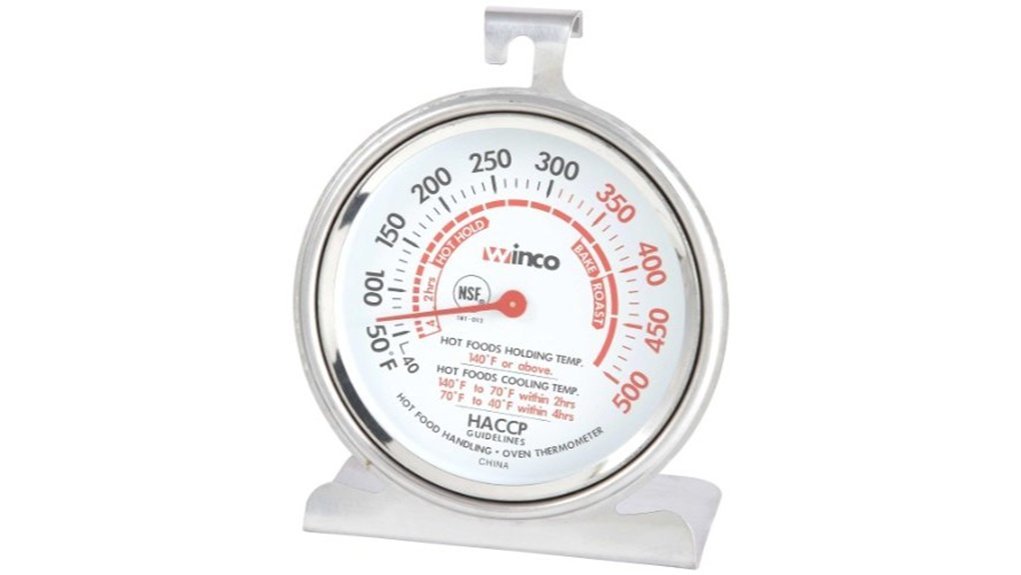
Winco’s 3-inch dial oven thermometer suits busy kitchens needing reliable, easy-to-read temperature checks. The white dial provides clear visibility, while the 40° to 500°F range supports everything from low-heat warming to high-temperature roasting. Built by Winco USA as model TMT-OV3, it is designed for demanding kitchen use. Its robust construction helps it withstand frequent handling. HACCP compliance and NSF certification add confidence in food safety and professional standards. For operators seeking a practical, durable thermometer, it offers straightforward performance without unnecessary complexity.
Best For: Busy kitchens, food service operators, and home cooks who need a durable, easy-to-read oven thermometer for reliable temperature checks across a wide range.
Pros:
- Clear 3-inch dial makes temperature readings easy to see at a glance.
- Wide 40° to 500°F range works for both low-heat warming and high-heat roasting.
- HACCP compliance and NSF certification support food safety and professional use.
Cons:
- Analog dial design may be less precise than digital thermometers for some users.
- Basic feature set may not suit those wanting alarms or advanced monitoring.
- White face may be harder to read in low-light kitchen environments.
OXO Good Grips Oven Thermometer
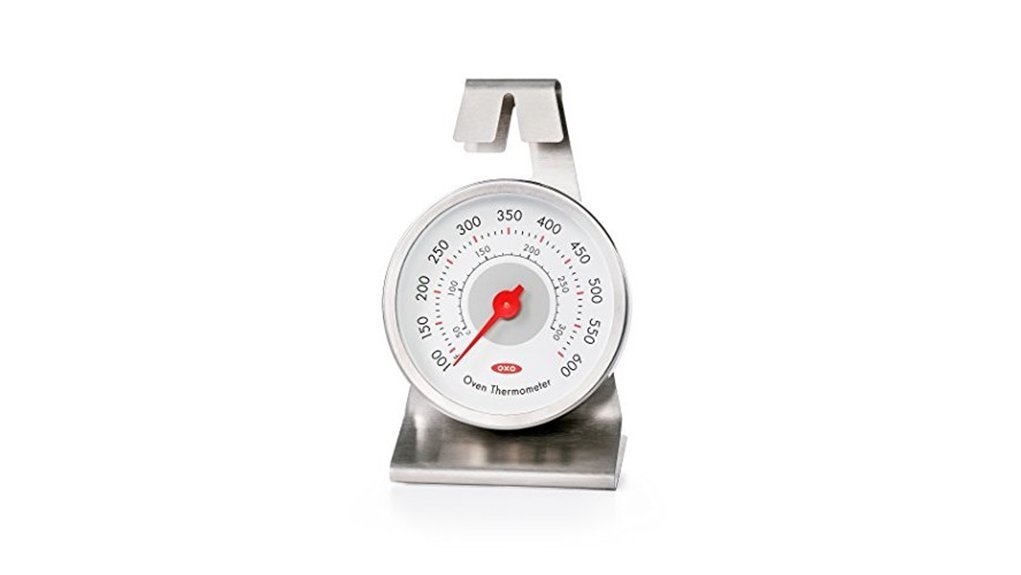
OXO’s Good Grips Oven Thermometer suits home cooks who want dependable, easy-to-read temperature control. Its large numbers display both Fahrenheit and Celsius clearly, while the wide, angled base keeps it steady when standing inside the oven. A two-point hook secures it to thin or thick wires, helping it stay put during loading and unloading. Positioned near the food, it delivers reliable readings for more consistent oven heat. The silver, one-size design from OXO, model 11133600, fits the kitchen well and supports precise everyday baking and roasting tasks.
Best For: Home cooks and bakers who want a dependable, easy-to-read oven thermometer for precise temperature control.
Pros:
- Large numbers show both Fahrenheit and Celsius clearly for quick reading.
- Wide, angled base helps keep the thermometer stable inside the oven.
- Two-point hook secures it to thin or thick wires and helps it stay in place.
Cons:
- It only measures oven temperature, so it has limited use beyond baking and roasting.
- Accuracy depends on placement near the food and proper positioning in the oven.
- The one-size design may not suit every oven setup or preference.
Rubbermaid Stainless Steel Oven/Grill Monitoring Thermometer
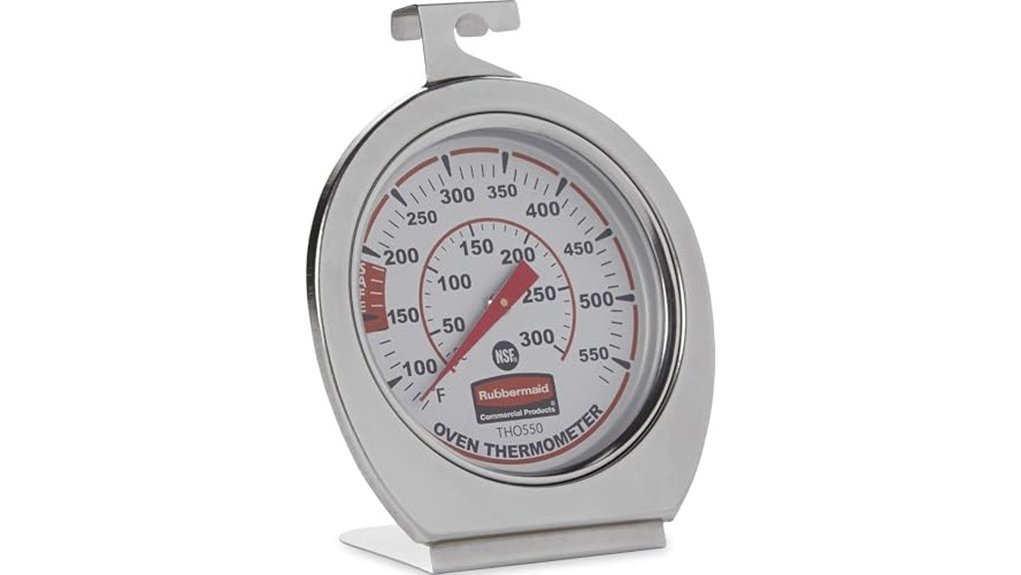
With its instant, battery-free readout, the Rubbermaid Commercial Products Stainless Steel Monitoring Thermometer suits cooks who value reliability. Model FTGRO550 offers a 60° to 580°F range, or 20° to 300°C, giving a clear true-temperature reading for safer food preparation. Its stainless steel body and shatter-proof lens support durability in demanding kitchens. NSF certification adds food-safety confidence. The thermometer works in traditional ovens, toaster ovens, grills, smokers, and similar appliances. It may be hung or stood for flexible placement, making it a practical, low-maintenance option for consistent heat monitoring.
Best For: Home cooks, grill enthusiasts, and professional kitchen users who want a durable, battery-free thermometer for accurate oven, grill, and smoker temperature monitoring.
Pros:
- Instant, battery-free temperature readings for convenient use
- Durable stainless steel construction with a shatter-proof lens
- NSF certified and versatile for ovens, grills, smokers, and more
Cons:
- Mechanical design may be less precise than digital thermometers
- No backlight or digital display for low-light reading
- Requires physical placement inside the cooking appliance, which may limit visibility
KT THERMO Oven Thermometer 150-600°F Stainless Steel
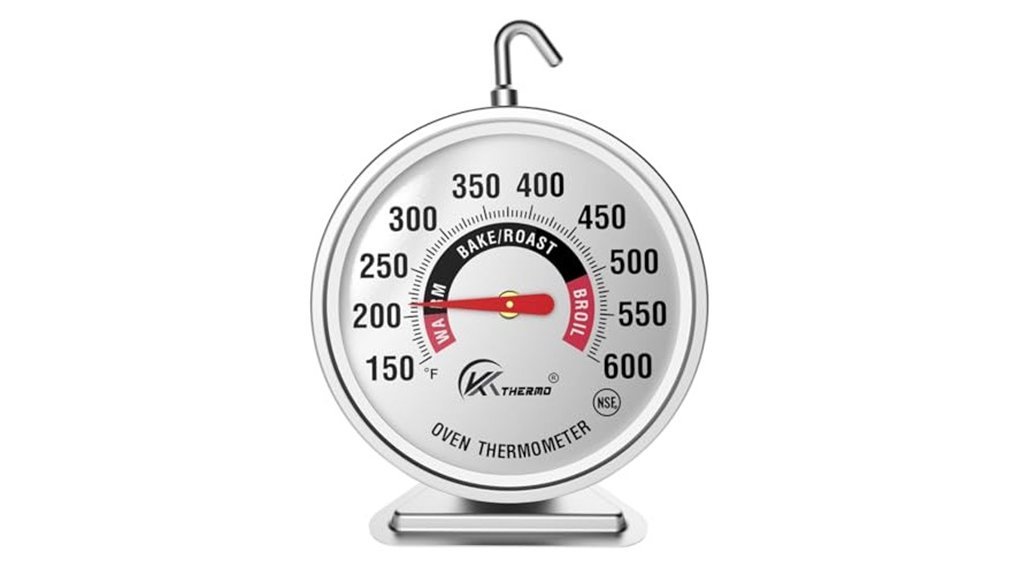
KT THERMO suits cooks who need a readable, leave-in thermometer for high-heat ovens. The stainless steel body and toughened glass lens support durability, while the large dial uses clear blue and red zones to simplify temperature checks. Its 150-600°F range covers conventional ovens, toaster ovens, grills, and smokers. A 360° rotating hook allows flexible placement on racks or shelves. The 3-inch silver design is intended for easy cleaning and long-term use, with dial colors made to resist fading.
Best For: Home cooks, grillers, and bakers who want a durable, easy-to-read leave-in oven thermometer for monitoring high-heat cooking.
Pros:
- Large dial with clear blue and red zone indicators makes temperature checks easy at a glance.
- Stainless steel body and toughened glass lens support durability and long-term use.
- 360° rotating hook allows flexible placement on oven racks, shelves, grills, or smokers.
Cons:
- Analog dial may be less precise than digital thermometers for exact temperature readings.
- 150°F minimum range may be too high for low-temperature cooking applications.
- 3-inch size may be smaller than some users prefer for viewing from a distance.
Factors to Consider When Choosing Oven Thermometers 2026: Top Picks and Buying Guide
When selecting an oven thermometer in 2026, attention typically centers on temperature range, accuracy levels, dial size, material quality, and mounting options. A wider range and reliable calibration can improve usefulness across different cooking tasks, while a clear dial and durable construction support easier reading and longer service life. Mounting style also matters, since placement affects visibility and how consistently the thermometer reflects oven conditions.
Temperature Range
Temperature range is one of the most important factors in choosing an oven thermometer, since most models cover roughly 100°F to 600°F and should match the demands of the cook’s preferred methods. A broader span supports more cooking styles, from low-temperature baking to high-heat roasting, and it can also suit grills or smokers when the device is built for those appliances. The full range should be readable at a glance, so clear markings and easy-to-spot indicators matter during active cooking. Some thermometers are intended only for ovens, while others are better matched to specialized equipment. Selecting a model with a suitable range helps guarantee it remains useful across everyday recipes and more demanding techniques without forcing constant replacement.
Accuracy Levels
Accuracy levels should be a top priority because even small deviations can affect baking and roasting results. Most oven thermometers advertise accuracy within about ±1°F to ±25°F, but that figure may change across the temperature range. The most reliable models state accuracy at several specific points, allowing a clearer picture of performance during low-heat baking and high-heat roasting. NSF-certified thermometers are often preferred because they tend to meet stricter standards for dependable readings. Long-term consistency also matters, since heat exposure can gradually reduce reliability. A thermometer that stays steady over time supports better results in demanding ovens. Clear temperature indications, whether through a simple dial or digital display, help users verify readings quickly and cook with greater confidence.
Dial Size
Beyond accuracy, dial size plays a major role in how practical an oven thermometer is in daily use. A larger dial, usually 3 inches or more, improves visibility and lets users check temperatures quickly in a busy kitchen without leaning in. It also tends to provide more detailed markings, which can support finer readings than smaller models. By contrast, dials around 1.7 inches may be harder to read from a distance, increasing the chance of cooking at the wrong temperature. Dial size can also affect appearance, helping the thermometer blend with or stand out in kitchen decor. In addition, larger dials may offer better stability when mounted or hung, making them easier to position securely and use consistently.
Material Quality
Material quality is a key indicator of how well an oven thermometer will hold up over time. High-quality models are often built from stainless steel, valued for durability, corrosion resistance, and the ability to withstand high heat without warping. The lens also matters: glass lenses generally provide clearer visibility and better heat resistance than plastic, helping preserve accurate readings through repeated use. A sturdy build is important in busy kitchens, where frequent handling can quickly expose weak materials. NSF certification adds another layer of confidence by signaling that the thermometer meets recognized safety and sanitation standards for food preparation. Material choice affects upkeep as well; stainless steel is easier to clean and maintain, supporting better hygiene and long-term reliability in demanding cooking environments.
Mounting Options
Mounting options often determine how practical an oven thermometer is in daily use. Many models offer flexible placement, either hanging from an oven rack or standing upright on a flat surface. This versatility helps suit different oven layouts and cooking habits. A 360° rotating hook is especially useful because it lets the thermometer be repositioned for the clearest angle without removing it. Some thermometers use integrated hangers that secure firmly to racks, reducing the chance of slipping during cooking. The option to stand alone or hang also makes it easier to adapt the thermometer to varying dishes, rack heights, and oven sizes. Reliable mounting improves usability by keeping the device stable when food is added or removed, which supports consistent monitoring throughout cooking.
Readability Features
Readability features can make the difference between a thermometer that gets used often and one that is ignored during busy cooking. A larger dial, ideally 3 inches or more, improves visibility and lets temperature be checked at a glance. Large, bold numbers are especially useful in hectic kitchens, where quick reading matters. Color-coded zones add another layer of convenience, with blue marking lower temperatures and red highlighting higher ones. A clear glass lens protects the dial while reducing glare, helping the numbers stay legible from different angles. Stability also affects readability; angled bases or hooks can keep the thermometer positioned for consistent viewing. Together, these features support fast, accurate monitoring without unnecessary strain or distraction during cooking.
Certification Standards
Beyond visibility and ease of use, certification standards add another layer of confidence when selecting an oven thermometer. NSF certification and similar labels show that a product has met safety and sanitation requirements for food preparation. These certifications also signal rigorous testing for accuracy, durability, and cleanability, helping buyers expect dependable readings over time. In demanding kitchens, certified models may better resist high heat and frequent handling, lowering the chance of failure during cooking. Compliance with recognized standards can also support professional operations by aligning with industry regulations and best practices. For home cooks and professionals alike, choosing a certified thermometer increases trust in performance, supports food safety, and can contribute to more consistent cooking results without adding unnecessary complexity to the buying decision.
Oven Compatibility
Oven fit is a practical starting point when selecting a thermometer, since the device must match the heat demands and layout of the appliance it will monitor. A suitable model should cover roughly 50°F to 600°F so it can handle low-temperature roasting, standard baking, and hotter cooking tasks. Leave-in construction matters because the thermometer may sit inside the oven for long periods without heat damage. Mounting style also affects compatibility; hangable or upright designs can suit different rack arrangements and cavity shapes. Clear, easy-to-read dials help users check temperatures quickly during active cooking. Durable materials such as stainless steel and glass improve longevity and resistance to repeated exposure. Together, these traits determine whether a thermometer works reliably in a given oven.
Frequently Asked Questions
How Often Should Oven Thermometers Be Calibrated?
Oven thermometers should generally be calibrated every six months, or whenever accuracy seems questionable. They should also be checked after drops, extreme temperature changes, or repeated use, since drift can gradually affect readings.
Can Oven Thermometers Stay Inside During Self-Cleaning Cycles?
No; during self-cleaning cycles, oven thermometers should be removed, as the heat can damage them. Like a watch left in a furnace, they may warp or fail, leaving readings unreliable afterward.
Do Digital Oven Thermometers Read Faster Than Analog Models?
Yes, digital oven thermometers usually read faster than analog models because electronic sensors respond quickly. Analog versions often lag slightly, though they can remain accurate once stabilized. Speed, however, varies by design and quality.
Are Oven Thermometers Accurate in Convection Ovens?
Yes, oven thermometers can be accurate in convection ovens, though placement matters because circulating air creates temperature variation. A detached observer would note that frequent calibration and avoiding direct fan exposure improve reliability.
How Do I Clean an Oven Thermometer Safely?
Gentle, careful cleaning keeps the thermometer safe: they should cool fully, then be wiped with a damp cloth and mild soap, avoiding immersion, abrasives, or harsh chemicals; drying thoroughly prevents damage and drift.
Conclusion
Choosing the right oven thermometer can make the difference between uneven results and reliable cooking. From budget-friendly picks to professional-grade models, the best options offer clear readings, durable construction, and wide temperature ranges. For example, a home baker using a precise thermometer may finally stop burning cookie bottoms while getting evenly risen cakes. In the end, the right tool helps reduce guesswork, improve consistency, and make every recipe more dependable.