Updated August 2026.
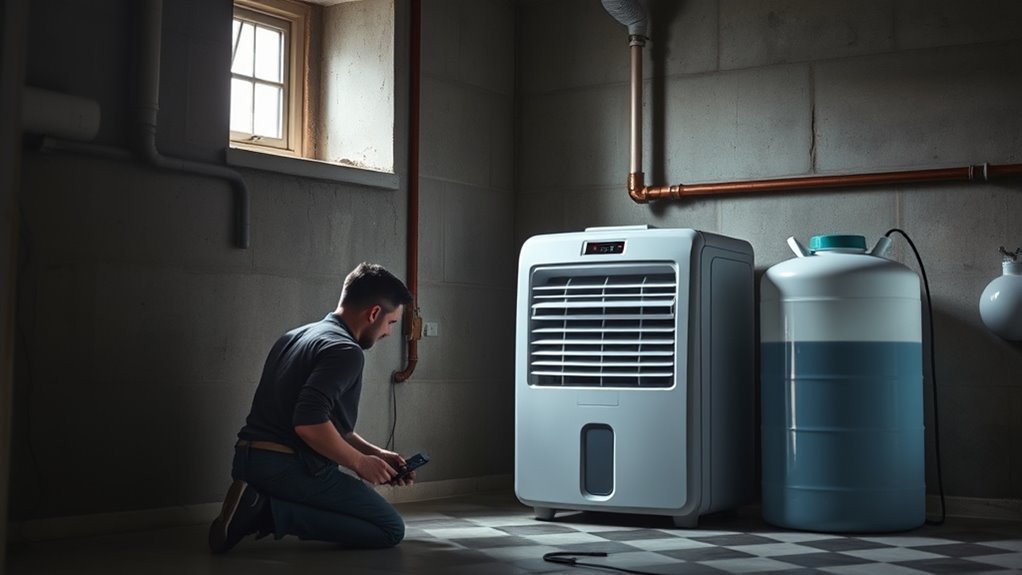
If you need a dehumidifier for a cool basement, garage, storage room, or lower-temperature living space, check the documented minimum operating temperature before looking at square-foot coverage. Cooler air contains less moisture, and frost can form on the refrigerated coils of a compressor dehumidifier, reducing how much water it collects.
The three strongest matches retained in this guide are the Waykar PD160B-PRO, Aiusevo AS320, and VEAGASO VG380. Each has automatic defrost and a documented operating range that begins at approximately 41°F. These models may suit a cool basement or other above-freezing room, but none should be treated as a compressor dehumidifier for freezing conditions.
Quick Verdict
Best Overall: The Waykar PD160B-PRO combines a documented 41°F minimum operating temperature, automatic defrost, ENERGY STAR certification, adjustable humidity control, quiet-operation positioning, and continuous gravity drainage.
Best High-Capacity Pick: The Aiusevo AS320 has the highest advertised warm-condition extraction and coverage figures in this group, making it the strongest candidate for a larger open basement with a substantial moisture load.
Best Value and Simple-Control Pick: The VEAGASO VG380 includes automatic defrost, three operating modes, a drain hose, and straightforward controls. Its manual also provides useful capacity figures at several temperature and humidity conditions.
Important: All three are compressor dehumidifiers rated to operate from approximately 41°F. For a garage, shed, boat, or seasonal property that regularly approaches freezing, investigate a true cold-rated desiccant dehumidifier instead.
Quick Comparison of the Best Dehumidifiers for Lower Temperatures
| Product | Best For | Documented Operating Range | Advertised Maximum Capacity | Cooler or Standardized Reference | Stated Coverage | Drainage | Amazon |
|---|---|---|---|---|---|---|---|
| Waykar PD160B-PRO | Best Overall | Approximately 41°F to 89.6°F | Up to 34 pints/day at 95°F and 90% RH | 10.16 pints/day under the applicable ENERGY STAR test procedure | Up to 2,000 sq. ft. | 0.62-gallon tank or included gravity-drain hose; no built-in pump | Check Details |
| Aiusevo AS320 | Large Open Basements | Approximately 41°F to 95°F | Up to 52 pints/day at 95°F and 90% RH | No separate standardized capacity was verified for this comparison | Up to 5,000 sq. ft. | 0.66-gallon tank or gravity-drain hose; no verified built-in pump | Check Details |
| VEAGASO VG380 | Value and Simple Controls | Approximately 41°F to 95°F | Up to 34 pints/day at 95°F and 90% RH | 8.5 pints/day at 65°F and 60% RH in the manual | Up to 2,500 sq. ft. | Two-liter tank or included gravity-drain hose; no built-in pump | Check Details |
How We Selected These Dehumidifiers
These recommendations were selected by prioritizing specifications that matter in a lower-temperature, above-freezing room:
- A documented minimum operating temperature instead of an unsupported “cold-room” claim.
- Automatic defrost to manage temporary frost on the evaporator coils.
- Adjustable humidity control rather than a basic on-and-off switch.
- Continuous gravity drainage for basements and other spaces that may be left unattended.
- Enough capacity for the moisture load, with clear separation between warm-condition maximums and cooler-condition performance.
- Honest limitations involving pumps, tank size, room layout, test conditions, and advertised coverage.
No claim is being made that these products were personally tested. Rankings are based on documented specifications, certification information where available, feature sets, and suitability for the article’s lower-temperature buyer intent.
Waykar PD160B-PRO Energy Star Dehumidifier
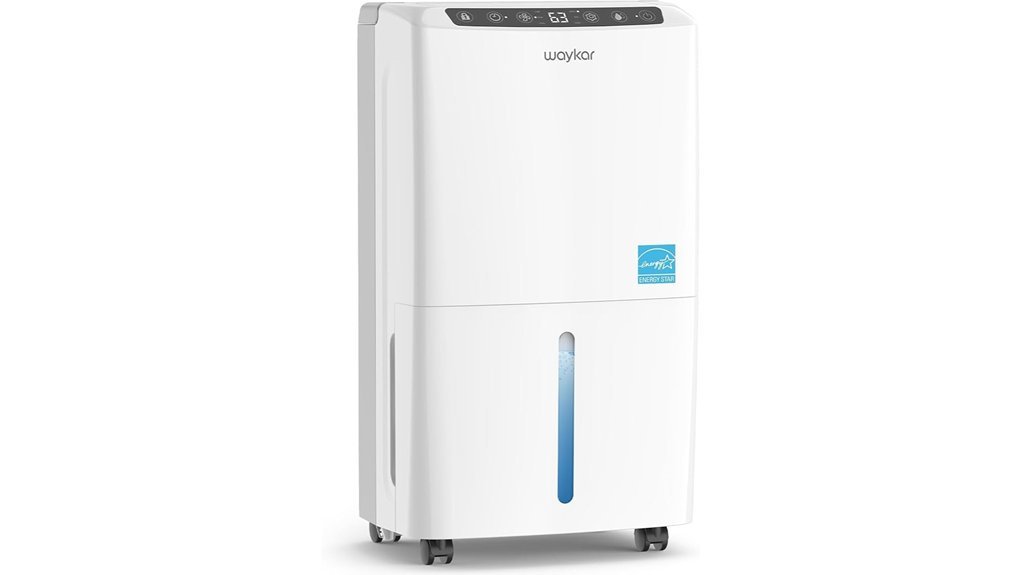
The Waykar PD160B-PRO is the strongest all-around option in this group because it combines a documented 41°F minimum operating temperature, automatic defrost, verified ENERGY STAR certification, adjustable humidity control, and continuous gravity drainage.
The manufacturer advertises removal of up to 34 pints per day at 95°F and 90% relative humidity. Under the applicable ENERGY STAR test procedure, the model has a listed water-removal capacity of 10.16 pints per day. That difference demonstrates why buyers should not compare warm-condition headline numbers with standardized basement-condition ratings as though they were identical.
The recommended operating range is approximately 41°F to 89.6°F. Automatic defrost can clear temporary frost within that range, but extraction will still decline as the room approaches the lower limit.
Why You’ll Like It
- The documented 41°F minimum makes it a clearer cool-basement option than models with no published temperature range.
- Automatic defrost helps manage frost during cooler operation.
- The EPA product finder lists the PD160B-PRO as ENERGY STAR certified and carrying a Most Efficient designation.
- The adjustable humidistat supports a target range rather than continuous uncontrolled operation.
- An included drain hose supports continuous gravity drainage.
- The manufacturer lists a minimum noise level of approximately 33 dB.
Best For: A moderately cool basement, bedroom, office, storage room, or living area that normally remains at or above 41°F and has access to a lower drain.
Who Should Avoid It: Buyers with a near-freezing garage or anyone who needs to move water upward to a sink or window. This model does not include a built-in condensate pump.
Pros:
- Documented operation down to approximately 41°F.
- Automatic defrost and adjustable humidity control.
- ENERGY STAR certification provides a verified efficiency reference.
- Included hose and removable washable filter.
- Two fan speeds and automatic restart features.
Cons:
- The 34-pint headline capacity is measured in much warmer and more humid conditions than a typical basement.
- The 0.62-gallon tank may fill frequently under a heavy moisture load.
- Gravity drainage requires the hose to remain below the drain outlet.
- The lowest noise claim may apply only under a lower fan or operating condition.
Aiusevo AS320 5000 Sq. Ft Dehumidifier with Drain Hose
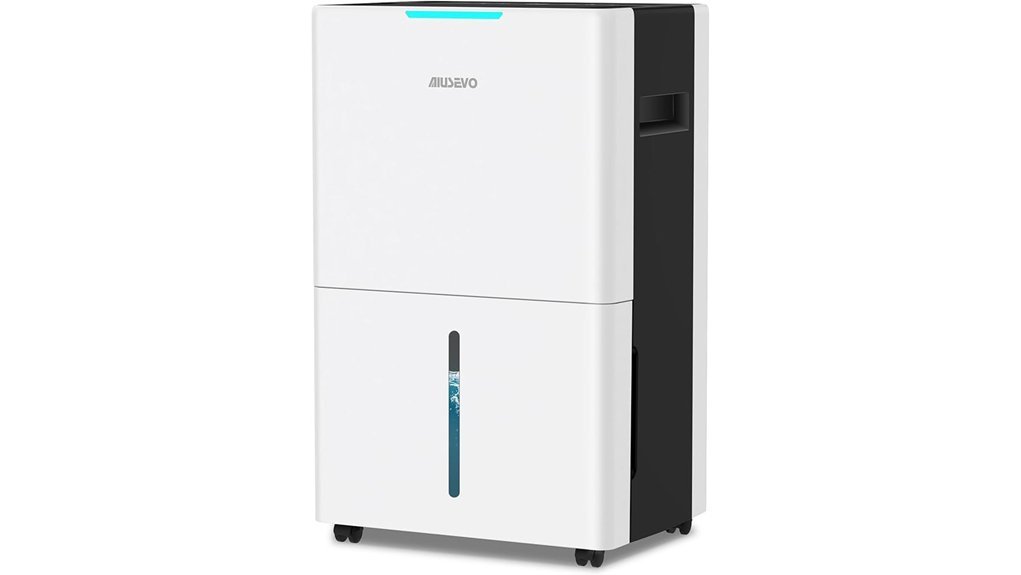
The Aiusevo AS320 is the highest-advertised-capacity option retained in this roundup. Its manual documents an operating range of approximately 41°F to 95°F, while the product information advertises up to 52 pints of moisture removal per day at 95°F and 90% relative humidity.
It also includes automatic defrost, adjustable humidity control, three operating modes, a child lock, a 24-hour timer, a washable filter, a removable tank, and a continuous-drain connection. These features make it a reasonable candidate for a larger open basement that remains above freezing.
The advertised 5,000-square-foot coverage should be treated as a broad maximum rather than a sizing guarantee. Room divisions, low temperature, air leakage, ceiling height, standing water, and poor circulation can reduce effective coverage significantly.
Why You’ll Like It
- The manual documents operation from approximately 41°F to 95°F.
- Automatic defrost supports operation in the cooler part of that range.
- Its advertised maximum extraction is the highest among the three retained products.
- DEHU, DRY, and CONT modes cover normal humidity control, laundry support, and continuous operation.
- Continuous drainage reduces the need to empty the tank manually.
- Caster wheels and a handle help with movement across an open floor.
Best For: A larger open basement, laundry area, storage room, or above-freezing garage with a heavier moisture load and access to a lower drain.
Who Should Avoid It: Buyers choosing only from the 5,000-square-foot claim or expecting 52 pints of collection in a 41°F room. It is also unsuitable when water must be pumped upward unless a separate condensate pump is added.
Pros:
- Documented minimum operating temperature of approximately 41°F.
- Highest advertised warm-condition extraction in the retained list.
- Automatic defrost and adjustable humidity control.
- Drain-hose connection, timer, child lock, and washable filter.
- Portable design for a larger compressor dehumidifier.
Cons:
- The 52-pint claim is measured at 95°F and 90% relative humidity.
- No separate standardized capacity was verified for this comparison.
- The 0.66-gallon tank may fill quickly without continuous drainage.
- Advertised coverage does not guarantee even performance through closed rooms.
- No verified built-in condensate pump.
VEAGASO VG380 2500 Sq. Ft Dehumidifier with Drain Hose
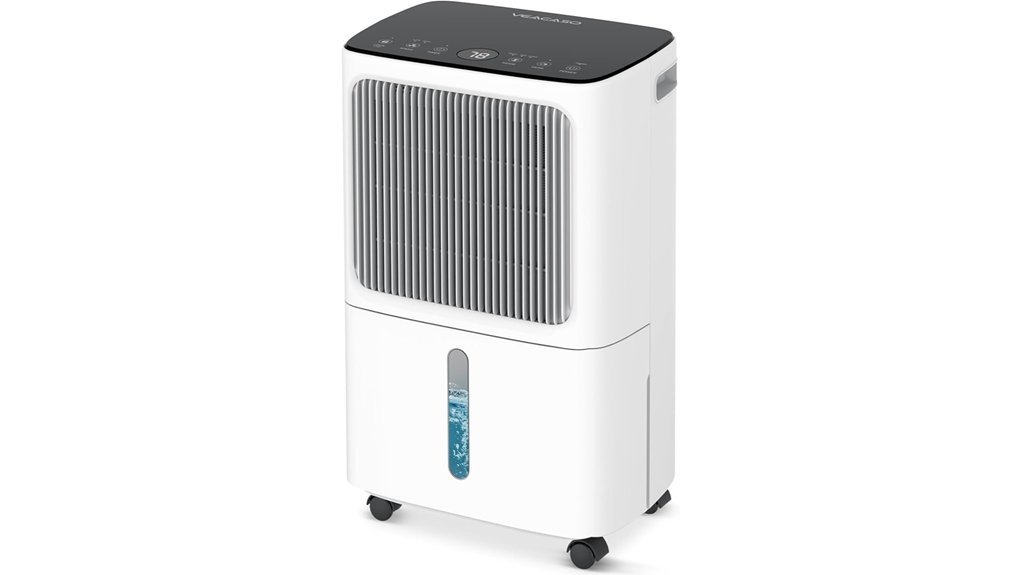
The VEAGASO VG380 is a straightforward compressor dehumidifier with a documented operating range of approximately 41°F to 95°F. It includes automatic defrost, adjustable humidity control, three operating modes, two fan speeds, a timer, a washable filter, a two-liter tank, and continuous gravity drainage.
Its manual provides more useful temperature-dependent capacity information than a single headline figure. The listed extraction rates include approximately 34 pints per day at 95°F and 90% RH, 27 pints at 86°F and 80% RH, 13 pints at 80°F and 60% RH, and 8.5 pints at 65°F and 60% RH.
Those figures help set realistic expectations: the unit can operate in a cooler room, but water collection drops substantially as temperature and available moisture decrease.
Why You’ll Like It
- The operating range is documented down to approximately 41°F.
- Automatic defrost helps clear temporary frost within the approved range.
- DEHU, DRY, and CONT modes are straightforward to understand.
- The included hose supports continuous gravity drainage.
- The manual provides capacity figures at several temperature and humidity conditions.
- The manufacturer lists operating noise at around 40 dB.
Best For: Buyers who want uncomplicated controls and transparent performance information for a cool basement, bedroom, laundry area, bathroom, or storage room.
Who Should Avoid It: Anyone whose room falls below 41°F or who needs a built-in pump to lift water to a higher drain.
Pros:
- Documented 41°F to 95°F operating range.
- Automatic defrost and adjustable humidity control.
- Multiple documented capacity test conditions.
- Three operating modes and two fan speeds.
- Included drain hose and washable filter.
- Simple physical controls without required app setup.
Cons:
- The two-liter tank may fill frequently in very damp conditions.
- Output at 65°F and 60% RH is much lower than the 34-pint warm-condition maximum.
- No built-in condensate pump.
- The 2,500-square-foot claim should not replace moisture-load calculations.
Factors to Consider When Choosing a Dehumidifier for Lower Temperatures
Choosing a low-temperature dehumidifier requires more than matching an advertised square-foot number to your room. Measure the actual temperature and relative humidity, identify the moisture source, and check the manufacturer’s operating limits before buying.
Minimum Operating Temperature
The most important specification is the minimum operating temperature. All three compressor models retained in this guide document a lower operating limit of approximately 41°F.
That does not mean they remove their full advertised capacity at 41°F. It means 41°F is the lower boundary of the stated operating range. Near that limit, the machine may collect less water and spend more time in defrost mode.
If your room regularly approaches or falls below freezing, investigate a cold-rated desiccant dehumidifier. Desiccant units operate differently from the compressor models reviewed here and are often considered for unheated garages, sheds, boats, and seasonal properties.
Automatic Defrost Versus a Low-Temperature Rating
Automatic defrost responds when frost develops on the evaporator coils. The compressor pauses while the fan or control system helps clear the ice. Normal dehumidification resumes after the coils warm sufficiently.
Defrost protects operation, but it does not expand the approved temperature range indefinitely. A documented minimum temperature is more useful than an automatic-defrost claim by itself.
Frequent defrost cycles also reduce active moisture-removal time. A machine may appear to run normally while collecting relatively little water in a very cool room.
Compressor, Semiconductor, or Desiccant
- Compressor dehumidifiers: Effective for normal indoor rooms and many cool basements. A documented operating range and automatic defrost are important.
- Semiconductor or Peltier dehumidifiers: Compact and quiet but generally intended for smaller enclosures and light condensation. Do not assume they can manage a wet basement.
- Desiccant dehumidifiers: Often considered for colder, unheated locations because they do not depend on a refrigerated evaporator coil in the same way.
Capacity and Test Conditions
A pint-per-day figure is meaningful only when its test conditions are known. Warm-condition marketing claims may be measured at approximately 95°F and 90% relative humidity. Standardized portable-dehumidifier capacity is measured under cooler conditions intended to better represent common basement use.
A 45°F basement contains less removable water vapor than a 95°F test chamber. Even a model that remains operational at 41°F may collect only a small fraction of its warm-condition maximum.
Choose capacity based on the room and moisture load rather than the largest square-foot number. Consider:
- Floor area and ceiling height.
- Open layout versus multiple closed rooms.
- Lowest normal room temperature.
- Current relative humidity.
- Standing water, plumbing leaks, or foundation seepage.
- Outdoor air entering through doors, vents, windows, or cracks.
- Laundry, showers, cooking, or stored wet materials.
- Whether a fan is needed to improve airflow between areas.
Advertised Coverage Versus Real Room Performance
Advertised coverage figures such as 2,000, 2,500, or 5,000 square feet are broad manufacturer estimates. They do not account consistently for room temperature, ceiling height, water intrusion, air leakage, or closed doors.
For a divided basement, place the unit where air can circulate freely and keep interior doors open when practical. A single portable unit may not control humidity evenly across several isolated rooms.
Energy Efficiency Ratings
Dehumidifier efficiency is commonly expressed through an Integrated Energy Factor, measured in liters of water removed per kilowatt-hour of electricity. A higher value represents more water removal for the energy consumed under the specified test procedure.
ENERGY STAR certification is a more useful efficiency signal than an unsupported percentage-savings promise. Actual electricity use still depends on temperature, humidity, fan speed, selected set point, runtime, airflow, and filter maintenance.
A correctly sized unit may reach the selected humidity level and cycle off. An undersized machine may run continuously without controlling the room.
Drainage Options Available
The three retained models provide two basic drainage methods:
- Manual tank drainage: Simple to set up, but the compressor stops when the tank is full.
- Continuous gravity drainage: A hose carries water to a lower floor drain, sink, or suitable container. The hose must slope downward and remain free of kinks.
A drain-hose connection is not the same as a built-in pump. If water must move upward, across a long distance, or through a window, choose a pump-equipped model or use a compatible separate condensate pump.
Noise Level Considerations
Noise matters near a bedroom, office, nursery, or television area. Compare stated decibel figures, fan-speed options, compressor cycling, and vibration.
A minimum noise figure may represent the lowest fan setting under favorable conditions. The compressor, higher fan speed, defrost cycle, an uneven floor, or contact with nearby furniture can make operation more noticeable.
Humidity Setting
Many homes aim for approximately 30% to 50% relative humidity, but the practical target depends on outdoor conditions, room temperature, condensation, materials, and comfort. A setting around 45% to 50% is a reasonable starting point for many basements.
Use a separate hygrometer to compare with the machine’s display. Avoid forcing an unnecessarily low setting because that can increase runtime without solving an active leak or structural moisture problem.
Safety and Maintenance Features
Useful features include:
- Full-tank automatic shutoff.
- Automatic defrost.
- Automatic restart after a power interruption.
- Child lock.
- Washable air filter.
- Overheat or temperature protection.
- Clear water-level and error indicators.
Clean the filter according to the manual, keep the air inlet and outlet unobstructed, and inspect the drain hose regularly. Restricted airflow can reduce extraction and contribute to frost or overheating.
After transportation, allow the compressor dehumidifier to stand upright for the period specified in its manual before switching it on.
Before You Buy Checklist
- Measure the room’s lowest normal temperature.
- Confirm that the room normally remains at or above 41°F for these models.
- Check the exact model number and operating range in the current manual.
- Confirm automatic-defrost support.
- Compare standardized or cooler-condition capacity when available.
- Measure the room instead of relying only on the word “basement.”
- Use a hygrometer to verify actual relative humidity.
- Decide whether gravity drainage will work at the installation point.
- Check whether a separate condensate pump is required.
- Repair plumbing leaks, roof leaks, or foundation seepage first.
- Confirm warranty terms and access to replacement parts or support.
Frequently Asked Questions
What Temperature Is Too Low for These Dehumidifiers?
The Waykar PD160B-PRO, Aiusevo AS320, and VEAGASO VG380 have documented operating ranges that begin at approximately 41°F. Do not use them below the temperature stated in the current manual. A room that approaches or drops below freezing calls for a different category, such as a properly rated desiccant dehumidifier.
Will a Dehumidifier Remove Its Full Capacity at 41°F?
No. The minimum operating temperature is not a full-capacity rating. Extraction normally falls as temperature and available moisture decrease. Near 41°F, a compressor dehumidifier may collect much less water and enter automatic defrost more frequently.
Does Automatic Defrost Mean a Dehumidifier Works in a Freezing Garage?
No. Automatic defrost helps clear frost within the model’s intended operating range. It does not make a 41°F-rated compressor dehumidifier suitable for freezing conditions.
Which Dehumidifier Is Best for a Cool Basement?
The Waykar PD160B-PRO is the strongest all-around choice in this group because it combines a documented 41°F minimum operating temperature, automatic defrost, EPA-listed ENERGY STAR certification, adjustable humidity control, and continuous gravity drainage.
Which Option Is Best for a Large Basement?
The Aiusevo AS320 has the highest advertised warm-condition capacity and coverage figures among the retained products. It is the strongest candidate for a large open basement, but room divisions, low temperature, leakage, and the actual moisture source matter more than the 5,000-square-foot claim alone.
Which Model Has the Clearest Cooler-Condition Capacity Information?
The VEAGASO VG380 manual provides several temperature-dependent figures, including approximately 8.5 pints per day at 65°F and 60% relative humidity. This gives buyers more realistic context than a warm-condition maximum by itself.
Is a Drain Hose the Same as a Pump?
No. A standard drain hose normally relies on gravity and must run downward to a suitable drain. A pump can move collected water upward or across a longer distance. The retained products should not be treated as having built-in pumps unless the current product documentation specifically says otherwise.
Why Does My Dehumidifier Run Without Collecting Much Water?
Possible reasons include low room temperature, low absolute moisture content, a dirty filter, blocked airflow, an incorrect humidity setting, frequent defrost cycles, a full or incorrectly installed tank, a blocked drain hose, or a mechanical fault.
Compare the display with a separate hygrometer and follow the troubleshooting instructions for the exact model.
What Humidity Setting Should I Use?
A target around 45% to 50% relative humidity is a practical starting point for many basements. Adjust it based on condensation, comfort, outdoor conditions, and building materials. Avoid an unnecessarily low setting that causes continuous runtime without a useful benefit.
Can a Dehumidifier Remove Mold?
No. A dehumidifier may reduce the moisture conditions that support additional growth, but it does not remove existing mold or repair the leak that caused it. Existing contamination should be cleaned or remediated using appropriate safety practices.
How Often Should I Clean the Filter?
Follow the exact model’s manual. Inspect the filter more frequently in a dusty basement, garage, storage room, or laundry area. A clogged filter reduces airflow, lowers extraction, and may contribute to frost buildup.
Final Recommendation
The Waykar PD160B-PRO is the best overall option in this comparison for a moderately cool room because it combines a documented operating range beginning at approximately 41°F, automatic defrost, verified ENERGY STAR certification, adjustable humidity control, and continuous gravity drainage.
Choose the Aiusevo AS320 when you need the highest advertised capacity for a larger open basement. Choose the VEAGASO VG380 when you prefer simple controls, multiple operating modes, and clearer temperature-dependent capacity information.
Final Buying Advice
Measure the room’s lowest temperature before choosing. Then verify the exact model number, minimum operating temperature, automatic-defrost feature, drainage arrangement, and capacity test conditions.
For a basement or storage room that remains at or above approximately 41°F, one of these three compressor models may be suitable. For a near-freezing garage, shed, boat, or seasonal property, investigate a true cold-rated desiccant dehumidifier instead of relying only on an automatic-defrost claim.