
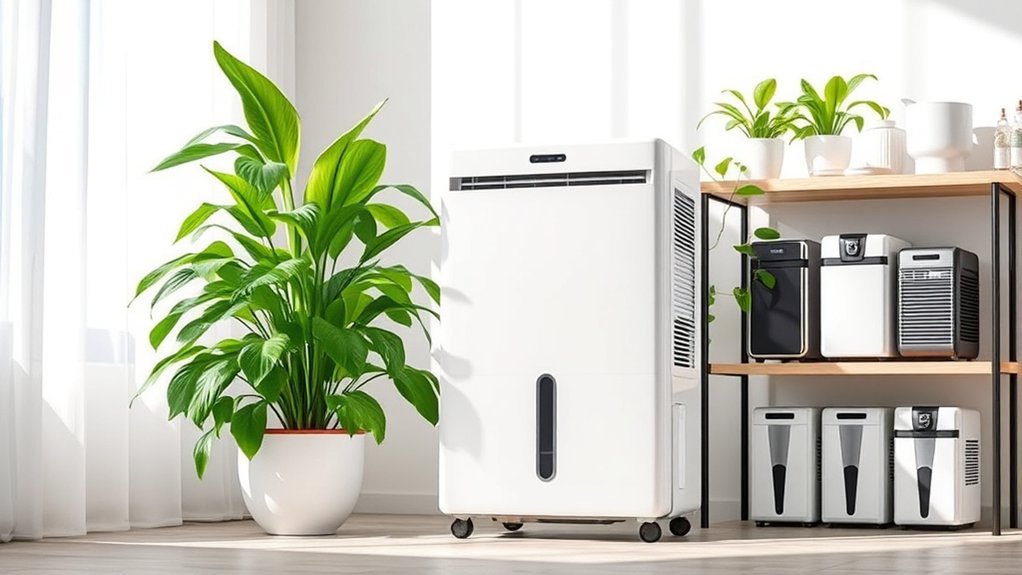
For a long-term basement setup, choose a compressor dehumidifier with enough moisture-removal capacity, dependable humidity controls, auto-defrost, and a drainage method that matches the room. The seven models below are portable floor units, not hard-wired or ducted whole-home systems, but each can remain in a dedicated basement location when it is installed, drained, and maintained according to its manual. Compare drainage type, DOE or standardized capacity, basement temperature, layout, and maintenance access instead of relying only on the largest advertised pint or square-foot number.
- A built-in pump is useful when the hose must rise to a sink, standpipe, or other approved drain point.
- Gravity drainage is simpler, but the hose must run continuously downhill without kinks or high spots.
- Peak-condition “max” pint ratings are not directly comparable with DOE-rated capacities measured under cooler standardized test conditions.
- Advertised coverage is only a starting point; temperature, humidity, air movement, ceiling height, and room divisions change real-world performance.
- A dehumidifier controls airborne moisture but does not repair leaks, seepage, flooding, or poor exterior drainage.
Quick Comparison
| Model | Best For | Drainage | Capacity Context | Amazon |
|---|---|---|---|---|
| DECIUU Max 100 Pint | Large, very damp basements | Tank and continuous-drain options | 100-pint peak claim at very hot, humid conditions; compare DOE-rated capacity before sizing | Check Price |
| Avylo with Pump | Basements without a low floor drain | Built-in pump plus drain options | 90-pint peak-condition claim; pump is the main buying advantage | Check Price |
| Midea 50 Pint with Pump | Smart control and pumped drainage | Built-in pump | 50-pint class with ENERGY STAR-listed model and built-in pump | Check Price |
| Frigidaire 50 Pint Wi-Fi | Remote monitoring and cooler basements | Tank or continuous gravity drain | 50-pint ENERGY STAR model; gravity hose must remain below the outlet | Check Price |
| Vellgoo 64 Pint | Large-room continuous drainage | Tank or gravity drain | 64-pint peak claim at hot, humid conditions; compare the DOE-rated capacity of the exact model | Check Price |
| VEAGASO 34 Pint | Smaller or moderately damp basements | Tank or included gravity hose | 34-pint maximum at hot, humid conditions; better suited to moderate moisture loads | Check Price |
| Waykar 80 Pint | Large spaces and adjustable airflow | Tank or gravity hose | 80-pint peak claim at hot, highly humid conditions; compare DOE capacity rather than the headline alone | Check Price |
DECIUU Max 100 Pint Dehumidifier for Home
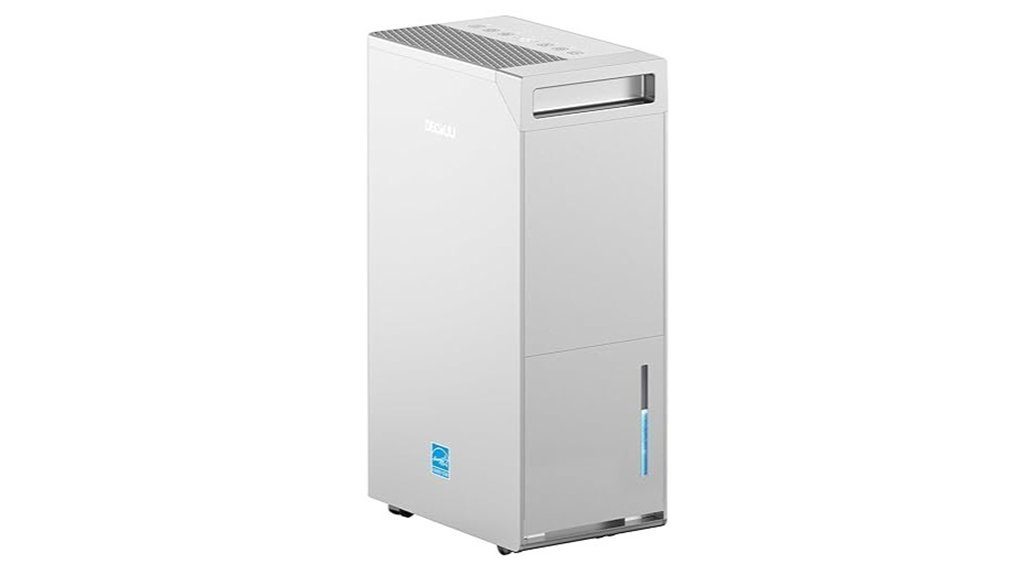
High-Capacity Pick
Best for large, very damp basements. The DECIUU is marketed for spaces up to 5,000 sq. ft. and with a maximum moisture-removal claim of 100 pints per day under very hot, humid conditions. The listing also provides lower moisture-removal figures under less extreme conditions, so the 100-pint headline should not be compared directly with a DOE-rated 50-pint model. Its compressor system, adjustable humidity control, auto-defrost function, wheels, tank, and continuous-drain options support a dedicated basement setup.
Why You’ll Like It: It gives homeowners dealing with a large moisture load more peak-condition headroom while still providing the controls and drainage features expected from a full-size basement dehumidifier.
Who Should Avoid It: Buyers with a small, mildly damp room may not need its footprint or high-capacity positioning.
Pros:
- Designed for large spaces and heavy humidity conditions.
- Adjustable humidity controls and auto-defrost support basement use.
- Continuous drainage reduces reliance on frequent bucket emptying.
Cons:
- The 100-pint maximum uses much hotter and more humid conditions than current DOE capacity testing.
- A large-capacity portable unit requires floor space and clear airflow around the cabinet.
- The filter, drain route, and collection system still need routine inspection.
Avylo Dehumidifier for Basement with Pump
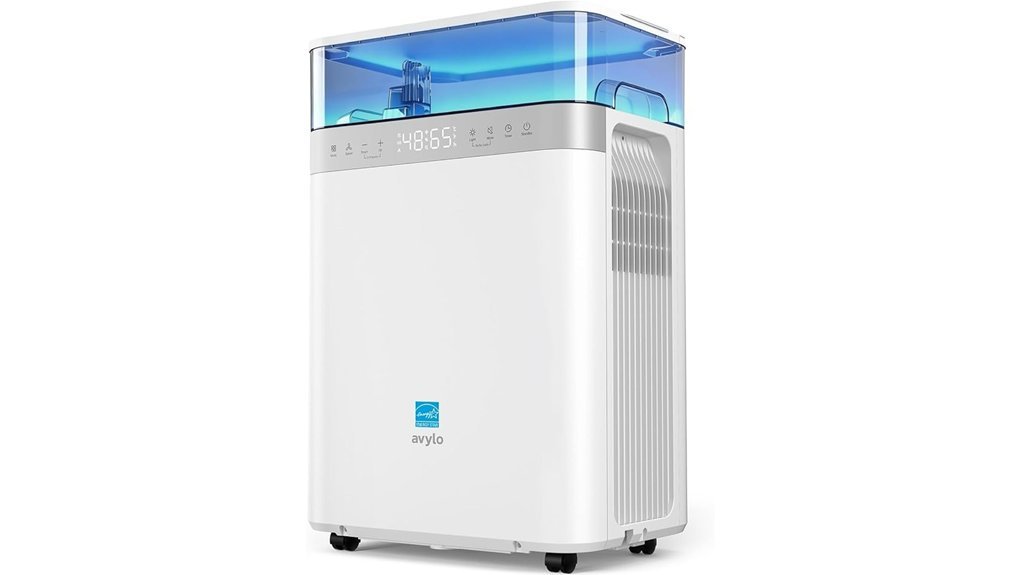
Best for Pumped Drainage
Best when the drain is higher than the unit. The Avylo is marketed with a maximum 90-pint daily capacity under very humid conditions and coverage for a large basement area. Its main advantage is the built-in pump, which can move collected water upward when gravity drainage is not practical. The current listing describes a top-mounted tank and multiple drainage options, along with auto-defrost and casters. Confirm the permitted pump lift, hose routing, and installation instructions in the manual before setting it up for extended operation.
Why You’ll Like It: A built-in pump gives you more placement flexibility than a gravity-only unit, especially when the nearest suitable drain is above the dehumidifier outlet.
Who Should Avoid It: If a floor drain is directly beside the unit and below its outlet, a simpler gravity-drain model may involve fewer pump components.
Pros:
- Built-in pump supports upward drainage.
- Top-mounted tank can simplify access when manual emptying is necessary.
- Auto-defrost and humidity controls suit extended basement operation.
Cons:
- Pump hoses must be secured and tested before extended or unattended operation.
- The 90-pint headline is a peak-condition figure rather than a like-for-like comparison with every regulated dehumidifier rating.
- The unit is larger and heavier than compact room dehumidifiers.
Midea 50 Pint Dehumidifier with Pump (4,500 Sq. Ft.)
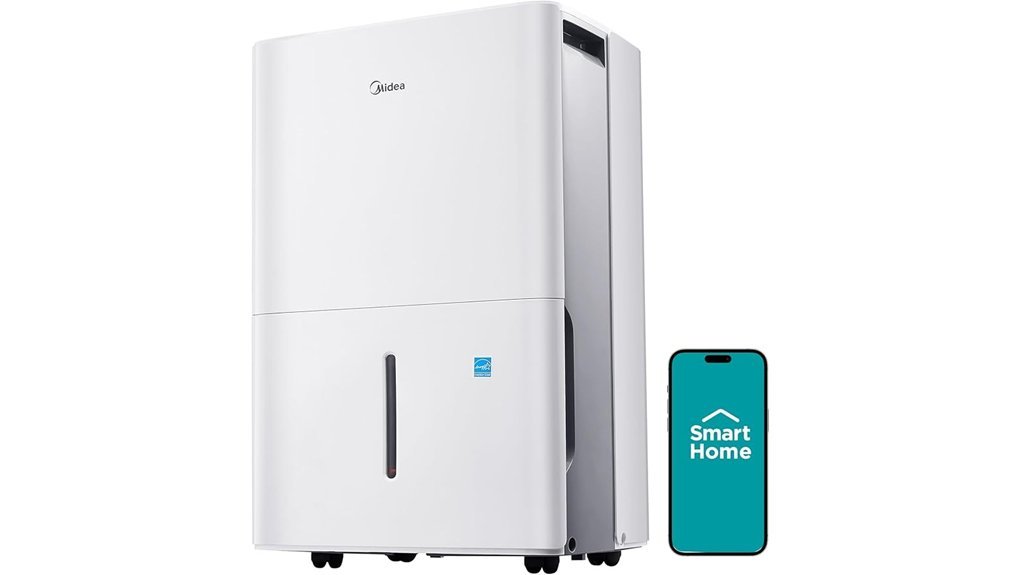
Best Overall
Best-balanced option for smart control and pump drainage. This Midea model is listed as a 50-pint portable dehumidifier for spaces up to 4,500 sq. ft. Its built-in pump can move collected water to a suitable drain location, while connected controls make it easier to check settings and operating status without repeatedly walking downstairs. The combination of a recognized 50-pint class, pumped drainage, adjustable humidity control, ENERGY STAR-listed model, and portable cabinet makes it a practical all-around basement choice.
Why You’ll Like It: It combines a 50-pint class rating, pumped drainage, smart control, and a mainstream manufacturer in one package.
Who Should Avoid It: Buyers who do not need connected controls or upward drainage may prefer a simpler gravity-drain model.
Pros:
- Built-in pump reduces dependence on manual bucket emptying.
- Connected controls can simplify monitoring and scheduling.
- Suitable for a dedicated basement location with a properly routed drain line.
Cons:
- Smart setup adds another configuration step and depends on compatible home Wi-Fi.
- The pump connection must be secured and checked for kinks or leaks.
- The broad square-foot claim should not replace sizing based on actual humidity and basement layout.
Frigidaire 50 Pint Dehumidifier with Wi-Fi
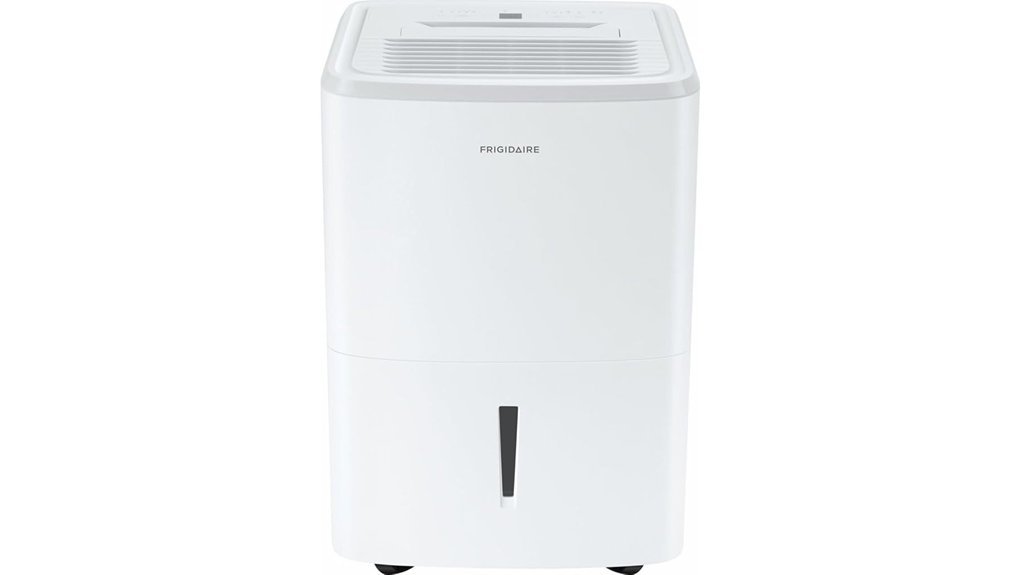
Best for Smart Gravity Drainage
Best for remote humidity monitoring with gravity drainage. The linked Frigidaire FHDD5034Y1 is a 50-pint ENERGY STAR dehumidifier with Wi-Fi controls, custom humidity settings, a continuous-drain option, and low-temperature operation intended for cooler spaces. It is a strong fit when you want to monitor a basement remotely but already have a suitable drain below the unit, so a built-in pump is unnecessary.
Why You’ll Like It: Remote access is useful for a basement, vacation property, or lower level that you do not check every day, while the continuous drain can reduce bucket handling.
Who Should Avoid It: Buyers without stable compatible Wi-Fi, or anyone who must push water upward to reach a drain, may be better served by a pump-equipped model.
Pros:
- Wi-Fi access supports remote setting changes and monitoring.
- Adjustable humidity control helps maintain a chosen humidity range.
- Continuous drainage and verified low-temperature capability improve basement suitability.
Cons:
- Gravity drainage requires a hose that runs continuously downward.
- Smart features depend on network and app availability.
- Fan noise may still be noticeable when the basement adjoins a quiet living area.
Vellgoo 64 Pint ENERGY STAR Dehumidifier for Home
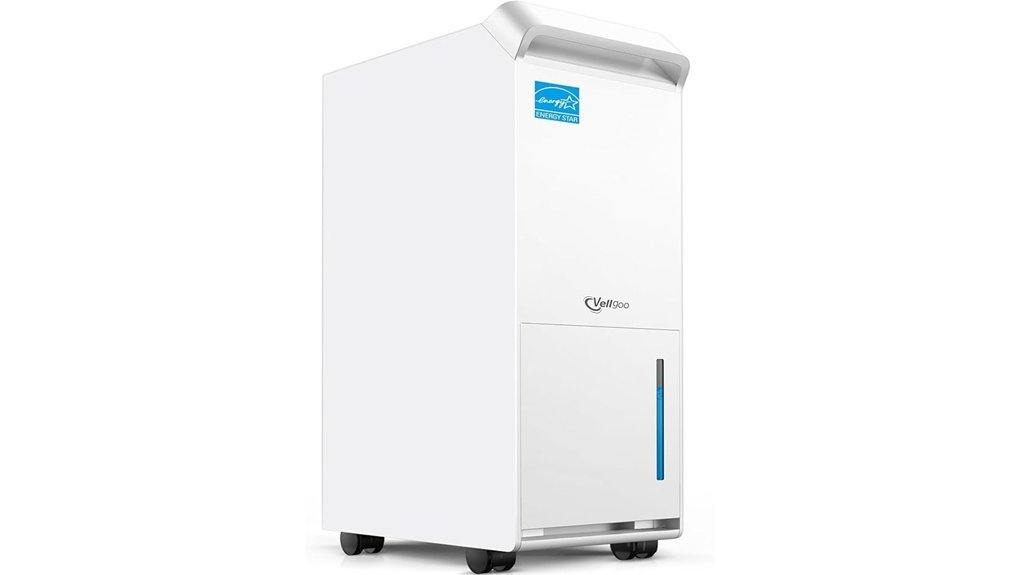
Best for Large-Room Gravity Drainage
Best for large-room gravity drainage. This Vellgoo model is marketed for spaces up to 4,000 sq. ft. and advertises up to 64 pints of moisture removal per day under hot, very humid conditions. It also provides a removable tank, humidity controls, auto-defrost, and a continuous-drain connection. Because the 64-pint headline is a peak-condition figure, use the exact model’s DOE or ENERGY STAR capacity when making a direct performance comparison with 35-pint or 50-pint units.
Why You’ll Like It: It offers the main features needed for a dedicated basement location without adding a pump when a reliable lower drain is already available.
Who Should Avoid It: A gravity-drain setup will not work correctly when the hose must rise to reach a sink or standpipe.
Pros:
- Continuous gravity drainage can reduce bucket handling.
- Compressor-based moisture removal is appropriate for full-room basement humidity control.
- Humidity controls and auto-defrost support extended operation.
Cons:
- The 64-pint peak-condition name can make direct comparisons confusing.
- Moisture-removal performance decreases as basement temperature and humidity fall.
- A secure downhill hose route is required for continuous gravity drainage.
VEAGASO 2500 Sq.Ft Dehumidifier with Drain Hose
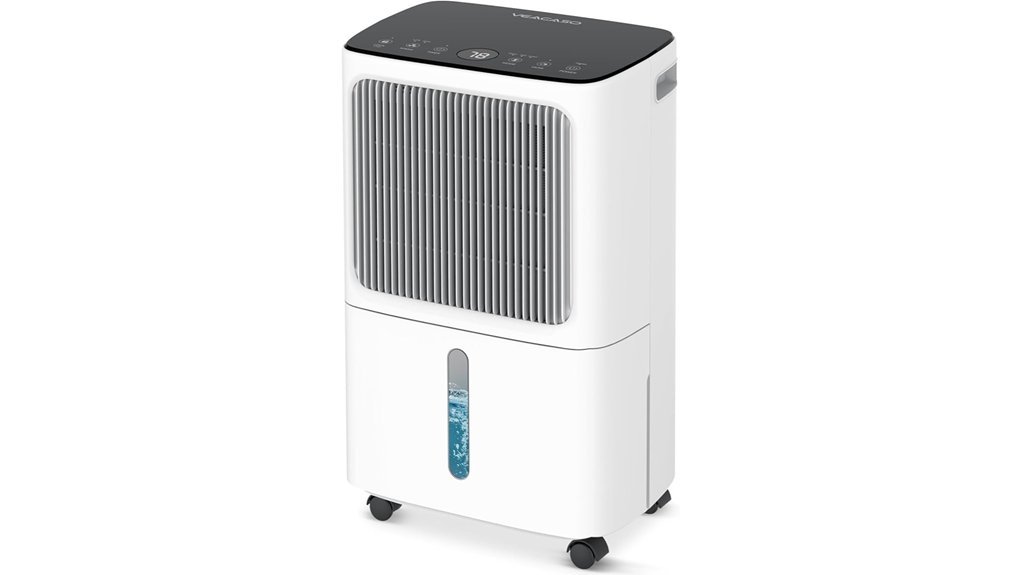
Best for Smaller Basements
Best for smaller or moderately damp basements. The VEAGASO VG380 is marketed with a maximum 34-pint daily rating under hot, humid conditions, three operating modes, a 0.53-gallon tank, and continuous-drain capability. Its lower moisture-removal capacity and compact tank make it a more sensible fit for a smaller basement, laundry area, bathroom, or moderate moisture problem than for a severely wet or highly divided 2,500-square-foot lower level.
Why You’ll Like It: Straightforward controls and gravity drainage make a basic continuous-drain setup easy when a suitable floor drain is nearby.
Who Should Avoid It: Choose a larger-capacity solution and address the moisture source separately if you have standing water, repeated water intrusion, or a very large wet basement.
Pros:
- Supports continuous gravity drainage.
- DEHU, DRY, and CONT modes cover common household uses.
- Wheels and handles simplify positioning before the drain hose is connected.
Cons:
- The 0.53-gallon tank can fill quickly when continuous drainage is not used.
- The maximum 34-pint claim is based on hot, highly humid conditions.
- It may be undersized for severe basement humidity despite the broad coverage claim.
Waykar 80 Pints ENERGY STAR Dehumidifier for Home
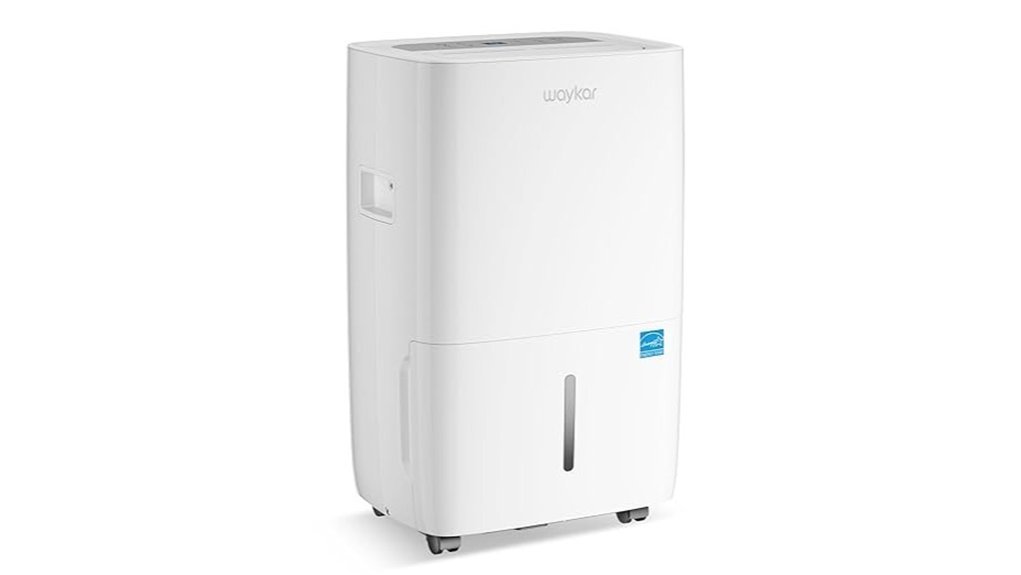
Best for Adjustable Airflow
Best for large spaces where adjustable airflow is useful. The Waykar JD025CE-80 is marketed to remove up to 80 pints per day at 95°F and 90% relative humidity and to cover a large open area. Its adjustable humidity control, auto-swing airflow, auto-defrost, timer, removable tank, and continuous gravity-drain option support basement use. Because the 80-pint figure is a hot, high-humidity maximum, compare its DOE or ENERGY STAR capacity rather than assuming the headline makes it substantially larger than every regulated 50-pint model.
Why You’ll Like It: The swing function can help distribute airflow around a large open basement while continuous drainage supports longer operation.
Who Should Avoid It: It is not the right drainage design when water must be pumped upward to reach the only suitable drain.
Pros:
- Large-space positioning with adjustable humidity control.
- Auto-swing airflow can improve circulation around an open room.
- Continuous drainage, ENERGY STAR status, and auto-defrost support basement use.
Cons:
- The 80-pint headline is a high-temperature, high-humidity maximum.
- A divided basement may require better air circulation or more than one moisture-control strategy.
- The tank, filter, and hose still need periodic inspection.
Factors to Consider for a Long-Term Basement Dehumidifier Setup
For a low-maintenance basement arrangement, focus on DOE-rated capacity, drainage reliability, low-temperature performance, energy efficiency, noise, and access for cleaning. A portable unit can stay in one location for long periods, but it still needs regular inspection and is not the same as a hard-wired or ducted whole-home dehumidifier.
Portable vs. Whole-Home Dehumidifiers
Every model in this roundup is a portable compressor dehumidifier. These units plug into a standard grounded outlet, collect water in a bucket or send it through a hose, and recirculate air within the basement. A true whole-home or ducted dehumidifier is integrated with ductwork or installed as a dedicated HVAC appliance. Consider professional installation when you need humidity control across multiple floors, concealed equipment, permanent duct connections, or capacity beyond what a portable unit can reasonably provide.
Dehumidification Capacity Requirements
Do not size a basement dehumidifier from square footage alone. Also consider current relative humidity, water intrusion, room temperature, ceiling height, whether the basement is divided into rooms, and how quickly humid outdoor air enters. Compare capacities measured under the same conditions whenever possible. Current DOE testing for portable units uses cooler conditions intended to better represent basement operation, so labels such as “Max 80 Pint” or “Max 100 Pint” measured in hotter and wetter air can be much higher than the standardized rating used for efficiency comparisons. For a wet basement, choose adequate capacity while also repairing leaks, seepage, clogged gutters, poor grading, or other water-entry problems.
Energy Efficiency Ratings
ENERGY STAR certification is a useful starting point, but compare the exact model number rather than the brand name alone. The key efficiency metric is the Integrated Energy Factor (IEF), expressed in liters of water removed per kilowatt-hour. A higher IEF means more moisture removal for the electricity consumed under the test method. Actual energy cost still depends on basement conditions, humidity setpoint, fan speed, runtime, and equipment cleanliness.
Drainage Options Available
Gravity drainage is simple and reliable when the hose can run continuously downhill to an approved floor drain, sump location, or other suitable drain point. A built-in pump gives you more placement flexibility because it can move water upward, but the pump hose must be secured and periodically tested. Before leaving any unit operating for extended periods, run it long enough to confirm that the hose does not leak, kink, back up, or pull loose. Keep the dehumidifier level and follow the manufacturer’s hose-size, drain-routing, and pump-lift instructions.
Low-Temperature Performance
Basements are often cooler than upstairs rooms, and compressor dehumidifiers remove less water as temperature drops. Choose a model with auto-defrost and check its listed minimum operating temperature. ENERGY STAR notes that frost can become a concern in spaces below about 65°F unless the appliance is designed to manage cooler conditions. If coils repeatedly ice over, improve airflow, clean the filter, raise the room temperature when practical, or use equipment intended for the actual temperature range.
Noise Level Considerations
Seller-stated decibel numbers are most useful when models are measured using the same test method, distance, and fan setting. A low-speed or sleep mode may reduce fan noise, but it can also reduce airflow and moisture-removal speed. If the basement shares a wall or ceiling with a bedroom or office, place the unit on a firm, level surface and keep it away from loose panels or objects that can vibrate.
Smart Features Integration
Wi-Fi controls can help you check humidity, change settings, or receive status information without going downstairs. Confirm app compatibility, supported Wi-Fi requirements, and whether core controls still work normally when internet service is unavailable. Smart features are convenient, but a dependable drain route, auto-restart behavior, auto-defrost, and accurate humidity control matter more for long-term basement operation.
Placement and Maintenance Access
Wheels and handles help during setup, but a dedicated basement unit should remain level with enough clearance around its intake and exhaust. Do not move it while it is operating or while drain hoses are attached. Leave room to remove the filter and bucket, inspect the hose connection, and clean dust from the grille. Avoid extension cords unless the manufacturer expressly permits one; use a properly grounded outlet suitable for the appliance load.
- Measure the basement and note whether doors or walls restrict airflow.
- Check humidity with a separate hygrometer.
- Identify a safe drain point and determine whether gravity or a pump is required.
- Compare DOE or same-condition capacity instead of only the largest headline number.
- Confirm auto-defrost, minimum operating temperature, hose requirements, and current warranty terms.
- Leave enough space to clean the filter, inspect the drain connection, and remove the bucket when necessary.
Frequently Asked Questions
How Do I Know if I Need a Dehumidifier?
Common signs include a persistent musty smell, condensation, damp-feeling surfaces, rust, peeling finishes, or a hygrometer reading that remains above roughly 50% to 60% relative humidity. A dehumidifier can control airborne moisture, but it should not replace repairs for leaks, flooding, foundation seepage, plumbing problems, or poor exterior drainage.
What Is the Ideal Humidity Level for Basements?
A practical target for many basements is around 40% to 50% relative humidity, while general indoor guidance commonly favors keeping humidity within roughly 30% to 50% when conditions allow. Avoid setting the unit lower than necessary because that can increase runtime and electricity use. Use a separate hygrometer to confirm the reading, since built-in sensors can differ based on placement and airflow.
Can a Dehumidifier Help With Mold Prevention?
Lowering humidity can make conditions less favorable for mold growth, but a dehumidifier cannot remove established mold or repair the moisture source. Existing growth should be handled appropriately while leaks, drainage problems, condensation sources, or water entry are corrected.
How Often Should I Empty the Dehumidifier Tank?
It depends on tank size, humidity, temperature, and actual moisture-removal rate. During very damp weather, a tank may fill more than once per day. For a long-term basement setup, continuous drainage is usually more convenient, but the hose, connection, and drain point still need regular inspection.
What Maintenance Is Required for a Dehumidifier?
Clean the filter at the interval specified in the manual, wipe dust from the intake and exhaust, inspect the bucket and float, clean the drain hose when necessary, and watch for frost, unusual noise, or water around the unit. Unplug the dehumidifier before cleaning or moving it and follow the manufacturer’s maintenance instructions.
Can I Run a Basement Dehumidifier Continuously?
Many models support a continuous mode or automatic cycling around a humidity setpoint. For extended operation, choose a reasonable target, understand the model’s auto-restart and auto-defrost behavior, test the drain system, keep the filter clean, and inspect the setup regularly. Continuous drainage reduces bucket handling but does not make the appliance maintenance-free.
Is a Portable Basement Dehumidifier a Permanent System?
No. A portable unit can remain in a dedicated location and use continuous drainage, but it is still a movable plug-in appliance that needs filter cleaning, hose checks, and periodic inspection. A permanently installed whole-home dehumidifier is typically ducted or professionally integrated with the home’s HVAC or drainage system.
Can One Dehumidifier Handle a Divided Basement?
It may, but closed doors and interior walls can restrict airflow. Keep doors open when practical, improve circulation, and check humidity in more than one area with separate hygrometers. A large divided basement may need a second unit or a ducted solution even when the advertised square-foot figure appears sufficient.
Conclusion
The best choice depends less on the largest advertised pint number and more on how the dehumidifier will work in your basement. The Midea 50 Pint with Pump offers the best-balanced mix of smart control and pumped drainage, while the Avylo is especially useful when water must be lifted to a higher drain. The DECIUU and Waykar suit buyers looking for greater peak-condition moisture-removal headroom in a large, humid space. The Frigidaire fits buyers who value remote monitoring, verified low-temperature capability, and a suitable gravity drain. The Vellgoo is a practical large-room gravity-drain option, while the VEAGASO is better for a smaller or moderately damp basement. Whichever model you choose, confirm the current model number and comparable capacity rating, route the drain safely, and keep access open for filter, bucket, and hose maintenance.


[…] Best Basement Dehumidifier 2026: 7 Long-Term Picks […]