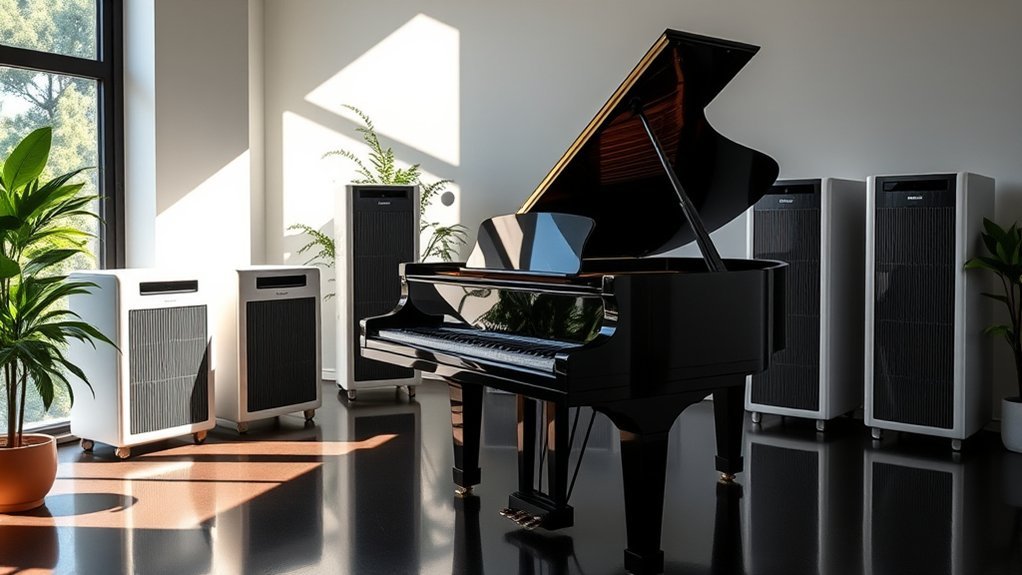
Books last longest in cool, stable, dry storage, but the best dehumidifier for books depends entirely on where your collection lives. Closed plastic bins, document safes, and glass-door bookcases need dry, spill-free silica gel desiccants that will never leak liquid onto paper, whereas damp walk-in closets and shelf corners call for higher-capacity moisture absorber boxes or fragrance-free hanging bags placed safely below book level. This guide compares 13 compact moisture absorbers—including silica gel packets, reusable indicating beads, cordless mini desiccant units, and calcium chloride tubs—so you can match the right humidity control to your storage space, avoid chemical spills, and keep pages crisp and mold-free.
Affiliate disclosure: As an Amazon Associate I earn from qualifying purchases. This article contains Amazon affiliate links, meaning if you buy through these links, we may earn a commission at no extra cost to you. Product details and availability can change, so always check the current Amazon listing before buying.
Book Dehumidifier Comparison Table
| Product | Type | Best Place to Use It | Reuse Style | Amazon |
|---|---|---|---|---|
| Ksend Moisture Absorbers for Closet, 12 Pack | Disposable calcium chloride box (300 mL) | Bottom shelves, cabinets, small closets | Replace when full | Check Price on Amazon |
| Moismile Moisture Absorber Boxes, Refillable Dehumidifier (3 Pack) | Calcium chloride absorber box | Closets, basements, RVs, book rooms | Refill or replace media | Check Price on Amazon |
| Silica Gel Desiccant Packets, 50 Pack (5g) | Small 5g dry silica gel packets | Sealed book boxes, bins, safes | Reactivate in oven or microwave | Check Price on Amazon |
| Eva-Dry Wireless Mini Dehumidifier, White (E-333) | Cordless renewable mini unit (up to 333 cu. ft.) | Enclosed bookcases, cabinets, closets | Recharge by plugging into wall outlet | Check Price on Amazon |
| Eva-Dry Dehumidifier, Liberty Safes | Wireless safe desiccant dehumidifier | Document safes, vaults, enclosed storage | Plug in to regenerate silica beads | Check Price on Amazon |
| Vacplus Moisture Absorber Dehumidifier Boxes for Closet (3 Pack) | Fragrance-free calcium chloride box | Closets, home studies, damp corners | Replace when granules dissolve | Check Price on Amazon |
| DampRid Fragrance Free Hanging Moisture Absorber 3 Pack | Fragrance-free hanging bag (16 oz.) | Closets, dorm rooms, storage alcoves | Replace at indicator line | Check Price on Amazon |
| Sukh Orange Silica Desiccant Beads 430g Reusable Dehumidifier | Loose orange-to-green indicating beads | Custom pouches for shelves, bins, safes | Reactivate in oven or microwave | Check Price on Amazon |
| Wisesorb Reusable Silica Gel Desiccant Packs (3-Pack) | Reusable 100g indicating silica packs | Large book bins, cabinets, document safes | Reactivate in oven or microwave | Check Price on Amazon |
| ATKMAYI Rechargeable Mini Dehumidifier for Bathroom, Closet, Cars | Compact plug-in rechargeable unit | Small wardrobes, cabinets, up to 35 sq. ft. | Plug in to recharge before reuse | Check Price on Amazon |
| 50PCS Silica Gel Moisture Absorber Packets (5g) | Small 5g non-indicating silica packets | Book boxes, drawers, enclosed shelves | Reactivate on a scheduled routine | Check Price on Amazon |
| CLEVAST Moisture Absorber Boxes 6 Pack | Unscented calcium chloride boxes | Closet floors, bottom shelves, damp rooms | Replace when full | Check Price on Amazon |
| CLEVAST Moisture Absorber Packets for Closets and Bathrooms | Unscented hanging liquid-collection bags | Closet rods, wardrobes, storage rooms | Replace after absorption period | Check Price on Amazon |
Quick Verdict
For sealed book boxes, totes, and safes: Choose dry silica gel packets, Wisesorb 100g packs, or Sukh orange indicating beads because they trap water vapor inside dry pores without accumulating liquid brine beside your books. For closets and open shelf areas: Fragrance-free calcium chloride absorbers from Ksend, Vacplus, CLEVAST, and DampRid pull significantly more moisture from humid air, provided they sit upright on a bottom shelf or hang well clear of your books. For enclosed cabinets and glass-door bookcases: The cordless Eva-Dry E-333 is the easiest set-and-recharge desiccant unit.
Book Storage Safety Note
For valuable, rare, leather-bound, cloth-bound, or antique books, never place a liquid-collecting calcium chloride box or hanging bag above or directly against your books. Calcium chloride dissolves into a salty liquid brineas it absorbs water; if knocked over or punctured, that brine permanently stains paper and warps book boards. Keep liquid absorbers upright on a lower shelf inside a secondary catch tray, and pair your setup with a small digital hygrometer to keep relative humidity near 40% to 50%. Passive moisture absorbers help manage enclosed dampness, but they cannot replace a full-size electric room dehumidifier in a wet basement or fix active water leaks.
Quick Picks for Book Storage
- Best disposable shelf box: Ksend Moisture Absorbers for Closet, 12 Pack
- Best clear-view absorber box: Moismile Moisture Absorber Boxes, Refillable Dehumidifier (3 Pack)
- Best small packet choice for bins: Silica Gel Desiccant Packets, 50 Pack (5g)
- Best large pack for storage totes: Wisesorb Reusable Silica Gel Desiccant Packs (3-Pack, 100g)
- Best hanging closet option: DampRid Fragrance Free Hanging Moisture Absorber 3 Pack
- Best cordless cabinet unit: Eva-Dry Wireless Mini Dehumidifier, White (E-333)
- Best bulk reusable bead option: Sukh Orange Silica Desiccant Beads 430g Reusable Dehumidifier
How We Picked These Book Dehumidifiers
We evaluated these products around six book-preservation priorities: spill-free chemistry near paper, strict fragrance-free operation, compact shelf footprint, visual saturation indicators, ease of reactivation or replacement, and realistic coverage limits. Because calcium chloride and silica gel work through completely different physical mechanisms, we separated liquid-collecting tubs and hanging bags (best for closets and room perimeters) from dry silica gel desiccants (best for inside archival boxes, storage totes, safes, and enclosed cabinets).
How to Choose a Book Dehumidifier
Start by matching the desiccant chemistry to your enclosure. Inside a tightly sealed plastic book bin, archival box, document safe, or glass-front cabinet, silica gel (in 5g packets, 100g packs, breathable bead pouches, or cordless units like the Eva-Dry E-333) is the safest choice. Silica gel adsorbs moisture into microscopic internal pores while remaining dry to the touch, eliminating any risk of liquid spills.
In a walk-in closet, study alcove, or storage room with open shelving, tiny silica packets will saturate almost immediately because fresh humid air constantly enters the space. There, a fragrance-free calcium chloride box or hanging bag offers much higher water-holding capacity—as long as you position it below book level, away from pages, and leave a few inches of breathing room around your shelves so damp air cannot stagnate behind the books.
Before You Buy Checklist
- Match the product to the enclosure: Use dry silica gel packets or 100g packs inside sealed bins and safes, cordless desiccant units inside small cabinets, and calcium chloride boxes or hanging bags in closets.
- Size your silica gel correctly: Plan on roughly 5 grams of silica gel per 0.5 to 1 cubic foot of sealed container volume (four to six 5g packets or one 50g–100g pack for a standard 18-gallon book bin).
- Insist on fragrance-free formulas: Artificial scents and essential oils transfer easily into porous paper fibers, cloth bindings, and dust jackets.
- Let regenerated units cool first: Oven-dried silica packs and plug-in rechargeable units get warm during drying; let them cool to room temperature before sealing them inside a book container.
- Monitor with a digital hygrometer: A compact humidity gauge lets you verify that your storage stays between 40% and 50% relative humidity rather than guessing when desiccants are spent.
Ksend Moisture Absorbers for Closet, 12 Pack
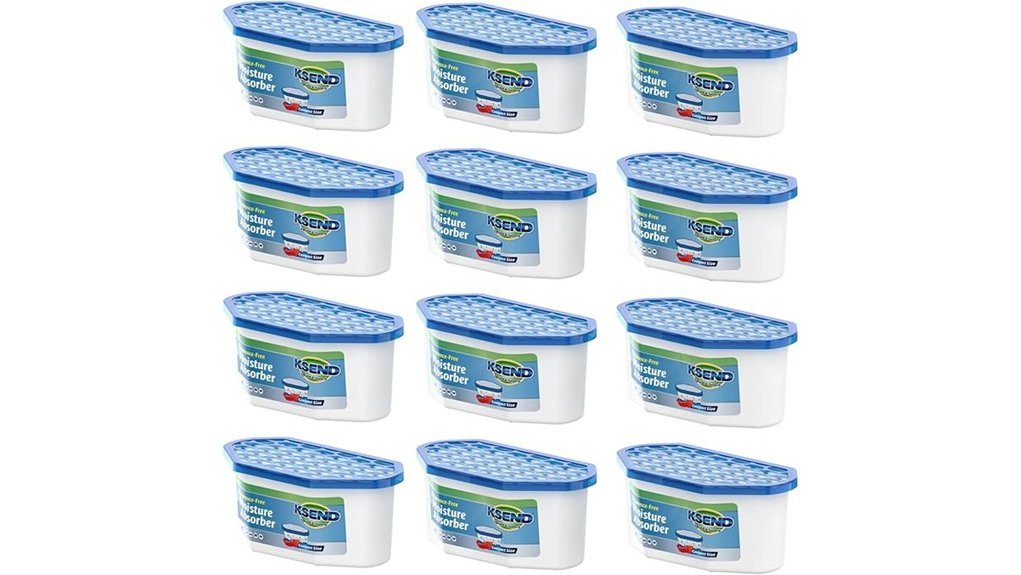
If you need an affordable, multi-box moisture absorber to distribute across several closet corners or bottom shelves, the Ksend Moisture Absorbers for Closet (12 Pack) gives you wide placement flexibility. Each slim container holds up to 300 mL of collected water, making it easy to tuck onto the floor of a wardrobe or the lowest level of a storage cabinet. Spherical calcium chloride beads in the upper tray draw water vapor from the air and drip dissolved brine into the lower reservoir. A white moisture-locking membrane under the vented lid helps slow down spills if a box is jostled, though you should still keep every tub flat, upright, and separated from your books. Setup takes seconds: remove the plastic grid lid, peel off the protective foil seal, and snap the lid back on.
Best For: Readers who want a bulk 12-pack of slim, disposable moisture tubs to place on closet floors, bottom cabinet shelves, or utility shelves near book storage.
Pros:
- Narrow footprint slots into tight closet corners and cabinet floors without crowding shelves.
- 12-pack bundle lets you protect multiple closets or rotate fresh tubs across humid summer months.
- One-way moisture-locking paper layer reduces splash risk compared with open-top desiccant bowls.
Cons:
- 300 mL reservoir per box is smaller than full-size 500 mL closet tubs, so boxes fill faster in very damp rooms.
- Single-use disposable plastic creates ongoing replacement waste and cost.
- Contains liquid calcium chloride brine once active and must never sit inside a closed book bin or above books.
Book-storage note: Place these boxes on the lowest shelf or closet floor inside a shallow plastic tray. Never set a calcium chloride tub directly on top of a stack of books or on a high shelf where an accidental bump could spill brine onto bindings below.
Why you’ll like it: The slim 300 mL profile and 12-count pack make it easy to station absorbers across multiple small cabinets and closets without running power cords.
Skip it if: You are protecting books inside sealed archival boxes or want a zero-waste reusable desiccant.
Moismile Moisture Absorber Boxes, Refillable Dehumidifier (3 Pack)
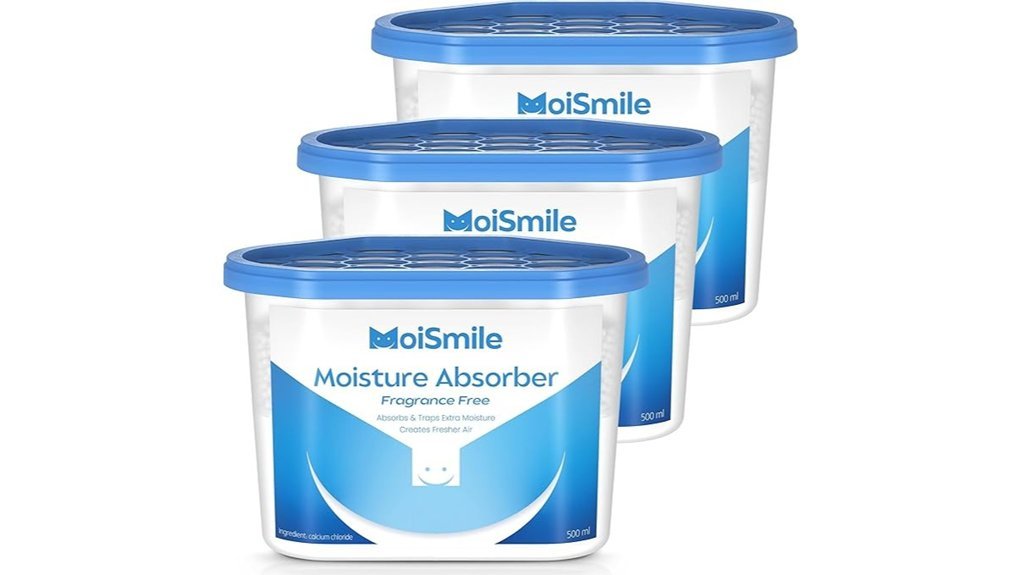
Moismile’s 3-pack moisture absorber boxes provide silent, no-power humidity control for small closets, basement storage corners, RVs, and study areas. High-purity calcium chloride granules sit in the upper section and pull excess dampness into a fully transparent lower collection chamber, allowing you to check water levels from across the room without touching the container. Depending on room temperature and relative humidity, each box works for several weeks before the granules fully dissolve. Because the formula is completely fragrance-free, it will not leave floral or powdery odors on paper or dust jackets. Check the current Amazon listing before ordering to confirm whether your chosen pack uses replaceable refill bags or sealed single-use membranes.
Best For: Homeowners who want a clear, fragrance-free calcium chloride box to visually track water collection in book closets, basement storage rooms, or RVs.
Pros:
- Crystal-clear lower chamber makes it effortless to see how much water has accumulated.
- Unscented calcium chloride prevents artificial fragrances from permeating paper and cloth covers.
- Operates silently with zero electricity, batteries, or heat generation.
Cons:
- Effective only in enclosed closets or small storage areas, not open living rooms.
- Requires periodic emptying and refilling or full box replacement once the salt dissolves.
- Liquid reservoir poses a spill hazard if placed near loose manuscripts or rare bindings.
Book-storage note: Use Moismile boxes as a perimeter defense on the floor of a book closet or storage room, keeping them at least a foot away from lower bookshelves.
Why you’ll like it: The transparent lower reservoir lets you check collected liquid at a glance during routine closet inspections.
Skip it if: You need a dry, spill-proof desiccant packet to place directly inside a sealed book tote.
Silica Gel Desiccant Packets, 50 Pack (5g)
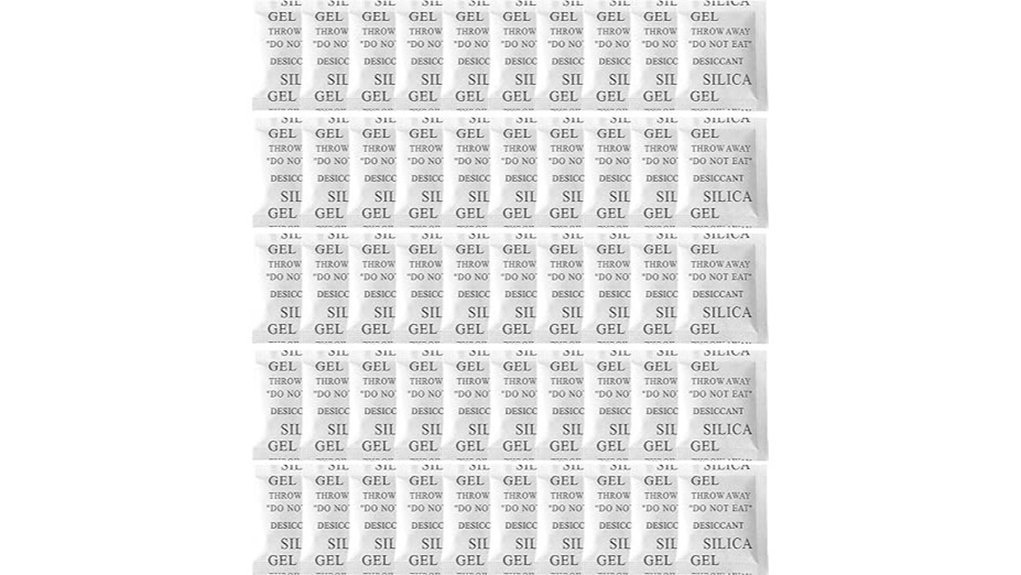
When you are packing books into lidded plastic totes, archival cardboard boxes, comic bins, or fire safes, these 5-gram Silica Gel Desiccant Packets (50 Pack) offer a clean, dry moisture barrier. Each breathable composite-paper sachet holds 5 grams of silica gel beads that trap airborne water vapor inside microscopic pores without ever forming liquid water or corrosive brine. Because a single 5g packet protects roughly 0.5 to 1 cubic foot of tightly sealed space, having 50 individual packets lets you distribute four to six sachets across multiple book bins or drawers. Once the beads become saturated, you can reactivate them in a low-heat oven or on microwave defrost mode according to the package instructions, then let them cool in an airtight jar before placing them back with your books.
Best For: Book collectors, comic and manga archivists, and anyone sealing books inside plastic storage bins, drawers, or document safes.
Pros:
- 100% dry adsorption means zero liquid reservoir and no risk of brine leaks inside book boxes.
- 50 individual 5g packets allow even distribution across top, middle, and bottom layers of a bin.
- Reusable via low-temperature oven or microwave reactivation, cutting down on long-term waste.
Cons:
- Each 5g packet covers only a small sealed volume; an 18-gallon tote requires 4 to 6 packets at once.
- Ineffective on open room bookshelves where humid air flows freely.
- Requires a hygrometer or regular schedule to know when packets need oven reactivation.
Book-storage note: Avoid laying desiccant packets directly against delicate leather or uncoated antique paper; tuck them into the corners of the bin or place a sheet of acid-free tissue buffer between the packets and your books.
Why you’ll like it: Small, flat 5g packets slip effortlessly into archival boxes, slipcases, drawers, and storage totes without creating any liquid spill hazard.
Skip it if: You are trying to dehumidify an open bookcase or a walk-in closet.
Eva-Dry Wireless Mini Dehumidifier, White (E-333)
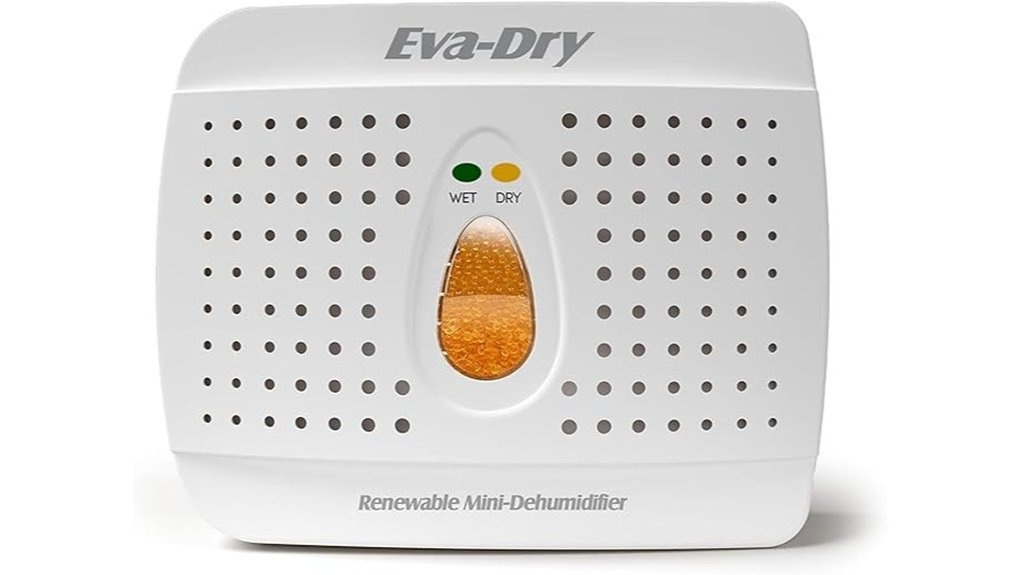
The Eva-Dry E-333 Wireless Mini Dehumidifier is the gold-standard cordless desiccant unit for enclosed bookcases with glass doors, small storage cabinets, and document safes up to 333 cubic feet. Inside its vented shell, crystalline silica gel beads absorb approximately 4 to 6 ounces of moisture over two to four weeks without batteries, power cords, or messy liquid pans. A built-in viewing window contains indicator beads that shift color (typically from blue when dry to pink when saturated) to signal when the unit is full. To regenerate it, fold out the integrated AC prongs on the back, plug it into a standard wall outlet in a well-ventilated room for 12 to 16 hours until the beads return to their dry color, and let the casing cool completely before returning it to your book cabinet.
Best For: Collectors with glass-door barrister bookcases, enclosed display cabinets, small closets, or safes who want a durable, spill-free, plug-in renewable dehumidifier.
Pros:
- Completely cordless and drip-free while inside your bookcase or cabinet.
- Built-in fold-out AC plug eliminates the need to bake loose silica packets in your kitchen oven.
- Visual indicator window takes the guesswork out of maintenance, backed by a 5-year manufacturer warranty.
Cons:
- Rated for enclosed spaces up to 333 cu. ft.; ineffective in open rooms or leaky basements.
- Takes 12 to 16 hours of outlet time to fully dry out once saturated.
- Gets warm during plug-in regeneration and must cool down before going back near books.
Book-storage note: Never plug the Eva-Dry E-333 in to regenerate inside the same enclosed cabinet as your books—it releases stored water vapor as warm steam during the drying cycle. Always recharge it in a separate, ventilated room.
Why you’ll like it: It combines the spill-free safety of silica gel with effortless wall-outlet recharging, making it ideal for enclosed bookcases and cabinets.
Skip it if: You need continuous moisture removal for a full room, basement, or open shelving wall.
Eva-Dry Dehumidifier, Liberty Safes
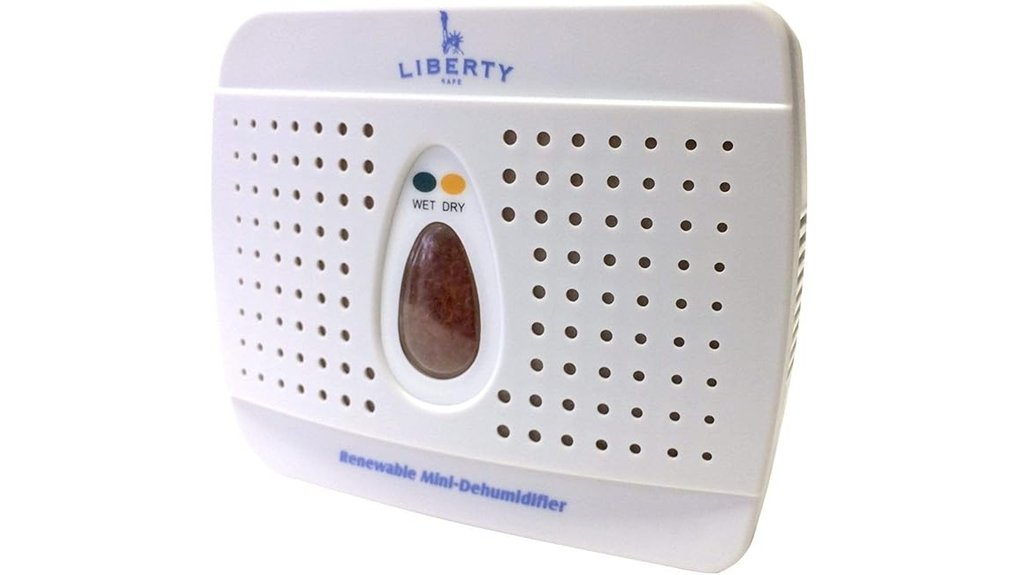
Designed specifically for tightly sealed vaults, gun safes, and fireproof document safes, the Liberty Safes Eva-Dry Dehumidifier protects rare editions, family Bibles, deeds, and archival papers stored in heavy metal enclosures. Fire-resistant safes are notorious for trapping residual moisture in their insulation panels, which can quickly cause foxing and mildew on paper if left unchecked. Weighing just over a pound and requiring no electrical cord pass-through into the safe, this compact renewable desiccant unit absorbs trapped humidity silently. Like the standard E-333 platform, it uses non-toxic silica gel beads that require no liquid reservoir and can be regenerated by plugging the unit into a standard wall outlet outside the safe whenever the indicator window shows saturation.
Best For: Collectors who store rare books, signed first editions, manuscripts, or legal documents inside a fireproof safe or security vault without an internal power outlet.
Pros:
- Operates cordlessly inside sealed safes without drilling or routing power cables through fire seals.
- Dry desiccant bed prevents water trays or salty brine from sitting near high-value collectibles.
- Slim, lightweight housing (approx. 1.2 lbs) stands upright or hangs on a safe shelf bracket.
Cons:
- In newly installed safes or humid climates, it may need recharging every 2 to 3 weeks.
- Engineered strictly for small enclosed vaults (around 333 cu. ft. max), not open rooms.
- Functional design is virtually identical to the standard Eva-Dry E-333 aside from Liberty Safe branding.
Book-storage note: When storing rare books inside a fire safe, open the safe door periodically to inspect the indicator beads and pair the unit with a small digital hygrometer so trapped moisture never spikes unnoticed.
Why you’ll like it: It provides cord-free, leak-free humidity control tailored for fire safes and locked cabinets holding valuable books and papers.
Skip it if: You already own a standard Eva-Dry E-333 or need coverage for an open library room.
Vacplus Moisture Absorber Dehumidifier Boxes for Closet (3 Pack)
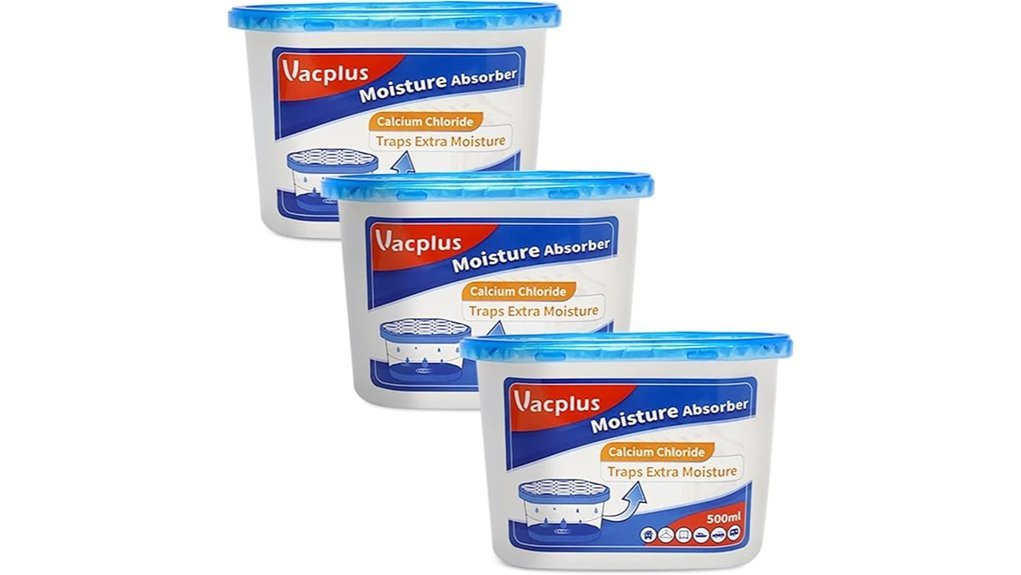
The Vacplus Moisture Absorber Dehumidifier Boxes (3 Pack) offer high-capacity, fragrance-free dampness control for closets, studies, and storage rooms where books sit on open shelving. Each tub uses spherical calcium chloride beads suspended above a translucent collection basin to pull excess moisture from stagnant air. A breathable, moisture-locking barrier sheet sits beneath the protective top grille to keep collected liquid inside the bottom chamber. Setup requires three quick steps—pop off the grille lid, peel back the silver foil seal (leaving the white permeable paper intact), and replace the lid. Because the formula is completely unscented, it removes damp air without introducing heavy perfumes into your reading space.
Best For: Readers who need simple, fragrance-free moisture tubs for a study corner, walk-in closet, or storage room adjacent to bookshelves.
Pros:
- High-surface-area spherical calcium chloride granules actively pull dampness from closet air.
- Translucent lower basin clearly shows liquid accumulation so you know when to replace the box.
- Unscented formula avoids tainting book pages with chemical fragrances.
Cons:
- Single-use tubs must be disposed of and replaced once the upper granules completely dissolve.
- Not strong enough to dehumidify a large basement or multi-room home library on its own.
- Must be kept on a stable, flat surface below book level to prevent accidental brine spills.
Book-storage note: Never peel off the white moisture-locking membrane underneath the top foil seal—damaging that white layer compromises the box’s spill resistance.
Why you’ll like it: It delivers dependable, unscented moisture collection with a clear viewing basin for closets and small study rooms.
Skip it if: Your bookshelves are tightly packed with no safe floor or lower-shelf clearance away from the books.
DampRid Fragrance Free Hanging Moisture Absorber 3 Pack
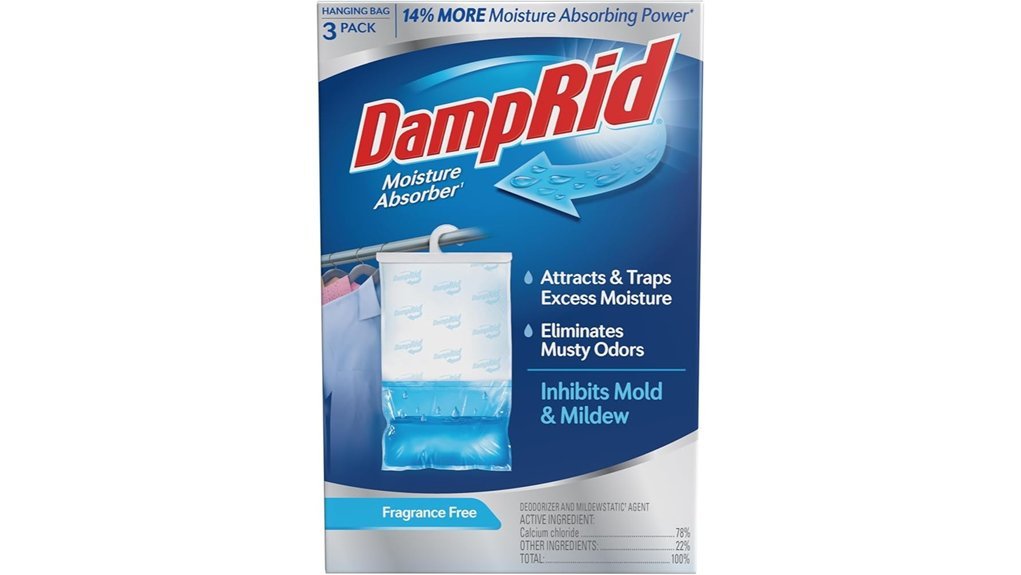
When shelf and floor space inside a storage closet is completely full, the DampRid Fragrance Free Hanging Moisture Absorber (3 Pack) lets you capture excess humidity vertically from a closet rod or wall hook. Each 16-ounce (453g) bag exposes a wide surface area of calcium chloride flakes to the air, drawing in dampness and channeling the dissolved liquid into a deep, clear lower pouch. Depending on seasonal heat and humidity, a single bag lasts up to 60 days and helps prevent the stagnant, musty odor that clings to stored paperbacks and hardcovers. Because this specific version is 100% fragrance-free, it avoids the overpowering lavender or fresh-linen scents found in standard hardware-store hanging bags.
Best For: Book owners storing boxed or shelved collections inside clothes closets, dorm closets, or narrow storage alcoves with a hanging rod.
Pros:
- Generous 16 oz. desiccant charge lasts up to 60 days and holds more water than miniature shelf boxes.
- Fragrance-free formulation protects books from absorbing lingering laundry-style perfumes.
- Hangs vertically to free up shelf space and displays a bold replacement indicator line on the lower bag.
Cons:
- Becomes heavy as the bottom pouch fills with liquid water, requiring a sturdy closet rod or hook.
- Disposable design requires replacing the bag once liquid reaches the fill line.
- Must never be hung directly above bookshelves or cardboard book boxes in case the bag is punctured.
Book-storage note: Hang the bag at the far end of the closet rod—with nothing stored directly underneath it, or place a plastic catch bin on the floor below the bag—and allow a few inches of open airflow around the pouch.
Why you’ll like it: It is the cleanest high-capacity hanging absorber for closets because it skips artificial scents while holding a substantial amount of moisture.
Skip it if: Your only hanging spot sits directly over open bookshelves or boxes of books.
Sukh Orange Silica Desiccant Beads 430G Reusable Dehumidifier
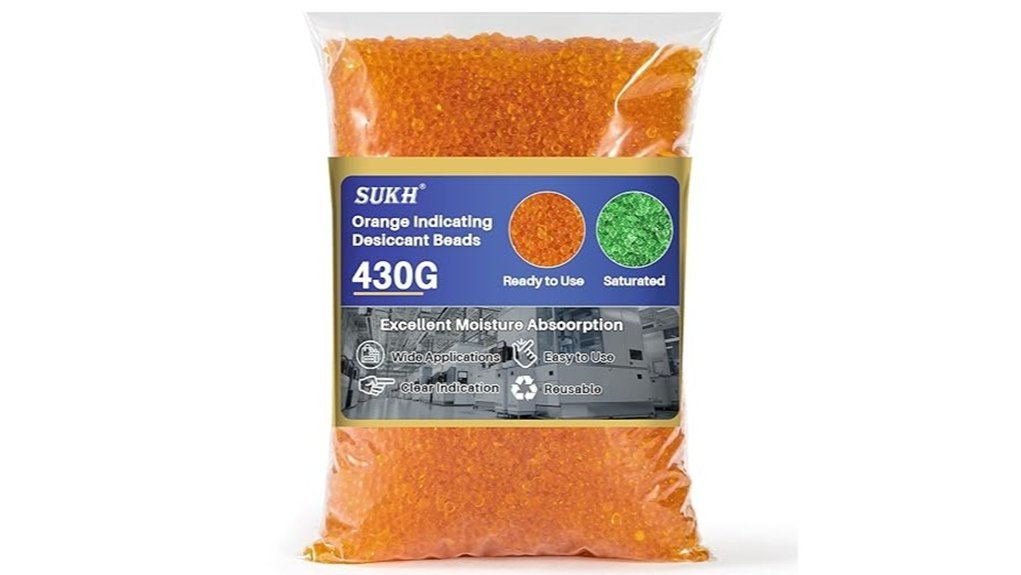
For collectors who want complete control over how much desiccant goes into every storage box or cabinet shelf, Sukh’s 430g Orange Silica Desiccant Beads provide bulk, color-changing protection without cobalt chloride. You can portion the 3–5 mm beads into breathable organza bags, muslin pouches, or perforated plastic canisters to match the exact volume of your book bins, display cases, or safes. As the beads adsorb moisture, they shift from bright orange to dark green, giving you an unmistakable visual cue that it is time to reactivate them. Simply pour the saturated beads onto a baking sheet and heat them in an oven (or follow the label’s microwave defrost instructions) until the bright orange color returns, then cool them in a sealed jar before reuse.
Best For: Serious book collectors and DIY archivists who want cobalt-chloride-free indicating silica gel to make custom-sized desiccant pouches or canisters for bins and display cases.
Pros:
- Clear orange-to-dark-green color shift eliminates guessing when your desiccant is saturated.
- Cobalt-chloride-free orange indicator is much safer for home book storage than blue silica gel.
- 430g bulk container lets you customize pouch sizes for everything from small slipcases to deep trunks.
Cons:
- Requires your own breathable drawstring pouches, tea tins, or perforated containers before use.
- Loose beads can roll everywhere if a pouch comes untied; always double-knot or seal bags securely.
- Bright orange beads resemble candy and must be clearly labeled and kept strictly away from children and pets.
Book-storage note: Use tightly woven cotton muslin bags or sturdy perforated canisters rather than thin mesh so tiny bead fragments or dust cannot sift onto book edges.
Why you’ll like it: Bulk orange-to-green indicating beads give you reusable, spill-free moisture control that you can scale to any box or cabinet size.
Skip it if: You prefer ready-to-use sealed packets and do not want to portion or bake loose beads.
Wisesorb Reusable Silica Gel Desiccant Packs (3-Pack)
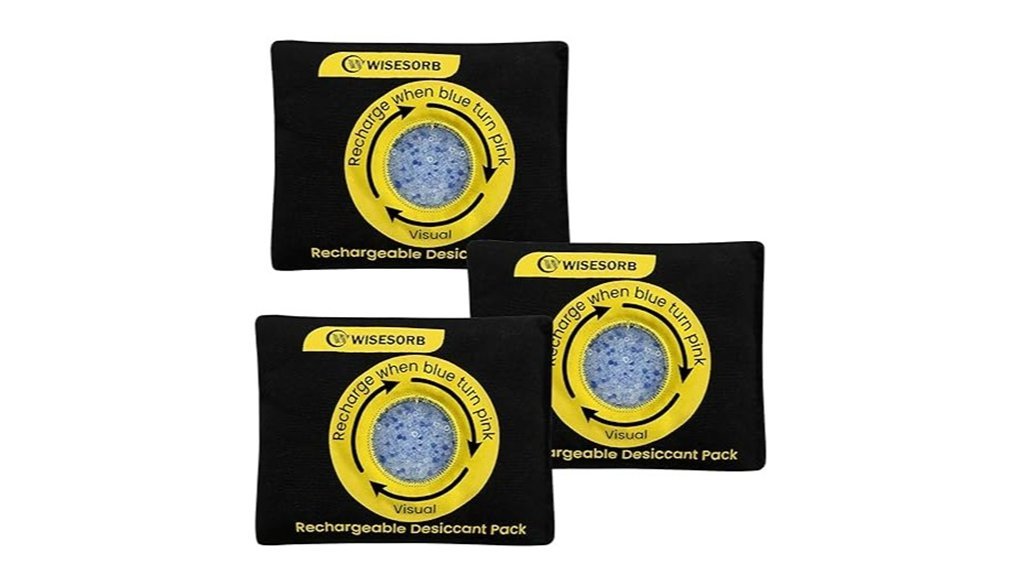
Instead of juggling dozens of tiny 5-gram sachets, the Wisesorb Reusable Silica Gel Desiccant Packs (3-Pack) give you three heavy-duty 100-gram packs (300 grams total—equivalent to sixty 5g packets) built for larger book bins, document safes, and enclosed cabinet shelves. Each durable fabric pouch features a central transparent indicator window that changes color as the internal silica gel reaches saturation, letting you check all your storage containers in seconds. Because all moisture stays locked inside the dry silica beads, you can place a 100g pack directly inside a sealed plastic tote of hardcovers or omnibus editions without worrying about leaks. When the indicator window changes color, reactivate the pack in a microwave or low-heat oven per Wisesorb’s instructions.
Best For: Collectors storing books in large 18- to 30-gallon lidded bins, fire safes, or enclosed cabinets who want high-capacity dry packs with a built-in indicator window.
Pros:
- Each 100g pack replaces twenty 5g packets, making bin organization much cleaner.
- Built-in color-changing viewing window clearly signals when reactivation is needed.
- Completely dry, leak-free operation is safe for enclosed plastic book totes and document boxes.
Cons:
- Requires periodic microwave or oven heating followed by cooling before reuse.
- Only three packs per order, so large collections across many bins will require multiple sets.
- Designed for enclosed containers and cabinets rather than open-air bookshelves.
Book-storage note: Always let a freshly microwaved or oven-dried 100g pack cool to room temperature on a dry counter before sealing it inside a plastic book bin; placing a hot pack inside a closed box can temporarily raise internal humidity and stress nearby bindings.
Why you’ll like it: The 100g capacity and indicator window make these the most practical ready-made silica packs for full-size book storage totes.
Skip it if: You want a disposable absorber for an open closet and never want to reactivate packs in an oven or microwave.
ATKMAYI Rechargeable Mini Dehumidifier for Bathroom, Closet, Cars
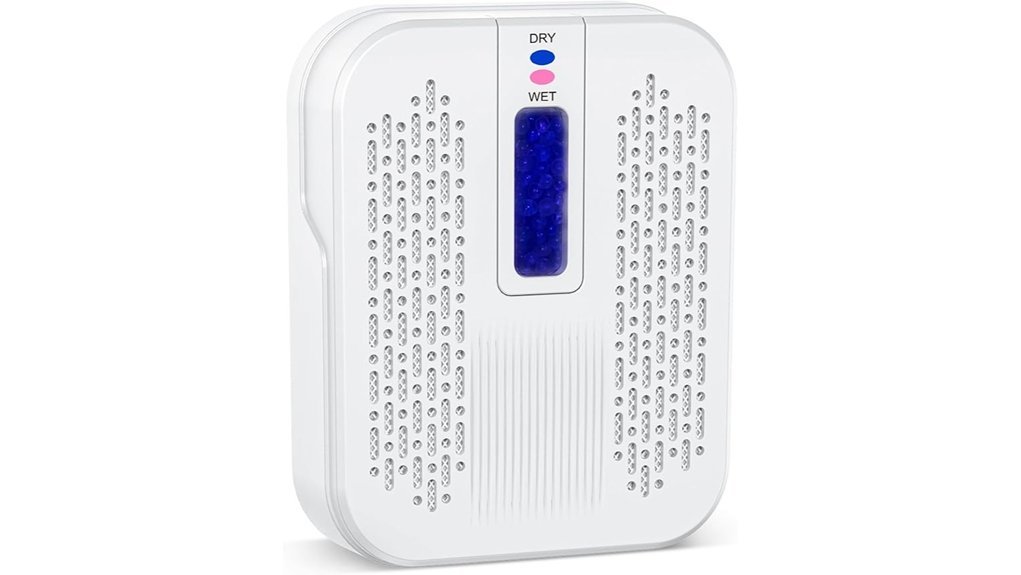
ATKMAYI’s Rechargeable Mini Dehumidifier features a flat, slim profile (6 x 4.8 x 1.5 inches) with a detachable hanging hook, making it easy to slip into narrow wardrobes, small book cabinets, or vehicle trunks up to 35 sq. ft. Inside the perforated shell, polymeric silica particles capture moisture through physical adsorption without accumulating liquid water. Double-sided ventilation slots allow air to contact both sides of the desiccant core whether you hang the unit from a closet rod or stand it alongside a row of books inside a closed cupboard. Note that according to the manufacturer’s directions, you should plug the unit in to complete an initial drying charge before its first use, and recharge it periodically whenever the internal desiccant saturates.
Best For: Readers who need an ultra-slim, hook-equipped rechargeable desiccant unit for a tight wardrobe, small cupboard, or car trunk up to 35 sq. ft.
Pros:
- Slim 1.5-inch thickness and detachable hook fit narrow cabinet gaps where boxy units cannot.
- Double-sided airflow vents improve moisture contact inside cramped enclosures.
- Dry internal silica core eliminates liquid water spills around stored paper.
Cons:
- Limited coverage (up to 35 sq. ft. enclosed space) makes it unsuitable for full bedrooms or basements.
- Requires an initial charge before first use and regular plug-in drying cycles in humid weather.
- Smaller desiccant mass saturates faster than larger units or bulk silica packs.
Book-storage note: Leave at least an inch of clearance on both vented faces so air can circulate through the double-sided perforations instead of pressing the unit flat against a book cover.
Why you’ll like it: Its flat 1.5-inch body and removable hook give you versatile placement in tight wardrobes and narrow book cupboards.
Skip it if: You want long multi-week intervals between recharges in a larger cabinet.
50PCS Silica Gel Moisture Absorber Packets (5g)
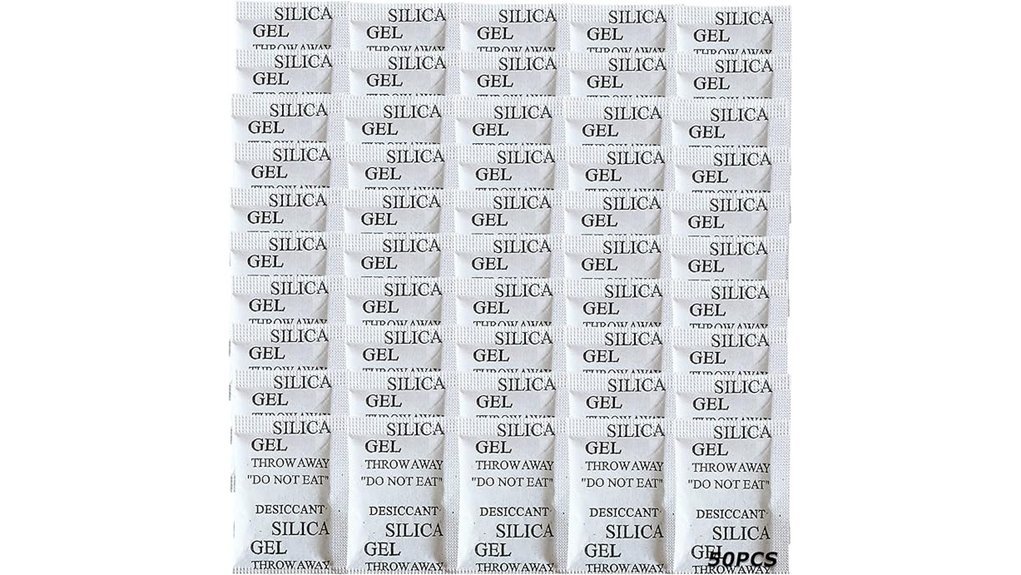
This 50-piece pack of 5-gram Silica Gel Moisture Absorber Packets is a straightforward, dye-free option for collectors who prefer pure white, non-indicating silica gel beads near books, photographs, stamps, and archival papers. Each compact 5g sachet traps moisture vapor inside sealed storage containers, comic boxes, or desk drawers without any chemical color dyes or liquid reservoirs. Because pure white silica gel does not change color when saturated, the best way to manage these packets is to place a miniature digital hygrometer inside your book bin (recharging the packets whenever relative humidity creeps above 50%) or weigh a sample packet on a gram scale (a fully saturated 5g packet weighs roughly 6.5g to 7g).
Best For: Collectors who want pure, dye-free 5g silica gel packets for book boxes, photo albums, and drawers and already use a digital hygrometer to track humidity.
Pros:
- Pure white silica gel contains zero indicator dyes, making it clean for archival boxes and paper storage.
- 50-count pack lets you scatter multiple packets across comic boxes, drawers, and small bins.
- Reusable when dried according to the manufacturer’s oven or microwave instructions.
Cons:
- No color-changing indicator beads, so you cannot tell saturation just by looking at the packet.
- Requires 4 to 6 packets per standard storage tote to provide meaningful humidity buffering.
- Small packets must be kept out of reach of children and pets.
Book-storage note: Write the placement date on the outside of your storage bin with a piece of painter’s tape or tuck a mini hygrometer inside the lid so you never leave saturated packets sitting in a closed box for months.
Why you’ll like it: Dye-free 5g packets are low-profile, inexpensive, and safe to tuck into corners of sealed book and document boxes.
Skip it if: You want visual color-changing beads that tell you at a glance when to recharge (choose Wisesorb #9 or Sukh #8 instead).
CLEVAST Moisture Absorber Boxes 6 Pack
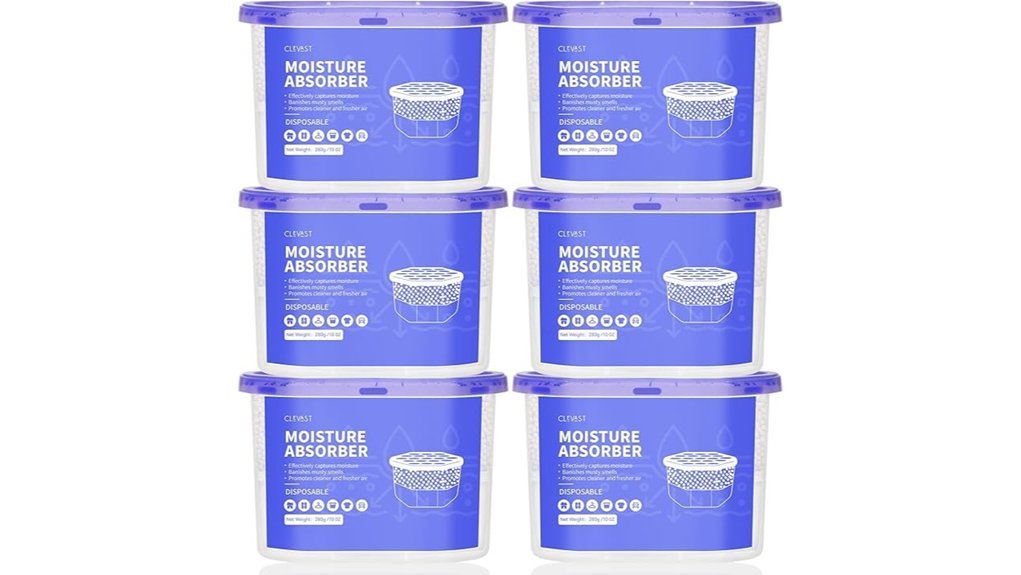
CLEVAST’s Moisture Absorber Boxes (6 Pack) strike a practical middle ground between small 3-packs and bulk 12-packs when you need unscented humidity control across a home library closet, basement storage area, or pantry. Each ready-to-use box contains spherical calcium chloride granules above a clear water reservoir, sealed beneath a one-way breathable paper membrane. During the first several days of exposure to damp air, you will notice the loose granules clump and harden into a solid cake—this is a normal chemical stage as anhydrous calcium chloride hydrates before liquid droplets begin dripping into the bottom basin. Because the boxes are completely fragrance-free, they keep nearby closets fresher without perfuming your books.
Best For: Homeowners who want a mid-sized 6-pack of unscented calcium chloride tubs to place on closet floors or utility shelves near book storage.
Pros:
- Unscented design protects books and paper from absorbing artificial chemical scents.
- Clear lower collection chamber makes it easy to track water buildup over weeks of use.
- 6-pack quantity is well sized for covering two or three closets with a spare set on hand.
Cons:
- Granules solidify into a hard crust for several days before visible liquid starts dripping down.
- Single-use disposable tubs must be replaced once the upper salt chamber is depleted.
- Liquid brine reservoir means boxes must remain upright and away from direct contact with books.
Book-storage note: Do not shake or poke the box when the granules clump during the first week; puncturing the white membrane paper while trying to break up caked salt can cause the box to leak if tilted.
Why you’ll like it: You get six unscented, clear-view absorber tubs that are easy to stage on closet floors and bottom shelves.
Skip it if: You want a rechargeable desiccant that produces zero plastic waste or liquid brine.
CLEVAST Moisture Absorber Packets for Closets and Bathrooms
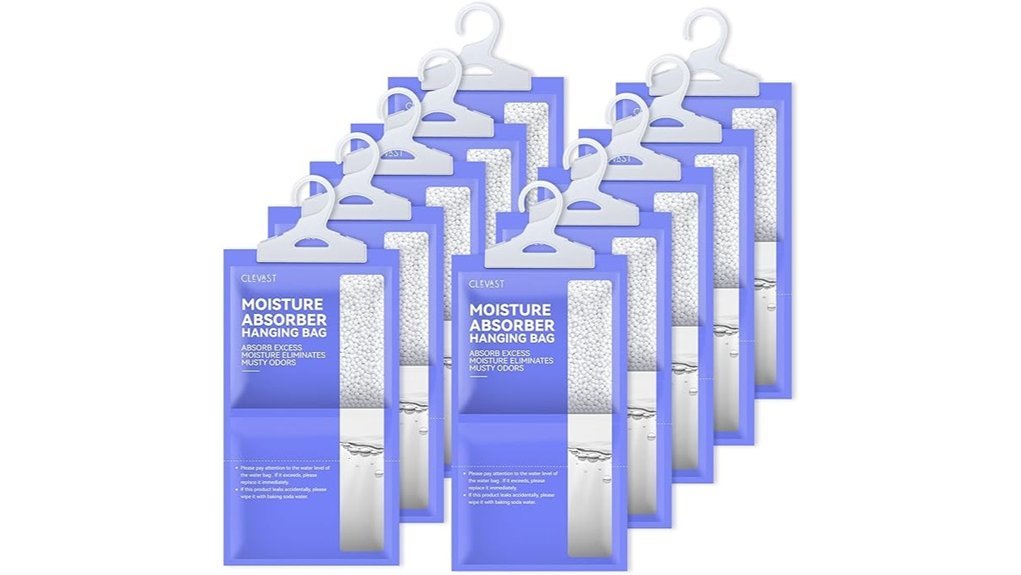
Despite the word “Packets” in the product name, the CLEVAST Moisture Absorber Packets for Closets and Bathrooms (10-Pack) are full-size unscented hanging calcium chloride bags—not small dry sachets meant to sit inside a book box. Each bag features an integrated top hanger, an upper chamber filled with spherical calcium chloride particles, and a transparent lower pouch where dissolved liquid collects over time. Hanging one or two bags on a closet rod or utility hook pulls excess dampness out of stagnant closet air without taking up a single inch of shelf space. Because they collect liquid brine in the bottom pouch, never lay these bags flat and never hang them directly over bookshelves or archival boxes.
Best For: Readers storing books inside walk-in closets or wardrobe alcoves who want a bulk 10-pack of unscented hanging moisture bags to hang well clear of their shelves.
Pros:
- Value 10-pack provides months of rotating humidity control across multiple closets and utility rooms.
- Unscented formula keeps closet air cleaner without transferring fragrances to book pages.
- Hanging hook design saves shelf space and shows collected water clearly in the bottom bag.
Cons:
- Title wording (“Packets”) can confuse buyers looking for small dry packets for sealed book bins.
- Must hang vertically in open space and must never sit near rare books or valuables.
- Single-use bags require disposal once the white calcium chloride beads fully dissolve.
Book-storage note: Treat these exactly like DampRid hanging bags: hang them on a rod away from your bookshelves with an empty floor area or plastic catch tray directly underneath.
Why you’ll like it: A 10-pack of unscented hanging bags is an economical way to manage dampness across several closets where shelf space is tight.
Skip it if: You need dry desiccant packets that can lie flat inside a sealed book box (choose #3, #8, #9, or #11 instead).
How to Use Dehumidifiers Around Books Safely
Protecting a book collection requires careful placement and routine monitoring so your dehumidifier solves moisture problems without creating new ones. Always keep liquid-collecting calcium chloride boxes and hanging bags upright, positioned below book level, and separated from rare covers, leather bindings, cloth boards, and loose papers. Inside sealed plastic bins, archival boxes, and document safes, rely exclusively on dry silica gel packets, reusable 100g packs, or cordless desiccant units that never accumulate liquid brine.
Place a compact digital hygrometer near your shelves or inside your primary storage bin so you can verify whether your absorber is holding relative humidity steady between 40% and 50%. Replace disposable tubs at the fill line and regenerate silica gel packs as soon as the indicator beads shift color—and always let oven-dried or plug-in regenerated units cool to room temperature before putting them back near books. Above all, avoid over-drying a sealed enclosure below 30% relative humidity, which can embrittle paper fibers, crack leather spines, and dry out binding adhesives.
Disposable vs Reusable Book Dehumidifiers
Disposable calcium chloride absorbers (boxes and hanging bags) work through deliquescence: the salt crystals absorb water vapor until they dissolve into a liquid brine that drips into a collection chamber. They hold a large volume of water and require zero oven baking or charging, making them convenient for damp closets and storage rooms. However, they generate ongoing replacement costs and carry a permanent staining risk if spilled near books.
Reusable silica gel dehumidifiers (5g packets, 100g packs, loose orange beads, and cordless plug-in units like the Eva-Dry E-333) work through physical adsorption: moisture binds inside millions of microscopic pores while the beads stay completely dry and solid. Although they hold less water per cycle than a large calcium chloride tub and require periodic heat reactivation, they are far safer for close-range book storage inside bins, cabinets, and safes.
Factors to Consider When Choosing a Dehumidifier for Books
When choosing a dehumidifier for books, evaluate how the product captures moisture, whether it fits safely in your storage enclosure, and how easily you can maintain stable humidity over time. Matching the absorber capacity and chemistry to your shelves, closets, or bins keeps your collection dry without risking chemical spills or over-dried bindings.
Moisture Control Level
Different storage spaces demand different moisture capacities. In a walk-in closet or basement storage alcove where doors open daily, high-capacity calcium chloride boxes (300 mL to 500 mL) or 16-ounce hanging bags pull enough moisture to reduce musty air between replacements. Inside a tightly gasketed plastic tote or safe, very little outside air enters once the lid closes; there, 20 to 100 grams of dry silica gel is plenty to buffer trapped humidity for weeks or months at a time.
Safe Humidity Range
Conservation institutions—including the Northeast Document Conservation Center (NEDCC) and the Library of Congress—recommend keeping home book collections at a stable 40% to 50% relative humidity (RH) paired with cool temperatures between 60°F and 70°F (16°C to 21°C). When relative humidity stays above 60% to 65%, dormant mold spores germinate, pages develop brown foxing spots, and pages cockle or warp. Conversely, if relative humidity drops below 30%, leather bindings dry out into powdery red rot, animal glues crack, and vellum or paper stiffens. Because relative humidity rises when air cools, never store sealed book bins against an uninsulated concrete floor or exterior wall where nighttime temperature drops can trigger internal condensation. Always track both temperature and humidity with a digital thermohygrometer.
Compact Placement
Bookcases, display cabinets, and storage totes rarely leave much extra clearance, so check product dimensions before buying. Flat 5g and 100g silica packs slide neatly beside book stacks inside a bin, while slim 1.5-inch units like the ATKMAYI or compact cordless models like the Eva-Dry E-333 stand upright on a glass-door bookcase shelf without blocking book spines or restricting air circulation.
Refillable Options
Refillable calcium chloride boxes and rechargeable silica gel units both cut down on household waste compared with single-use plastic tubs, provided you stay on top of maintenance. Transparent lower water basins (on calcium chloride boxes) and color-changing indicator windows (on Wisesorb packs, Sukh beads, and Eva-Dry units) make it easy to spot saturation during a quick visual check so an exhausted absorber never sits idle in a damp closet.
Leakproof Design
Around paper, cloth, and leather, spill prevention is non-negotiable. If you use calcium chloride boxes in a closet, choose tubs with a wide, flat base and a one-way moisture-locking paper membrane under the grille—and still place them inside a secondary plastic tray on the lowest shelf or floor. For inside book boxes, drawers, or upper cabinet shelves, skip liquid collectors entirely and stick with dry silica gel desiccants.
Non-Toxic Materials
Pay close attention to the indicator dye used in silica gel products. Traditional blue indicating silica gel is dyed with cobalt(II) chloride, a toxic compound classified as a carcinogen that should not be handled around home libraries or heated in a kitchen oven. Instead, choose either pure white non-indicating silica gel or orange-to-green indicating silica gel (which uses a cobalt-chloride-free organic indicator). For calcium chloride tubs, remember that the dissolved brine can irritate skin and eyes; keep all desiccants clearly labeled and out of reach of children and pets.
Reusability Features
Reusable silica gel packets, bulk beads, and cordless plug-in dehumidifiers pay for themselves over months of book storage. Packets and loose beads typically reactivate in a low-heat oven (around 200°F to 240°F) or on a microwave defrost setting per label directions, while cordless units like the Eva-Dry E-333 use a built-in heating element that dries the internal silica bed when plugged into a wall outlet. Always allow heat-reactivated desiccants to cool completely before returning them to your book enclosure.
Coverage Area
Every passive desiccant has a strict volume limit. A single 5-gram silica packet covers roughly 0.5 to 1 cubic foot of sealed bin space, a 100-gram pack covers roughly 10 to 20 cubic feet of sealed container volume, and an Eva-Dry E-333 handles up to 333 cubic feet inside an enclosed cabinet or safe. If you are protecting an entire room, open library wall, or damp basement, passive packets and boxes can only act as localized helpers—you will need one of the best basement dehumidifiers with a built-in humidistat to regulate the whole room.
Frequently Asked Questions
How Often Should Book Dehumidifiers Be Replaced or Recharged?
Recharge silica gel dehumidifiers whenever the color indicator shifts (orange to green, or blue to pink) or when your digital hygrometer shows relative humidity climbing above 50%. Replace disposable calcium chloride boxes and hanging bags once the upper crystals dissolve and liquid reaches the fill line—typically every 3 to 8 weeks depending on ambient humidity. Check your absorbers more frequently during humid summer months and in closets or basements with limited airflow.
Can Dehumidifiers Prevent Mold on Rare or Antique Books?
A dehumidifier or desiccant significantly reduces mold risk by keeping relative humidity below the 60% threshold where mold spores germinate, but you should not rely on it alone for rare or antique books. Long-term preservation also requires cool, stable temperatures (60°F to 70°F), gentle air circulation, clean archival storage materials, and regular inspections for water leaks or pests.
Are Book-Safe Dehumidifiers Suitable for Enclosed Bookshelves?
Yes, as long as you choose a dry desiccant format. Silica gel packets, 100g Wisesorb packs, custom pouches of Sukh indicating beads, and cordless units like the Eva-Dry E-333 are ideal for glass-door bookcases, bins, and safes. Liquid-collecting calcium chloride boxes or hanging bags should only be used on the lowest shelf or closet floor, kept upright in a tray, and separated from valuable pages.
What Humidity Level Is Best for Long-Term Book Storage?
A practical target for home book collections is 40% to 50% relative humidity at a steady temperature between 60°F and 70°F (16°C to 21°C). Preventing sharp daily swings matters more than chasing a single exact percentage; avoid humidity above 60% (which promotes mold, mildew, and paper foxing) and below 30% (which causes brittle paper, cracked adhesives, and dry leather bindings).
Can Dehumidifiers Damage Book Covers, Pages, or Adhesives?
Yes, careless placement or extreme over-drying can harm books. Spilled liquid brine from a calcium chloride box permanently stains pages and warps boards, while placing a hot, freshly regenerated desiccant unit directly against a book can warp covers. Keep liquid absorbers below book level, let heated silica packs cool before use, and monitor enclosed spaces with a hygrometer.
Are Calcium Chloride Moisture Absorbers Safe Inside a Closed Book Box?
No. Never place a calcium chloride tub or hanging pouch inside a closed plastic book bin or cardboard archival box. Because calcium chloride dissolves into a salty liquid brine as it pulls moisture from the air, shifting or tilting the box can cause the liquid to leak onto your books and ruin them permanently. Always use dry silica gel packets or reusable silica packs inside closed containers.
How Many Silica Gel Packets Do I Need for a Book Storage Bin?
Plan on roughly 5 grams of silica gel per 0.5 to 1 cubic foot of tightly sealed container space. For a standard 18-gallon (2.4 cubic foot) plastic storage tote with a gasketed lid, use four to six 5-gram packets spaced around the bin, or drop in a single 50-gram to 100-gram reusable silica pack.
What Is the Difference Between White, Orange, and Blue Silica Gel for Books?
White silica gel contains no indicator dye, so it stays white whether dry or saturated; you monitor it with a hygrometer or gram scale. Orange indicating silica gel uses a cobalt-chloride-free organic compound that shifts from orange to dark green when full, making it the safest color-changing choice near books. Blue indicating silica gel uses toxic cobalt chloride to turn from blue to pink and should not be used in loose pouches around home bookshelves or baked in kitchen ovens.
Final Recommendation
Match your pick to your exact enclosure: for sealed plastic book totes and archival boxes, choose the Wisesorb 100g Reusable Silica Gel Packs (or the 50-Pack of 5g Silica Gel Packets for smaller bins) so zero liquid sits near your pages. For glass-door bookcases and document safes, start with the cordless, plug-in renewable Eva-Dry E-333. For walk-in closets and storage alcoves, hang a DampRid Fragrance-Free Hanging Moisture Absorber on the closet rod or set a Ksend or CLEVAST unscented box on the floor well below your shelves.
Conclusion
Choosing the right dehumidifier for books comes down to separating dry, internal bin protection from high-capacity closet moisture control. By pairing spill-free silica gel inside your sealed containers with fragrance-free calcium chloride absorbers placed safely on closet floors—and checking a simple digital hygrometer to keep relative humidity between 40% and 50%—you can prevent mold, foxing, musty odors, and warped bindings for years to come.