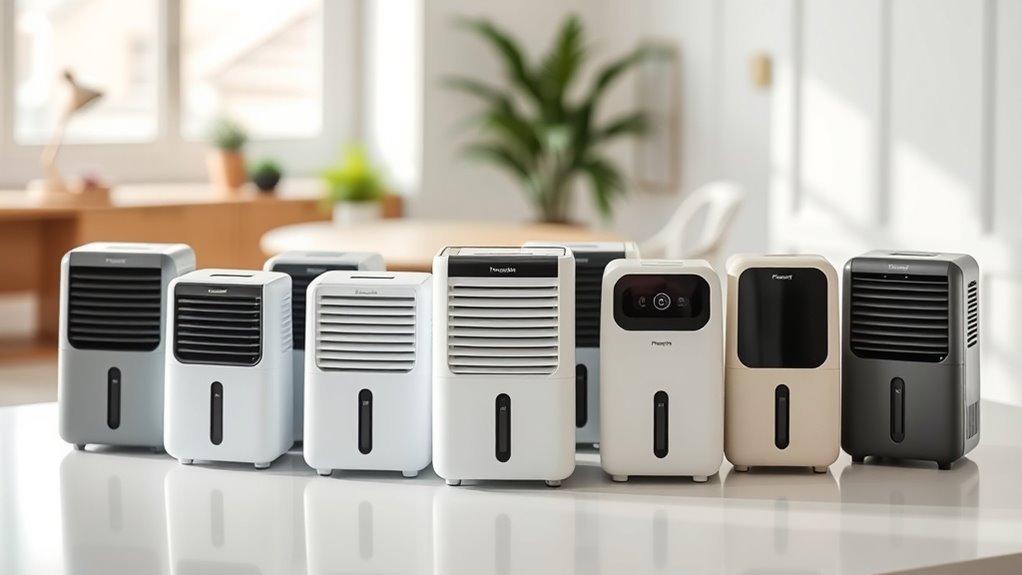
Professional dehumidifiers are built for demanding moisture-control jobs in crawl spaces, basements, warehouses, restoration sites, storage areas, and other large or continuously damp environments. The best commercial dehumidifier for your space depends on more than the largest advertised pint number. Compare the test conditions behind that rating, airflow, drainage method, operating temperature, portability, installation requirements, and whether you need permanent humidity control or faster restoration drying.
Affiliate disclosure: This article contains Amazon affiliate links. We may earn a commission from qualifying purchases at no additional cost to you.
Quick Verdict
Best compact crawl-space option: The ALORAIR Sentinel HD55S combines a low-profile metal housing, gravity drainage, and automatic defrost for permanent basement or crawl-space moisture control.
Best for restoration work: The ALORAIR Storm LGR Extreme combines 210 CFM stated airflow, an integrated condensate pump, and a compact restoration-focused design.
Best maximum-capacity option: The Moiswell Pioneer-XIII offers the highest advertised saturation capacity in this comparison, but its 95-pound build and higher power demand make it better suited to large commercial spaces than routine household use.
Important: Saturation ratings and AHAM ratings are measured under different conditions. Compare models using the same rating standard whenever possible.
How We Selected These Professional Dehumidifiers
We prioritized products positioned for commercial drying, crawl-space installation, industrial moisture control, or water-damage restoration. Important comparison points included stated moisture-removal capacity, airflow, continuous drainage, pump capability, automatic defrost, portability, construction, and intended operating environment. This article does not claim hands-on testing, and manufacturer coverage estimates should be treated as general guidance rather than guaranteed performance.
Listing note: Product specifications, included accessories, warranty terms, and seller availability can change. Confirm the current linked listing and manufacturer documentation before ordering.
Professional Dehumidifier Comparison
| Model | Advertised Capacity | Best For | Drainage | Key Consideration | Amazon |
|---|---|---|---|---|---|
| ALORAIR Sentinel HD55S | 120 PPD saturation / 55 PPD AHAM | Compact crawl spaces and basements | Gravity drain | Requires access to a lower drain | Check Price |
| Waykar AFW2.0D | 125 PPD at 95°F and 90% RH | Large crawl spaces | Gravity drain | Gravity-only drainage; airflow figures vary by source | Check Price |
| ALORAIR Storm LGR Extreme | 180 PPD saturation / 85 PPD AHAM | Restoration and job-site drying | Built-in pump | Heavier than fixed crawl-space units | Check Price |
| Yaufey DP605C | 155 PPD at 95°F and 90% RH | Large basements and open commercial rooms | Pump or gravity drain | Coverage depends heavily on airflow | Check Price |
| MOUNTO 180-Pint LGR | 180 PPD under high-temperature, high-humidity conditions | Mobile industrial drying | Built-in pump | Check current listing and support details | Check Price |
| Airzentti 155-Pint | 155 PPD saturation / approximately 70 PPD AHAM | Ductable crawl spaces and basements | Pump or gravity drain | Confirm current warranty and service terms | Check Price |
| Moiswell Pioneer-XIII | 260 PPD saturation / 110 PPD AHAM | Warehouses and severe moisture loads | Built-in pump | Large, heavy, and power intensive | Check Price |
| ALORAIR Sentinel HD55 | 113 PPD saturation / 53 PPD AHAM | Compact commercial humidity control | Gravity drain | Lower airflow than restoration machines | Check Price |
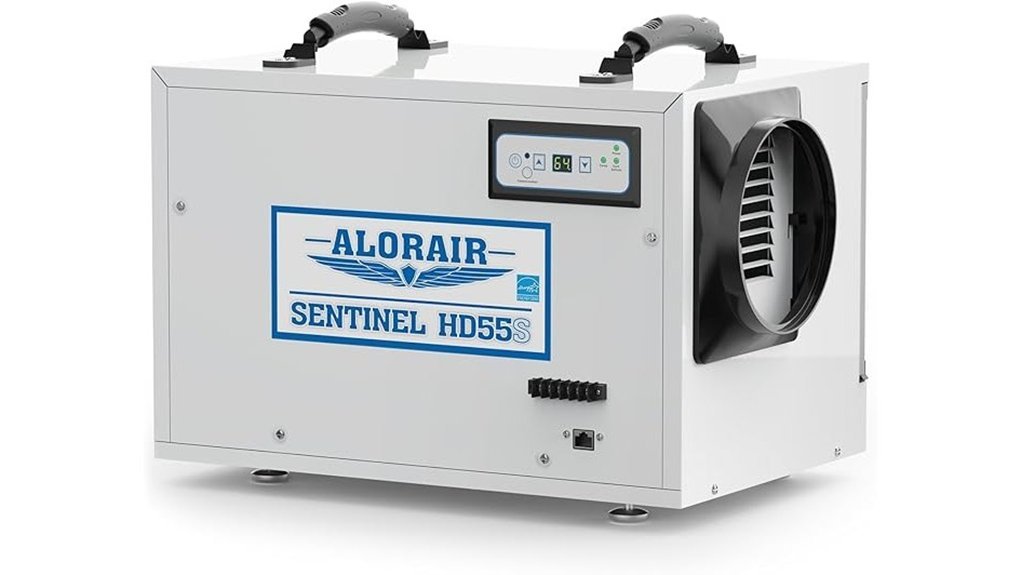
ALORAIR Crawl Space Dehumidifier, 120 PPD
Best Compact Crawl-Space Option
The ALORAIR Sentinel HD55S is designed for permanent humidity control in crawl spaces, basements, storage areas, and similar locations. It is advertised at up to 120 pints per day under saturation conditions and approximately 55 pints per day under AHAM conditions, with suggested coverage up to 1,300 square feet.
Its low-profile metal housing is easier to position in confined areas than a tall portable dehumidifier. Automatic defrost supports operation in cooler environments, while continuous gravity drainage removes the need for an internal collection bucket.
Why You’ll Like It: It provides commercial-style construction and automatic drainage without the bulk of a wheeled restoration unit.
Who Should Buy This: Encapsulated crawl spaces, compact basements, storage rooms, and fixed installations with access to a lower drain.
Who Should Avoid It: Buyers who need to pump condensate upward or frequently move the unit between job sites.
Pros:
- Compact metal housing suitable for confined installations.
- Continuous gravity drainage eliminates bucket emptying.
- Automatic defrost and restart features support unattended operation.
- Advertised cETL listing and manufacturer-backed limited warranty.
Cons:
- The 120-pint figure is a saturation rating, not an AHAM rating.
- No integrated condensate pump on the linked configuration.
- Approximately 42 pounds, so positioning it in a tight crawl space may require care.
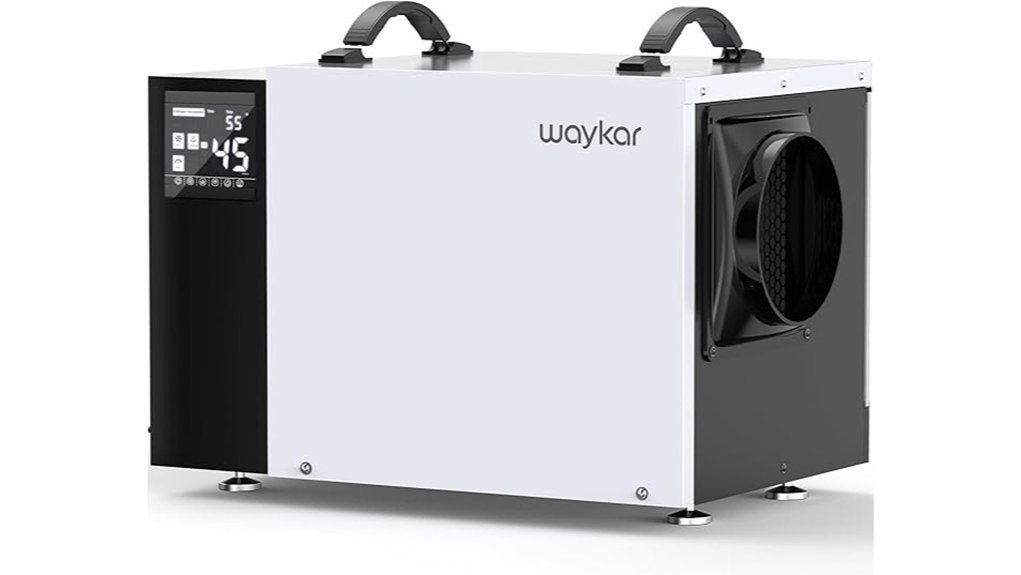
Waykar 125-Pint Crawl-Space Dehumidifier
Best for Large Crawl Spaces
The Waykar AFW2.0D is a commercial-style crawl-space dehumidifier rated to remove up to 125 pints per day at 95°F and 90% relative humidity. It is marketed for spaces up to 6,500 square feet, although actual performance will depend on temperature, air movement, water intrusion, and room separation. Because published airflow figures differ, confirm the current linked listing before using CFM as a deciding factor.
This linked model uses a continuous gravity drain rather than a built-in pump. That makes it a practical set-and-run option when a floor drain, sump, or other lower drainage point is available.
Why You’ll Like It: Its broad humidity setting range, continuous drainage, and crawl-space-friendly shape can serve larger open areas when a suitable lower drain is available.
Who Should Buy This: Large crawl spaces, basements, storage rooms, garages, and commercial areas with a suitable gravity drain.
Who Should Avoid It: Installations where condensate must travel upward to a sink, window, or elevated drain.
Pros:
- High advertised moisture-removal capacity for demanding environments.
- Continuous gravity drainage for unattended operation.
- Automatic defrost, adjustable humidity control, and washable filter.
- Metal construction and integrated handles support permanent installations.
Cons:
- The linked AFW2.0D model does not include a built-in pump.
- Coverage claims assume favorable airflow and should not be treated as guaranteed.
- The 125-pint rating is based on hot, highly humid test conditions.
ALORAIR Commercial Dehumidifier with Pump, 180 PPD
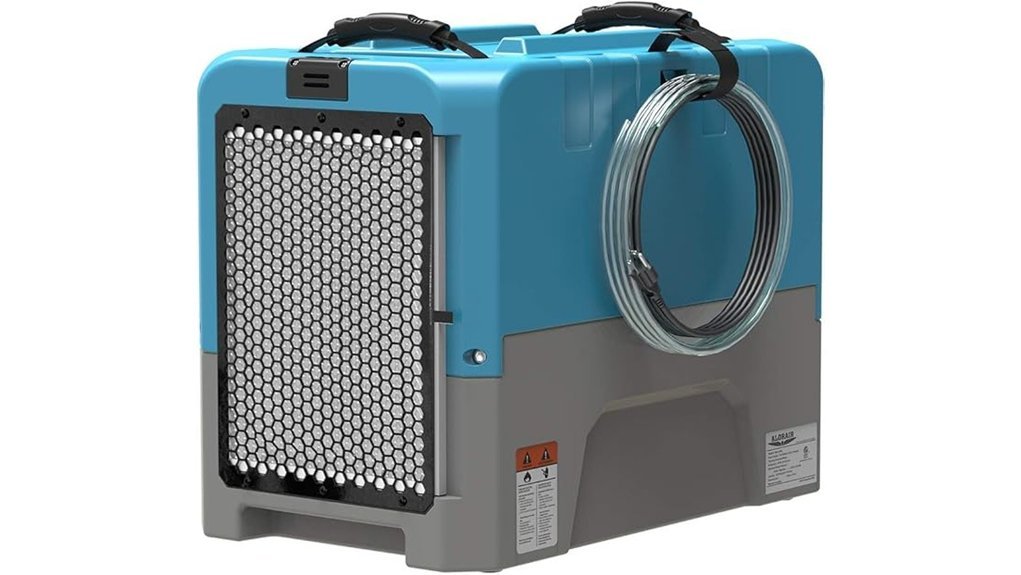
Best Overall for Restoration Work
The ALORAIR Storm LGR Extreme is built for water-damage restoration, construction drying, basements, crawl spaces, and commercial moisture control. It is advertised at up to 180 pints per day under saturation conditions and approximately 85 pints per day under AHAM conditions, with airflow around 210 CFM.
A built-in condensate pump provides more installation flexibility than gravity-only units. The pump can move collected water to an elevated or distant drain, while automatic defrost and restart functions support longer drying jobs.
Why You’ll Like It: It combines restoration-oriented airflow, pump drainage, portability, and a rugged housing in one machine.
Who Should Buy This: Restoration contractors, renovation projects, flooded basements, construction drying, and mobile commercial use.
Who Should Avoid It: Buyers who only need routine humidity maintenance in a small enclosed crawl space and do not need pump drainage or restoration-oriented airflow.
Pros:
- Built-in condensate pump supports flexible drainage routing.
- Commercial LGR-style design for faster drying applications.
- Automatic defrost, restart, and continuous operation features.
- Portable handles help with loading and repositioning.
Cons:
- Heavier and more expensive than a fixed crawl-space model.
- The headline 180-pint capacity is measured under saturation conditions.
- May provide more drying capacity than a small residential space requires.
Yaufey 155-Pint Commercial Dehumidifier
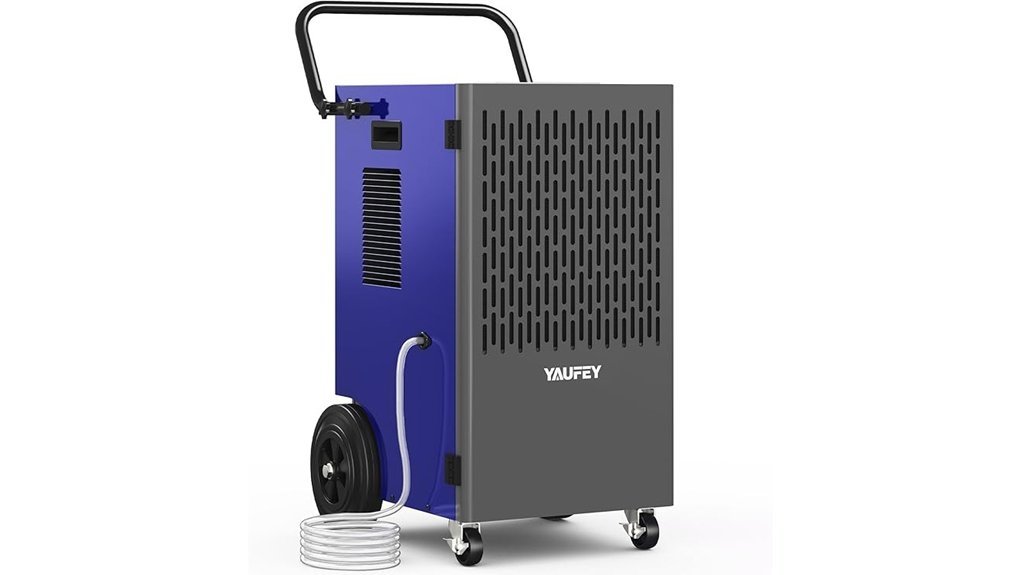
Best for Large Open Rooms
The Yaufey DP605C is rated to remove up to 155 pints per day at 95°F and 90% relative humidity. It offers approximately 164.7 CFM of airflow and is marketed for spaces up to 8,000 square feet. The maximum area should be treated as an estimate because divided rooms, low temperatures, and active water intrusion can substantially change performance.
The unit includes both gravity drainage and a built-in condensate pump. Its pump hose can route water upward or away from the machine, while the wheeled frame and handle make it more convenient to move than a fixed crawl-space unit.
Why You’ll Like It: It offers pump drainage, mobile construction, intelligent humidity control, and a large advertised coverage area.
Who Should Buy This: Large basements, warehouses, workshops, storage areas, and open commercial rooms.
Who Should Avoid It: Buyers who need a short, low-profile unit for installation between crawl-space joists.
Pros:
- Built-in pump and gravity-drain options.
- Automatic defrost and adjustable humidity control.
- Wheels and handle support movement between work areas.
- Washable filter and digital controls simplify routine operation.
Cons:
- The 155-pint capacity is measured under hot, near-saturated conditions.
- Bulkier than a compact crawl-space dehumidifier.
- Large coverage estimates depend on open airflow and moderate moisture loads.
MOUNTO 180-Pint Portable Industrial Dehumidifier
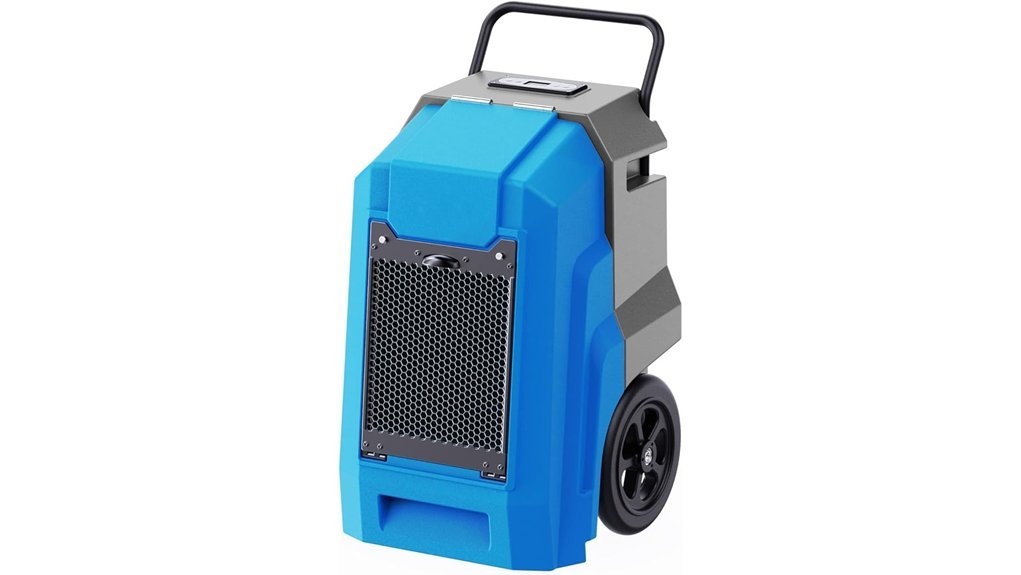
Best Mobile Industrial Option
The MOUNTO 180-Pint LGR dehumidifier is intended for commercial drying, basements, garages, storage areas, job sites, and water-damage projects. It is advertised to remove up to 180 pints per day under high-temperature, high-humidity conditions and to serve areas up to approximately 3,000 square feet.
The wheeled frame helps users move the machine between rooms, while an integrated pump supports continuous drainage without placing the unit beside a floor drain. Real-time humidity and temperature information can help operators monitor changing site conditions.
Why You’ll Like It: Its wheeled restoration-style form is better suited to frequent repositioning than fixed crawl-space equipment.
Who Should Buy This: Contractors, property maintenance teams, water-damage cleanup, commercial basements, and temporary drying jobs.
Who Should Avoid It: Buyers seeking a compact, quiet unit for permanent installation beneath a home.
Pros:
- High-capacity LGR-style commercial design.
- Integrated pump supports continuous drainage.
- Wheels make job-site movement easier.
- Automatic restart supports recovery after a power interruption.
Cons:
- Large and heavy compared with low-profile crawl-space models.
- Its commercial drying design may be more intrusive in occupied living or office areas than a smaller residential unit.
- Current availability, warranty coverage, and included accessories should be confirmed on the listing.
Airzentti 155-Pint Commercial Dehumidifier with Pump
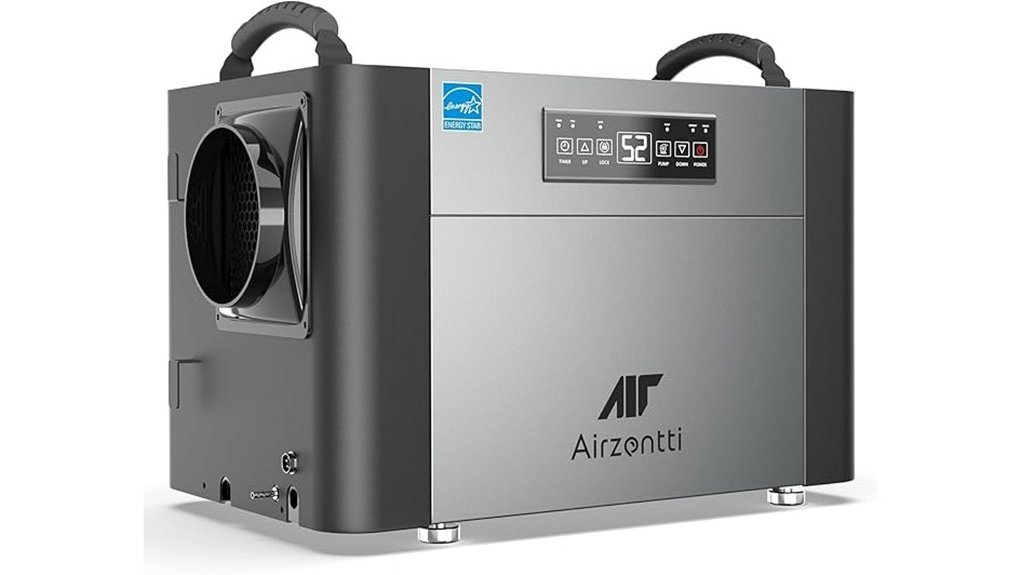
Best Ductable Crawl-Space Option
The Airzentti commercial dehumidifier is advertised at up to 155 pints per day under saturation conditions and approximately 70 pints per day under AHAM conditions. It provides around 220 CFM of airflow and is marketed for crawl spaces, basements, attics, garages, offices, warehouses, and water-damage applications.
A built-in pump can move condensate up to approximately 16.4 feet, and a gravity-drain option is also available. The included duct collar can help direct dry air where the room layout would otherwise limit circulation.
Why You’ll Like It: It combines pump drainage, ducting support, a low horizontal design, and commercial airflow.
Who Should Buy This: Large crawl spaces, divided basements, attics, storage areas, and installations requiring directed airflow.
Who Should Avoid It: Buyers who prefer a long-established restoration-equipment service network and do not need ducting support.
Pros:
- Built-in pump and gravity-drain options.
- Duct collar supports more flexible airflow routing.
- Automatic defrost, restart, and continuous operation.
- Metal housing is suitable for fixed commercial-style installations.
Cons:
- Approximately 60 pounds and not intended for frequent hand carrying.
- The 7,500-square-foot claim assumes favorable conditions and open airflow.
- Current warranty, replacement-parts, and service terms should be confirmed before purchase.
Moiswell Pioneer-XIII 260-Pint Commercial Dehumidifier
Best Maximum-Capacity Option
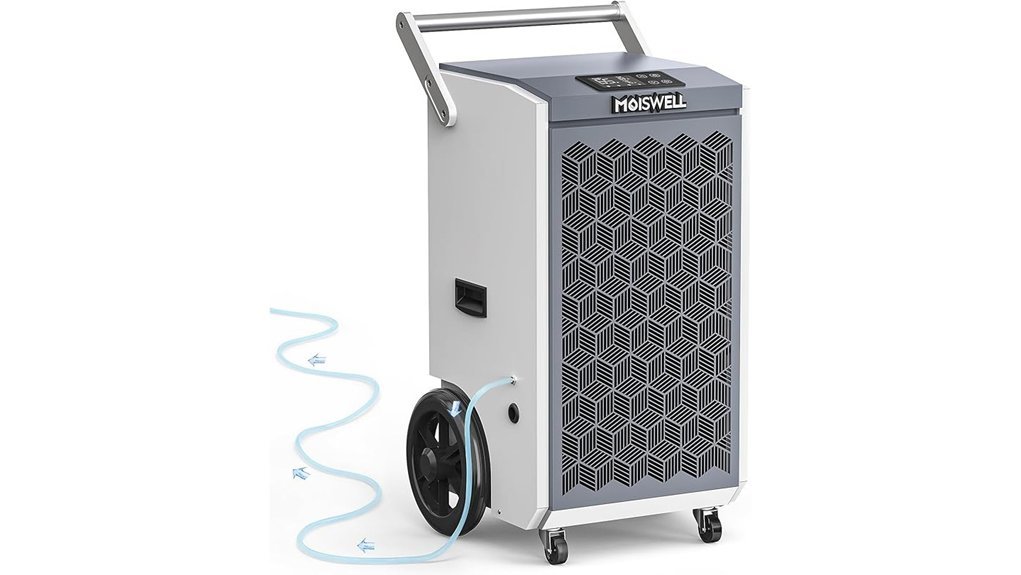
The Moiswell Pioneer-XIII has the highest stated moisture-removal capacity in this comparison. It is advertised at up to 260 pints per day under saturation conditions and approximately 110 pints per day under AHAM conditions. Airflow is listed at about 442 CFM, with suggested coverage up to 8,500 square feet.
A built-in pump and included drain hose allow automatic condensate removal. Large wheels and a detachable handle improve mobility, but its approximately 95-pound weight means it is still best treated as heavy commercial equipment.
Why You’ll Like It: It offers substantially more airflow and AHAM-rated capacity than the compact crawl-space models in this article.
Who Should Buy This: Warehouses, industrial rooms, large commercial basements, severe moisture loads, and water-damage cleanup.
Who Should Avoid It: Homeowners with a small basement, limited electrical capacity, narrow stairs, or no need for industrial airflow.
Pros:
- Highest advertised AHAM and saturation capacities in this comparison.
- High airflow supports faster moisture movement in large open spaces.
- Built-in pump allows flexible continuous drainage.
- Large wheels and handle assist with job-site movement.
Cons:
- Approximately 95 pounds and difficult to carry on stairs.
- Higher power consumption than compact commercial models.
- Oversized for routine humidity maintenance in smaller homes.
ALORAIR Sentinel HD55 113-Pint Commercial Dehumidifier
Best Compact Commercial Value
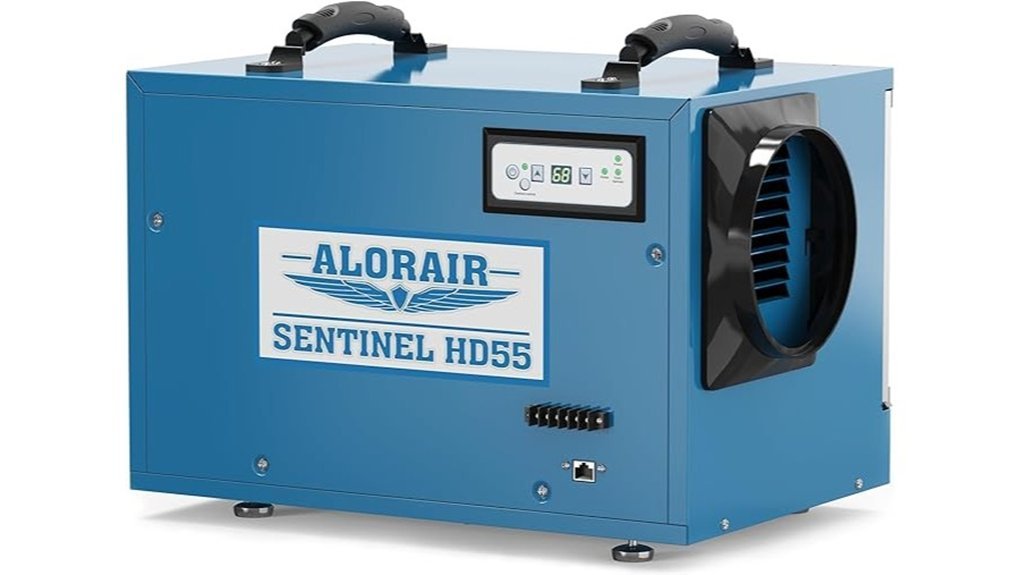
The ALORAIR Sentinel HD55 is a compact commercial crawl-space dehumidifier rated at up to 113 pints per day under saturation conditions and approximately 53 pints per day under AHAM conditions. It provides around 120 CFM of airflow and is intended for areas up to approximately 1,200 square feet.
The unit uses continuous gravity drainage rather than a collection tank. Its automatic defrost system, restart memory, metal housing, and compact dimensions make it suitable for permanent basement or crawl-space humidity control.
Why You’ll Like It: It delivers commercial construction in a smaller and easier-to-position package than high-output restoration machines.
Who Should Buy This: Crawl spaces, compact basements, garages, workshops, storage areas, and permanent humidity-control installations.
Who Should Avoid It: Buyers who require a built-in pump, very high airflow, or rapid structural drying after flooding.
Pros:
- Compact footprint for confined spaces.
- Commercial metal housing and washable filter.
- Automatic defrost and restart memory.
- Continuous gravity drainage with no internal bucket.
Cons:
- No integrated pump on this configuration.
- Lower airflow than mobile restoration dehumidifiers.
- The 113-pint headline rating is measured at saturation rather than AHAM conditions.
Factors to Consider When Choosing a Professional Dehumidifier
A professional dehumidifier should match the space, moisture load, drainage route, operating temperature, and type of work being performed. The largest advertised pint figure is not automatically the best choice.
Compare Capacity Under the Same Test Conditions
Commercial product listings often emphasize saturation capacity because warm, nearly saturated air allows the machine to collect more water. AHAM or DOE-style ratings use cooler, less extreme test conditions and generally produce a lower number.
Do not compare one product’s saturation capacity directly with another product’s AHAM capacity. When both figures are available, the AHAM figure is usually more useful for comparing performance in a typical basement or conditioned commercial space.
Coverage Area and Moisture Load
Square-foot coverage is a rough manufacturer estimate. A dry, open 5,000-square-foot warehouse can be easier to manage than a divided 1,500-square-foot basement with foundation seepage. Consider:
- Starting relative humidity
- Room temperature
- Ceiling height
- Active leaks or groundwater intrusion
- Open versus divided floor plans
- Air leakage from outdoors
- Desired drying speed
Water-damage restoration projects should be sized using moisture measurements and professional drying calculations rather than square footage alone.
Airflow and Room Layout
Airflow, measured in CFM, determines how quickly humid air moves through the machine. Higher airflow can improve drying in large open rooms, but it will not overcome closed doors, blocked crawl-space sections, or poor circulation.
For divided spaces, consider ducting, transfer grilles, air movers, or more than one dehumidifier. Never block the intake or exhaust openings.
Energy Efficiency
Compare energy efficiency using the Integrated Energy Factor when a verified rating is available. IEF measures how many liters of water the unit removes per kilowatt-hour while accounting for operating and standby energy.
Also compare wattage, expected daily runtime, capacity under the same test conditions, and whether the machine will cycle normally or run continuously. Avoid assuming that every ENERGY STAR model saves the same percentage.
Gravity Drainage Versus a Built-In Pump
Gravity drainage is simple and reliable, but the hose must slope continuously downward toward a floor drain or sump. It will not move water uphill.
Pump drainage is more flexible because it can send water upward to an elevated drain or across a room. Check the maximum vertical lift, hose length, and maintenance instructions before installation.
Whichever method you use, secure the hose, prevent kinks, and test the drainage path before leaving the unit unattended.
Temperature and Automatic Defrost
Dehumidifier performance decreases as air becomes cooler. In a cold basement or crawl space, frost can form on the evaporator coil. Automatic defrost allows the machine to pause moisture removal and clear frost before resuming operation.
Check the manufacturer’s minimum operating temperature and avoid assuming that automatic defrost makes every model suitable for freezing conditions.
Noise Level
Commercial fans, compressors, and pumps can be louder than portable home dehumidifiers. Noise may be less important in a warehouse or crawl space but more noticeable in an office, workshop, or occupied basement.
Place the unit on a level surface, keep it away from loose panels, and use vibration-isolating pads when appropriate. Do not enclose the machine in a way that restricts airflow.
Portability and Design
Low-profile crawl-space models are easier to install permanently but may be awkward to carry through a narrow access opening. Restoration dehumidifiers often provide wheels, large handles, and stackable housings for transport between jobs.
Review the unit’s weight, dimensions, handle design, wheel size, and stair access before purchasing.
Controls and Monitoring
Useful features include a digital humidistat, real-time humidity display, automatic restart, hour meter, timer, filter reminder, pump purge control, and remote sensor support. Wi-Fi can be helpful for remote properties, but dependable drainage and correctly positioned humidity sensing are more important than app features.
Warranty and Support
Read the complete warranty rather than relying only on the number of years in the product title. Determine whether coverage differs for the compressor, pump, refrigerant system, parts, labor, shipping, or commercial use.
Also check whether registration is required, who pays return freight, and whether replacement filters, pump parts, hoses, and remote controls remain available.
Before You Buy Checklist
- Compare capacities measured under the same test conditions.
- Measure the available installation space and access opening.
- Confirm the room temperature stays within the operating range.
- Choose gravity drainage only when the hose can slope downward.
- Choose a pump when water must travel upward or across the room.
- Check the electrical circuit and manufacturer power requirements.
- Confirm the filter, hose, pump, remote, and duct accessories included.
- Read the current warranty and commercial-use limitations.
- Repair leaks and drainage problems instead of relying only on dehumidification.
Safety note: Connect the dehumidifier to a properly grounded outlet and follow the manufacturer’s electrical, clearance, drainage, refrigerant, and maintenance instructions. Do not operate a damaged unit or place it where standing water can contact electrical components.
Frequently Asked Questions
What Is the Difference Between Saturation and AHAM Capacity?
Saturation capacity is measured in hotter, more humid air and normally produces a larger pint-per-day number. AHAM/DOE-style capacity uses standardized conditions that generally produce a lower figure. Compare dehumidifiers using the same test conditions rather than selecting the largest headline number.
How Long Does a Professional Dehumidifier Last?
There is no guaranteed universal lifespan. Service life depends on operating hours, temperature, maintenance, drainage reliability, dust exposure, refrigerant-system quality, and whether the machine is properly sized. Cleaning the filter, keeping airflow unobstructed, inspecting the drain, and following the maintenance schedule can reduce avoidable failures.
How Often Should I Clean the Filter?
Follow the schedule in the product manual. Checking the filter every two to four weeks is a reasonable starting point in a clean space, while restoration sites, workshops, and dusty crawl spaces may require more frequent inspection. Never operate the unit with an incorrect or severely clogged filter.
Can a Dehumidifier Remove Allergens?
A dehumidifier is not an air purifier and does not directly remove all airborne allergens. Maintaining appropriate humidity may make the environment less favorable for excess mold growth and dust mites, but existing contamination, leaks, and damaged materials may require cleaning or professional remediation.
Which Safety Features Should I Look For?
Useful features include automatic defrost, automatic restart, overflow protection, pump-failure alerts, thermal protection, grounded electrical connections, error codes, and a locking control panel. These features do not replace correct installation and routine inspection.
How Do I Determine the Right Size?
Start with the room area, ceiling height, temperature, starting humidity, water intrusion, and desired drying speed. Then compare AHAM or DOE capacity under consistent conditions. For active flooding, structural drying, or complex commercial buildings, use professional moisture readings and drying calculations.
Do I Need a Built-In Pump?
You need a pump when condensate must move upward or when no continuously descending hose route is available. Gravity drainage is usually simpler when a nearby floor drain or sump sits below the dehumidifier.
Can a Dehumidifier Fix a Wet Basement?
A dehumidifier can lower airborne humidity, but it cannot repair foundation cracks, failed gutters, poor grading, plumbing leaks, or groundwater intrusion. Correct the moisture source first whenever possible, then use dehumidification to manage the remaining humidity load.
Final Recommendations
For a compact crawl-space installation, the ALORAIR Sentinel HD55S 120 PPD offers a practical balance of commercial construction, automatic defrost, and gravity drainage. The Waykar 125-Pint AFW2.0D is a stronger fit for a larger crawl space when a lower drain is available.
For mobile restoration work, the ALORAIR Storm LGR Extreme stands out because it combines commercial airflow with a built-in pump. The Yaufey DP605C is another flexible choice for large open rooms that need pump or gravity drainage.
For warehouses or severe commercial moisture loads, the Moiswell Pioneer-XIII has the highest stated AHAM capacity in this group, but its weight, size, and electrical demand should be considered carefully.
Whichever model you choose, compare capacities under the same test conditions, verify the drainage route, check dimensions and electrical requirements, confirm the operating-temperature range, and address the underlying source of unwanted moisture before relying on the dehumidifier alone.