Affiliate disclosure: As an Amazon Associate, we may earn from qualifying purchases at no extra cost to you.
Selection note: Updated in August 2026. These dehumidifiers were compared by built-in pump drainage, standardized moisture-removal capacity, room-use fit, controls, portability, maintenance, and warranty. Maximum-condition and saturation ratings are shown only for context because they are not directly comparable with DOE or AHAM ratings.
A dehumidifier with a built-in pump is useful when the nearest drain is above the unit or when a downward-sloping gravity hose is not practical. The best choice depends on standardized capacity, room moisture, pump routing, operating temperature, noise tolerance, and whether you need app control.
For most residential basements and large rooms, the Frigidaire FFAP5034W1 50 Pint Dehumidifier with Pump offers the best balance of capacity, drainage flexibility, familiar controls, and portability. The hOmeLabs 50 Pint Wi-Fi Dehumidifier with Pump is the stronger remote-control option, the AEOCKY LEO-001 includes a long pump hose for flexible drainage routing, and the BaseAire AirWerx 35P is designed for crawlspaces and low-clearance installations.
Quick verdict
- Best overall: Frigidaire FFAP5034W1 50 Pint Dehumidifier with Pump
- Best smart option: hOmeLabs 50 Pint Wi-Fi Dehumidifier with Pump
- Best for flexible pump routing: AEOCKY LEO-001
- Best for crawlspaces: BaseAire AirWerx 35P
Quick Comparison
| Product | Best For | Comparable Capacity | Pump / Drainage | Warranty / Key Consideration | Amazon |
|---|---|---|---|---|---|
| Frigidaire FFAP5034W1 | Large rooms and residential basements | 50 pints/day | Built-in pump plus continuous gravity-drain connection | One-year warranty; verify the exact model and included hoses | Check Price |
| hOmeLabs Wi-Fi 50 Pint | Large spaces and remote app control | 50 pints/day at 80°F and 60% RH; up to 120 pints at 95°F and 90% RH | Pump-equipped listing with continuous drainage | One-year warranty; confirm the listing explicitly says “with pump” | Check Availability |
| AEOCKY LEO-001 | Flexible pump-hose routing in humid rooms | About 45 pints/day under standardized conditions; up to 80 pints at maximum conditions | Built-in pump with an included 5 m hose; verify vertical lift separately | Three-year warranty; automatic controls but no confirmed Wi-Fi connection | Check Price |
| BaseAire AirWerx 35P | Crawlspaces and compact installations | 35 pints/day AHAM; 70 pints/day at saturation | Pump or gravity drainage | Five-year warranty; specialized design and availability may vary | Check Availability |
Model-check reminder: Manufacturers may sell pump and non-pump versions with nearly identical names. Before ordering, confirm that the Amazon title, model number, specifications, and images all describe a unit with a built-in pump.
Frigidaire FFAP5034W1 50 Pint Dehumidifier with Pump
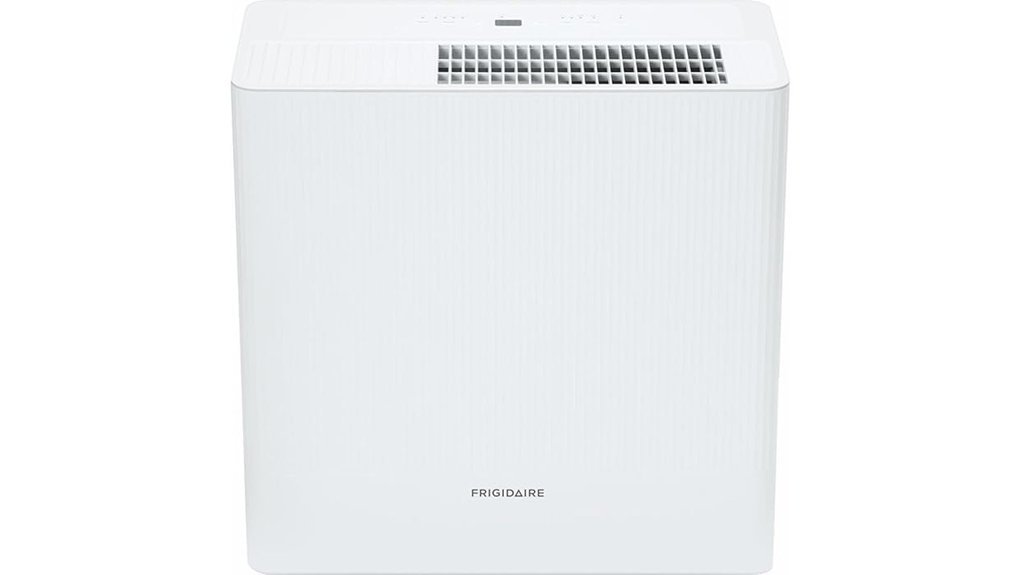
The Frigidaire FFAP5034W1 is a balanced full-size option for basements, garages, and other demanding residential areas. Its main advantage is drainage flexibility. The built-in pump can move collected water toward a suitable elevated drain, while the continuous-drain connection can be used when a safe downward-sloping route is available.
The unit is rated to remove 50 pints per day and has a 2.2-gallon bucket. It also includes electronic humidity controls, three fan speeds, caster wheels, a washable filter, auto restart, automatic shutoff, and low-temperature operation. At approximately 42 pounds, it is easy to roll across a level floor but less convenient to carry between floors.
Why you’ll like it: It combines standardized 50-pint capacity, pump drainage, a relatively large bucket, and familiar appliance-style controls without requiring an app.
Best For: Homeowners who want a dependable pump-equipped dehumidifier for a basement, garage, laundry area, or large room.
Who should avoid it: Buyers who need Wi-Fi control, a lightweight cabinet, or warranty protection longer than one year.
Pros:
- 50-pint standardized daily capacity.
- Built-in pump and continuous gravity-drain options.
- Three fan speeds and adjustable humidity control.
- 2.2-gallon bucket reduces the frequency of manual emptying.
- Washable filter, caster wheels, auto restart, and automatic shutoff.
Cons:
- Its approximately 42-pound weight can make stair transport difficult.
- The compressor and pump will still be audible in a quiet living area.
- The parts-and-labor warranty is limited to one year.
- Drain-hose inclusion should be confirmed on the live product listing.
Before ordering: Confirm that the Amazon listing shows model FFAP5034W1, a built-in pump, and the hoses or adapters required for your planned drain route.
hOmeLabs 50 Pint Wi-Fi Dehumidifier with Pump
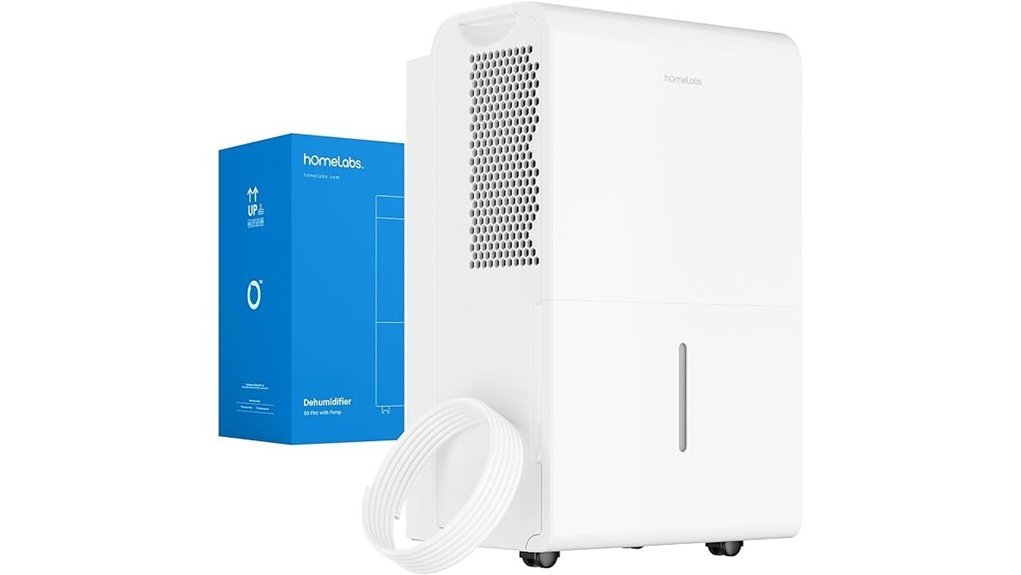
The hOmeLabs Wi-Fi Dehumidifier with Pump is designed for buyers who want to monitor or change settings without visiting the unit. This can be helpful in a remote basement, utility area, vacation property, or another space that is not checked every day.
The manufacturer states a removal rate of 50 pints per day at 80°F and 60% relative humidity and a maximum of 120 pints per day at 95°F and 90% relative humidity. The two figures represent different test conditions and should not be compared as though they were the same capacity measurement.
The pump-equipped version supports elevated drainage, while Wi-Fi control allows remote humidity adjustments, scheduling, and mode changes. Turbo mode increases airflow when faster moisture removal is needed. Wheels, handles, a washable filter, and a removable water tank support ordinary residential use.
Why you’ll like it: It reduces trips to a basement or utility room by combining app control with automatic pump drainage.
Best For: Large basements, open living areas, rental properties, and buyers who want phone-based monitoring.
Who should avoid it: Buyers who do not need Wi-Fi, are shopping for a small room, or cannot confirm that the linked version includes a built-in pump.
Pros:
- 50-pint daily capacity under the stated standard conditions.
- Wi-Fi control for remote humidity adjustments and scheduling.
- Built-in pump on the referenced pump-equipped version.
- Turbo mode, washable filter, wheels, and carrying handles.
Cons:
- The large square-foot claim should not replace capacity-based sizing.
- Turbo mode may be distracting in a bedroom or office.
- Similar hOmeLabs models are sold with and without pumps.
- The stated warranty is one year.
Before ordering: Confirm that the Amazon title explicitly says “with pump.” Do not rely only on the product image or the 50-pint capacity because similar non-pump versions are available.
AEOCKY LEO-001 Dehumidifier with Pump
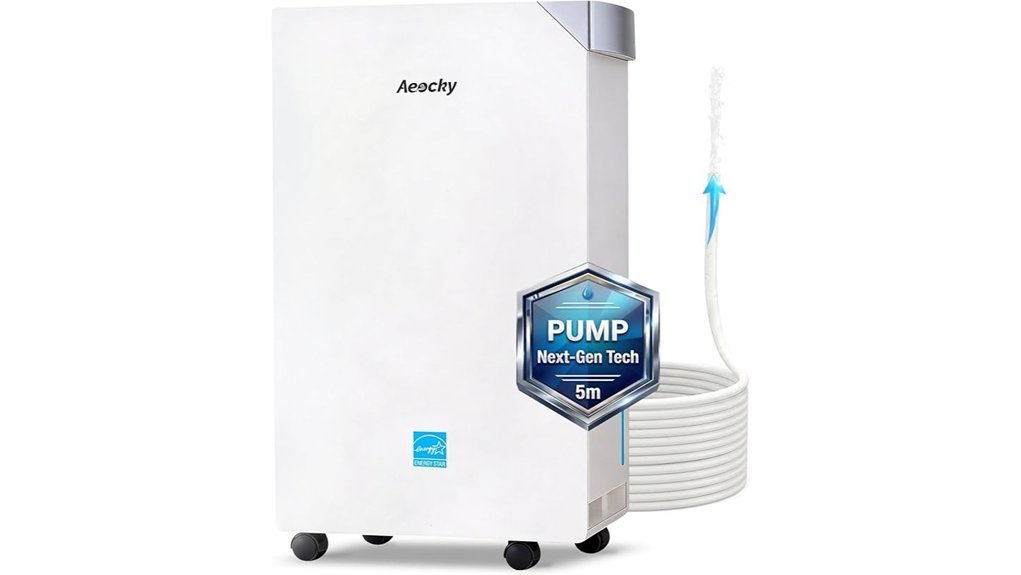
The AEOCKY LEO-001 is designed for buyers who need automatic drainage but cannot place the dehumidifier directly beside a drain. Its built-in pump is supplied with a 5-meter hose, giving the installer more flexibility when routing water toward a suitable discharge point.
Capacity requires careful interpretation. The corresponding standardized rating is approximately 45 pints per day, while the advertised maximum is up to 80 pints per day under hotter and wetter conditions. The standardized figure is the more useful number when comparing it with another modern dehumidifier.
The unit also includes automatic humidity control, automatic defrost, power-outage memory, and a compact upright cabinet. Although the product uses “smart” control language, the exact certified model is not listed as connected-capable. Buyers should therefore treat it as an automatically controlled dehumidifier rather than a Wi-Fi or app-controlled model.
Why you’ll like it: The included long pump hose can make drainage routing easier in a basement, garage, or utility area without a nearby floor drain.
Best For: Humid residential areas where the drain is some distance from the preferred dehumidifier location.
Who should avoid it: Buyers who specifically need app control or a published vertical-lift specification that can be confirmed before purchase.
Pros:
- Built-in pump with an included 5-meter hose.
- Approximately 45-pint standardized capacity.
- Automatic humidity control, defrost, and power-outage memory.
- Compact upright design and a three-year warranty.
Cons:
- The 80-pint number is a maximum-condition rating, not its comparable standardized rating.
- A 5-meter hose does not necessarily mean 5 meters of vertical lift.
- No confirmed Wi-Fi or app connection for the exact certified model.
- The live manual should be checked for pump-lift and hose-routing limits.
Before ordering: Measure both the total hose route and vertical rise. Confirm the permitted lift height in the current manual rather than assuming it equals the supplied hose length.
BaseAire AirWerx 35P Crawlspace Dehumidifier with Pump
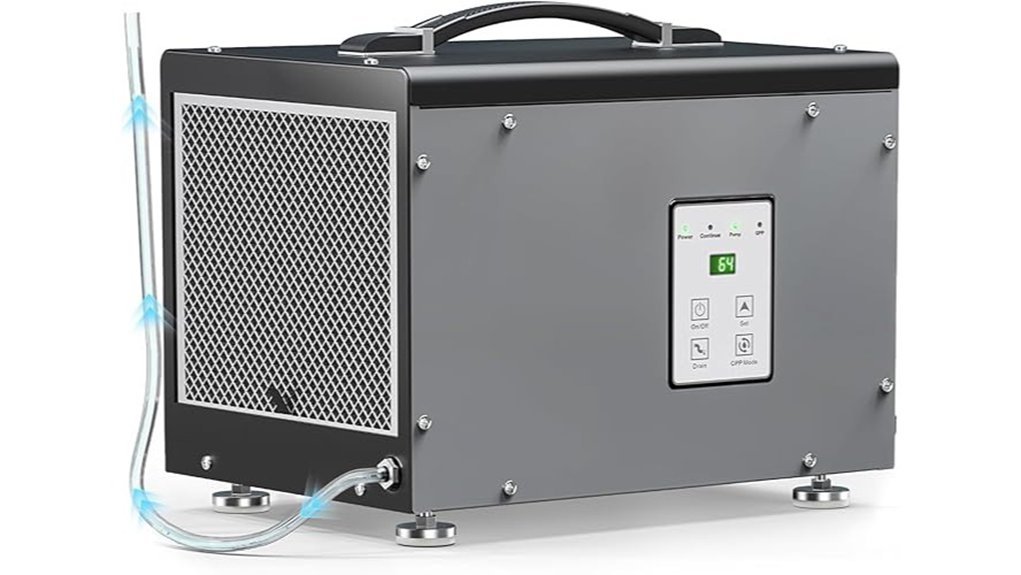
The BaseAire AirWerx 35P is a purpose-built option for crawlspaces, compact basements, storage areas, and other low-clearance locations. Its short cabinet is easier to position in a tight space than a tall residential bucket-style dehumidifier.
The unit is rated at 35 pints per day under AHAM conditions and 70 pints per day at saturation. BaseAire states coverage up to 1,000 square feet, although actual suitability still depends on moisture entry, temperature, air movement, and whether the crawlspace is sealed or vented.
It supports both pump and gravity drainage. Automatic defrost helps manage normal frost formation in cooler areas, and the stated operating range begins near 33°F. The five-year warranty is a meaningful advantage for a model intended for semi-permanent installation.
Why you’ll like it: It provides automatic drainage and a low-profile cabinet without requiring the floor space or height of a conventional portable unit.
Best For: Crawlspaces, low-clearance basements, storage rooms, and fixed installations within the stated capacity range.
Who should avoid it: Buyers who want Wi-Fi control, a large removable bucket, or frequent room-to-room use.
Pros:
- Compact crawlspace-focused design.
- Pump and gravity-drainage options.
- Clearly separated 35-pint AHAM and 70-pint saturation ratings.
- Automatic defrost and a stated 33°F–105°F operating range.
- Five-year warranty.
Cons:
- Its 35-pint comparable capacity is lower than the full-size residential models.
- At approximately 39.7 pounds, installation still requires care.
- Drainage setup is more specialized than a normal bucket-style unit.
- Current availability may vary by seller.
Before ordering: Check crawlspace access dimensions, required airflow clearance, drainage connections, electrical access, and current seller availability.
Factors to Consider When Choosing Dehumidifiers With a Pump
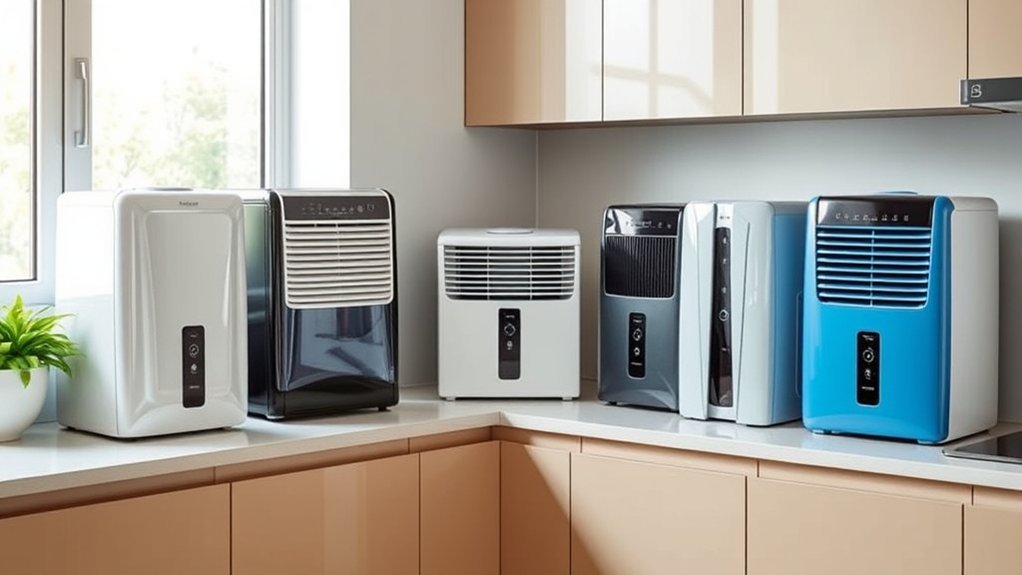
A pump solves a drainage problem, but it does not automatically make a dehumidifier the right size for your space. Compare standardized capacity, pump lift, hose routing, operating temperature, noise, controls, maintenance, and warranty before buying.
Standardized Capacity Versus Maximum Capacity
Dehumidifier capacity is measured in pints removed over 24 hours, but brands may show several different numbers. A modern DOE, ENERGY STAR, Appendix X1, or AHAM-style rating is generally the most useful number for comparing models.
A larger maximum-condition or saturation figure is normally measured in much hotter and wetter air. It may show what the machine can collect under extreme conditions, but it should not be compared directly with a standardized basement-style rating.
Coverage Area and Moisture Load
Square-foot coverage is only a starting point. A cool, very wet basement may need more capacity than a warm room of the same size. Ceiling height, open doors, air leaks, indoor laundry drying, foundation seepage, and recent water damage can all increase the moisture load.
Choose capacity from the room’s size and moisture condition rather than selecting whichever model advertises the largest coverage number. Modest oversizing is generally safer than undersizing when a room consistently feels wet or shows condensation.
Pump Lift, Hose Length, and Drain Route
Hose length and vertical lift are not the same measurement. A manufacturer may include a long hose without allowing the pump to raise water through that entire distance vertically.
Measure the total route and the rise from the dehumidifier outlet to the highest point. The hose should reach the drain without sharp bends, pinching, loose connections, or a discharge point that directs water back toward the foundation.
A built-in pump is useful for draining toward a sink, standpipe, utility basin, window route, or another suitable point above the unit. Use gravity drainage when a safe lower drain is available because it is simpler and does not rely on a pump motor.
Temperature and Defrost
Basements and crawlspaces can become cool enough for frost to form on a dehumidifier’s coils. Look for automatic defrost and check the manufacturer’s minimum operating temperature. Low-temperature operation does not mean the machine can be used in freezing conditions.
Noise and Placement
Compressors, fans, and pumps all create sound. A noise level that is acceptable in a basement may be distracting in a bedroom, office, or media room.
Leave the required clearance around the air intake and exhaust, keep the cabinet level, and avoid positioning the hose where it can be stepped on, pinched, or pulled loose.
Maintenance and Care Requirements
Clean the washable filter according to the manual, inspect the bucket and pump inlet, and check hoses for kinks, slime, mineral buildup, or clogs. Test the pump after installation and after moving or storing the dehumidifier.
Keep dust away from the intake and do not operate the machine with blocked airflow. A dirty filter or obstructed coil can reduce performance and increase strain on the compressor.
Wi-Fi Controls and Auto Restart
Wi-Fi control is useful for a remote basement, rental property, vacation home, or room that is not visited often. It is less important when the dehumidifier is nearby and easy to check.
Do not assume that the word “smart” means Wi-Fi. Some manufacturers use it to describe automatic humidity or fan-speed control. Look specifically for app, Wi-Fi, or connected-capable language when remote operation is required.
Auto restart is valuable after a power interruption, but confirm whether the model restores its previous humidity, fan, and pump settings before relying on it in an unattended space.
Moisture-control note
A dehumidifier can lower airborne humidity, but it cannot repair plumbing leaks, stop groundwater entry, dry hidden wall cavities, or remove established mold. Fix the moisture source first and use qualified water-damage or mold-remediation help when the problem is beyond ordinary surface cleaning.
Before You Buy Checklist
- Measure the space and decide whether it feels slightly damp, very damp, or wet.
- Compare standardized pint ratings rather than only maximum-condition claims.
- Confirm that the Amazon title and specifications describe a built-in pump.
- Verify the exact model number shown in the article.
- Measure the total drain-hose route and the vertical rise separately.
- Check the manufacturer’s maximum pump lift.
- Confirm which pump and gravity-drain hoses are included.
- Check the minimum operating temperature for a basement or crawlspace.
- Allow the required intake and exhaust clearance.
- Review filter access, pump-cleaning instructions, warranty terms, and seller availability.
Frequently Asked Questions
How Do I Maintain a Dehumidifier With a Pump?
Unplug the unit before cleaning. Wash or vacuum the filter as directed, wipe the bucket, inspect the pump inlet, and clean or replace a dirty drain hose according to the manual. Check for kinks and leaks, then test the pump before leaving the unit unattended.
What Size Dehumidifier Do I Need for My Space?
Choose capacity by both room size and moisture condition. For a small or medium room under 2,000 square feet, approximately 20 to 30 pints per day may suit slightly or moderately damp conditions, 25 to 40 pints may suit very damp conditions, and 30 to 50 pints may be appropriate for wet conditions.
For spaces above 2,000 square feet, start around 30 pints for moderate dampness, 40 pints for very damp conditions, and 50 pints or more for wet conditions. These are starting ranges, not guarantees. Water intrusion, temperature, ceiling height, and airflow can change the required capacity.
Can I Use a Dehumidifier in a Basement?
Yes. Basements are one of the most common places to use a dehumidifier. Choose a model that fits the moisture load, supports the available drain route, and can operate at the basement’s temperature. Repair seepage, plumbing leaks, and drainage problems instead of relying on the dehumidifier alone.
How High Can a Dehumidifier Pump Water?
It depends on the model. Some manufacturers specify vertical lift, while others advertise only the included hose length or total drainage route. Follow the exact manual and do not assume that a 16-foot or 5-meter hose means the pump can raise water vertically by that full distance.
Is a Built-In Pump Better Than Gravity Drainage?
A pump is better when the drain is above the dehumidifier or when a downward-sloping hose is impossible. Gravity drainage is simpler when a safe lower drain is available because it uses fewer moving parts and does not depend on a pump cycle.
How Noisy Are Dehumidifiers With Pumps?
Noise varies by fan speed, compressor design, room acoustics, and how often the pump cycles. Look for a published decibel range when available and place the unit away from sleeping or work areas when noise is a concern.
What Humidity Level Should I Set?
A practical starting point for many basements and living areas is approximately 40% to 50% relative humidity. Indoor humidity should remain below 60%, and the EPA identifies 30% to 50% as the ideal range when practical. Adjust the setting when necessary to reduce condensation without making the air uncomfortably dry.
What Is the Lifespan of a Dehumidifier?
Service life varies with runtime, room temperature, maintenance, drainage setup, storage, and build quality. Regular filter cleaning, open airflow, a clean pump path, and correct off-season storage can reduce avoidable wear. Warranty length is useful for comparison, but it does not guarantee the unit’s total lifespan.
Conclusion
The Frigidaire FFAP5034W1 50 Pint Dehumidifier with Pump is the strongest overall fit for buyers who want standardized residential capacity, flexible drainage, and straightforward controls. Choose the hOmeLabs Wi-Fi model when remote monitoring and app adjustments are the priorities.
The AEOCKY LEO-001 is the more useful choice when a long included pump hose helps solve a difficult drainage route, although its exact vertical-lift limit should be confirmed. For a crawlspace or low-clearance fixed installation, the BaseAire AirWerx 35P is the most purpose-built option and offers the longest stated warranty in this group.
Final recommendation
Start with the Frigidaire for general residential use, hOmeLabs for Wi-Fi control, AEOCKY for flexible pump-hose routing, or BaseAire for a crawlspace. Before ordering, confirm the exact model, built-in pump, standardized capacity, included hoses, vertical-lift limit, minimum operating temperature, warranty, and current seller availability.