Affiliate disclosure: As an Amazon Associate, we may earn from qualifying purchases made through links in this article, at no additional cost to you.
Last reviewed: August 2026. Product specifications, sellers, warranties, and availability can change, so confirm the current Amazon listing before ordering.
A dehumidifier can make a home without air conditioning feel less damp and clammy, but it will not cool the room like an air conditioner. A compressor model is usually the better choice for a basement, laundry area, larger room, or persistent humidity problem. Compact thermoelectric models use less power and are easier to move, but they remove moisture more gradually and are best for closets, RVs, bathrooms, and other small enclosed spaces.
For the strongest moisture control in this comparison, the SEMKAP dehumidifier is the best overall option because it uses a compressor and supports continuous hose drainage. The NeedDuck 44-Ounce Dehumidifier suits very small spaces and low-power operation, while the Tenergy Sorbi adds a replaceable HEPA filter for buyers who want gradual moisture removal and basic particle filtration in one compact unit.
Quick Verdict
Best Overall: Choose the SEMKAP if you need stronger humidity control in a basement, laundry area, or larger living space and can manage the heat and noise of a compressor unit.
Best for Very Small Spaces: Choose the NeedDuck for a closet, small bathroom, RV, or compact bedroom with mild dampness.
Best 2-in-1: Choose the Tenergy Sorbi when you also want a replaceable HEPA filter for particles passing through the unit.
Quick Comparison
| Product | Best For | Technology | Tank | Key Advantage | Amazon |
|---|---|---|---|---|---|
| SEMKAP Dehumidifier | Basements, laundry areas, and larger rooms | Compressor | 2.5 liters | Highest moisture-removal claim here and hose drainage | Check Current Availability |
| NeedDuck 44-Ounce | Closets, RVs, and very small rooms | Thermoelectric | 44 ounces | Low 28-watt power draw and compact size | Check Current Availability |
| Tenergy Sorbi | Small rooms needing basic filtration | Peltier with HEPA filter | 1 liter | Dehumidifier and particle filter in one unit | Check Current Availability |
How We Selected These Dehumidifiers
We compared the products using the factors that matter most in a home without air conditioning:
- Moisture-removal capacity: The amount of water the unit claims to extract and the test conditions behind that claim, not simply the advertised room size.
- Technology: Compressor units for stronger performance and thermoelectric units for gradual small-space moisture control.
- Drainage: Tank size, automatic shutoff, and continuous-hose support.
- Operating environment: Room temperature, humidity level, room layout, and ventilation.
- Noise and heat: Whether the unit is practical for a bedroom, office, bathroom, basement, closet, or RV without air conditioning.
- Buyer clarity: Current model information, honest limitations, warranty and replacement-part considerations, and features that directly support humidity control.
SEMKAP 2500 Sq.Ft Dehumidifier with Drain Hose
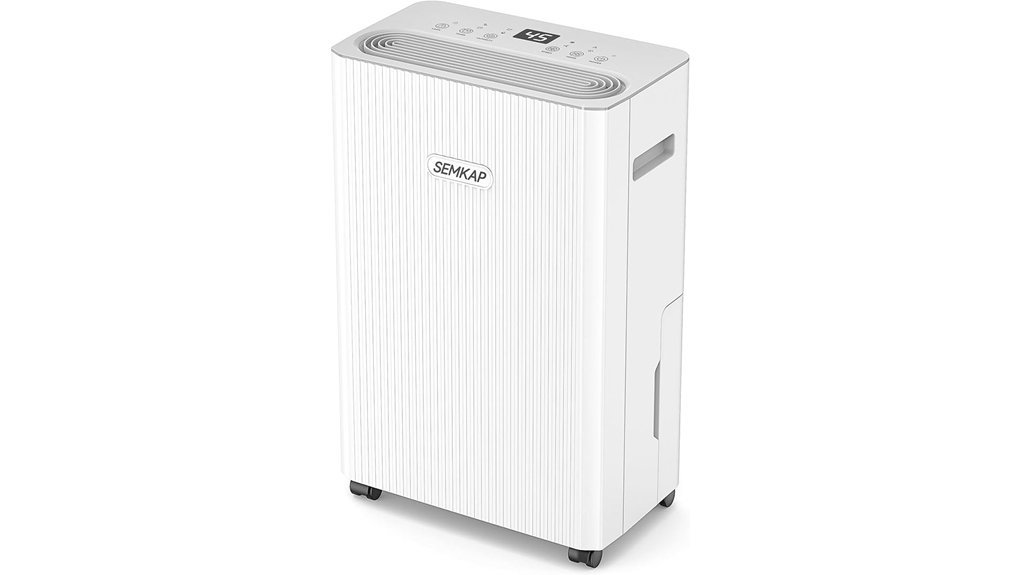
The SEMKAP dehumidifier is the most suitable option in this roundup for a basement, laundry area, larger living room, or persistent whole-room humidity problem. Unlike the compact thermoelectric models below, it uses a compressor system and provides adjustable humidity control with manual or continuous drainage.
The current listing advertises moisture removal of up to 32 pints per day at approximately 95°F and 90% relative humidity. Those are hot, highly humid test conditions, so the figure should not be treated as a guaranteed result or compared directly with a standardized DOE or ENERGY STAR capacity rating. Actual water collection will normally be lower in cooler or less-humid rooms.
The removable tank holds 2.5 liters, and the included hose supports gravity-fed continuous drainage. The listing also identifies automatic defrost, automatic restart, a 24-hour timer, a washable filter, a child lock, wheels, and a carrying handle. Its advertised 2,500-square-foot coverage is a manufacturer estimate rather than a promise; divided rooms, wet walls, air leakage, or severe dampness can reduce real-world performance.
Why You’ll Like It
- Its compressor system is better suited to meaningful room humidity control than the compact thermoelectric models in this article.
- The included drain hose can reduce the need to empty the relatively small tank.
- Adjustable humidity settings, automatic modes, restart, and a timer support longer daily operation.
- Wheels, a handle, and automatic defrost improve portability and use in cooler rooms.
Who Should Buy This
Choose the SEMKAP if you have a moderately damp basement, laundry area, living room, or larger connected space and want a compressor dehumidifier with a humidistat and continuous drainage.
Who Should Avoid This
Skip it if you only need occasional moisture control in a closet or tiny bathroom. A compressor unit uses more electricity, produces more operating noise, and adds more heat to the room than a small thermoelectric model.
Pros:
- Strongest moisture-removal claim among the products in this comparison.
- Manual and continuous drainage options.
- Adjustable humidity control, timer, automatic restart, and defrost.
- Portable upright design with wheels and a carrying handle.
Cons:
- The 32-pint claim is based on 95°F and 90% relative humidity, not typical room conditions.
- The 2.5-liter tank may fill quickly in a damp room unless the hose is used.
- Advertised square-foot coverage may not reflect performance in very wet or divided spaces.
- Compressor operation can add noticeable warmth to a home without air conditioning.
NeedDuck Portable Dehumidifier with 44-Ounce Water Tank
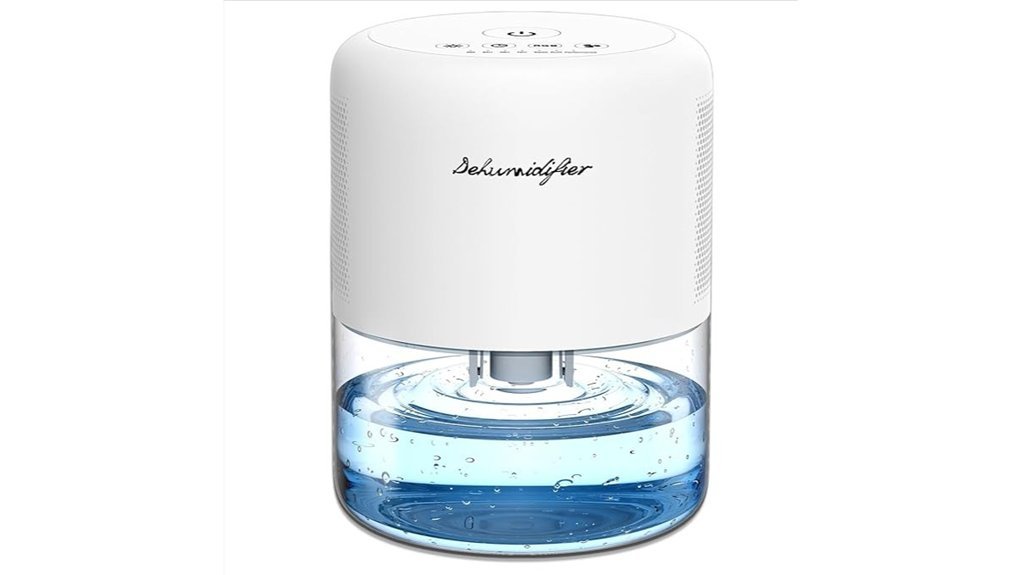
The NeedDuck Portable Dehumidifier is designed for gradual humidity control in small enclosed spaces. Its listing states a 44-ounce tank, a 28-watt power draw, a weight of approximately 2.56 pounds, and an advertised coverage area of up to 215 square feet. Its semiconductor cooling module uses the thermoelectric effect rather than a compressor.
The unit includes three operating modes, four timer options, automatic defrost, and automatic shutoff. Decorative light settings are also included, but the main buying reason is its compact size and low power use. The listing advises using it above approximately 59°F and 45% relative humidity, with better performance at humidity above 60%.
Because the listing does not provide a clearly standardized daily pint-removal rating, this model should be treated as a small-space maintenance tool rather than a substitute for a full-size compressor dehumidifier. It is most useful for mild condensation or musty air in a closet, RV, small bathroom, or compact bedroom.
Why You’ll Like It
- Low 28-watt power draw for gradual, ongoing operation.
- Lightweight body and small footprint that are easy to move or store.
- Automatic defrost and shutoff help simplify daily use.
- Three modes and four timer options provide more control than a basic one-button mini unit.
Who Should Buy This
Choose the NeedDuck for a closet, small bathroom, RV, compact bedroom, or another enclosed space with mild dampness and warm operating conditions.
Who Should Avoid This
Do not choose it for a large room, a persistently wet basement, standing water, wet walls, or fast laundry drying. A compressor model will remove moisture much more quickly in those situations.
Pros:
- Compact dimensions and low weight.
- Low listed power consumption.
- Automatic defrost and full-tank shutoff.
- Multiple operating modes and timer settings.
Cons:
- No clearly standardized daily pint-removal rating is provided on the listing.
- Limited to small-space and mild-humidity applications.
- Performance falls in cooler or less-humid conditions.
- The 44-ounce tank may still need frequent emptying during humid weather.
Tenergy Sorbi 1000ml Air Dehumidifier with HEPA Filter
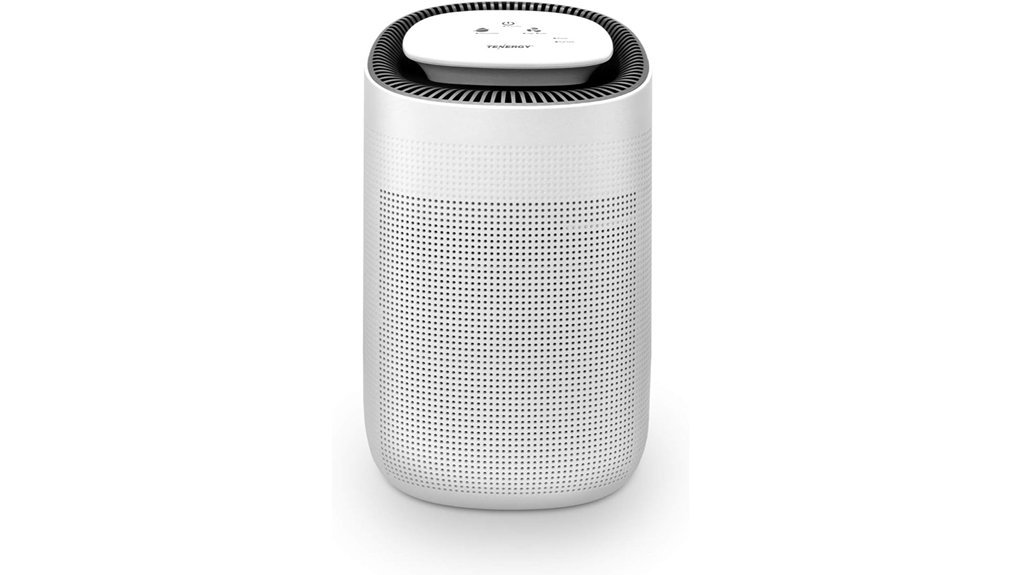
The Tenergy Sorbi combines a compact Peltier dehumidifier with a replaceable HEPA filter. It is designed for localized use in spaces of up to approximately 200 square feet, such as a bathroom, closet, bedroom corner, or home office.
The manufacturer states that it can collect up to 750 ml, or about 1.6 U.S. pints, per day at 86°F and 80% relative humidity. Actual collection will normally be lower in cooler or less-humid rooms. Its removable tank holds 1 liter, and a water-level sensor stops dehumidification when the tank is full.
The integrated filter is a useful secondary benefit for capturing particles that pass through the unit. The listing identifies an airflow rating of about 22 CFM, so buyers should not treat this compact combination appliance as a replacement for a higher-airflow room purifier, whole-home filtration system, or full-size compressor dehumidifier.
Why You’ll Like It
- Combines small-space dehumidification and HEPA particle filtration.
- The 1-liter tank is easy to remove and monitor.
- The listed operating range of approximately 35–42 dB is suitable for many bedrooms and offices.
- Separate dehumidification and filtration controls provide more flexibility than a basic mini unit.
Who Should Buy This
Choose the Tenergy Sorbi if you need gradual moisture removal in a small room and value a replaceable HEPA filter for particles moving through the unit.
Who Should Avoid This
Skip it if your main goal is rapidly reducing humidity in a basement or large living area. You should also account for the ongoing cost and availability of compatible replacement filters.
Pros:
- Two functions in one compact appliance.
- Replaceable HEPA filter for particles passing through the unit.
- One-liter tank with a water-level sensor and automatic shutoff.
- Suitable size and listed operating noise for small rooms.
Cons:
- Limited to localized use in spaces up to approximately 200 square feet.
- The maximum extraction figure applies to 86°F and 80% relative humidity.
- Its modest airflow is not comparable to many dedicated room air purifiers.
- Compatible replacement filters add an ongoing ownership cost.
Factors to Consider When Choosing a Dehumidifier for a Home Without Air Conditioning
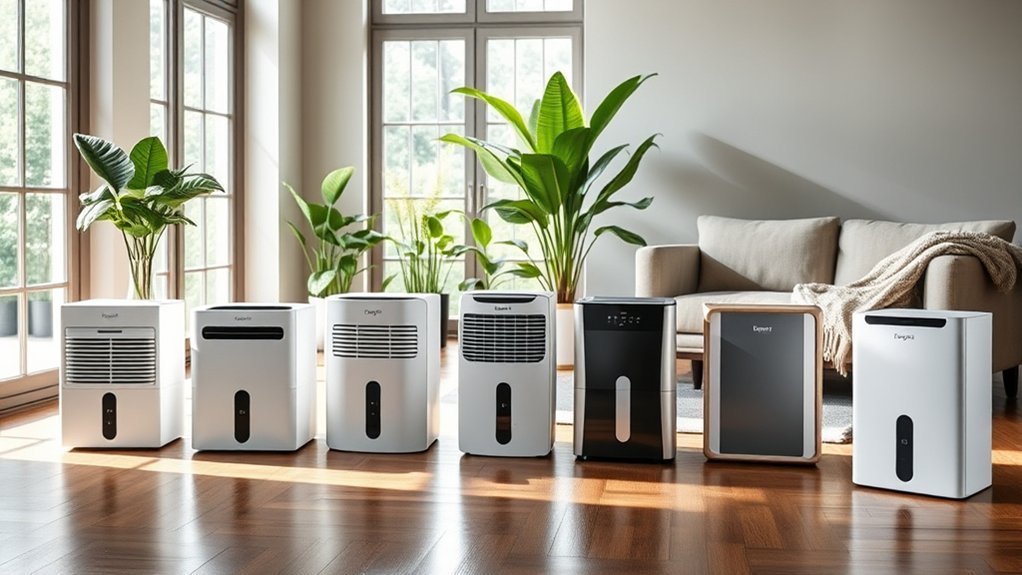
A home without air conditioning can become hot and humid at the same time. The right dehumidifier can reduce excess moisture, but you need to consider extraction capacity, room temperature, heat output, drainage, and operating cost before choosing a model.
Compressor vs. Thermoelectric Technology
A compressor dehumidifier is usually the better choice for a basement, large bedroom, living area, laundry room, or persistent humidity above 60%. It can remove many pints of water per day, but it is heavier, louder, and may noticeably warm the room.
A thermoelectric or Peltier dehumidifier uses less power and is often quieter. It is best for small enclosed spaces with mild dampness. It should not be compared directly with a 20-, 30-, or 50-pint compressor unit.
Room Size and Dampness
Do not choose a dehumidifier using square footage alone. A 300-square-foot room with wet walls and laundry drying may need more capacity than a 1,000-square-foot area with only mild seasonal humidity.
Consider:
- The room’s measured square footage.
- Current relative humidity from a separate hygrometer.
- Visible condensation, musty odors, damp walls, or water seepage.
- Whether doors and windows remain closed while the unit operates.
- How much outside humid air enters the home.
- Whether cooking, showering, or indoor laundry adds moisture.
Moisture-Removal Capacity
Full-size portable dehumidifiers are normally compared by pints removed per 24 hours. This is different from tank capacity. A unit can collect far more water in a day than its tank can hold, which means it may need continuous drainage or repeated emptying.
Check the temperature and humidity used for any extraction claim. A capacity measured in unusually warm, humid conditions should not be compared directly with a standardized rating without that context.
Compact products often state capacity in ounces or milliliters. For comparison, 750 ml is approximately 1.6 U.S. pints. That difference helps explain why a thermoelectric model is better for a closet or small bathroom than a large damp basement.
Heat Output Without Air Conditioning
A dehumidifier does not send collected heat outdoors. Its motor, fan, and refrigeration process release heat into the room, so the air leaving the unit may feel warmer. In a home without AC, consider operating a larger unit during cooler parts of the day and using safe ventilation when outdoor humidity is lower.
Do not leave windows open while the dehumidifier is trying to control humid outdoor air. That can make the unit run continuously without reaching the target humidity.
Noise Level
A sleep mode can reduce fan speed and turn off display lights, but advertised decibel ratings may use different testing methods. Place the unit several feet from the bed when possible, keep the air vents clear, and expect compressor models to be more noticeable than compact thermoelectric units.
Noise level does not prove energy efficiency. Check power consumption, extraction capacity, and current efficiency certification separately.
Drainage Options
Manual drainage works well when you can check the tank every day. Automatic shutoff should stop collection when the tank is full, but the unit will no longer lower humidity until the tank is emptied.
Continuous drainage is more convenient for a basement or laundry area. The hose normally requires a downward path to a suitable drain unless the dehumidifier has a built-in pump. Check that the hose is firmly connected and inspect it periodically for kinks, leaks, or blockages.
Energy Efficiency
Compare efficiency only between units designed for similar jobs. A 28-watt mini dehumidifier consumes less electricity than a compressor model, but it also removes far less moisture.
For a full-size compressor unit, check whether the exact model currently holds an ENERGY STAR certification and review its Integrated Energy Factor when available. Features such as a humidistat, timer, automatic cycling, clean filter, and correct room sizing can also reduce unnecessary runtime.
Room Temperature
Temperature affects condensation. Thermoelectric models generally perform better in warm, humid rooms. Compressor units may develop frost in cooler conditions, so automatic defrost is useful in basements and other cool areas.
Always check the manufacturer’s minimum operating temperature. A standard portable dehumidifier may not perform properly in a very cold garage, crawl space, or unheated basement.
Before You Buy
- Measure the room rather than relying on a general room label.
- Use a hygrometer to confirm the actual relative humidity.
- Choose daily extraction capacity before comparing tank size.
- Check the temperature and humidity behind advertised extraction figures.
- Decide whether you have access to a suitable continuous drain.
- Check the unit’s minimum operating temperature.
- Consider how much heat and noise the room can tolerate.
- Confirm the exact model number, warranty, seller, and return policy on the current listing.
- Check the model against current product-recall information.
- Make sure replacement filters are available when buying a filtered model.
Safety and Maintenance
- Place the dehumidifier upright on a stable, level surface.
- Keep the air inlet and outlet clear according to the manual’s clearance instructions.
- Keep the appliance and plug away from standing water, shower spray, and wet hands.
- Follow the manufacturer’s instructions for wall outlets, extension cords, adapters, and power strips.
- Unplug the unit before cleaning the tank, filter, intake, or exterior.
- Clean the collection tank regularly to prevent residue and odors.
- Inspect continuous-drain hoses for leaks and blockages.
- Stop using the unit if the plug becomes hot, the cord is damaged, or the appliance produces a burning smell.
- Check the model number against current dehumidifier recalls before use.
Frequently Asked Questions
How Do I Determine the Right Size Dehumidifier?
Measure the room and check its relative humidity with a hygrometer. Then consider how damp the room is. Mild seasonal humidity may need less capacity, while condensation, wet walls, laundry drying, or seepage requires a stronger unit. Daily pint capacity is more useful than advertised square footage alone.
Will a Dehumidifier Cool a Room Without AC?
No. A dehumidifier removes water vapor but normally releases some heat into the room. Reduced humidity may make the air feel less clammy, but the appliance does not lower room temperature like an air conditioner.
What Humidity Level Should I Use?
A practical target for many homes is approximately 30% to 50% relative humidity. Keeping humidity below 60% helps reduce conditions that support condensation and mold growth. Avoid making the air uncomfortably dry.
Are Mini Dehumidifiers Effective?
They can be effective for mild dampness in small enclosed spaces. They are not equivalent to compressor dehumidifiers rated for 20, 30, or more pints per day. Check the listed daily extraction rate in ounces, milliliters, or pints before comparing products.
Should I Leave Windows Open While Using a Dehumidifier?
Usually not. Open windows can continuously introduce humid outdoor air and prevent the room from reaching its target humidity. Close windows and exterior doors while operating the unit unless outdoor air is significantly drier and you are ventilating the home instead.
How Often Should I Empty the Tank?
It depends on the tank size, extraction rate, and room humidity. Check the tank daily during the first week. A full-size unit in a damp room may fill several times per day, while a small thermoelectric unit may take much longer. Use continuous drainage when practical.
What Maintenance Is Required?
Clean or replace the filter as directed, wash and dry the water tank, remove dust from the air intake, inspect the drain hose, and keep the surrounding area clear. Unplug the appliance before cleaning and follow the model’s manual for coil care and storage.
Can a Dehumidifier Remove Existing Mold?
No. It can reduce excess moisture that supports future growth, but it does not remove existing mold or repair the source of water. Address leaks and clean or professionally remediate existing mold as appropriate.
Is a HEPA Dehumidifier a Replacement for an Air Purifier?
Not necessarily. A compact combination unit can filter particles that pass through it, but its airflow may be lower than a dedicated room air purifier. Compare filter type, replacement availability, airflow, and recommended room size before relying on it for filtration.
Conclusion
The SEMKAP 32-Pint Dehumidifier is the strongest overall choice in this comparison because its compressor system, adjustable controls, and drain-hose support are better suited to meaningful room humidity control. It is the most practical option here for a basement, laundry area, or larger living space, provided the listing’s capacity and operating conditions match your needs.
For a closet, compact bathroom, RV, or other small enclosed space, the NeedDuck offers lightweight, low-power thermoelectric operation. Choose the Tenergy Sorbi when you also want a replaceable HEPA filter, while recognizing that its low airflow does not make it a substitute for a high-capacity room air purifier.
Whichever model you choose, measure the room, monitor humidity with a hygrometer, account for the heat the unit will release, and correct leaks or water intrusion. A properly sized dehumidifier can make a home without AC feel less damp, but it cannot cool the room or fix the source of structural moisture.
Final Recommendation
For persistent humidity or a larger room, start with the SEMKAP and use continuous drainage when possible.