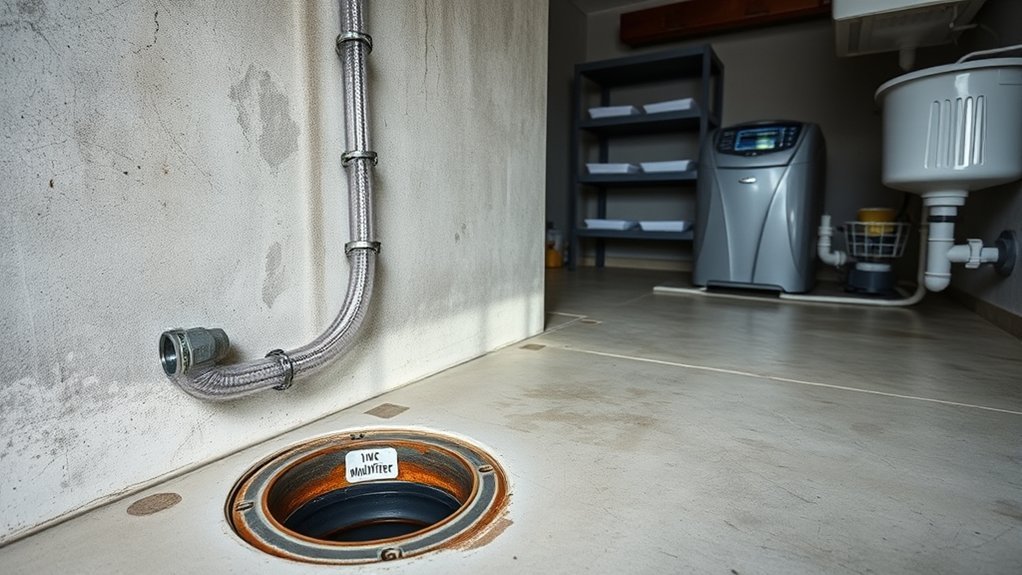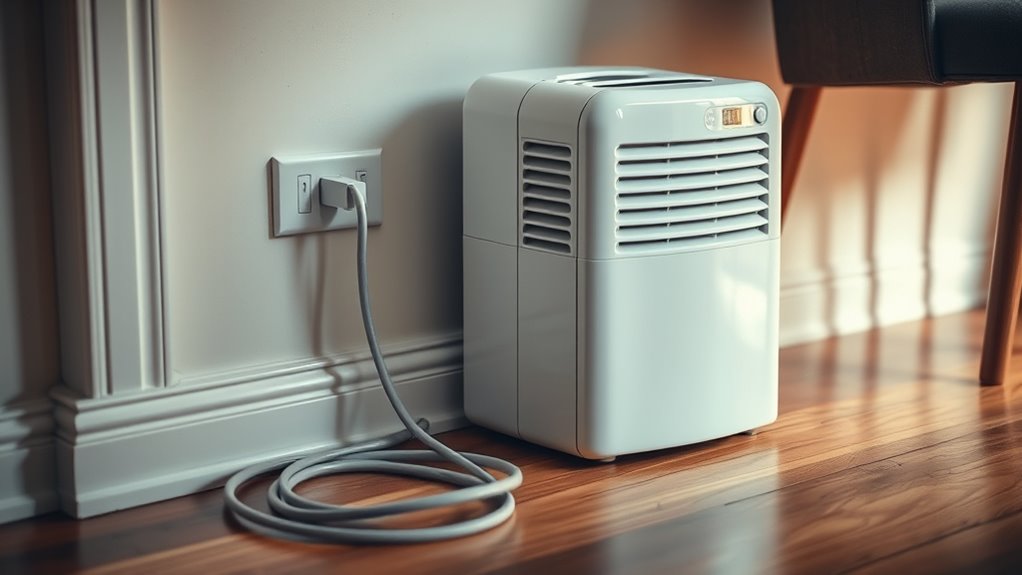
For normal use, you should not use an extension cord with a dehumidifier. Plug the unit directly into a properly grounded 3-prong wall outlet. Many dehumidifier manuals and manufacturer support pages explicitly warn against extension cords, surge protectors, adapters, and multi-outlet taps. If your specific manual allows temporary cord use, use only one short, grounded, heavy-duty cord rated above the unit’s nameplate load. If the manual says no extension cord, the safe answer is no.
Quick Answer
A dehumidifier should normally plug straight into a grounded wall outlet. Do not use a power strip, surge strip, outlet splitter, damaged cord, coiled cord, or cord with a missing ground prong. If your owner’s manual specifically allows temporary extension-cord use, choose one short, grounded, heavy-duty cord rated above the unit’s amps. Do not override a manual that says not to use an extension cord.
Key Takeaways
- The safest setup is a direct connection to a grounded 3-prong wall outlet.
- Major manufacturers often prohibit extension cords, surge protectors, adapters, and multi-outlet taps for dehumidifiers.
- If your manual allows temporary cord use, check the nameplate amps or watts first and choose a cord rated above that load.
- Use one 3-prong, grounded, heavy-duty cord only. Avoid light-duty 16 AWG or 18 AWG household cords for compressor appliances.
- Stop using the setup immediately if the cord feels hot, smells burnt, flickers lights, trips a breaker, or shows damaged insulation.
- For basements and damp areas, a nearby GFCI-protected outlet or a properly installed dedicated circuit is the safer long-term fix.
At a Glance
| Best Setup | Grounded wall outlet near the dehumidifier |
| Time Required | 5–15 minutes to check the manual, outlet, cord label, plug, and dehumidifier rating plate |
| Difficulty | Easy for inspection; hire a licensed electrician for new outlets or circuit work |
| Tools Needed | Owner’s manual, rating label, grounded outlet, and a heavy-duty 3-prong cord only if temporary cord use is allowed |
| Cost | No added cost if a safe outlet is already nearby; cord and electrician costs vary by rating, location, and code requirements |
Can You Use an Extension Cord for a Dehumidifier?
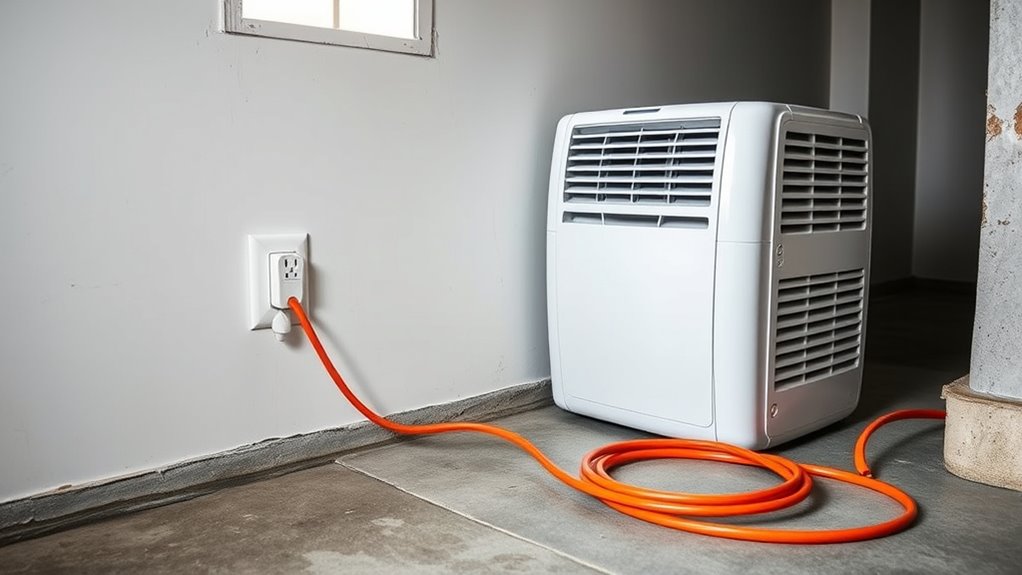
You normally should not use an extension cord for a dehumidifier. A compressor appliance can run for long periods, and its startup demand can be harder on a cord than steady running alone. A weak cord, loose plug, long run, or power strip can create heat, voltage drop, shock risk, or fire risk.
The manual controls the answer. Some manufacturer instructions say the dehumidifier must plug directly into a grounded 3-prong wall outlet and must not use an extension cord, surge protector, adapter, or multi-outlet adaptor. If your manual says that, do not use a cord. If the manual allows a temporary extension cord, use one grounded, properly rated cord only, and keep it as short as possible.
| Setup | Verdict | Why |
|---|---|---|
| Grounded wall outlet | Best choice | Matches typical manufacturer electrical instructions |
| One short heavy-duty cord, if manual allows | Temporary only | Must exceed the unit’s load and stay cool during use |
| Power strip, surge strip, splitter, adapter, or daisy chain | Do not use | Adds overload, loose-connection, and overheating risk |
Warning: Never plug a dehumidifier into a power strip, surge strip, outlet splitter, lamp cord, damaged cord, or a chain of multiple extension cords. These setups can overload, overheat, or fail without much warning.
Check the Owner’s Manual and Rating Label First
The safest cord decision starts with the dehumidifier itself. Do not guess from the bucket size, pint rating, or room-size claim. Two dehumidifiers that look similar can draw different current. Find the electrical label on the back or side of the unit and check:
- Voltage: Most U.S. household units are designed for a standard 115–120 volt outlet.
- Amps or watts: The cord, outlet, and circuit must support the appliance load.
- Grounding: A 3-prong dehumidifier plug must go into a grounded 3-slot receptacle.
- Manual warnings: If the manual forbids extension cords, adapters, or surge protectors, follow the manual.
If the label lists watts instead of amps, estimate the running amps with this simple formula: watts ÷ volts = amps. For example, a 600-watt unit on 120 volts draws about 5 running amps. Do not size the cord to the exact edge, because compressor startup, cord length, and poor connections can increase stress on the setup.
If you are unsure whether the outlet, circuit, or cord is safe, stop and ask a licensed electrician. That is especially important in basements, laundry rooms, crawl spaces, garages, and other damp areas.
What Gauge Extension Cord Does a Dehumidifier Need?
If your manual allows temporary extension-cord use, choose the cord by amp rating, wire gauge, length, grounding, and listing mark, not by color or plug shape. Lower AWG numbers mean thicker wire, so 12 AWG is heavier than 14 AWG. A thick, grounded cord can still be unsafe if it is damaged, too long, coiled, wet, or plugged into an overloaded circuit.
For many household dehumidifiers, a short 14 AWG grounded cord may exceed the running load, but the safer choice is still a direct outlet. If the run is longer than about 25 feet, step up to 12 AWG or install a closer outlet. Avoid light-duty 16 AWG or 18 AWG household cords for a compressor appliance unless the manual and cord rating clearly allow the exact load.
| Cord setup | Safer guidance |
|---|---|
| Direct wall outlet | Best choice for normal dehumidifier use |
| Manual says no extension cord | Do not use a cord; install or use a closer grounded outlet |
| Short temporary cord allowed by manual | Use one grounded, heavy-duty cord rated above the unit’s amp draw |
| Longer temporary run | Use a heavier cord such as 12 AWG, but avoid long runs when possible |
| Power strip or outlet splitter | Do not use for a dehumidifier |
Pro Tip: Buy by the label, not by the color. A bright orange cord is not automatically safe. Check the AWG size, amp rating, grounding, indoor/outdoor rating, listing mark, and condition of the cord.
Recommended Products

Extra Heavy Duty Outdoor Extension Cords: This 10 foot electrical extension cord serves as an ideal extension cable for both indoor and outdoor use. The extension cord 10 ft is a perfect solution for various applications, including landscaping, lawn care, gardening, powering tools, and operating household appliances.

Lighted End and Extra Size for Safety: The power socket indicator light shows that power is on and the heavy duty extension cord 25 ft is ready for work; Extra size male NEMA 5-15P power plug and female NEMA 5-15R power socket for safety; It is thicker and more durable than the normal type on market and has high insulation safety performance to prevent electric shock; ETL/cETL listed for safe approval
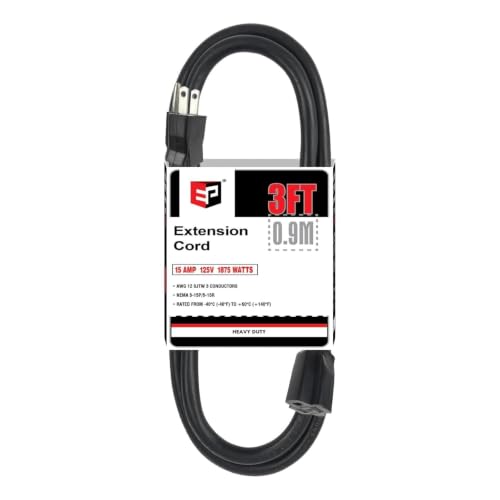
Heavy Duty Extension Cord - 15 amps, 125 volts, 1875 watts, 5-15P/R, 12 gauge heavy duty cord with pure copper wire.
How Long Can a Dehumidifier Extension Cord Be?
If temporary cord use is allowed, keep the dehumidifier cord as short as possible. A 6–10 foot cord is safer than a 25 foot cord, and a direct outlet is safer than either one. Longer cords add resistance, which can increase voltage drop, heat buildup, weak compressor starts, and reduced performance.
Recommended Products

Extension Cord: The GoGreen Power (GG-14025) is a contractor grade 12/3 SJTW extension cord. This item SHOULD NOT be used with an EV Charger.

Product Specification:12awg 10 ft extension cord; outdoor extension cord power 15Amp 1875W; 12 gauge extension cord plug model 5-15P/R;temperature range: -58°F to +158°F; 10ft extension cord ETL/cETL certified; heavy duty extension cord is a great peace of mind for power tools, gardening equipment and outdoor lighting
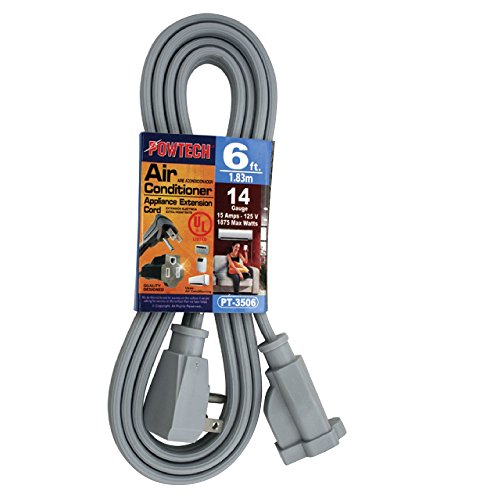
Air Conditioner and Major Appliance Extension Cord UL Listed. Sturdy cord Ideal for plugging in large appliances such as washers, dryers, or refrigerators, power tools and other major appliances
Cord Length Limits
As a conservative rule, avoid pushing a 14 AWG cord beyond a short temporary run. If you need more reach, do not keep adding cords. Use one heavier cord rated for the load, or install a properly grounded outlet closer to the unit.
- Use one cord only, never a chain of cords.
- Uncoil the full cord before running the dehumidifier.
- Keep the cord in open air so heat can escape.
- Keep the plug and connection away from water, puddles, and drain hoses.
- Unplug the cord when the dehumidifier is not in use.
Gauge Needs By Distance
The farther power has to travel, the heavier the cord should be. For a dehumidifier, that usually means a properly rated 14 AWG cord only for short temporary use and a heavier 12 AWG cord for longer temporary use, if your manual allows a cord at all. Avoid very long extension-cord runs for compressor appliances. If the only outlet is across the room, the safer fix is a new outlet, not a longer cord.
Also remember that the wall circuit matters. A heavy-duty cord cannot make an overloaded circuit safe. If the breaker trips, lights dim, the outlet buzzes, or the plug feels hot, stop using the setup and have the circuit checked.
Safer Power Alternatives
The best alternative is to move the power source, not stretch the cord. A licensed electrician can install a grounded outlet near the dehumidifier. In a basement or other damp location, ask about GFCI protection and whether the dehumidifier should be on a dedicated circuit.
You can also move the water instead of moving the electricity. Use a gravity drain hose to a floor drain, utility sink, or sump area if the manual allows it. If the drain is uphill or farther away, use a condensate pump made for dehumidifier drainage.
A direct, grounded outlet near the dehumidifier is safer than a long cord running through a damp basement.
What Are the Signs of an Undersized Cord?
An undersized or overloaded cord often gives warning signs before it fails. Check the cord during the first few minutes of operation and again after the dehumidifier has been running for a while. The cord and plug should stay cool or only slightly warm. Hot is not normal.
| Sign | What it means | What to do |
|---|---|---|
| Warm or hot cord | Possible overload, voltage drop, or poor connection | Unplug and switch to a safer setup |
| Burning smell | Insulation or plug may be overheating | Stop immediately and do not reuse the cord |
| Flickering lights | Circuit or voltage-drop issue | Use a different circuit or call an electrician |
| Tripped breaker | Circuit overload or fault | Do not reset repeatedly; find the cause |
| Cracked, cut, soft, or repaired insulation | Shock and fire hazard | Discard the cord |
Warning: Do not run the cord under rugs, through doorways, behind furniture, across wet floors, or through walls. A hidden cord can overheat or become damaged before you notice a problem.
What Are Safer Alternatives to Extension Cords?
Safer options remove the long-cord problem altogether. If the dehumidifier is in a room where you use it often, install a properly grounded outlet near the unit. In damp spaces, use a GFCI-protected outlet where local code requires it or an electrician recommends it.
- Install a nearby outlet: This is the cleanest long-term fix.
- Use a dedicated circuit: Helpful if the dehumidifier shares power with freezers, sump pumps, tools, or laundry equipment.
- Use a drain hose: Keep the unit near a safe outlet and route water to a floor drain.
- Use a condensate pump: Move collected water when gravity drainage is not possible.
- Move the dehumidifier: Place it where airflow is good and a safe outlet is nearby.
If you are using a dehumidifier to control mold risk, also fix the source of moisture. A dehumidifier helps manage damp air, but it does not repair leaks, poor grading, clogged gutters, foundation seepage, or bad ventilation.
Recommended Products

Certified Safety with US Patent Protection. This GFCI outlet is UL 943 & UL 498 Certified, Class A Rated, ensuring the highest level of ground fault protection. With a 20A/125V/60Hz rating, it’s perfect for both residential and commercial use. Additionally, its US Patent Protected design guarantees unmatched reliability and safety.

15 amp Non-Tamper Resistant Ground Fault Circuit Interrupter (GFCI) outlet receptacle for indoor use. Please kindly check if the depth of electrical box can fit our GFCI outlets before purchasing.

Designed to improve immunity for reduced High Frequency (HF) nuisance tripping. providing increased compatibility with appliances and other electronics
What Dehumidifier Safety Tips Matter in Basements?
Basements need extra care because moisture and electricity are a bad mix. Place the dehumidifier on a level, stable surface with open airflow around the intake and exhaust. Keep the cord, plug, outlet, and drain hose separated so water cannot drip onto electrical connections.
- Use a grounded outlet with GFCI protection where appropriate.
- Do not share the outlet with a freezer, sump pump, space heater, or other heavy load.
- Keep the cord off wet concrete and away from foot traffic.
- Do not use a cord with a missing ground prong.
- Clean the filter so the unit does not overwork from poor airflow.
- Empty the bucket before it overflows, or use a properly routed drain hose.
- Unplug the dehumidifier before cleaning, moving, or inspecting it.
Note: A dehumidifier works best when the space is mostly closed to outside humid air. Keep basement windows and exterior doors closed while the unit is running, unless you are ventilating for a specific reason.
Frequently Asked Questions
Can you put a dehumidifier on an extension cord?
Usually, no. Plug it directly into a grounded wall outlet. Use an extension cord only if your specific owner’s manual allows it, and only as a temporary setup with one grounded, heavy-duty cord rated above the unit’s load. If the manual says not to use a cord, do not use one.
What gauge extension cord should you use for a dehumidifier?
If temporary cord use is allowed, use a grounded heavy-duty cord rated above the dehumidifier’s nameplate amps. A short 14 AWG cord may be enough for some household units, while a longer temporary run should use a heavier cord such as 12 AWG. A direct outlet is still safer.
Why does my dehumidifier say not to use an extension cord?
That warning helps prevent overheating, voltage drop, loose connections, shock hazards, and fire risk. Manufacturers cannot control the cord’s gauge, length, condition, listing, or how many devices share the circuit, so many require a direct grounded outlet.
Can I plug a dehumidifier into a power strip?
No. A power strip adds outlets, not electrical capacity. A dehumidifier should plug into a properly grounded wall outlet. Do not use a surge strip, outlet splitter, adapter, or daisy-chained cord setup.
Does a basement dehumidifier need a GFCI outlet?
Basements, garages, laundry rooms, and other damp spaces often need GFCI protection under local electrical rules. Requirements vary by location and installation. Ask a licensed electrician to confirm the safest outlet type for your home.
Can a dehumidifier share an outlet with a freezer or sump pump?
Avoid sharing the outlet or circuit with another heavy or critical load. A freezer, sump pump, power tool, or space heater can add startup demand and overload risk. If breakers trip or lights dim, stop using the setup and have the circuit checked.
Conclusion
The safest way to power a dehumidifier is simple: plug it directly into a properly grounded wall outlet. If the manual prohibits extension cords, surge protectors, adapters, or multi-outlet taps, follow that warning. If temporary cord use is allowed, choose one short, grounded, heavy-duty cord rated above the unit’s load, uncoil it fully, and inspect it during use. If the cord gets hot, smells burnt, flickers lights, or trips a breaker, unplug it. For regular basement use, install a safer outlet near the dehumidifier and move the water with a drain hose or condensate pump instead of stretching electricity across the room.
Sources
- GE Appliances: Dehumidifier use of extension cord or surge protector — supports direct grounded outlet guidance and the warning against extension cords, surge protectors, and multi-outlet adaptors.
- Hisense dehumidifier user manual — supports manufacturer warnings against extension cords and adapters for dehumidifiers.
- Midea dehumidifier user manual — supports grounded-wall-receptacle instructions and nameplate-based electrical requirements.
- Electrical Safety Foundation International: Extension cord safety tips — supports cord rating, gauge, grounding, and temporary-use guidance.
- U.S. Consumer Product Safety Commission: Household extension cords can cause fires — supports overload, hot-cord, damaged-cord, and under-rug warnings.
- U.S. EPA: Care for Your Air — supports indoor humidity guidance and mold-risk context.
- ENERGY STAR: Dehumidifiers — supports dehumidifier placement, grounded outlet, drainage, and 30%–50% relative humidity guidance.