
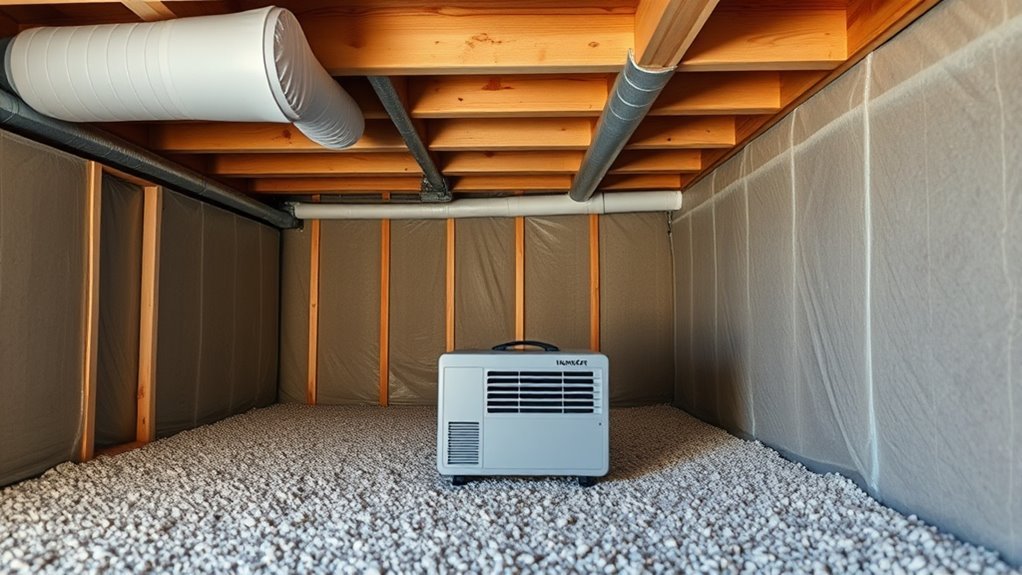
Choosing the right crawl space dehumidifier size takes more than multiplying floor length by width. Ceiling height, air sealing, ground vapor, and outdoor climate all change how many pints of water a unit must pull from the air each day. If you guess based on square footage alone, you risk buying a unit that runs nonstop without stopping mold growth.
Quick Answer
For a sealed 1,000 to 1,800 sq. ft. crawl space with moderate humidity, a 70-pint-class dehumidifier is the standard starting size. Spaces under 1,000 sq. ft. typically need 35 to 50 pints, while damp, leaky, or 2,000+ sq. ft. spaces require 70 to 100+ pints after sealing and drainage fixes.
What Crawl Space Dehumidifier Size Do You Need?
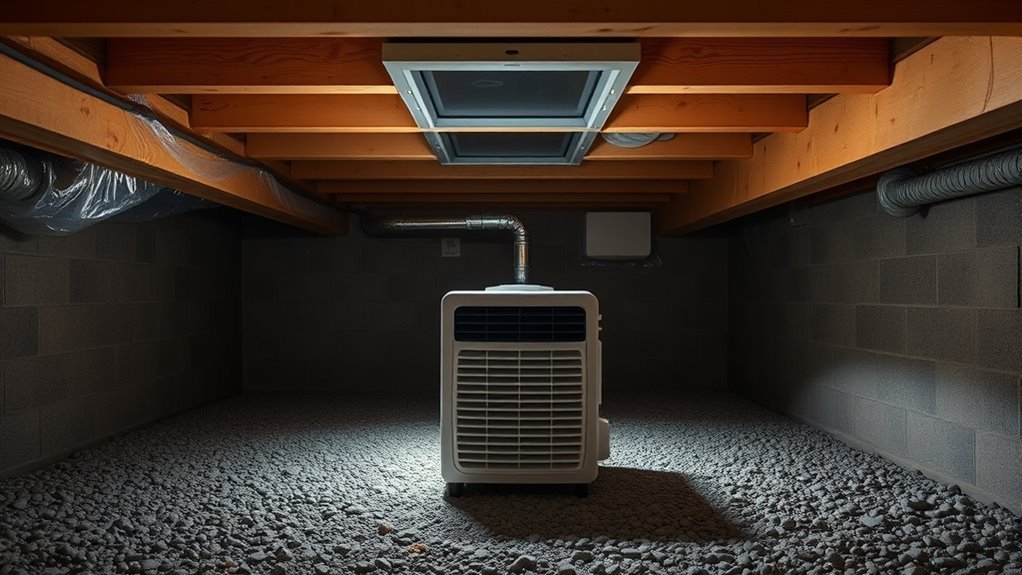
Most sealed crawl spaces between 1,000 and 2,000 square feet need a 70-pint-class crawl space dehumidifier. Smaller encapsulated spaces under 1,000 square feet usually need a 35- to 50-pint model, while spaces over 2,000 square feet or those with high moisture loads require 90 to 120+ pints of daily capacity.
Start by calculating both floor area and cubic volume. A 33 x 36 foot crawl space equals 1,188 square feet. Multiply that floor area by the average height from the soil or liner to the subfloor joists. At 3 feet high, that space holds 3,564 cubic feet of air; at 5 feet high, it holds 5,940 cubic feet—67% more air to dry and circulate.
Next, log relative humidity (RH) with a digital hygrometer for at least 24 to 48 hours during dry weather, and check it again after heavy rain. The EPA advises keeping indoor humidity below 60%, ideally between 30% and 50%. Similarly, the CDC recommends keeping indoor humidity no higher than 50% throughout the day to inhibit mold growth. In a crawl space, maintaining 45% to 50% RH keeps wooden floor joists at a safe equilibrium moisture content below 16%, preventing fungal decay without over-drying hardwood floors upstairs.
For a 1,200-square-foot space that is encapsulated with a sealed vapor barrier and has no standing water, a 70-pint-class unit handles the load comfortably. Furthermore, the International Residential Code (IRC Section R408.3) sets a baseline benchmark of 70 pints (33 liters) of moisture removal per day for every 1,000 square feet of floor area when conditioning an unvented crawl space with a dehumidifier. If your crawl space is vented, smells musty, has exposed damp dirt, or stays above 60% RH, fix the moisture entry points first or step up to a higher-capacity unit.
Crawl Space Dehumidifier Sizing Chart
Use the chart below to match your crawl space floor area, approximate cubic volume (assuming a 3- to 4-foot ceiling height), and sealing condition to a starting pint capacity. Always verify the final model against the manufacturer’s cubic-foot coverage, minimum operating temperature, and airflow rating in cubic feet per minute (CFM).
| Crawl space condition & area | Approx. volume (3–4 ft height) | Common starting capacity (current DOE rating) | What to check before buying |
|---|---|---|---|
| Under 1,000 sq. ft., tightly sealed, mildly damp (50%–60% RH) | Up to 4,000 cu. ft. | 35 to 50 pint class | RH stays at 45% to 50% after rain; gravity drain slope |
| 1,000 to 1,800 sq. ft., mostly sealed, moderate humidity (60%–70% RH) | 4,000 to 7,200 cu. ft. | 70 pint class | Crawl-space-rated unit, auto-defrost, continuous drainage, 150+ CFM blower |
| 1,800 to 2,600 sq. ft., sealed but humid (70%–80% RH) | 7,200 to 10,400 cu. ft. | 70 to 90 pint class | Low-temperature operation, 200+ CFM airflow, condensate pump or sump route |
| 2,600+ sq. ft., very humid (80%+ RH), vented, or loosely sealed | 10,400+ cu. ft. | 90 to 130+ pint class, or multiple units | Seal vents and vapor barrier first; check ducting options for long spaces |
Manufacturer coverage ratings vary depending on how tightly sealed the building envelope is. For example, a commercial-grade 70-pint crawl space dehumidifier is often rated to cover up to 2,600 square feet (15,000 cubic feet) in a tightly encapsulated crawl space, up to 2,200 square feet in a moderately sealed space, and only 1,800 square feet in a loosely sealed space.
Note: If your crawl space has chronic standing water, rotting joists, or L-shaped foundation walls that block airflow, ask a waterproofing contractor or HVAC professional to perform a formal moisture load calculation before purchasing equipment.
Why Pint Ratings Are Not Always Comparable (2020 DOE Test Changes)
Dehumidifier pint ratings changed in early 2020 when the U.S. Department of Energy (DOE) lowered the test chamber temperature for portable units from 80°F to 65°F at 60% RH. Because cooler air holds less water vapor, a machine removes fewer pints per day at 65°F than at 80°F even though its actual drying power has not changed.
ENERGY STAR defines capacity as the water a dehumidifier removes in 24 hours under standardized test conditions. Before 2020, manufacturers tested units at the Association of Home Appliance Manufacturers (AHAM) standard of 80°F and 60% RH. Under current federal rules, portable units are tested at 65°F and 60% RH to mirror cool basements and crawl spaces, while whole-home (ducted) dehumidifiers follow a separate DOE test procedure. Use the official ENERGY STAR conversion table below when comparing older guidance or pre-2020 labels with current models.
| Dehumidifier Category | Pre-2020 Capacity (80°F / 60% RH) | Current DOE Capacity (Post-2020 Test) | Typical Crawl Space Use |
|---|---|---|---|
| Portable Unit | 30 pints/day | 20 pints/day | Small, tight spaces under 500 sq. ft. |
| Portable Unit | 50 pints/day | 30 pints/day | Sealed crawl spaces under 1,000 sq. ft. |
| Portable Unit | 70 pints/day | 40 to 45 pints/day | Mildly damp spaces around 1,000 to 1,200 sq. ft. |
| Portable Unit | 90 pints/day | 55 pints/day | Moderately damp spaces up to 1,500 sq. ft. |
| Whole-Home / Crawl Space Unit | 80 pints/day | 70 pints/day | Standard encapsulated crawl spaces (1,000 to 2,200 sq. ft.) |
| Whole-Home / Crawl Space Unit | 100 pints/day | 85 pints/day | Humid or larger spaces (1,800 to 2,600 sq. ft.) |
| Whole-Home / Crawl Space Unit | 120 pints/day | 100 pints/day | Large or wet crawl spaces (2,600+ sq. ft.) |
Always check whether a manufacturer lists its capacity at the current DOE test standard or at AHAM (80°F / 60% RH) conditions. Never compare a pre-2020 or saturation rating (90°F / 90% RH) directly against a current DOE pint rating.
How Humidity and Temperature Affect Capacity
Cool crawl space temperatures and high moisture infiltration directly reduce how effectively a dehumidifier controls humidity. Standard room units lose capacity and develop frost on their evaporator coils when temperatures drop below 60°F, while unsealed foundation vents continuously feed humid outdoor air into the space.
Moisture load comes from active sources rather than square footage alone. Exposed dirt floors, open foundation vents, groundwater seepage, plumbing drips, poor exterior grading, and humid summer air all add water vapor. Because of the stack effect, warm air rising through your house pulls crawl space air—and any mold spores or musty odors it carries—up through subfloor gaps into your living area.
Crawl spaces also stay cooler than upstairs rooms because they sit below grade next to cool soil. At 80°F and 60% RH, air holds significantly more water vapor than at 60°F and 60% RH. A standard residential dehumidifier often freezes up in a 55°F crawl space. Always choose a dedicated crawl space model with auto-defrost and a stated minimum operating temperature between 33°F and 40°F.
How to Calculate Required Airflow (CFM)
Pint capacity only works if the fan can circulate dry air into every corner of the crawl space. Building science guidelines recommend moving the total air volume of the crawl space about 3 to 4 times per hour (air changes per hour, or ACH) to prevent stagnant, damp pockets around perimeter sill plates.
To estimate the airflow your space needs in cubic feet per minute (CFM), multiply your crawl space cubic footage by 4 ACH and divide by 60 minutes:
- 3,000 cu. ft. crawl space (1,000 sq. ft. × 3 ft height): 3,000 × 4 ÷ 60 = 200 CFM.
- 4,800 cu. ft. crawl space (1,200 sq. ft. × 4 ft height): 4,800 × 4 ÷ 60 = 320 CFM.
- 7,200 cu. ft. crawl space (1,800 sq. ft. × 4 ft height): 7,200 × 4 ÷ 60 = 480 CFM.
Place one hygrometer within 6 feet of the unit and a second hygrometer at the farthest corner of the crawl space. If the far corner stays 10% or more higher in RH than the area near the unit, poor airflow—not low pint capacity—is the bottleneck. Adding flex ducting or a crawl space circulation fan solves uneven drying without buying a second dehumidifier.
Fix Moisture Sources Before Sizing Up
Stop bulk water entry, ground evaporation, and outdoor air leaks before you size or install a crawl space dehumidifier. A dehumidifier is designed to maintain dry air inside a sealed envelope, not to overcome standing puddles, missing gutters, or uncovered soil.
The ENERGY STAR closed crawl space design guide outlines a complete moisture-control system: exterior site grading, roof runoff control, foundation drainage, a continuous sealed vapor retarder, outdoor routing for appliance exhausts, and mechanical air drying.
- Bulk water and drainage: Fix standing water, leaking pipes, foundation wall seepage, clogged gutters, and negative soil grading first. Downspouts should discharge water at least 5 to 10 feet away from the foundation, and interior perimeter drains or a sump pump should handle groundwater intrusion.
- Ground vapor retarder: Cover 100% of exposed earth with a continuous polyethylene liner. The DOE Building America Solution Center guide on unvented crawl spaces specifies a minimum 6-mil polyethylene sheet as a capillary break, while 10- to 20-mil reinforced liners offer stronger puncture resistance during maintenance. In addition, the DOE Building America guide to closing ventilated crawl spaces details overlapping seams by at least 6 to 12 inches, taping all seams, and sealing the liner to foundation walls and support piers.
- Open foundation vents: In a closed crawl space conversion, seal exterior foundation vents and rim-joist gaps with foam board and spray foam. Before closing vents, confirm that no furnace or water heater relies on the crawl space for combustion makeup air, and verify local building codes.
- Appliance exhausts: Route clothes dryer, bathroom fan, and kitchen range vents completely outdoors through rigid metal ducting—never terminate them inside the crawl space.
- Condensate drainage: Route the dehumidifier’s drain hose to a sump basin, interior floor drain, or exterior discharge line, and insulate any exterior section against freezing.
Warning: Never place a dehumidifier in standing water or power it with a light-duty extension cord. If your crawl space has widespread mold, raw sewage, exposed wiring, radon concerns, or atmospherically vented gas appliances, hire a licensed professional before sealing vents or installing electrical equipment.
How to Pick the Right Capacity, Step by Step
Follow these seven steps in order to calculate your crawl space dehumidifier size accurately and verify that the installed unit controls moisture across the entire footprint.
- Measure floor area and volume: Multiply length by width to get square footage, then multiply by average height to find total cubic feet.
- Log baseline humidity: Record temperature and RH for 48 hours in dry weather and again 12 to 24 hours after heavy rain.
- Inspect air sealing and liner integrity: Check for open foundation vents, unsealed rim joists, loose access doors, and untaped vapor barrier seams.
- Eliminate standing water: Repair plumbing drips, extend downspouts, or install a sump pump before sizing the dehumidifier.
- Select your starting pint capacity: Match your square footage, cubic volume, and baseline RH to our sizing chart, and verify the model’s current DOE pint rating and CFM airflow.
- Plan the condensate drain and power: Choose between a downhill gravity hose and an internal or external condensate pump, and confirm a dedicated GFCI-protected outlet is within reach.
- Verify performance after 7 days: Check RH at both the unit and the farthest corner after one week of operation, aiming for 45% to 50% RH throughout the space.
For a crawl space near 2,000 square feet that remains above 65% RH or is only partially sealed, step up from a 70-pint model to an 85- to 100-pint-class unit. Spaces divided by interior block walls or masonry piers often require ducting kits to push dry air into separate bays.
Pro Tip: Pair your hygrometer check with a pin-type wood moisture meter on the floor joists. Air RH fluctuates daily, but wood moisture content shows long-term drying—your dehumidifier is properly sized when wood joists stay between 10% and 14% moisture content.
Features Worth Having
A dedicated crawl space dehumidifier is built with heavy-duty coils, corrosion-resistant housing, and horizontal cabinets that fit low clearances. Look for these seven features when comparing models:
- Low-temperature operation and auto-defrost: Prevents ice buildup on evaporator coils when crawl space temperatures drop into the 40°F to 55°F range.
- Built-in digital humidistat (or remote wired sensor): Automatically cycles the compressor to hold a steady 45% to 50% RH target without constant manual adjustment.
- Continuous drainage: Includes a threaded gravity drain port or an integrated condensate pump capable of lifting water 10 to 20 feet vertically so you never empty a bucket.
- Auto-restart after power outages: Restores your saved humidity setpoint automatically as soon as electricity returns after a storm.
- Accessible MERV-8 to MERV-11 air filter: Slides out from the front or side panel so you can clean or replace it quickly from the crawl space access hatch.
- Ducting collars: Allows you to attach 6- to 10-inch flex ducting to draw air from one section and discharge dry air into distant corners.
- High Integrated Energy Factor (IEF): Removes more liters of water per kilowatt-hour (L/kWh). Under the ENERGY STAR key efficiency criteria for dehumidifiers, certified whole-home units must achieve an IEF of at least 2.22 L/kWh (for case volumes up to 8.0 cu. ft.) or 3.81 L/kWh (above 8.0 cu. ft.), while certified 50+ pint portable models require at least 3.30 L/kWh.
Installation and Maintenance
Proper placement and seasonal upkeep keep your dehumidifier running at full rated pint capacity and prevent water backups underneath your home.
- Level, elevated mounting: Set the unit on concrete blocks, leveling pads, or overhead joist hangers so it sits completely flat and above any potential water intrusion.
- Airflow clearance: Leave at least 12 to 24 inches of unobstructed space around the air intake and discharge vents, pointing the discharge away from foundation walls.
- Drain line routing: Slope gravity drain lines continuously downward without loops or kinks. If lifting water to an upper drain or sump pit, install a condensate pump with a float safety switch.
- Initial setpoint adjustment: Set the humidistat between 45% and 50% RH. Expect the unit to run nearly continuously for the first 3 to 7 days while it pulls stored moisture out of damp wood framing and concrete walls.
- Filter and coil care: Clean or replace the air filter every 2 to 3 months. Dust-clogged filters restrict CFM airflow, reduce pint output, and cause coils to ice over.
- Seasonal inspection: Flush the drain line with water and mild vinegar each spring, test the condensate pump float switch, and inspect the vapor barrier for tears.
Troubleshooting Sizing Problems
If your crawl space stays damp after installing a dehumidifier, use the symptoms below to tell whether the unit is undersized, oversized, or fighting an installation flaw.
- RH stays above 60%: Check for unsealed foundation vents, gaps in the vapor barrier, groundwater seepage, or a dirty air filter before assuming the unit is undersized.
- Unit runs 24/7 after the first two weeks: Outdoor air or ground moisture is leaking into the space faster than the unit can remove it, or the pint capacity is too small for the cubic volume.
- Unit short-cycles (turns on and off every few minutes): Discharge air is bouncing off a wall or pier right back into the intake sensor, or the unit is heavily oversized for a small, partitioned area.
- Coils freeze or water output drops sharply: Crawl space temperature has fallen below the unit’s minimum operating threshold, or restricted airflow from a clogged filter is freezing the evaporator coil.
- Musty smell lingers despite 50% RH: Check for damp fiberglass batt insulation between floor joists, hidden mold on subflooring, or dead air pockets in far corners.
- Water pooling around the cabinet: Inspect for an unlevel unit, a clogged drain pan port, a kinked vinyl tube, or a failed condensate pump check valve.
Related guides
- How to dehumidify a crawl space, step by step
- Are crawl space dehumidifiers worth it?
- Can you use a regular dehumidifier in a crawl space?
- How to install a crawl space dehumidifier
- Basement dehumidifier size chart
Key Takeaways
- Size by cubic volume and tightness: Multiply floor square footage by ceiling height and aims for 3 to 4 air changes per hour (ACH) so dry air reaches perimeter corners.
- Check the test standard: Post-2020 DOE portable ratings (tested at 65°F) look 30% to 40% lower than pre-2020 ratings (tested at 80°F) for the exact same machine.
- Follow the IRC R408.3 benchmark: Building code guidelines for unvented crawl spaces call for 70 pints of daily moisture removal per 1,000 square feet alongside a sealed 6-mil minimum vapor retarder.
- Target 45% to 50% RH: This range keeps wood floor joists below 16% moisture content to stop mold without wasting electricity.
Frequently Asked Questions
What size dehumidifier for a 2,000 sq ft crawl space?
A 2,000-square-foot crawl space typically requires a 70- to 100-pint-class crawl space dehumidifier. Choose a 70-pint unit if the space is tightly encapsulated with a sealed vapor barrier and moderate humidity. Step up to an 85- to 100-pint unit if relative humidity stays above 60%, ceilings exceed 4 feet, or the space is loosely sealed.
Is a dehumidifier worth it in a crawl space?
Yes, a crawl space dehumidifier is worth it if your space stays above 55% relative humidity, smells musty, or has wood framing vulnerable to mold and rot. It performs best after you fix standing water, install a sealed polyethylene vapor barrier, close foundation vents, and route dryer exhausts outdoors.
Is it better to undersize or oversize a dehumidifier?
Slightly oversizing by 10 to 20 pints is much better than undersizing for a crawl space. An undersized dehumidifier runs continuously, drives up electricity bills, and still fails to keep humidity below 60%. Avoid extreme oversizing, however, which increases upfront equipment cost and can cause short-cycling in small spaces.
What humidity should a crawl space dehumidifier be set to?
Set your crawl space dehumidifier between 45% and 50% relative humidity. Both the EPA and CDC recommend keeping indoor humidity below 50% to 60% to prevent mold growth. A 45% to 50% setpoint keeps wood joists safely below 16% moisture content without running the compressor unnecessarily.
Can I use a regular basement dehumidifier in a crawl space?
A standard residential basement dehumidifier is usually a poor fit for a crawl space. Consumer upright units often freeze up below 60°F, have weaker fans that cannot push air across low spaces, and lack auto-restart after power outages. A dedicated horizontal crawl space unit handles low temperatures, ducting, and continuous drainage.
How many CFM do I need for a crawl space dehumidifier?
Aim for enough cubic feet per minute (CFM) to circulate your crawl space air volume 3 to 4 times per hour. Multiply cubic footage by 4 and divide by 60: a 4,500-cubic-foot crawl space needs roughly 225 to 300 CFM of total airflow from the dehumidifier blower and any auxiliary circulation fans.
How much does a crawl space dehumidifier cost to run?
An ENERGY STAR 70-pint crawl space dehumidifier with an Integrated Energy Factor around 2.35 L/kWh typically uses 400 to 850 kWh per year in a sealed crawl space. At the U.S. average electricity rate of $0.16 per kWh, expect to pay roughly $65 to $135 per year once the space is sealed.
Sources
- U.S. EPA: A Brief Guide to Mold, Moisture and Your Home: Indoor relative humidity targets (below 60%, ideally 30% to 50%) and moisture-control guidelines.
- CDC: About Mold: Daily home humidity ceiling (no higher than 50% RH) for mold prevention.
- International Code Council: IRC Section R408.3 Unvented Crawl Space: Building code dehumidification benchmark of 70 pints (33 liters) per day per 1,000 square feet of floor area.
- ENERGY STAR: Dehumidifier Testing and Capacity: 2020 DOE test temperature changes (65°F vs. 80°F) and capacity conversion table for portable and whole-home units.
- ENERGY STAR: Designing Closed Crawlspaces: Drainage, grading, vapor retarder, and mechanical drying requirements for closed crawl spaces.
- U.S. DOE Building America Solution Center: Unvented, Insulated Crawlspaces: Minimum 6-mil polyethylene capillary break and air-sealing specifications.
- U.S. DOE Building America: Guide to Closing and Conditioning Ventilated Crawlspaces: Lapped, taped liner seams and sealed perimeter wall edges.
- ENERGY STAR: Dehumidifiers Key Efficiency Criteria: Minimum Integrated Energy Factor (IEF in L/kWh) requirements for portable and whole-home dehumidifiers.


[…] For a detailed walkthrough, see our guide to how to install a crawl space dehumidifier step by step. To match capacity to your space, use the crawl space dehumidifier size guide. […]