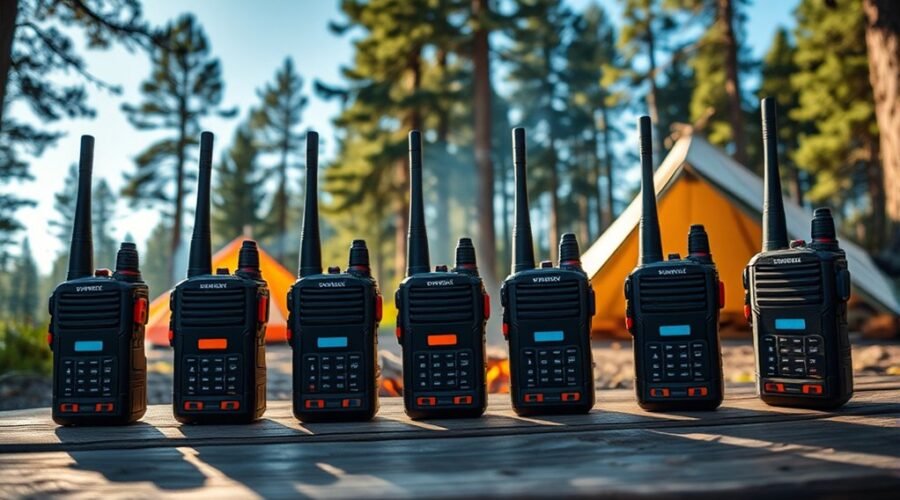
Planning outdoor trips for 2026 means choosing communication gear that matches the terrain, group size, weather, and radio rules where you will use it. The walkie-talkies below cover everything from simple license-free FRS radios for family travel to more powerful GMRS radios for serious backcountry communication. Range claims should always be read as best-case figures: mountains, trees, buildings, valleys, and other obstacles can shorten real-world communication distance significantly.
Affiliate disclosure: This article contains Amazon affiliate links. If you make a qualifying purchase through one of these links, the site may earn a commission at no additional cost to you.
Quick Verdict
Midland T10 X-Talker: A straightforward license-free choice for families, road trips, campsites, and casual outdoor use.
BAOFENG GT-18: A useful three-radio package for groups that want rechargeable FRS radios without moving into GMRS licensing.
Cobra TrailBlazer 450: A feature-rich GMRS option with 2.5W output, repeater capability, NOAA weather functions, and an IP54 rating.
Rocky Talkie Expedition: The premium high-power choice here for demanding backcountry use, with 5W GMRS output, IP67 protection, and multi-day battery life.
Rocky Talkie Mountain: A rugged license-free FRS option for hikers, climbers, skiers, and travelers who value simplicity and weather resistance.
Quick Comparison of the Walkie-Talkies
| Model | Radio Type | License | Weather Protection | Range Context | Best For | Amazon |
|---|---|---|---|---|---|---|
| Midland T10 X-Talker | FRS | No individual U.S. license required | Water resistant | Up to 20 miles in optimal open conditions | Simple family and travel use | Check Amazon |
| BAOFENG GT-18 | FRS version | No individual U.S. license required | No verified IP rating stated here | Up to about 3 miles under favorable conditions | Groups wanting three rechargeable radios | Check Amazon |
| Cobra TrailBlazer 450 | GMRS | GMRS license required in the U.S. | IP54 | Advertised up to 36 miles; obstacles reduce range | GMRS features without stepping up to a 5W premium radio | Check Amazon |
| Rocky Talkie Expedition | GMRS, 5W | GMRS license required in the U.S. | IP67 | 35+ miles line-of-sight; about 2–8 miles in mountains | Serious backcountry and rugged use | Check Amazon |
| Rocky Talkie Mountain | FRS, 2W | No individual U.S. license required | IP56 | 35+ miles line-of-sight; about 1–5 miles in mountains | Rugged license-free outdoor use | Check Amazon |
Before you buy: FRS vs. GMRS
FRS radios are the simpler choice for most U.S. travelers because compliant FRS operation does not require an individual license. GMRS can provide higher power and repeater capability, but normal GMRS operation in the United States requires a valid GMRS license. Do not assume a U.S. FRS or GMRS radio is legal to transmit with in another country; radio rules and approved frequencies vary by destination.
Safety note: A walkie-talkie can keep members of your group connected, but it is not a substitute for a satellite messenger, personal locator beacon, or other emergency device when nobody within radio range can hear you.
Midland T10 X-Talker Walkie Talkie 2 Pack
Best For: Simple, License-Free Travel Communication
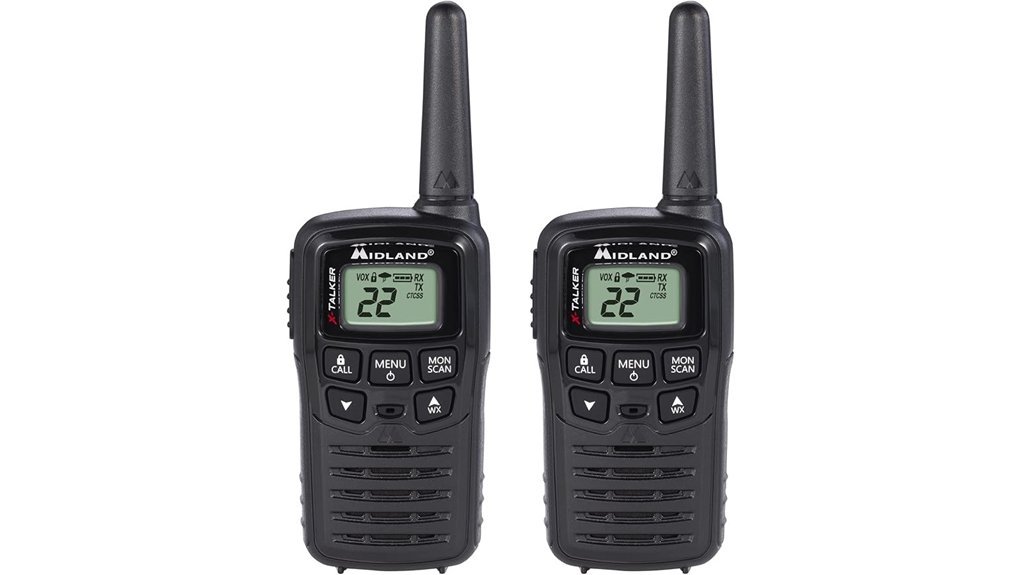
The Midland T10 X-Talker is a practical choice when you want an uncomplicated FRS walkie-talkie for camping, family trips, road-trip convoys, parks, or other casual outdoor situations. It provides 22 channels, 38 CTCSS privacy codes, weather radio and alert functions, channel scanning, and eVOX hands-free operation.
Midland advertises a maximum range of up to 20 miles, but that figure applies to favorable open conditions with minimal obstruction. Trees, buildings, hills, vehicles, and terrain can reduce usable distance significantly. That makes the T10 better suited to keeping a nearby group connected than to relying on it for long-distance backcountry communication.
Another important difference is its power system. The T10 operates on three AAA alkaline or compatible NiMH batteries per radio, and the standard package does not include batteries or a charger. This can actually be useful for travelers who prefer replaceable batteries, but buyers expecting built-in USB charging should look elsewhere.
Why You’ll Like It: It is easy to understand, license-free for compliant FRS use in the U.S., offers weather information, and avoids the extra setup and licensing associated with GMRS.
Pros:
- 22 channels with 38 CTCSS privacy codes.
- Weather radio and alert features for changing outdoor conditions.
- eVOX hands-free operation.
- Uses easy-to-find AAA batteries.
- Water-resistant construction for basic outdoor use.
Cons:
- The 20-mile figure is a best-case maximum, not a typical wooded or urban range.
- Batteries and a charger are not included with the standard T10 package.
- It is water resistant rather than a heavily waterproofed IP67-style backcountry radio.
BAOFENG GT-18 Walkie Talkies (3 Pack)
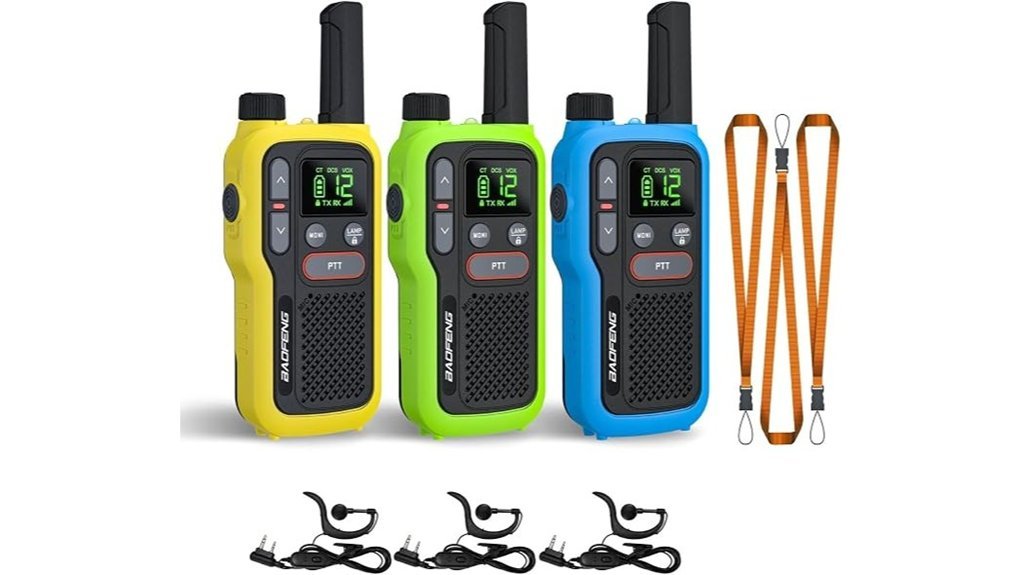
Best For: Groups Wanting Three Rechargeable FRS Radios
The BAOFENG GT-18 is appealing when three people need their own compact radio. The FRS version provides 22 channels, a backlit display, dual push-to-talk buttons, channel scanning, a flashlight, and a rechargeable 1500mAh lithium-ion battery.
The manufacturer advertises up to three days of battery life and a maximum talking range of roughly three miles under favorable conditions. Real-world range will usually be shorter around dense trees, buildings, hills, or other obstructions. Micro-USB charging makes the radios easier to recharge from common travel power sources, including power banks and vehicle USB adapters when a compatible cable is available.
Why You’ll Like It: The three-radio package can make more sense for families or small groups than buying two-radio sets and adding another unit later.
Pros:
- Three radios in the package for small groups.
- 22 FRS channels.
- 1500mAh rechargeable batteries.
- Micro-USB charging.
- Backlit screen, scanning, flashlight, and dual PTT controls.
Cons:
- Advertised maximum range is much shorter than the premium radios in this guide.
- No specific rugged IP rating is relied on here, so it is not the strongest choice for severe weather or repeated immersion risk.
- Battery-life claims still depend on how often you transmit and environmental conditions.
Cobra TrailBlazer 450 GMRS Radio (2-Pack)
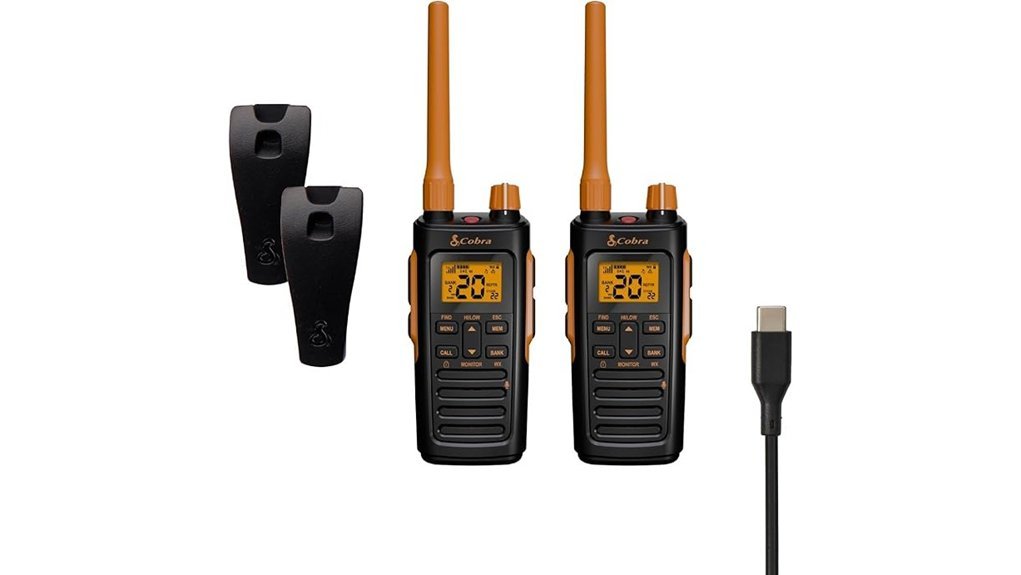
Best For: Buyers Who Want GMRS Features and Repeater Capability
The Cobra TrailBlazer 450 steps beyond basic FRS radios with 2.5 watts of GMRS power, repeater capability, a removable antenna, a large LCD display, NOAA weather functions, and an IP54 dust- and water-resistant design. It is a strong middle-ground option for hikers, hunters, campers, and outdoor groups who want more capability than a basic license-free radio.
Cobra lists 22 standard shared channels plus eight GMRS repeater channels in its primary channel bank, along with privacy-code options. Its rechargeable Li-ion battery is rated for about 16 hours, and USB-C charging is convenient for travel.
The manufacturer advertises up to 36 miles of maximum range, but buyers should treat that as an optimal-condition figure. Terrain, trees, buildings, valleys, and antenna position can reduce usable range dramatically.
License note: The TrailBlazer 450 is a GMRS radio. Normal GMRS operation in the United States requires a valid GMRS license.
Why You’ll Like It: It combines rechargeable USB-C power, weather functions, repeater support, and improved ruggedness without requiring buyers to jump directly to a 5W premium radio.
Pros:
- 2.5W GMRS output.
- 22 standard shared channels plus eight repeater channels.
- IP54 dust- and water-resistant construction.
- Approximately 16 hours of rated battery life.
- USB-C charging, removable antenna, and NOAA weather functionality.
Cons:
- GMRS licensing is required for normal U.S. operation.
- IP54 protects against dust and water exposure but does not make the radio submersible.
- The advertised maximum range should not be expected in dense forest, cities, or mountainous terrain.
Rocky Talkie Expedition GMRS Radio – 2 Pack
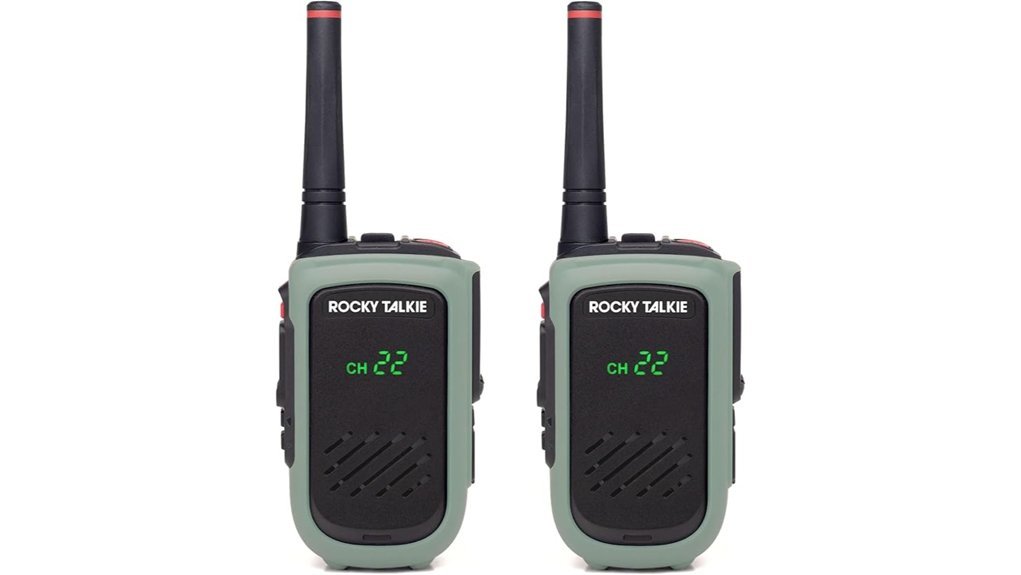
Best For: Premium Backcountry GMRS Communication
The Rocky Talkie Expedition is the most rugged high-power option in this group. It is a 5-watt GMRS radio with IP67 waterproofing, a shatter-resistant screen design, removable antenna options, NOAA weather channels and emergency alert monitoring, repeater capability, and dual-channel watch.
Its 1800mAh rechargeable lithium-ion battery is rated for approximately 4–6 days of use, including in cold conditions. For travelers spending several days away from easy charging access, that is a meaningful advantage.
Rocky Talkie states a 35+ mile line-of-sight maximum, but its own more realistic terrain guidance is more useful: roughly 2–8 miles in mountains, 0.5–5 miles in forest or hills, 0.5–3 miles around rivers, and up to about 1.5 miles in a city. Those numbers show why terrain matters more than the headline maximum.
License and region note: The Expedition is a U.S. GMRS radio. Normal GMRS operation requires a valid U.S. GMRS license, and travelers should not assume the same frequencies or equipment are legal abroad.
Why You’ll Like It: Its combination of 5W output, IP67 protection, replaceable rechargeable battery, repeater support, and terrain-focused range makes it especially well suited to demanding outdoor trips.
Pros:
- 5W GMRS output.
- IP67 protection, including rated one-meter submersion.
- Approximately 4–6 days of rated battery life.
- 35+ mile line-of-sight maximum under ideal conditions.
- Repeater capability, NOAA weather functions, and dual-channel watch.
Cons:
- A GMRS license is required for normal U.S. operation.
- Typical mountain and forest range is far shorter than the 35+ mile line-of-sight maximum.
- Its premium construction and additional capability may be more than casual travelers need.
Rocky Talkie Mountain Radio – 2 Pack Walkie Talkies
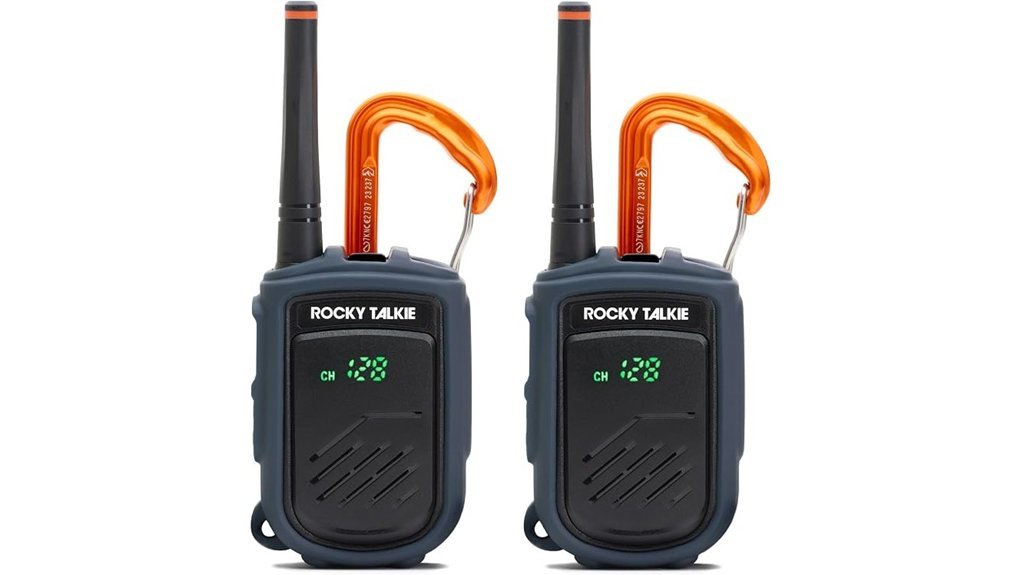
Best For: Rugged License-Free Hiking and Mountain Use
The Rocky Talkie Mountain Radio is designed for buyers who want rugged outdoor communication without moving into GMRS licensing. It operates as a 2-watt FRS radio and combines a shatter-resistant screen, thermoplastic protective housing, secure attachment system, USB-C charging, and an IP56 rating.
The rechargeable 1550mAh lithium-ion battery is rated for roughly 3–5 days of use. Rocky Talkie lists a maximum line-of-sight range of more than 35 miles, but typical mountain performance is around 1–5 miles, with approximately 0.5–3 miles in forests or hills and up to about one mile in a city.
IP56 means the radio is designed to handle splashes, snow, and demanding weather exposure, but it should not be confused with the Expedition model’s IP67 submersion protection.
Why You’ll Like It: It combines simple license-free FRS operation with construction aimed at hiking, climbing, skiing, and other trips where ordinary consumer radios may feel too fragile.
Pros:
- License-free FRS operation in the U.S. when used in compliance with FRS rules.
- 2W output.
- Approximately 3–5 days of rated battery life.
- IP56 splash- and snow-resistant design.
- USB-C charging and a secure outdoor attachment system.
Cons:
- Lower transmit power than 5W GMRS alternatives.
- Typical mountain range is around 1–5 miles rather than the 35+ mile ideal line-of-sight maximum.
- IP56 does not mean the radio can be submerged.
Factors to Consider When Choosing Walkie-Talkies for Travel and Outdoor Adventures in 2026
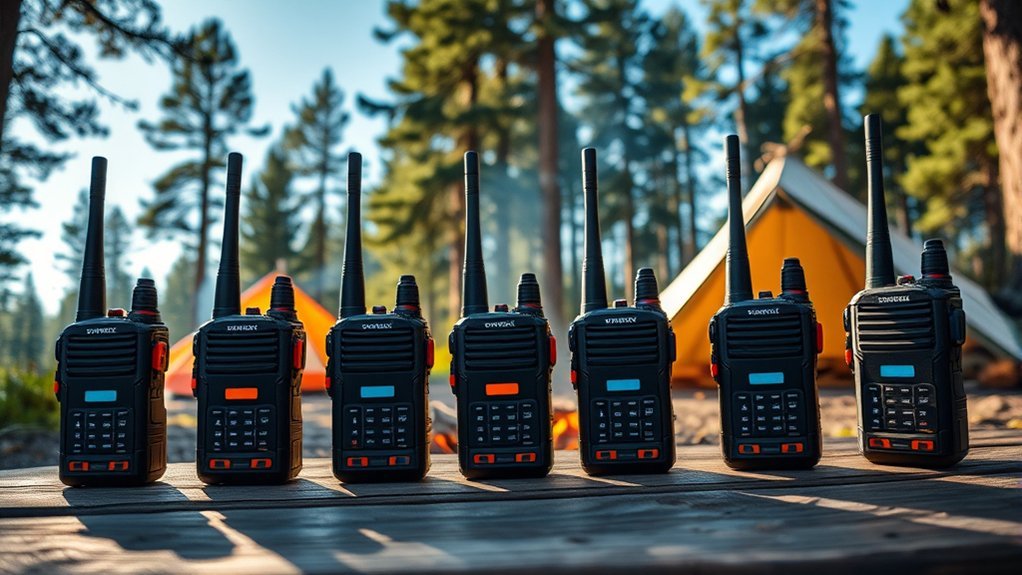
The best walkie-talkie for travel depends on more than the largest range number printed on the box. Consider the radio service, realistic terrain, battery system, water resistance, portability, weather features, and whether licensing is required.
Key Communication Features
Start by deciding whether FRS or GMRS fits your trip. FRS is convenient for families and travelers who want straightforward license-free U.S. operation. GMRS can provide higher output and repeater capability, but it requires a license for normal U.S. operation.
Channel scanning, weather reception, hands-free VOX, keypad locks, dual-channel monitoring, and repeater capability can all be useful depending on your activity. Do not mistake CTCSS or DCS “privacy codes” for encryption. They can filter unwanted chatter heard through your speaker, but they do not make a shared radio channel private.
Range and Durability
Walkie-talkie range is highly dependent on line of sight. An advertised 20-, 35-, or 36-mile maximum may be possible between elevated locations with very few obstructions, but it should not be treated as a guaranteed hiking range.
For forests, valleys, cities, and mountainous terrain, expect substantially shorter distances. If staying connected over difficult terrain is critical, compare the manufacturer’s terrain-specific estimates rather than simply choosing whichever box has the largest maximum number.
Durability also matters. Basic water resistance may be enough for family camping, while hikers, paddlers, skiers, or backcountry users may prefer a defined rating such as IP54, IP56, or IP67. Remember that these ratings are not equivalent: splash resistance is different from submersion protection.
Battery Life Considerations
Battery strategy can matter as much as capacity. Replaceable AAA-powered radios such as the Midland T10 make it easy to carry spare batteries. Rechargeable models reduce the need to keep buying disposable batteries and may be convenient when you already carry a USB power bank.
Manufacturer battery-life estimates are not guarantees. Frequent transmitting, high-power operation, cold temperatures, poor battery condition, display use, scanning, and other features can shorten runtime. For multi-day travel, bring a backup charging method or spare compatible batteries where practical.
Weather Resistance Ratings
IP ratings help you compare protection against dust and water. The Cobra TrailBlazer 450’s IP54 rating is useful for dust and outdoor water exposure, while the Rocky Talkie Mountain’s IP56 rating is designed for more forceful water exposure but is still not intended for submersion. The Rocky Talkie Expedition’s IP67 rating adds temporary submersion protection under its specified test conditions.
Do not assume that a radio described only as “water resistant” provides the same protection as a product with a verified IP rating.
Usability and Portability
A technically powerful radio is not automatically the best travel radio. Consider whether controls are easy to use with gloves, whether the display is readable outdoors, how securely the radio attaches to a pack or clothing, and whether its charger matches the cables you already carry.
For family trips, simple controls may be more valuable than repeater programming. For mountain travel, secure clips, long battery life, cold-weather performance, and rugged construction may deserve more weight.
License and Destination Rules
Check the radio service before transmitting. In the United States, compliant FRS operation does not require an individual license, while GMRS normally does. If you travel internationally, verify the destination country’s approved radio frequencies, power limits, equipment requirements, and licensing rules before use. A radio sold in an FRS, GMRS, or PMR446 version should not automatically be assumed legal everywhere.
Frequently Asked Questions
How Far Can Walkie-Talkies Transmit Signals in Open Areas?
Some consumer radios advertise maximum open or line-of-sight ranges from a few miles to more than 35 miles. These figures represent favorable conditions rather than guaranteed everyday performance. Trees, hills, buildings, valleys, vehicles, elevation differences, and antenna position can reduce range significantly. For backcountry buying decisions, terrain-specific estimates are more useful than maximum-range marketing numbers.
Are Walkie-Talkies Waterproof and Suitable for Extreme Weather?
Some are, but protection varies. A radio described as water resistant may handle light exposure without being suitable for heavy rain or immersion. IP54 and IP56 models provide defined levels of dust or water protection, while an IP67 radio is designed to withstand temporary submersion under specified conditions. Always check the exact rating of the model you plan to use.
Can Walkie-Talkies Be Used Internationally Without Restrictions?
No. Do not assume a U.S. FRS or GMRS radio can legally transmit in every country. Frequency allocations, permitted power, approved equipment, and license requirements differ. Some manufacturers offer separate regional versions, such as PMR446 models, but travelers should verify the rules and correct product version for their destination before transmitting.
What Is the Battery Life of These Models?
Battery life varies widely. The Midland T10 uses replaceable AAA batteries, the Cobra TrailBlazer 450 is rated around 16 hours, the BAOFENG GT-18 is advertised for up to about three days, the Rocky Talkie Mountain for roughly 3–5 days, and the Rocky Talkie Expedition for roughly 4–6 days. Actual runtime depends on transmitting frequency, power level, temperature, battery condition, scanning, and other features.
Are There Age Restrictions for Using Walkie-Talkies?
For U.S. FRS use, there is no general requirement for an individual user license. GMRS is different: a new individual GMRS license applicant must be at least 18. A GMRS license holder can allow eligible immediate family members to operate GMRS stations under that license in accordance with FCC rules. Children should still be taught basic radio etiquette and how to use the device safely.
Do I Need a License for a Walkie-Talkie?
It depends on the radio service. The Midland T10 and Rocky Talkie Mountain are FRS choices designed for license-free U.S. operation when used according to FRS rules. The Cobra TrailBlazer 450 and Rocky Talkie Expedition are GMRS radios, so normal U.S. GMRS operation requires a valid GMRS license. Always confirm the exact model and local regulations before transmitting.
Do Privacy Codes Make a Conversation Private?
No. CTCSS and DCS codes can reduce the unwanted conversations you hear by filtering transmissions that do not use the same tone or code. They do not encrypt the radio signal, and another radio monitoring the same frequency can still receive the transmission.
Conclusion
The right walkie-talkie for travel and outdoor adventures depends on how far your group may separate, how rough the environment will be, and whether you want license-free FRS simplicity or more capable GMRS features.
For easy family and casual travel use, the Midland T10 X-Talker is straightforward and uses widely available AAA batteries. The BAOFENG GT-18 is worth considering when three people need rechargeable radios. Buyers who specifically want GMRS, repeater capability, USB-C charging, and an IP54 rating can look at the Cobra TrailBlazer 450.
For demanding outdoor conditions, the two Rocky Talkie models stand out for different reasons. The Rocky Talkie Mountain combines rugged construction with license-free FRS operation, while the Rocky Talkie Expedition adds 5W GMRS output, IP67 protection, repeater capability, and longer rated battery life for buyers willing to meet GMRS licensing requirements.
Whichever radio you choose, compare realistic terrain range rather than relying only on headline maximums, confirm the rules for your destination, and carry a separate emergency communication solution when your trip takes you beyond the reach of nearby radio users.