Disclosure: As an Amazon Associate, we earn from qualifying purchases. If you click a link on this page and make a purchase, we may receive a small commission at no extra cost to you.
Finding an air purifier that actually covers a large living room or open floor plan, without turning into background noise you notice all day, narrows the field fast. The Coway Airmega 350 (model AP-1924A) is built for that gap: Coway rates it for spaces up to 2,640 square feet and as quiet as 21.6 dB on its lowest setting. This review checks those numbers against Coway’s own specifications and the Amazon listing, and looks at where the unit makes sense and where a smaller or smarter model might serve you better.
Quick Verdict
Rating: Recommended for large rooms and allergy-prone households
Best For: Buyers purifying rooms or open spaces up to roughly 2,640 sq ft who want quiet operation and real-time air quality feedback
Bottom Line: The Airmega 350 backs up its coverage claim with a documented CADR of 376 (dust) and 450 (pollen) and genuinely quiet 21.6 dB operation, but it has no app or smart-speaker control and its 12 x 12 x 26.3 inch footprint is bulkier than compact bedroom units.
Key Specifications
| Specification | Detail |
|---|---|
| Brand / Model | Coway Airmega 350, model AP-1924A(W) |
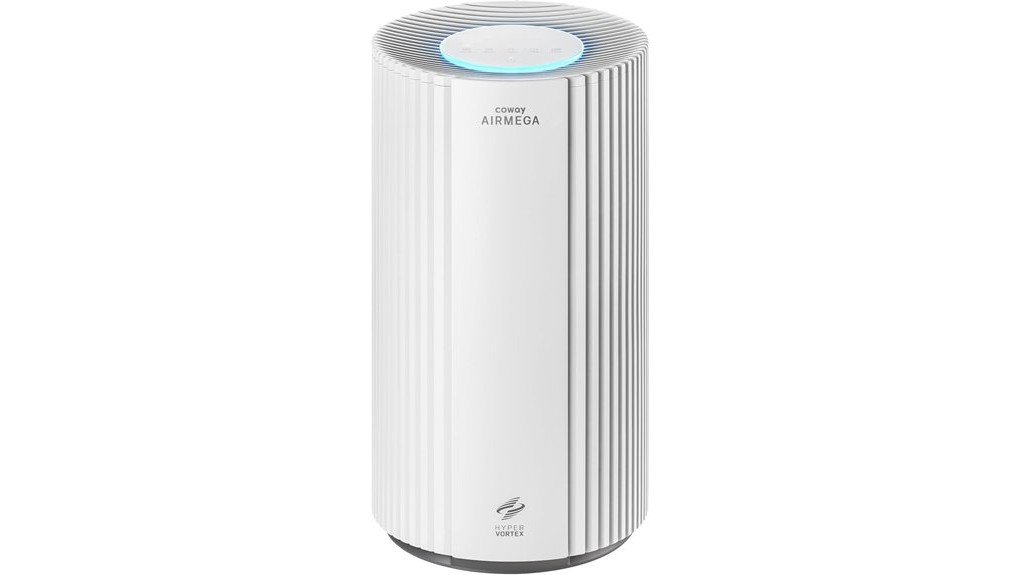
| Product type | Cylindrical tower air purifier |
| Coverage area | Up to 2,640 sq ft in 60 minutes |
| Dimensions | 12″D x 12″W x 26.3″H |
| Weight | 17.19 lb |
| Filter system | 3-in-1: vacuumable pre-filter, activated carbon, True HEPA |
| Particle capture | 99.97% of particles down to 0.3 microns |
| CADR | Dust 376, Smoke 352, Pollen 450 |
| Noise level | As low as 21.6 dB, up to roughly 55 dB at top speed |
| Power consumption | 62 W rated (independent testing measured under 60 W at top speed, roughly 3 W in sleep mode) |
| Controls | On-unit touch controls, real-time air quality monitor, Auto/Eco/Turbo/Sleep modes, 1/4/8-hour timer |
| Certifications | Energy Star, CARB, ETL |
| Warranty | 3-year manufacturer’s limited warranty |
| Color | White (Beige also listed by Coway) |
What Is the Coway Airmega 350?
The Airmega 350 is Coway’s large-room entry in its Airmega lineup, built around what Coway calls a HyperVortex system with 360-degree air intake. It’s meant for people whose room is too big for a compact bedroom purifier but who don’t want the price or bulk of Coway’s biggest units, like the ProX or the 400 series.
Its main selling point is the combination of a documented CADR (376 dust, 352 smoke, 450 pollen) with a noise floor as low as 21.6 dB, which is quiet enough to leave running continuously in a shared living space. The 3-in-1 filter stack (pre-filter, activated carbon, HEPA) handles particles, odors, and gases in one pass, and the whole unit is Energy Star certified.
Who Should Buy It?
Best For
- Large living rooms, open floor plans, or bedrooms over roughly 500 sq ft
- Allergy or pet-dander households wanting a documented CADR above 350
- Anyone who wants a purifier quiet enough to run continuously
Skip If
- You have a small room; a smaller Coway model costs less to buy and run
- You want app or voice-assistant control
- You’re on a tight budget, since this sits in Coway’s mid-to-premium tier
Filtration and Air Quality Performance
The 3-in-1 filter combines a vacuumable pre-filter for larger particles and pet hair, an activated carbon layer for odors and gases including ammonia and acetaldehyde fumes, and a True HEPA layer rated to capture 99.97% of particles down to 0.3 microns. Coway also states it reduces more than 99% of volatile organic compounds. Being able to vacuum the pre-filter between full replacements is a genuine cost saver, since it’s usually the part that clogs first in pet households.
CADR Ratings: What the Numbers Actually Mean
CADR (Clean Air Delivery Rate) measures how much filtered air a purifier delivers per minute for a specific pollutant. The Airmega 350’s ratings, 376 for dust, 352 for smoke, and 450 for pollen, are solidly mid-to-upper tier for a home unit and explain why it can claim a 2,640 sq ft coverage figure.
Before You Buy: Coway’s 2,640 sq ft coverage claim assumes one full air change per hour. If you want faster clearing in a genuinely large room, such as for heavy smoke or severe allergies, plan on running it in Turbo mode more often or sizing down the effective room it covers.
Noise Level and Design
Coway lists a noise range of about 21.6 dB on the lowest setting up to roughly 55 dB at maximum, and independent lab testing measured just under 58 dB at top speed, close enough to be a reasonable real-world expectation. At 12″D x 12″W x 26.3″H and 17.19 lb, it’s a floor-standing cylindrical tower rather than a compact tabletop unit, so plan for actual floor space rather than a shelf or nightstand.
Real-Time Monitoring and Smart Modes
A built-in air quality monitor tracks particles down to PM10 and drives an LED indicator that changes color with air quality. Auto and Eco modes let the fan respond to that reading instead of running at a fixed speed, Sleep mode keeps things quiet overnight, and Turbo mode is there for a fast clean-up. There’s no app or voice-assistant support listed in Coway’s specifications, all of this is controlled from the unit itself.
Energy Use and Running Costs
The Airmega 350 is rated at 62 W and carries Energy Star certification. Independent metered testing found actual draw stays well under that at everyday speeds, roughly 3 W in Sleep mode and climbing toward the mid-50s in watts at Turbo, so day-to-day electricity cost is modest as long as you’re not running it flat-out around the clock.
Pro Tip: Leave it on Auto instead of a fixed high speed. The monitor only ramps the fan up when it detects a real drop in air quality, which keeps both noise and power draw closer to their lower end most of the day.
Certifications and Safety
The unit is CARB certified (California’s ozone emission limit for air cleaners), ETL certified for electrical safety, and Energy Star rated. It runs on 120V/60Hz corded power only, and Coway’s manual recommends a dedicated grounded outlet. As with any electrical appliance with intake vents, keep it away from water and out of reach of small children or pets who might interact with the intake or cord. It filters airborne particles; it isn’t a medical device, so if you’re managing asthma, severe allergies, or another respiratory condition, treat this as a supplement to, not a replacement for, guidance from your doctor.
How It Performs in Real Use
For Large Living Rooms and Open Floor Plans
This is the scenario the Airmega 350 is built for. Its coverage and CADR numbers hold up in rooms where compact 200-400 sq ft purifiers get overwhelmed.
For Allergy and Pet Households
The pollen CADR of 450 and the vacuumable pre-filter (which catches pet hair before it reaches the HEPA layer) make this a reasonable fit for shedding pets or seasonal allergies, though it won’t eliminate the need for regular vacuuming and cleaning.
For Overnight and Bedroom Use
At 21.6 dB on its quietest setting, most people won’t find it disruptive overnight, and Sleep mode is built specifically for this. Just factor in the larger footprint compared to a dedicated bedroom unit.
For Wildfire Smoke Season
The activated carbon layer plus a smoke CADR of 352 makes it a reasonable option for smoke-heavy days, though during severe smoke events running Turbo mode rather than Auto will clear the air faster.
Placement Tips for Better Results
- Keep it several inches away from walls and furniture so the 360-degree intake isn’t blocked
- Place it centrally in the room rather than tucked in a corner
- Use Auto or Eco mode day-to-day and reserve Turbo for smoke, cooking, or a sudden air-quality spike
- Plug it directly into a dedicated grounded outlet rather than an extension cord, per Coway’s manual
Pros and Cons
Pros
- Documented CADR of 376 (dust), 352 (smoke), and 450 (pollen)
- 3-in-1 filtration captures 99.97% of particles down to 0.3 microns
- Genuinely quiet at 21.6 dB on the low setting
- Energy Star, CARB, and ETL certified, with a 3-year warranty
- Vacuumable pre-filter reduces how often you need full filter replacements
Cons
- No app or smart-speaker control, on-unit touch only
- 12 x 12 x 26.3 inch, 17+ lb footprint is bulkier than compact units
- 2,640 sq ft coverage figure assumes one air change per hour, not a fast clean-up rate
Is It Worth the Price?
The Airmega 350 sits in Coway’s mid-to-premium tier, priced above basic tower purifiers but below Coway’s largest models like the 400S or ProX. You’re paying for the combination of a large coverage rating and quiet operation rather than for smart-home extras.
It’s a smart buy for everyday use if you’re purifying a real large room and would otherwise need two smaller units to get similar coverage. It’s not the best fit if you need app scheduling or if your space is closer to 300-500 sq ft, where a smaller and cheaper model does the job.
How It Compares to Alternatives
If your room is closer to 500-600 sq ft and you want app control, the Levoit Core 600S offers WiFi scheduling and a PM2.5 sensor that the Airmega 350 doesn’t have, though its coverage claim tops out well below the Airmega 350’s. If you want the simplest possible operation, Blueair’s Blue Pure 211+ uses one-button controls with a washable pre-filter sleeve, but has no auto mode or air-quality sensor. The Airmega 350 makes the most sense when your room is genuinely large and you’d rather have Coway’s higher coverage rating than app-based features.
Warranty and Support
The Airmega 350 comes with Coway’s 3-year manufacturer’s limited warranty. Claims go through Coway’s customer service by phone or email, with responses typically arriving within about 48 hours.
| Warranty Features | Details |
|---|---|
| Warranty Duration | 3 Years |
| Claim Process | Customer Service Contact |
| Support Availability | Phone and Email |
| Response Time | Typically within 48 hours |
Frequently Asked Questions
How often should I replace the filters?
The HEPA and carbon layer typically last around 12 months under normal use. The pre-filter is vacuumable, so you can clean it between full filter replacements to stretch that timeline.
Is it loud when running on high?
On its lowest setting it’s rated as quiet as 21.6 dB, but expect it to climb to somewhere in the mid-50s dB range at top speed. Most people only need max speed briefly, since Auto mode handles everyday air quality.
Does it connect to an app or smart assistant?
No. It’s controlled entirely from the unit’s touch panel, with an LED ring that shows air quality. If app control matters to you, that’s a real limitation compared to WiFi-enabled competitors.
What does the 2,640 sq ft coverage rating actually mean?
It reflects one full air change per hour in a space that size. If you want faster clearing in a large room, plan to run Turbo mode more often rather than relying on Auto alone.
Can it help with pet odor and pet hair?
The activated carbon layer is designed for odors, and the vacuumable pre-filter catches pet hair before it reaches the HEPA layer. It won’t replace regular vacuuming, but it can noticeably cut down on lingering pet odor.
How does it compare to smaller Coway models like the Airmega 250 or 200M?
The 350 covers more square footage and posts higher CADR numbers than the 250 (up to 1,860 sq ft) or 200M (up to 1,748 sq ft), but it also costs more and takes up more floor space. A smaller room is usually better served, and cheaper, with one of those smaller models.
Does it produce ozone or use an ionizer?
Coway’s published specifications describe a mechanical 3-in-1 filter system (pre-filter, carbon, HEPA) with no listed ionizer or plasma feature, unlike some competitors that add an ionizing stage.
Who should skip the Airmega 350?
Skip it if your room is under about 500 sq ft, if app or voice control is a must-have, or if you’re working with a tight budget. In those cases, a smaller Coway model or a competitor with app support is a better match.
The Bottom Line
The Coway Airmega 350 is a solid pick for anyone purifying a genuinely large room who wants documented CADR numbers and quiet, continuous operation over app-based features. Skip it if your space is small or you specifically want smart-home integration, where a smaller Coway model or an app-connected competitor will serve you better.