Disclosure: As an Amazon Associate, we earn from qualifying purchases. If you click a link on this page and make a purchase, we may receive a small commission at no extra cost to you.
Dust, pet dander, and stale bedroom air are easy to notice and hard to fix by opening a window. The AirHub A282 is a compact HEPA air purifier built for rooms up to roughly 500 square feet at a genuinely useful cleaning rate, with a PM2.5 sensor that reads the air and adjusts the fan for you. This review breaks down what the A282 does well, where its 1,092 square foot coverage claim gets optimistic, and who should buy it instead of a larger or app-connected alternative.
Quick Verdict
Rating: 7.5/10 (Recommended for bedrooms and small-to-medium rooms)
Best For: Renters, pet owners, and light sleepers who want a compact, sensor-driven HEPA purifier for a bedroom or home office.
Bottom Line: The A282 pairs real 3-stage HEPA and activated carbon filtration with a genuinely quiet 20 dB sleep mode and a PM2.5 sensor that runs the fan for you. Its AHAM-verified numbers hold up best in rooms under about 500 square feet, so its 1,092 sq ft figure is really a slow, 1-ACH ceiling rather than a fast whole-room clean.
Key Specifications
| Specification | Detail |
|---|---|
| Brand | AirHub |
| Model | A282 |
| Product Type | HEPA air purifier, dual-side intake |
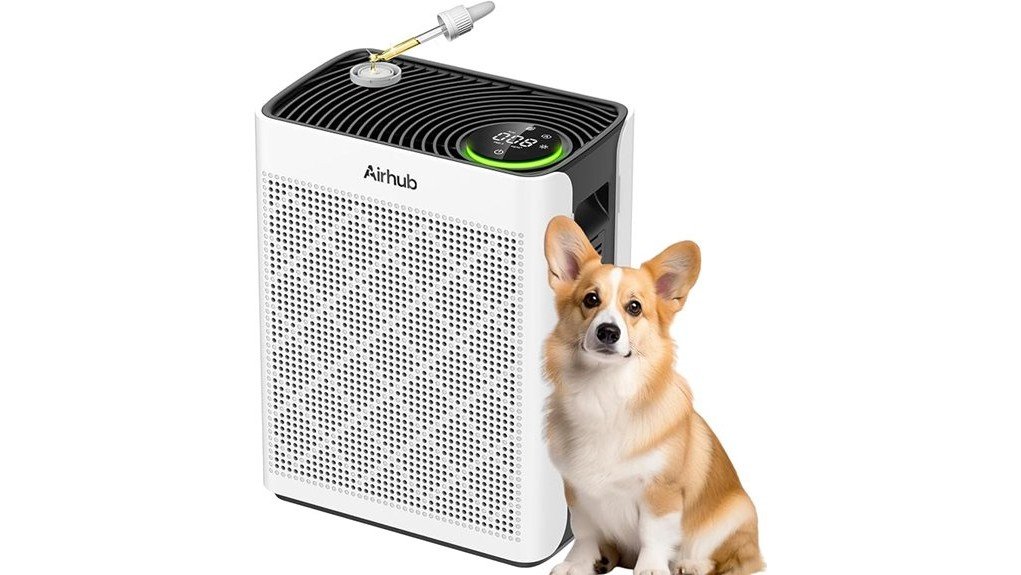
| Design | Tower-style, touch controls, white finish |
| Dimensions | 6.5″D x 10″W x 13″H |
| Weight | 6.82 lbs |
| Power | AC/DC, 24 watts |
| Filtration | 3-stage: washable pre-filter + 2-in-1 True HEPA H13 and activated carbon (dual-side) |
| Particle Retention | 99.97% at 0.3 microns (HEPA H13 standard) |
| Noise Level | 20 dB in sleep mode |
| Coverage Area | Up to 1,092 sq ft at 1 ACH; 209 sq ft at 4.8 ACH (~12.5 min); 506 sq ft at 2 ACH (~30 min) |
| Smart Features | PM2.5 sensor, AQI display, Auto Mode |
| Filter Lifespan | Up to 3,000 hours (about 5-6 months typical use) |
| Included Accessories | Purifier body, aroma diffuser tray, power adapter, 2x 2-in-1 filters, 2x pre-filters, manual |
| Certifications | AHAM Verified, CARB, ETL, FCC |
| Warranty | 2-year manufacturer warranty |
| Package Note | Replacement filters (2-pack) sold separately |
What Is the AirHub A282?
The AirHub A282 is a tower-style HEPA air purifier built for bedrooms, home offices, and small-to-medium living spaces. It stands about 13 inches tall and weighs 6.82 pounds, small enough for a nightstand, desk, or floor space next to a couch.
Its main selling point is a 3-stage filtration system that pulls air in from both sides of the unit at once: a washable pre-filter on each side, a 2-in-1 True HEPA H13 and activated carbon filter, and a PM2.5 sensor that reads air quality in real time and adjusts the fan automatically through Auto Mode.
It’s built for everyday air-quality issues, dust, pet dander, cooking odors, and pollen, rather than industrial-grade smoke filtration, and it’s positioned as a practical daily purifier rather than a whole-house system.
Who Should Buy It?
Best For
- Renters and apartment dwellers who need a compact unit with no installation
- Pet owners dealing with dander, hair, and odor in a bedroom or living room
- Light sleepers who want a genuinely quiet purifier for overnight use
Skip If
- You need to cover an open floor plan over roughly 500 sq ft at a fast air-change rate
- You want app-based scheduling or voice control built in
- You’re dealing with heavy smoke or wildfire-level air quality events
Filtration and Coverage: How the A282 Cleans Air
The A282 uses a dual-side air intake, meaning it draws air in from two sides of the unit at once rather than a single face. Each side has its own washable pre-filter and 2-in-1 True HEPA H13 and activated carbon filter, so the two intakes work as a matched set rather than sharing one filter.
The HEPA H13 layer is rated to capture 99.97 percent of airborne particles as small as 0.3 microns, the standard benchmark for True HEPA filtration, while the activated carbon layer targets odors from pets, cooking, and smoke rather than fine particles.
AirHub’s AHAM-verified performance data shows the unit completing 4.8 air changes per hour in a 209 square foot room (about every 12.5 minutes), 2 air changes per hour in a 506 square foot room (roughly every 30 minutes), and 1 air change per hour across its maximum rated 1,092 square feet.
Before You Buy: The 1,092 sq ft coverage figure only reflects a slow, 1-air-change-per-hour cycle. For a room where you want fast, noticeable air turnover, keep the A282 in spaces closer to 200 to 500 square feet.
Noise Level and Power Draw
In sleep mode, the A282 runs at 20 decibels, quiet enough to sit next to a bed without becoming a distraction, and it draws just 24 watts of power, so running it overnight adds very little to an electricity bill.
PM2.5 Sensor and Auto Mode
A built-in PM2.5 sensor reads particulate levels in the room and feeds that data to an AQI display on the unit. Auto Mode then uses those readings to raise or lower fan speed on its own, without you touching a button.
Pro Tip: Leave the A282 in Auto Mode for the first day or two in a new room so the PM2.5 sensor can calibrate to your space’s baseline air quality before you judge its readings.
Design, Size, and Controls
The unit measures roughly 6.5 inches deep, 10 inches wide, and 13 inches tall, and weighs 6.82 pounds, light enough to move between rooms without much effort. Controls are handled through a touch panel on top of the unit; the listing doesn’t mention a companion app, WiFi, or voice-assistant support, so every adjustment happens at the unit itself.
Filter Replacement and Maintenance
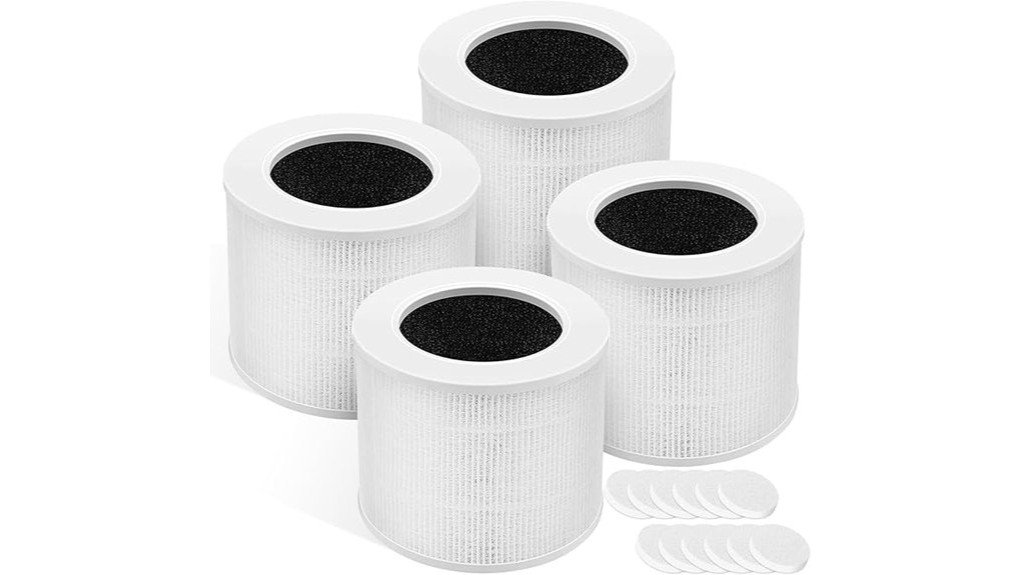
The washable pre-filters can be rinsed and reused, while the 2-in-1 HEPA and activated carbon filters are rated for up to 3,000 hours of use, roughly 5 to 6 months under typical daily operation. Because the A282 draws air from both sides, both filters in the set should be replaced together rather than staggered. Replacement filters are sold separately as a 2-pack made from PP and PET material, and the unit is backed by a 2-year manufacturer warranty.
How It Performs in Real Use
Daily Use in a Bedroom or Home Office
In a bedroom or home office under about 300 square feet, the A282’s 4.8 ACH rate refreshes the room’s air roughly every 12 to 13 minutes, fast enough to notice a difference in dust buildup and stuffiness over a week.
Homes With Pets
Pairing a HEPA layer for dander and hair with an activated carbon layer for odor makes it a reasonable fit for a room where pets sleep or spend most of their time, though it won’t replace regular vacuuming and litter box maintenance.
Overnight and Sleep Mode Use
At 20 dB, sleep mode is quiet enough to run through the night next to a bed, and the low 24-watt draw means leaving it on overnight has a minimal effect on your power bill.
Larger Living Rooms or Open Layouts
In a large or open-plan living room, the same unit only reaches 1 air change per hour at its stated maximum coverage, so you’ll notice a much slower improvement in air quality, and running it continuously on a higher fan speed uses up filter life faster.
Placement Tips for Better Results
- Leave several inches of clearance on both sides of the unit so the dual-side intake can draw air in properly.
- Avoid corners, behind furniture, or inside a cabinet, since blocked airflow slows down purification.
- Set it at roughly breathing height, such as a nightstand, desk, or low shelf, so the PM2.5 sensor reads the air you’re actually breathing.
- Run Auto Mode for the first few days in a new room to let the sensor establish a baseline before switching to manual fan speeds.
- Keep windows and doors closed while it runs for the air-change numbers above to hold up as closely as possible.
Before You Use It: Safety and Materials
The replacement filters are made from PP and PET material, and the unit carries AHAM Verified, CARB, ETL, and FCC certifications. As with any air purifier, it’s meant to reduce airborne particles and odors, not to treat, cure, or prevent asthma, allergies, or any other medical condition. If you or someone in your home manages a respiratory condition, use this alongside guidance from a doctor rather than as a substitute for it. Follow the included manual for setup and filter changes, and keep the intake and outlet vents clear.
Pros and Cons
Pros
- Dual-side 3-stage filtration with washable pre-filters and True HEPA H13 plus activated carbon
- PM2.5 sensor and Auto Mode adjust fan speed automatically from real-time readings
- 20 dB sleep mode is quiet enough for overnight bedroom use
- AHAM-verified air-change data backs up the coverage claims instead of relying on estimates
- 2-year manufacturer warranty is longer than many budget purifiers offer
Cons
- The 1,092 sq ft figure only applies at a slow 1 ACH cycle; real-world large-room performance is closer to 500 sq ft
- Replacement filters are sold separately, and both sides need replacing together
- No app, WiFi, or voice control is mentioned, so every adjustment happens at the unit
Is It Worth the Price?
The A282 sits in the budget-to-mid-range tier of HEPA purifiers. It doesn’t have the WiFi or app control that pushes some competitors into a higher price bracket, but it does include AHAM-verified performance data and a 2-year warranty, features you don’t always see at this level.
You get the most value from it in a bedroom, home office, or small living room, and especially if you’re dealing with pet dander or odor in a space under about 500 square feet.
If you need to cover an open-concept space over 500 sq ft quickly, you may end up paying more for a large-room unit, or running the A282 continuously on a higher fan speed, which shortens filter life and adds to replacement costs.
How It Compares to Alternatives
If you want app and voice control alongside similar HEPA filtration, the GoveeLife Smart Air Purifier line adds WiFi and Bluetooth control that the A282 doesn’t offer. If your room runs well past 500 square feet, a larger-capacity unit such as a Blueair large-room purifier is built for that scale, at a higher price and a bigger footprint. If you’re shopping strictly by budget for a small bedroom, a compact HEPA option like the Kenmore PM1010 is worth comparing on price alone. The A282 makes the most sense if you want real HEPA and activated carbon filtration with automatic sensing in a mid-size room, without paying for smart-home features you might not use.
Frequently Asked Questions
How large of a room can the AirHub A282 actually handle?
Its fastest AHAM-verified rate is 4.8 air changes per hour in about 209 square feet, refreshing the air roughly every 12.5 minutes. The 1,092 square foot figure only applies at a much slower 1 ACH cycle, so bedrooms and home offices under 500 square feet get the most useful performance.
Does the AirHub A282 replace allergy or asthma medication?
No. It’s designed to reduce airborne dust, pet dander, and pollen in a room, not to treat a medical condition. If you manage allergies or asthma, talk with your doctor about how an air purifier fits into your overall plan.
How often do I need to replace the filters?
The 2-in-1 HEPA and activated carbon filter is rated for up to 3,000 hours, roughly 5 to 6 months of typical daily use. Because the A282 pulls air from both sides, you replace both filters in the set at the same time.
Is the AirHub A282 quiet enough to run overnight in a bedroom?
Its sleep mode is rated at 20 decibels, close to a quiet library and quieter than most box fans. Most people find it unobtrusive enough to leave running through the night.
Does the A282 have an app or voice control?
The listing doesn’t mention a companion app, Alexa, or Google Assistant support. All settings, including Auto Mode and sleep mode, are handled through the touch panel on the unit itself.
What comes in the box, and what do I need to buy separately?
The unit ships with the purifier body, an aroma diffuser tray, a power adapter, a user manual, and one full set of filters (two 2-in-1 HEPA and carbon filters plus two pre-filters). Additional replacement filters are sold separately as a 2-pack.
Where should I place the AirHub A282 for the best results?
Give it several inches of clearance on both sides for the dual-side intake, and avoid corners or behind furniture. Placing it at roughly breathing height, such as a nightstand or low shelf, helps the PM2.5 sensor give an accurate reading of the air you’re actually breathing.
The Bottom Line
The AirHub A282 is a solid pick if you want real 3-stage HEPA and activated carbon filtration, a genuinely quiet sleep mode, and automatic PM2.5-based fan control in a bedroom, home office, or small living room. Skip it if you need to cover an open floor plan over 500 square feet quickly or want app and voice control built in. For its price tier, it delivers AHAM-verified performance and a 2-year warranty that back up the 7.5/10 rating above.