Disclosure: As an Amazon Associate, we earn from qualifying purchases. If you click a link on this page and make a purchase, we may receive a small commission at no extra cost to you.
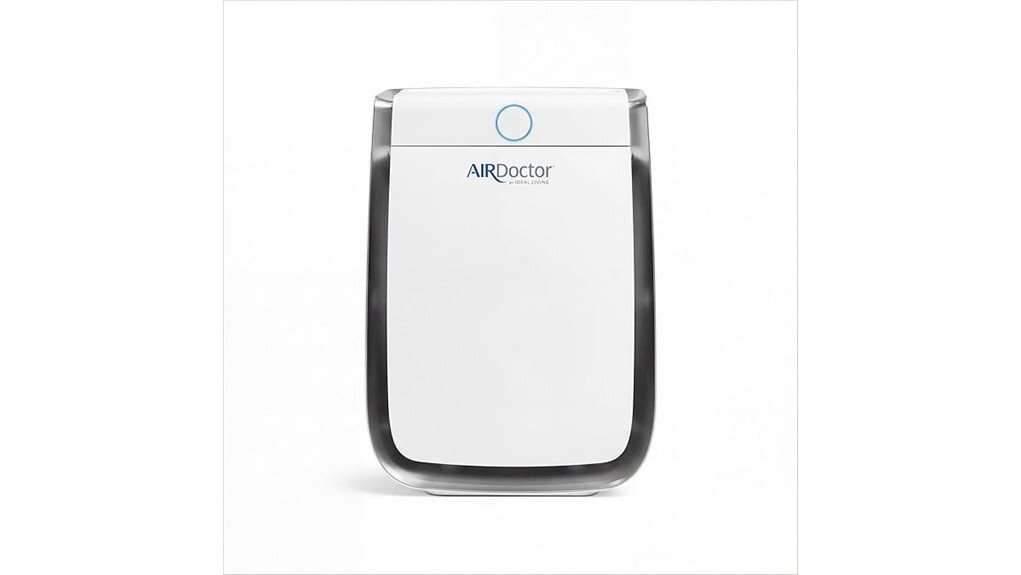
Large rooms can be difficult to clean with a small air purifier, especially when you are dealing with dust, pet dander, pollen, cooking odors, or smoke particles. The AIRDOCTOR AD3500 Air Purifier addresses that problem with high airflow, a three-stage filter system, and automatic air-quality monitoring. Its strongest points are its large-room performance and detailed controls, but you also need to account for its floor space and recurring replacement-filter costs. This review explains the specifications, setup, maintenance, limitations, and buyer types that make the most sense for the AD3500.
Quick Verdict
Rating: 8.5/10, Recommended with caveats
Best For: Medium-to-large rooms where you want strong particle filtration, odor control, and automatic fan adjustment.
Bottom Line: The AD3500 combines UltraHEPA filtration, a carbon/VOC filter, a particle sensor, and four fan speeds in one capable unit. Its main tradeoffs are replacement-filter costs, a larger footprint than compact purifiers, and more noticeable airflow when you use the faster settings.
AIRDOCTOR AD3500 Key Specifications
| Specification | Detail |
|---|---|
| Brand | AIRDOCTOR |
| Model | AD3500 |
| Product Type | Portable room air purifier |
| Filtration | Pre-Filter, Carbon/Gas Trap/VOC Filter, UltraHEPA Filter |
| Particle Filtration Claim | Captures 99.99% of airborne particles at 0.003 microns |
| Room Coverage | About 630 ft² at four air changes per hour or up to 2,520 ft² at one air change per hour |
| CADR | 340 |
| Dimensions | 15.75 in wide × 8.25 in deep × 23 in tall |
| Weight | 18 lb |
| Fan Speeds | Low, Medium, High, and Boost |
| Power Consumption | 11 watts on Low and 110 watts on High, according to the AD3500 manual |
| Power | 120V AC, 60Hz |
| Power Cord | 6 ft |
| Controls | Auto Mode, fan-speed control, Dim Mode, 1-to-24-hour timer, ionizer, control lock, filter alerts |
| UltraHEPA Replacement | About every 12 months under the manual’s maintenance guidance |
| Carbon Filter Replacement | About every 6 months under the manual’s maintenance guidance |
| Certification | ENERGY STAR certified |
| Standard Warranty | One-year limited warranty in the AD3500 manual; promotional warranty terms can differ |
What Is the AIRDOCTOR AD3500?
The AIRDOCTOR AD3500 is a floor-standing purifier designed for medium and large indoor spaces. Instead of relying on a particle filter alone, it combines a reusable pre-filter, a Carbon/Gas Trap/VOC filter, and an UltraHEPA filter.
The unit also monitors particulate air quality while it runs. In Auto Mode, it can change its fan speed as conditions change, so you do not have to manually increase airflow every time the sensor detects more particles.
That combination makes the AD3500 most useful when you want one purifier for everyday particle filtration plus help with odors and VOCs. It is still a room purifier rather than a replacement for proper ventilation, source control, HVAC maintenance, or professional treatment of indoor-air problems.
Key Takeaways
- The AD3500 uses a three-stage filtration system with a pre-filter, carbon/VOC filter, and UltraHEPA filter.
- AirDoctor rates it for approximately 630 ft² at four air changes per hour or up to 2,520 ft² at one air change per hour.
- Auto Mode responds to the built-in particle sensor and changes fan speed according to measured air quality.
- You get four manual speed settings: Low, Medium, High, and Boost.
- Maintenance includes monthly pre-filter vacuuming plus scheduled Carbon and UltraHEPA replacements.
- The unit offers a timer, dimming control, optional ionizer, filter alerts, and a control lock.
Who Should Buy It?
Best For
- You need frequent air cleaning in a medium-to-large bedroom, office, or living area.
- You want both particle filtration and a dedicated carbon/VOC filter for odors and gases.
- You prefer a purifier that can adjust fan speed automatically instead of requiring constant manual changes.
Skip If
- You only need to clean a very small room and want the smallest possible purifier.
- You want to minimize ongoing replacement-filter expenses.
- You need a purifier to solve a serious mold, ventilation, smoke-source, or medical problem by itself.
Before You Buy: Do not treat the 2,520 ft² figure as equivalent to rapid cleaning of a room that size. That figure represents roughly one air change per hour. For more frequent filtration, AirDoctor rates the AD3500 at about 630 ft² for four air changes per hour.
How Does the AIRDOCTOR AD3500 Filtration System Work?
1. Pre-Filter
The first layer catches larger debris before it reaches the more expensive filters. This is useful for visible dust, hair, and other larger particles. The pre-filter is attached to the carbon-filter assembly and can be vacuumed as part of routine maintenance.
Keeping this layer clear matters because accumulated debris can restrict airflow and place more load on the filters behind it.
2. Carbon/Gas Trap/VOC Filter
The second stage addresses a different problem. Particle filters are not designed to handle gases the same way they handle dust or pollen, so the AD3500 includes a dedicated carbon-based filter for odors and VOCs.
This can be useful around pet odors, normal household smells, and some airborne gases. However, an air purifier should not be used as a substitute for ventilation when you are dealing with fumes or a known hazardous gas source.
3. UltraHEPA Filter
The final filtration stage is AirDoctor’s UltraHEPA filter. The company states that it captures 99.99% of airborne particles at 0.003 microns.
For you as a buyer, the practical advantage is fine-particle filtration for airborne dust, pollen, smoke particles, pet dander, and other particulate matter passing through the purifier. Actual room results still depend on room size, placement, airflow, operating speed, and how much pollution continues to enter the space.
Large-Room Performance and Air Changes
Room-size claims are easier to understand when you look at air changes per hour instead of a single maximum square-foot figure. The AD3500 can circulate the air in approximately 630 ft² four times per hour under the manufacturer’s coverage method. The same airflow can cover a much larger 2,520 ft² area if you only require about one complete air change per hour.
This difference matters. A 600 ft² living room and a 2,500 ft² open floor plan do not receive the same cleaning frequency even though both numbers can appear in product descriptions.
AirDoctor also reports a CADR of 340 for the AD3000/3500 series. CADR gives you a standardized way to compare how quickly purifiers deliver filtered air, making it more useful than marketing language alone.
Auto Mode, Controls, and Noise
The built-in air-quality monitor uses three color states. Blue indicates good measured air quality, orange indicates moderate conditions, and red indicates poor conditions. When Auto Mode is active, the purifier changes fan speed in response to those readings.
You can also select Low, Medium, High, or Boost manually. Low and Medium make more sense for routine continuous operation, while the faster settings move more air when you need a stronger cleaning cycle.
Expect airflow noise to increase as fan speed rises. That is an unavoidable tradeoff with higher airflow, so Boost is better suited to periods when faster cleaning matters more than minimum sound.
Other controls include a 1-to-24-hour timer, Dim Mode for reducing control-panel light, filter-change indicators, and a control lock. The lock can help prevent accidental setting changes around children or pets.
Air Quality and Health Expectations
The AD3500 can reduce airborne particles that pass through its filtration system, but an air purifier is not a medical treatment. It should not be described as curing allergies, asthma, respiratory disease, infections, or another health condition.
If airborne dust, pollen, pet dander, or smoke particles are concerns in your home, reducing their concentration may improve the indoor environment. The amount of benefit you notice depends on the pollutant source, room conditions, ventilation, purifier placement, and how consistently you operate the unit.
For persistent breathing problems or health symptoms, professional medical guidance is more appropriate than relying on an air purifier alone.
Ionizer and Safety Notes
The AD3500 includes a built-in ionizer that you can switch on or off. AirDoctor states that its purifier does not produce measurable ozone. If you simply prefer filtration without ionization, you can leave the ionizer turned off.
The manufacturer’s instructions specify 120V AC, 60Hz operation. The unit should remain on the floor, away from wet areas, heated surfaces, curtains, and other objects that could interfere with its inlet or outlet.
Adult supervision is recommended when the appliance operates around children. You should also unplug the purifier before cleaning, moving it, or removing parts.
How It Performs in Real Use
For a Bedroom
Auto Mode is useful when you want the purifier to run for long periods without manually adjusting it. Dim Mode can reduce control-panel lighting at night, while Low or Auto gives you more flexibility than leaving the purifier at a high setting continuously.
For a Living Room
A medium-to-large living area is where the AD3500’s airflow makes more sense than a compact purifier. In a room near the 630 ft² range, its four-air-changes-per-hour coverage gives you a useful benchmark for frequent circulation.
For Pets and Household Odors
The pre-filter helps catch larger hair and debris before they reach the main filter, while the carbon stage targets odors and VOCs. Homes with pets may also require more frequent pre-filter cleaning because hair and dust can accumulate faster.
For Temporary Particle Spikes
Cooking activity, outdoor smoke entering the home, cleaning, or other events can temporarily raise particle levels. Auto Mode can increase fan speed when its sensor detects poorer air quality, or you can select High or Boost manually for a faster cleaning cycle.
Setup Tips Before First Use
Before you switch on a new AD3500, remove the front cover and make sure the filters have been taken out of their shipping bags. Reinstall the filters and front cover before operating the purifier.
AirDoctor’s manual recommends keeping both sides of the unit more than 1 foot away from a wall. Do not position curtains or drapes where they can block the inlet or outlet, and do not aim a fan or air conditioner directly into the purifier.
For targeted cleaning, placing the purifier closer to the main pollution source can help, as long as the placement remains safe and airflow is not blocked.
Pro Tip: Give the purifier breathing room. Keeping the sides clear and vacuuming the pre-filter regularly is more useful than hiding the unit tightly against furniture where airflow can be restricted.
Cleaning and Filter Maintenance
AirDoctor recommends vacuuming the reusable pre-filter about once a month. Do not introduce moisture into the filters, and do not wash the UltraHEPA or Carbon/VOC filters because washing can damage them.
The manual lists an approximate 12-month replacement interval for the UltraHEPA filter and 6 months for the Carbon/Gas Trap/VOC filter. Actual filter life can vary with use and indoor conditions, and the purifier provides replacement indicators to help you keep track.
The air-quality sensor may also collect dust. If its indicator becomes stuck on one color despite changing room conditions, the manufacturer provides instructions for vacuuming the sensor chamber and carefully cleaning the sensor lens.
Replacement filters are an important part of the ownership cost. Before buying the purifier, check current genuine-filter pricing so you understand the longer-term expense rather than judging value only by the purifier’s purchase price.
Pros and Cons
Pros
- Three-stage system handles particles plus odors and VOCs.
- Strong room coverage with approximately 630 ft² at four air changes per hour.
- Auto Mode responds to real-time particulate readings.
- Four fan speeds give you control over airflow and sound.
- Useful extras include Dim Mode, timer, filter alerts, optional ionizer, and control lock.
Cons
- Carbon and UltraHEPA filters create recurring ownership costs.
- Higher fan speeds produce more noticeable airflow noise.
- The 2,520 ft² maximum figure represents much less frequent air circulation than the 630 ft² rating.
Is It Worth the Price?
The AD3500 sits closer to the premium side of the room-air-purifier market. Its value comes from combining substantial airflow, fine-particle filtration, a carbon/VOC stage, automatic sensing, and detailed controls rather than offering the lowest possible initial cost.
You are more likely to get good value from it if you have a medium-to-large room and plan to use the purifier consistently. A small bedroom that could be handled by a much smaller unit may not justify the AD3500’s size or filter costs.
Remember to compare the cost of replacement filters as part of your buying decision. The purifier itself is only one part of the long-term expense.
How It Compares to Alternatives
Alternatives such as the Coway Airmega 400, Blueair Blue Pure 211i Max, and Levoit Core 600S are also worth comparing when you shop for a purifier for a larger room. Look at each model’s recommended room size, CADR, replacement-filter cost, control features, and whether you need dedicated carbon filtration or connected smart features.
The AD3500 makes the most sense when UltraHEPA filtration, automatic air-quality response, a dedicated carbon/VOC filter, and straightforward onboard controls are high on your list.
Frequently Asked Questions
How large of a room can the AIRDOCTOR AD3500 handle?
AirDoctor rates the AD3500 for about 630 ft² at four air changes per hour. The often-listed 2,520 ft² figure represents roughly one air change per hour, so the smaller figure is more useful when you want frequent filtration.
How often do you replace the AD3500 filters?
The AD3500 manual lists about 12 months for the UltraHEPA filter and about six months for the Carbon/Gas Trap/VOC filter. Filter life can vary with operating time and indoor pollution levels.
Can you wash the AIRDOCTOR AD3500 filters?
Do not wash the UltraHEPA or Carbon/VOC filters. AirDoctor recommends vacuuming the reusable pre-filter about once a month rather than adding moisture to it.
Does the AIRDOCTOR AD3500 produce ozone?
The purifier has a switchable ionizer, and AirDoctor states that the unit does not produce measurable ozone. You can leave the ionizer switched off if you prefer to use only the filtration stages.
Is the AIRDOCTOR AD3500 suitable for a bedroom?
Yes, provided the room size and available floor space suit the unit. Auto Mode and Dim Mode are particularly useful in bedrooms because they reduce the need for repeated manual adjustments and can minimize control-panel lighting.
How far should the AD3500 be from a wall?
The manufacturer’s manual recommends keeping both sides of the purifier more than one foot from a wall. You should also keep curtains and other objects away from the air inlet and outlet.
What warranty comes with the AIRDOCTOR AD3500?
The AD3500 owner’s manual documents a one-year limited warranty for defects in materials and workmanship. AirDoctor sometimes advertises longer promotional warranty offers, so check the exact warranty terms attached to the seller and offer you are using.
Who should skip the AIRDOCTOR AD3500?
It may be more purifier than you need for a very small room, especially if compact size and low replacement-filter costs matter most. You should also skip it if you expect one portable purifier to correct a serious ventilation, moisture, mold, or hazardous-fume problem without addressing the source.
The Bottom Line
The AIRDOCTOR AD3500 is a strong option when you need frequent filtration in a medium-to-large room and want UltraHEPA particle capture, carbon/VOC filtration, automatic sensing, and flexible controls in one unit. It is less compelling if your room is small or you want to minimize replacement-filter expenses, but for the right space its filtration system and 340 CADR make it a well-rounded large-room choice.