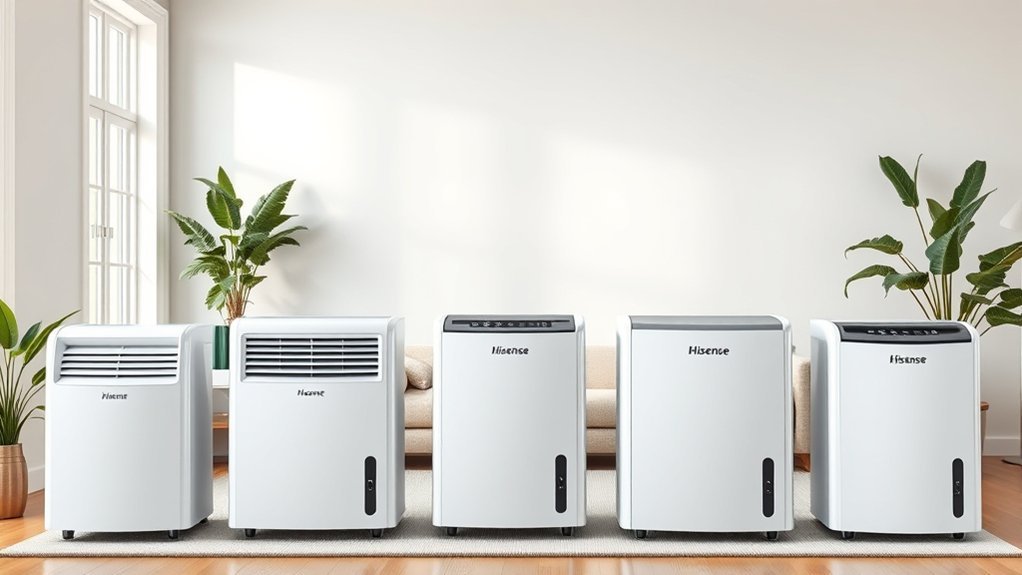
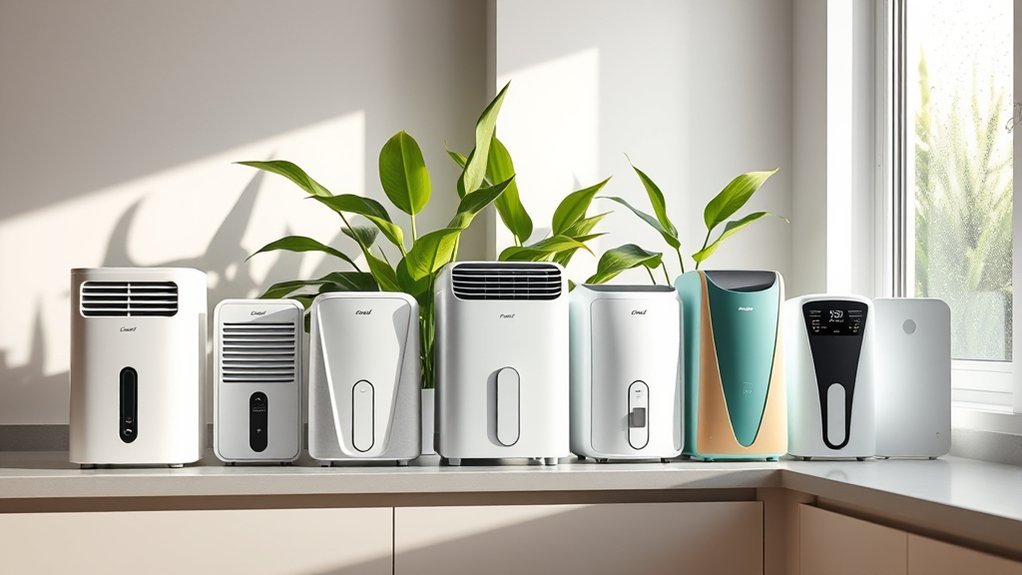
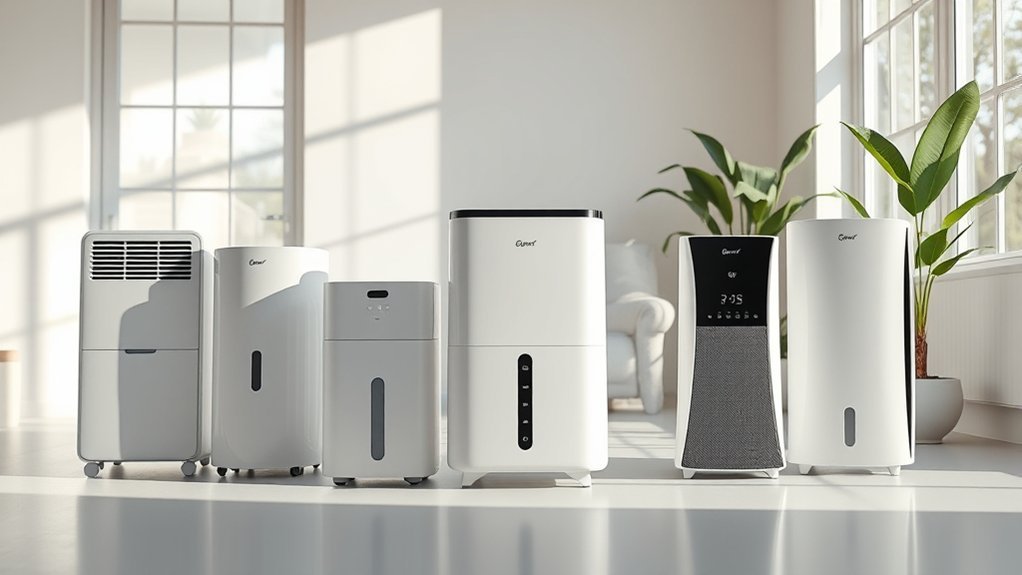
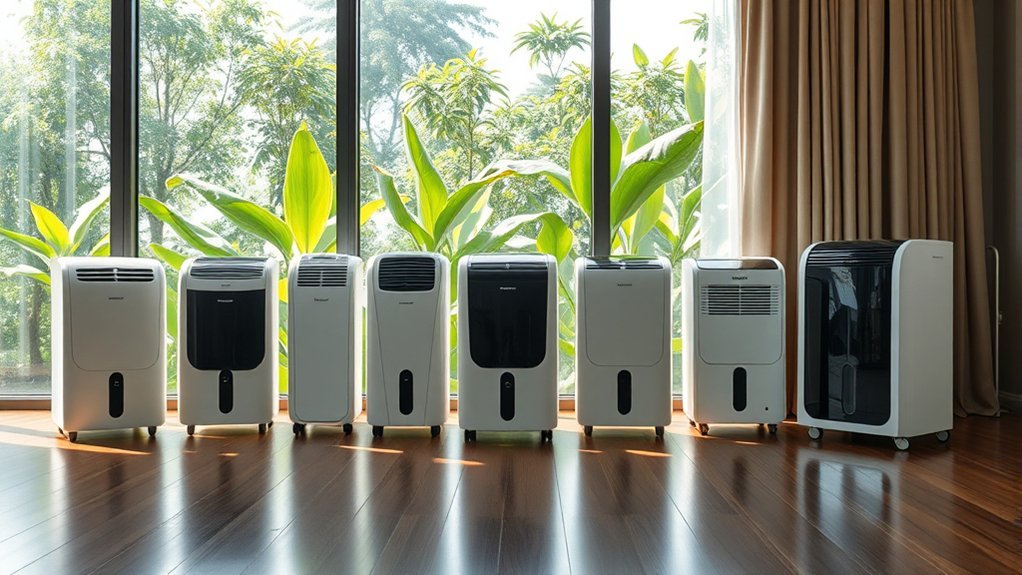
A cool or unheated garage needs more than a high capacity claim. The best garage dehumidifier for cool conditions should have automatic defrost, an adjustable humidistat, continuous drainage, and a clearly documented operating-temperature range. The three options below are designed for damp garages that remain above the minimum temperature stated in the product manual. The DECIUU DER32S01-50 is the best overall choice because it combines the highest standardized moisture-removal capacity in this group with a documented 41°F minimum. The AEOCKY RHEA-001 is best for automated control modes, while the Waykar JD025CE-80 is a practical option for moderate moisture loads.
- Best Overall — DECIUU DER32S01-50: Best combination of standardized capacity, energy efficiency, drainage flexibility, and documented 41°F operation.
- Best for Automated Control — AEOCKY RHEA-001: Multiple operating modes, automatic defrost, continuous drainage, and clear temperature guidance.
- Best for Moderate Dampness — Waykar JD025CE-80: ENERGY STAR certified with straightforward controls, automatic defrost, and gravity drainage.
Quick Comparison
Standardized DOE or ENERGY STAR capacity is the most useful figure for comparing dehumidifiers. Larger “maximum” capacities are normally measured by manufacturers under much hotter and more humid conditions than a typical garage.
| Product | Best For | Standardized Capacity | Temperature Guidance | Drainage | Amazon |
|---|---|---|---|---|---|
| Waykar JD025CE-80 | Moderately cool garages with manageable moisture | 24.93 pints per day; manufacturer advertises up to 80 pints at 95°F and 90% RH | Published manual revisions differ; verify the current manual and plan conservatively for about 45°F or warmer | Tank or continuous gravity drain | Check Price on Amazon |
| DECIUU DER32S01-50 | Best overall for heavier garage moisture | 32 pints per day; manufacturer also lists 70- and 100-pint warm-condition measurements | Manual operating range of 41°F to 95°F | Tank, included hose, or garden-hose adapter | Check Price on Amazon |
| AEOCKY RHEA-001 | Automated humidity control and flexible operating modes | About 24.5 pints per day; manufacturer also lists 56- and 80-pint warm-condition measurements | 41°F to 95°F operating range; 50°F or warmer recommended for better performance | Tank or continuous drain hose | Check Price on Amazon |
Waykar JD025CE-80 ENERGY STAR Dehumidifier
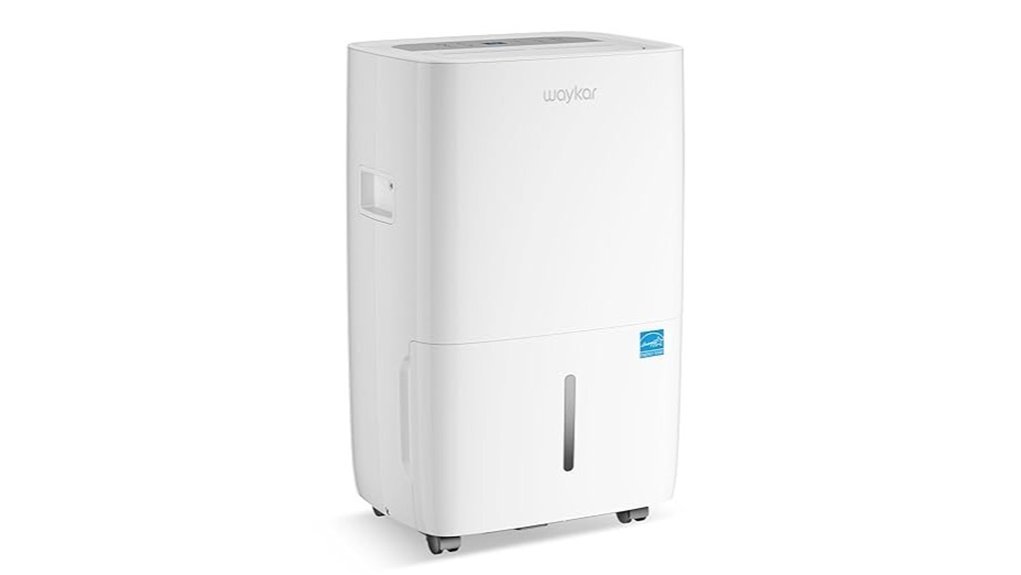
Best for moderate garage dampness: The Waykar JD025CE-80 is an ENERGY STAR-certified portable dehumidifier with automatic defrost, an adjustable humidistat, a timer, a washable filter, and continuous gravity drainage. Its current standardized moisture-removal capacity is 24.93 pints per day, while the advertised 80-pint figure is measured at 95°F and 90% relative humidity.
Temperature guidance needs extra attention with this model because published manual revisions have not been completely consistent. Some documentation lists a working range beginning around 44.6°F, while newer troubleshooting guidance warns that moisture removal may stop below 41°F. Check the manual and rating label supplied with the exact unit. For conservative garage planning, use it where temperatures normally remain around 45°F or warmer.
The 1.14-gallon tank provides reasonable temporary storage, while the included drain hose is better for unattended operation. The hose must run continuously downhill because this model uses gravity drainage and cannot pump water upward.
Why You’ll Like It:
- The official standardized rating makes it easier to compare with competing models.
- Automatic defrost helps the unit recover from coil frost in cooler conditions.
- The adjustable humidistat allows the compressor to cycle after reaching your target humidity.
- The 1.14-gallon tank is larger than the tanks found in many compact dehumidifiers.
Who Should Buy This:
- Garage owners dealing with moderate condensation, musty odors, or damp storage.
- Buyers who want ENERGY STAR certification and straightforward controls.
- Users who can provide a short, continuously downward drain route.
Who Should Avoid It:
- Garages that frequently fall into the low 40s or below.
- Buyers expecting 80 pints per day under normal cool-garage conditions.
- Anyone who needs a built-in condensate pump or app-based control.
DECIUU DER32S01-50 ENERGY STAR Dehumidifier
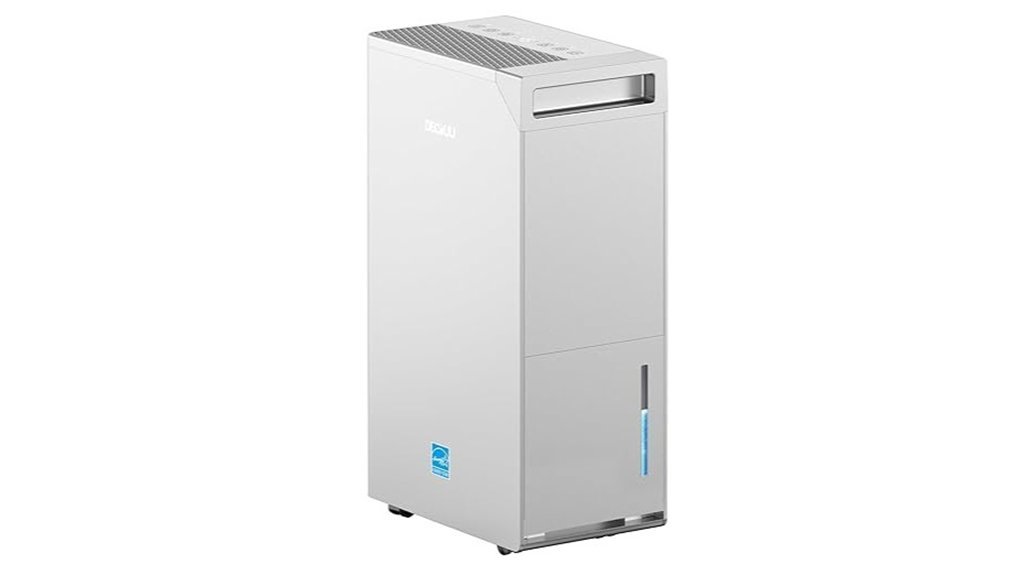
Best overall: The DECIUU DER32S01-50 offers the strongest combination of standardized capacity, efficiency, temperature documentation, and drainage flexibility in this group. Its current ENERGY STAR record lists a standardized moisture-removal capacity of 32 pints per day and an Integrated Energy Factor of 2.13 liters per kilowatt-hour.
The manufacturer also advertises 70- and 100-pint capacities under warmer and more humid test conditions. Those figures can describe the unit’s potential in extreme summer humidity, but the 32-pint standardized figure is the better number for comparing it with other portable dehumidifiers.
The manual lists an ambient operating range of 41°F to 95°F. Automatic defrost helps manage frost near the lower end of that range, although collection will slow as the garage becomes colder. The humidity setting can be adjusted from 35% to 80% RH.
Drainage options include the 1.45-gallon tank, an included continuous-drain hose, and a garden-hose adapter. These are gravity-drain arrangements. The standard model linked here should not be treated as having a built-in pump unless the exact listing and model label specifically state otherwise.
Why You’ll Like It:
- The 32-pint standardized capacity is the highest among the three remaining models.
- A documented 41°F minimum provides clearer guidance for a cool garage.
- Its 2.13 L/kWh Integrated Energy Factor supports efficient long-duration operation.
- Three gravity-drain arrangements make installation more flexible.
- Automatic restart memory can restore the previous settings after a power interruption.
Who Should Buy This:
- Owners of larger garages with persistent condensation or moisture from wet vehicles.
- Workshop users who want a larger tank and continuous drainage.
- Buyers seeking the strongest standardized moisture-removal capacity in this comparison.
Who Should Avoid It:
- Small garages with only occasional mild dampness.
- Users who need water to be pumped uphill to a sink or elevated drain.
- Unheated spaces that regularly fall below 41°F.
AEOCKY RHEA-001 Smart Dehumidifier with Drain Hose
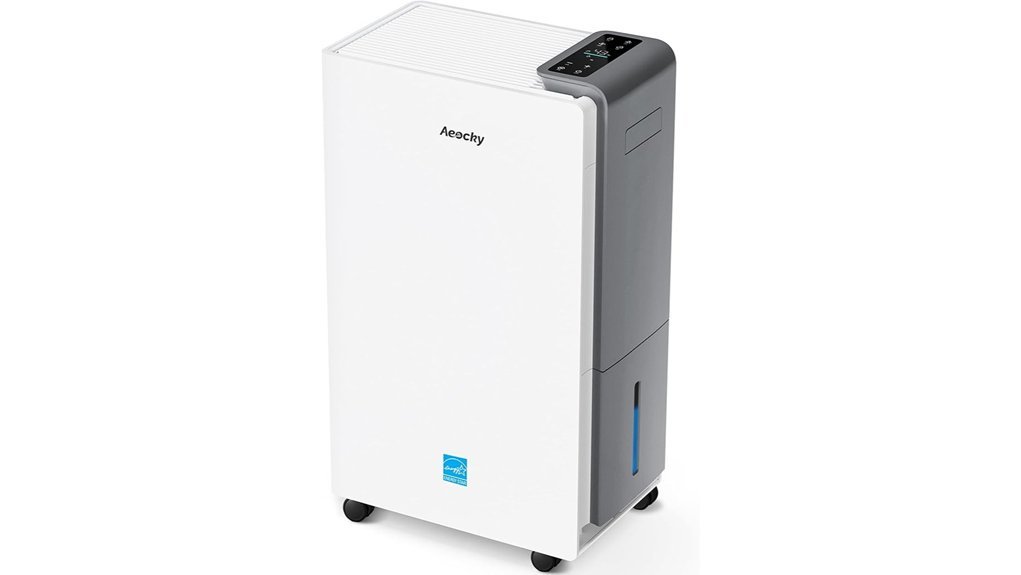
Best for automated control: The AEOCKY RHEA-001 combines automatic defrost, continuous drainage, several operating modes, and clear temperature guidance. At the time of this update, its ENERGY STAR certification record lists approximately 24.5 pints per day of standardized capacity, a 1.86 L/kWh Integrated Energy Factor, and qualification under the program’s Most Efficient criteria.
The manufacturer separately lists up to 56 pints per day at 86°F and 80% RH and up to 80 pints at more extreme heat and humidity. Those warm-condition figures should not be confused with the standardized 24.5-pint rating used for direct product comparison.
The manual permits operation from 41°F to 95°F but recommends temperatures of 50°F or warmer for better dehumidification performance. That makes it suitable for a cool, non-freezing garage, but not the best choice for a space that spends long periods near its minimum limit.
Auto, Constant Humidity, Continuous, Smart Drying, and Sleep modes make it easy to adapt operation to changing moisture levels. The word “smart” refers to automated sensing and control; the product is not listed as a connected or Wi-Fi-capable dehumidifier. The manufacturer also lists 44 dB operation at the lowest fan setting, a 1.45-gallon tank, drain-hose support, power-off memory, a child lock, and three-year unit coverage.
Why You’ll Like It:
- Multiple control modes make it easy to manage changing garage humidity.
- The manual clearly separates the 41°F operating limit from the recommended 50°F performance range.
- Automatic defrost, memory, and continuous drainage suit unattended operation.
- The larger tank reduces how often it must be emptied when a drain is unavailable.
Who Should Buy This:
- Buyers who value automated humidity control and multiple operating modes.
- Garages that generally remain at 50°F or warmer.
- Users who want continuous drainage without paying for an app-connected system.
Who Should Avoid It:
- Buyers who specifically need Wi-Fi or app-based remote control.
- Garages that remain close to 41°F for long periods.
- Small, mildly damp spaces where this size and feature set would be unnecessary.
Factors to Consider for a Cool, Non-Freezing Garage
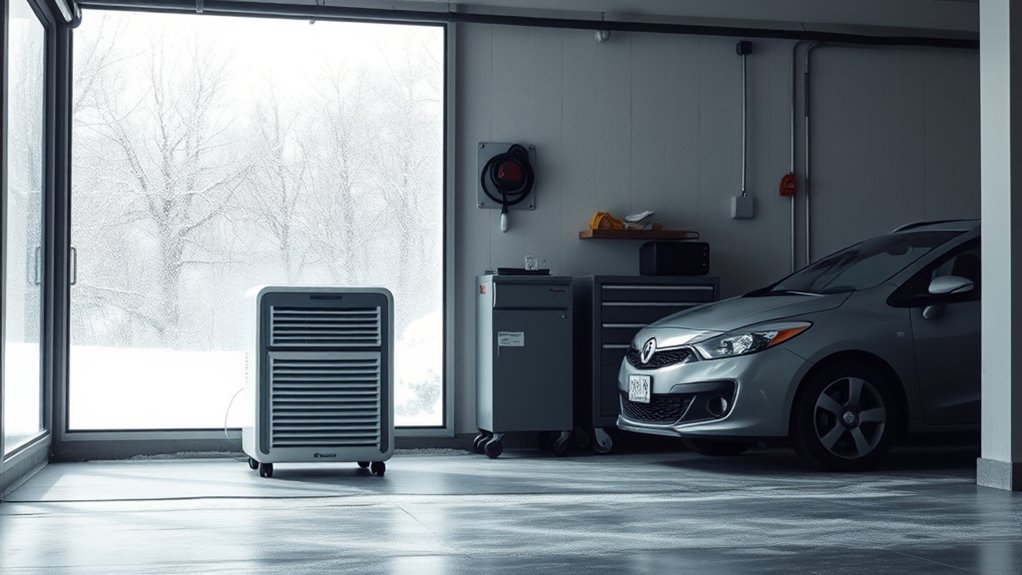
Choose a garage dehumidifier by its verified ambient operating range, standardized moisture-removal capacity, drainage requirements, energy efficiency, and the actual source of the moisture. Marketing coverage figures do not account for wet vehicles, concrete seepage, poor insulation, high ceilings, outdoor-air leakage, or frequent opening of the garage door.
Minimum Operating Temperature
The minimum operating temperature is the first specification to check. The temperature that activates coil defrost is not necessarily the same as the lowest approved room temperature. Use a thermometer that records daily minimums and compare the coldest garage temperature with the range printed in the current product manual.
A model with a 41°F minimum should not be treated as suitable at 32°F. It may also remove substantially less water while operating close to its lower limit. Leaving a reasonable temperature margin generally produces better performance and fewer defrost cycles.
Automatic Defrost
Automatic defrost pauses or changes compressor operation when the evaporator coil becomes too cold. This helps clear frost and protects moisture-removal performance. However, every defrost cycle is time when the unit is collecting little or no water, so winter output will be lower than the headline summer capacity.
Garage Size and Moisture Load
Do not size a dehumidifier by square footage alone. A one-car garage containing a wet vehicle can create a heavier short-term moisture load than a larger, dry, well-sealed garage. Concrete seepage, roof leaks, standing water, and uncontrolled outdoor-air entry should be corrected before relying on a dehumidifier.
Choose a larger standardized capacity when the garage has frequent condensation, visible dampness, wet vehicles, or stored materials that must remain dry. A smaller model may be enough for mild seasonal humidity and occasional musty odors.
Standardized Pint Capacity
Portable dehumidifier capacities can be published under several test conditions. A model advertised as 80 or 100 pints in extreme heat and humidity may have a standardized rating in the 20- to 30-pint range. Use the current DOE or ENERGY STAR pints-per-day figure for direct comparisons and treat higher manufacturer figures as separate warm-condition measurements.
Drainage Options
Continuous gravity drainage is usually the easiest arrangement for a garage. The hose must remain below the drain outlet, slope downward for its full length, and stay free of kinks. A gravity-drain dehumidifier cannot push water uphill.
If the only suitable drain is above the unit, use a compatible external condensate pump or choose a model with a verified built-in pump. Protect hoses and drain outlets from freezing, and never route discharged water where it can create ice, water damage, an electrical hazard, or a walking obstruction.
Energy Efficiency
Look for current ENERGY STAR certification and compare the Integrated Energy Factor, measured in liters of water removed per kilowatt-hour. A higher number generally indicates more efficient standardized operation. Actual electricity use will still depend on temperature, humidity, air leakage, filter condition, target humidity, and daily runtime.
Noise Levels
Noise claims often refer to the lowest fan setting and may not be measured in exactly the same way. A garage workshop may tolerate more sound than an attached garage next to a bedroom. Place the unit on a level, solid surface and keep the air inlet and outlet clear to reduce vibration and airflow noise.
Humidity Control
An adjustable humidistat is more practical than continuous operation for most garages. A target of approximately 45% to 50% RH is a useful starting point for reducing condensation, musty odors, and corrosion risk without forcing unnecessary runtime.
Humidity may need to be lower when outdoor temperatures are extremely cold and condensation is forming on windows or metal surfaces. The dehumidifier must still remain within its approved operating-temperature range.
- Measure and record the garage’s lowest overnight temperature.
- Check the exact model number and ambient operating range in the current manual.
- Compare standardized pints per day rather than only the maximum marketing capacity.
- Confirm that automatic defrost is included.
- Plan a continuously downhill drain route or purchase a suitable condensate pump.
- Check whether the hose outlet and drain could freeze during winter.
- Fix leaks, standing water, and major outdoor-air entry before relying on dehumidification.
Frequently Asked Questions
How Often Should Garage Dehumidifier Filters Be Cleaned?
Inspect the filter about every two weeks during the first month and clean it according to the manual whenever dust becomes visible or airflow decreases. Garages used for woodworking, sanding, vehicle repair, or other dusty activities may require more frequent cleaning.
Can a Dehumidifier Prevent Rust on Garage Tools?
A dehumidifier can reduce the humidity and condensation that contribute to corrosion, but it cannot guarantee complete rust prevention. Dry wet tools promptly, avoid storing them directly against damp concrete, and use suitable protective coatings or enclosed storage when necessary.
Do Garage Dehumidifiers Increase Electricity Bills Significantly?
Operating cost depends on the unit’s wattage, efficiency, runtime, local electricity rate, garage leakage, temperature, and moisture load. An ENERGY STAR model, a reasonable humidity setting, a clean filter, and closed doors can reduce unnecessary compressor runtime.
Is a Smart Dehumidifier Useful for an Unheated Garage?
Automated humidity sensing, restart memory, and operating modes can be useful, but “smart” does not always mean Wi-Fi or app control. Minimum ambient temperature remains more important than remote-control features. No automation feature can make a compressor dehumidifier work properly outside its approved temperature range.
What Drainage Options Work Best in a Detached Garage?
A short gravity hose leading to a protected floor drain is usually the simplest option. Keep the hose sloped downward and protect both the hose and drain outlet from freezing. Use a condensate pump only when water must travel uphill or across a route that cannot maintain a downward slope.
Will a Compressor Dehumidifier Work Below Freezing?
Most standard portable compressor dehumidifiers are not intended for below-freezing operation. The three models in this article require temperatures above freezing, and two have documented minimums of 41°F. Choose purpose-built low-temperature equipment or provide safe background heating if the garage regularly freezes.
How Warm Should a Garage Be for These Dehumidifiers?
Follow the minimum temperature in the manual supplied with the exact model. The DECIUU and AEOCKY manuals allow operation beginning at 41°F, although AEOCKY recommends 50°F or warmer for better performance. Because published Waykar documentation has varied, approximately 45°F or warmer is a more conservative planning point for that model.
Conclusion
Final Recommendation: The DECIUU DER32S01-50 is the best overall option for a cool, damp garage because it combines a 32-pint standardized capacity, a documented 41°F minimum, strong energy efficiency, automatic defrost, and flexible gravity drainage.
Choose the AEOCKY RHEA-001 when automated operating modes and clear temperature guidance are more important than maximum standardized capacity. The Waykar JD025CE-80 is a suitable ENERGY STAR option for moderate dampness when the garage remains conservatively around 45°F or warmer and the supplied manual confirms the exact operating range.
Whichever model you select, verify the current manual, provide a safe downhill drain route, and remember that a portable compressor dehumidifier is designed for a cool, non-freezing garage—not a space that regularly drops below freezing.