Last updated: August 2, 2026.
The best dehumidifier for an outbuilding depends on the actual moisture load, the building’s lowest indoor temperature, drainage access, and how well the structure is sealed. For most enclosed sheds, garages, workshops, and storage buildings, the ALORAIR Sentinel HD55 offers the best overall balance of moisture removal, cool-space operation, compact construction, and continuous drainage. The Airecoler GT-X5 is better for a larger, warmer, and wetter building, while the Waykar JD025CE-80 suits a heated or finished workspace. The BaseAire AirWerx 35P is the most practical compact option when condensate must be pumped to a higher drain.
The recommendations prioritize moisture-removal capacity with its stated test conditions, minimum operating temperature, drainage method, airflow, form factor, portability, and manufacturer-stated support. Because dehumidifier capacity labels use different tests, maximum, saturation, manufacturer-AHAM, and current DOE ratings are shown separately rather than treated as equal.
Quick Verdict
Best Overall: ALORAIR Sentinel HD55 for its compact commercial-style housing, gravity drainage, automatic defrost, and listed operation down to about 34°F.
Best for High Moisture Loads: Airecoler GT-X5 for higher airflow and stronger manufacturer-rated moisture removal in warm, very humid conditions.
Best for a Heated Workshop or Finished Garage: Waykar JD025CE-80 for portable controls, a water bucket, quieter operation, and optional gravity drainage.
Best Compact Model With a Pump: BaseAire AirWerx 35P when water must be lifted to a sink, wall outlet, or higher drain.
Quick Comparison
| Product | Best For | Moisture-Removal Rating | Listed Temperature Range | Drainage | Key Limitation | Details |
|---|---|---|---|---|---|---|
| ALORAIR Sentinel HD55 | Most enclosed outbuildings | 53 PPD at manufacturer-stated AHAM conditions; 113 PPD at saturation | 33.8°F to 104°F | Gravity hose | No built-in condensate pump | Check Product Details |
| Airecoler GT-X5 | Large, warm, very damp spaces | 58 PPD at 80°F/60% RH; 125 PPD at 95°F/95% RH | 41°F to 95°F | Gravity hose | About 50 pounds and unsuitable below its listed minimum temperature | Check Product Details |
| Waykar JD025CE-80 | Heated or finished garages and workshops | 24.93 PPD under the current ENERGY STAR/DOE procedure; up to 80 PPD at 95°F/90% RH | Not clearly stated on the current product page; verify the manual | Bucket or gravity hose | Residential-style unit intended for indoor-like conditions | Check Product Details |
| BaseAire AirWerx 35P | Compact spaces needing pumped drainage | 35 PPD at manufacturer-stated AHAM conditions; 70 PPD at saturation | 33°F to 105°F | Built-in pump or gravity hose | Lower capacity for very large or severely wet buildings | Check Product Details |
ALORAIR Sentinel HD55 Commercial Dehumidifier
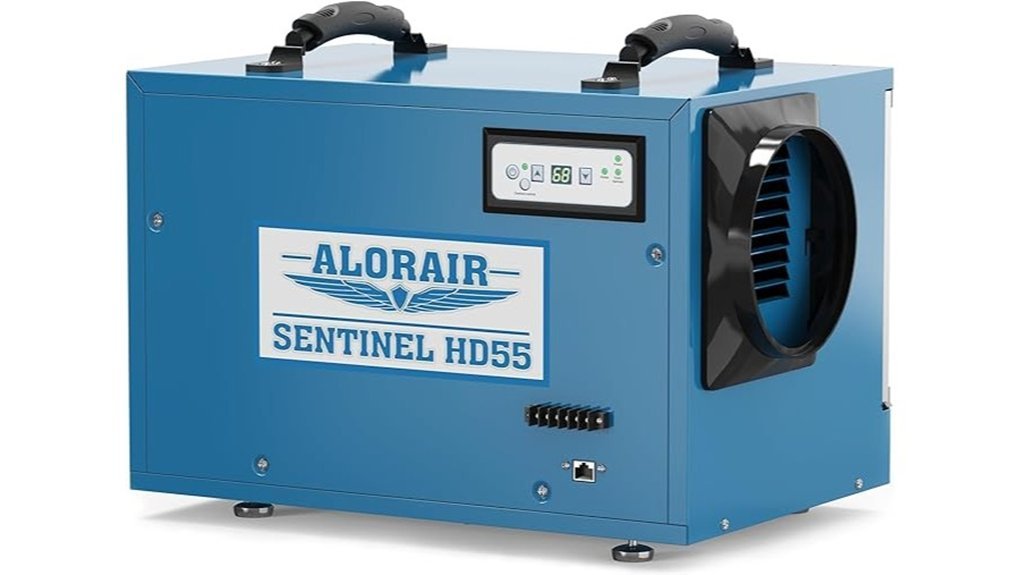
Best Overall
The ALORAIR Sentinel HD55 is the most balanced choice for an enclosed shed, garage, workshop, or storage building. The manufacturer states coverage up to 1,200 square feet, but the more useful specifications are its 53-pint manufacturer-AHAM rating, 120 CFM airflow, and listed operating range of 33.8°F to 104°F. Its 113-pint figure is a saturation rating measured in much hotter and wetter air.
The compact commercial-style housing, automatic defrost, memory restart, MERV-1 intake filter, and continuous gravity drainage make it better suited to a permanent outbuilding installation than a bucket-only home unit. It can work in cooler conditions than the Airecoler, but it is not freeze-proof and should not be operated below its stated range.
Why You’ll Like It: It combines useful moisture-removal capacity, a compact footprint, cool-space operation, and unattended gravity drainage without moving into oversized restoration equipment.
Best For: Enclosed workshops, garages, equipment rooms, storage buildings, and similar spaces with a nearby lower drain.
Who Should Avoid It: Choose a pump-equipped model if the water must travel upward or there is no continuous downhill drain route.
Pros:
- Useful manufacturer-AHAM rating: Rated at 53 PPD under the manufacturer’s stated AHAM condition.
- Cool-space operation: Automatic defrost and a listed minimum temperature of about 34°F.
- Continuous drainage: Gravity drainage removes the need to empty a bucket.
- Compact construction: Easier to position in crowded storage or equipment areas.
Cons:
- No built-in pump: The drain hose must maintain a continuous downhill slope.
- Basic filtration: The MERV-1 filter protects internal parts but is not a substitute for an air cleaner.
- Not freeze-proof: Automatic defrost does not make the unit suitable for temperatures below its rated range.
Airecoler GT-X5 Commercial Dehumidifier
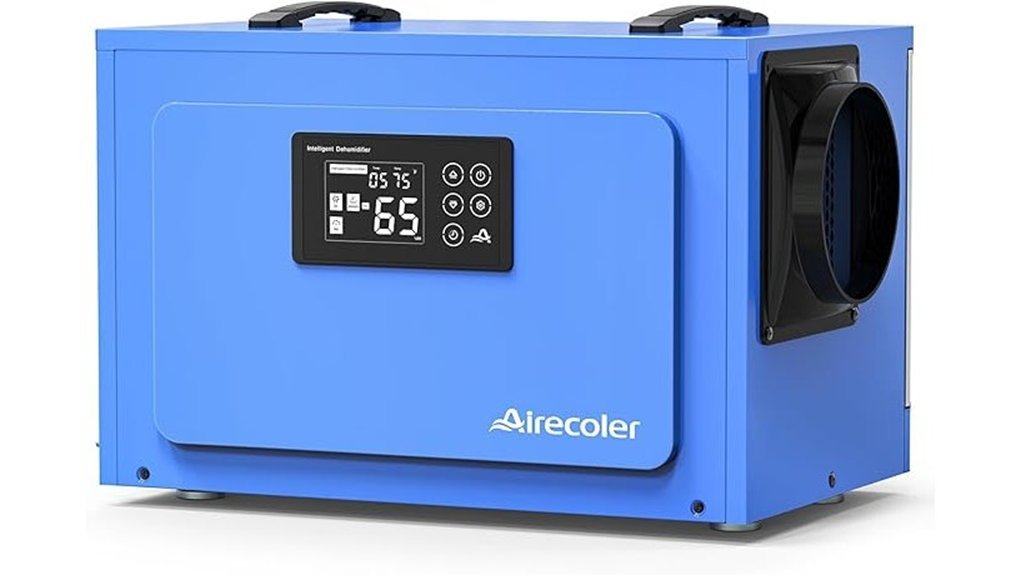
Best for High Moisture Loads
The Airecoler GT-X5 is the stronger option for a large, warm, and consistently damp outbuilding. The manufacturer lists 58 pints per day at 80°F and 60% relative humidity and 125 pints at 95°F and 95% RH. Its 265 CFM airflow can circulate more air through a large open workshop, garage, warehouse-style shed, or storage building than the smaller models in this comparison.
The horizontal housing fits low-clearance areas, and the included drain hose supports continuous gravity drainage. Automatic defrost, auto restart, adjustable humidity control, and a 24-hour timer support unattended operation. Its stated range begins at 41°F, making it more suitable for an insulated, heated, or seasonally warm building than a shed that approaches freezing.
Why You’ll Like It: The higher airflow and stronger warm-condition capacity make it a better match for severe seasonal humidity and large open layouts.
Best For: Large garages, workshops, storage buildings, and commercial-style enclosed spaces that stay at or above 41°F.
Who Should Avoid It: Buyers with a cold winter outbuilding, limited lifting ability, or no downhill drain route should consider another model.
Pros:
- Higher airflow: Rated at up to 265 CFM for better circulation in larger open areas.
- Strong warm-condition output: Rated at 58 PPD at 80°F/60% RH and 125 PPD at 95°F/95% RH.
- Continuous-operation features: Includes gravity drainage, auto restart, auto defrost, and a timer.
- Commercial-style shape: Fits locations where a tall portable home unit may be awkward.
Cons:
- Heavier construction: At about 50 pounds, it is less convenient to move frequently.
- No built-in pump: Condensate must flow downhill through the hose.
- Higher minimum temperature: The listed operating range begins at 41°F.
Waykar JD025CE-80 ENERGY STAR Portable Dehumidifier
Best for Heated or Finished Outbuildings
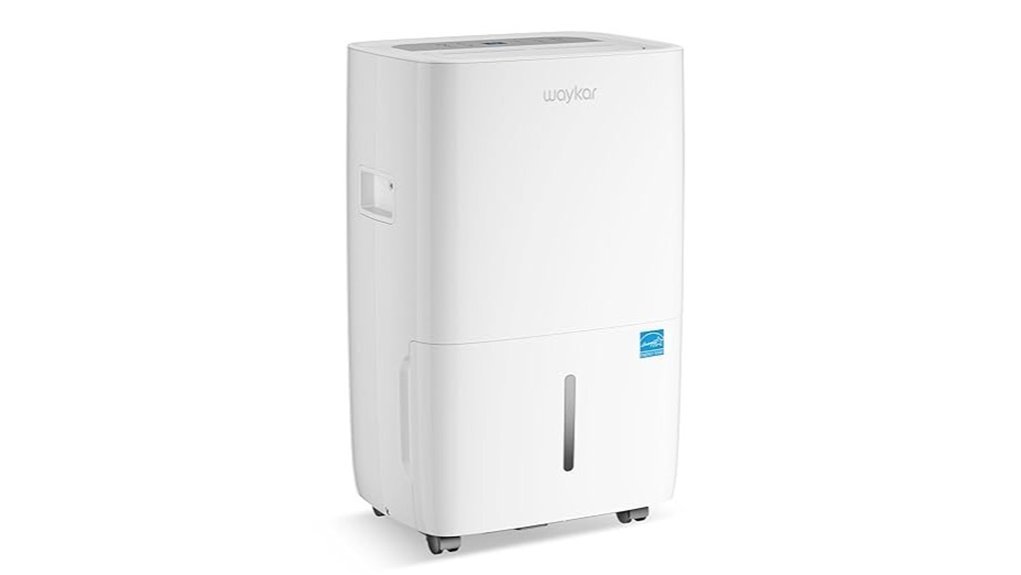
The Waykar JD025CE-80 is a portable residential-style dehumidifier for a heated workshop, finished garage, hobby room, studio, or insulated storage building. The manufacturer markets up to 80 pints per day at 95°F and 90% RH, while the current ENERGY STAR database lists a 24.93-pint capacity under the cooler DOE procedure. This difference demonstrates why the test condition matters more than the large number in a product name.
It offers adjustable humidity control, automatic defrost, a removable 1.14-gallon water tank, an included gravity drain hose, casters, carrying handles, and automatic airflow swing. The manufacturer lists operation as low as about 42 dB, making it the most comfortable choice here for a studio or workshop where people spend long periods.
Why You’ll Like It: It is easier to move and operate than the horizontal commercial models and can use either its bucket or a gravity drain.
Best For: Finished garages, hobby shops, studios, utility rooms, and insulated outbuildings that maintain indoor-like temperatures.
Who Should Avoid It: It is not the best choice for exposed, freezing, extremely dusty, or continuously wet spaces that require commercial-style construction.
Pros:
- Flexible drainage: Use the removable tank or connect the included gravity drain hose.
- Portable design: Casters and handles simplify movement between work zones.
- Lower listed sound level: The manufacturer states operation as low as about 42 dB.
- Verified ENERGY STAR certification: Model JD025CE-80 appears in the current ENERGY STAR product database.
Cons:
- Capacity-label confusion: The advertised 80-pint figure uses much hotter and wetter air than the current DOE test.
- Residential-style construction: It is designed for indoor home-like environments rather than harsh utility spaces.
- Minimum temperature is unclear: Check the current manual before placing it in an unheated outbuilding.
BaseAire AirWerx 35P Dehumidifier With Pump
Best Compact Model With a Pump
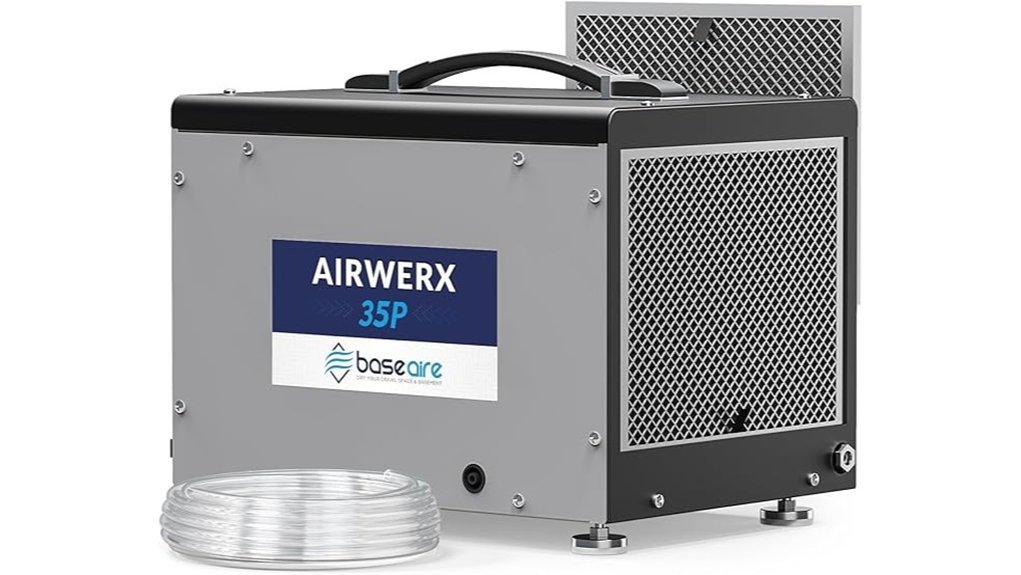
The BaseAire AirWerx 35P is the best choice in this group when an outbuilding lacks a nearby lower drain. Its built-in condensate pump can move collected water upward, while gravity drainage remains available when the layout allows it. The manufacturer rates the unit at 35 pints per day under its stated AHAM condition and 70 pints at saturation, with coverage promoted up to 1,000 square feet.
Its compact footprint works well in a small garage, equipment room, storage shed, or low-clearance installation. Automatic defrost, memory restart, adjustable feet, and carrying handles support long-term use. The listed operating range begins at 33°F, but it must still be protected from freezing temperatures, weather, and standing water.
Why You’ll Like It: Pumped drainage solves installation problems that gravity-only dehumidifiers cannot.
Best For: Smaller enclosed outbuildings where the drain is higher than the dehumidifier or located across the room.
Who Should Avoid It: A very large, open, or severely wet building may require a higher-capacity model.
Pros:
- Two drainage options: Use the built-in pump or gravity drainage.
- Compact footprint: Fits low-clearance and crowded utility spaces.
- Cool-space capability: Automatic defrost and a listed operating range beginning at 33°F.
- Manufacturer support: The current manufacturer page advertises a five-year limited warranty and lifetime technical support; confirm the seller’s terms before ordering.
Cons:
- Lower manufacturer-AHAM capacity: Its 35 PPD rating may be too small for a large or extremely damp building.
- Audible fan: The listed sound pressure is below 50 dBA, but it may still be noticeable in a quiet studio.
- Additional pump maintenance: The pump line, reservoir, and filter require routine inspection.
Factors to Consider When Choosing a Dehumidifier for Outbuildings
A dehumidifier can control moisture in the air, but it cannot compensate for an open structure, leaking roof, groundwater entry, wet slab, or unsealed door. Use the following checks before choosing a model.
1. Enclosed and Weather-Protected Space
None of these models is an outdoor appliance. Install the unit on a stable, level surface inside a dry, enclosed building. Keep it away from rain, puddles, wash-down water, direct sunlight, chemical vapors, and areas where a vehicle or tool could strike it. Seal obvious gaps and repair active leaks first.
2. Size, Moisture Load, and Capacity
Do not choose by square footage alone. Ceiling height, air leakage, wet materials, an unsealed slab, frequent door opening, and the amount of stored lumber or equipment can change the moisture load. A damp 700-square-foot workshop may require more capacity than a dry, tightly sealed 1,500-square-foot storage room.
- Occasionally damp: A mild musty odor or temporary humidity after wet weather.
- Persistently damp: Repeated readings above 60% RH, regular condensation, or damp-feeling materials.
- Severely wet: Active seepage, standing water, visibly wet walls, or materials that do not dry.
A modest capacity margin can help a unit reach its target without running at maximum output all day. However, automatically choosing the largest model can increase cost and may cause short cycling in a small, tightly sealed room.
3. Operating Temperature and Defrost
Compressor dehumidifiers remove less water as air temperature falls, and frost can form on their coils. Automatic defrost helps manage frost, but it does not make a machine freeze-proof. Compare the unit’s stated minimum temperature with the coldest temperature recorded inside the building.
If the outbuilding stays below the compressor model’s operating range for long periods, consider improving insulation, adding safe background heat, or using a properly sized desiccant dehumidifier designed for lower temperatures.
4. Drainage Options
Continuous drainage is usually better than a bucket for unattended use. A gravity drain requires an uninterrupted downhill hose route. A built-in pump is useful when water must travel upward to a sink, through a wall, or to a higher drain.
Secure the hose and inspect it for kinks, algae, debris, or damage. In cold weather, protect the drain line from freezing. A frozen or blocked hose can cause shutdowns, leaks, or water backup.
5. Power and Electrical Safety
Use a properly grounded outlet that matches the manufacturer’s voltage, current, and installation instructions. Many dehumidifiers should be plugged directly into an outlet rather than an extension cord. Keep the plug and receptacle away from water, sawdust, metal filings, fuel, paint fumes, and other workshop contaminants.
A qualified electrician should inspect questionable wiring, overloaded circuits, damaged receptacles, or older detached-building electrical systems.
6. Humidity Setting and Monitoring
A practical starting target for most storage and workshop spaces is around 45% to 50% relative humidity. The EPA recommends keeping indoor humidity below 60%, ideally between 30% and 50%, to help control moisture and mold growth. See the EPA guide to mold and moisture control.
Do not set the humidistat lower than necessary. A very low setting increases runtime and energy use without repairing the source of moisture. Place a separate hygrometer across the room or near vulnerable stored items to check whether humidity is even throughout the building.
7. Airflow, Dust, and Maintenance
Leave the manufacturer-recommended clearance around the air intake and exhaust. Avoid placing the unit behind boxes, under loose fabric, or against a wall that blocks airflow.
Clean the filter more often in woodshops, garages, and equipment sheds. Dust buildup reduces airflow and may shorten equipment life. Inspect the coils, drain hose, pump reservoir, electrical cord, and air openings on a regular schedule.
- Measure the enclosed floor area and ceiling height.
- Record temperature and humidity for several days.
- Note the lowest winter temperature inside the building.
- Look for roof, wall, pipe, slab, and foundation leaks.
- Identify a downhill drain or decide whether you need a pump.
- Confirm the outlet, voltage, current, and circuit requirements.
- Check whether the drain hose could freeze in winter.
- Allow room for airflow, filter cleaning, and service access.
Frequently Asked Questions
How Do I Determine the Right Size Dehumidifier for My Outbuilding?
Measure the floor area and ceiling height, then consider humidity, temperature, air leakage, wet materials, and how often the doors open. Compare pint ratings only after checking their test conditions. A persistently damp 1,000-square-foot garage may require more capacity than a sealed storage building of the same size.
Can I Use a Dehumidifier in an Unheated Shed?
Only when the shed stays within the model’s stated operating-temperature range. Automatic defrost helps in cool air, but a standard compressor dehumidifier should not operate below its minimum temperature or where the unit or drain line may freeze.
What If My Shed Gets Too Cold for a Compressor Dehumidifier?
Improve air sealing and insulation first. Safe background heat may keep the space within the unit’s range. For consistently colder conditions, a desiccant dehumidifier designed for low-temperature operation may be more suitable, although its energy use and capacity should still be checked carefully.
Can Dehumidifiers Help Prevent Mold in Outbuildings?
Controlling humidity can reduce the moisture that supports mold growth. However, a dehumidifier does not remove existing mold or repair water entry. Fix leaks, dry wet materials promptly, improve drainage, and keep relative humidity below 60%, ideally around 30% to 50% where practical.
What Maintenance Is Required for Dehumidifiers?
Clean or wash the filter as directed, inspect the coils and air openings, and check the drain hose for blockage or freezing. Test the condensate pump if the unit has one. Keep boxes, dust, tools, and standing water away from the intake, exhaust, cord, and outlet.
Can a Dehumidifier Run Continuously in an Outbuilding?
Many models support continuous drainage and humidistat-controlled operation. Before leaving a new installation unattended, confirm that the hose drains correctly, the pump cycles normally, the outlet stays dry, and the unit shuts off or cycles when it reaches the selected humidity.
Is a Built-In Pump Worth It?
A pump is useful when there is no lower drain or the condensate must move upward. Gravity drainage is simpler and has fewer moving parts, but it works only when the hose can maintain a downward slope from the unit to the disposal point.
Can I Use an Extension Cord With an Outbuilding Dehumidifier?
Follow the product manual. Many compressor dehumidifiers should be connected directly to a properly grounded outlet. An undersized, damaged, or coiled extension cord can overheat or cause excessive voltage drop. Have an electrician install a suitable outlet when the existing power location is not adequate.
Conclusion
For most enclosed outbuildings, the ALORAIR Sentinel HD55 offers the best balance of useful moisture-removal capacity, cool-space operation, compact construction, and continuous drainage. Choose the Airecoler GT-X5 for a larger, warmer, and wetter building; the Waykar JD025CE-80 for a heated or finished workshop where portability and lower noise matter; or the BaseAire AirWerx 35P when compact size and pumped drainage are the priorities.