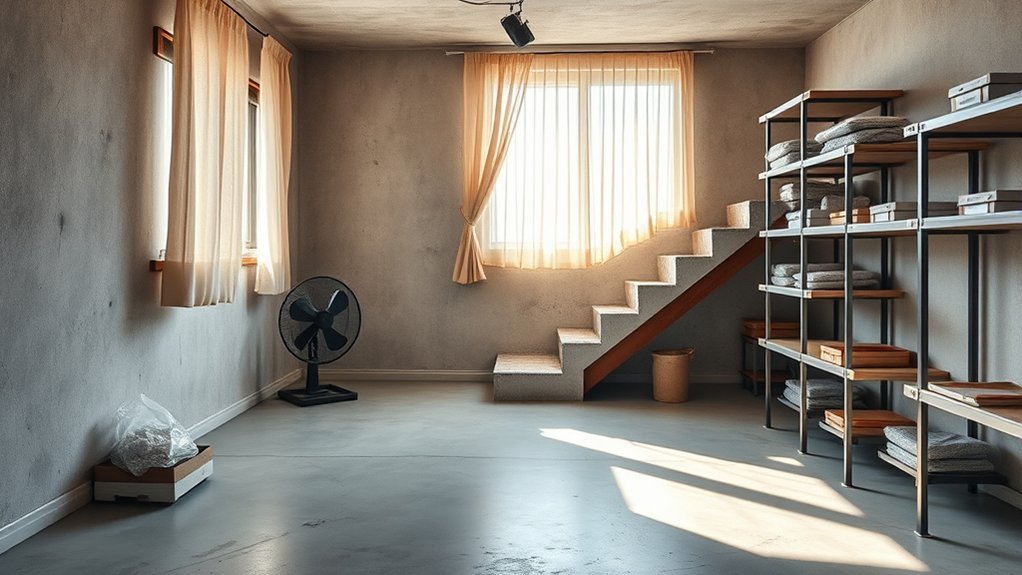
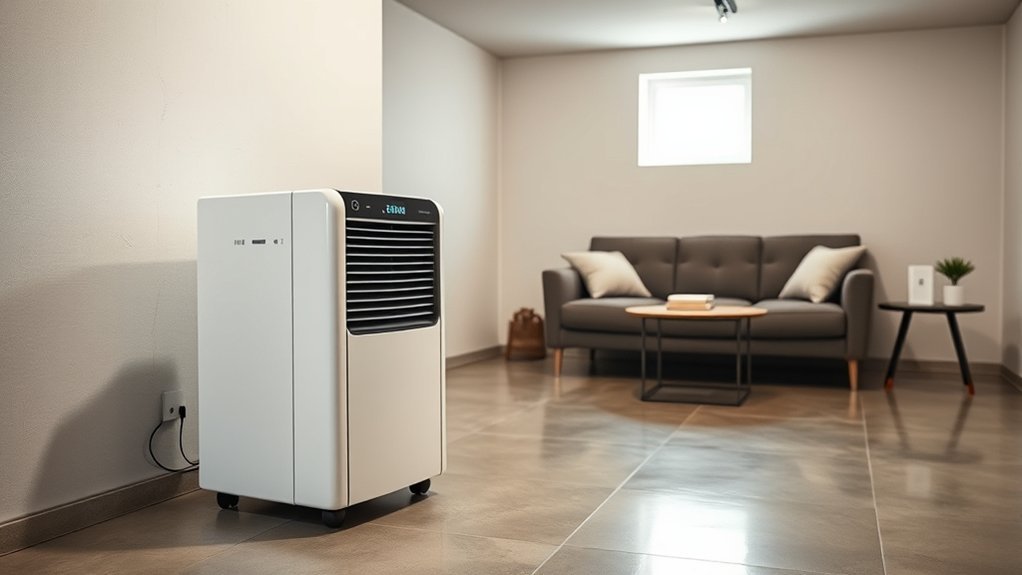
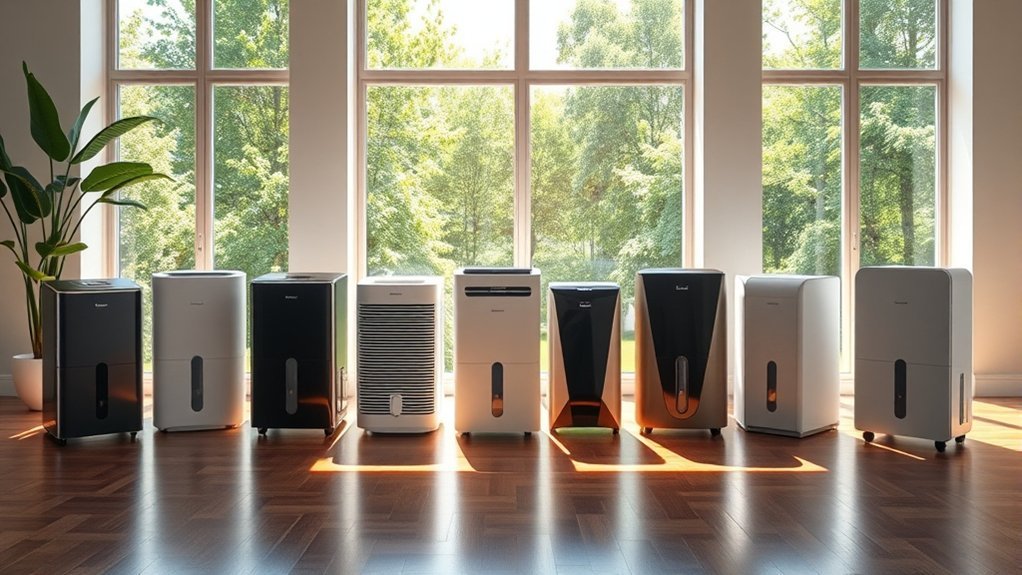
Last updated: August 2026. A high-capacity basement dehumidifier can help reduce persistent dampness, musty odors, condensation, and excess moisture. This guide compares eight portable compressor models for medium, large, and severely damp basements, including options with Wi-Fi control, continuous drainage, large tanks, automatic defrost, and adjustable humidistats.
The most important comparison is not the biggest number in the product title. Some sellers advertise a maximum moisture-removal figure measured in unusually hot, humid air, while the current U.S. test procedure rates portable dehumidifiers at cooler basement-like conditions. Compare like-for-like capacity, drainage setup, operating temperature, tank size, model-specific ENERGY STAR status, and warranty terms before buying.
Key Takeaways
- Best balanced pick: AEOCKY 50 Pint for buyers who want a compact footprint, flexible drainage, and lower weight than the largest models.
- Best smart pick: Frigidaire 50 Pint Wi-Fi for app-based control from another floor.
- Best drainage flexibility: Gasbye for tank, gravity-hose, and adapter-based setups.
- Best for severe moisture: AEOCKY 7,000 Sq. Ft. is worth comparing, but its 140-pint figure is a hot-and-humid maximum rather than a directly comparable standardized rating.
How We Compared These Models
The comparison focuses on product relevance, seller-listed capacity and test conditions, drainage options, tank size, portability, automatic controls, cold-room features, noise claims, current model details, and the clarity of warranty or support information. No product is presented as personally tested, and seller claims are treated as claims unless supported by a model-specific certification record or manufacturer documentation.
Quick Verdict
AEOCKY 50 Pint is the best balanced choice for many medium-to-large basements because it combines a compact body, humidistat control, and flexible drainage without the bulk of the largest option. Frigidaire is the best smart choice when remote app control matters. Waykar and Yaufey are easy-to-understand large-room options with included drain hoses. Gasbye stands out for flexible drainage and a larger tank. For severe moisture loads, compare the exact standardized rating and model record of the AEOCKY 7,000 Sq. Ft. unit before treating its 140-pint maximum as the strongest option.
Quick Comparison of Basement Dehumidifiers
| Product | Capacity Context | Drainage | Standout Feature | Best Fit | Amazon |
|---|---|---|---|---|---|
| Frigidaire Wi-Fi Best Smart Control |
Listing: 50 pints/day; model FHDD5034Y1 | Tank; verify hose and continuous-drain accessories | Remote app control | Medium-to-large basements where Wi-Fi convenience matters | Check Availability |
| Ludatido Large-Tank Pick |
Seller-listed 80 pints/day; standardized rating not confirmed | Tank or continuous drain; verify included hose length | Multiple modes and large-tank design | Very damp large rooms with a nearby drain | Check Availability |
| Waykar YDZ-80 Best Auto Features |
80 pints/day at 95°F/90% RH; 62 at 86°F/80% RH; verify standardized rating | 0.92-gallon tank or included drain hose | Auto defrost and self-drying | Large basements needing simple automatic operation | Check Availability |
| AIRPLUS AP20-1905EE Portable Pick |
Seller-listed 70 pints/day; standardized rating not confirmed | 0.7-gallon tank or included drain hose | Four operating modes | Large-room use where repositioning matters | Check Availability |
| AEOCKY RHEA-003 Severe-Moisture Pick |
140 pints/day at 95°F/95% RH; 95 at 86°F/80% RH; verify standardized rating | 1.85-gallon tank, drain hose, or garden-hose adapter | Highest hot-and-humid maximum in this guide | Large, persistently damp basements | Check Availability |
| Yaufey JD025Q-80 Easiest Controls |
Seller-listed 80 pints/day; standardized rating not confirmed | 1.06-gallon tank or drain hose | Clearly labeled operating modes | Continuous basement use with simple setup | Check Availability |
| Gasbye DryPrime Best Drainage Flexibility |
115 pints/day at 86°F/80% RH; 50 at 65°F/60% RH | 1.7-gallon tank, gravity hose, or compatible adapter | Multiple drainage choices | Large basements near living areas | Check Availability |
| AEOCKY BOREAS-001 Best Balanced Pick |
50 pints/day at 95°F/95% RH; 38 at 86°F/80% RH; verify standardized rating | 0.8-gallon tank, included hose, or garden-hose adapter | Compact size and versatile drainage | Medium-to-large basements with a gravity drain | Check Availability |
Frigidaire 50 Pint Dehumidifier with Wi-Fi
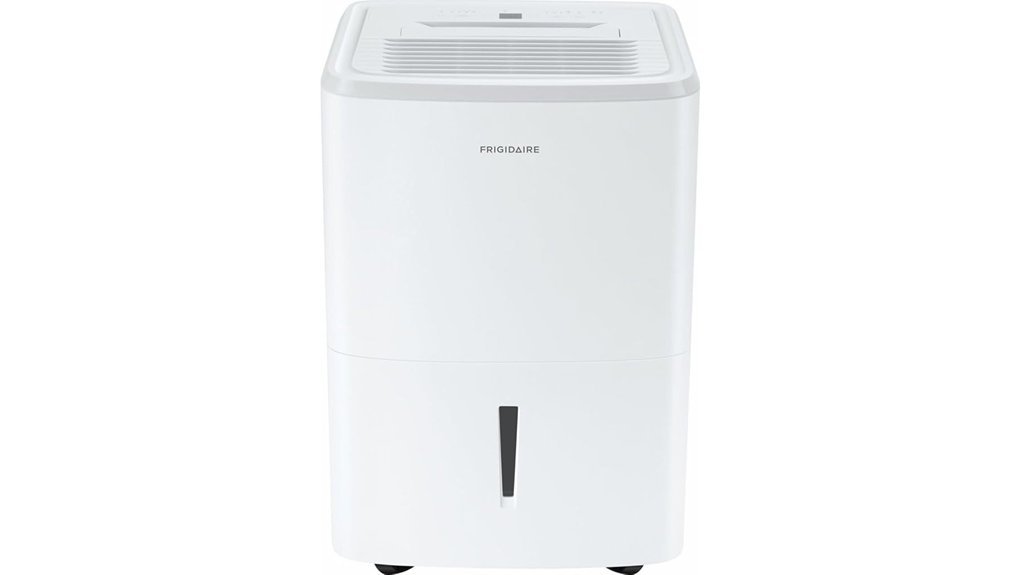
The Frigidaire 50 Pint Dehumidifier is the most convenient choice here for readers who want remote monitoring and control. The current listing identifies model FHDD5034Y1 and describes Wi-Fi control, customizable humidity settings, and a washable filter. App access can be useful when the basement is not visited every day.
Best For: Homeowners who want a recognized appliance brand and app-based control for a medium-to-large basement.
Why You’ll Like It: Remote controls can reduce trips downstairs, while the adjustable humidistat supports automatic cycling around the selected setting. The current product information also lists a one-year limited warranty.
Who Should Avoid It: Buyers who do not plan to use Wi-Fi may get better value from a simpler model. The current Amazon details list the air filter and tank as included components, so confirm whether a drain hose or adapter must be purchased separately.
Pros:
- Wi-Fi control can make basement monitoring more convenient.
- Adjustable humidity settings support automatic operation.
- Washable filter can simplify routine maintenance.
Cons:
- Smart features add little value without a reliable compatible Wi-Fi connection.
- Do not assume a drain hose is included without checking the exact package contents.
- The listing’s 50-pint figure should still be compared with the exact standardized model record.
Ludatido 2026 ENERGY STAR Dehumidifier
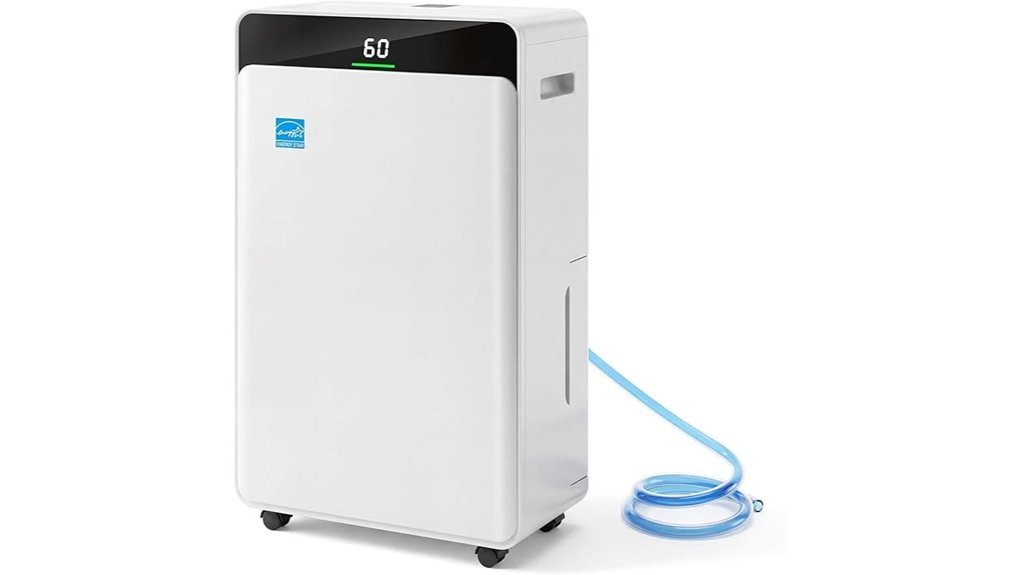
The Ludatido model 527BZV1R5 targets large, very damp rooms with a seller-listed capacity of up to 80 pints per day. The listing describes automatic drainage, automatic shutoff, several operating modes, a timer, child lock, and overheat protection.
Best For: Buyers who want multiple modes, a large-tank design, and the option to run a drain hose in a damp basement.
Why You’ll Like It: Automatic controls and continuous drainage can reduce daily attention once the unit is positioned near a suitable gravity drain.
Who Should Avoid It: It may be excessive for a small basement with only seasonal dampness. The Amazon page may also display a newer-version option, so confirm the exact ASIN, model number, standardized capacity, tank size, hose length, certification record, and warranty before ordering.
Pros:
- Seller-listed high-capacity moisture removal for large spaces.
- Tank and continuous-drain options support different installations.
- Multiple modes and safety controls improve convenience.
Cons:
- The advertised 80-pint figure is not confirmed here as the standardized 65°F/60% RH rating.
- The large unit may take up unnecessary space in a small room.
- Exact noise, efficiency, and warranty terms require model-specific verification.
Waykar 80 Pint Energy Star Dehumidifier
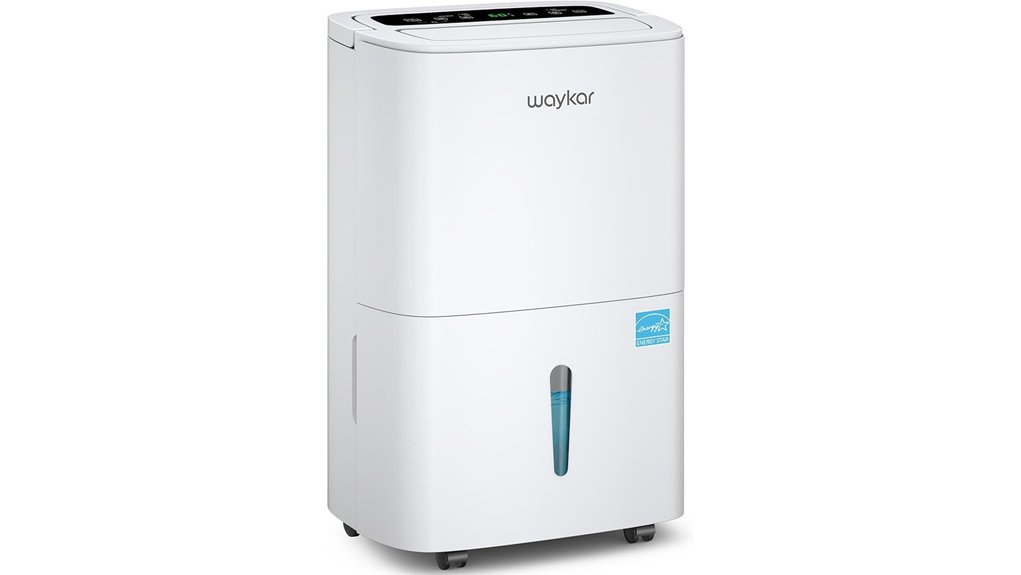
The Waykar YDZ-80 is marketed for spaces up to 5,000 square feet. Its listing states up to 80 pints per day at 95°F and 90% RH and 62 pints per day at 86°F and 80% RH. Those hot-and-humid figures should not be treated as the standardized basement rating.
The unit includes adjustable humidity control, automatic and continuous modes, a timer, automatic defrost, self-drying, a washable filter, wheels, a 0.92-gallon tank, and an included drain hose.
Best For: Large basements that have access to a gravity drain and need uncomplicated automatic operation.
Why You’ll Like It: Automatic defrost and self-drying are practical features for prolonged basement operation. The listing also gives useful physical details, including a seller-listed weight of about 28.6 pounds.
Who Should Avoid It: Avoid relying on the 5,000-square-foot or 80-pint headline alone. A very wet basement, open stairway, low temperature, or water seepage can create a much heavier moisture load.
Pros:
- Automatic defrost, self-drying, and humidity control support low-attention use.
- Included drain hose and 0.92-gallon tank provide two drainage choices.
- Wheels, handle, and washable filter support easier upkeep.
Cons:
- The 80-pint figure is measured at 95°F/90% RH rather than the cooler standardized basement condition.
- The tank can fill quickly when the basement is very damp.
- Gravity drainage requires a continuous downward hose path.
AIRPLUS 70 Pint Dehumidifier for Basements and Home
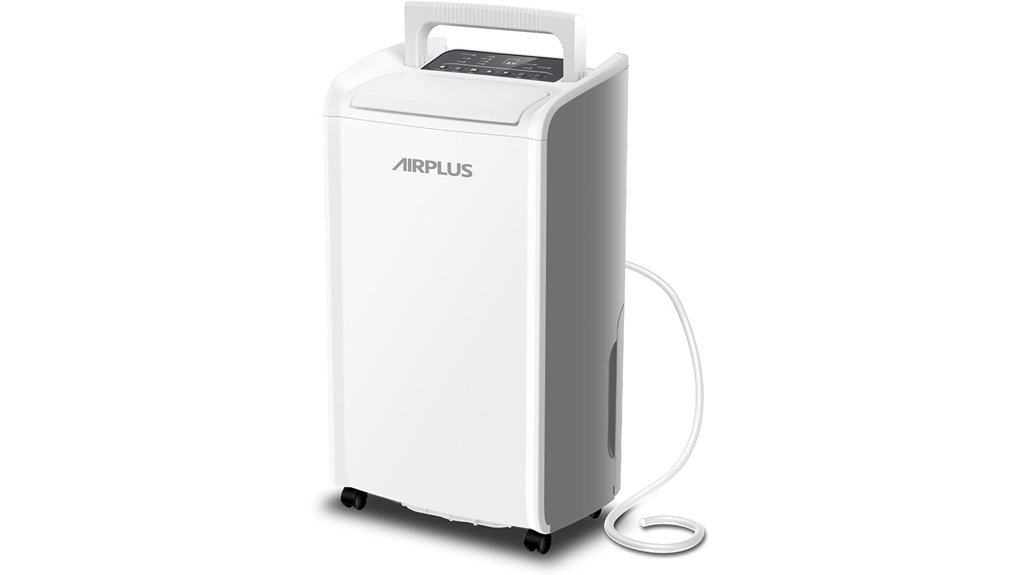
The AIRPLUS AP20-1905EE is advertised as a 70-pint dehumidifier for spaces up to 4,500 square feet. Its controls show humidity, temperature, timer, and operating mode. The listing also describes four modes, automatic shutoff, automatic restart, defrost, a washable filter, and continuous drainage with an included hose.
Best For: Buyers who want a portable large-room model with several operating modes and straightforward digital controls.
Why You’ll Like It: Its seller-listed weight of about 28 pounds and built-in portable features may make it easier to reposition than heavier high-capacity units. The 0.7-gallon tank is manageable to carry when full.
Who Should Avoid It: The small tank is not ideal for a very wet basement unless continuous drainage is available. The seller-listed 70-pint capacity also needs an equivalent test-condition comparison.
Pros:
- Digital display provides quick access to operating information.
- Four modes can adapt the unit to different moisture conditions.
- Included drain hose reduces manual tank emptying.
Cons:
- The 0.7-gallon tank makes hose drainage important in damp spaces.
- The standardized capacity is not confirmed in the visible listing details reviewed.
- Portable does not mean convenient for frequent stair carrying.
AEOCKY 7000 Sq. Ft. Smart Compressor Dehumidifier
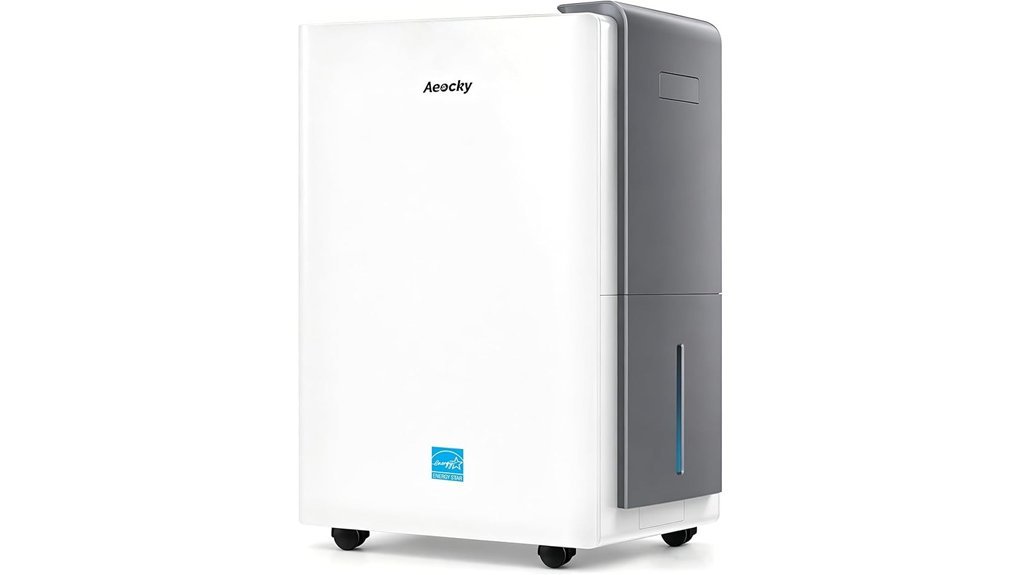
The AEOCKY RHEA-003 has the roundup’s highest seller-listed maximum: 140 pints per day at 95°F and 95% RH. The listing also states 95 pints per day at 86°F and 80% RH and markets the unit for areas up to 7,000 square feet. These figures are useful only when their test conditions are kept visible.
The current product information describes a 1.85-gallon tank, adjustable humidity control, multiple modes, a drain hose, a garden-hose adapter, and seller-provided three-year coverage. It also presents the model as ENERGY STAR Most Efficient 2025; verify the exact model in the official product finder before publishing that certification as an independent fact.
Best For: Large or unusually humid spaces where a buyer wants to compare one of the highest advertised portable maximum capacities.
Why You’ll Like It: The larger tank, multiple drainage options, and humidistat are suited to long operating periods in severe conditions.
Who Should Avoid It: At about 43.4 pounds, it is bulky for a small basement and may not provide a practical benefit if a smaller unit already maintains the target humidity.
Pros:
- Highest hot-and-humid maximum capacity in this roundup.
- 1.85-gallon tank, drain hose, and garden-hose adapter improve installation flexibility.
- Adjustable controls can maintain a selected humidity level.
Cons:
- The 140-pint headline is measured at 95°F/95% RH, not the standardized basement condition.
- Large size and weight can make placement more difficult.
- Certification and savings claims should be checked against the exact model record.
Yaufey 5000 Sq. Ft. Energy Star Dehumidifier
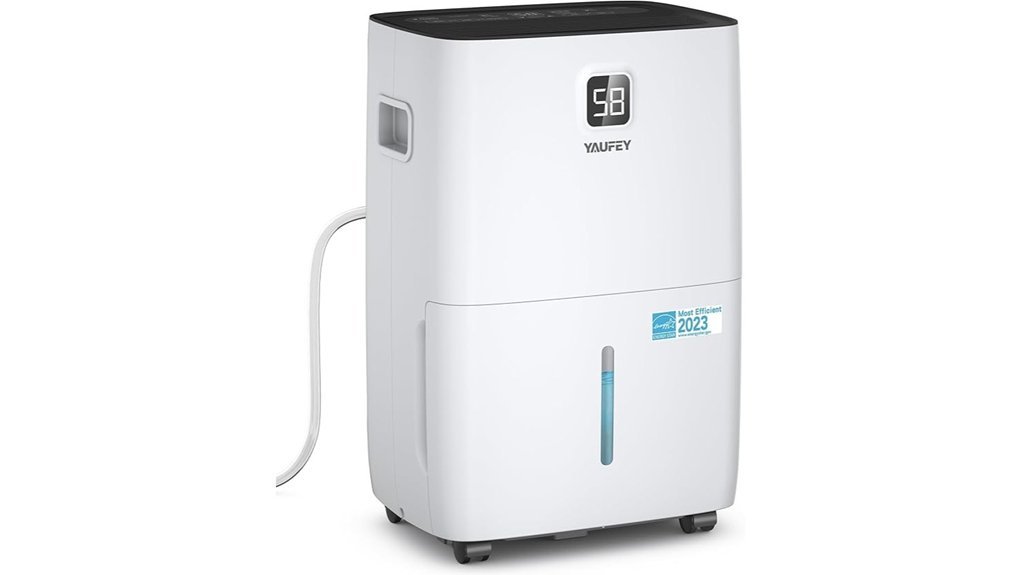
Yaufey’s JD025Q-80 is advertised for spaces up to 5,000 square feet with a seller-listed capacity of 80 pints per day. The current title describes ENERGY STAR status, a 1.06-gallon tank, a drain hose, intelligent humidity control, automatic shutoff, and a 24-hour timer.
Best For: Homeowners who want clearly labeled modes and a simple continuous-drain setup for a large basement.
Why You’ll Like It: Sleep, living-space, basement, and continuous modes make the control choices easier to understand for a first-time buyer.
Who Should Avoid It: The 1.06-gallon tank can require frequent emptying during heavy moisture removal. Plan to use the drain hose when possible and verify the standardized capacity for the exact model.
Pros:
- Multiple labeled modes simplify setup.
- Continuous drainage and automatic shutoff support longer operation.
- Wheels, handle, and washable filter improve everyday usability.
Cons:
- The 80-pint headline needs test-condition context.
- The tank may fill quickly without hose drainage.
- Large coverage claims should not replace moisture-load sizing.
Gasbye 4500 Sq. Ft. Energy Star Dehumidifier with Drain Hose
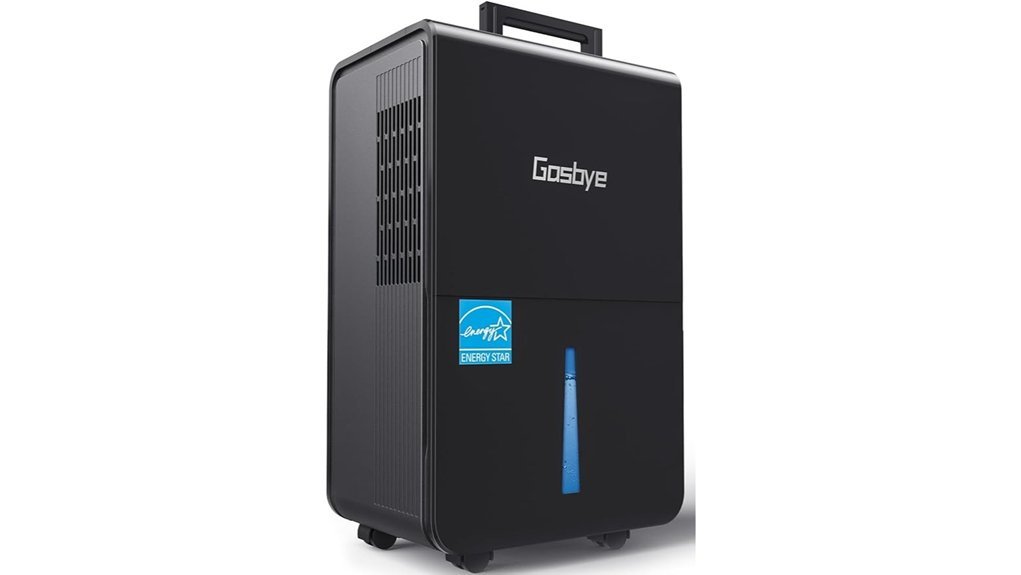
Gasbye markets the DryPrime with a maximum extraction rating of 115 pints per day at 86°F and 80% RH. More importantly for comparison, its listing also states 50 pints per day at 65°F and 60% RH. The current page describes 4,500-square-foot coverage, a 1.7-gallon tank, automatic shutoff and restart, and approximately 45 dB operation.
The drainage system is the main benefit. Depending on the installation, you can use the tank, a gravity drain hose, or a compatible hose adapter. Available modes include Normal, Turbo, Comfort, and Continuous.
Best For: Large basements where flexible drainage and a larger tank matter more than app control.
Why You’ll Like It: Its 1.7-gallon tank gives more buffer than small-tank models when a drain hose is temporarily unavailable, and the listing provides a capacity figure at the standardized 65°F/60% RH condition.
Who Should Avoid It: At roughly 43 pounds, it is not ideal for frequent movement between floors. The Amazon page may also show a newer-version option, so compare the exact ASIN and model before ordering.
Pros:
- Three drainage approaches offer installation flexibility.
- Large tank can reduce emptying frequency.
- The listing provides both a hot-and-humid maximum and a 65°F/60% RH figure.
Cons:
- Heavy to carry despite having portable features.
- The 115-pint headline is condition-dependent.
- The 45 dB figure is seller-listed and actual sound varies with mode, floor, and room acoustics.
AEOCKY 50 Pint Dehumidifier for Home Basement
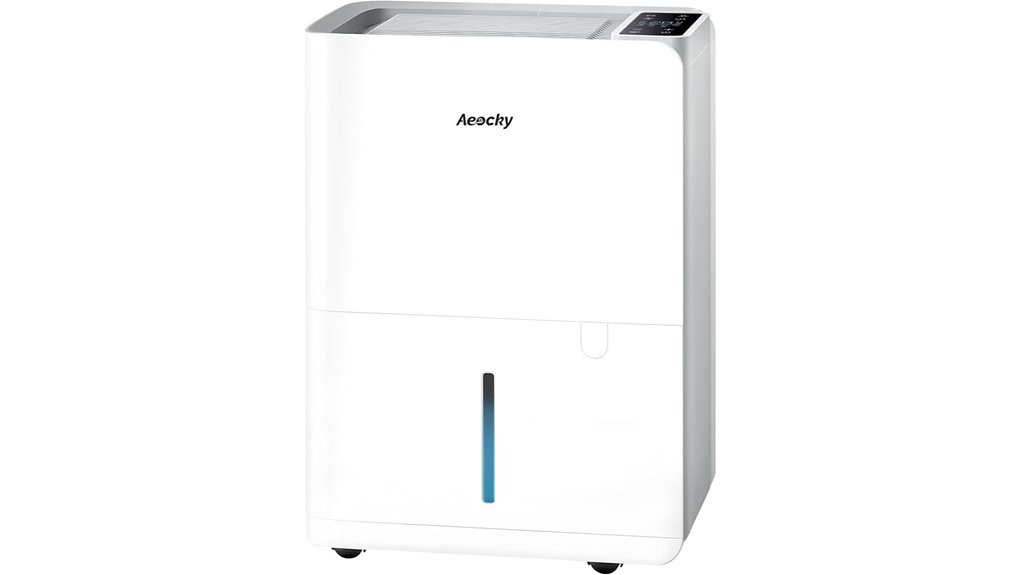
The AEOCKY BOREAS-001 is a compact option for a medium-to-large basement. Its listing states 50 pints per day at 95°F and 95% RH and 38 pints per day at 86°F and 80% RH, so its “50 Pint” name should not be mistaken for a confirmed 50-pint standardized basement rating.
The current details describe coverage up to 3,500 square feet, a 0.8-gallon tank, intelligent humidity control, automatic defrost, an included 2-meter drain hose, a garden-hose adapter, and seller-provided three-year coverage.
Best For: Buyers who want a compact compressor model with versatile drainage and do not need the bulk of the largest unit.
Why You’ll Like It: It combines a manageable seller-listed weight of about 25.3 pounds with tank drainage, gravity-hose drainage, an adapter, a timer, casters, and a child lock.
Who Should Avoid It: A 0.8-gallon tank is small for a continuously wet basement. Use a hose whenever practical, and do not size the unit from the 3,500-square-foot claim alone.
Pros:
- Compact body and lower weight than several high-capacity models.
- Included drain hose and garden-hose adapter improve setup flexibility.
- Humidistat and auto-defrost support automatic basement use.
Cons:
- The 50-pint figure is a maximum at 95°F/95% RH.
- Small tank can fill quickly during heavy moisture removal.
- Quietness, efficiency savings, and long-life claims are seller claims that should not be treated as independent test results.
Factors to Consider When Choosing a High-Pint Dehumidifier for a Basement
Choose a basement dehumidifier by comparing standardized capacity, actual dampness, drainage, operating temperature, energy efficiency, tank size, and noise. Seller-listed square footage can help narrow the options, but it should not be your only sizing tool.
Standardized Pint Capacity
A dehumidifier’s capacity describes how much water it can remove during a set test period. Current U.S. testing for portable dehumidifiers uses 65°F and 60% relative humidity to better represent basement conditions. Seller titles may instead show a maximum measured at 86°F/80% RH or 95°F/90–95% RH. A “Max 115 Pint” product is therefore not automatically more than twice as powerful as every product labeled 50 pints.
Look for the standardized pints-per-day figure in the exact model’s specifications or ENERGY STAR record. The ENERGY STAR capacity guide explains why newer ratings can look lower than older or high-temperature claims. For a wet basement with condensation, seepage, or frequent laundry drying, choose more capacity than you would for a room with only a mild musty odor.
Basement Coverage and Layout
Measure the basement, but also consider its layout. Closed rooms, stored belongings, poor air circulation, open stairways, and low ceilings can affect how well one unit controls the entire space. A fan may help move damp air from remote corners toward the dehumidifier.
Coverage numbers such as 3,500, 5,000, or 7,000 square feet are broad manufacturer estimates. They do not guarantee that a product will handle every basement of that size.
Drainage Options
Gravity drainage is the simplest low-maintenance setup. The drain hose must slope downward from the dehumidifier to a floor drain, sink, or suitable sump location. Avoid loops or raised sections that can trap water.
A built-in pump is useful only when water must travel upward to reach a drain. None of the retained products should be assumed to include a pump unless the exact current model listing clearly says so.
Manual tank drainage works when no drain is nearby, but large-capacity units can fill a small tank quickly. Automatic shutoff helps prevent overflow, but the dehumidifier stops removing moisture until the tank is emptied.
Energy Efficiency
An ENERGY STAR label can help identify a more efficient model, but certification applies to a specific model number. Match the model number from the Amazon listing or appliance label with the official ENERGY STAR Product Finder rather than assuming every product from the brand is certified.
Your actual electricity cost depends on wattage, fan speed, room humidity, temperature, runtime, and local electricity rates. Automatic humidistat control can reduce unnecessary runtime by cycling the compressor after the target humidity is reached.
Model Number and ASIN Check
Amazon product pages can combine several sizes, years, colors, or updated versions under one listing family. Before ordering, confirm that the selected ASIN, model number, capacity condition, tank size, included hose, and warranty match the version described in this guide. This is especially important when a page displays a newer-version link or changes the selected variation automatically.
Basement Operating Temperature
Compressor dehumidifiers may remove less moisture in a cold basement. Frost can form on the coils when temperatures fall, causing the compressor to stop while the unit defrosts.
Check the manufacturer’s minimum operating temperature. Automatic defrost is useful, but it does not make every portable dehumidifier equally effective in a very cold cellar or unheated basement.
Noise Level
Noise matters when the basement includes a bedroom, office, television area, or workshop. Compare decibel figures only when the listings identify the same fan mode and testing method. Compressor startup, vibration, floor type, and room echo can make two products with similar ratings sound different.
Place the unit on a firm, level floor with the required clearance around its intake and exhaust. Avoid placing it against walls, furniture, or stored boxes.
Humidity Controls
An adjustable humidistat lets you choose a target relative humidity and allows the unit to cycle automatically. A setting around 45% to 50% is a practical starting point for many basements. EPA guidance generally recommends keeping indoor relative humidity below 60% and ideally between 30% and 50%; see its mold and moisture guide.
Use a separate hygrometer to check the room because built-in sensors can read differently depending on placement and airflow. Setting the target extremely low can increase runtime without solving the cause of moisture. Repair leaks, redirect outdoor water, seal obvious entry points where appropriate, and improve ventilation alongside dehumidifier use.
Tank Size and Maintenance
A large tank gives you more time before automatic shutoff, but it also becomes heavier to carry when full. If continuous drainage is available, tank size becomes less important.
Clean the filter according to the manufacturer’s instructions and inspect it every few weeks during regular use. Dust buildup restricts airflow, reduces moisture removal, and can increase operating noise.
Before You Buy
- Measure the basement and identify how damp it becomes.
- Compare standardized pints per day, not only the advertised maximum.
- Match the selected Amazon ASIN and model number to the version reviewed.
- Check the exact model’s ENERGY STAR record when efficiency is important.
- Confirm the minimum operating temperature for a cool basement.
- Decide whether gravity drainage is possible.
- Check whether a hose is included and whether it is long enough.
- Measure the available floor space and required airflow clearance.
- Review tank size if you cannot use continuous drainage.
- Use a separate hygrometer to confirm the room’s actual humidity.
- Confirm warranty terms, registration requirements, and seller support.
- Repair leaks and drainage problems instead of relying only on the appliance.
Frequently Asked Questions
How Do I Size a Dehumidifier for a Damp Basement?
Measure the basement and rate the moisture problem as slightly damp, very damp, or wet. Then compare the product’s standardized pints-per-day capacity. A wet basement with condensation, seepage, or frequent laundry drying needs more capacity than a basement with only an occasional musty smell.
Should I Trust the Square-Foot Coverage Number?
Use it only as a broad guide. Manufacturer coverage claims may assume open space, warm air, strong circulation, or a lighter moisture load. Standardized capacity, basement temperature, layout, and dampness provide better comparison information.
Why Do Some Dehumidifiers Have Two Pint Ratings?
The ratings may come from different temperature and humidity test conditions. A seller may advertise a high maximum measured at 86°F/80% RH or 95°F/90–95% RH while the current U.S. portable-dehumidifier test uses 65°F/60% RH. Compare identical test conditions whenever possible.
Do High-Pint Dehumidifiers Raise Electricity Bills Significantly?
They can increase electricity use, especially when they run continuously. Actual cost depends on wattage, daily runtime, electricity rate, humidity, and temperature. ENERGY STAR certification and an accurate humidistat can help reduce unnecessary energy use.
How Often Should I Clean the Dehumidifier Filter?
Follow the manufacturer’s schedule and inspect the filter every few weeks during regular use. Check it more often in a dusty basement, workshop, laundry area, or home with shedding pets.
Can a Dehumidifier Prevent Basement Mold Completely?
No. It can make the environment less favorable for mold by reducing excess humidity, but it cannot guarantee prevention. Repair leaks, dry wet materials, improve drainage or ventilation, and clean existing contamination safely.
Is a Pump Necessary for Basement Dehumidifier Drainage?
No. A pump is unnecessary when a hose can slope continuously downward to a floor drain or another approved outlet. A pump is useful when the available drain is higher than the dehumidifier.
What Humidity Setting Should I Use in a Basement?
A setting around 45% to 50% relative humidity is a reasonable starting point for many basements and falls within EPA’s ideal 30% to 50% range. Use a separate hygrometer, then adjust gradually while checking for condensation, musty odors, excessive runtime, and comfort.
Will a Dehumidifier Work in a Cold Basement?
It may work less effectively as the temperature drops. Check the product’s minimum operating temperature and automatic-defrost feature. A very cold space may require equipment designed specifically for lower-temperature operation.
Which Basement Dehumidifier Is Best for Most Buyers?
The AEOCKY BOREAS-001 is the most balanced option in this lineup when compact size and flexible drainage matter, but its 50-pint figure is a hot-and-humid maximum. Choose Frigidaire instead when Wi-Fi control is the priority, Gasbye when drainage flexibility and a larger tank matter most, or the larger AEOCKY RHEA-003 when you need to compare a higher-capacity option for severe dampness.
Conclusion
Final Recommendation
Choose the AEOCKY BOREAS-001 for a compact, balanced setup with an included hose and adapter. Choose Frigidaire when app control is worth paying for. Choose Gasbye when a larger tank and flexible drainage are the priority. Choose AEOCKY RHEA-003 only after comparing its exact standardized capacity with the other models for a severe moisture load.
The right high-capacity basement dehumidifier depends on more than the largest pint number. Waykar and Yaufey offer straightforward hose-drain operation, AIRPLUS provides a lighter portable option, and Ludatido combines multiple modes with a large-tank design. Every seller-listed maximum should be read with its temperature and humidity test conditions.
Before ordering, confirm the selected ASIN and model number, standardized capacity, drainage accessories, minimum operating temperature, exact ENERGY STAR record, tank size, warranty, and return terms. Pair the appliance with leak repair, exterior drainage, and prompt drying of wet materials for a basement that stays drier and easier to maintain.