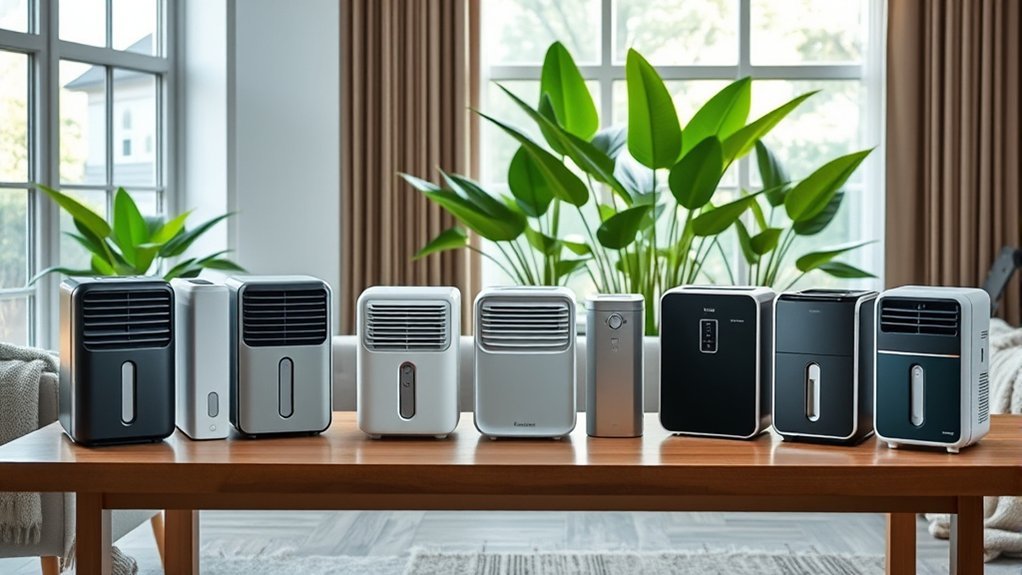
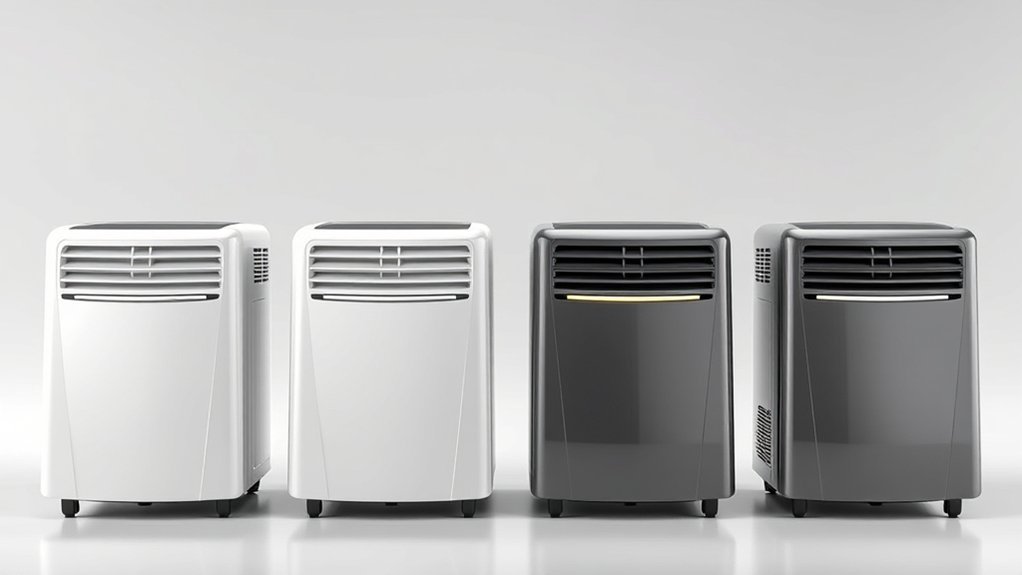
If you are shopping for a 70 pint dehumidifier for a basement or large room, compare more than the number printed in the product title. Some models advertise 70 or 80 pints under extremely warm and humid test conditions, so those headline figures are not always directly comparable. This updated 2026 guide reviews four relevant 70-pint-class dehumidifiers and compares their rating conditions, drainage setup, tank size, controls, portability, and best use cases.
Affiliate disclosure: As an Amazon Associate, we may earn from qualifying purchases made through links in this article, at no extra cost to you. Product specifications, certification status, seller terms, and availability can change.
Updated August 2026.
Quick Verdict
- Best overall for home use: Yaufey JD025Q-80 for its balanced controls, 1.06-gallon tank, preset modes, wheels, and continuous-drain option.
- Best straightforward portable option: AIRPLUS AP16-602EE for its lighter body, simple controls, multiple modes, and included drain hose.
- Best for crawlspaces and gravity drainage: Airecoler Stellar S10 for its compact commercial-style housing, 34-pint AHAM rating, and hands-free drain setup.
- Best for mobility and convenience modes: Waykar YDZ-80 for its casters, adjustable humidistat, self-drying mode, and continuous drainage.
Important capacity note: The 70-pint and 80-pint figures in many online listings are maximum removal claims measured in very hot, humid conditions. They should not automatically be treated as equivalent to a current DOE or AHAM-style capacity rating.
For a fair comparison, check the exact model label, manual, test temperature, relative humidity, and standardized capacity. ENERGY STAR explains the difference between advertised capacity and standardized testing in its dehumidifier testing and capacity guidance.
Quick Comparison of the Best 70-Pint-Class Dehumidifiers
| Product | Advertised Removal | Best For | Drainage | Approx. Weight | Check Details |
|---|---|---|---|---|---|
| Yaufey JD025Q-80 Best Overall |
Up to 80 pints/day at 95°F and 90% RH | Large warm rooms, basements, garages, and general home use | 1.06-gallon tank or included 3.28-foot gravity hose | About 30.4 lb | Check Price on Amazon |
| AIRPLUS AP16-602EE Simple Portable Pick |
Up to 70 pints/day at 86°F and 90% RH | Homeowners who want simple controls and easier room-to-room movement | 2.8-liter tank or continuous drain hose | About 22.2 lb | Check Price on Amazon |
| Airecoler Stellar S10 Best for Crawlspaces |
70-pint maximum; 34 pints/day at 80°F and 60% RH | Crawlspaces, basements, garages, and low-clearance areas up to 1,000 sq. ft. | Gravity drainage with included 6.56-foot hose; no collection tank | About 40.5 lb | Check Price on Amazon |
| Waykar YDZ-80 Best Mobility Features |
Up to 80 pints/day at 95°F and 90% RH; about 62 pints at 86°F and 80% RH | Basements and large rooms where wheels, timer controls, and self-drying are useful | 0.92-gallon tank or continuous drainage | About 28.6 lb | Check Price on Amazon |
Coverage reminder: Advertised square-foot figures are marketing estimates, not guarantees. Room temperature, starting humidity, ceiling height, open doors, air leaks, water intrusion, and the severity of the moisture problem can all affect performance.
Yaufey JD025Q-80 Dehumidifier
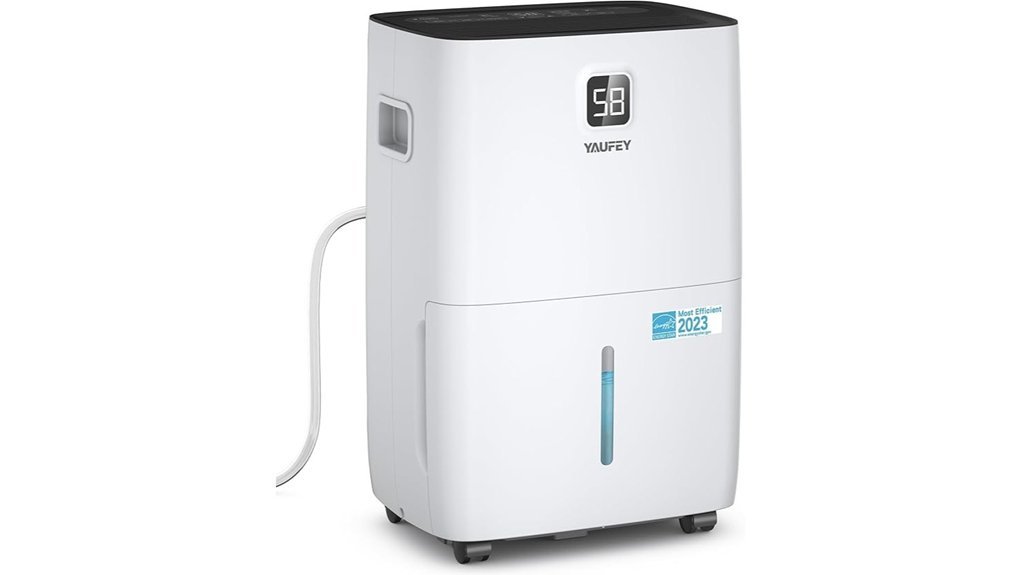
The Yaufey JD025Q-80 is the strongest all-around choice in this group for a conventional basement, garage, or large living area. Its manufacturer advertises up to 80 pints of moisture removal per day at 95°F and 90% relative humidity. Because that is a maximum-condition figure, expect less water collection in cooler or moderately humid rooms.
You can set the humidistat from 30% to 80% and choose preset modes for sleeping areas, living areas, basements, or continuous operation. The unit includes a 1.06-gallon collection tank, a 3.28-foot gravity drain hose, automatic defrost, restart protection, a washable filter, recessed handles, and swivel wheels.
Best For: Homeowners who want a versatile portable dehumidifier with a larger tank, automatic humidity control, preset modes, and both manual and continuous drainage.
Why You’ll Like It: It combines the features most households need without forcing you into a permanent gravity-drain installation. The visible humidity display and preset modes can also make daily operation easier.
Who Should Avoid It: Buyers who need a verified 70- or 80-pint DOE capacity should not rely on the maximum-condition figure alone. Also consider a smaller model if you only need humidity control in a bedroom, closet, or compact bathroom.
Pros:
- Large advertised moisture-removal capacity for warm, very damp conditions.
- 1.06-gallon tank reduces emptying frequency compared with smaller portable units.
- Includes continuous drainage, automatic defrost, restart protection, timer controls, and a washable filter.
- Wheels and recessed handles make it easier to reposition on one floor.
Cons:
- The 80-pint figure is a maximum-condition rating, not necessarily its current standardized DOE capacity.
- Gravity drainage requires the hose outlet to remain lower than the drain connection.
- The exact sound level was not independently confirmed, so bedroom suitability depends on personal noise tolerance.
- ENERGY STAR status should be confirmed using the exact model number before purchase.
AIRPLUS AP16-602EE Dehumidifier with Drain Hose
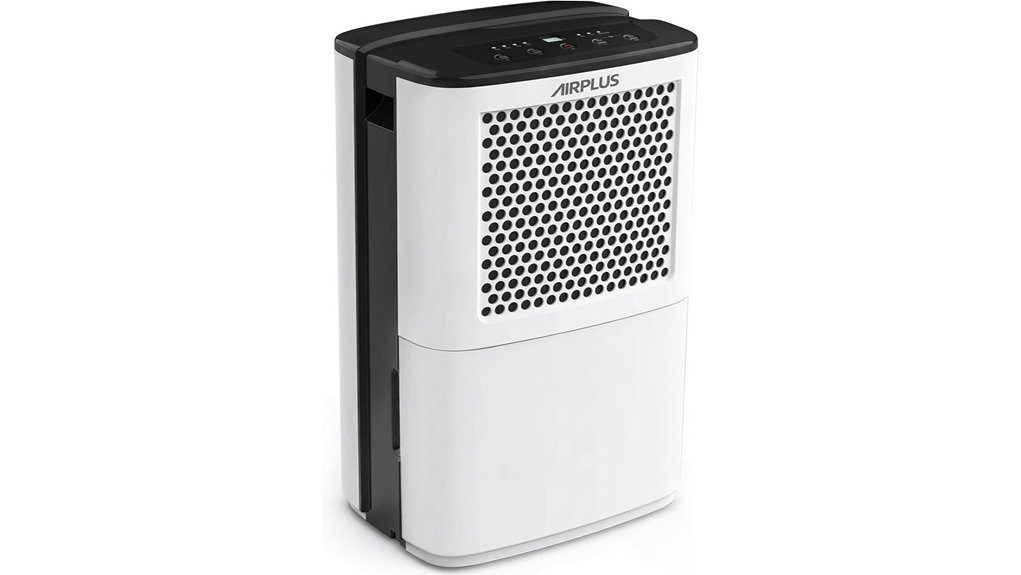
The AIRPLUS AP16-602EE is a practical option for buyers who value simpler controls and a lighter body. The listing advertises up to 70 pints per day at 86°F and 90% relative humidity. That test environment is much warmer and wetter than many occupied rooms, so the real daily collection amount will usually be lower.
The AIRPLUS provides adjustable humidity control, three fan speeds, dehumidification, clothes-drying, and fan-only modes. It also includes a timer, automatic tank-full shutoff, a 2.8-liter collection tank, and a continuous-drain connection. At approximately 22.2 pounds, it is one of the easier units in this comparison to move between rooms.
Best For: Homeowners or renters who want a lighter portable unit for a basement, laundry area, bathroom, or other damp room and prefer straightforward controls.
Why You’ll Like It: The multiple operating modes provide more flexibility than a basic on-and-off dehumidifier, while the included drain hose can reduce routine tank emptying.
Who Should Avoid It: Avoid selecting it solely because of the advertised 4,500-square-foot coverage. Buyers with serious seepage, flooding, or a very large unfinished basement should size the machine according to the actual moisture load rather than the marketing area.
Pros:
- Lighter than the other portable products reviewed here.
- Includes manual collection and continuous gravity drainage.
- Offers adjustable airflow, multiple operating modes, timer controls, and automatic tank-full shutoff.
- Simple control layout may suit buyers who do not want complicated smart features.
Cons:
- The 70-pint claim is measured at 86°F and 90% RH and should not be compared directly with a DOE capacity figure.
- The 2.8-liter tank may fill quickly during the initial drying of a very damp room.
- Coverage is seller-advertised and will vary with the building and moisture conditions.
- ENERGY STAR certification was not confirmed for this exact model during this review.
Airecoler Stellar S10 Commercial-Style Dehumidifier
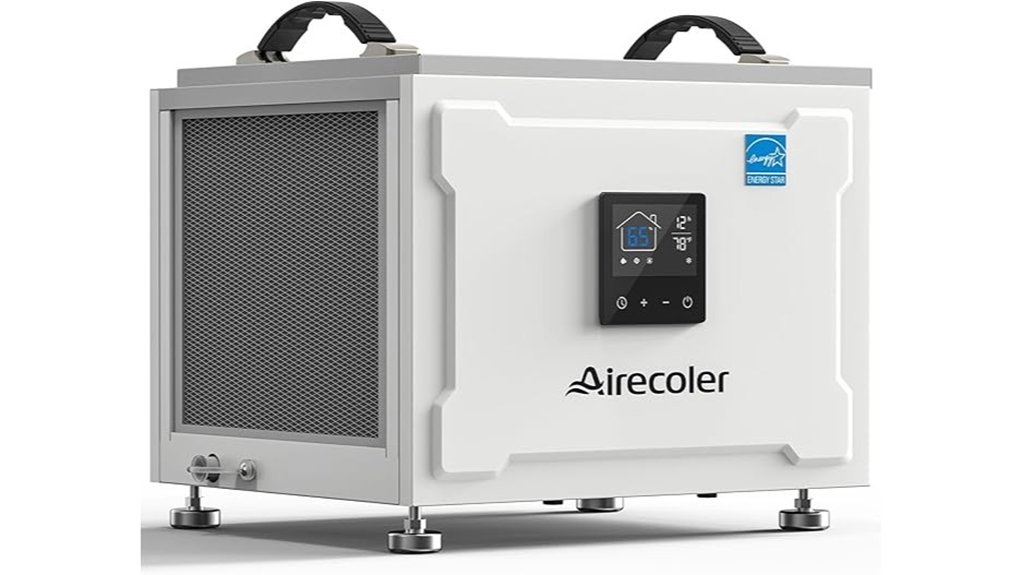
The Airecoler Stellar S10 is a different type of product from the upright tank models in this guide. Its low metal housing is designed for basements, garages, kitchens, and low-clearance crawlspaces where the machine can remain near a drain.
Airecoler lists a 70-pint maximum removal rate at 95°F and 95% RH and a more useful 34-pint-per-day rating at 80°F and 60% RH. The manufacturer recommends it for spaces up to 1,000 square feet. It does not have a collection tank; instead, water exits through the included 6.56-foot gravity drain hose.
The Stellar S10 includes standard, continuous, and timer modes, a detachable control panel, automatic defrost, restart after a power interruption, error detection, and a washable filter. Its published operating range is 41°F to 95°F.
Best For: Crawlspaces, utility rooms, garages, and basements where a suitable floor drain or lower discharge point is always available.
Why You’ll Like It: The compact horizontal shape fits places where a tall portable unit may be awkward, and the 34-pint rating at 80°F/60% RH gives buyers a more realistic comparison point than the maximum 70-pint figure alone.
Who Should Avoid It: It is not a good choice when you need a removable water bucket, built-in casters, or frequent room-to-room portability. At about 40.5 pounds, it is better treated as a semi-permanent installation.
Pros:
- Provides both a maximum-condition figure and a 34-pint rating at 80°F/60% RH.
- Compact metal housing works well in low-clearance areas.
- Continuous gravity drainage eliminates tank-emptying chores.
- Includes automatic defrost, restart, timer operation, and a detachable control panel.
- Manufacturer states five-year limited coverage, with different coverage periods for the full machine and dehumidification system.
Cons:
- No collection tank is included.
- Gravity drainage requires a continuously downward hose route to a suitable drain.
- Its 1,000-square-foot recommended area is much smaller than the marketing figures attached to the upright models.
- Heavier and less convenient to reposition than a wheeled portable dehumidifier.
Waykar YDZ-80 Dehumidifier for Large Spaces
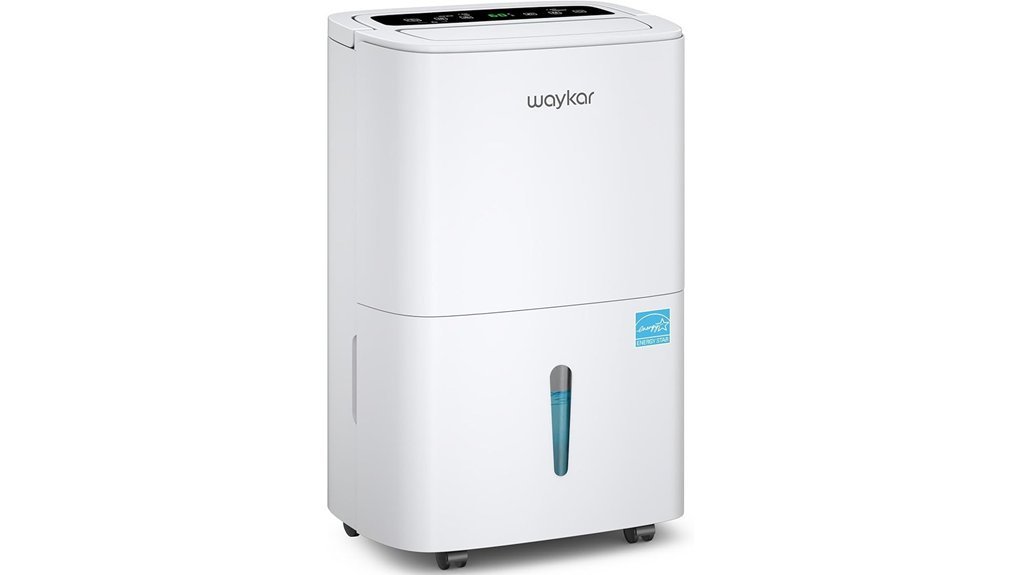
The Waykar YDZ-80 is another 80-pint maximum model that competes in the same buyer category as many products advertised as 70-pint dehumidifiers. Available specifications list up to 80 pints per day at 95°F and 90% RH and approximately 62 pints per day at 86°F and 80% RH.
It offers an adjustable 30%–80% humidistat, automatic and continuous modes, a 24-hour timer, automatic defrost, restart protection, a washable filter, and a self-drying function. Casters and a top handle help with movement, while the approximately 0.92-gallon tank and drain-hose connection support manual or continuous operation.
Best For: Buyers who want a wheeled upright dehumidifier for a large room or basement and value self-drying, automatic defrost, and timer controls.
Why You’ll Like It: It balances portability with useful maintenance features. The self-drying mode can help remove residual internal moisture after operation, while the hose connection supports longer unattended runs.
Who Should Avoid It: This model may be unnecessary for small enclosed rooms. Buyers should also verify the exact YDZ-80 certification and warranty information on the current listing rather than assuming that claims applying to another Waykar model also apply here.
Pros:
- Two disclosed high-humidity removal figures provide more context than a single headline capacity.
- Casters and top handle support easier room-to-room movement.
- Includes automatic defrost, restart, timer, washable filter, and self-drying operation.
- Supports both tank collection and continuous drainage.
Cons:
- The advertised 5,000-square-foot figure is a marketing estimate, not a promise of equal performance in every building.
- The 0.92-gallon tank can fill frequently during heavy initial moisture removal.
- The machine is still close to 29 pounds and may be awkward to carry upstairs.
- ENERGY STAR status should be checked against the exact model number in the official database.
Factors to Consider When Choosing a 70 Pint Dehumidifier
Choosing the right large-room dehumidifier requires more than matching an advertised pint figure to a square-foot number. Compare the test conditions, standardized capacity, room temperature, moisture source, drainage route, tank size, efficiency, operating range, and how often you expect to move the machine.
Understand the Pint Rating
A pint-per-day rating tells you how much water a dehumidifier can collect during 24 hours under specified conditions. The number is meaningful only when you know those conditions.
For example, a machine rated at 70 pints in an extremely hot room with 90% or 95% relative humidity may collect much less water in a cooler basement. When available, prioritize the current standardized DOE capacity or an AHAM-style figure over an unsupported maximum claim.
Pro tip: Do not assume a recently advertised “70-pint” model is more powerful than an older-looking 50-pint model. Test procedures and labeling practices can differ, so compare like with like.
Treat Coverage Area as an Estimate
Coverage claims such as 4,500 or 5,000 square feet usually come from the seller or manufacturer. They do not account for every ceiling height, floor plan, open doorway, exterior air leak, plumbing leak, wet foundation, or climate.
Use square footage as an initial filter, then consider the severity of the moisture problem. A moderately humid open room may be easier to control than a much smaller basement with active water intrusion.
Match Capacity to the Moisture Load
A larger machine may be appropriate when the room regularly stays above 60% RH, has visible condensation, smells musty, or contains damp building materials. However, a dehumidifier should not be used to hide an unresolved roof leak, plumbing leak, foundation problem, or flooding.
Use an inexpensive hygrometer to measure the room before and after installation. This is more useful than judging performance only by how much water appears in the tank.
Choose the Right Drainage Method
Portable models normally offer a removable tank and a gravity-drain connection. A tank lets you use the unit almost anywhere near an outlet, but it may require frequent emptying during the first days of drying.
Gravity drainage is more convenient for long-term basement use, but the hose must slope downward without loops, kinks, or raised sections. If the available drain is above the machine, choose a model with a built-in pump or use a compatible external condensate pump rather than expecting gravity to move water uphill.
Check the Tank Capacity
A large daily removal claim does not mean the product has a large bucket. Some high-capacity portable units have tanks close to one gallon or less. During severe humidity, the machine may fill its bucket several times per day unless continuous drainage is installed.
Automatic tank-full shutoff helps prevent overflow, but it also means dehumidification stops until someone empties and replaces the tank.
Verify Energy Efficiency by Exact Model
An ENERGY STAR certified dehumidifier can use less energy than a similarly sized conventional model. However, certification applies to a specific model number, not automatically to every machine sold by the same brand.
Check the model label against the official ENERGY STAR Product Finder. Also compare the Integrated Energy Factor, standardized water-removal capacity, annual energy-consumption estimate, and your local electricity rate.
Features such as an accurate humidistat, automatic cycling, timer, clean filter, and correctly sized capacity can also reduce unnecessary runtime.
Consider Basement Temperature
Refrigerant dehumidifiers become less effective as temperatures fall. Automatic defrost can protect the evaporator when frost begins forming, but it does not make every portable model equally effective in a cold basement.
Check the published operating range and measure the room during the coldest season. A desiccant dehumidifier or a different moisture-control strategy may be more appropriate in consistently cold conditions.
Consider Noise and Placement
A compressor dehumidifier produces fan noise, compressor noise, and occasional cycling sounds. Published sound figures were not consistently available for the exact models in this comparison, so do not assume that words such as “quiet” or “sleep mode” mean silent operation.
Place the unit on a level, stable surface with the required clearance around its air intake and outlet. Keeping it away from a bed, desk, television, or shared wall can make normal operating noise less distracting.
Evaluate Portability Realistically
Casters and handles are useful on one floor, but a 25- to 40-pound dehumidifier can still be difficult to carry up stairs. Check the product’s dimensions, weight, handle design, and whether water remains in the tank before moving it.
Drain the bucket and disconnect the hose before repositioning a portable model. Keep the machine upright unless the manual specifically allows another transport position.
Look for Useful Controls, Not Just More Modes
The most important control is an adjustable humidistat that cycles the compressor near your chosen relative humidity. Timer settings, automatic restart, defrost, child lock, tank-full shutoff, washable filters, and continuous mode can also be useful.
Preset labels such as “basement,” “living area,” or “sleeping area” are convenient, but the actual target humidity behind each preset matters more than the label.
Before You Buy: Quick Checklist
- Confirm the exact model number on the Amazon listing.
- Check whether the pint rating is a maximum claim or standardized capacity.
- Measure the actual room area and starting relative humidity.
- Identify and repair leaks or water intrusion first.
- Confirm that the operating-temperature range suits the room.
- Decide whether you need a bucket, gravity drain, or pump.
- Measure the distance and vertical drop to the drain.
- Verify tank capacity, hose length, weight, dimensions, and electrical requirements.
- Check ENERGY STAR status using the exact model number.
- Read the current warranty, return policy, and seller information before ordering.
Frequently Asked Questions
Is a 70 Pint Dehumidifier Enough for a Large Basement?
It may be, but the answer depends on what “70 pint” means, the standardized capacity, basement temperature, starting humidity, water intrusion, ceiling height, and layout. Do not choose solely from the advertised square-foot figure. Measure the humidity and compare capacity ratings recorded under similar test conditions.
Why Do Some 70 Pint Dehumidifiers Have Lower Standardized Ratings?
Some sellers use a maximum removal figure measured in extremely warm, humid air. A current standardized rating uses controlled conditions intended to make products easier to compare. The same machine can therefore display a much larger maximum-condition number than its standardized capacity.
Can a 70 Pint Dehumidifier Run Continuously?
Yes, when the model supports continuous operation and water can drain safely. Follow the manual, keep the filter clean, maintain airflow clearance, and make sure the gravity hose slopes continuously downward. Continuous mode should not be used as a substitute for repairing an active leak.
How Often Should I Clean the Dehumidifier Filter?
Follow the exact manual. For many washable filters, inspection every two to four weeks is a practical starting point. Clean it more frequently in dusty rooms, workshops, homes with pets, or during long periods of continuous operation.
What Is the Ideal Humidity Level for Large Rooms?
The EPA recommends keeping indoor relative humidity below 60% and ideally around 30% to 50%. A target near 45% to 50% is a practical starting point for many basements, although comfort, climate, condensation, and building materials may affect the best setting. See the EPA’s moisture and mold guidance.
Do Dehumidifiers Help Reduce Mold and Mildew?
A dehumidifier can make the room less favorable for mold by reducing excess moisture. It does not kill established mold, remove contaminated materials, or repair the water source. Fix leaks, dry wet materials promptly, and use appropriate remediation when visible mold or significant water damage is present.
Do I Need a Drain Hose or a Built-In Pump?
A gravity hose is sufficient when the drain is lower than the dehumidifier and the hose can slope downward throughout its route. A pump is useful when water must travel upward, across a long distance, or into a sink or other elevated outlet.
Are Advertised 5,000-Square-Foot Dehumidifiers Really Suitable for 5,000 Square Feet?
They may manage mild or moderate humidity across a large open area, but coverage claims are estimates. Closed doors, multiple floors, active leaks, low temperatures, poor airflow, and severe dampness can greatly reduce effective coverage. Capacity and moisture conditions are more useful comparison points than square footage alone.
Final Recommendation
Choose the Yaufey JD025Q-80 when you want the best-balanced portable home model with a larger tank, preset humidity modes, wheels, and continuous drainage.
Choose the AIRPLUS AP16-602EE when lower weight and simple controls matter more than advanced features.
Choose the Airecoler Stellar S10 for a crawlspace, garage, or basement where the machine can remain beside a suitable gravity drain.
Choose the Waykar YDZ-80 when mobility, self-drying, timer control, and automatic operating features are priorities.
Conclusion
The best 70 pint dehumidifier for a large room is not necessarily the product with the largest coverage claim. Start by comparing the rating conditions and standardized moisture-removal capacity. Then check the room temperature, drainage route, tank size, operating controls, weight, warranty, and exact certification status.
For most conventional home applications, the Yaufey offers the most balanced feature set. AIRPLUS is the simpler and lighter portable choice, Waykar provides useful mobility and maintenance features, and the Airecoler is better suited to a semi-permanent crawlspace or basement installation. Whichever model you select, pair it with a hygrometer and repair the underlying moisture source so the machine can maintain humidity efficiently.