Affiliate disclosure: This article contains Amazon affiliate links. We may earn a commission from qualifying purchases at no extra cost to you.
Last updated: August 2026
The best dehumidifier for a large basement is not simply the model with the biggest number in its title. Compare the standardized moisture-removal capacity, basement size and dampness, drainage route, operating temperature, noise, and energy efficiency. For most large basements, continuous drainage is more important than tank size because a full bucket can stop the unit when you need it most.
Quick Answer
Best overall with a pump: avylo Dehumidifier with Pump.
Best high-output gravity-drain model: Gasbye 2026 Energy Star Dehumidifier.
Best energy-efficient pick: AEOCKY 4500 Sq.Ft Smart Dehumidifier.
Best maximum-capacity option: Vellgoo 140 Pint Energy Star Dehumidifier.
How We Compared These Dehumidifiers
- Fit for large-basement moisture loads and advertised coverage
- Clarity of capacity test conditions
- Gravity drainage, tank drainage, or built-in pump
- ENERGY STAR status where clearly supported
- Automatic defrost, restart, humidistat, timer, and noise considerations
- Honest limitations, including small tanks and condition-dependent capacity claims
Quick Comparison
| Product | Advertised Coverage | Advertised Capacity | Drainage | Best Use |
|---|---|---|---|---|
| avylo with Pump | Up to 5,000 sq. ft. | 90 pints max at 90°F/90% RH | Tank, gravity hose, built-in pump | Very damp basements; uphill drain |
| AEOCKY 80 Pint Max | Up to 4,500 sq. ft. | 80 pints max; condition-dependent | Tank and gravity hose | Energy-conscious continuous use |
| Gasbye 2026 | Up to 4,500 sq. ft. | 115 at 86°F/80% RH; 73 at 80°F/60% RH | Tank and gravity hose | High output with floor drain |
| KNKA 34 Pint Max | Up to 2,500 sq. ft. | 34 pints max | Tank and gravity hose | Moderately damp basements |
| Waykar 80 Pint Max | Up to 5,000 sq. ft. | 80 pints max; verify current test condition | Tank and gravity hose | Open layouts and airflow |
| VEAGASO 34 Pint Max | Up to 2,500 sq. ft. | 34 pints max | Tank and gravity hose | Compact finished basements |
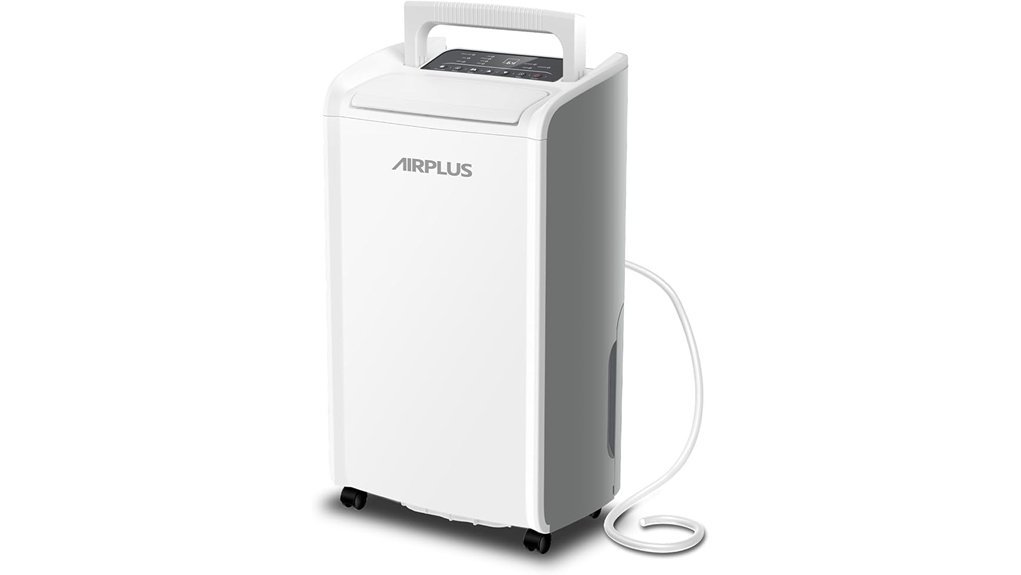
| AIRPLUS 70 Pint Max | Up to 4,500 sq. ft. | 70 pints max; condition not clearly stated | Tank and gravity hose | Multi-mode value |
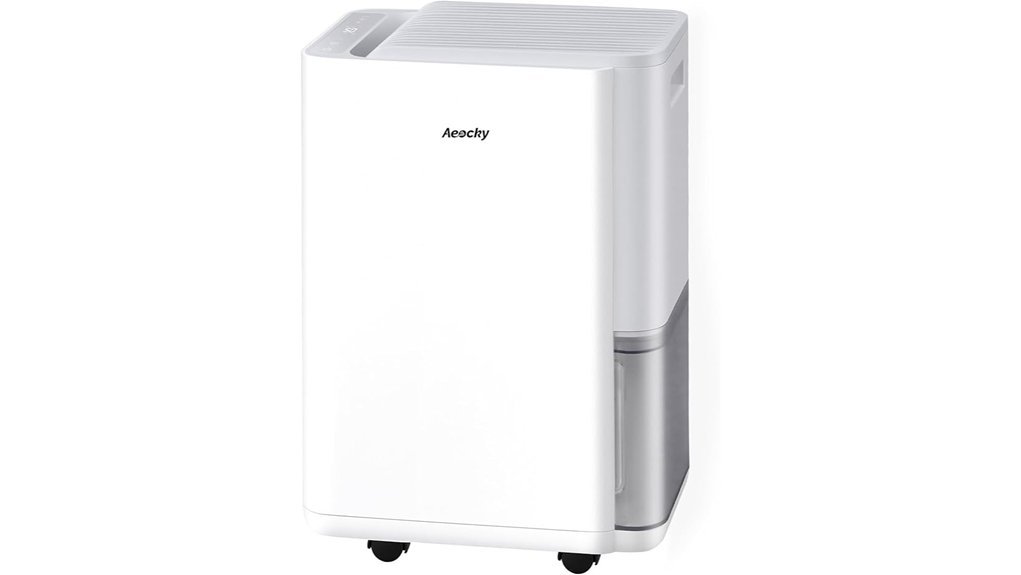
| AEOCKY 50 Pint Max | Up to 2,500 sq. ft. | 50 pints max | Tank and gravity hose | Mid-size moderate humidity |
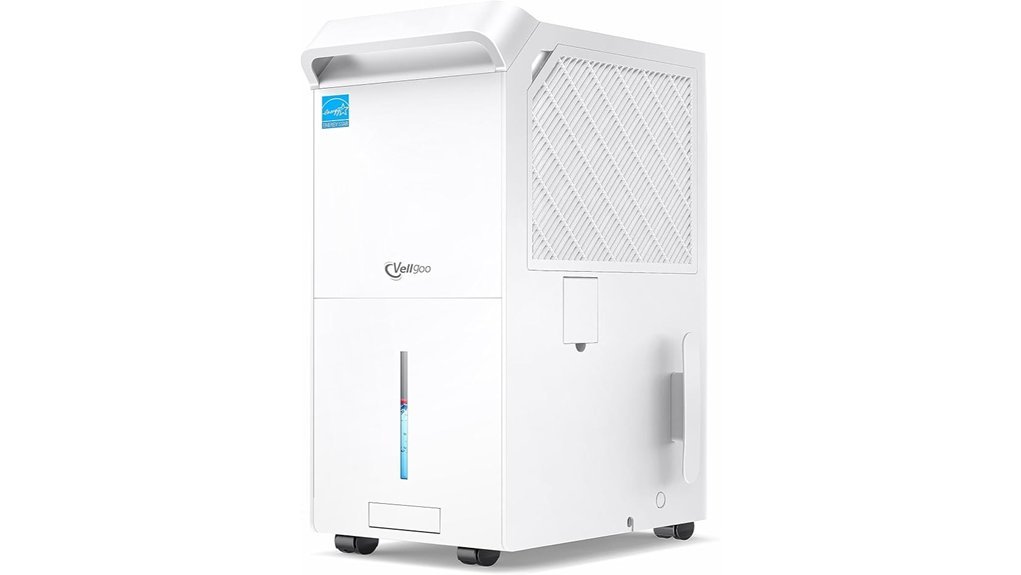
| Vellgoo 140 Pint Max | Up to 6,000 sq. ft. | 140 pints max; condition-dependent | Tank and gravity hose | Highest advertised output |
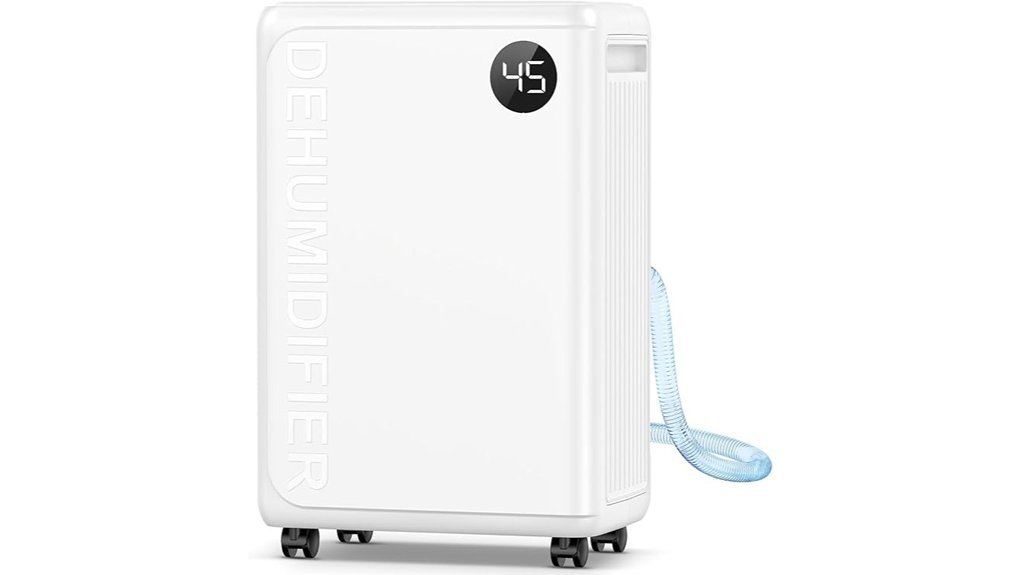
| PLUSCENT 32 Pint Max | Up to 2,500 sq. ft. | 32 at 95°F/90% RH | Tank and gravity hose | Light-duty portable use |
| Landeagle 100 Pint Max | Up to 6,000 sq. ft. | 100 pints max; recheck listing | Tank and gravity hose | Simple high-capacity setup |
| AEOCKY 74 Pint Max | Up to 4,500 sq. ft. | 74 at 95°F/95% RH; 52 at 86°F/80% RH | Tank and gravity hose | ENERGY STAR value |
| MEPTY 100 Pint Max | Up to 6,000 sq. ft. | 100 pints max; condition-dependent | Tank and gravity hose | Smart display and controls |
Capacity note: “Maximum” pint figures are often measured in hotter and more humid air than a typical basement. Compare the current DOE Appendix X1 or ENERGY STAR capacity whenever it is available; do not assume every “80-pint” or “100-pint” title uses the same test.
avylo Dehumidifier for Basement with Pump
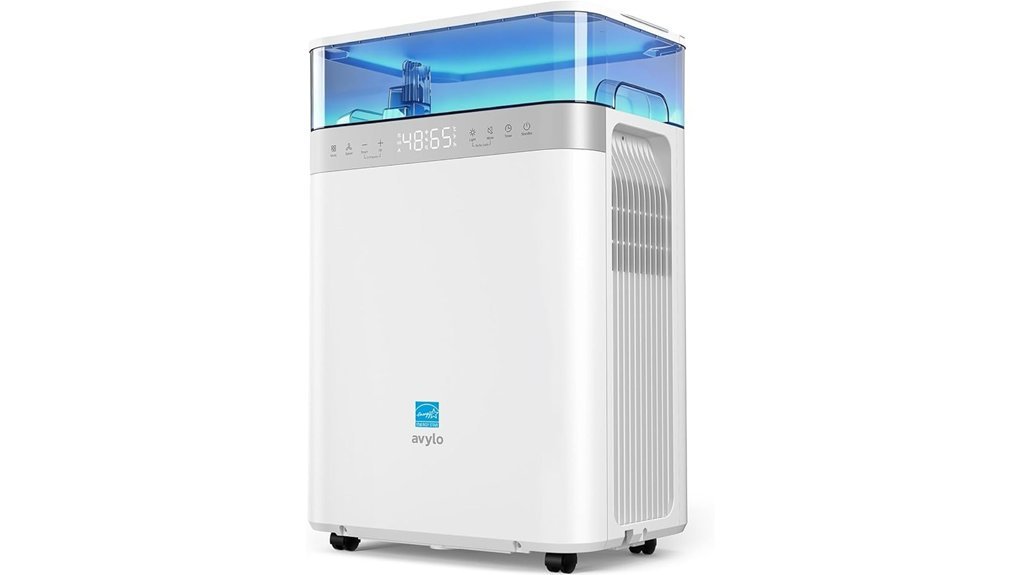
Best Built-In Pump
The avylo model is the strongest fit for basements where gravity drainage is not practical. Its listing advertises coverage up to 5,000 sq. ft., a maximum removal rate of 90 pints per day at 90°F and 90% RH, and a built-in pump that can move water to a higher drain point. The top-mounted 2.11-gallon tank, included drain hose, automatic shutoff, and auto-defrost controls make it suitable for long-term basement use.
Best For: Large or very damp basements that need pumped drainage to a sink, window, or elevated drain.
Why You’ll Like It
- Built-in condensate pump reduces dependence on a floor-level drain.
- Large tank and multiple drainage choices reduce daily maintenance.
- Humidity controls and auto-defrost support unattended operation.
Who Should Avoid It: Choose a simpler gravity-drain model if you do not need a pump or want a lighter unit.
Pros:
- Built-in pump with continuous-drain capability.
- Advertised for very large spaces and high moisture loads.
- Large top-mounted tank and automatic overflow protection.
Cons:
- Heavier than many mid-capacity models.
- Pump and hose routing require careful setup.
- The 90-pint figure is a maximum-condition rating, not a universal daily result.
AEOCKY 4500 Sq.Ft Smart Dehumidifier (80 Pint/Day Max)
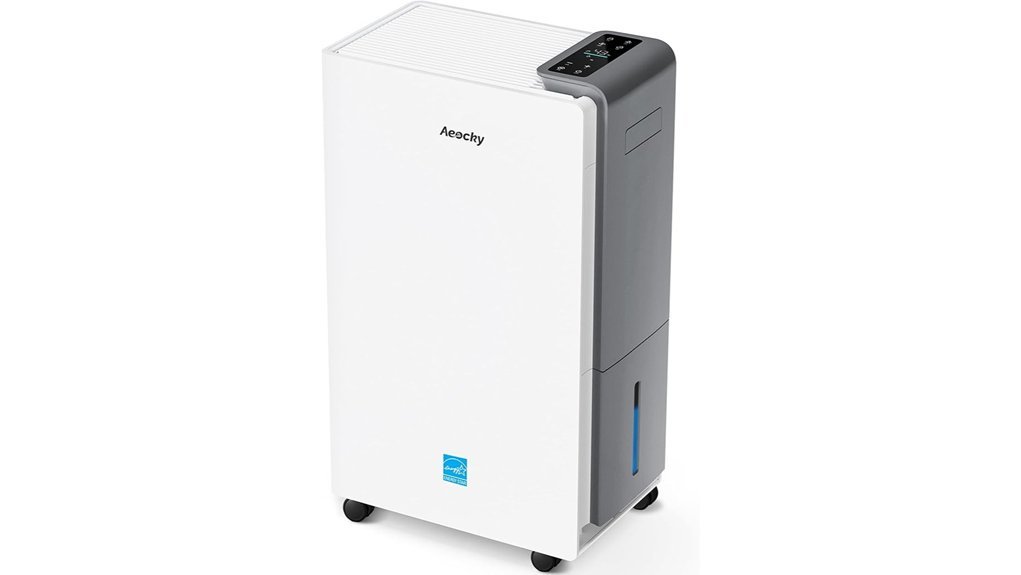
Best Energy-Efficient Pick
The AEOCKY RHEA-001 is a strong choice for buyers who prioritize energy efficiency and quiet operation. The listing identifies it as an ENERGY STAR Most Efficient 2025 model for spaces up to 4,500 sq. ft. Its advertised 80-pint maximum is measured in very warm, humid conditions, so compare the standardized capacity shown in the current ENERGY STAR record or manufacturer documentation before judging it against other models.
Best For: Large basements where energy use, low noise, and precise humidity control matter more than having a pump.
Why You’ll Like It
- ENERGY STAR certification provides a more useful efficiency signal than vague savings promises.
- Smart humidistat, power-loss memory, and auto-defrost support set-and-forget use.
- Compact footprint and listed 44 dB low-speed operation suit finished basements.
Who Should Avoid It: Skip it if your drain is above the unit and you specifically need a built-in pump.
Pros:
- ENERGY STAR-certified efficiency.
- Intelligent humidity control and power-loss memory.
- Drain hose and garden-hose adapter are listed as included.
Cons:
- No built-in pump on this version.
- The maximum 80-pint claim uses hot, high-humidity test conditions.
- Small-to-medium tank means frequent emptying without continuous drainage.
Gasbye 2026 Energy Star Dehumidifier for Large Rooms
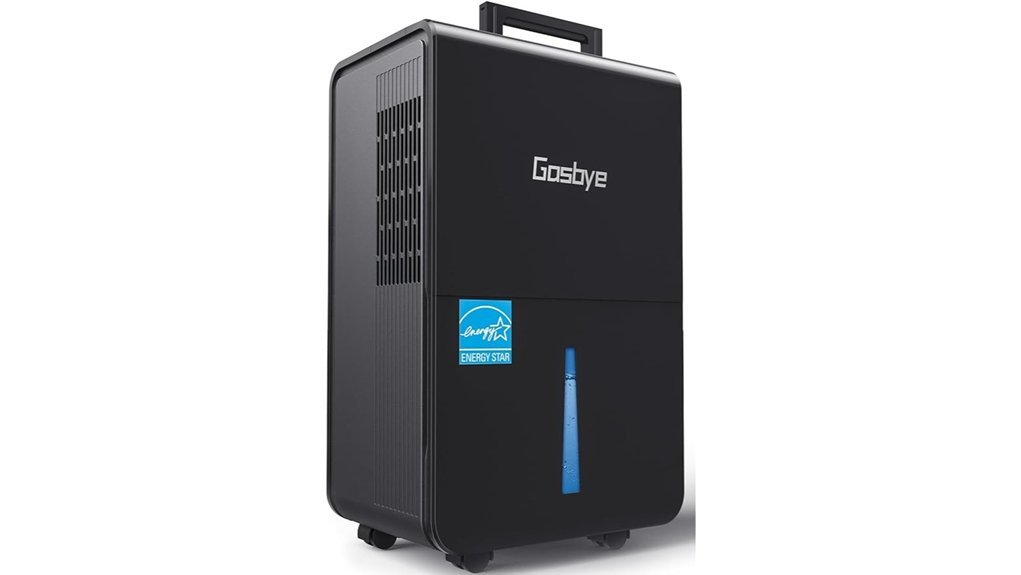
Best High-Output Gravity Drain
Gasbye provides unusually clear capacity figures at several conditions: the listing states up to 115 pints/day at 86°F and 80% RH, 73 pints/day at 80°F and 60% RH, and 50 pints/day at 65°F and 60% RH. That makes it easier to compare with real basement conditions. It targets spaces up to 4,500 sq. ft. and includes a 1.7-gallon tank plus hose drainage.
Best For: Very damp large basements with a nearby floor drain or sump where a pump is unnecessary.
Why You’ll Like It
- Multiple condition-specific capacity figures make the performance claim more transparent.
- Large tank and direct drainage suit continuous basement operation.
- Reinforced construction and automatic restart support demanding use.
Who Should Avoid It: Choose the pump version or another pumped model when water must travel uphill.
Pros:
- Strong listed moisture-removal performance.
- Large tank with continuous-drain option.
- ENERGY STAR positioning and relatively quiet listed operation.
Cons:
- Heavy for frequent movement.
- Standard version relies on gravity drainage.
- Performance falls as basement temperature and humidity decrease.
KNKA 2500 Sq.Ft Dehumidifier with Drain Hose
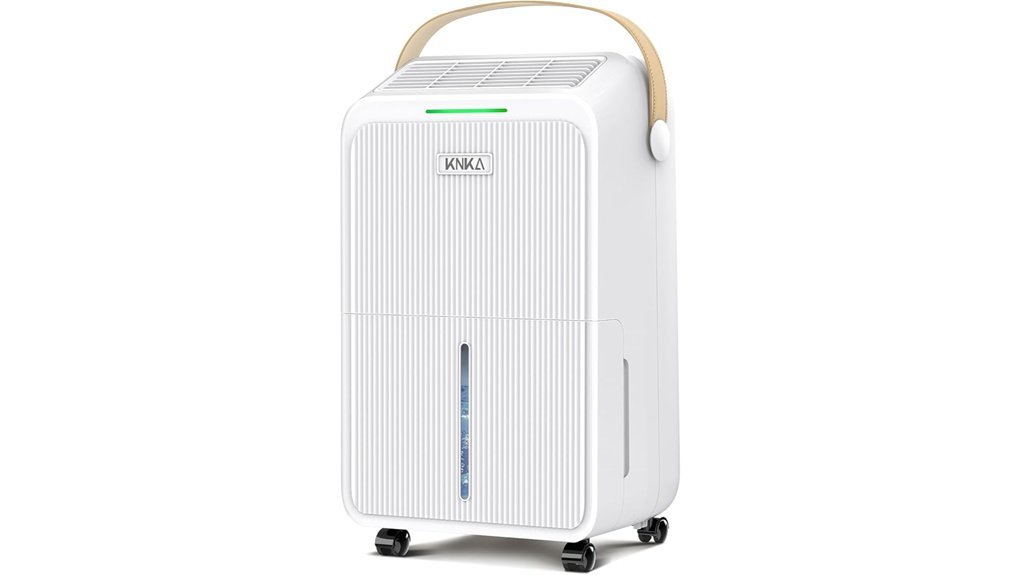
Best for Moderately Damp Basements
The KNKA is a lighter-duty option for a moderately damp basement rather than a flooded or continuously wet space. It is advertised for up to 2,500 sq. ft. with a maximum 34-pint daily figure, three modes, a 24-hour timer, intelligent humidity control, and an included drain hose. Its smaller tank makes continuous drainage especially important in humid conditions.
Best For: Moderately damp basements near 2,000 to 2,500 sq. ft. with an accessible gravity drain.
Why You’ll Like It
- Simple DEHU, DRY, and continuous modes are easy to understand.
- Included hose supports hands-off drainage.
- Smaller footprint is easier to position in a finished basement or laundry area.
Who Should Avoid It: Do not choose it for seepage, standing water, or a very wet large basement that needs 40- to 50-plus standardized pints per day.
Pros:
- Compact and easier to move than high-capacity models.
- Multiple modes and timer.
- Continuous drainage included.
Cons:
- Small tank requires frequent emptying without the hose.
- Lower capacity than the leading large-basement picks.
- Maximum rating may not reflect cool-basement output.
Waykar 80 Pints Energy Star Dehumidifier for Home
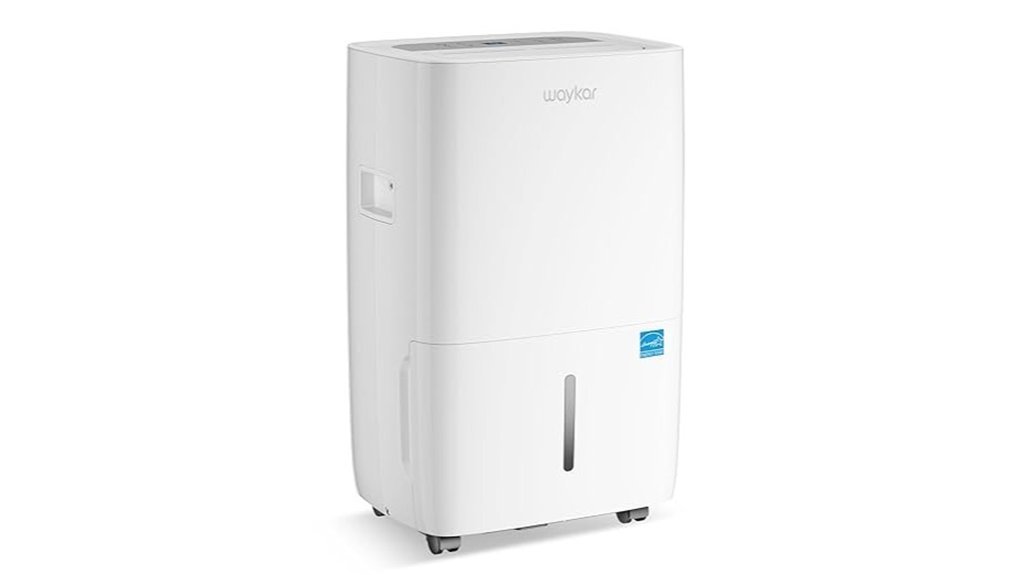
Best Airflow Coverage
The Waykar model is listed for spaces up to 5,000 sq. ft. and combines ENERGY STAR positioning with a 90-degree swing outlet designed to distribute dry air more evenly. Its 1.14-gallon tank, drain hose, humidity setting range, casters, and automatic controls make it a practical choice for open basement layouts.
Best For: Large open basements where even airflow and easy mobility are priorities.
Why You’ll Like It
- Swinging airflow can help reduce stagnant damp zones.
- ENERGY STAR certification supports more efficient continuous use.
- Gravity-drain hose and removable tank provide flexible operation.
Who Should Avoid It: Avoid it when you need a pump or have no safe downhill path to a drain.
Pros:
- Large advertised coverage area.
- ENERGY STAR-certified model.
- User-friendly controls, casters, and drainage options.
Cons:
- No built-in pump.
- Tank still needs frequent attention without hose drainage.
- Advertised 80-pint maximum should not be compared blindly with standardized ratings.
VEAGASO 2500 Sq.Ft Dehumidifier with Drain Hose
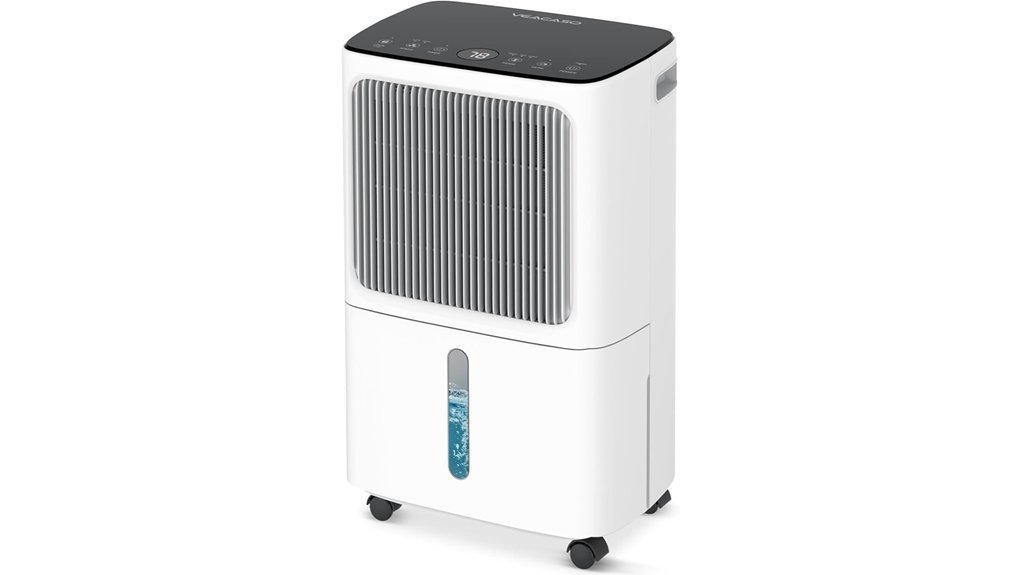
Best Compact Controls
The VEAGASO VG380 is another compact 2,500-sq.-ft. option for moderate moisture loads. It advertises a maximum 34-pint daily rate, DEHU, DRY, and CONT modes, a 24-hour timer, a 0.53-gallon tank, and an included hose. The LED touch panel and listed 40 dB operation make it appealing for finished basements, but its smaller tank is not ideal for manual-only use.
Best For: Finished basements, laundry rooms, and moderate humidity where compact size and simple controls matter.
Why You’ll Like It
- Three operating modes cover humidity control, clothes drying, and continuous use.
- Touch controls and humidity display improve day-to-day usability.
- Drain hose is included for continuous gravity drainage.
Who Should Avoid It: Choose a larger standardized-capacity model for very damp or wet basements.
Pros:
- Compact, portable design.
- Quiet-operation positioning.
- Included hose and automatic tank shutoff.
Cons:
- Small water tank.
- No pump for uphill drainage.
- Lower output than the main large-basement recommendations.
AIRPLUS 70 Pint Dehumidifier for Basements and Home
Best Multi-Mode Value
The AIRPLUS model is marketed for up to 4,500 sq. ft. with a 70-pint maximum rating, four operating modes, a 24-hour timer, automatic defrost, and both tank and hose drainage. It offers useful controls for basements, garages, and laundry areas, although the listing does not clearly state the temperature and humidity used for the 70-pint figure.
Best For: Buyers seeking broad coverage, several modes, and a straightforward gravity-drain setup.
Why You’ll Like It
- Four modes provide flexibility for humidity control and laundry drying.
- Digital display shows humidity, temperature, timer, and operating mode.
- Drain hose and washable filter support practical maintenance.
Who Should Avoid It: Look elsewhere if published standardized capacity or verified ENERGY STAR data is a top requirement.
Pros:
- Broad advertised coverage.
- Multiple modes and automatic controls.
- Tank and continuous-drain options.
Cons:
- Capacity test conditions are not clearly stated in the listing.
- No built-in pump.
- Noise may be more noticeable outside reduced-noise mode.
AEOCKY 2500 Sq.Ft Dehumidifier with Drain Hose
Best Mid-Size AEOCKY
This AEOCKY model is listed for 2,500 sq. ft. with a maximum 50-pint daily rate, intelligent humidity control, quiet operation, a 0.5-gallon tank, and an included drain hose. It is best positioned as a mid-size option for moderate basement humidity rather than as a severe-moisture solution.
Best For: Moderately damp mid-size basements where a compact compressor unit and hose drainage are sufficient.
Why You’ll Like It
- Compact dimensions simplify placement.
- Humidistat and continuous mode support automatic control.
- Drain hose reduces dependence on the small tank.
Who Should Avoid It: Skip it for very wet basements, large open areas above its listed coverage, or uphill drainage.
Pros:
- Correctly matched to a 2,500-sq.-ft. use case.
- Compact design with intelligent humidity control.
- Continuous drainage included.
Cons:
- Smaller tank.
- No pump.
- The maximum 50-pint claim may use warmer conditions than a cool basement.
Vellgoo 140 Pint Energy Star Dehumidifier
Best Maximum-Capacity Pick
The Vellgoo is the highest advertised-capacity option in this roundup, with a maximum 140-pint claim and coverage up to 6,000 sq. ft. The listing identifies it as an ENERGY STAR Most Efficient 2025 model and includes a drain hose, smart humidity control, auto-defrost, and auto-restart. It is most attractive for very damp, large spaces where high output matters more than compact size.
Best For: Very damp large basements, garages, or open areas with reliable gravity drainage.
Why You’ll Like It
- Highest advertised maximum output in the retained lineup.
- ENERGY STAR Most Efficient positioning strengthens its efficiency case.
- Automatic restart and defrost are useful for continuous basement operation.
Who Should Avoid It: It may be excessive for a small or only slightly damp room, and it does not replace leak or drainage repairs.
Pros:
- Very high advertised capacity.
- Large coverage claim and continuous drainage.
- Energy-efficient certification positioning.
Cons:
- Higher purchase cost than smaller models.
- Large footprint and weight.
- The 140-pint maximum is condition-dependent.
PLUSCENT 32 Pint Dehumidifier for Home
Best Light-Duty Portable Pick
The PLUSCENT is listed for up to 2,500 sq. ft., but its 32-pint maximum is measured at 95°F and 90% RH. That means it should be treated as a light-duty or moderate-humidity choice rather than a direct substitute for a standardized 32-pint basement model. It includes three modes, a 24-hour timer, child lock, casters, a 2-liter tank, and a drain hose.
Best For: Moderately damp finished basements or open rooms where portability and simple controls are more important than maximum output.
Why You’ll Like It
- Clear controls, timer, and child lock suit family spaces.
- Casters and handles make room-to-room movement easier.
- Included hose supports continuous drainage.
Who Should Avoid It: Avoid it for cold, wet, or seepage-prone large basements.
Pros:
- Portable and easy to operate.
- Three modes and timer.
- Continuous-drain hose included.
Cons:
- 32-pint figure is based on extreme test conditions.
- Small tank for manual drainage.
- Lower real-world output in cool basements.
Landeagle 6000 Sq. Ft Dehumidifier with Drain Hose
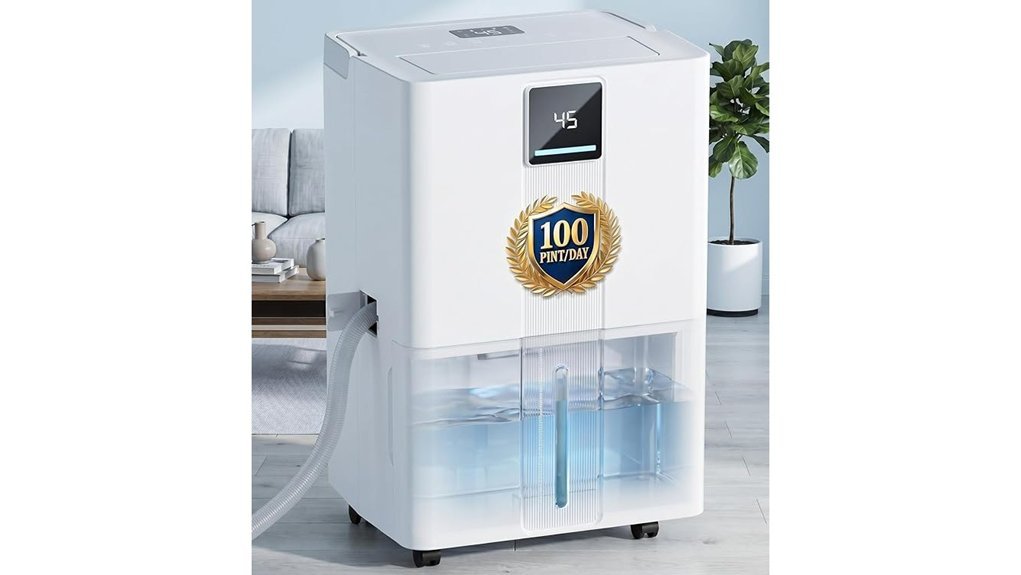
Best Simple 100-Pint-Class Pick
The Landeagle is marketed as a 6,000-sq.-ft., 100-pint-class dehumidifier with Dry, Auto, and Sleep modes, a drain hose, a 1.6-gallon tank, humidity indicator, automatic defrost, and mobility features. Listing details can change, so verify the current seller, model specifications, warranty, and included accessories before ordering.
Best For: Large basements where you want straightforward controls and gravity drainage without paying for a pump.
Why You’ll Like It
- High advertised coverage and moisture-removal class.
- Large tank and hose drainage reduce maintenance.
- Simple mode selection and visual humidity indicator.
Who Should Avoid It: Do not rely on it when you need independently confirmed certification data or pumped drainage.
Pros:
- High advertised capacity and coverage.
- Large tank with continuous-drain option.
- Portable design with casters and handle.
Cons:
- Current listing details should be rechecked before purchase.
- No built-in pump.
- Large unit may be difficult to move on stairs.
AEOCKY 74 Pint Energy Star Dehumidifier
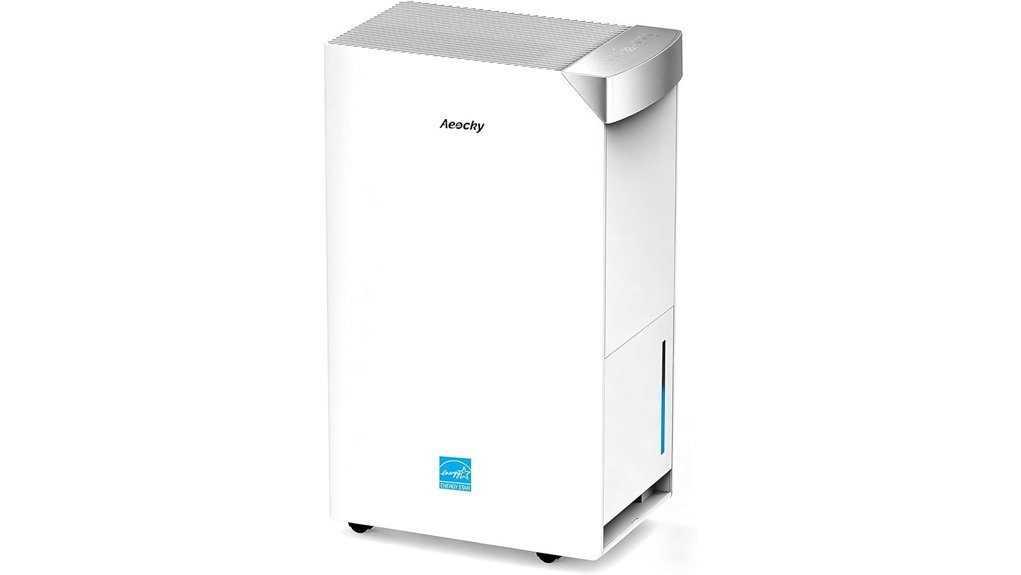
Best Energy-Star Value
The AEOCKY LEO-Lite is listed for up to 4,500 sq. ft. and carries ENERGY STAR certification. Its advertised output is 74 pints/day at 95°F and 95% RH and 52 pints/day at 86°F and 80% RH. It adds smart humidity control, auto-defrost, power-loss memory, a 1.45-gallon tank, and an included drain hose.
Best For: Large basements needing an efficient gravity-drain model at a lower tier than AEOCKY’s 80-pint flagship.
Why You’ll Like It
- ENERGY STAR certification improves confidence in efficiency.
- Auto-defrost and power memory suit basement use.
- Quiet-operation positioning and compact footprint work well in finished spaces.
Who Should Avoid It: Choose the 80-pint AEOCKY or a pump model for heavier moisture loads or uphill drainage.
Pros:
- ENERGY STAR-certified model.
- Smart controls and automatic restart behavior.
- Drain hose and manageable weight.
Cons:
- No pump.
- Capacity claims use warm, humid conditions.
- Tank still requires frequent emptying without hose drainage.
MEPTY 6000 Sq.Ft Dehumidifier with Smart Control
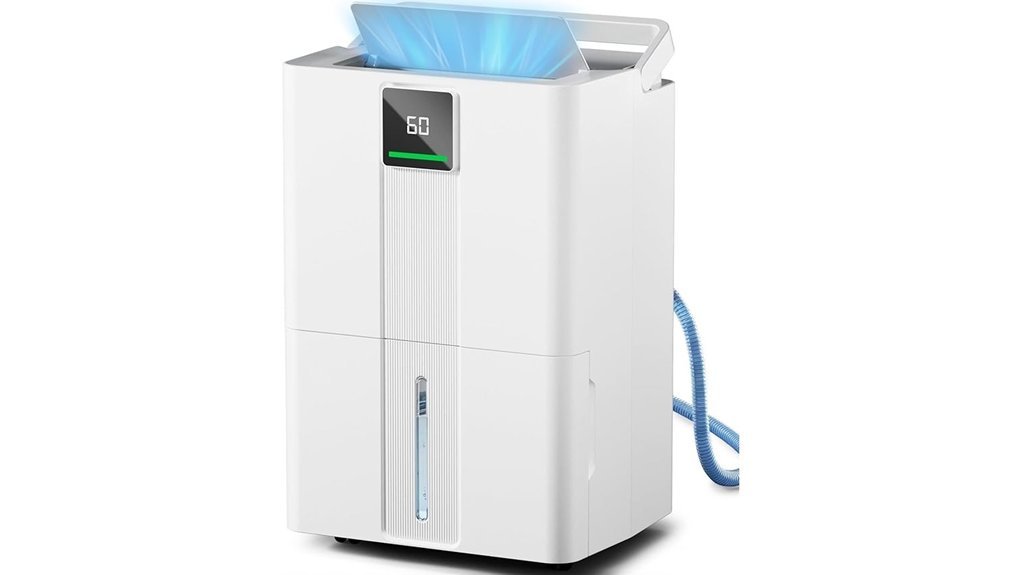
Best Smart Display
The MEPTY targets large rooms up to 6,000 sq. ft. with a maximum 100-pint daily claim, Auto, Sleep, and Dry modes, a 24-hour timer, child lock, drain hose, and a three-color humidity display. The display makes it easy to see whether the room is dry, comfortable, or humid from across the basement.
Best For: Large basements where an easy-to-read humidity display and simple smart controls are priorities.
Why You’ll Like It
- Three-color indicator improves at-a-glance monitoring.
- Auto, Sleep, and Dry modes cover common basement needs.
- Casters, handle, and hose drainage support practical use.
Who Should Avoid It: Choose a verified ENERGY STAR model if efficiency certification is your main decision factor.
Pros:
- Large advertised coverage.
- Useful humidity display and multiple modes.
- Continuous drainage and portability features.
Cons:
- No built-in pump.
- Maximum capacity is condition-dependent.
- Large footprint may not suit narrow utility rooms.
Factors to Consider When Choosing a Dehumidifier for a Large Basement
A large basement needs a dehumidifier sized for both the floor area and the moisture load. ENERGY STAR dehumidifier guidance recommends looking at how damp the room is, not just square footage. A large room that is only slightly damp may need far less capacity than a wet basement with seepage, laundry drying, or condensation.
Capacity and Test Conditions
Capacity is measured in pints collected over 24 hours under specified conditions. Because warmer air holds more moisture, a unit can show a much larger number at 95°F and 90% RH than it does under the cooler DOE conditions intended to represent basement use. Compare standardized capacity when possible, and treat “max” figures as marketing ceilings rather than guaranteed daily output.
Basement Size and Dampness
Match the unit to the basement’s actual condition. A slightly or moderately damp space may only smell musty after rain, while a very damp space has persistent odor and visible damp spots. A wet basement may have sweating walls, seepage, or frequent water intrusion. Dehumidifiers manage airborne moisture; they do not repair foundation leaks, plumbing leaks, failed gutters, or poor exterior drainage.
Drainage Options Available
For long-term basement use, continuous drainage is usually preferable. Gravity hoses must slope downward without kinks. A built-in pump is useful when the only drain is above the unit or across the room. Confirm the pump lift height, hose length, and whether the hose is included before buying.
Energy Efficiency Ratings
ENERGY STAR certification is more trustworthy than an unsupported promise to save a fixed dollar amount. Energy cost depends on local electricity rates, run time, humidity load, set point, temperature, and how often the compressor cycles. Compare the exact model in the ENERGY STAR Product Finder, including its Integrated Energy Factor and standardized capacity.
Noise Level During Operation
Noise matters most in a finished basement, bedroom, office, or media room. Check the listed sound level at both low and high fan settings. Also remember that compressor cycling, vibration on uneven floors, and hose contact with walls can make a unit sound louder than the headline decibel figure suggests.
Low-Temperature Operation
Cool basements reduce moisture-removal performance and can cause frost on the coil. Choose a model with automatic defrost, keep the air intake clear, and follow the manufacturer’s minimum operating-temperature guidance. If the basement stays very cold, a portable compressor unit may run less efficiently.
Tank Size and Maintenance
A larger tank reduces emptying frequency but also adds weight when full. For continuous use, prioritize an accessible filter, washable filter design, full-tank shutoff, hose routing, and easy coil cleaning. Clean the filter on the schedule in the manual and check the hose periodically for clogs, algae, or poor slope.
Before You Buy Checklist
- Measure the basement and note whether doors divide the space.
- Use a hygrometer to track relative humidity over several days.
- Identify whether the basement is moderately damp, very damp, or wet.
- Confirm a safe gravity drain or determine whether a pump is necessary.
- Compare standardized capacity, not only the largest marketing number.
- Check tank size, hose inclusion, minimum operating temperature, warranty, and return terms.
- Plan to correct leaks or seepage instead of relying on the dehumidifier alone.
Frequently Asked Questions
How Often Should I Empty the Water Tank of a Dehumidifier?
Empty it whenever the full-tank indicator appears. In a very humid basement, a small tank may fill several times a day. Continuous hose drainage or a built-in pump is the better choice when you cannot check the unit regularly.
Can Dehumidifiers Help With Mold Prevention in Basements?
They can reduce the excess humidity that supports mold growth, but they do not remove existing mold or fix the water source. Repair leaks, dry wet materials quickly, improve drainage, and follow EPA mold and moisture guidance in addition to controlling humidity.
What Is the Ideal Humidity Level for Basements?
A practical target is generally 30% to 50% relative humidity. The EPA recommends keeping indoor humidity in that range. Keep it below 60%, watch for condensation, and avoid setting the unit unnecessarily low because that increases run time and energy use.
Are Dehumidifiers Noisy When Operating in Large Spaces?
All compressor dehumidifiers make fan and compressor noise. Models listed in the high-30s to mid-40s dB range may be comfortable in many finished basements, but sound varies by fan speed, floor vibration, and room acoustics.
How Can I Estimate a Dehumidifier’s Energy Cost?
Multiply the unit’s wattage by daily operating hours, divide by 1,000 to get kilowatt-hours, and multiply by your electricity rate. Actual use changes as the humidistat cycles the compressor on and off, so a plug-in energy meter gives a better real-world estimate.
Do I Need a Dehumidifier With a Pump?
You need a pump when water must travel upward to a sink, window, or elevated drain. Use gravity drainage when the hose can run continuously downhill to a floor drain or sump. A pump adds convenience but also cost and another component that requires correct setup.
Conclusion
Final recommendation: Choose the avylo when pumped drainage is essential, the Gasbye when you want clearly stated high-output performance with a gravity drain, or the AEOCKY 80 Pint Max when energy efficiency and quieter operation are the priorities.
For a very damp or wet large basement, start with a higher standardized capacity and continuous drainage. For a moderately damp 2,000- to 2,500-sq.-ft. space, a compact model may work, but avoid comparing maximum-condition pint claims as though they were measured under the same basement test.