Updated August 2026.
If you’re comparing large-capacity dehumidifiers for basements, garages, crawl spaces, and other damp areas, do not choose by the biggest pint number alone. Drainage method, standardized capacity, room temperature, installation style, noise, and maintenance can matter just as much. This guide compares portable basement dehumidifiers, pump-equipped models, and low-profile crawl-space units so you can match the machine to the moisture problem and drain location.
Quick verdict: The DECIUU pump model offers the most flexible drainage for a large residential basement. The Frigidaire 50 Pint with Pump is the strongest mainstream-brand option, while the ALORAIR Sentinel HD35P Wi-Fi is the better fit for remote monitoring in a crawl space.
Capacity warning: Portable DOE capacity, older test-condition claims, and commercial “saturation” ratings are not directly interchangeable. ENERGY STAR explains that current portable dehumidifier capacity is tested at 65°F, while some marketplace titles use hotter and more humid conditions that produce larger numbers.
How these products were compared: We reviewed the current model names and listed features for moisture-removal capacity, drainage, controls, intended placement, operating style, and manufacturer support. We did not perform hands-on testing.
Best practice: Compare the exact model number and its standardized pints-per-day rating before treating a “70,” “80,” or “100 pint” title as a like-for-like performance claim.
Quick Comparison
| Product | Capacity Label | Drainage | Best Use |
|---|---|---|---|
| DECIUU Max 100 Pint with Pump | Max 100 pint; listing also states standard 70 pint | Built-in pump, gravity hose, or tank | Large basement without a low drain |
| Frigidaire FHDP5033Y1 | 50 pints per day listed | Built-in pump, continuous drain, or bucket | Mainstream residential pump option |
| HBN FDD25-5259 | 53 pint standard claim; 80 pint maximum claim | Gravity hose or 1.71-gallon tank | Large room needing a bigger bucket |
| DECIUU Max 100 Pint with Drain Hose | Max 100 pint; listing also states standard 70 pint | Gravity hose or tank | Large basement with a nearby low drain |
| ALORAIR Helios MP35 | 70 PPD saturation; 35 PPD AHAM | Built-in pump or gravity drain | Low-clearance space with difficult drainage |
| ALORAIR Sentinel HD35P Wi-Fi | 70 PPD saturation; 35 PPD AHAM | Pump or gravity drain | Remote crawl-space monitoring |
| ALORAIR Sentinel HS35 | 70 PPD saturation; 35 PPD AHAM | Continuous gravity drain | Crawl space with a dependable low drain |
DECIUU Max 100 Pint Dehumidifier with Pump and Hose
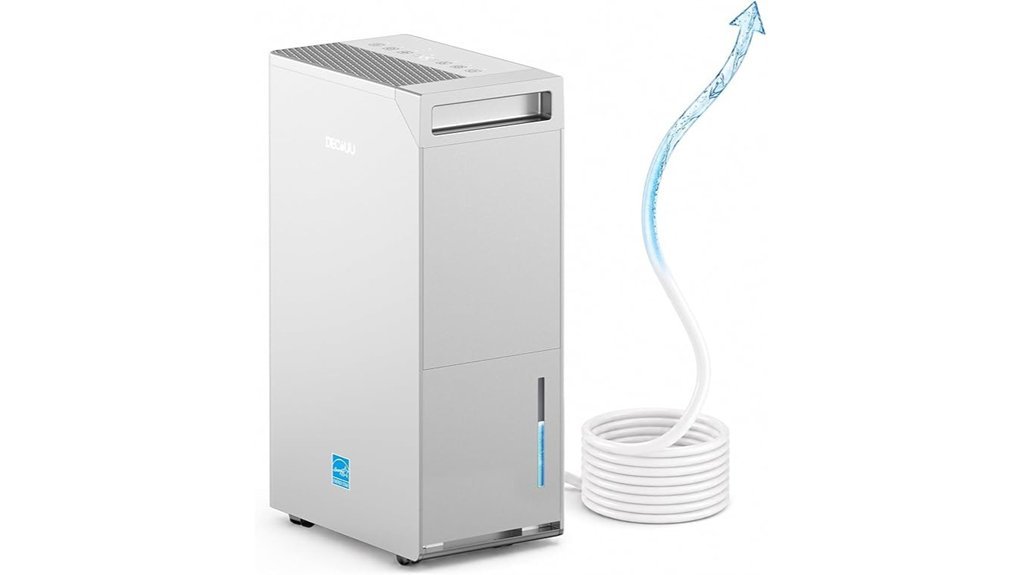
Best Overall for Large Basements
This DECIUU model is the strongest all-around fit when you need flexible condensate drainage in a large basement. The marketplace title describes it as a maximum 100-pint model and also references a standard 70-pint rating. Its main advantage is the built-in pump, which can move collected water to an elevated sink, window, or drain when gravity drainage is not practical.
Why You’ll Like It: You can choose between pump drainage, a downhill hose, or the collection tank. Smart humidity control, automatic defrost, restart memory, a timer, wheels, and a washable filter are useful for ongoing basement operation.
Who Should Buy This: Homeowners who need a portable high-capacity dehumidifier but cannot place the unit next to a floor drain.
Who Should Avoid This: Buyers who have a reliable low drain and do not want the added cost or maintenance of an internal pump.
Pros:
- Built-in pump provides more placement freedom
- Three drainage approaches suit changing room layouts
- Automatic humidity control can reduce unnecessary runtime
Cons:
- The maximum 100-pint claim should not be compared directly with current DOE ratings
- A pump adds another component that needs correct hose routing and maintenance
- Confirm current ENERGY STAR status by exact model number before buying
Frigidaire FHDP5033Y1 50 Pint Dehumidifier with Built-In Pump
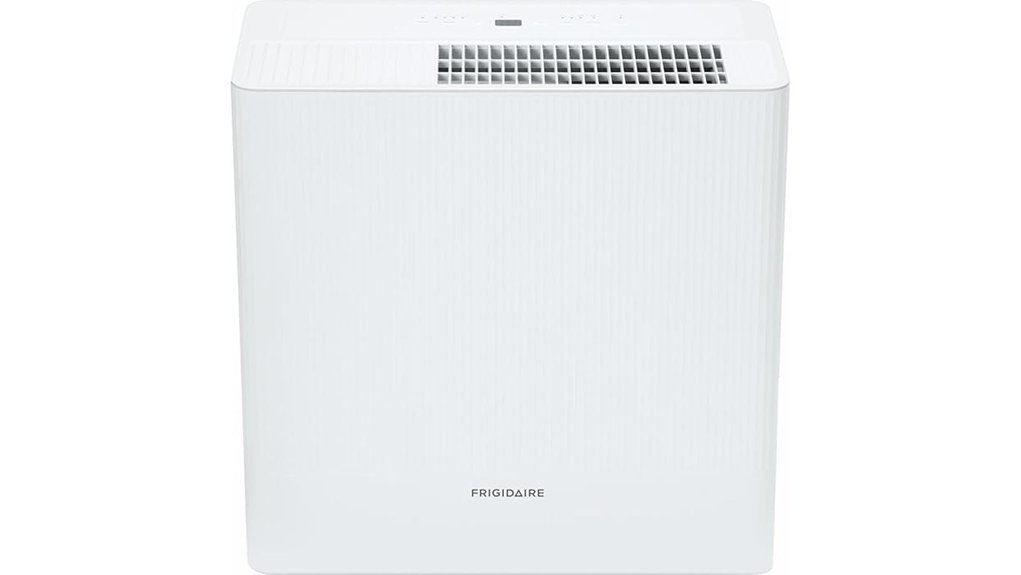
Best Mainstream Brand Option
The Frigidaire FHDP5033Y1 is a 50-pint residential dehumidifier with a built-in pump. It is a better fit for buyers who value a recognizable appliance brand, app-based controls, and flexible upward drainage more than the largest marketplace capacity claim.
Why You’ll Like It: The pump can discharge water upward, while the bucket and continuous-drain options provide alternatives. Wi-Fi control, customized humidity settings, automatic shutoff, and a washable filter make it easier to manage in a finished basement or regularly used living area.
Who Should Buy This: Buyers who want a current Frigidaire pump model for a medium-to-large residential space.
Who Should Avoid This: Owners of very cold, continuously wet crawl spaces that need a low-profile commercial cabinet or a higher standardized removal rate.
Pros:
- Built-in pump supports upward drainage
- Wi-Fi and humidity controls add day-to-day convenience
- Established appliance brand with broad retail support
Cons:
- Heavier than many basic portable models
- Check whether the required pump or gravity hose is included with the exact listing
- Not designed as a permanent ducted whole-home system
HBN FDD25-5259 Dehumidifier with Smart Humidity Control
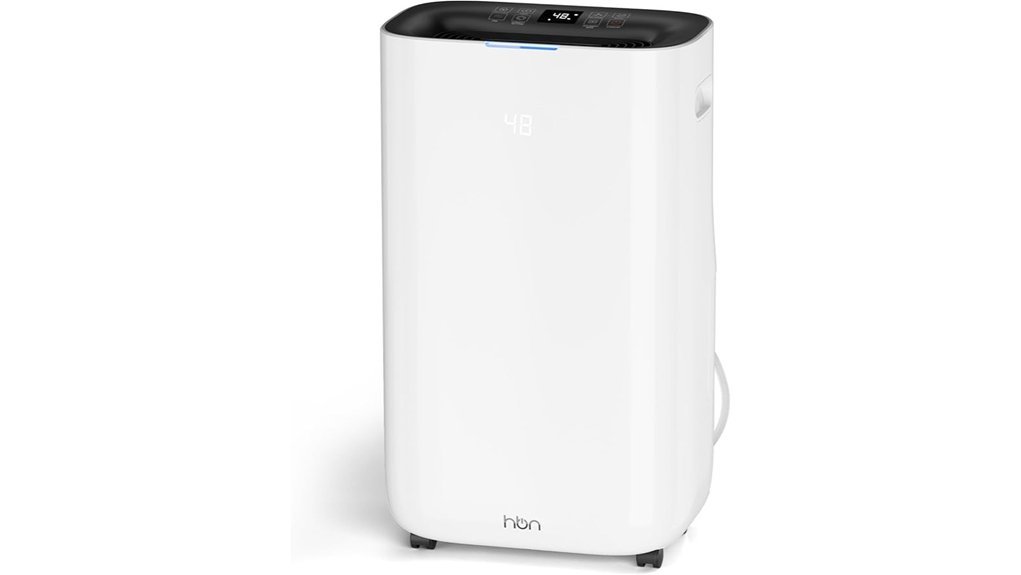
Best Large-Tank Portable Pick
The HBN FDD25-5259 combines a 1.71-gallon collection tank with smart humidity control, a timer, multiple operating modes, and gravity-hose drainage. The listing distinguishes between a 53-pint standard claim and an 80-pint maximum claim under hotter, wetter conditions, making the lower number the more useful comparison point for most shoppers.
Why You’ll Like It: The larger tank gives you more time between manual emptying when continuous drainage is unavailable. Casters, a child lock, washable filter, multiple fan speeds, and a dry-clothes mode add flexibility for household use.
Who Should Buy This: Buyers who want a large bucket and do not need to pump water upward.
Who Should Avoid This: Anyone whose only drain is above the machine or across a route where a gravity hose cannot maintain a steady downhill slope.
Pros:
- Large tank reduces emptying frequency
- Listing separates its standard and maximum-condition capacity claims
- Timer, humidity settings, modes, and fan speeds support flexible use
Cons:
- No built-in pump
- A full 1.71-gallon bucket can be heavy to carry
- Advertised square-foot coverage is only a starting point
DECIUU Max 100 Pint Dehumidifier for Basement with Drain Hose
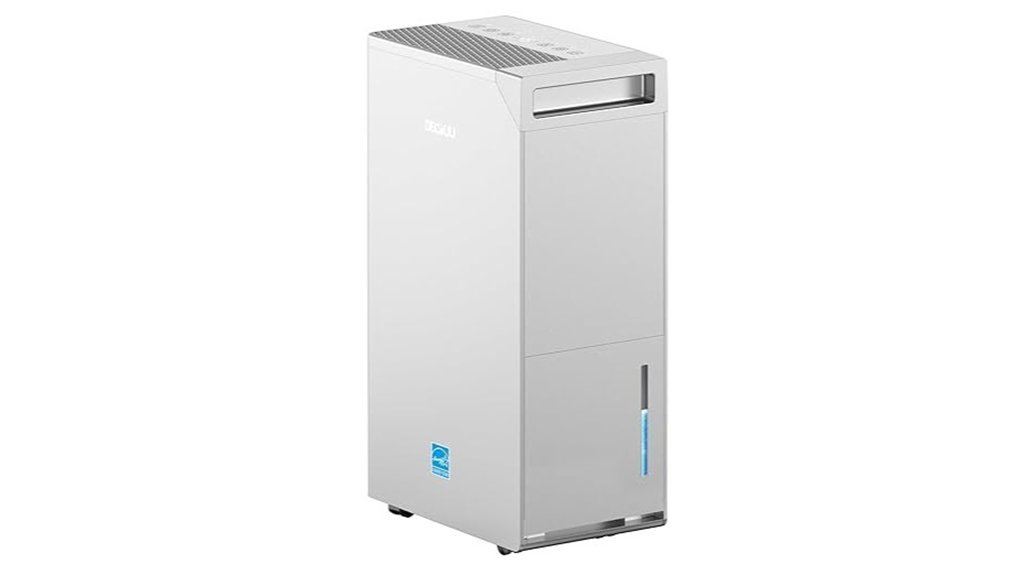
Best for a Nearby Floor Drain
This DECIUU version targets the same large-space buyer as the pump model but uses gravity drainage instead of an internal pump. The listing describes a maximum 100-pint capacity and a standard 70-pint rating, along with automatic humidity control, defrost, restart memory, a drain hose, and a collection tank.
Why You’ll Like It: A gravity-only design is simpler when a floor drain, low sink connection, or other downhill outlet is already available. You still get automatic control and continuous drainage without paying for a pump you may not use.
Who Should Buy This: Homeowners with a dependable low drain close to the dehumidifier.
Who Should Avoid This: Buyers who need to route water upward or cannot keep the hose continuously sloped.
Pros:
- Continuous gravity drainage reduces bucket handling
- Auto defrost and restart memory support basement use
- Wheels and handles improve portability
Cons:
- No built-in pump for elevated drainage
- The “Most Efficient 2024” wording is dated and should not be treated as a current award
- Confirm the exact standardized capacity and certification by model number
ALORAIR Helios MP35 Crawl Space Dehumidifier with Pump
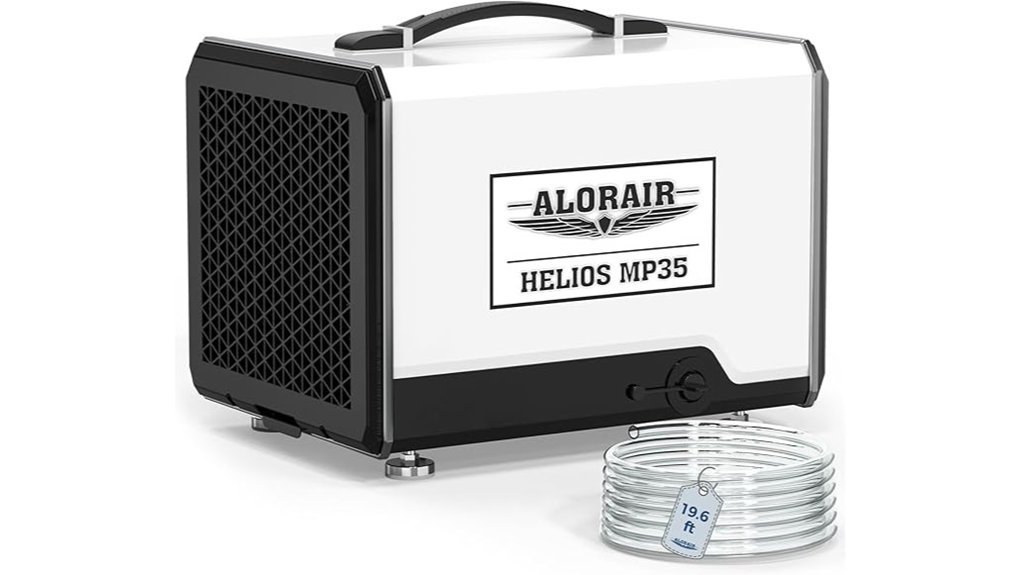
Best Low-Profile Model with Pump
The ALORAIR Helios MP35 is a compact commercial-style dehumidifier intended for crawl spaces, basements, garages, storage areas, and other low-clearance locations. ALORAIR lists it at 70 pints per day under saturation conditions and 35 pints per day under AHAM conditions, with coverage up to 1,000 sq. ft.
Why You’ll Like It: The built-in pump can move condensate upward, while the low-profile cabinet fits locations where a tall wheeled unit would be awkward. Automatic defrost, restart memory, and a corrosion-resistant cabinet support unattended use.
Who Should Buy This: Property owners who need a low-profile machine and cannot rely on gravity drainage.
Who Should Avoid This: Buyers who want a large removable bucket or a simple living-room-style portable appliance.
Pros:
- Built-in pump and gravity-drain options improve installation flexibility
- Low-profile cabinet suits crawl spaces
- Manufacturer lists a six-year limited warranty
Cons:
- 35 PPD AHAM capacity is the fairer comparison with standardized ratings
- Installation requires careful hose routing and a level surface
- Basic filtration protects the machine but does not replace an air purifier
ALORAIR Sentinel HD35P Wi-Fi Crawl Space Dehumidifier
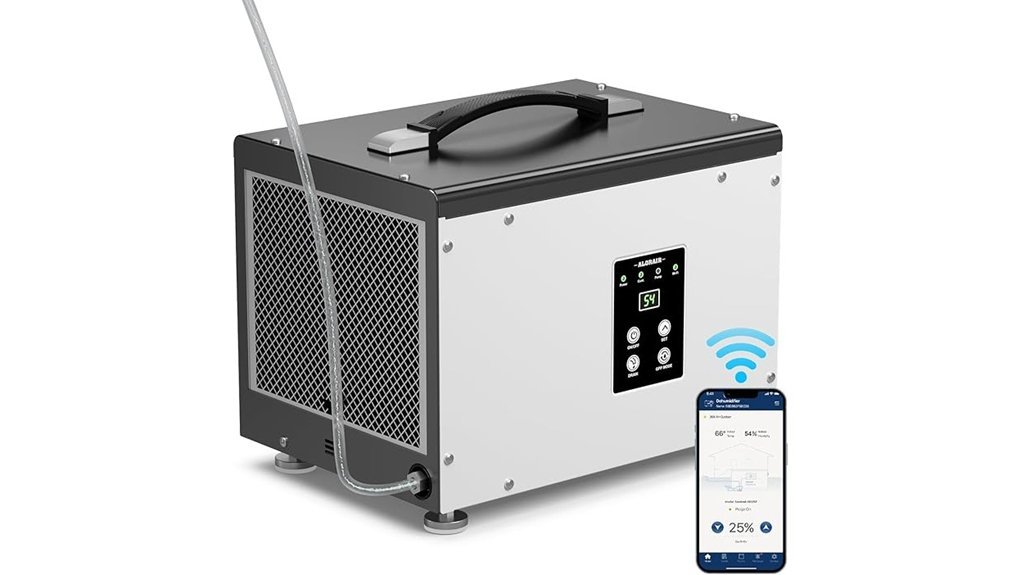
Best Smart Crawl-Space Pick
The ALORAIR Sentinel HD35P Wi-Fi adds remote monitoring and app control to a compact pump-equipped crawl-space platform. ALORAIR lists 70 pints per day at saturation and 35 pints per day under AHAM conditions, coverage up to 1,000 sq. ft., automatic defrost, memory restart, pump drainage, and gravity drainage.
Why You’ll Like It: Remote humidity checks are valuable when the machine is installed in a crawl space or another area you do not want to inspect every day. The pump also reduces placement restrictions.
Who Should Buy This: Landlords, property managers, and homeowners who want to check or adjust a hard-to-reach unit remotely.
Who Should Avoid This: Buyers who have unreliable Wi-Fi in the installation area or do not need app-based control.
Pros:
- Wi-Fi control reduces unnecessary crawl-space visits
- Pump and gravity drainage provide two installation paths
- Automatic defrost and restart memory support unattended operation
Cons:
- Smart features depend on app support and a stable connection
- 35 PPD AHAM is the more realistic comparison number
- More setup is required than with a basic portable room model
ALORAIR Sentinel HS35 Crawl Space Dehumidifier
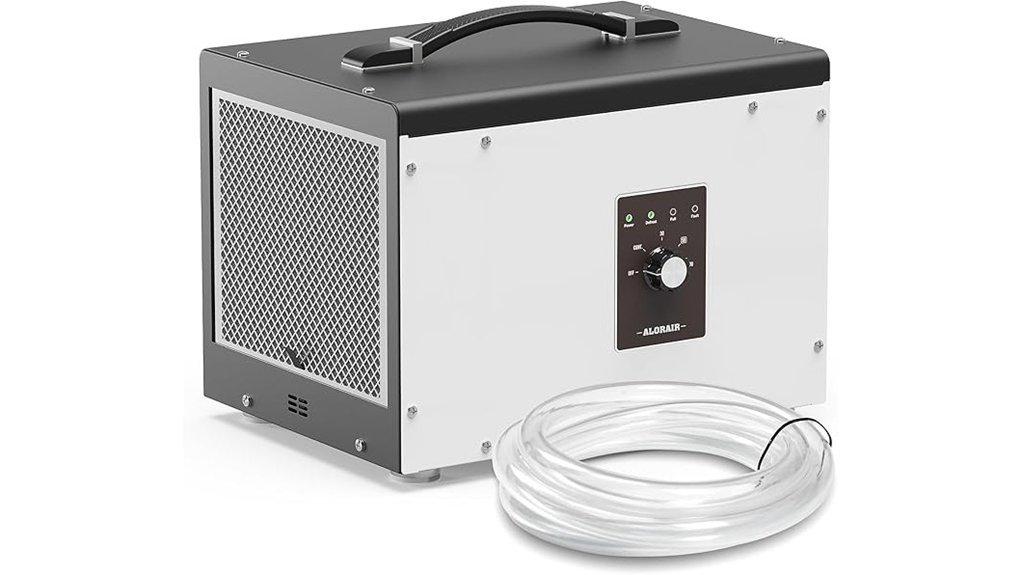
Best Gravity-Drain Crawl-Space Pick
The ALORAIR Sentinel HS35 is the simplest low-profile option in this comparison when your crawl space already has a reliable downhill drainage route. ALORAIR lists it at 70 PPD at saturation and 35 PPD under AHAM conditions, with automatic defrost, a compact cabinet, continuous gravity drainage, and a six-year limited warranty.
Why You’ll Like It: Removing the pump keeps the drainage system straightforward. The rotary humidity control and automatic defrost are suited to utility spaces where simple set-and-maintain operation matters more than app features.
Who Should Buy This: Buyers with a floor drain or other low outlet near the installation point.
Who Should Avoid This: Anyone who needs to push water uphill or across a long flat hose run.
Pros:
- Purpose-built low-profile cabinet
- Continuous gravity drainage requires no bucket emptying
- Automatic defrost and long limited warranty support long-term use
Cons:
- No built-in pump
- Hose must remain continuously downhill and free of kinks
- 35 PPD AHAM should be used for fairer capacity comparisons
Factors to Consider When Choosing a Large-Capacity Dehumidifier
Choose the unit that fits your actual moisture load, room temperature, and drainage layout, not simply the largest number in the product title. A built-in pump may solve a bigger practical problem than extra headline capacity, while a low-profile crawl-space cabinet may be more useful than a wheeled upright model in a tight installation.
Capacity Rating and Test Conditions
Dehumidifier capacity is the amount of water removed in 24 hours under specified conditions. ENERGY STAR notes that the current DOE procedure tests portable dehumidifiers at 65°F, which usually produces a lower and more realistic basement rating than older 80°F tests. Commercial crawl-space models may also publish a much larger saturation rating beside a lower AHAM value. Compare like with like.
Coverage Area and Moisture Load
Square-foot coverage is a marketing estimate, not a guarantee. Ceiling height, outside air leakage, standing water, open doors, laundry, foundation moisture, and room temperature all affect runtime. A small sealed room with severe water intrusion can be harder to dry than a larger mildly damp room.
Drainage Options
A built-in pump is useful when water must travel upward to a sink, window, or elevated drain. Gravity drainage is simpler, but the hose must slope continuously downward without kinks. A bucket provides placement freedom but requires emptying and a dependable automatic shutoff.
Portable Versus Crawl-Space Design
Portable upright models are easier to move and usually include a bucket. Crawl-space dehumidifiers are lower, more installation-focused, and designed around continuous drainage. Neither type should be confused with a permanently ducted whole-home dehumidifier.
Operating Temperature and Auto Defrost
Cool air reduces moisture-removal performance and can allow frost to form on the coils. Check the exact minimum operating temperature in the manual, especially for an unheated basement or crawl space. Automatic defrost helps, but it does not make every compressor dehumidifier equally effective in cold conditions.
Noise, Controls, and Maintenance
For a finished basement or bedroom-adjacent space, compare published sound data when available instead of relying only on the word “quiet.” A clear humidistat, timer, restart memory, child lock, app control, and filter reminder can improve daily use. Clean the filter and inspect the bucket, pump tubing, and drain hose according to the manual.
Energy Efficiency
Verify ENERGY STAR certification using the exact model number in the current ENERGY STAR product database. ENERGY STAR uses Integrated Energy Factor to compare water removal with electricity use. Correct sizing and automatic humidity control can also prevent wasteful continuous operation.
Before You Buy
- Measure the space and note whether it is mildly damp, very damp, or frequently wet.
- Fix active leaks or standing-water sources before relying on a dehumidifier.
- Identify whether the drain is below or above the machine.
- Compare standardized capacity, not only the maximum-condition headline.
- Check minimum operating temperature, pump lift, hose length, voltage, and clearances.
- Confirm the exact model number, included accessories, warranty terms, and current certification.
Frequently Asked Questions
Are 70-, 80-, and 100-Pint Dehumidifiers Directly Comparable?
No. A 100-pint maximum claim measured in very hot, humid air may represent less real-world capacity than a smaller number measured under the current DOE procedure. Compare the test condition and exact standardized pints-per-day rating.
Why Do the ALORAIR Models Show Two Capacity Numbers?
ALORAIR publishes a higher saturation rating and a lower AHAM rating for these models. The AHAM figure is the more useful number when comparing them with other standardized dehumidifier ratings.
Is a Built-In Pump Better Than Continuous Gravity Drainage?
A pump is better when condensate must move upward or across a difficult route. Gravity drainage is simpler and may require less maintenance, but it works only when the hose can run continuously downhill to a suitable drain.
Can I Use a Dehumidifier in a Cold Basement?
Yes, but output normally falls as the temperature drops. Check the model’s minimum operating temperature and automatic-defrost system. A unit that performs well in a warm test may remove much less moisture in a cold basement.
Are Large Portable Dehumidifiers Whole-Home Units?
Not necessarily. A portable model can serve a large open basement, but a true whole-home dehumidifier is normally installed with ductwork. Closed doors and separated floors limit how well one portable unit controls humidity throughout a house.
What Humidity Setting Should I Use?
The EPA recommends keeping indoor humidity between 30% and 50% when practical. Many homeowners begin near 45% to 50% and adjust for comfort, condensation, and building conditions. Lower is not always better because an unnecessarily low setting increases runtime and energy use.
How Often Should the Filter and Drain System Be Checked?
Follow the manufacturer’s manual. During heavy use, inspect the filter, bucket, pump tube, drain hose, and hose outlet at least monthly, and clean or correct them sooner if you notice dust buildup, odors, slow drainage, leaks, or unusual noise.
Conclusion
The best large-capacity dehumidifier depends first on standardized capacity and drainage, then on operating temperature, installation style, controls, and maintenance. The DECIUU pump model is the most flexible portable option when water must move upward. The Frigidaire FHDP5033Y1 is the strongest choice for buyers who prefer a mainstream smart appliance, while the ALORAIR models are better suited to low-clearance crawl-space installations.
Final recommendation: Choose a pump model only when your drain layout requires it. When a dependable floor drain is available, a gravity-drain unit is usually the simpler setup. Before ordering, verify the exact model number, standardized pints-per-day rating, hose or pump requirements, operating-temperature range, warranty, and current certification.
For general moisture control, the U.S. EPA recommends keeping indoor relative humidity between 30% and 50% when practical.