
Affiliate disclosure: This article contains Amazon affiliate links. We may earn a commission from qualifying purchases at no extra cost to you. Product specifications, certifications, and listing details can change, so confirm the exact model before ordering.
Last updated: August 1, 2026
Georgia’s long, humid summers can leave a small house feeling damp even when the air conditioner is running. For recurring household moisture, a compressor dehumidifier with a humidistat and continuous-drain connection is usually more practical than a small semiconductor unit.
The two models below serve different needs. The AEOCKY RHEA is the stronger choice for a very damp small house, open layout, basement, or heavy moisture load. The Waykar PD160B is better treated as a lower-capacity option for one enclosed room, a small basement area, or localized dampness rather than the primary dehumidifier for an entire house.
Quick Verdict
Best high-capacity pick: AEOCKY RHEA for a very damp area, open floor plan, basement, or home where a smaller unit cannot keep up.
Best for one damp area: Waykar PD160B for an enclosed room or smaller moisture load where its lower current-rated capacity is sufficient.
Capacity-rating note: Manufacturer headline capacities may be measured under very hot and humid conditions. They are not always directly comparable with current DOE Appendix X1 or ENERGY STAR ratings. Check the exact model number and standardized capacity instead of relying only on the largest pint figure in a retail title.
Quick Comparison
| Product | Best Use | Type | Drainage | Main Limitation | Check Details |
|---|---|---|---|---|---|
| AEOCKY RHEA | Very damp spaces, open layouts, basements, or heavier household moisture | Compressor | Bucket or hose | The Amazon and ENERGY STAR model identifiers should be matched before relying on certification claims | Check Price on Amazon |
| Waykar PD160B | One damp room, a small basement zone, office, or other enclosed area | Compressor | Bucket or hose | Its official current-rated capacity is much lower than the 34-pint retail headline | Check Price on Amazon |
How We Selected These Dehumidifiers
We focused on products that could address common Georgia-home conditions such as sustained summer humidity, basement dampness, laundry moisture, limited floor space, and frequent bucket filling. The main criteria were standardized moisture-removal capacity, humidistat control, drainage options, room layout, energy efficiency, portability, noise, and honest use-case suitability.
Only compressor models suitable for primary or single-zone residential moisture control were retained. Products intended mainly for closets, RVs, or mild localized condensation were excluded because their extraction performance is not directly comparable with a household compressor dehumidifier.
AEOCKY RHEA High-Capacity Dehumidifier: Best for Heavy Moisture
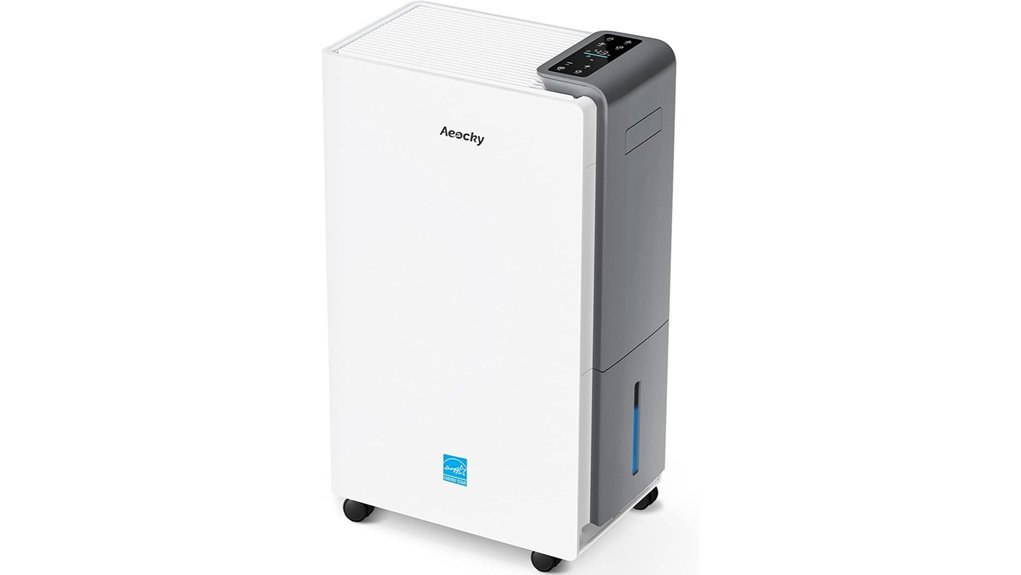
The AEOCKY RHEA is the stronger option when a small house has a very damp basement, an open floor plan, frequent laundry moisture, or a persistent humidity load. The linked listing describes a compressor dehumidifier with adjustable humidity control, timer functions, automatic operating features, a removable tank, and hose drainage.
The Amazon listing identifies the product as model RHEA-001 and advertises up to 80 pints per day under hot, highly humid conditions. An official ENERGY STAR record for a RHEA PRO model reports a 44.34-pint current rating and ENERGY STAR Most Efficient status. Because that record and the Amazon listing do not use the same model identifier, compare the certification label, model number, and product nameplate before assuming the record applies to the exact unit delivered.
Why You’ll Like It: It provides more reserve capacity than the Waykar and supports hose drainage for longer operation without frequent tank emptying.
Best For: A very damp small house, basement, open layout, laundry area, or space where a lower-capacity unit cannot reach the target humidity.
Avoid If: You only need mild moisture control in one closed bedroom or do not have enough floor space for a larger compressor unit.
Pros:
- Higher-capacity compressor platform for demanding humidity conditions.
- Humidistat control and continuous-drain capability.
- Removable tank and mobile format support flexible placement.
- Better suited to open or heavily damp areas than a mini dehumidifier.
Cons:
- Larger and heavier than the Waykar.
- May be excessive for one mildly damp bedroom.
- The 80-pint headline uses hot, highly humid test conditions.
- The exact Amazon model should be matched with the certification database before purchase.
Waykar PD160B ENERGY STAR Dehumidifier: Best for One Damp Area
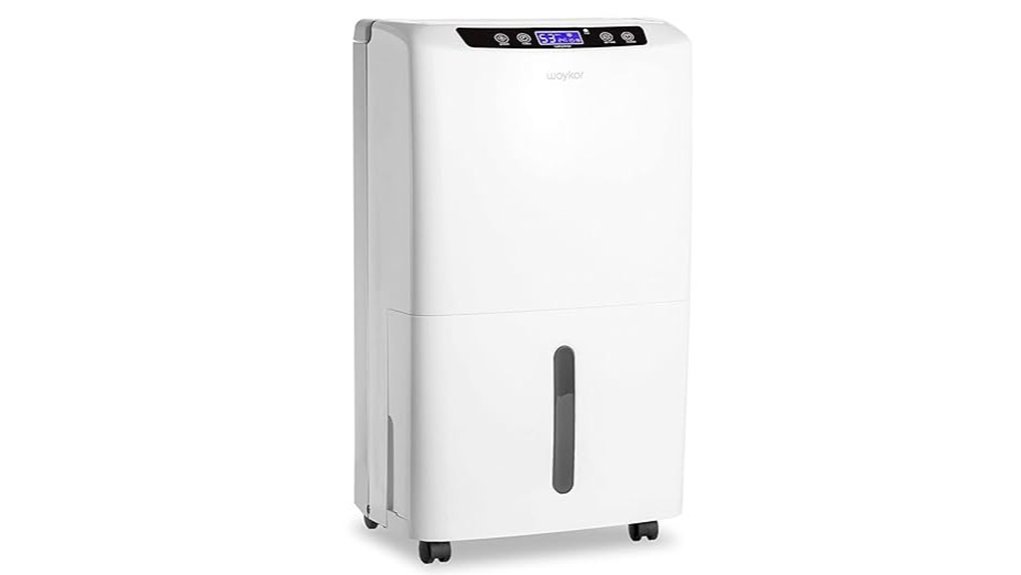
The Waykar PD160B combines compressor-based moisture removal, adjustable humidity control, automatic shutoff, a washable filter, a removable tank, and hose drainage. These features make it more practical than a semiconductor model for an enclosed room, small basement zone, home office, or other area with recurring dampness.
The linked retail listing markets the unit as removing up to 34 pints per day at 95°F and 90% relative humidity. However, the official ENERGY STAR listing for model PD160B reports an Appendix X1 capacity of 9.81 pints per day. That standardized figure is more useful when comparing it with other current-rated dehumidifiers.
Because of that lower current rating, the PD160B should not be presented as the automatic best choice for an entire damp house. It is a more defensible choice when the actual treated area is enclosed, the moisture load is moderate, and a hygrometer confirms that the unit can maintain the target humidity.
Why You’ll Like It: It offers automatic humidity control and hose drainage in a narrower, easier-to-place format.
Best For: One damp room, a small basement section, office, garage area, or other enclosed zone with a manageable moisture load.
Avoid If: You need one portable unit to control a very damp open-plan house or several closed rooms.
Pros:
- ENERGY STAR-certified exact model.
- Adjustable humidity control and automatic shutoff.
- Continuous-drain connection reduces bucket-emptying work.
- Washable filter and portable residential design.
Cons:
- The 9.81-pint current rating is low for whole-house moisture control.
- The tank may fill quickly if hose drainage is not used.
- Compressor sound will be more noticeable than a tiny semiconductor unit.
- The retail 34-pint figure is not directly comparable with current Appendix X1 ratings.
Factors to Consider When Choosing a Dehumidifier for a Small House in Georgia
1. Measure Humidity Before Buying
Use a separate hygrometer to learn how often indoor relative humidity rises above your target. A practical starting point is about 50% relative humidity, with a general indoor range of 30% to 50%. If the house regularly remains above 60%, inspect for leaks, drainage problems, bathroom ventilation issues, damp crawl spaces, or HVAC concerns instead of relying only on a portable appliance.
2. Choose Capacity by Moisture Load
Square-foot claims alone are not enough. A mildly damp bedroom and a wet basement of the same size need different capacities. The ENERGY STAR sizing guide generally recommends 20–30 current-rating pints per day for a slightly to moderately damp space under 2,000 square feet, 25–40 pints for a very damp space, and 30–50 pints for wet conditions.
Those figures describe the area actually exchanging air with the dehumidifier. Closed bedroom doors, separated floors, narrow hallways, and walls can prevent one portable unit from controlling humidity throughout the entire house.
3. Compare Current Test Ratings
Dehumidifier capacity ratings changed when DOE testing moved to cooler, more realistic conditions. A product advertised with a high-temperature “pints per day” figure may look much stronger than a current Appendix X1-rated model. Compare standardized ratings whenever possible, and verify that the model number in the certification database matches the product label.
4. Prioritize a Humidistat and Drainage
A built-in humidistat lets the unit cycle around a selected humidity level instead of running continuously. A hose connection is also valuable during humid Georgia weather because a small tank can fill repeatedly.
Most included drain hoses rely on gravity. The hose must normally run downhill without kinks to an approved drain. Water will not travel uphill unless the dehumidifier has a condensate pump or drains into a separate pump system.
5. Consider Noise and Placement
Compressor dehumidifiers move more air and usually make more sound than semiconductor models. Keep the required clearance around the intake and exhaust, follow the manufacturer’s instructions, and avoid placing an electrical appliance where it can be splashed.
For bathroom moisture, run the exhaust fan during and after showers. Position a portable dehumidifier outside the direct wet zone rather than beside a bathtub, shower, or sink where water may reach it.
6. Check Energy Efficiency and Maintenance
Look for ENERGY STAR certification on the exact model rather than assuming every product from the same brand is certified. Clean the filter as directed, keep the air path clear, wash and dry the bucket, and inspect the drain hose for kinks, algae, or buildup.
A correctly sized unit that reaches the selected humidity and cycles off is generally more useful than an undersized model that runs continuously without catching up.
Before You Buy
- Confirm the exact model number on the Amazon listing and product label.
- Compare current DOE or ENERGY STAR capacity rather than only the retail headline.
- Measure the area that actually shares air with the dehumidifier.
- Choose hose drainage for recurring heavy moisture or basement operation.
- Confirm that the hose can run downhill to a suitable drain.
- Check the nameplate voltage, warranty terms, tank size, and included accessories.
- Repair leaks, seepage, grading, ventilation, or HVAC problems first.
- Use a separate hygrometer to verify that the target humidity is being reached.
Frequently Asked Questions
What Size Dehumidifier Do I Need for a Small House in Georgia?
For an area under 2,000 square feet, ENERGY STAR guidance generally suggests approximately 20–30 current-rating pints per day for slightly to moderately damp conditions, 25–40 pints for very damp conditions, and 30–50 pints for wet conditions. The correct size depends on moisture severity and the area that shares air with the appliance, not the property’s total square footage alone.
What Humidity Setting Is Best?
Start near 50% relative humidity and adjust within the general 30% to 50% range based on comfort and condensation. Avoid setting the unit unnecessarily low. Investigate leaks, air-conditioning problems, or ventilation issues if a correctly sized unit cannot keep humidity below 60%.
Can One Portable Dehumidifier Cover a Small House?
It may work in a compact, open layout with good air circulation, but it will be less effective through closed doors, between floors, or around separated rooms. Place the unit near the main moisture source and monitor humidity in distant rooms with separate hygrometers. Some layouts need more than one unit or a professionally installed whole-home system.
Is a Mini Dehumidifier Enough for a Small House?
Usually not. A small semiconductor dehumidifier may collect moisture in a closet, RV, bedroom, or other enclosed area, but it normally removes much less water than a compressor dehumidifier. Tank size and advertised coverage do not prove that it can handle a household humidity load.
Should I Use Continuous Drainage?
Continuous drainage is useful when the appliance runs daily or the bucket fills frequently. Route the hose downward without kinks to a suitable drain and inspect the connection regularly. A gravity hose cannot move water uphill unless a pump is used.
Can a Dehumidifier Fix Mold or Water Leaks?
No. A dehumidifier can lower airborne moisture, but it cannot repair roof leaks, plumbing leaks, foundation seepage, poor grading, clogged HVAC drainage, or existing mold contamination. Correct the moisture source and clean or remediate affected materials as appropriate.
How Often Should I Clean a Dehumidifier?
Follow the manufacturer’s maintenance schedule and inspect the filter at least monthly during heavy use. Clean it sooner if dust builds up or airflow falls. Empty and rinse the bucket regularly, keep the intake and exhaust clear, and inspect the drain hose for algae, clogs, or standing water.
Final Recommendation
Choose the AEOCKY RHEA when a small Georgia house has an open layout, a very damp basement, frequent laundry moisture, or a humidity load that requires more reserve capacity. Before ordering, match the exact product model with the applicable ENERGY STAR record rather than relying only on the listing title.
Choose the Waykar PD160B for one enclosed damp room or a smaller basement zone where its 9.81-pint current rating is enough to maintain the target humidity. It should not be treated as the default whole-house solution simply because the retail title advertises 34 pints or 2,000-square-foot coverage.
Whichever model you select, confirm the current rating, plan the drain route, monitor humidity with a separate hygrometer, and correct leaks or ventilation problems so the appliance is not fighting a constant source of moisture.

[…] Best Compressor Dehumidifier for Georgia Homes 2026 […]