
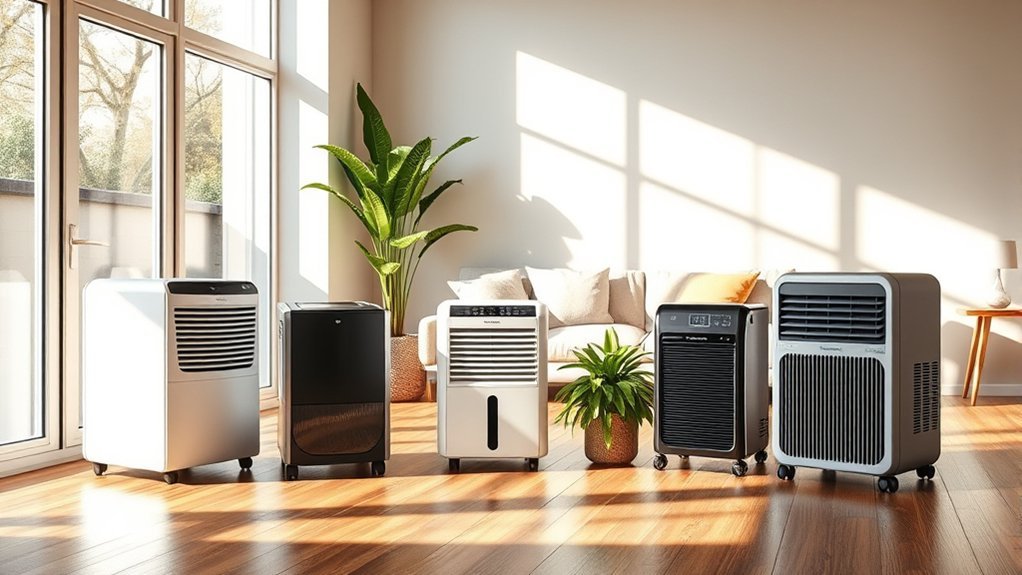
A dehumidifier starts removing water from the air after its compressor and fan begin operating, but that does not mean the whole room is immediately dry. In a closed space with a correctly sized unit, an independent hygrometer may show a lower relative humidity within a few hours. There is no universal time for reaching the target. Use the first 12–24 hours as an assessment window for an ordinary room, while very damp spaces and wet building materials can require several days and separate moisture testing.
Last updated: August 19, 2026
Quick Answer
A properly sized dehumidifier can begin collecting water soon after normal startup, and a separate hygrometer may show a lower relative humidity within a few hours. There is no fixed time for reaching the target. Use 12–24 hours as an assessment window for an ordinary enclosed room. Very damp, cold, open, or water-damaged spaces may take several days, and wet building materials should be evaluated separately rather than judged by room humidity alone.
Key Takeaways
- Water collection can begin soon after startup, but a stable room humidity may take hours or days.
- Treat 12–24 hours as a useful checkpoint, not a guaranteed drying time.
- Room size alone cannot predict drying time; starting humidity, temperature, airflow, leaks, and wet materials also matter.
- Use a hygrometer rather than comfort or bucket volume alone to confirm that relative humidity is falling.
- Keep normal living spaces around 30–50% relative humidity unless condensation risk, a medical professional, or a building specialist calls for a different target.
- A dehumidifier cannot repair leaks, remove standing water, or confirm that hidden building materials are fully dry.
At a Glance
| Time Required | A few hours may be enough to see an initial RH change; use 12–24 hours as a practical assessment window; severe dampness or wet materials can require several days or longer |
| Difficulty | Easy for ordinary humidity control; professional assessment may be needed after flooding, leaks, or persistent dampness |
| Tools Needed | Dehumidifier, separate hygrometer, suitable outlet, and an optional drain hose or circulation fan; water-damaged materials may also require a moisture meter or professional testing |
| Cost | Electricity, replacement filters when required, and possible drainage or moisture-source repairs |
How Long Does a Dehumidifier Take to Work?
A dehumidifier begins condensing water after the compressor starts and humid air moves across the cold coil. You may see water enter the bucket or drain line before the room feels different. A measurable change on an independent hygrometer may appear within a few hours, but there is no fixed countdown for reaching and maintaining the selected humidity.
It helps to separate the process into three milestones:
- Water removal begins: The unit starts collecting condensate after normal startup and any compressor-protection delay.
- Room humidity falls: A separate hygrometer shows a consistent downward trend.
- The space stabilizes: The unit begins cycling instead of running continuously, and the humidity remains near the target.
Note: A lower air-humidity reading does not prove that drywall, wood, concrete, insulation, carpet, or furniture is fully dry. Those materials may continue releasing stored moisture after the air begins to improve. After water damage, material moisture should be checked separately when complete structural drying matters.
What Do the First 12–24 Hours Tell You?
For an ordinary humidity problem, the first 12–24 hours are most useful as a diagnostic window. Do not expect every room to reach the final target in that time. Instead, look at the direction of the humidity reading and what happens when the unit cycles.
| What You Observe | What It Usually Means |
|---|---|
| RH falls steadily toward the target | The unit is removing moisture faster than the space is gaining it. Continue normal operation and let the humidistat cycle the unit after the target is reached. |
| RH changes very little and remains high | Check capacity, airflow, room temperature, open doors or windows, active leaks, drainage interruptions, and other moisture sources. |
| RH falls but rebounds quickly | Wet materials, humid outdoor air, exposed soil, leaks, or another continuing moisture source may be replenishing the air. |
| Air reaches the target but materials remain damp | Airborne humidity control is working, but structural drying is not necessarily complete. Use material-moisture measurements or qualified restoration guidance when water damage is involved. |
For general indoor moisture control, the U.S. Environmental Protection Agency recommends keeping indoor humidity below 60% and ideally around 30–50%. The best setting may vary with outdoor temperature, condensation risk, comfort, and health needs. In cold climates during heating season, a lower indoor RH may be needed to prevent condensation on cold windows and surfaces.
What Affects Dehumidifier Drying Time?
A dehumidifier’s drying time depends on the total moisture load, not only the room’s square footage. Starting RH, ceiling height, temperature, outdoor-air leakage, wet materials, and the machine’s tested capacity all affect how quickly the reading falls.
Room Size and Humidity
A small enclosed bedroom with moderately high humidity may respond within the same day. A large open basement with damp concrete, stored cardboard, an active leak, or humid outside air entering through gaps can take much longer, even with a powerful unit.
- Air volume: Large rooms and high ceilings contain more air to process.
- Starting humidity: A room at 80% RH has more excess moisture to remove than one at 60% RH.
- Wet materials: Wood, drywall, concrete, fabric, and carpet can release moisture back into the air.
- Outside-air leakage: Open windows, doors, vents, and foundation gaps can continuously add humidity.
- Active moisture sources: Leaks, exposed soil, unvented dryers, cooking, showers, and drying laundry increase the load.
Close windows and exterior doors during ordinary dehumidification when the outdoor air is humid. Keep interior doors open only when the unit is sized to treat the connected rooms. A portable unit may work faster when it is initially confined to the dampest room.
Capacity and Airflow
Capacity is measured in pints of water removed during 24 hours under specified laboratory conditions. It is not the bucket size, and it does not guarantee that the appliance will collect the labeled amount in your home every day. Cooler temperatures, lower RH, restricted airflow, and cycling all reduce real-world collection.
The current DOE/ENERGY STAR testing explanation also matters when comparing units. Newer portable-dehumidifier ratings use a test procedure with a 65°F condition, while older ratings were produced under warmer conditions. That means an older and newer machine with different pint ratings may still serve a similar use case, so compare ratings made under the current test method rather than assuming the larger historical number is automatically stronger.
The current ENERGY STAR dehumidifier guidance recommends sizing a unit using both the size of the space and how damp it is. A slightly damp room needs less capacity than a wet room of the same size.
| Factor | Effect on Drying |
|---|---|
| Correctly sized capacity | Provides enough water-removal ability for the space and dampness level |
| Clear intake and discharge | Allows the rated airflow to pass through the machine |
| Open or connected rooms | Increases the volume and moisture load the unit must handle |
| Clean filter and coils | Supports airflow and heat exchange |
| Continuous drainage | Prevents shutdown when the collection bucket fills |
Temperature and Moisture Sources
Most refrigerant dehumidifiers remove less water in cool conditions. The evaporator coil may frost, causing the unit to pause for automatic defrosting. ENERGY STAR notes that frost can become a performance concern below about 65°F for units that are not designed for lower-temperature operation. Every appliance still has its own approved operating range.
Do not rely on a universal wall-clearance rule. Place the machine on a level surface and follow the owner’s manual for the required intake and discharge space. Keep curtains, boxes, furniture, and walls from blocking airflow.
How Long Does a Dehumidifier Take by Room Size?
Room size provides only a starting point. The ranges below are planning expectations for a correctly sized unit, not guarantees. Begin with a hygrometer reading, run the appliance under stable conditions, and compare the reading after several hours and again within the first 12–24 hours.
| Space and Condition | Reasonable Expectation |
|---|---|
| Small, closed room with moderate humidity | A measurable RH drop may appear within a few hours, with the target potentially reached the same day. |
| Medium room or connected living area | Use the first 12–24 hours to judge whether RH is moving steadily toward the target, provided no major moisture source remains. |
| Large, open, or very humid area | Initial improvement may take longer, while stabilization can require several days when the moisture load remains high. |
| Water-damaged room or wet materials | The air may improve before materials dry. Begin drying immediately; EPA recommends drying wet materials within 24–48 hours when possible to reduce mold risk. Extraction, air movement, moisture testing, removal of damaged materials, or professional restoration may be necessary. |
Judge a dehumidifier by the humidity trend and the condition of the space, not by a fixed countdown based only on square footage.
Recommended Products

Semiconductor dehumidifiers use thermoelectric cooling to remove moisture from the air. They create a drier, more comfortable environment by reducing humidity and improving air quality.

Maintain the Right Room Temperature and Humidity Levels: This wireless indoor thermometer/hygrometer combination is perfect to pair with humidifiers or dehumidifiers

POWERFUL 2,500 SQ. FT. COVERAGE - Stop letting sticky, heavy air dictate your comfort. The BANABIE dehumidifier utilizes a high-efficiency rotary compressor to deliver heavy-duty moisture removal, extracting 32 pints daily (at 95°F, 90%RH). Engineered with a smart integrated airflow system, this unit effectively covers up to 2,500 Sq. Ft., ensuring that your basement, crawl space, or large open floor plans stay bone-dry
How Long Do Dehumidifiers Take in Basements and Crawl Spaces?
A basement or crawl-space dehumidifier may lower airborne humidity within the first day, but persistent moisture can keep the machine running for several days or continuously. Foundation seepage, exposed soil, outdoor-air entry, wet concrete, plumbing leaks, and poor drainage must be corrected for lasting control.
Recommended Products

120 PPD Crawl Space Dehumidifier: The Sentinel HD55S Energy Star Certified dehumidifier removes up to 120 pints of moisture per day at saturation (55 PPD at AHAM) and effectively controls humidity in spaces up to 1,300 sq. ft. Its rugged metal housing is built for demanding environments and long-term reliability, making it ideal for crawl spaces, basements, warehouses, offices, factories, and storage areas

Specially Designed for Crawl Spaces— The AIUSEVO commercial dehumidifier features a high-performance compressor and a powerful 265 CFM airflow, removes up to 125 pint/d(at 95°F, 90% RH). Covers up to 6500 sq. ft. It can keep humidity at an ideal level and prevent excessive moisture from damaging your personal belongings. With compact dimensions of 19.3" x 17.8" x 17.5" , it fits between floor joists and in low-clearance crawl spaces. Ideal for Garage,warehouses, offices, factories, shops

PRO-GRADE 70-PINT PERFORMANCE – This AlorAir Crawl Space Dehumidifier removes up to 70 pints per day under saturated conditions (35 pints per day under AHAM standards). The advanced R32 system efficiently controls humidity in areas up to 1,000 sq. ft. Ideal for crawl spaces, basements, garages, attics, commercial and industrial environments. Serious performance meets modern efficiency.
Basement Drying Timelines
In a basement with normal seasonal humidity, a correctly sized unit should show a downward RH trend during the first 12–24 hours even if it has not fully stabilized. A very damp basement may require several days before the humidity settles near the target, especially when concrete, boxes, carpets, or furniture have absorbed moisture.
- Use a separate hygrometer: Place it away from the dehumidifier’s discharge air.
- Inspect for seepage: Look at walls, floors, windows, plumbing, and the sump system.
- Use continuous drainage: A properly routed hose or condensate pump prevents full-bucket shutdown.
- Reduce stored absorbent material: Cardboard and fabrics can hold moisture and support mold.
- Check adjacent rooms: An open stairwell or connected utility area increases the treated volume.
Crawl Space Drying Factors
Crawl spaces do not automatically dry faster than basements. Ground moisture, seepage, humid outdoor air, and air leakage can create a continuous load. Depending on the crawl-space design and local building requirements, moisture control may involve a ground vapor retarder, drainage improvements, air sealing, an appropriate venting or encapsulation strategy, and a dehumidifier sized for the actual conditions.
For crawl-space or whole-space equipment, compare the pints-per-day rating at stated test conditions, airflow, drainage method, operating-temperature range, noise, electrical requirements, ducting options, and installation clearances. Manufacturer coverage figures are planning estimates, not guarantees of drying time.
Warning: Do not place or plug in a dehumidifier where you are standing in water. After flooding, have the electrical system checked when necessary and remove standing water safely. EPA recommends drying wet materials within 24–48 hours when possible to reduce mold risk. If visible mold is already present after a flood, EPA advises gently cleaning the visible mold before starting fans or dehumidifiers so airflow does not spread contamination. Extensive mold, contaminated floodwater, or major structural wetting may require qualified restoration help.
How Can You Make a Dehumidifier Work Faster?
The fastest setup is one that stops new moisture from entering, gives the unit unrestricted airflow, and allows it to run without full-bucket interruptions.
- Fix the moisture source. Repair leaks, improve drainage, vent dryers outdoors, use kitchen and bathroom exhaust fans, and control ground moisture in crawl spaces where appropriate.
- Close humid outdoor air out. During ordinary operation, close exterior windows and doors when the outdoor air is damp.
- Follow the placement instructions. Keep the intake and discharge clear according to the owner’s manual rather than using a universal distance.
- Use the correct capacity. Size the unit for both the treated area and the dampness level.
- Use continuous drainage when possible. Ensure a gravity hose follows the required route or use the specified pump arrangement.
- Clean the filter. Follow the manufacturer’s cleaning or replacement schedule.
- Use air movement safely. Fans can move humid air toward the unit during ordinary drying, but after flooding EPA advises cleaning visible mold before starting fans or dehumidifiers so airflow does not spread contamination.
- Keep the room within the operating range. Excessively cool conditions may reduce extraction or trigger defrost cycles.
- Measure with a separate hygrometer. Built-in sensors may read differently because they sit inside the appliance’s airflow.
Pro Tip: Record the starting humidity, room temperature, and time. Check the reading from the same location after two to four hours and again within the first 12–24 hours. A steady downward trend is more useful than how quickly the bucket fills.
Why Does a Dehumidifier Take Longer Sometimes?
A dehumidifier may run much longer when the moisture load exceeds its removal rate. The following conditions commonly slow progress:
- The room is larger or more open than the unit was selected to handle.
- Doors, windows, crawl-space openings, or foundation gaps admit humid outside air.
- A leak, exposed soil, wet laundry, shower, dryer, or cooking activity adds moisture.
- Concrete, drywall, carpet, furniture, or framing is releasing stored water.
- The room temperature is near or below the model’s efficient operating range.
- The filter, intake, discharge, or coil is dirty or obstructed.
- The bucket is full, incorrectly seated, or activating the shutoff switch.
- The unit is defrosting or waiting through a compressor-protection delay.
- The setpoint is lower than the machine can reasonably maintain in that space.
- The dehumidifier is undersized, damaged, or affected by a drainage problem.
How Do You Measure Dehumidifier Progress?
Use a separate digital hygrometer placed in the occupied part of the room, away from the dehumidifier’s outlet, windows, vents, and direct sunlight. Built-in displays can differ from a room sensor because the appliance measures air near its intake.
- Record the starting RH and temperature.
- Set the dehumidifier to about 45–50% RH for an initial test.
- Run it under stable conditions with the room configured as it will normally be used.
- Check the independent hygrometer after two to four hours.
- Check again within the first 12–24 hours.
- Confirm that the humidity stays near the target after the unit begins cycling.
A falling reading, water in the bucket or drain, warmer dry air leaving the unit, and reduced condensation are all useful signs. However, tank volume alone is not a reliable performance test because collection naturally slows as the room becomes drier. For more detail on interpreting condensate volume, see how much water a dehumidifier should collect per day.
After a flood or major leak, do not use room RH as the only stopping rule. A room can reach a normal airborne humidity while drywall, framing, subflooring, insulation, carpet, or concrete still contains excess moisture. Structural drying should be confirmed with appropriate material-moisture measurements or qualified restoration guidance when the damage is significant.
What if the Dehumidifier Is Not Collecting Water?
An empty bucket does not always mean the unit is broken. Check these common causes:
| Symptom or Cause | What to Check |
|---|---|
| Room humidity is already near the setting | Confirm the RH with a separate hygrometer and temporarily choose a slightly lower setting for testing. |
| Fan runs but compressor has not started | Allow for the normal restart delay described in the manual. |
| Bucket warning remains on | Empty and reseat the bucket so it correctly engages the safety switch. |
| Airflow feels weak | Clean the filter and grille and remove anything blocking the intake or discharge. |
| Ice or frequent defrosting | Check the room temperature and the model’s approved operating range. |
| Drain hose is connected but no water exits | Inspect for kinks, upward sections, loose fittings, blockage, or an incorrectly configured pump. For a full drainage checklist, see why a dehumidifier may not drain through the hose. |
| Humidity remains high after the first 12–24 hours | Look for leaks, outdoor-air entry, an oversized connected area, wet materials, low temperature, restricted airflow, or an undersized machine. |
If the appliance overheats, smells hot, makes unusual electrical noises, repeatedly trips a breaker, or has a damaged cord, unplug it and stop using it. Check the model against the U.S. Consumer Product Safety Commission’s dehumidifier recall information. Follow the appliance manufacturer’s instructions for outlet, cord, and electrical requirements rather than assuming an extension cord or adapter is acceptable.
Which Dehumidifier Is Best for Fast Drying?
The best dehumidifier for fast drying is one sized for the space, dampness level, temperature, drainage arrangement, and airflow path. Higher capacity can shorten the initial drying phase when the moisture load is high, but a larger unit is not a substitute for repairing water entry or distributing air through separate rooms.
Compare these features:
- Current pints-per-day rating: Use a rating produced under current test conditions rather than comparing an old and new pint number as though they were identical.
- Recommended dampness level: Follow current sizing guidance rather than floor area alone.
- Operating-temperature range: This is especially important in basements, garages, and crawl spaces.
- Airflow and ducting: Whole-space or ducted units may distribute dry air more effectively through difficult layouts.
- Drainage: Choose gravity drainage or a condensate pump that fits the installation.
- Humidistat: An adjustable control allows the unit to cycle after reaching the target.
- Energy efficiency: ENERGY STAR certification can reduce electricity use compared with a similarly sized conventional model.
- Service access: Filters, coils, pumps, and drain lines should be easy to inspect and maintain.
Recommended Products

125-Pint Crawl Space Dehumidifier - This powerful 125-pint commercial dehumidifier features a high-brush motor and up to 177 CFM rated circulation, capable of extracting up to 125 pints of water per day (95°F, 90% RH). It effectively reduces humidity in spaces up to 6,500 sq. ft. The adjustable humidity range of 10%-90% RH provides greater control than most models (20%-80% RH). Well-suited for commercial and industrial facilities, crawlspaces, storage rooms, garages, living areas, and offices

[Commercial Grade Dehumidifier] This Airzentti crawl space dehumidifier with large capacity removes moisture from basement, attic, large room and small rooms efficiently up to 155 pints per day under nearly saturated condition (70 PPD in AHAM), with 220 CFM airflow, it is ideal for space up to 7,500 square feet.

【Waykar Dehumidifier For Spaces Up To 7,000 Sq. Ft.】Our dehumidifier are able to remove up to 150 pints (under 95°F, 90%RH condition) of moisture per day, which cover areas up to 7,000 Sq. Ft. and adjust humidity from 30% to 80%. It is a dehumidifier ideal for home, basement, wine cellars, garages, supermarkets, concourses, and other indoor/outdoor places,cellars, crawlspace, large spaces, etc.
Frequently Asked Questions
How do I know if a dehumidifier is working?
Check for a downward humidity trend on a separate hygrometer, water entering the bucket or drain, dry and slightly warmer discharge air, and less condensation or musty odor. Give the unit several hours under stable conditions before judging it. An empty tank can be normal when the room is already near the selected humidity.
Can a dehumidifier help with dust mites?
It may help when it keeps indoor humidity consistently below about 50%. Research indexed by the National Library of Medicine found substantial reductions in mites and allergens after sustained low-humidity control. The benefit develops over time and should be combined with cleaning, bedding care, and other allergy-management measures.
Should you use a dehumidifier if you have COPD?
A dehumidifier may improve comfort when indoor air is excessively humid, but it is not a COPD treatment and is not automatically appropriate for everyone. Measure the humidity, avoid both very damp and excessively dry air, and follow your personal COPD action plan. NHS guidance notes that hot weather and humidity can worsen breathing for some people with COPD. Contact a healthcare professional if breathlessness, coughing, sputum, wheezing, or other symptoms worsen.
Will a dehumidifier help with gnats?
A dehumidifier may make a persistently damp room less favorable, but it will not solve most fungus-gnat infestations by itself. Fungus gnats commonly breed in continually wet potting soil. The University of Minnesota Extension recommends avoiding excess soil moisture and using sticky traps as part of indoor-plant pest management.
Should a dehumidifier run continuously at first?
Continuous mode can be useful during an initial assessment if the owner’s manual permits it, the filter and airflow path are clear, and drainage and electrical setup are safe. Once the target is reached, a humidistat-controlled unit should cycle as needed rather than being forced to run continuously.
Why does my dehumidifier run all day?
The setpoint may be too low, the unit may be undersized, or moisture may be continuously entering through leaks, open doors, outdoor air, wet materials, soil, laundry, or plumbing. Confirm the room RH with a separate hygrometer and inspect the space before assuming the appliance is faulty.
What humidity setting should I use?
A setting around 45–50% RH is a practical starting point for many homes. Adjust it to prevent condensation while maintaining comfort. In cold climates, a lower winter setting may be necessary to prevent condensation on cold windows or surfaces. Avoid forcing the humidity unnecessarily low, and consider professional or medical advice when a building problem or respiratory condition affects the appropriate target.
How long should I run a dehumidifier after a leak?
Do not use a fixed number of hours as the stopping rule after water damage. Start drying immediately; EPA recommends drying wet materials within 24–48 hours when possible to reduce mold risk. Continue appropriate drying until affected materials are actually dry, using material-moisture measurements or qualified restoration guidance when necessary. A normal room-humidity reading alone does not prove that walls, floors, insulation, or framing are dry.
Conclusion
How long a dehumidifier takes to work depends on what you are measuring. Water removal can begin soon after startup, and an independent hygrometer may show a noticeable RH change within a few hours. Use the first 12–24 hours as an assessment window rather than a guaranteed completion time. Large, cold, open, or heavily damp spaces can require several days.
For the best result, match the unit to the space and dampness level, stop new moisture from entering, follow the manufacturer’s placement instructions, use continuous drainage when appropriate, and track the room with a separate hygrometer. After a flood or major leak, begin drying immediately and do not assume a normal air-humidity reading means hidden materials are dry.
Sources
- ENERGY STAR: Dehumidifiers — capacity, sizing, operating temperature, drainage, placement, humidity, and efficiency guidance
- ENERGY STAR: Dehumidifier Testing and Capacity — DOE capacity ratings, pints per day, and current portable-dehumidifier test conditions
- U.S. EPA: A Brief Guide to Mold, Moisture and Your Home — indoor humidity, moisture control, mold prevention, and 24–48-hour wet-material guidance
- U.S. EPA: Flood Cleanup to Protect Indoor Air and Your Health — flood drying, visible mold, fans, dehumidifiers, and contamination precautions
- U.S. Consumer Product Safety Commission: Dehumidifier Recalls — overheating, fire hazards, and recalled-model checks
- National Library of Medicine: Relative Humidity and Dust-Mite Control — evidence on sustained humidity reduction and mite allergens
- NHS: Living With COPD — hot weather, humidity, respiratory triggers, and symptom management
- University of Minnesota Extension: Managing Insects on Indoor Plants — indoor-plant pests, fungus gnats, moisture, and sticky-trap guidance

[…] minutes to set up, then 12 to 24 hours to judge the first […]