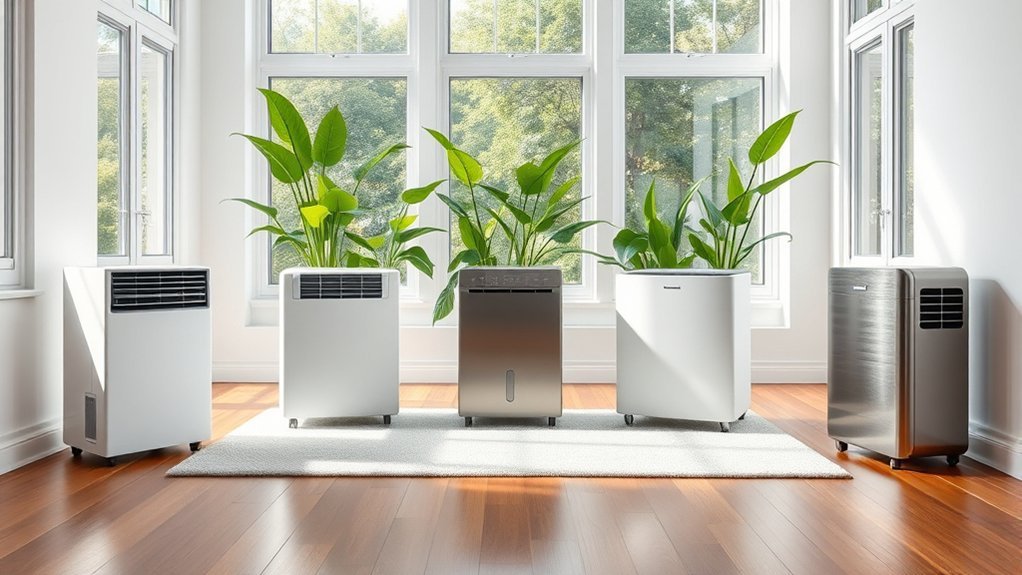
If you’re choosing a 50-pint or large-capacity dehumidifier in 2026, the best pick depends on your room size, humidity level, drainage setup, noise tolerance, and energy use. This guide compares portable high-capacity models from Waykar, Manastin, Gasbye, DECIUU, AEOCKY, avylo, and Landeagle for basements, garages, laundry rooms, large bedrooms, offices, and other damp spaces. Instead of choosing only by the biggest pint or square-foot claim, compare the test conditions behind the capacity rating, gravity-drain or pump options, tank size, operating noise, ENERGY STAR information, controls, and maintenance needs.
Affiliate disclosure: This article contains affiliate links. If you buy through them, we may earn a commission at no extra cost to you.
Selection note: Dehumidifier pint ratings can be measured under different temperature and humidity conditions, so a larger advertised number is not automatically a better real-world match. Use room dampness, drainage, noise, and verified efficiency information together when comparing models.
Quick Verdict
Best overall large-space pick: Waykar Energy Star Dehumidifier for Basement & Home because it offers very high moisture removal, wide coverage, quiet operation, and flexible drainage.
Best automatic-control efficiency pick: AEOCKY 4500 Sq.Ft Energy Star Most Efficient 2025 Dehumidifier because it focuses on efficiency, intelligent humidity control, and quiet daily use.
Best hands-free drainage pick: AEOCKY 4500 Sq.Ft Energy Star Dehumidifier with Pump or avylo Basement Dehumidifier with Pump if you need water moved upward instead of relying only on gravity drainage.
| Product | Best For | Key Strength | Amazon |
|---|---|---|---|
| Waykar Energy Star Dehumidifier for Basement & Home | Large basements and humid homes | High capacity with quiet operation | Check Price |
| Manastin 5000 Sq.Ft 52-Pint Dehumidifier with Drain Hose | Basements, laundry rooms, bedrooms, and offices | Drain hose and multi-mode use | Check Price |
| Gasbye 4500 Sq.Ft. Energy Star Dehumidifier for Basements | Large basements and garages | Energy Star focus with multiple modes | Check Price |
| DECIUU 100 Pint Energy Star Dehumidifier | Large damp storage areas and basements | Smart humidity control and mobility | Check Price |
| AEOCKY 4500 Sq.Ft Energy Star Most Efficient 2025 Dehumidifier | Large homes and quiet spaces | Intelligent humidistat and efficiency | Check Price |
| avylo Basement Dehumidifier with Pump, 90 Pint/Day | Basements needing pump drainage | Built-in pump and quiet use | Check Price |
| AEOCKY 4500 Sq.Ft Energy Star Dehumidifier with Pump | Hands-free basement drainage | 360° auto-drainage pump | Check Price |
| Landeagle 6000 Sq. Ft Dehumidifier with Drain Hose | Large multi-room areas | Quiet operation and oscillation | Check Price |
| Waykar 150 Pint Energy Star Dehumidifier with Pump | Huge spaces, garages, and warehouses | Very high capacity with pump drainage | Check Price |
Waykar Energy Star Dehumidifier for Basement & Home
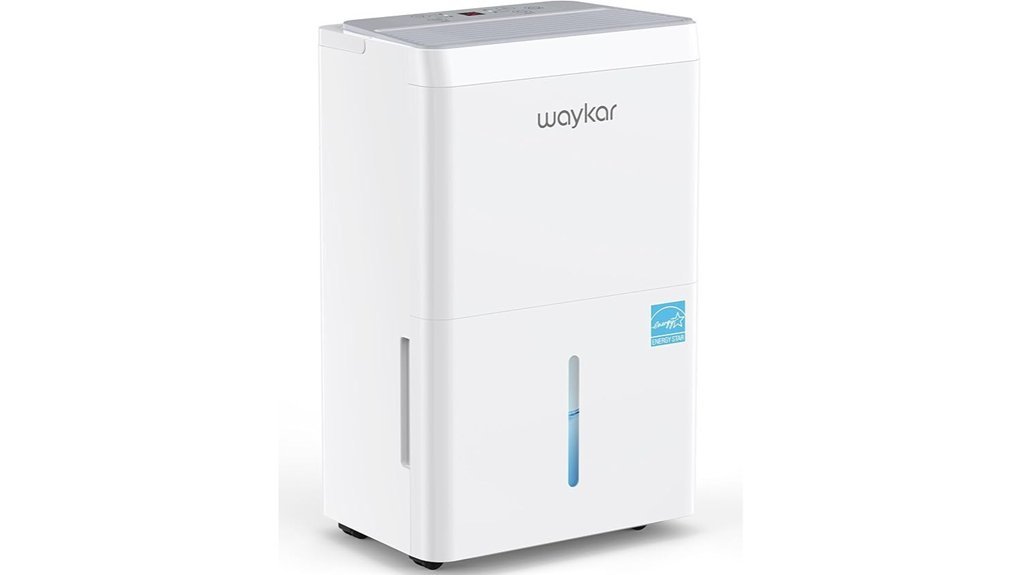
Best Overall for Large Basements
The Waykar Energy Star Dehumidifier is a strong fit if you need serious moisture control for a large basement or humid home. Its current listing advertises up to 120 pints a day at 95°F and 90% RH and coverage up to 6,000 sq. ft., so it is aimed at large, damp areas rather than light-duty rooms. The listing also carries ENERGY STAR information and specifies operation as low as 40 dB, making it a strong option when capacity and noise both matter.
The smart auto comfort mode is designed to help hold a target humidity without constant adjustment. You can drain it with the tank or hose and move it when you need to reposition it. This is a good option if you want one powerful unit for a basement, large living area, or humid home zone.
Why You’ll Like It: It balances power, efficiency, quiet operation, and flexible drainage, which are the four features most buyers need in a large-space dehumidifier.
Best For: Large basements, humid homes, and other sizable spaces that need powerful, energy-efficient moisture control with quiet operation.
Who Should Avoid It: Skip it if you only need a compact dehumidifier for a small room, closet, bathroom, or very light humidity issue.
Pros:
- Advertised for up to 120 pints/day at 95°F and 90% RH and coverage up to 6,000 sq. ft.
- Current product information shows ENERGY STAR certification for improved energy efficiency.
- Quiet 40 dB operation with smart auto comfort mode and flexible drainage options.
Cons:
- May be larger and heavier than smaller dehumidifiers, so it’s less ideal for compact spaces.
- High-capacity units can be more expensive than basic models.
- Best performance is focused on large, humid areas rather than light-duty use.
Manastin 5000 Sq.Ft 52-Pint Dehumidifier with Drain Hose
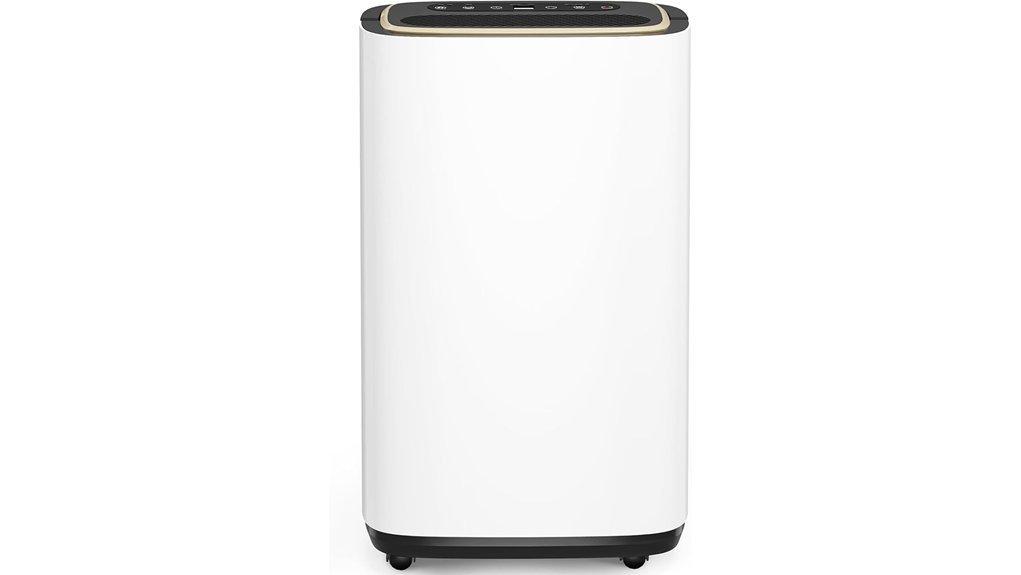
Best for Flexible Everyday Use
Need steady moisture control for a large space without making the setup complicated? The Manastin 5000 Sq.Ft 52-Pint Dehumidifier with Drain Hose is marketed for large spaces and offers up to 52 pints a day of moisture removal, with the exact output depending on room temperature and humidity. It is a practical choice if you want a unit that can handle daily humidity problems but still feels easy to operate.
You can switch between dehumidify, dry clothes, and circulate air modes, while the compact white-and-gold design fits neatly into your space. Use the 1.6-gallon tank when you want portability, or connect the drain hose for continuous operation. Its quiet, energy-saving compressor, auto shutoff, washable filter, and child lock help you stay comfortable and safe.
Why You’ll Like It: It gives you useful daily features without forcing you into a complicated pump setup. The included hose is helpful if you plan to run it in a basement or laundry area for long periods.
Best For: Homeowners, renters, and office users needing powerful, continuous moisture control in large spaces like basements, laundry rooms, and bedrooms.
Who Should Avoid It: Avoid it if you need pump-assisted drainage upward into a sink, window, or higher drain point.
Pros:
- Covers up to 5,000 sq. ft. with 52 pints/day of dehumidification for large areas.
- Offers both a 1.6-gallon tank and a drain hose for flexible or nonstop use.
- Includes useful features like quiet operation, auto shutoff, washable filter, and child lock.
Cons:
- The 1.6-gallon tank may still need regular emptying without the drain hose.
- At 52 pints/day, it may be more capacity than needed for smaller rooms.
- Requires maintenance such as filter cleaning to keep performance optimal.
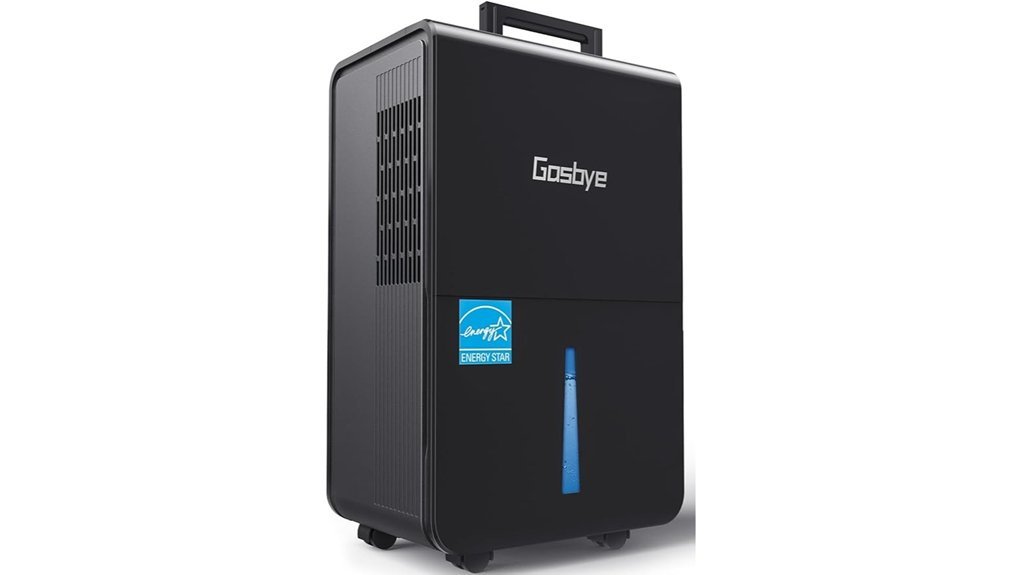
Gasbye 4500 Sq.Ft. Energy Star Dehumidifier for Basements
Best Energy-Focused Basement Pick
Gasbye’s 4500 sq. ft. coverage makes it a smart pick for big, damp basements. You get the DryPrime model, which pulls up to 115 pints a day in muggy conditions and still handles cooler rooms well. Its current listing carries 2026 ENERGY STAR wording, which makes energy efficiency a meaningful comparison point without relying on an unverified percentage-savings claim.
At 45 dB according to the listing, it is positioned as a quieter high-capacity option. You can choose Normal, Turbo, Comfort, or Continuous mode and use the tank or continuous-drain setup, giving you flexibility for long basement runs.
Why You’ll Like It: It focuses on the two things basement buyers usually care about most: keeping moisture under control and avoiding wasteful energy use.
Best For: Homeowners with large basements, garages, or damp living areas who want a quiet, energy-efficient dehumidifier with flexible drainage options.
Who Should Avoid It: It may not be the easiest choice if you need a very lightweight unit that you plan to carry between floors often.
Pros:
- Covers up to 4,500 sq. ft. and removes up to 115 pints per day in humid conditions.
- Current listing identifies the model as ENERGY STAR certified.
- Quiet 45dB operation with multiple modes and convenient tank, hose, and adapter drainage options.
Cons:
- At 43 pounds, it may be cumbersome to move around.
- The 1.7-gallon tank may require frequent emptying if you don’t use continuous drainage.
- Best suited for larger spaces, so it may be overkill for small rooms.
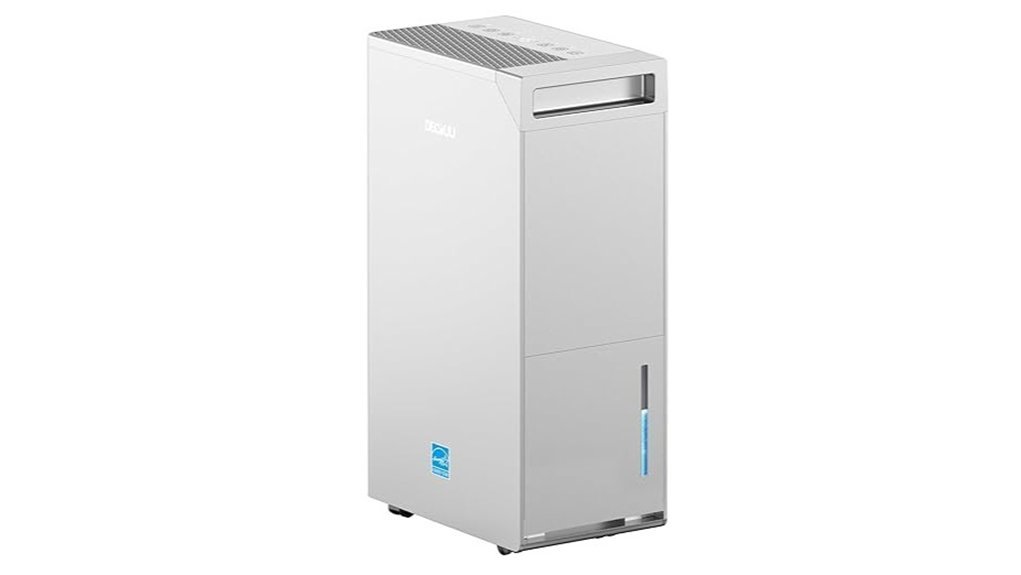
DECIUU 100 Pint Energy Star Dehumidifier
Best for Smart Humidity Control
DECIUU’s Max 100 Pint Dehumidifier suits you if you need powerful coverage for large, damp spaces. Its current listing advertises coverage up to 5,000 sq. ft. and up to 100 pints per day under high-humidity conditions. The listing also presents it as an ENERGY STAR model, so it is worth comparing its efficiency information alongside capacity and drainage.
You’ll appreciate the smart humidity sensor, adjustable 35% to 80% settings, and memory chip that restores your preferences. Use the hose adapter or tank with auto shut-off, and move it easily on swivel wheels. This makes it easier to place in a basement, garage, storage room, or other damp area where humidity changes throughout the day.
Why You’ll Like It: It gives you more control over the target humidity range, which helps prevent over-drying while still managing dampness.
Best For: Homeowners or property managers who need a powerful, energy-efficient dehumidifier for large, damp areas like basements, garages, or storage spaces.
Who Should Avoid It: It is not the most practical choice for small bedrooms or areas where a compact low-capacity unit would already be enough.
Pros:
- Advertised for spaces up to 5,000 sq. ft., with up to 100-pint/day output under high-humidity test conditions.
- ENERGY STAR certified and designed for improved efficiency with stable, reliable performance.
- Offers flexible drainage, smart humidity control, and easy mobility with swivel wheels.
Cons:
- May be more dehumidifier than needed for smaller rooms or light moisture problems.
- At 5,000 sq. ft. coverage, it is likely bulkier and less discreet than compact models.
- Continuous drainage setup or tank emptying may still require regular maintenance.
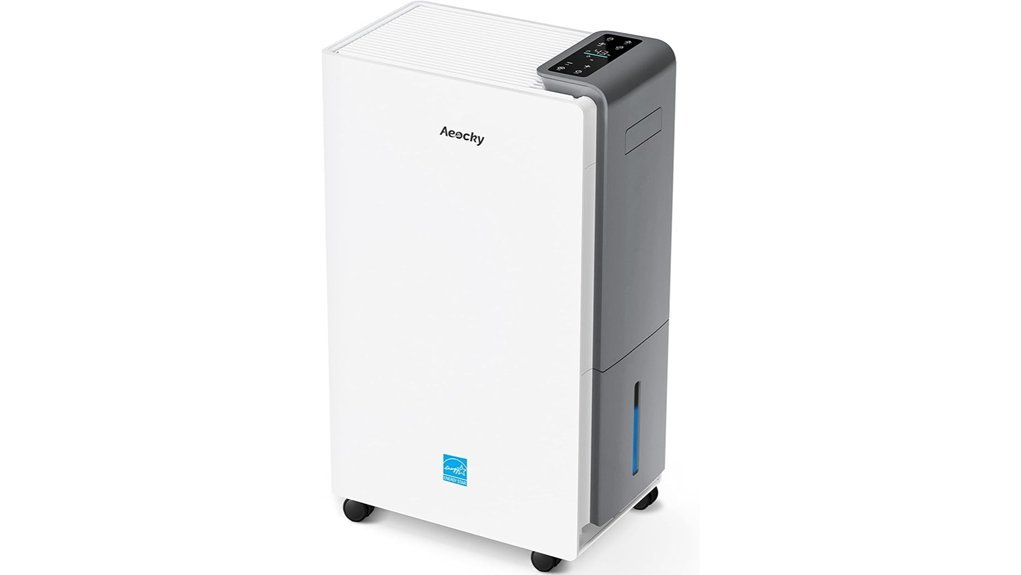
AEOCKY 4500 Sq.Ft Energy Star Most Efficient 2025 Dehumidifier
Best Intelligent Humidistat Pick
If you want an automatic, efficient dehumidifier for a large home, AEOCKY stands out. The current listing identifies this model as ENERGY STAR Most Efficient 2025 and rates the 4,500-sq.-ft. variant at up to 80 pints per day. That makes it a strong fit for buyers who prioritize automatic humidity control and efficiency without needing a built-in pump.
You’ll appreciate its intelligent humidistat, automatic control, power-off memory, drain-hose support, and quiet-use focus. Its relatively slim footprint also makes it easier to place in a basement, bedroom, office, or other frequently used room. This is a strong option if you want automatic humidity controls but do not need a built-in pump.
Why You’ll Like It: It is built for people who want automatic humidity control, lower energy use, and quieter operation in spaces they use every day.
Best For: Homeowners with large, humid spaces who want an energy-efficient, automatic dehumidifier for basements, bedrooms, or other large living spaces.
Who Should Avoid It: Choose a pump model instead if your drain point is higher than the dehumidifier or far from the floor drain.
Pros:
- ENERGY STAR Most Efficient 2025 certified, offering strong energy savings and high efficiency.
- Up to 80-pint/day capacity with intelligent humidity control and power-off memory.
- Quiet-use design, drain-hose support, and a relatively compact footprint for a large-space unit.
Cons:
- Best suited for larger spaces, so it may be overkill for small rooms.
- Advanced controls and components may come at a higher upfront cost.
- Performance benefits are most noticeable in consistently humid environments rather than mild ones.
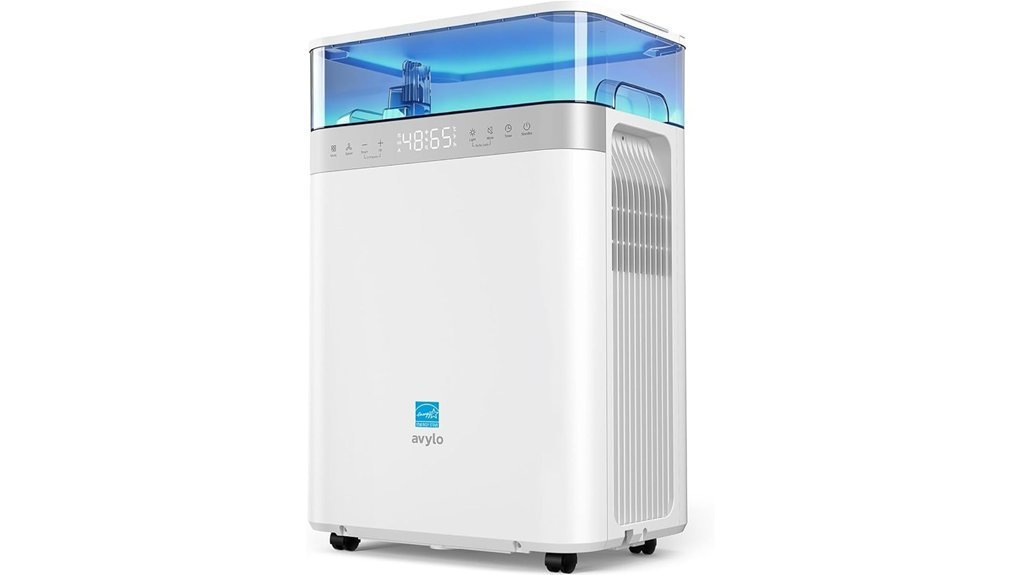
avylo Basement Dehumidifier with Pump, 90 Pint/Day
Best for Pump-Assisted Basement Drainage
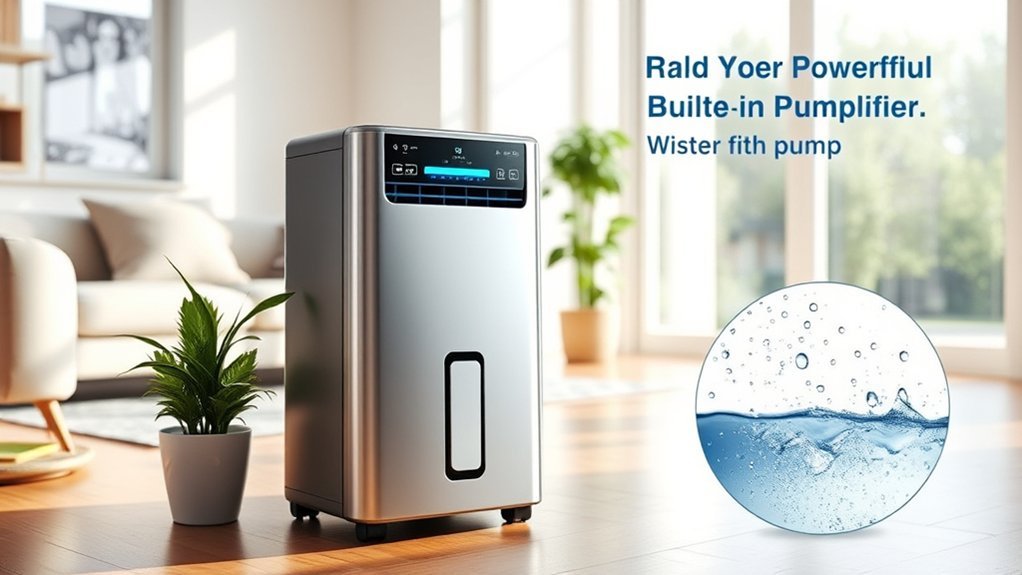
The avylo Basement Dehumidifier with Pump suits large, damp spaces that need steady, hands-free moisture control. Its current listing advertises up to 90 pints a day at 90°F and 90% RH for large spaces and identifies the model as ENERGY STAR Most Efficient 2025. The listing also states an efficiency figure of 2.05 L/kWh, but actual electricity cost will depend on runtime and your local utility rate.
The 2.11-gallon top tank includes a full-tank reminder and auto shut-off, while the built-in pump gives you upward-drain flexibility when gravity drainage is not practical. You get three fan speeds, operation listed as low as 41 dB, a timer, child lock, and wheels and handles for easier placement. This is especially useful in basements where the drain, sink, or window is not at floor level.
Why You’ll Like It: The built-in pump reduces the need to empty buckets and gives you more freedom to place the unit where it works best.
Best For: Large basements, damp living areas, or homeowners who want a quiet, energy-efficient dehumidifier with pump-assisted continuous drainage.
Who Should Avoid It: Skip it if you only need simple gravity drainage and want the lowest-maintenance basic setup.
Pros:
- Advertised for up to 90 pints/day at 90°F and 90% RH for large-space use.
- ENERGY STAR Most Efficient 2025 listing with a stated 2.05 L/kWh efficiency figure.
- Quiet 41 dB operation with useful extras like a 24-hour timer, child lock, and easy mobility.
Cons:
- The 2.11-gallon tank may still need manual emptying if continuous drainage isn’t used.
- Best suited for larger spaces, so it may be overkill for smaller rooms.
- Built-in pump and extra features may make it more complex than a basic dehumidifier.
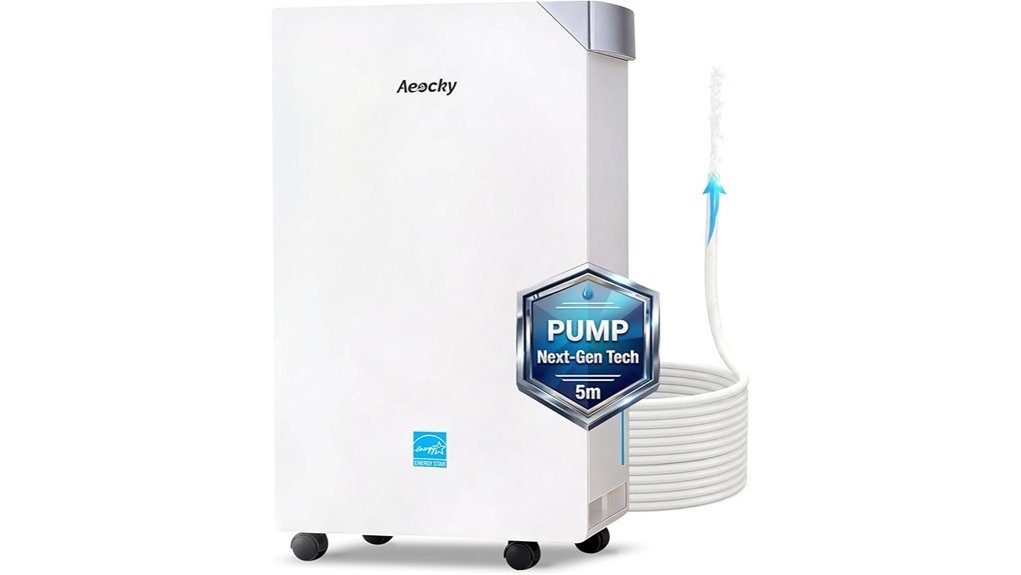
AEOCKY 4500 Sq.Ft Energy Star Dehumidifier with Pump
Best Hands-Free Pump Pick
AEOCKY’s 4500 Sq.Ft Energy Star Dehumidifier with Pump suits you if you want hands-free drainage and top efficiency. You get the LEO-001 model with a 360° auto-drainage pump, so you are not limited to a floor-level drain. The current listing rates it for up to 80 pints per day and up to 4,500 sq. ft., with pump drainage designed to move water upward.
The current listing identifies it as ENERGY STAR Most Efficient 2025 and specifies upward pump drainage of up to about 5 meters. You also get an intelligent humidistat, drain-hose support, and low-vibration operation for basements, garages, bedrooms, or other damp rooms.
Why You’ll Like It: It combines efficient performance, pump drainage, and automatic humidity control, making it one of the easier choices for set-and-forget basement use.
Best For: Homeowners who want a high-efficiency, Energy Star certified dehumidifier with hands-free pump drainage for basements, bedrooms, garages, or other damp spaces.
Who Should Avoid It: It may be more than you need if your room is small and you can easily drain by gravity into a floor drain.
Pros:
- 360° auto-drainage pump supports hands-free continuous drainage when correctly connected.
- ENERGY STAR Most Efficient 2025 certification signals excellent energy savings and performance.
- Intelligent humidity control, low-vibration operation, and pump-assisted drainage.
Cons:
- Pump models can be more complex to maintain than basic dehumidifiers.
- Likely heavier and less portable than smaller unit designs.
- Premium features and certification may come with a higher upfront cost.
Landeagle 6000 Sq. Ft Dehumidifier with Drain Hose
Best Quiet Large-Room Pick
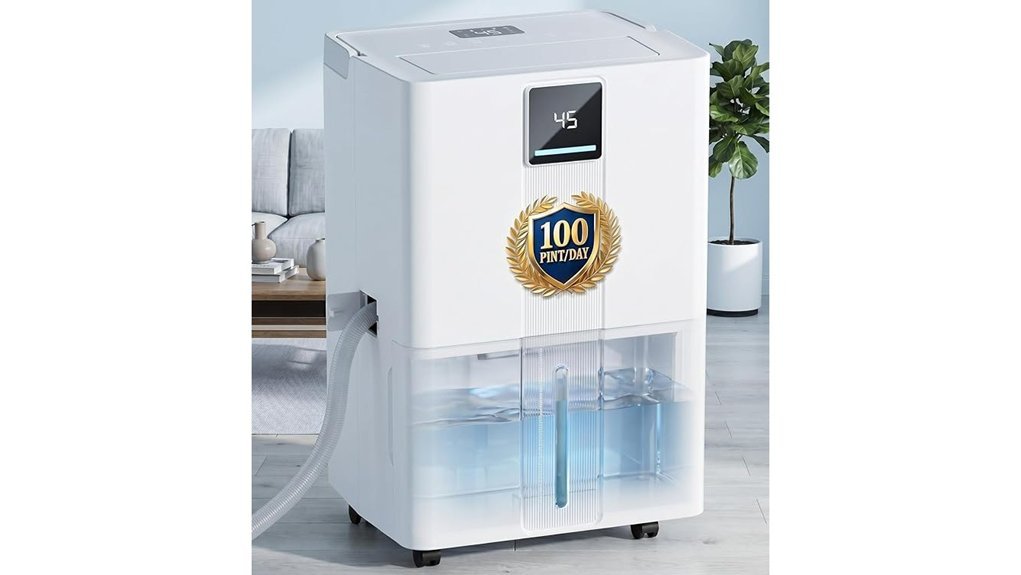
Landeagle’s 100-pint capacity suits you if you need serious dehumidifying power for large spaces. The listing advertises coverage up to 6,000 sq. ft., and its 120° oscillation is marketed as widening airflow coverage for more even circulation. This makes it useful for open basements, multi-room areas, garages, and other large humid zones.
Use Dry Mode to speed laundry drying, Auto Mode to hold your target humidity from 30% to 80%, or Sleep Mode for quieter nights. You’ll like the included drain hose for continuous drainage, plus the 1.6-gallon tank with auto shutoff. A washable rear filter, 35dB operation, child lock, and caster wheels make daily use easier.
Why You’ll Like It: It stands out for quiet operation and air distribution, which can help if you want moisture control without a loud appliance running nearby.
Best For: Homeowners or property managers needing a powerful, quiet dehumidifier for large spaces like basements, garages, or multi-room areas.
Who Should Avoid It: Choose a pump model instead if you need to push water upward to a sink or window drain point.
Pros:
- Advertised for coverage up to 6,000 sq. ft. and up to 100-pint/day moisture removal.
- Offers convenient continuous drainage plus a removable tank with auto shutoff.
- Quiet 35dB operation with useful features like child lock, washable filter, and caster wheels.
Cons:
- Large capacity and feature set may be more than needed for small rooms.
- 1.6-gallon tank may still require frequent emptying if not using the drain hose.
- The unit may be bulky compared with compact dehumidifiers.
Waykar 150 Pint Energy Star Dehumidifier with Pump
Best for Huge Spaces
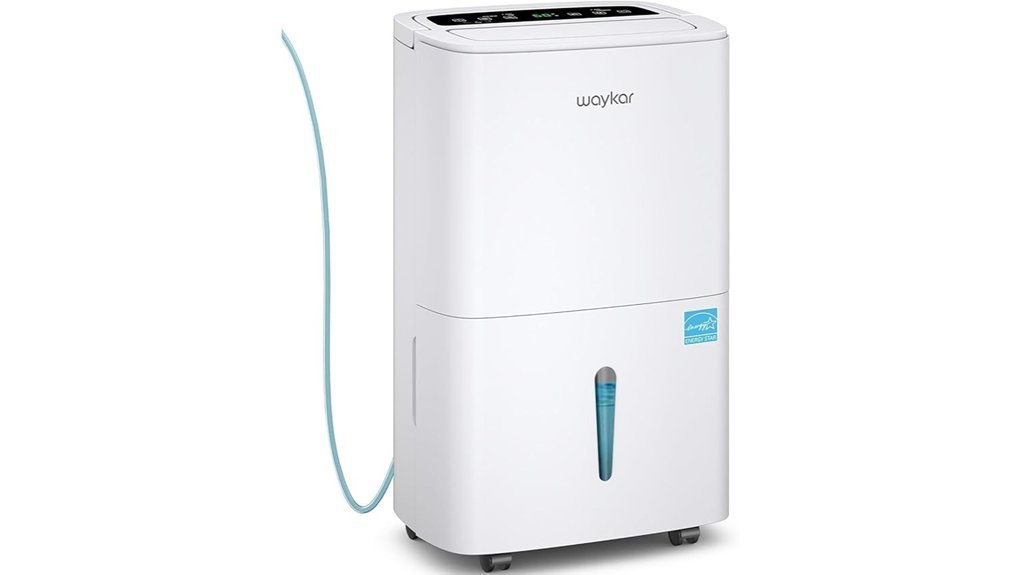
Waykar’s 150-pint Energy Star dehumidifier is best if you need serious moisture control for huge spaces. The current listing advertises coverage up to 7,000 sq. ft. and up to 150 pints of moisture removal per day under high-humidity conditions, so it is aimed at demanding basements, garages, large storage areas, and similar spaces. This is the kind of model to consider when a standard 50-pint unit may not keep up with heavy moisture.
The built-in pump lets you drain upward to 9.84 feet, and you can also use gravity drainage or the 1.85-gallon tank. You’ll appreciate the quiet operation, touch controls, 24-hour timer, auto restart, and self-drying design. Casters and a handle help with repositioning, while the multiple drainage choices reduce routine tank emptying.
Why You’ll Like It: It gives you maximum coverage and high removal power, making it a better match for demanding spaces than smaller home dehumidifiers.
Best For: Homeowners, property managers, and businesses needing powerful, energy-efficient moisture removal for very large spaces like basements, garages, warehouses, and wine cellars.
Who Should Avoid It: Skip it if you have a small room or only mild seasonal humidity because the size and capacity may be unnecessary.
Pros:
- Advertised for coverage up to 7,000 sq. ft. and up to 150 pints/day under high-humidity conditions.
- Built-in pump supports upward drainage, with gravity drain and tank options for flexibility.
- Quiet operation, smart touch controls, timer, auto restart, and self-drying features add convenience.
Cons:
- Large capacity and size may be more than needed for smaller rooms.
- At 38.6 lbs, it may still be somewhat cumbersome despite the casters and handle.
- Upward pump drainage height is limited to 9.84 ft, which may not suit all setups.
Factors to Consider When Choosing a 50-Pint or Large-Capacity Dehumidifier
When you choose a 50-pint or large-capacity dehumidifier, start by matching its coverage area to your room size and dampness level. You’ll also want to compare moisture removal rate, drainage options, noise level, energy efficiency, tank size, and smart controls. A powerful model can be a great investment, but only if it matches the way you plan to use it.
Portable vs. whole-home note: The products in this guide are portable room or large-space dehumidifiers. They are not the same as a ducted whole-home dehumidifier connected to an HVAC system.
Before You Buy Checklist
- Measure your room or basement square footage before choosing coverage.
- Decide whether you need a tank, gravity drain hose, or built-in pump.
- Check whether the unit is easy to roll, lift, and clean.
- Look for auto shut-off if you plan to use the tank often.
- Choose quieter models for bedrooms, offices, nurseries, and living areas.
- Use a separate hygrometer if you want to double-check room humidity.
Coverage Area
A 50-pint or large-capacity dehumidifier can usually handle big rooms, basements, or open areas, but the right coverage depends on more than just room size. You should match the unit’s coverage area to the square footage you want to control, and it’s smart to choose one that meets or exceeds that number. In humid climates, your space may need extra capacity to stay comfortable, so a bigger coverage range can help.
Also think about where you’ll use it. A damp basement usually needs more support than a living room because moisture builds up differently. Check your space’s conditions, not just its size, so you can pick a dehumidifier that works efficiently and keeps humidity in check. Treat manufacturer square-foot figures as rough guidance rather than a guarantee, especially in divided rooms or spaces with ongoing water intrusion.
Moisture Removal Rate
Coverage area tells you how much space a dehumidifier can handle, but moisture removal rate shows how hard it can work once it’s there. You should check this rating in pints per day, since it tells you how much moisture the unit can pull from the air in 24 hours. If you’re dealing with a larger room or persistent dampness, a 50-pint-per-day model gives you a solid starting point, while 80-pint, 100-pint, 120-pint, and 150-pint units are aimed at more demanding spaces.
Keep in mind that output changes with test conditions: warm, very humid air can produce a much higher pint-per-day number than the standardized rating used for typical consumer comparisons. Check the temperature and relative-humidity conditions behind any “max” capacity claim before comparing two models. Match capacity to the actual dampness of your space for steadier humidity control.
Drainage Options
Drainage options can make or break how easy a 50-pint or large-capacity dehumidifier is to live with. You’ll usually get a tank that holds about 1.6 to 2 gallons, so if you don’t use drainage, you’ll empty it often. Manual emptying works if you don’t mind the routine, but automatic drainage saves time and keeps moisture removal going without interruption.
Many units let you connect a standard garden hose for continuous draining, which is ideal in damp basements or during long runs. Look for an auto shut-off feature too; it stops the unit when the tank fills and helps prevent spills. If you need to drain uphill or out a window, a built-in pump gives you extra flexibility and makes placement much easier.
Noise Level
Noise level matters just as much as drainage when you’re choosing a large dehumidifier, especially if it’ll run in a bedroom, nursery, office, or main living area. You’ll usually see noise ratings in decibels, and quieter models sit around 40 to 45 dB, which sounds like soft conversation or light rainfall. Most units fall between 35 and 60 dB, so compare specs carefully if you’re noise-sensitive.
Keep in mind that bigger capacity often means a louder compressor and fan, so you should balance drying power with comfort. Look for features like sound dampening, sleep mode, and low-speed fan settings, since they can cut noise without hurting comfort. Modern residential models often run quietly enough to blend into daily life.
Energy Efficiency
When you’re comparing large dehumidifiers, energy efficiency can make a big difference in operating cost and long-term value. ENERGY STAR certification is a useful signal because qualifying models must meet U.S. EPA efficiency requirements.
For dehumidifiers, compare the Integrated Energy Factor (IEF), expressed in liters of water removed per kilowatt-hour. In general, a higher IEF means better efficiency. Also compare wattage, humidistat behavior, fan settings, and how often the unit is likely to run in your actual space.
Smart Controls
Automatic controls can make a 50-pint or large-capacity dehumidifier much easier to manage. An intelligent humidistat can cycle the compressor around your target humidity, while timers and memory functions reduce repeated setup. Only expect phone or smart-home control when the specific product variant explicitly lists Wi-Fi or app support.
If you want lower operating costs, look for energy-saving modes that fine-tune power use based on humidity readings. Programmable timers and memory functions also help you set a schedule that fits your routine. If remote control matters, verify that the exact ASIN and size variant includes Wi-Fi or app support, because those features can differ across variants that share one product page.
Tank Size and Maintenance
Tank size matters because a powerful dehumidifier can collect water quickly in a damp basement. A small tank may fill often, which can interrupt operation unless you use a drain hose or pump. If you plan to run the unit daily, choose a model with easy tank access, auto shut-off, and a clear full-tank alert.
Maintenance is just as important. A washable filter can reduce long-term hassle, while self-drying or auto-defrost features may help in cooler areas. For best performance, clean the filter regularly, keep the air intake clear, and make sure the drain hose slopes correctly if you use gravity drainage.
Pro Tips for Better Results
Close doors and windows while the unit runs, or it will keep pulling moisture from outside air.
Place it away from walls so airflow is not blocked.
Use continuous drainage in very damp basements to avoid frequent tank emptying.
Target roughly 30% to 50% indoor humidity in many homes, adjusting for season, comfort, and condensation risk.
Frequently Asked Questions
How Often Should a 50-Pint Dehumidifier Run?
You should run a 50-pint dehumidifier until humidity stays around 40–50%, then let its humidistat cycle it on and off. In damp spaces, it may run many hours daily; in dry spaces, much less. If the unit never cycles off, your space may be very damp, too large for the unit, or receiving new moisture from leaks or outdoor air.
Can a 50-Pint Dehumidifier Reduce Mold Growth?
A dehumidifier can make indoor conditions less favorable for mold by lowering excess humidity, but it does not remove an existing mold problem or fix the moisture source. Control leaks or seepage, improve airflow where appropriate, and address existing mold separately.
What Room Humidity Is Ideal for Dehumidifier Use?
You should aim for 30% to 50% humidity, ideally around 45%. You’ll feel more comfortable, reduce conditions that encourage mold, and let your dehumidifier run efficiently without making air overly dry. If your air feels too dry, raise the target humidity slightly.
Do 50-Pint Dehumidifiers Work in Cold Basements?
Yes, but moisture-removal capacity usually falls as the air gets cooler. Check the model’s minimum operating temperature and look for automatic defrost or other low-temperature protection if your basement regularly gets cold.
How Noisy Are 50-Pint Dehumidifiers During Operation?
Noise varies by compressor, fan speed, and test method. If the unit will run near a bedroom or office, compare the manufacturer’s low-speed or sleep-mode dB figure and remember that real-room sound can be higher than a best-case specification.
Is a Built-In Pump Worth It?
A built-in pump is worth it if your drain point is higher than the dehumidifier, such as a sink, window, or raised drain. If you have a floor drain nearby, a regular gravity drain hose may be enough. Pump models are more convenient but can be more complex to maintain.
Is 50 Pint Enough for a Basement?
A 50-pint model can be enough for many basements, but very large, wet, or poorly sealed spaces may need more capacity. If your basement smells musty, has visible condensation, or the unit runs constantly without lowering humidity, consider a higher-capacity model or check for moisture sources.
Final Recommendation
For many large basements and humid homes, the Waykar Energy Star Dehumidifier for Basement & Home is the best all-around fit in this group because its current listing combines high maximum capacity, wide advertised coverage, 40 dB low-noise positioning, and flexible drainage.
If you want automatic humidity control and efficient operation, the AEOCKY 4500 Sq.Ft Energy Star Most Efficient 2025 Dehumidifier is a better fit. If your basement needs upward drainage, choose a pump model like the avylo Basement Dehumidifier with Pump or the AEOCKY 4500 Sq.Ft Energy Star Dehumidifier with Pump.
The right choice comes down to your space and the rating conditions behind each number. A true 50-pint class model can suit many damp basements, while higher “max pint” claims may be measured under hotter and more humid conditions and should not be compared one-to-one without checking the test basis.
Conclusion
If you’re choosing a 50-pint or large-capacity dehumidifier, focus on space size and dampness, drainage needs, energy efficiency, noise, controls, and maintenance. Compare capacity using the stated test conditions, verify pump or Wi-Fi features on the exact variant you plan to buy, and choose continuous drainage when frequent bucket emptying would be inconvenient. A well-matched unit can help keep humidity more stable and reduce the damp, musty conditions that make basements and other large rooms uncomfortable.