South Florida businesses, workshops, storage areas, crawl spaces, and restoration projects often need more moisture-removal capacity than a standard room dehumidifier can provide. The three commercial-grade models below cover different needs: the compact CADPXS Remois X70 for smaller service areas, the wheeled EUHOMY DH-01 for large open spaces, and the Moiswell Explorer VP170 for demanding jobs that need pump-assisted drainage.
The best choice depends on more than square footage. Compare the practical pint rating, airflow, room temperature, drainage route, electrical requirements, and the amount of outside air entering the building. For an active leak or flood, stop the water source and address damaged materials instead of relying on a dehumidifier alone.
Quick Verdict
- Best for crawl spaces and smaller commercial areas: CADPXS Remois X70. Compact and easy to position, but limited to gravity drainage.
- Best for large open facilities: EUHOMY DH-01. High airflow and wheeled mobility, but buyers must confirm the exact drainage variant.
- Best for restoration and pump-assisted drainage: Moiswell Explorer VP170. Highest practical capacity here, but also the heaviest option.
Capacity note: Dehumidifier listings may show several pint ratings. A maximum or saturation rating is measured in very warm, humid conditions and will normally be much higher than a DOE or AHAM rating. Compare models using the same test conditions whenever possible. Advertised square-foot coverage is only a starting point because ceiling height, air leakage, temperature, outdoor-air exchange, and moisture severity all affect performance.
How We Compared These Models
- DOE or AHAM moisture-removal capacity for a more realistic comparison.
- Maximum-condition capacity for extremely warm and humid environments.
- Gravity drainage, tank drainage, or built-in pump drainage.
- Airflow, portability, dimensions, and approximate unit weight.
- Operating temperature, automatic defrost, restart, and maintenance access.
- Suitability for crawl spaces, large facilities, or restoration work.
Quick Comparison
| Model | Best Use | Capacity Ratings | Claimed Coverage | Drainage | Check Details |
|---|---|---|---|---|---|
| CADPXS Remois X70 | Crawl spaces, basements, utility rooms | 80 pints/day at saturation; 38 pints/day at AHAM conditions; about 24.2 pints/day at DOE conditions | Up to 1,000 sq. ft. | Continuous gravity drain with 6.56-foot hose | Check Current Amazon Availability |
| EUHOMY DH-01 | Warehouses, workshops, large basements | Up to 160 pints/day in maximum conditions; about 70 pints/day at AHAM conditions | Up to 7,000 sq. ft. | Tank or continuous gravity-hose drainage; verify listing variant | Check Current Amazon Availability |
| Moiswell Explorer VP170 | Restoration work, garages, large facilities | Up to 170 pints/day in maximum conditions; about 84 pints/day at AHAM conditions | Up to 7,500 sq. ft. | Built-in pump with 16-foot hose | Check Current Amazon Availability |
CADPXS Remois X70 Commercial Dehumidifier
Best for Crawl Spaces
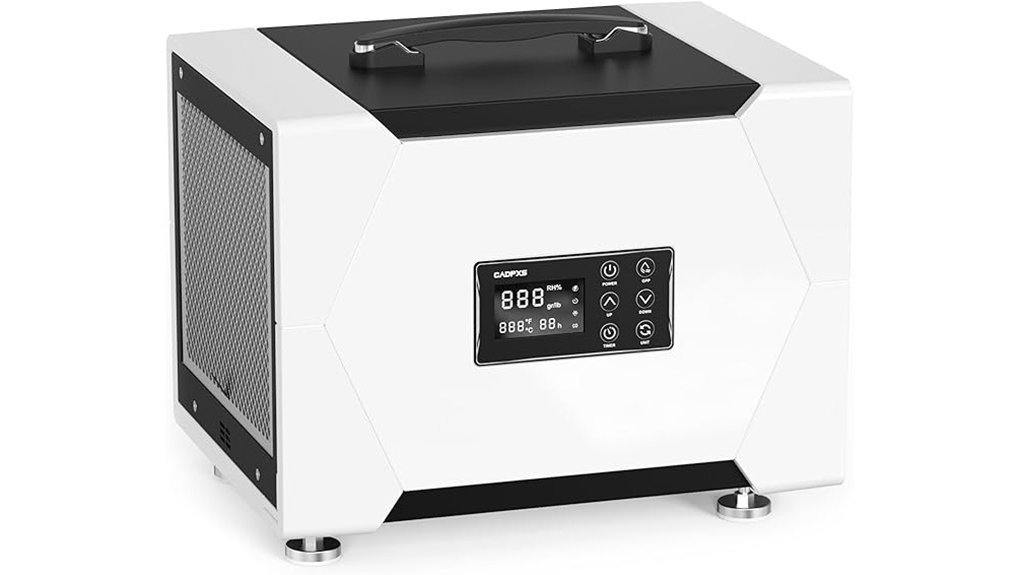
The CADPXS Remois X70 is the smallest and lightest model in this comparison. It is designed for crawl spaces, compact basements, utility rooms, storage rooms, and other moisture-prone areas where a full-size wheeled machine would be difficult to position.
Its listing shows three useful capacity figures: up to 80 pints per day at saturation, approximately 38 pints per day at AHAM conditions, and about 24.2 pints per day at DOE conditions. The lower DOE and AHAM figures provide a more realistic comparison than the 80-pint headline alone.
The unit provides approximately 131 CFM airflow and measures about 15.6 by 12 by 12.6 inches. At approximately 36 pounds, it is easier to carry and install than the two larger machines. Automatic defrost, memory restart, a timer, a washable filter, and an included 6.56-foot gravity-drain hose support unattended humidity control.
Best For: Crawl spaces, smaller basements, equipment rooms, storage areas, and light commercial spaces with a drain below the unit.
Why You’ll Like It: It provides commercial-style construction and continuous drainage in a compact cabinet that is easier to move and install.
Who Should Avoid It: Buyers drying a large warehouse, heavily ventilated facility, or water-damaged structure should choose a higher-capacity machine.
Pros:
- Compact footprint for tight spaces.
- Approximately 36-pound weight improves portability.
- Continuous gravity-drain hose is included.
- Automatic defrost and restart support unattended operation.
- Published DOE and AHAM ratings make comparison easier.
Cons:
- Practical capacity is much lower than the 80-pint saturation headline.
- No built-in condensate pump.
- The drain hose normally needs a continuous downward path.
- Claimed coverage may fall in cooler, leakier, or exceptionally damp spaces.
Placement tip: Confirm that the drain outlet is above the full hose route. Avoid low spots, upward sections, and sharp bends that could trap water and stop gravity drainage.
EUHOMY DH-01 Commercial Dehumidifier
Best for Large Open Spaces
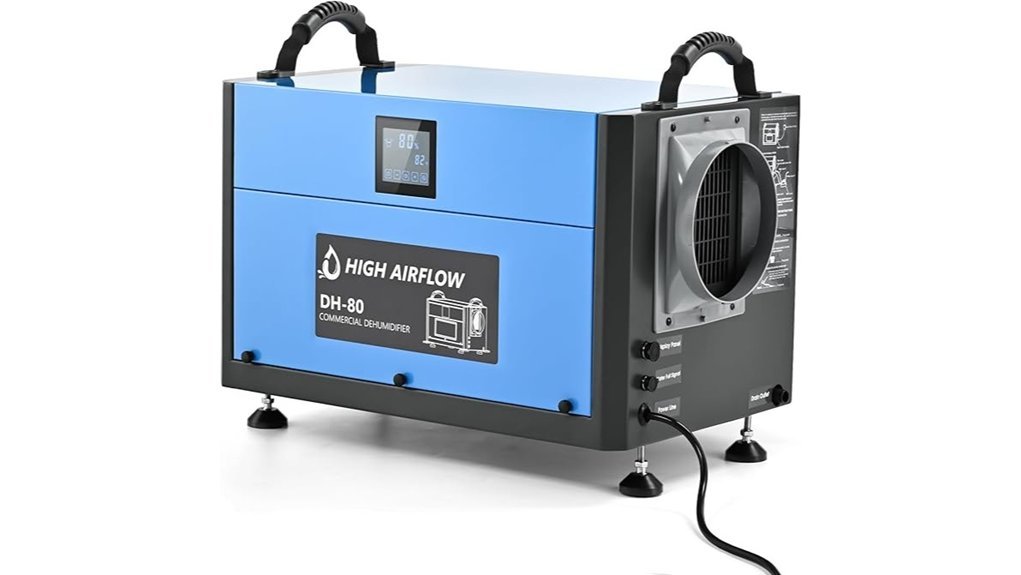
The EUHOMY DH-01 is aimed at large basements, warehouses, workshops, storage facilities, and drying projects. It is advertised at up to 160 pints per day in very warm, humid conditions, with a more comparable rating of approximately 70 pints per day at AHAM conditions.
The manufacturer information lists approximately 265 CFM airflow, a 1.45-gallon water tank, adjustable humidity control, continuous operation, automatic defrost, memory restart, a timer, a removable filter, and a wheeled cabinet. At approximately 88 pounds, it is heavy, but the handle and wheels make movement across a level floor more practical.
This model is best treated as a tank-and-gravity-drain machine unless the current product page clearly identifies a built-in pump. A separate condensate pump may be needed when the drain is above the unit.
Best For: Large open rooms, warehouses, workshops, large basements, and facilities that need more airflow than a compact crawl-space unit.
Why You’ll Like It: Its combination of higher practical capacity, 265 CFM airflow, a water tank, and wheeled mobility makes it flexible for large work areas.
Who Should Avoid It: It may be excessive for small occupied rooms, and buyers who require upward drainage should verify that they are ordering a pump-equipped version or plan for a separate condensate pump.
Pros:
- Approximately 70-pint AHAM capacity for larger spaces.
- Approximately 265 CFM airflow.
- Tank and continuous-drain options add placement flexibility.
- Adjustable humidity control and continuous mode.
- Wheels and handles help manage its weight.
Cons:
- The 160-pint headline is a maximum-condition figure, not the AHAM rating.
- Heavy and bulky compared with compact crawl-space units.
- Drainage features can vary between DH-01 listings.
- A separate pump may be needed for upward drainage.
Important model check: EUHOMY sells or has listed more than one DH-01 configuration. Before ordering, confirm the exact model number, Amazon ASIN, drainage method, included hose, pump status, voltage, dimensions, and warranty shown on the current product page.
Moiswell Explorer VP170 Commercial Dehumidifier with Pump
Best Built-In Pump Option
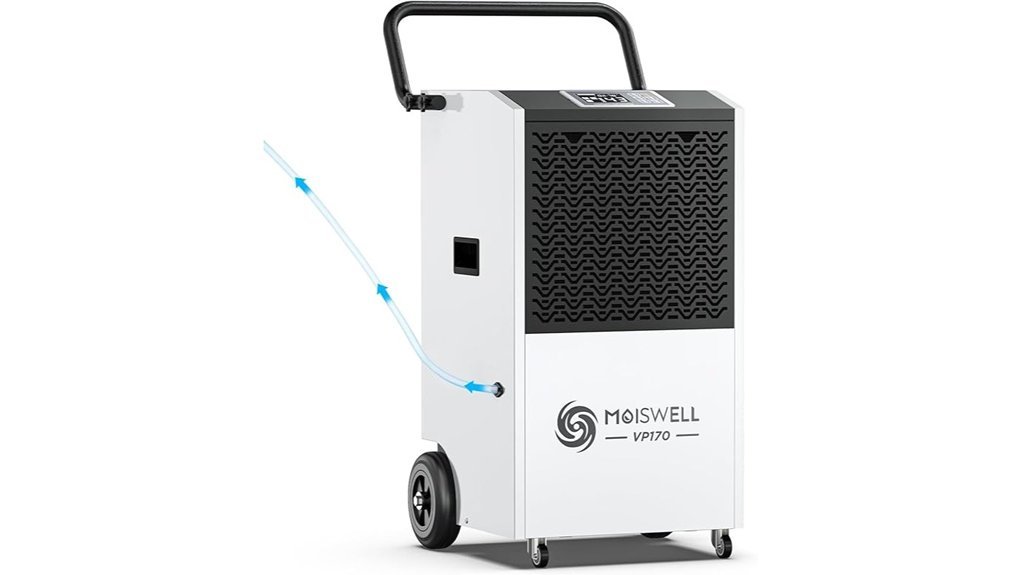
The Moiswell Explorer VP170 is the strongest fit here for water-damage restoration, construction drying, large garages, warehouses, gyms, and other demanding spaces where gravity drainage would restrict placement.
It is rated at up to 170 pints per day in maximum conditions and approximately 84 pints per day at AHAM conditions. It also provides approximately 265 CFM airflow and carries a manufacturer-listed coverage claim of up to 7,500 square feet.
The built-in pump can move condensate through the included 16-foot hose, which is useful when the drain is above the machine or across the room. Large rear wheels and a detachable handle help with transportation, although the unit still weighs approximately 85 pounds. Its listed operating range is approximately 41°F to 95°F.
Best For: Water-damage restoration, construction drying, workshops, warehouses, large basements, and facilities that need pump-assisted drainage.
Why You’ll Like It: The built-in pump allows more flexible placement and can support longer unattended operation without relying on a downhill drain route.
Who Should Avoid It: Small offices, bedrooms, and lightly damp rooms usually do not need this level of capacity, weight, or operating sound.
Pros:
- Highest AHAM-rated capacity in this comparison.
- Built-in pump and 16-foot hose provide flexible drainage.
- Approximately 265 CFM airflow supports demanding drying work.
- Large wheels and detachable handle improve job-site mobility.
- Automatic defrost and restart support continuous operation.
Cons:
- Heavy at approximately 85 pounds.
- More difficult to carry up stairs than a compact crawl-space model.
- Likely to be more noticeable in occupied areas than a small room dehumidifier.
- More equipment than most lightly damp residential rooms require.
Pump tip: A 16-foot hose does not always mean 16 feet of vertical lift in every installation. Follow the current manual for the permitted hose route, lift height, cleaning schedule, and blocked-drain procedure.
Factors to Consider When Choosing a Commercial Dehumidifier for South Florida
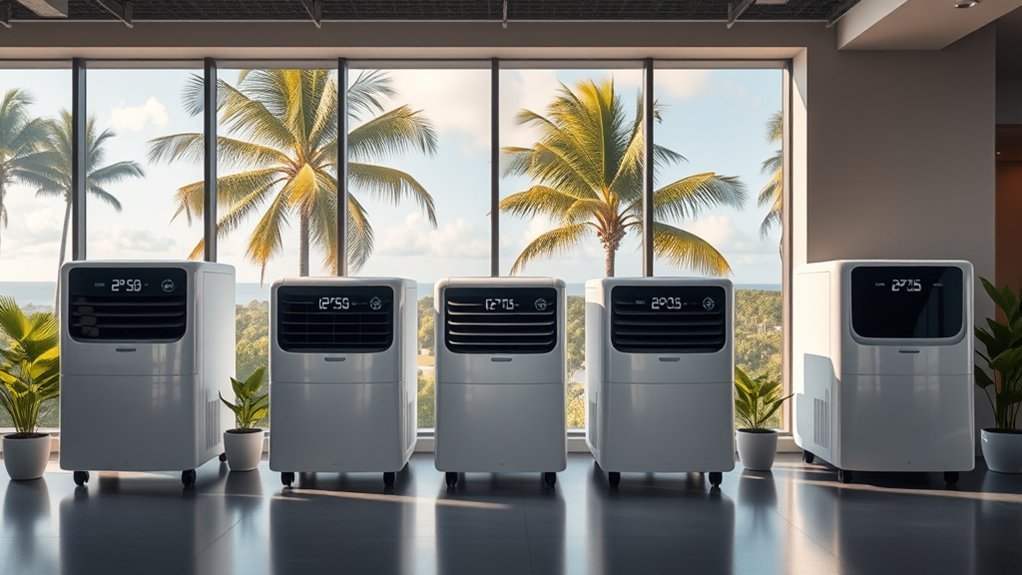
A commercial dehumidifier should be selected for the actual moisture load, not just the advertised floor area. South Florida buildings can gain humidity through open doors, outdoor-air ventilation, unsealed walls, wet materials, groundwater intrusion, and frequent occupant traffic. Drainage, airflow, temperature, electrical capacity, and service access can be as important as the headline pint rating.
Compare DOE, AHAM, and Maximum Capacity
Do not compare one model’s maximum-condition rating with another model’s DOE or AHAM rating. Maximum figures are measured in hotter and wetter conditions, which allow the machine to collect more water. DOE and AHAM figures provide a more useful practical comparison when the test conditions are stated.
For these three models, the main side-by-side AHAM comparison is approximately 38 pints per day for the CADPXS, 70 pints per day for the EUHOMY, and 84 pints per day for the Moiswell. The CADPXS also lists a lower DOE rating of approximately 24.2 pints per day.
Match Capacity to the Moisture Load
Square footage alone cannot determine the correct size. Consider ceiling height, outdoor-air exchange, water intrusion, wet inventory, laundry or process moisture, and how quickly the space must dry after a leak. A compact crawl-space unit may maintain humidity in a sealed area, while a restoration project may require a larger machine, several dehumidifiers, and separate air movers.
Choose the Right Drainage Method
Gravity drainage is simple when a floor drain sits below the dehumidifier outlet and the hose can slope downward for its full length. A built-in pump is more flexible when condensate must move upward or across a longer distance. Before buying, confirm the hose length, permitted lift, drain location, and what happens if the hose or pump becomes blocked.
Check Airflow and Placement
Airflow, measured in CFM, helps move humid air through the machine. Keep the intake and exhaust clear, follow the manufacturer’s clearance requirements, and avoid placing the unit where discharged dry air immediately returns to the intake. Large, divided, or heavily stocked spaces may need air movers, ducting, or more than one dehumidifier.
Review Temperature Range and Automatic Defrost
Refrigerant dehumidifiers normally lose capacity as temperatures fall. Automatic defrost can reduce ice buildup and support operation in cooler basements or crawl spaces, but it does not make every machine suitable for near-freezing conditions. Check the current operating range before installing a unit in an unconditioned area.
Consider Electrical Load
Confirm the required voltage, rated current, plug type, circuit capacity, and extension-cord restrictions in the manual. Large dehumidifiers should not share an overloaded circuit with air movers, heaters, power tools, or other high-draw equipment. Use a properly grounded outlet and follow local electrical requirements.
Consider Energy Efficiency
Look for a published Integrated Energy Factor or a verified ENERGY STAR listing when available. Do not assume a certification shown for one model applies to every size, ASIN, or variant. A higher-capacity machine may finish an active drying job faster, but an oversized unit running continuously in a small space can waste energy.
Plan for Noise
Commercial units move more air and use larger compressors than standard room dehumidifiers, so they are usually more noticeable. Sound can also increase when a unit sits on an uneven floor or against a wall. For offices, occupied rooms, or customer-facing areas, review the current sound specification and place the machine away from desks and seating where possible.
Check Maintenance and Serviceability
Choose a unit with an accessible filter, understandable error codes, available replacement parts, and a warranty suitable for the intended application. Clean the filter on the manual’s schedule, inspect the drain hose and pump, keep the coils and grilles free of debris, and confirm that condensate is reaching the drain.
Before You Buy
- Measure the floor area and ceiling height.
- Record the current RH and temperature with a hygrometer.
- Identify whether the moisture source is humidity, a leak, flooding, or wet materials.
- Compare DOE or AHAM capacity instead of only the maximum headline.
- Confirm whether you need gravity drainage or a built-in pump.
- Check the hose route, pump lift, plug, voltage, and circuit capacity.
- Verify the exact model number and drainage variant on the product page.
- Confirm that replacement filters, hoses, and warranty service are available.
Safety note: Do not place or operate electrical equipment in standing water or in an area with damaged wiring. Floodwater may contain sewage, chemicals, or other contamination. For major water damage, unsafe electrical conditions, or widespread mold, use qualified restoration and remediation professionals.
Frequently Asked Questions
What Size Commercial Dehumidifier Do I Need?
Start with the DOE or AHAM pint rating, space volume, current RH, temperature, and moisture source. A sealed 1,000-square-foot crawl space may require less capacity than a smaller room with open doors, an active leak, or wet construction materials. Restoration jobs often require a professional drying calculation rather than a square-foot estimate.
What Humidity Level Should I Use?
For many occupied buildings, 45% to 50% RH is a practical starting target. Indoor RH should generally remain below 60%, with 30% to 50% often used as an ideal range for moisture and mold control. Warehouses, archives, manufacturing spaces, and specialty storage areas may require a different target based on the materials or process.
Do I Need a Built-In Pump?
You need a pump when the dehumidifier sits below the available drain or when water must travel upward. Gravity drainage is usually simpler when a floor drain is nearby and lower than the machine. The Moiswell VP170 includes a pump. The CADPXS X70 uses gravity drainage, while the drainage configuration of the EUHOMY DH-01 should be confirmed on the exact listing.
Can a Commercial Dehumidifier Dry a Flooded Building?
It can be part of the drying process, but it is not the only equipment or action required. Stop the water source, remove standing water, evaluate electrical and structural hazards, remove materials that cannot be safely dried, and use air movement where appropriate. Contaminated floodwater and extensive damage should be handled by qualified professionals.
Can a Commercial Dehumidifier Replace Air Conditioning?
No. A dehumidifier removes moisture but releases heat into the room. It can work with air conditioning, ventilation, and building-envelope repairs, but it does not replace cooling or repair an active roof, plumbing, or groundwater leak.
Can Dehumidifiers Reduce Allergens in the Air?
Lower humidity can make conditions less favorable for mold and dust mites, but a dehumidifier is not an air purifier and does not directly capture every allergen or mold spore. Repair moisture sources, clean or remove contaminated materials safely, and use appropriate filtration or professional remediation when needed.
How Do I Maintain My Commercial Dehumidifier?
Clean the filter according to the manual, keep the intake and exhaust clear, inspect the coils, flush or replace dirty drain hoses, test the pump, and confirm that water is flowing to the drain. Unplug the machine before cleaning. Arrange service if it repeatedly freezes, leaks, overheats, trips the circuit, or displays persistent error codes.
How Loud Are Commercial Dehumidifiers?
Noise varies by fan speed, compressor design, cabinet construction, floor surface, and placement. Commercial models are generally more noticeable than room dehumidifiers. Compare the current manufacturer sound specifications before installing one in an occupied office, bedroom, or customer-facing area.
Conclusion
For a smaller crawl space, utility room, or service area, the CADPXS Remois X70 offers a compact commercial-style cabinet, published DOE and AHAM capacity figures, and straightforward gravity drainage.
For a large open basement, workshop, or warehouse, the EUHOMY DH-01 provides substantially more practical capacity and airflow. Confirm the exact Amazon listing and drainage configuration before ordering because DH-01 variants may differ.
For restoration work or any installation that needs condensate pumped to a higher or more distant drain, the Moiswell Explorer VP170 is the most flexible choice in this comparison. It combines the highest AHAM capacity here with a built-in pump and 16-foot drain hose.
Final Recommendation
- Choose the CADPXS X70 when compact size and easier installation matter most.
- Choose the EUHOMY DH-01 for a large open area with a suitable tank or gravity-drain setup.
- Choose the Moiswell VP170 when restoration capacity and built-in pump drainage are the priorities.
Whichever model you select, compare ratings measured under similar conditions, confirm the drainage route and electrical supply, measure the actual humidity, and repair leaks or water intrusion instead of relying on the dehumidifier alone.