Affiliate Disclosure: This site participates in the Amazon Associates Program. We may earn a small commission from qualifying purchases at no additional cost to you. This helps us continue publishing independent, buyer-focused content.
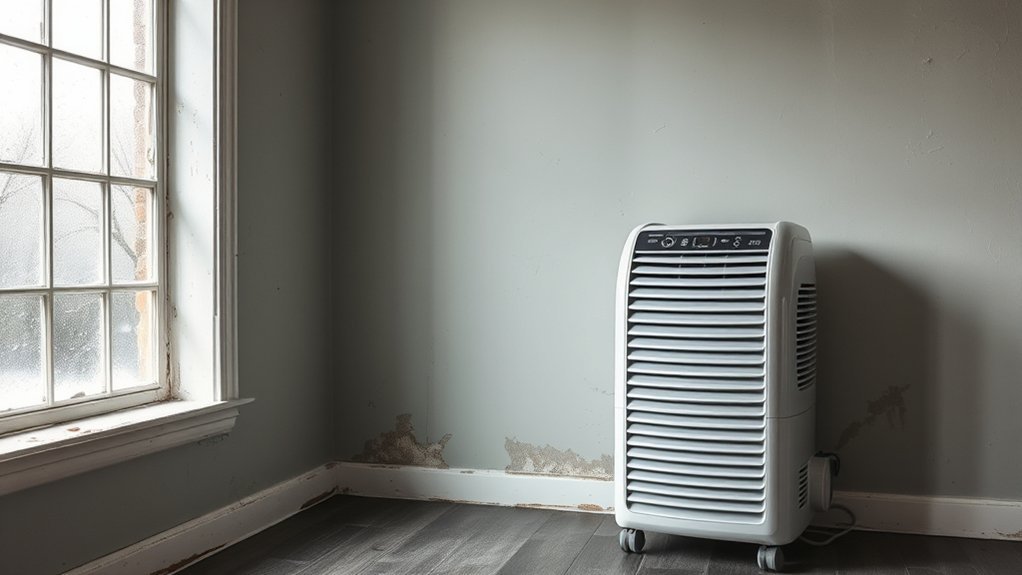
Excess humidity can make a home feel damp, musty, and uncomfortable. It can also encourage mould growth, dust mites, condensation, and lingering odours, especially in coastal or wet-season areas. A well-matched dehumidifier can help control excess indoor moisture, but South African buyers need to consider something equally important before importing a unit: electrical compatibility with 230V/50Hz power.
This guide compares three imported US-market dehumidifiers for 2026 from the original product list. They cover different needs, from stronger compressor-based moisture removal to quieter compact-room operation. However, these should not be treated as automatic plug-and-play recommendations for South Africa. Check the appliance or power-adapter label, voltage, frequency, plug type, warranty support, and manufacturer instructions before ordering or connecting any imported electrical appliance.
Quick Verdict
Best large-space performance if electrically compatible: The Vellgoo 64 Pint Energy Star Dehumidifier offers substantially stronger moisture-control capability than the two compact units, plus humidity control and continuous drainage.
Best compact feature set: The UBBO 95oz Dehumidifier combines a drain hose, 95oz tank, timer, auto shut-off, and a manufacturer-listed 35 dB sleep mode for smaller rooms.
Quiet compact pick: The PSOS Quiet Dehumidifier is aimed at buyers who prioritize low-noise operation, a 98oz tank, and simple humidity monitoring in compact spaces.
Important electrical note for South African buyers
South Africa uses approximately 230V/50Hz mains power. The Vellgoo model reviewed here is a US-market 120V/60Hz appliance, while the PSOS listing identifies 110V operation. The UBBO is also sold as a US-market import, so its appliance or power-adapter input rating should be checked before use.
Do not connect a 110V/120V-only appliance directly to a 230V outlet. A plug adapter changes only the plug shape. A step-down transformer can change voltage, but it does not automatically change a 60Hz supply requirement to 50Hz. If the product is not explicitly rated for your local supply, confirm compatibility with the manufacturer or a qualified electrical professional before use.
Quick Comparison: Imported Dehumidifiers for 2026
| Product | Listed Coverage | Moisture Removal | Noise | Electrical Fit | Best For |
|---|---|---|---|---|---|
| Vellgoo 64 Pint Energy Star | Manufacturer-listed up to 4,000 sq ft | 24.5 pints/day standardized ENERGY STAR rating; up to 64 pints/day at peak 90°F/90% RH conditions | Not clearly listed | 120V/60Hz US model Not direct 230V/50Hz use |
Larger damp spaces where compatible power is confirmed |
| UBBO 95oz | Manufacturer-listed up to 1,000 sq ft | Up to 1.2L/day at 86°F/80% RH test conditions | 35 dB sleep mode | US-market import Verify appliance or adapter input label |
Bedrooms, bathrooms, RVs, and compact spaces |
| PSOS Quiet Dehumidifier | Manufacturer-listed up to 1,000 sq ft | Compact-unit output; verify current test-condition specification before comparing with compressor models | Under 30 dBA sleep mode | 110V listing Not direct 230V use |
Quiet overnight use where compatible power is confirmed |
Coverage and extraction figures depend on temperature, relative humidity, airflow, room layout, and manufacturer test conditions. Compact semiconductor dehumidifiers are not directly comparable with full-size compressor dehumidifiers.
Vellgoo 64 Pint Energy Star Dehumidifier for Home
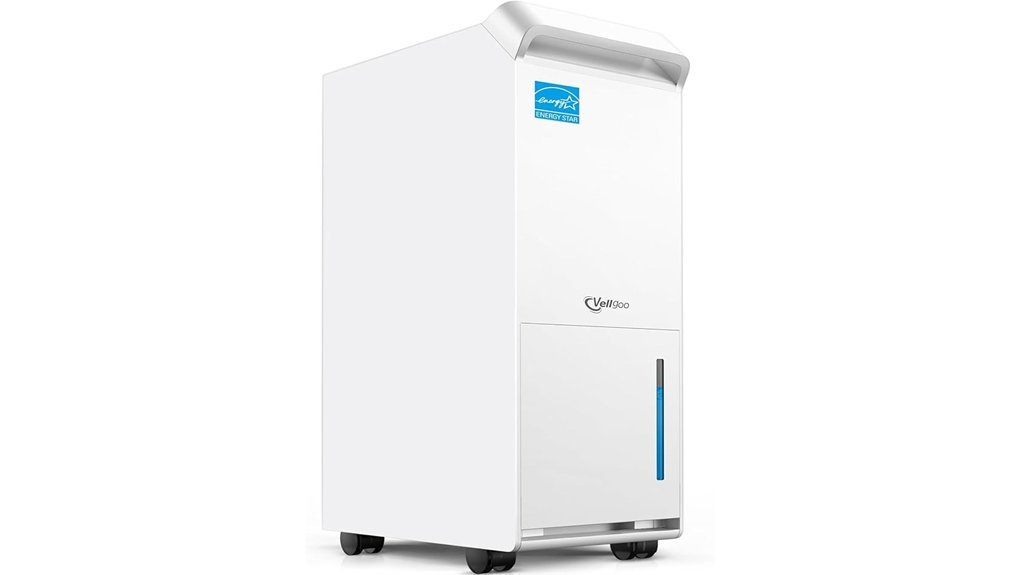
If you need substantially stronger moisture removal for a larger room, basement-style space, laundry area, garage, or open-plan area, the Vellgoo 64 Pint Energy Star Dehumidifier is the most capable option in this comparison. The manufacturer markets it for spaces up to 4,000 sq ft and up to 64 pints of moisture removal per day under hot, very humid peak test conditions.
For a fairer standardized comparison, the ENERGY STAR product record associated with this model lists a lower standardized water-removal capacity than the 64-pint peak-condition claim. That difference is normal when products are measured under different temperature and humidity conditions, which is why buyers should always check how a capacity figure was tested.
The main advantage is the combination of compressor-class moisture removal, automatic humidity control, a washable filter, multiple operating modes, and continuous drainage. If your space stays persistently damp, this type of full-size compressor unit generally provides much stronger extraction than a small semiconductor dehumidifier.
Continuous drainage is especially useful in a utility room or other persistently damp area because you can route the supplied drainage setup to an appropriate outlet instead of relying only on the collection bucket.
South Africa compatibility warning: This Vellgoo model is specified for 120V/60Hz power. Do not plug it directly into a standard South African 230V/50Hz outlet. Because this is a compressor appliance, do not assume that a basic step-down transformer alone resolves every compatibility issue. Confirm both voltage and frequency requirements before use.
Best For: Buyers who need stronger large-space moisture control, continuous drainage, and automatic humidity management, provided a safe and manufacturer-approved electrical setup is available.
Who Should Avoid This: Anyone looking for a direct plug-and-play South African appliance, buyers who need a small bedside unit, or anyone who cannot safely resolve the 120V/60Hz electrical requirement.
Why You’ll Like It: Among these three products, it addresses serious moisture problems most directly. The compressor design, drainage option, and humidity controls make it more appropriate for persistent dampness than the compact models.
Pros:
- Strongest moisture-control capability in this three-product comparison.
- ENERGY STAR certified model with standardized efficiency information available.
- Continuous drain option reduces repeated bucket emptying.
- Washable filter and automatic humidity controls simplify regular use.
Cons:
- 120V/60Hz US-market electrical requirement is a major limitation for South African buyers.
- Larger and heavier than compact bedroom units.
- Peak-condition 64-pint claim should not be compared directly with standardized capacity ratings.
- Published noise information is less clear than on the compact picks.
UBBO 95oz Dehumidifier for Home with Drain Hose
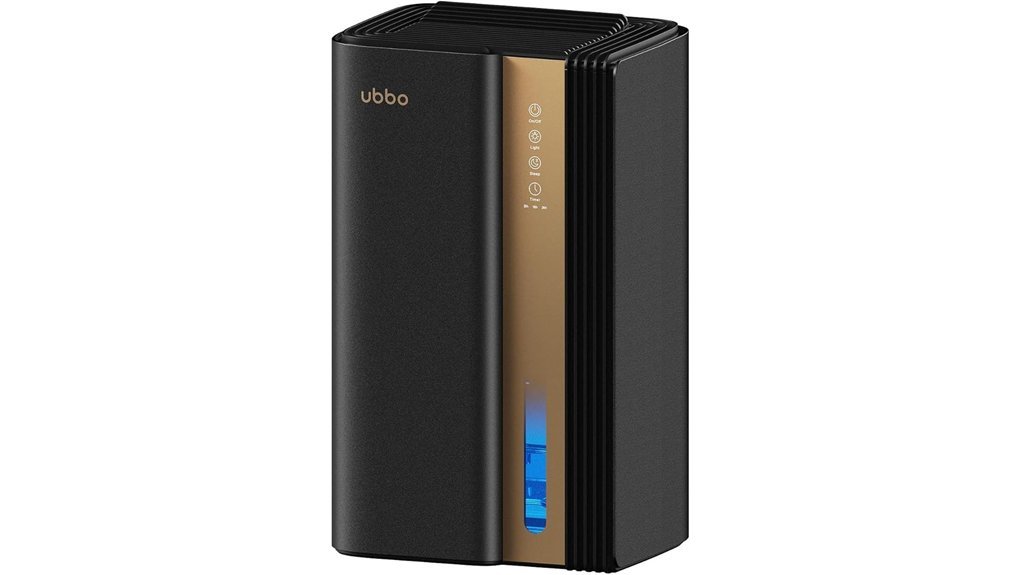
For a smaller space where low noise and easy placement matter more than maximum extraction power, the UBBO 95oz Dehumidifier is the most feature-rich compact option here. Its manufacturer listing targets bedrooms, bathrooms, home offices, RVs, closets, and other smaller spaces.
The product is listed with a 95oz tank, up to 1.2L of moisture removal per day under 86°F/80% RH test conditions, a 35 dB sleep mode, drain hose support, auto shut-off, and timer settings. Those features make it easier to run in a bedroom or small room without the bulk of a full compressor unit.
Its advertised 1,000 sq ft coverage should be treated as a manufacturer-listed maximum rather than a promise that it will control serious humidity across every 1,000 sq ft space. Temperature, starting humidity, airflow, door openings, and the actual source of moisture can change real-world performance substantially.
Because this is a compact semiconductor-style product, it is better suited to mild or localized dampness than a wet basement, large open-plan room, or active water intrusion. Fix leaks and major moisture sources before relying on any dehumidifier.
South Africa compatibility warning: This is a US-market import. Before use, inspect the appliance or power adapter for its exact INPUT rating. If the adapter clearly states 100–240V and 50/60Hz, the electrical situation may differ from a 110V-only appliance. If it states only 110V/120V, do not connect it directly to a 230V outlet.
Best For: Bedrooms, bathrooms, RVs, closets, compact offices, and small living areas with mild to moderate humidity where quiet operation and drainage convenience matter.
Who Should Avoid This: Buyers dealing with severe dampness, large open rooms, wet basements, active leaks, or anyone who cannot verify a safe electrical input rating for South African use.
Why You’ll Like It: It combines several convenience features in a smaller package. The quiet sleep setting, larger compact-unit tank, timer, auto shut-off, and drain hose make it easier to live with day to day.
Pros:
- Manufacturer-listed 35 dB sleep mode suits quieter spaces.
- 95oz tank is generous for a compact semiconductor-style unit.
- Drain hose, timer, and auto shut-off add useful convenience.
- Compact dimensions make it easier to place in bedrooms, bathrooms, RVs, and closets.
Cons:
- Not a substitute for a high-capacity compressor dehumidifier.
- Manufacturer-listed 1,000 sq ft coverage may overstate what buyers experience in very damp conditions.
- Real-world extraction depends heavily on temperature and humidity.
- Electrical input compatibility must be confirmed before South African use.
PSOS Quiet Dehumidifier for Home with 98 OZ Tank
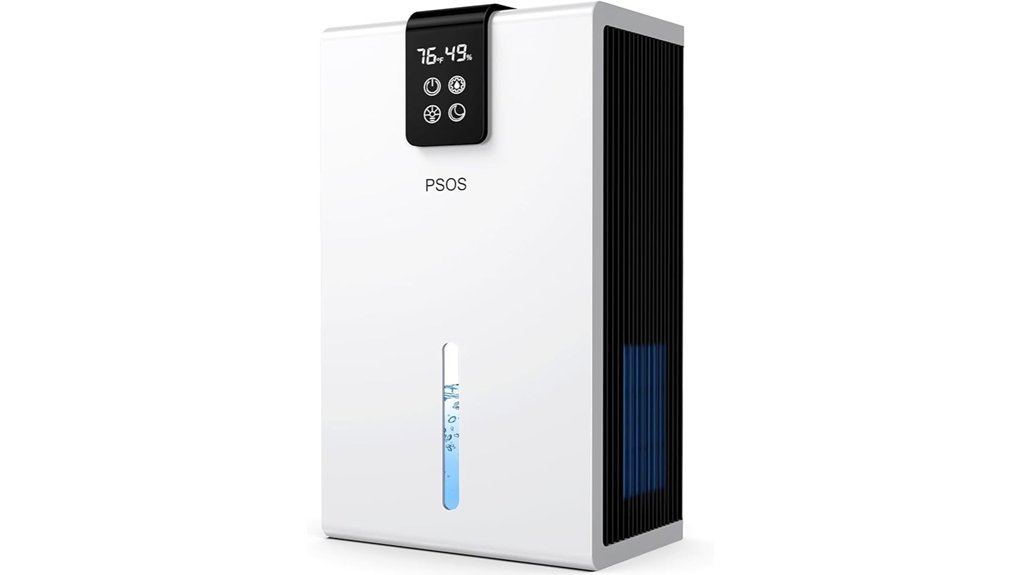
The PSOS Quiet Dehumidifier is another compact option, but its strongest selling point is low-noise operation. The manufacturer lists sleep-mode noise below 30 dBA, making it potentially attractive for bedrooms, reading rooms, nurseries, and home offices where a compressor dehumidifier may feel intrusive.
The unit is listed with a 98-ounce tank, auto shut-off, humidity display, temperature display, removable tank, air filter, and 7-colour ambient light. These are primarily convenience and monitoring features rather than substitutes for high extraction capacity.
The manufacturer also promotes coverage up to 1,000 sq ft, but compact-dehumidifier coverage claims should be interpreted cautiously. Tank size, floor-area claims, and test-condition extraction figures do not make this equivalent to a full-size compressor dehumidifier.
South Africa compatibility warning: The reviewed listing identifies this PSOS model as a 110V appliance. Do not connect it directly to South Africa’s 230V supply. Confirm the complete electrical requirements and an appropriate manufacturer-approved setup before importing or using it.
Best For: Light sleepers, home offices, bathrooms, and compact bedrooms where low noise and basic humidity monitoring are more important than high extraction capacity.
Who Should Avoid This: Buyers who need fast moisture removal from large rooms, garages, wet basements, or whole-home areas, as well as anyone wanting a direct 230V South African appliance.
Why You’ll Like It: It focuses on comfort and convenience. The low-noise sleep mode, display, 98oz tank, auto shut-off, and ambient-light feature make it more bedroom-oriented than a typical compressor model.
Pros:
- Manufacturer-listed under-30 dBA sleep mode is attractive for nighttime use.
- 98oz water tank is large for this compact product class.
- Humidity and temperature displays provide convenient room-condition monitoring.
- Auto shut-off and removable tank make routine operation easier.
Cons:
- 110V electrical rating prevents direct use on standard South African 230V supply.
- Not designed to replace a full-size compressor unit for serious moisture problems.
- Manufacturer-listed coverage and extraction claims should be viewed as test-condition information.
- Compact plastic construction may feel less substantial than a full-size compressor model.
Factors to Consider When Choosing a Dehumidifier in South Africa
Choosing the right dehumidifier goes beyond picking the highest advertised capacity. Match the unit to your room size, humidity level, drainage requirements, noise tolerance, and electrical supply before buying.
1. Electrical Compatibility Comes First
For South African households, check the appliance data plate or power-adapter label before looking at secondary features. Your safest option is normally a unit specifically rated for approximately 220–240V and 50Hz.
A plug adapter changes the physical plug shape but does not change voltage. A step-down transformer can reduce voltage, but it does not automatically change electrical frequency. This distinction is especially important with compressor appliances and other motor-driven equipment.
Also check whether an imported product has usable warranty support in South Africa. International purchases may have different service, return, plug, or certification arrangements from locally distributed appliances.
2. Dehumidifier Capacity Requirements
Dehumidifier capacity should be compared using the test conditions attached to the rating. A larger compressor model is generally better suited to persistent dampness, laundry areas, garages, basements, and larger connected spaces. Compact semiconductor units are better for localized moisture in bedrooms, closets, RVs, bathrooms, and smaller rooms.
Do not compare a compact unit’s litre-per-day claim directly with a compressor unit’s pint-per-day figure unless both were measured under comparable test conditions. Real-world removal depends on temperature, starting humidity, airflow, room layout, and how often doors or windows are opened.
3. Energy Efficiency Ratings
Running a dehumidifier for long periods can increase electricity use, so efficiency matters. Look for credible efficiency information, automatic humidity control, timers, cleanable filters, and operating modes that reduce unnecessary runtime.
ENERGY STAR information can be useful when comparing eligible North American compressor models, but an efficiency certification does not override local voltage and frequency requirements.
4. Noise Level Considerations
Noise matters most in bedrooms, nurseries, home offices, and TV rooms. Compact semiconductor units can operate more quietly than full-size compressor models, but lower noise usually comes with lower moisture-removal capability.
For sleep use, look for a clearly stated dB rating and dedicated sleep mode. If the room has serious dampness, choose adequate extraction capacity first rather than selecting an undersized product simply because it is quiet.
5. Drainage Options Available
Your main choices are manual drainage and continuous drainage. Manual drainage means emptying the tank yourself. Continuous drainage sends collected water through a hose to an appropriate drainage point.
In persistently humid conditions, tanks can fill quickly. If you plan to operate the unit for long periods, a drain hose and automatic full-tank shutoff can reduce maintenance.
6. Size and Portability
Coverage area is only one part of sizing. Compare dimensions, weight, handle design, wheels, tank access, and where the product will physically sit. A full-size compressor model may offer stronger performance, while a compact model is easier to move or fit beside furniture.
For one damp room, choose the product class that matches that room. For several connected rooms or a widespread humidity problem, a stronger compressor unit may make more sense than several very small units.
7. Additional Features Worth Considering
Useful extras to compare when choosing between models include:
- Adjustable humidistat for maintaining a chosen relative-humidity level.
- Continuous mode for periods when maximum moisture removal is needed.
- Sleep mode for quieter nighttime operation.
- Programmable timer to limit unnecessary runtime.
- Auto shut-off to stop operation when the collection tank fills.
- Washable filter for simpler routine maintenance.
- Humidity display so you can monitor conditions instead of guessing.
- Drain hose support for less frequent manual emptying.
- Wheels or handles if the unit will move between rooms.
✅ Before You Buy: Quick Checklist
- Does the appliance or power-adapter label explicitly support my local voltage and frequency?
- What is the actual floor area of the space I need to dehumidify?
- Is the room mildly damp, persistently humid, or affected by leaks or water intrusion?
- Was the advertised extraction capacity measured under standardized or unusually humid test conditions?
- Will I use the unit in a bedroom or quiet space where noise matters?
- Do I need continuous drainage, or can I empty the tank manually?
- Is warranty or service support available in South Africa?
- Do I need portability, a timer, auto shut-off, a humidistat, or a humidity display?
Which Dehumidifier Should You Buy?
First decision: If you want a simple plug-and-play appliance in South Africa, choose a dehumidifier specifically rated for local 220–240V/50Hz power rather than assuming an imported US model will work safely.
| Choose This Product | If Your Main Need Is |
|---|---|
| Vellgoo 64 Pint Energy Star | Stronger moisture removal for a larger damp area, but only if its 120V/60Hz electrical requirements can be safely and properly supported. |
| UBBO 95oz | A compact unit with drain hose, timer, auto shut-off, and quieter bedroom-oriented operation after electrical compatibility is verified. |
| PSOS Quiet Dehumidifier | Low-noise compact operation and simple humidity monitoring where a safe 110V-compatible power solution has been properly confirmed. |
Frequently Asked Questions
How often should I empty my dehumidifier’s water tank?
It depends on humidity, room conditions, extraction rate, and tank capacity. During very humid weather, a small tank may require frequent emptying. Larger compressor units can also collect substantial amounts of water. If you want less maintenance, choose a model that supports continuous drainage and install the hose according to the manufacturer’s instructions.
Can dehumidifiers help control dampness-related allergens?
Keeping indoor humidity under control can make conditions less favourable for mould and dust mites, but a dehumidifier is not a medical treatment and does not replace cleaning, ventilation, leak repair, or professional health advice. A hygrometer can help you avoid both excessive humidity and unnecessarily dry indoor air.
Are dehumidifiers energy-efficient for long-term use?
Efficiency varies by product type, size, climate, and operating conditions. Certified high-efficiency compressor models may use less energy than comparable standard models. To avoid unnecessary runtime, close exterior doors and windows while dehumidifying, clean the filter as instructed, use an appropriate humidity setting, and choose a unit suited to the actual moisture problem.
Do I need to clean my dehumidifier regularly?
Yes. Regular maintenance helps preserve airflow and reduces residue or odour in the collection system. Empty and clean the water tank as instructed, maintain the filter according to the manual, and check continuous-drain hoses for kinks or buildup. Always disconnect the appliance from power before maintenance when instructed by the manufacturer.
What indoor humidity level should I aim for?
Many households find an indoor relative-humidity range around 40% to 50% comfortable during humid conditions. A hygrometer is useful because it tells you whether the room actually needs dehumidification and helps prevent the unit from running longer than necessary.
Can I use a US dehumidifier in South Africa?
Not directly unless its electrical label explicitly supports South Africa’s supply. Many US-market appliances are designed around 110V or 120V, while South Africa uses approximately 230V/50Hz. A basic plug adapter does not change voltage. A step-down transformer changes voltage but does not automatically change frequency, so a 120V/60Hz appliance should not be assumed compatible with 230V/50Hz power without manufacturer approval or appropriate professional guidance.
Is a compact dehumidifier enough for a very damp room or basement?
Often not. Compact semiconductor units are better suited to localized moisture and smaller spaces. Persistent dampness across a large room generally calls for a higher-capacity compressor dehumidifier. If you see leaks, wet walls, flooding, or standing water, address the underlying moisture source instead of relying only on a portable appliance.
What is the difference between a plug adapter and a voltage converter?
A plug adapter changes the physical shape of the plug so it can fit a different socket. It does not change the supplied voltage. A voltage converter or transformer can change voltage when correctly specified, but it does not necessarily change electrical frequency. Always check the appliance label and manufacturer instructions rather than assuming an adapter or converter makes an imported appliance compatible.
Conclusion: Which Dehumidifier Should You Choose?
These three products serve different moisture-control needs, but for a South African buyer the first question is not which one has the largest tank or lowest noise rating. It is whether the appliance can be used safely with local electrical power.
- For stronger large-space moisture removal → Vellgoo 64 Pint Energy Star, but only after its 120V/60Hz requirements are properly resolved.
- For compact bedrooms, bathrooms, RVs, and smaller rooms → UBBO 95oz, after verifying the exact appliance or adapter input specification.
- For quiet compact operation and basic humidity monitoring → PSOS Quiet Dehumidifier, provided its 110V electrical requirement is safely supported.
If you do not want to deal with transformers, frequency questions, imported-appliance warranties, or electrical compatibility checks, a dehumidifier sold specifically for 220–240V/50Hz South African use is the simpler choice.
Once electrical compatibility is confirmed, compare actual moisture-removal capacity, room conditions, drainage, noise, tank size, controls, and maintenance needs. That approach gives you a much more reliable buying decision than choosing by advertised floor area alone.
🏆 Strongest Large-Space Performer in This Comparison
The Vellgoo 64 Pint Energy Star Dehumidifier offers the strongest moisture-removal capability of these three products, plus continuous drainage and automatic humidity control. However, its US-market 120V/60Hz requirement means South African buyers should not treat it as a direct plug-in recommendation. Verify a safe, manufacturer-approved electrical setup before ordering for local use.