Choosing a dehumidifier for a large home, basement, crawl space, or ducted installation requires more than comparing advertised square footage. You first need to decide whether you want a portable compressor dehumidifier for one open area or a fixed, bucketless unit that can be connected to dedicated ducts or an HVAC system. This guide compares five high-capacity options and explains where each one fits, what its limitations are, and what to verify before buying.
Quick Verdict: The AprilAire E070 Pro is the most established option here for a crawl space, basement, or professionally planned whole-home installation. The 208 Pint Whole House Dehumidifier offers the highest advertised output for a dedicated high-capacity setup. For a portable unit, the AEOCKY 3500 Sq.Ft model is the most compact choice, while the SUNGDOGIN and Ludatido models are better suited to larger open rooms where air can circulate freely.
Important: Portable models marketed for “whole-home” use are not the same as ducted whole-house systems. Closed doors, multiple floors, poor airflow, low temperatures, and active water leaks can greatly reduce their effectiveness.
UK Compatibility Note: The product links in this article point to Amazon.com, and some models may be designed for North American electrical systems. Before ordering for use in the UK, confirm that the exact model supports 220–240V at 50Hz, has a suitable UK Type G plug, carries appropriate UKCA or CE marking, and includes valid UK warranty, replacement-part, and service support. A plug adapter alone does not make a voltage-incompatible compressor appliance safe to use.
Affiliate disclosure: This article contains Amazon affiliate links. We may earn a commission from qualifying purchases at no additional cost to you. Product specifications, certifications, package contents, warranties, and availability can change, so verify the current listing before ordering.
Quick Comparison
| Product | Unit Type | Advertised Capacity | Best For | Details |
|---|---|---|---|---|
| 208 Pint Whole House Dehumidifier | Fixed or ductable, bucketless | Up to 208 pints per day at saturation | High-moisture areas and planned duct installations | Check on Amazon |
| SUNGDOGIN 5500 Sq.Ft Dehumidifier | Portable compressor | Up to 100 pints per day under high-humidity test conditions | Large open basements, garages, and living areas | Check on Amazon |
| AEOCKY 3500 Sq.Ft Dehumidifier | Compact portable compressor | Up to 50 pints per day under extreme conditions | Tight spaces and continuous gravity drainage | Check on Amazon |
| Ludatido 80 Pint Dehumidifier | Portable compressor | 80-pint class; maximum varies by test conditions | Large rooms needing several operating modes | Check on Amazon |
| AprilAire E070 Pro Bundle | Professional bucketless or ductable | 70 pints per day | Crawl spaces, basements, and planned whole-home systems | Check on Amazon |
Capacity figures above are manufacturer or seller claims and may use different temperature and humidity test conditions. Do not compare maximum pint ratings without checking the test standard used for each model.
Whole House Dehumidifier 208 Pint for 3000 sq. ft
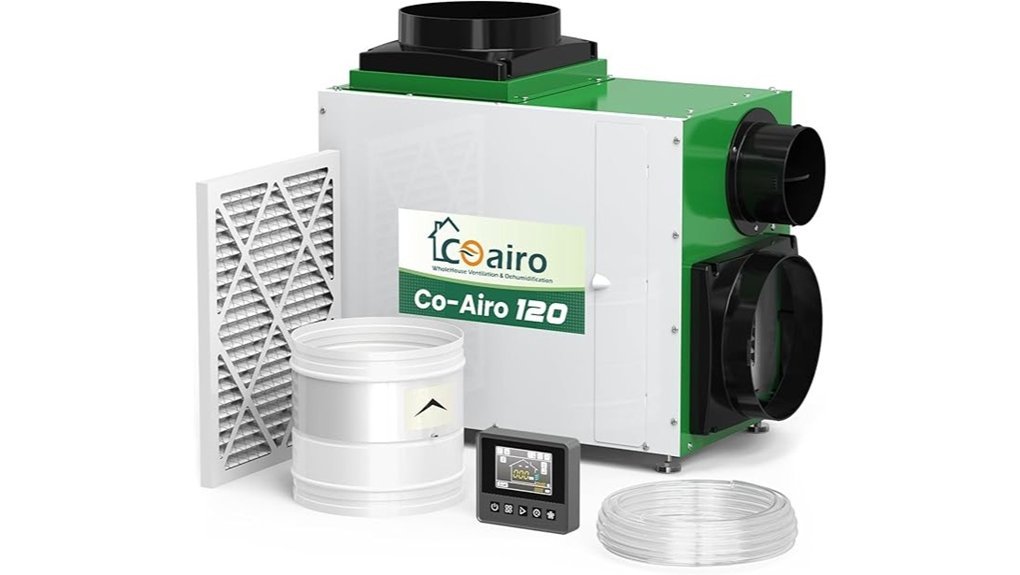
This high-capacity dehumidifier is designed for fixed, crawl-space, basement, commercial, or ducted applications rather than occasional room-to-room use. The listing advertises moisture removal of up to 208 pints per day at saturation and coverage up to 3,000 sq. ft. Because saturation testing represents unusually hot and humid conditions, its everyday extraction rate will normally be lower.
The unit offers two advertised airflow settings of 229 CFM and 309 CFM, a wired LCD controller, continuous drainage, automatic restart, and a fresh-air connection. The ventilation feature can be useful in a properly designed system, but introducing outdoor air also adds heat and moisture loads. Duct size, intake location, condensate drainage, electrical supply, and airflow balance should therefore be planned carefully.
Why You’ll Like It: It combines high advertised moisture-removal capacity with duct connections, continuous drainage, and a wall-mounted controller.
Best For: Large basements, crawl spaces, grow rooms, restoration work, commercial areas, or homes where a professional has designed a dedicated dehumidification system.
Who Should Avoid It: Buyers who only need to control one bedroom or small basement, or anyone without a suitable drain, electrical supply, ventilation plan, and installation space.
Pros:
- High advertised maximum capacity for severe moisture loads.
- Two airflow settings provide more installation flexibility.
- Continuous drainage and automatic restart support long-running use.
- Fresh-air connection may be useful in a correctly designed ventilation system.
Cons:
- The 208-pint saturation rating is not directly comparable with standard-condition ratings.
- Installation is more involved than setting up a portable dehumidifier.
- Ducting, drainage, filters, and ventilation components require ongoing inspection.
- Warranty terms, voltage, certification, and local servicing should be confirmed before purchase.
5500 Sq.Ft Dehumidifier with Drain Hose
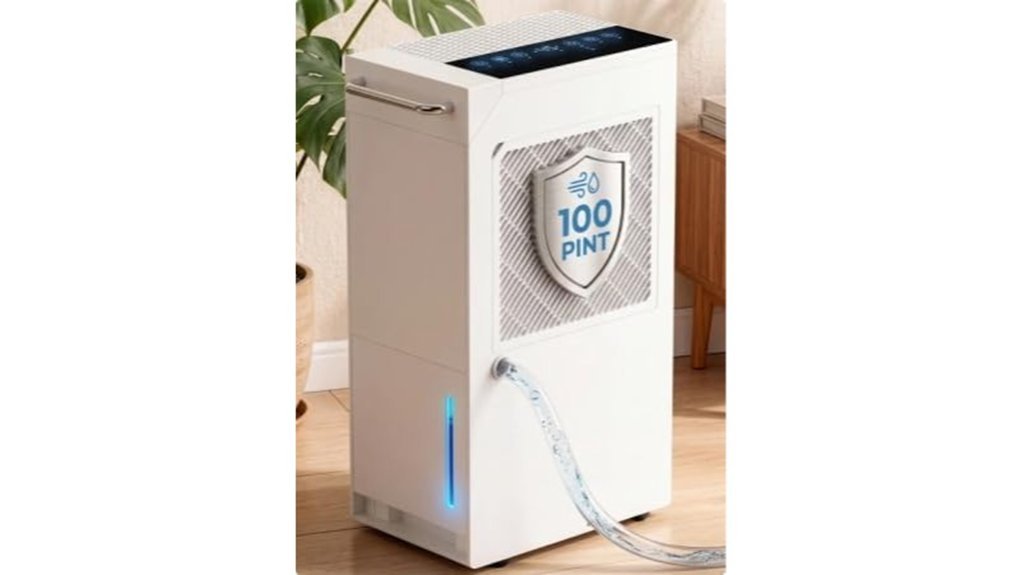
The SUNGDOGIN 5500 Sq.Ft model is a portable compressor dehumidifier intended for large open basements, garages, bathrooms, utility areas, and living spaces. Its listing advertises removal of up to 100 pints per day under hot, highly humid conditions. That maximum should not be treated as a standard everyday extraction rate or as proof that the unit will control every room in a 5,500 sq. ft. home.
The unit includes a 1.6-gallon collection tank, adjustable humidistat, automatic defrost, washable filter, automatic shutoff, and a drain-hose option. Continuous gravity drainage is the more convenient setup for a persistently damp area, provided the hose can slope downward to a suitable drain without kinks.
Why You’ll Like It: It offers a large tank, continuous-drain capability, and straightforward humidity controls in a portable format.
Best For: A large basement, workshop, garage, or open-plan level where air can move freely around the appliance.
Who Should Avoid It: Buyers expecting one portable unit to dehumidify several closed bedrooms, multiple floors, or a complete duct system evenly.
Pros:
- High advertised maximum extraction for very humid conditions.
- Tank and continuous gravity-drain options.
- Automatic defrost can help protect the coils as temperatures fall.
- Washable filter simplifies routine maintenance.
Cons:
- The 5,500 sq. ft. claim is a marketing coverage figure, not a whole-home performance guarantee.
- Maximum pint ratings may be measured under extreme test conditions.
- Noise performance and energy certification should be verified on the current listing.
- Gravity drainage requires a lower drain point unless a separate pump is used.
AEOCKY 3500 Sq.Ft Dehumidifier with Drain Hose
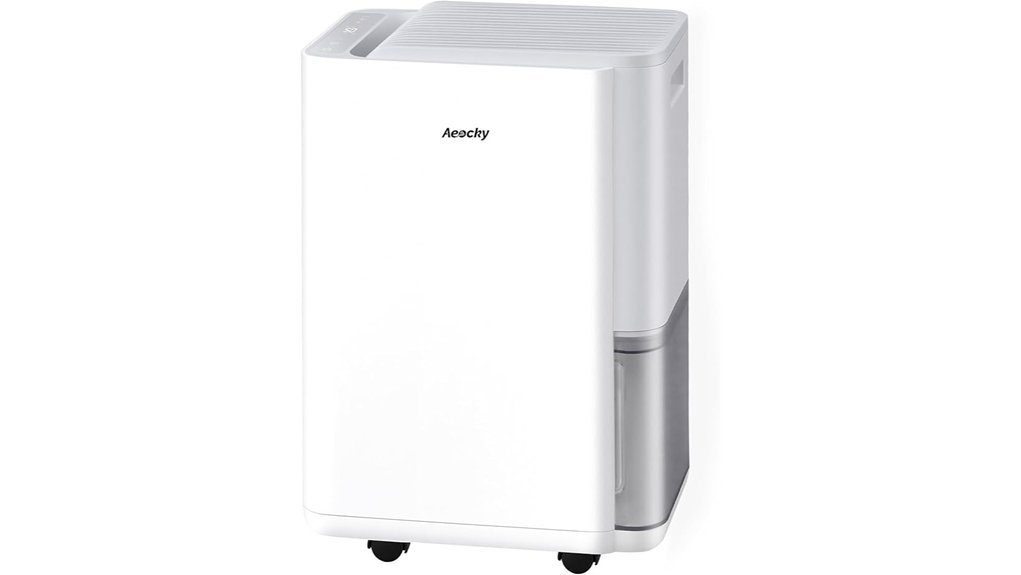
The AEOCKY 3500 Sq.Ft Dehumidifier is designed for buyers who want compressor-based moisture removal without the footprint of a large conventional unit. The listing advertises up to 50 pints per day at 95°F and 95% relative humidity, with a lower output under less extreme conditions. This distinction matters because maximum-capacity claims do not represent every home environment.
Its compact body makes it easier to position in a bathroom, bedroom, small basement, RV, storage area, or narrow utility space. The collection tank is relatively small for the advertised output, so the included continuous-drain hose is likely to be the most practical option during prolonged use. Make sure the hose runs downhill to a safe drain point.
Why You’ll Like It: It delivers compressor dehumidification in a compact body and includes flexible gravity-drain connections.
Best For: Tight spaces, individual rooms, smaller open basements, and buyers who can use continuous drainage.
Who Should Avoid It: Anyone who needs balanced humidity across a multi-room home or prefers a large tank that requires less frequent emptying.
Pros:
- Compact footprint for restricted installation areas.
- Continuous-drain hose reduces manual tank emptying.
- Adjustable humidistat and multiple operating modes.
- Portable design is easier to reposition than a fixed system.
Cons:
- The small tank can fill quickly in a very damp space.
- The 3,500 sq. ft. claim assumes favourable airflow and does not equal ducted coverage.
- Maximum output is based on unusually hot and humid conditions.
- Voltage, certification, warranty coverage, and service availability must be checked for the destination country.
Ludatido 80 Pint Dehumidifier for Home
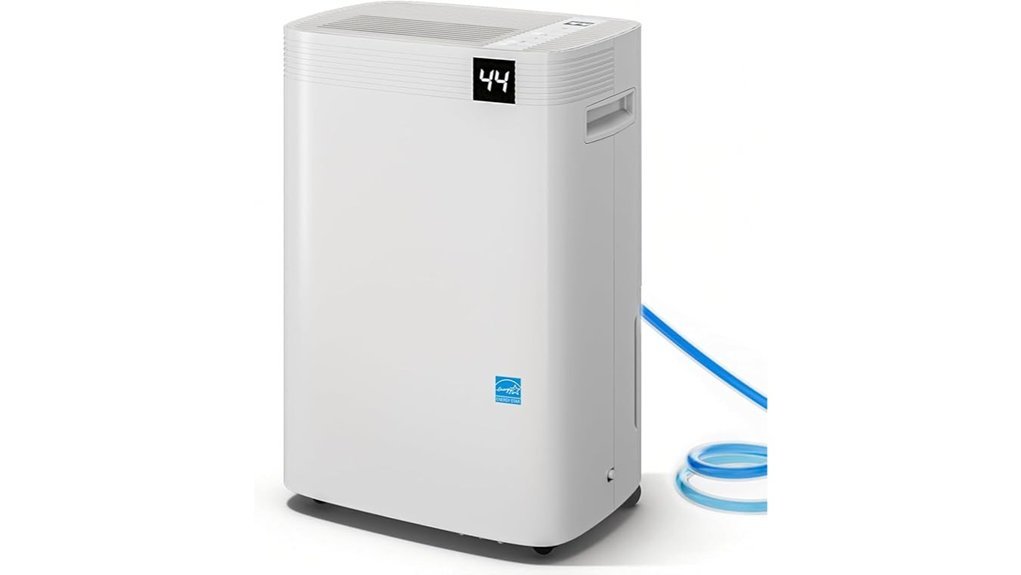
The Ludatido is a portable compressor dehumidifier marketed for large rooms and basements. Current descriptions identify it as an 80-pint-class model, although some listing text may show a higher maximum under extreme temperature and humidity. Compare the exact test conditions rather than relying only on the largest number displayed in the product title.
Its advertised features include adjustable humidity from 30% to 80% RH, Dry, Sleep, and Fan modes, a 24-hour timer, child lock, automatic shutoff, and continuous-drain capability. These controls can make day-to-day operation easier, but buyers should verify the current package contents, including whether the drain hose is supplied.
Why You’ll Like It: It provides several operating modes and convenient controls for changing humidity needs throughout the day.
Best For: Basements, laundry areas, garages, and large individual rooms where automatic humidity control and continuous drainage are useful.
Who Should Avoid It: Buyers who require independently confirmed noise data, energy certification, UK electrical compatibility, or established local service support before ordering.
Pros:
- Wide adjustable humidity range.
- Sleep, Dry, and Fan modes offer flexible operation.
- Timer, child lock, and automatic shutoff improve convenience.
- Supports continuous drainage for long-running use.
Cons:
- Maximum extraction figures vary across available listing descriptions.
- Energy certification and exact noise output should be confirmed on the live product page.
- The tank may need frequent emptying if continuous drainage is not used.
- Confirm whether a drain hose is included with the current package.
AprilAire E070 Pro Dehumidifier Bundle – 70 Pint
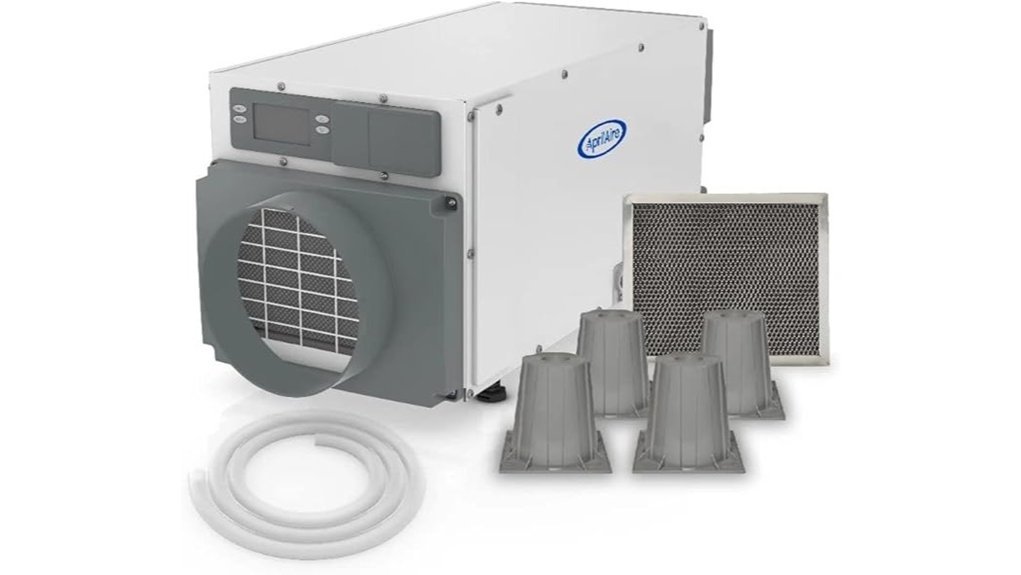
The AprilAire E070 Pro is the clearest choice in this group for a sealed crawl space, basement, or professionally planned whole-home installation. AprilAire currently rates the E070 to remove up to 70 pints per day and serve suitable spaces up to approximately 2,200 sq. ft. Actual sizing still depends on climate, air leakage, ceiling height, construction, drainage, and the severity of the moisture problem.
Unlike a typical portable model, the E070 is bucketless and drains through tubing. It can operate as a standalone crawl-space or basement unit or be incorporated into a ducted design using the supplied collars. Its digital humidistat automatically activates the compressor when humidity rises above the selected level.
Why You’ll Like It: It comes from an established indoor-air-quality manufacturer and supports bucketless, standalone, and ducted installations.
Best For: Sealed crawl spaces, basements, and homeowners working with an HVAC or waterproofing professional.
Who Should Avoid It: Renters, buyers seeking a lightweight portable appliance, or anyone who has not confirmed local voltage, installation, warranty, and service compatibility.
Pros:
- Professional-grade bucketless design with continuous drainage.
- Can be used independently or connected to suitable ducts.
- Automatic humidistat supports set-point-based operation.
- Includes installation components such as drain tubing and duct collars.
- Backed by an advertised five-year manufacturer warranty, subject to its terms.
Cons:
- Professional installation is recommended for many applications.
- It costs more and requires more planning than a portable room unit.
- A safe, reliable condensate drain is required.
- The current model is primarily marketed for North American installations, so international compatibility must be confirmed.
Factors to Consider When Choosing a Large-Capacity Dehumidifier
The right dehumidifier depends on the type of space, actual moisture load, temperature, airflow, drainage, electrical system, and installation method. Advertised square footage alone is not enough to make a reliable choice.
Portable Versus Ducted Dehumidifiers
A portable dehumidifier draws air from the room where it is placed and returns drier air to that same area. It works best in an open basement, garage, large room, or floor where air can circulate freely. Closed doors and separate floors restrict its reach.
A ducted or bucketless dehumidifier can be installed in a crawl space, basement, mechanical room, or dedicated duct network. It usually provides more consistent coverage but requires drainage, adequate airflow, installation space, electrical planning, and sometimes professional duct design.
Capacity and Coverage Area
Moisture-removal capacity is normally expressed in pints per day or litres per day. Before comparing products, check the temperature and relative-humidity conditions used for each rating. A capacity measured at saturation or 90% to 95% RH can look much higher than a rating measured under a recognised standard.
Square-foot coverage is also only an estimate. Ceiling height, outdoor climate, air leakage, damp building materials, number of rooms, ventilation, and active water intrusion can all change the required capacity. A dehumidifier should control airborne moisture; it should not be used as a substitute for repairing leaks, failed drainage, or flooding.
Electrical and Market Compatibility
Confirm the voltage, frequency, plug, fuse requirements, power draw, safety certification, warranty region, and service network before ordering. This is especially important when buying through an overseas marketplace. A plug adapter changes the plug shape but does not convert voltage or frequency.
Energy Efficiency Ratings
Check whether the exact model number carries a recognised current energy certification rather than assuming every version in a product family is certified. Compare moisture removal per unit of electricity when standardised data is available. Automatic humidistats, appropriately sized equipment, clean filters, and continuous drainage can also reduce unnecessary operation.
Drainage Options Available
Portable models may use a collection tank, a gravity drain hose, or an internal pump. Gravity drainage requires the hose to slope continuously downward to a floor drain or sump. If the water must travel upward to a sink or window, choose a model with a suitable pump or add a compatible condensate pump.
Fixed whole-home and crawl-space units are usually bucketless and require permanent drainage. The drain line should be protected against kinks, freezing, blockage, backflow, and accidental disconnection.
Cold-Temperature Performance
Compressor dehumidifiers lose efficiency as the air becomes colder and may develop frost on their coils. For an unheated garage, basement, or crawl space, check the minimum operating temperature and automatic-defrost system. A desiccant dehumidifier may perform better in consistently cold spaces, although it often uses more electricity.
Noise Levels During Operation
Noise depends on the compressor, fan speed, ductwork, surface vibration, and room acoustics. Do not rely solely on a minimum decibel claim. Look for noise data at each fan setting and consider placing the unit away from bedrooms or living areas. Anti-vibration feet, secure ducts, and proper installation can reduce transmitted noise.
Installation and Setup Process
Portable models normally require level placement, clearance around the air inlet and outlet, a grounded electrical connection, and a safe drainage route. Fixed units may also need duct collars, insulated ducts, condensate traps, remote controls, service access, and airflow balancing.
Professional installation is advisable when connecting a dehumidifier to HVAC ducts, adding outdoor air, installing permanent wiring, or routing drainage through finished areas.
User-Friendly Features
Helpful features include an adjustable humidistat, automatic restart, memory after a power outage, tank-full shutoff, washable filter, timer, child lock, continuous mode, auto defrost, remote control, and clear filter reminders. Prioritise the features that solve your actual setup problem rather than paying for controls you will not use.
Warranty and Support Services
Check the warranty duration, covered components, labour terms, registration deadline, authorised installer requirements, return policy, and availability of replacement filters or drain fittings. A long written warranty has limited value if the manufacturer does not provide service or parts in your country.
Before You Buy Checklist
- Measure the actual area and note whether doors normally remain open or closed.
- Record typical temperature and relative humidity with a separate hygrometer.
- Identify and repair leaks, standing water, or failed external drainage first.
- Decide between portable room treatment and a fixed or ducted system.
- Confirm the capacity test conditions, not just the largest advertised number.
- Plan where collected water will drain and whether a pump is required.
- Verify voltage, frequency, plug, certification, power consumption, and warranty region.
- Allow enough clearance for airflow, filter cleaning, and future servicing.
Frequently Asked Questions
Is a Portable Dehumidifier the Same as a Whole-House Unit?
No. A portable model mainly treats the room or open area where it is placed. A true whole-house dehumidifier is normally bucketless and connected to dedicated ducts or an HVAC system so it can move air through a larger part of the building.
How Do I Know the Right Size for My Home?
Consider floor area, ceiling height, temperature, starting humidity, air leakage, number of closed rooms, and whether dampness is mild or severe. Compare capacities measured under the same test conditions. For a ducted system or persistent structural dampness, ask an HVAC or waterproofing professional to calculate the moisture load.
How Often Should I Empty the Dehumidifier’s Water Tank?
Empty it whenever the tank-full indicator appears. In a very damp space, a small tank may fill several times per day. Continuous drainage is usually more convenient, but the hose and drain should be checked regularly for blockage or leaks.
Can I Install a Dehumidifier Myself?
Most portable models can be set up by following the manufacturer’s instructions and arranging safe drainage. A fixed, ducted, permanently wired, or fresh-air-connected system may require an HVAC technician, electrician, plumber, or other qualified installer.
What Maintenance Do Dehumidifiers Require?
Clean or replace the air filter on schedule, inspect the drain hose, remove dust from the inlet and outlet, clean the collection tank, and check for unusual noise, frost, water leakage, or reduced airflow. Fixed systems should also have their ducts, coils, condensate line, and controls inspected periodically.
Are Dehumidifiers Noisy During Operation?
All compressor dehumidifiers create some fan and compressor noise. Sound can increase at higher fan settings or when vibration passes into floors, walls, or ducts. Check model-specific noise data and place the unit away from sleeping areas when possible.
Can I Use an Amazon US Dehumidifier in the UK?
Only when the exact model is explicitly rated for the UK electrical supply and meets local safety requirements. Confirm 220–240V/50Hz support, plug type, certification, warranty, and service arrangements in writing. Do not assume that a plug adapter or ordinary travel converter is suitable for a high-power compressor appliance.
What Relative Humidity Should I Set?
A setting around 45% to 55% RH is a practical starting range for many occupied homes. Adjust it for the season, comfort, condensation risk, and manufacturer guidance. Setting the target unnecessarily low can increase energy use without solving the underlying source of moisture.
Conclusion
The best choice depends first on whether you need a portable appliance or a fixed dehumidification system. For a sealed crawl space, basement, or professionally planned whole-home setup, the AprilAire E070 Pro is the most established option in this group. The 208 Pint Whole House Dehumidifier may suit a higher-capacity ducted application, but its saturation rating, ventilation design, installation requirements, voltage, and service support must be checked carefully.
For one large open area, the SUNGDOGIN 5500 Sq.Ft and Ludatido 80 Pint models provide portable controls and continuous-drain capability. The AEOCKY 3500 Sq.Ft model is the better fit where floor space is limited. None of these portable units should automatically be treated as a substitute for a correctly sized ducted whole-house system.
Final Recommendation: Match the unit type to the building before comparing advertised capacity. Verify the current specifications, test conditions, drainage accessories, electrical compatibility, certification, installation requirements, and warranty region on the live listing. The right dehumidifier should maintain the target humidity without masking leaks, poor ventilation, or other structural moisture problems.