A compact dehumidifier can help manage light, localized moisture in a dorm room, such as mild window condensation, a musty closet, or damp air near a bathroom area. Among these four relevant thermoelectric models, the Windangel 44oz offers the best overall balance of tank size, operating modes, timers, and low listed power draw. The TABYIK 38OZ is the strongest quiet pick, the Deyagoo 1500ML provides the largest nominal tank, and the Hoomace 1000 ml adds timer controls and a reusable G4 filter.
These are small Peltier-style units that collect only a few hundred milliliters of water per day under favorable test conditions. They are best for light moisture in enclosed spaces—not active leaks, wet walls, serious mold problems, or heavily damp rooms that need a higher-capacity compressor dehumidifier.
Quick Verdict
Best Overall: Windangel 44oz for its balanced combination of three modes, timer settings, auto defrost, and a 44 oz nominal tank. Quiet Pick: TABYIK 38OZ for its seller-listed 28 dB noise level. Best Larger Tank: Deyagoo 1500ML. Best Filter-Equipped Pick: Hoomace 1000 ml with timer controls and a reusable G4 filter.
How These Picks Were Compared
The recommendations prioritize listed daily water removal, tank size, noise information, automatic shutoff, timers, physical footprint, and honest suitability for dorm use. Maximum extraction figures are seller claims measured under warm, highly humid conditions and should not be treated as guaranteed performance in every room.
Quick Comparison
| Product | Best For | Nominal Tank | Seller-Listed Maximum Removal | Notable Features | Amazon |
|---|---|---|---|---|---|
| Windangel 44oz | Balanced everyday dorm use | 44 oz / 1.3 L | Up to 11.8 oz / 349 ml per day at 86°F and 80% RH | Three modes, 24/48/72-hour timers, auto defrost, auto shutoff | Check Product Details |
| TABYIK 38OZ | Quiet study and sleep areas | 38 oz | Up to 11 oz / about 325 ml per day at 86°F and 80% RH | 28 dB listed noise, auto defrost, auto shutoff | Check Current Availability |
| Deyagoo 1500ML | A larger tank in a narrow footprint | 1500 ml / 50 oz | Up to 300 ml per day at 86°F and 80% RH | 30 dB listed noise, transparent tank, auto shutoff | Check Product Details |
| Hoomace 1000 ml | Timer control plus reusable coarse filtration | Marketed as 1000 ml / 35 oz; verify current specification | Up to 11 oz / 350 ml per day at 86°F and 80% RH | Reusable G4 filter, 4/8/12-hour timers, auto shutoff | Check Product Details |
Important comparison note: Tank size and daily extraction are different measurements. A larger tank can reduce emptying frequency, but it does not make a unit remove moisture faster. All extraction figures above are seller-listed maximums under warm, highly humid test conditions.
Windangel 44oz Small Portable Dehumidifier
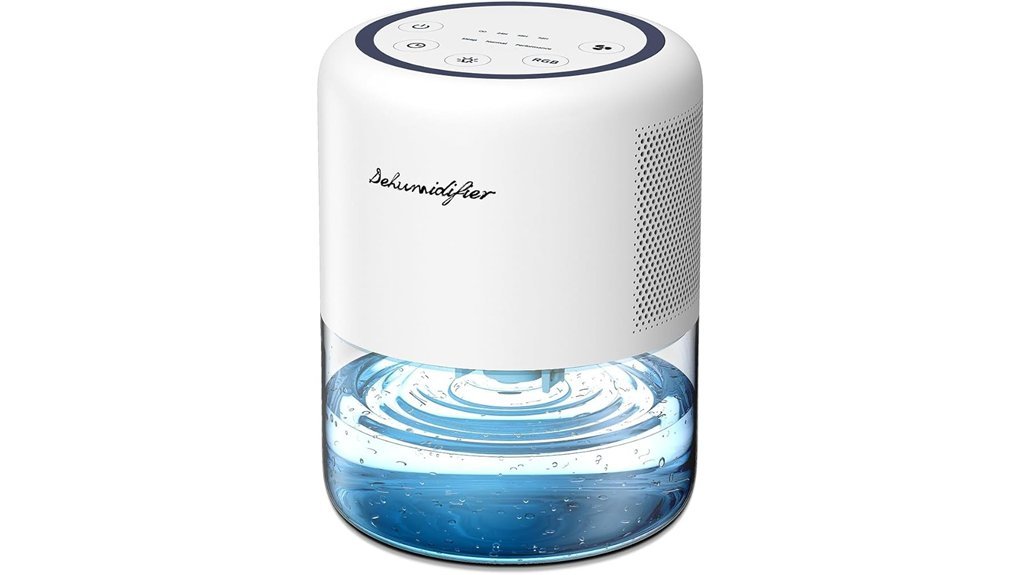
The Windangel 44oz is the most balanced dorm-room option in this group. Its listing combines a 44 oz/1.3-liter nominal tank, three operating modes, automatic defrost, automatic shutoff, and 24-, 48-, and 72-hour timer settings. The seller states that it can collect up to 11.8 oz or 349 ml per day at 86°F and 80% relative humidity.
Sleep, Normal, and Performance modes give students more control over noise and output, while the seller-listed 24W input is modest for a small plug-in appliance. One detail worth knowing is that the listing says the unit stops when approximately 32 oz/950 ml has collected, so its usable fill point may be lower than the nominal 1.3-liter tank size.
Why You’ll Like It: It offers the best combination of operating controls and moisture-management features without requiring much room.
Best For: Small dorm rooms, wardrobes, closets, bathrooms, or similar enclosed spaces with mild localized humidity.
Who Should Avoid It: Anyone dealing with active leaks, wet walls, frequent heavy laundry drying, or humidity that remains high across the whole room.
Pros:
- Three operating modes make it easier to balance sound and moisture removal.
- Includes automatic shutoff, automatic defrost, and multiple timer settings.
- Seller-listed 24W input is relatively modest.
- The 44 oz nominal tank is larger than the TABYIK tank.
Cons:
- Maximum 349 ml-per-day extraction is intended for light moisture only.
- The stated automatic-shutoff level is lower than the nominal tank capacity.
- Different sections of the listing show slightly different dimensions, so confirm the current measurements before ordering.
- Decorative lighting may add little value for buyers who want a basic appliance.
TABYIK 38OZ Quiet Small Dehumidifier
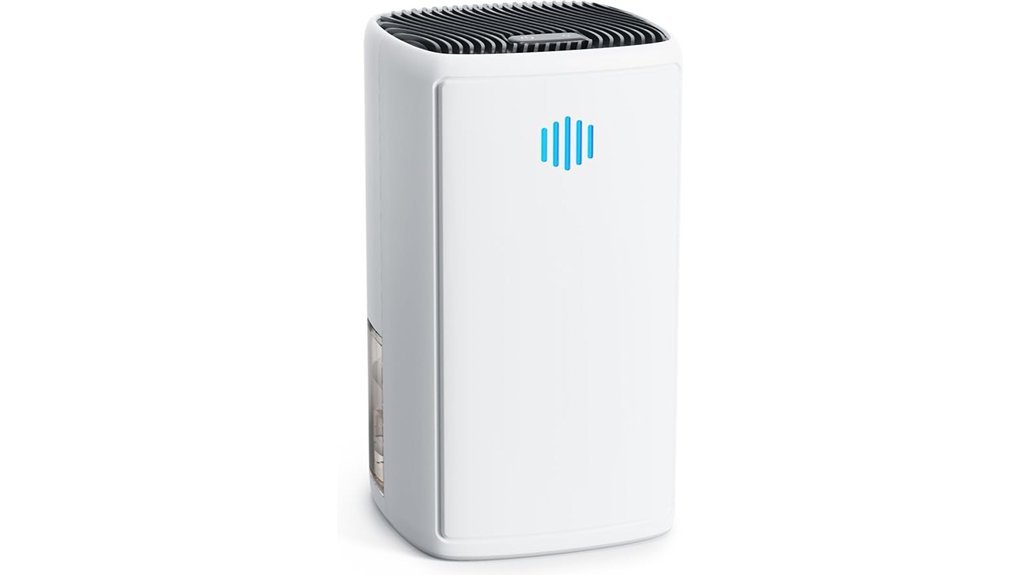
The TABYIK 38OZ is the strongest choice here for students who place quiet operation near the top of their checklist. Its current product title lists 28 dB operation, while the feature description more generally states that it runs below 30 dB. The seller also lists a 38 oz removable tank, automatic defrost, automatic shutoff, and a full-tank indicator.
Its maximum advertised collection is 11 oz per day, or about 325 ml, under test conditions of 86°F and 80% relative humidity. That makes it suitable for localized light moisture around a closet, wardrobe, bathroom area, or small sleeping space, but not severe room-wide dampness.
Why You’ll Like It: Its low seller-listed noise level is useful when the unit will sit near a desk or bed.
Best For: Dorm residents who prioritize quieter operation for studying and sleeping.
Who Should Avoid It: Buyers who need fast water removal, a built-in humidity display, or control over a persistently damp full-size room.
Pros:
- Seller-listed 28 dB noise level is the lowest numerical claim in this comparison.
- Automatic shutoff and a full-tank indicator help prevent overflow.
- Automatic defrost can help manage frost buildup in cooler conditions.
- The removable 38 oz tank is easy to monitor and empty.
Cons:
- The corrected maximum extraction figure is about 325 ml per day, not 0.45 L per day.
- Actual collection can be much lower in cooler or less humid rooms.
- It does not provide a built-in humidistat display for choosing a precise target humidity.
- Dimension information differs between sections of the current listing, so verify the latest measurements.
Deyagoo 1500ML Small Dehumidifier
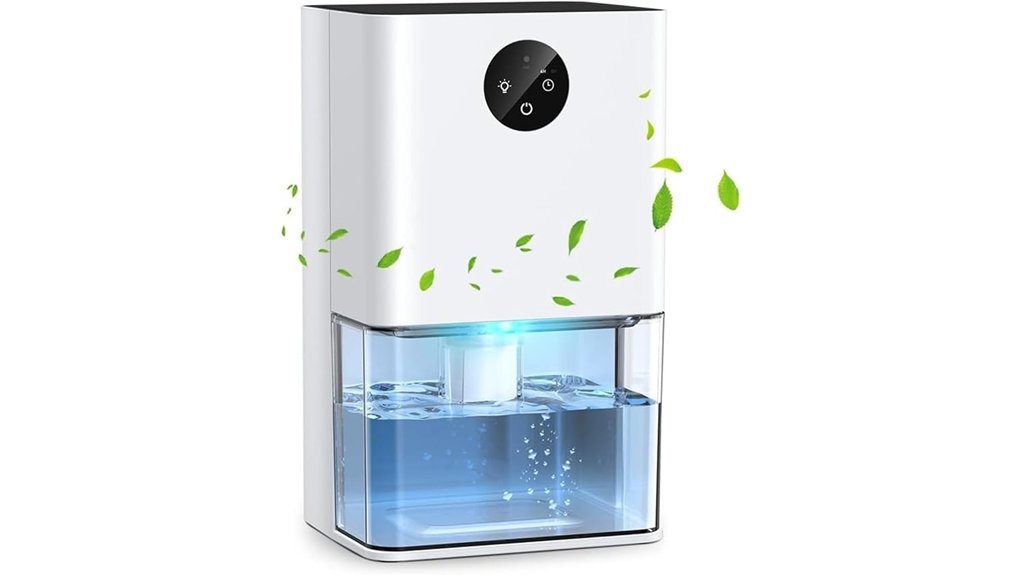
The Deyagoo DY501 is the most useful choice for a buyer who prioritizes tank size. Its 1500 ml/50 oz transparent tank is the largest among these four products, while its narrow 5.91 × 4.72-inch footprint may fit more easily on a shelf than a wider unit. The listed height is 9.84 inches.
Under the seller’s stated conditions of 86°F and 80% relative humidity, it can collect up to 300 ml in 24 hours. The listing also specifies 30 dB operation, automatic shutoff, a visible water tank, and optional seven-color lighting. Although it is advertised for areas up to 300 square feet, the modest extraction rate makes it better for localized moisture than serious whole-room dehumidification.
Why You’ll Like It: The 1500 ml tank can reduce emptying frequency without requiring an especially wide placement area.
Best For: Dorm bedrooms, closets, bathroom areas, or RV spaces with mild humidity and limited shelf width.
Who Should Avoid It: Anyone who needs continuous drainage, precise humidity control, or rapid moisture removal following a leak.
Pros:
- Largest nominal tank in this four-product comparison.
- Transparent tank makes the water level easy to check.
- Seller-listed 30 dB operation is suitable for many bedrooms and study spaces.
- Automatic shutoff stops operation when the tank reaches its stated full range.
Cons:
- Maximum 300 ml-per-day collection is the lowest listed extraction figure here.
- The advertised 300-square-foot coverage should not be treated as guaranteed room-wide performance.
- The tank must be emptied manually because no continuous drain connection is listed.
- Performance will fall below the maximum in cooler or moderately humid conditions.
Hoomace 1000 ml Dehumidifier with Reusable Filter
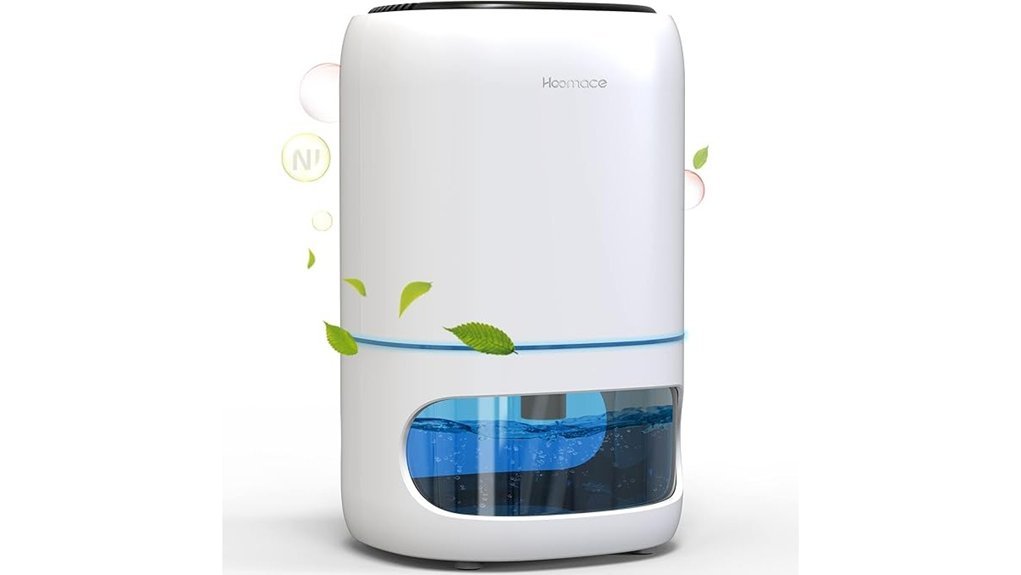
The Hoomace combines compact thermoelectric moisture removal with a reusable G4 filter, 4-, 8-, and 12-hour timer settings, automatic shutoff, and LED lighting. The product title markets a 1000 ml/35 oz model, although Amazon’s catalog fields contain conflicting capacity information. Confirm the exact tank size shown in the current listing and manual before ordering.
The seller states that the unit can extract up to 11 oz or 350 ml per day at 86°F and 80% relative humidity and operate below 30 dB. Its reusable filter may catch larger debris such as visible dust, hair, and dander. It should not be compared with a certified HEPA air purifier for fine-particle filtration or allergy control.
Why You’ll Like It: It adds timer controls and a washable coarse-filter feature to basic small-space moisture collection.
Best For: Dorm rooms where a timer-equipped unit with reusable coarse filtration is more useful than maximum tank capacity.
Who Should Avoid It: Buyers whose main goal is verified high-efficiency air cleaning, precise humidity control, or large-room dehumidification.
Pros:
- Includes 4-, 8-, and 12-hour timer options.
- Reusable G4 filter can catch some larger airborne debris.
- Seller-listed below-30 dB operation suits many sleeping and studying environments.
- Automatic shutoff stops the unit when the tank is full.
Cons:
- Tank-capacity fields on the current listing are inconsistent.
- The G4 filter is not a replacement for a HEPA air purifier.
- Maximum moisture removal depends on warm, highly humid test conditions.
- The tank requires manual emptying and regular cleaning.
Factors to Consider When Choosing a Dehumidifier for Dorm Rooms
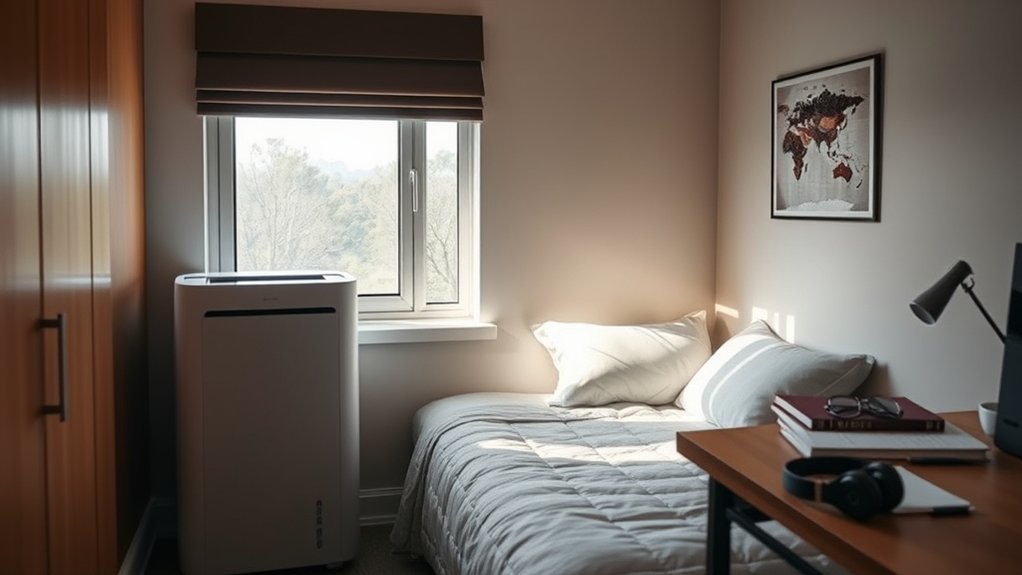
A dorm dehumidifier should fit the available space, operate quietly enough for studying and sleeping, and collect a useful amount of water under the room’s actual conditions. Compare the daily extraction rate, nominal tank size, usable shutoff level, dimensions, noise information, timers, and dorm appliance rules rather than relying on square-foot marketing alone.
Use a separate digital hygrometer to check whether humidity is truly elevated. A commonly recommended indoor relative-humidity range is approximately 30% to 50%, although the most comfortable setting can vary with outdoor temperature and building conditions.
Room Size and Moisture Level
Advertised square-foot coverage is only a starting point. Compact thermoelectric models are most useful for mild moisture in enclosed dorm rooms, closets, wardrobes, and bathroom areas. Their maximum water-removal figures are generally measured at about 86°F and 80% relative humidity, so collection can be considerably lower in a cool or moderately humid room.
Do not compare these few-hundred-milliliter figures directly with the pint-per-day capacity of a compressor dehumidifier. Contact residence-hall management if the room has wet drywall, recurring water stains, active leaks, extensive condensation, or visible water damage.
Noise Level Matters
Look for a clearly stated decibel figure when the appliance will sit near a bed or desk. TABYIK’s title lists 28 dB, while Deyagoo lists 30 dB and Hoomace states below 30 dB. Windangel offers a Sleep mode but does not provide the same clear numerical noise figure in its main feature copy.
Seller-listed decibel measurements may not match what you hear in a quiet dorm. A hollow desk, hard shelf, nearby wall, or vibrating surface can make fan noise more noticeable. A level, stable pad may help reduce vibration without blocking airflow.
Tank Capacity Versus Removal Rate
A larger tank can reduce emptying frequency, but it does not automatically provide faster moisture removal. Deyagoo has the largest nominal tank at 1500 ml, while Windangel and Hoomace list slightly higher maximum daily extraction figures than Deyagoo under their specified test conditions.
Also check the automatic-shutoff point. A unit may stop before the tank reaches its full advertised volume, as the Windangel listing indicates. Empty, rinse, and dry the tank regularly rather than allowing collected water to sit for long periods.
Power Use and Electrical Rules
Small thermoelectric dehumidifiers generally use less power than full-size compressor models, but wattage alone does not show how effectively a unit removes water. Compare both rated input and daily extraction. A low-wattage model that runs continuously may still use more energy than expected.
Check the input rating on the exact adapter and review your residence hall’s appliance policy. Use the manufacturer-supplied power supply, keep plugs and cords dry, and do not overload a shared outlet or power strip.
Automatic Shutoff and Dorm Safety
Choose a model that stops when the tank fills or is removed. Place it upright on a stable, dry surface with the inlet and outlet completely clear. Keep it away from bedding, loose papers, curtains, sinks, and places where it may be knocked over.
Automatic shutoff helps reduce overflow risk, but it does not replace the manufacturer’s safety instructions or dorm rules. Inspect the cord and adapter regularly and do not assume that unattended or overnight use is permitted.
Portability and Placement
Measure the intended shelf, desk, or floor area before buying and leave enough room to remove the tank. Product listings sometimes contain conflicting dimension fields, so check the current measurements rather than relying only on a third-party summary.
A compact dehumidifier works best with open airflow. Do not hide it behind clothes, push it tightly against a wall, place books over the inlet, or operate it inside a completely closed cabinet unless the manufacturer specifically permits that placement.
Before You Buy Checklist
- Measure the placement area and allow clearance for airflow and tank removal.
- Compare daily moisture removal under the stated test conditions.
- Check both nominal tank size and the automatic-shutoff level.
- Verify current dimensions, wattage, noise information, and included power supply.
- Use a hygrometer to determine whether room humidity is actually elevated.
- Review dorm appliance, outlet, overnight-use, and unattended-use rules.
- Report leaks, wet drywall, water stains, or recurring mold to building management.
Moisture warning: A small dehumidifier can collect moisture from the air, but it cannot repair a plumbing leak, stop water entering through a wall, remove established mold, or dry water-damaged building materials. Report those conditions promptly.
Frequently Asked Questions
How Do I Know if My Dorm Needs a Dehumidifier?
Use a digital hygrometer and watch for repeated humidity readings above the recommended indoor range, especially when combined with window condensation, musty odors, damp fabrics, or moisture on walls. A dehumidifier may help with airborne humidity, but leaks and water intrusion require repair.
Can a Dorm Dehumidifier Run Overnight?
Only run it overnight when the dorm permits the appliance, the manufacturer’s instructions allow that use, the automatic shutoff works, and the cord and power supply are undamaged. Place it upright with unrestricted airflow and away from bedding, water, curtains, and combustible clutter. Do not assume that an automatic shutoff feature makes every model suitable for unattended operation.
Do Dehumidifiers Help Reduce Mold in Dorm Closets?
Lower humidity can make conditions less favorable for mold growth, but a dehumidifier does not remove established mold or fix the water source. Improve airflow, dry wet materials, clean affected areas according to building guidance, and report recurring growth or moisture to dorm management.
How Often Should I Empty a Dorm Dehumidifier Tank?
Check the tank at least daily during the first week so you can learn how quickly it fills. The schedule depends on temperature, relative humidity, tank size, and extraction rate. Empty, rinse, and dry the tank regularly to reduce residue and odors.
Can a Small Dehumidifier Help Dry Clothes in a Dorm?
It may help remove a small amount of moisture released by a few damp garments, especially in a closed room with good airflow. However, these compact models collect only a few hundred milliliters per day under favorable conditions and are not strong enough for regular full laundry loads. Follow dorm rules for indoor clothes drying and use approved ventilation where available.
Can a Small Dorm Dehumidifier Handle Severe Dampness?
Usually not. Persistent wet surfaces, extensive condensation, water damage, strong mold growth, or active leakage should be reported to building management. A higher-capacity compressor dehumidifier may be needed after the moisture source has been identified and repaired.
Conclusion
Final Recommendation
The Windangel 44oz is the best all-around choice among these four compact dorm dehumidifiers because it balances operating modes, timers, automatic defrost, and a reasonably large nominal tank. Choose the TABYIK 38OZ when low seller-listed noise matters most, the Deyagoo 1500ML when you prefer the largest tank, or the Hoomace 1000 ml when timer controls and a reusable G4 filter are useful extras.
Whichever model you select, verify the current Amazon specifications, confirm your dorm’s appliance rules, monitor humidity with a hygrometer, and keep the air inlet and outlet unobstructed. Treat leaks, wet building materials, and visible mold as maintenance problems rather than conditions a small thermoelectric dehumidifier can solve by itself.