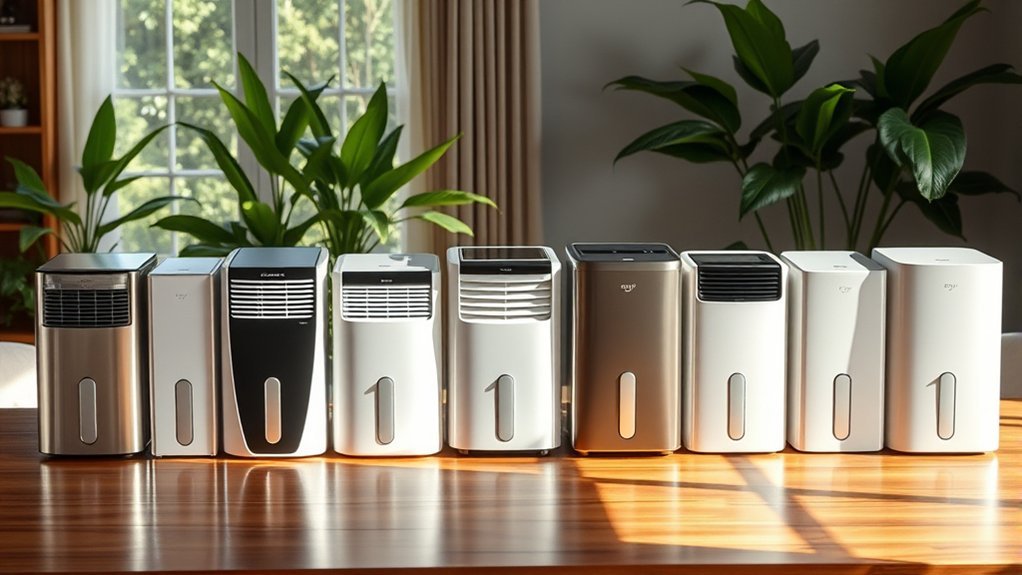
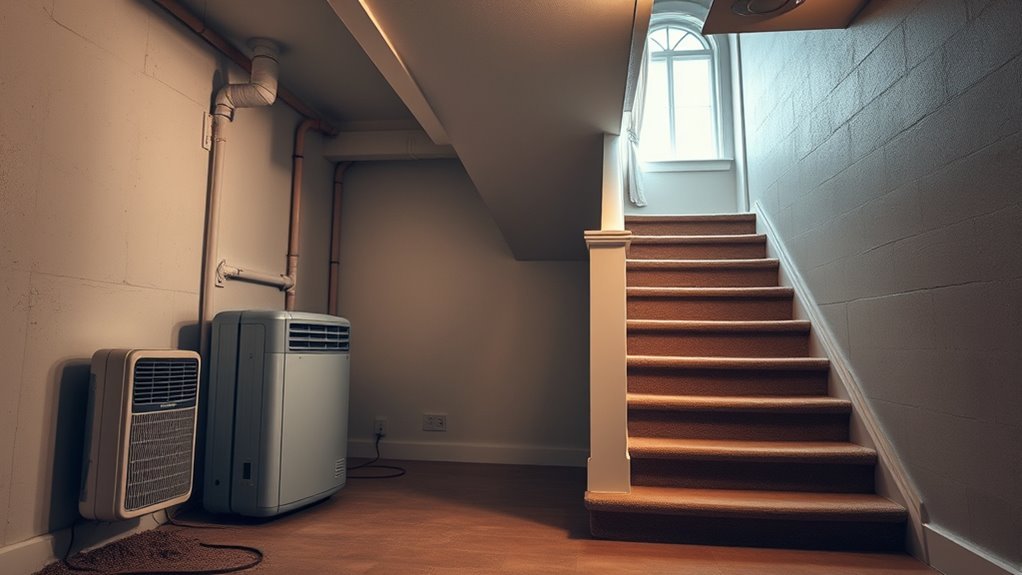
Choosing the best dehumidifier with a pump for a basement requires looking beyond the largest square-foot or pints-per-day number printed on the box. Real-world moisture control depends on the temperature and humidity conditions used to calculate capacity, vertical condensate pump lift, hose routing, basement temperature, noise levels, and ease of maintenance. This updated 2026 buyer’s guide compares eight pump-equipped dehumidifiers—ranging from low-clearance crawl-space units to high-capacity residential towers and commercial dehumidifiers—so you can set up reliable, hands-free basement drainage.
Quick verdict
The AEOCKY 4500 Sq.Ft Dehumidifier with Pump is the strongest all-around choice for most residential basements because it pairs a 16.4-foot (5-meter) vertical lift pump with disclosed moisture-removal ratings at multiple test conditions and dependable automatic humidity controls.
Choose the MOISWELL Defender ME-7S for a low-clearance basement or crawl space, the DECIUU Max 100 Pint or Waykar 150 Pints for expansive residential areas, the Gasbye DryPrime for easier pump cleaning, or the Airzentti 155 Pints when you need a heavy-duty commercial unit with a disclosed 70-pint AHAM rating.
Important capacity note:
A dehumidifier advertised at 80, 100, 150, or 155 pints per day typically reaches that headline figure only under hot, nearly saturated test conditions (such as 95°F and 90% relative humidity). In a cooler basement, actual daily water extraction will be lower. Always compare pints per day under matching temperature and relative humidity (RH) standards—such as AHAM (80°F / 60% RH) or U.S. DOE (65°F / 60% RH)—and treat advertised square-foot coverage as an upper ceiling rather than a guarantee.
Quick Comparison of Basement Dehumidifiers With Pumps
| Product | Published Capacity | Advertised Coverage | Pump Detail | Best For | Check Details |
|---|---|---|---|---|---|
| AEOCKY 4500 Sq.Ft | Max 80 pints; also rated at 56 pints (86°F / 80% RH) | Up to 4,500 sq. ft. | Integrated pump with up to 16.4 ft. (5 m) vertical lift | Balanced residential performance | Check on Amazon |
| DECIUU Max 100 Pint | Max 100 pints (95°F / 90% RH); 70 pints (86°F / 80% RH) | Up to 5,000 sq. ft. | Built-in pump with up to 16.4 ft. (5 m) vertical lift | Large basements without a floor drain | Check on Amazon |
| MOISWELL Defender ME-7S | 70 pints at saturation; 35 pints under AHAM conditions | Up to 1,000 sq. ft. | Built-in pump with automatic vertical drainage | Compact basements and crawl spaces | Check on Amazon |
| Airzentti 155 Pints | 155 pints near saturation; 70 pints under AHAM conditions | Up to 7,500 sq. ft. | Built-in pump and continuous pump/hose drainage | Commercial or restoration-style use | Check on Amazon |
| Waykar 150 Pints | Max 150 pints under hot, very humid conditions | Up to 7,000 sq. ft. | Built-in pump with up to 9.84 ft. (3 m) vertical lift | Large residential basements | Check on Amazon |
| Uhome 150 Pints | Max 150 pints under hot, very humid conditions | Up to 7,000 sq. ft. | Pump, gravity drain, and 1.85-gal. bucket options | Large rooms needing flexible drainage | Check on Amazon |
| Gasbye DryPrime | Max 75 pints per day | Up to 4,500 sq. ft. | Removable serviceable pump and 16.5 ft. pump hose | Easier pump cleaning and servicing | Check on Amazon |
| Sijipt 80 Pints | Max 80 pints (95°F / 90% RH) | Up to 5,000 sq. ft. | Built-in pump with up to 16.4 ft. (5 m) vertical lift | Simple automatic pump drainage | Check on Amazon |
AEOCKY 4500 Sq.Ft Dehumidifier with Pump
Best Overall
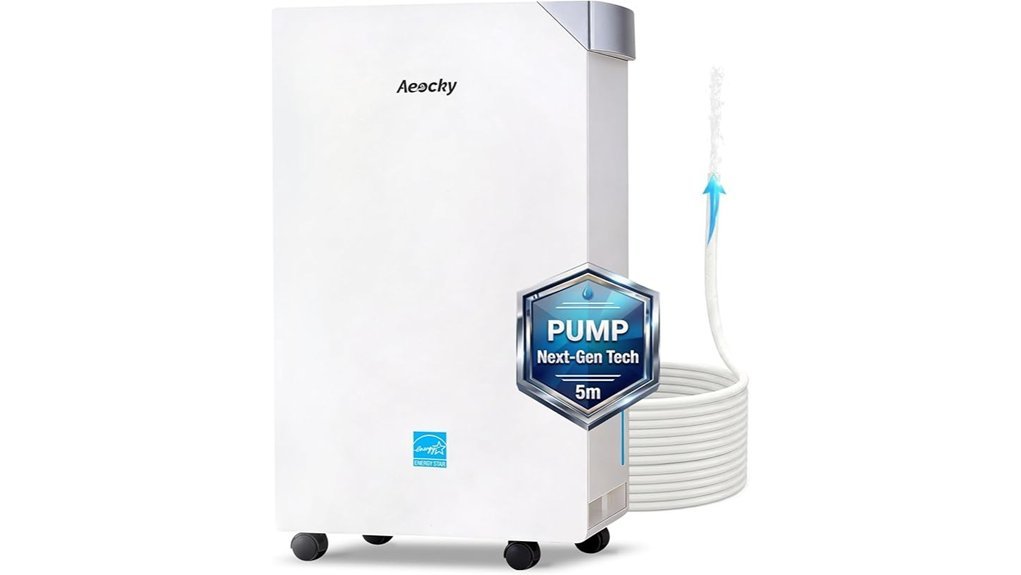
The AEOCKY 4500 Sq.Ft Dehumidifier with Pump strikes a practical balance between residential moisture-removal capacity, automatic vertical drainage, and energy-conscious operation. Rather than relying solely on a single peak saturation number, its specifications list a maximum extraction rate of 80 pints per day under hot, saturated summer conditions and 56 pints per day at 86°F and 80% relative humidity. Having both figures makes it much easier to gauge how the unit will perform in realistic household conditions.
Its integrated condensate pump can push collected water vertically up to 16.4 feet (5 meters) through the included drain hose, allowing you to discharge water into an elevated utility sink, laundry standpipe, or sump basin when no floor drain is nearby. Smart humidistat controls, automatic defrost, and power-off memory allow the unit to resume your target settings automatically after a brief power outage.
Key Specifications:
- Published Capacity: Up to 80 pints/day max; 56 pints/day at 86°F and 80% RH
- Advertised Coverage: Up to 4,500 sq. ft.
- Vertical Pump Lift: Up to 16.4 ft. (5 m)
- Drainage Methods: Built-in condensate pump, continuous gravity drain, internal bucket
- Core Controls: Digital humidistat, auto restart (power-off memory), auto defrost
Best For: Homeowners who want a well-rounded, pump-equipped dehumidifier for a medium-to-large basement with transparent multi-condition capacity ratings.
Why You’ll Like It:
- Publishes both a maximum saturation figure and a 56-pint rating at 86°F / 80% RH.
- Integrated pump provides up to 16.4 feet (5 meters) of upward drainage where gravity drainage is impossible.
- Digital humidity controls and power-off restart memory support unattended basement operation.
Consider Before Buying:
- The 4,500-square-foot figure represents an ideal ceiling; severely damp basements require more conservative sizing.
- The headline 80-pint rate applies to hot, high-humidity conditions rather than cool 65°F basement air.
- Measure both the vertical rise and total horizontal hose distance to your drain before setup.
Bottom-Line Verdict: For most standard and large residential basements lacking a floor-level drain, the AEOCKY 4500 Sq.Ft delivers the most practical combination of 16.4-foot vertical pump lift, honest capacity reporting, and everyday ease of use.
DECIUU Max 100 Pint Dehumidifier with Pump
Best Value for Large Basements
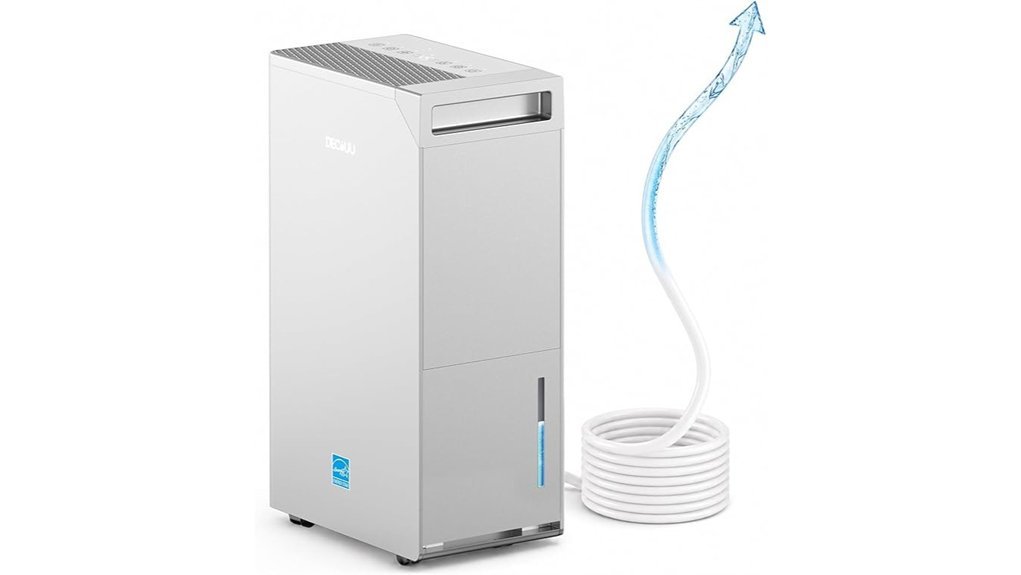
The DECIUU Max 100 Pint Dehumidifier is built for large basements, multi-room lower levels, garages, and laundry areas that struggle with persistent dampness. It is rated to remove up to 100 pints per day at 95°F and 90% relative humidity and up to 70 pints per day at 86°F and 80% relative humidity, giving it extra headroom over standard 70- or 80-pint max-rated residential towers.
Its built-in condensate pump supports up to 16.4 feet (5 meters) of vertical lift, making it straightforward to route water up to a basement utility sink or plumbing standpipe. You can also switch between continuous gravity drainage and the removable internal collection tank. Smooth-rolling casters, a digital control panel, auto defrost, and automatic power-off restart round out its basement-friendly feature set.
Key Specifications:
- Published Capacity: Up to 100 pints/day (95°F / 90% RH); 70 pints/day (86°F / 80% RH)
- Advertised Coverage: Up to 5,000 sq. ft.
- Vertical Pump Lift: Up to 16.4 ft. (5 m)
- Drainage Methods: Built-in pump, gravity hose drainage, removable tank
- Core Controls: Digital humidistat, auto defrost, automatic restart, caster wheels
Best For: Large residential basements where the nearest drain sits above floor level and higher moisture extraction is needed during muggy summer months.
Why You’ll Like It:
- Discloses both peak (100-pint) and lower-condition (70-pint at 86°F / 80% RH) performance figures.
- Strong 16.4-foot (5-meter) vertical pump lift handles elevated basement sinks and standpipes.
- Includes all three drainage methods (pump, gravity hose, and manual bucket).
Consider Before Buying:
- The 100-pint figure reflects extreme heat and humidity rather than cool basement conditions.
- The internal water bucket will fill rapidly if you operate the unit without connecting the pump or gravity hose.
- The washable air filter and internal pump reservoir require periodic inspection to prevent buildup.
Bottom-Line Verdict: If you want higher extraction capacity than an 80-pint residential model without stepping up to a heavy industrial cabinet, the DECIUU Max 100 Pint is a versatile choice for large basements.
MOISWELL 70 Pints Portable Commercial Dehumidifier
Best for Compact Basements and Crawl Spaces
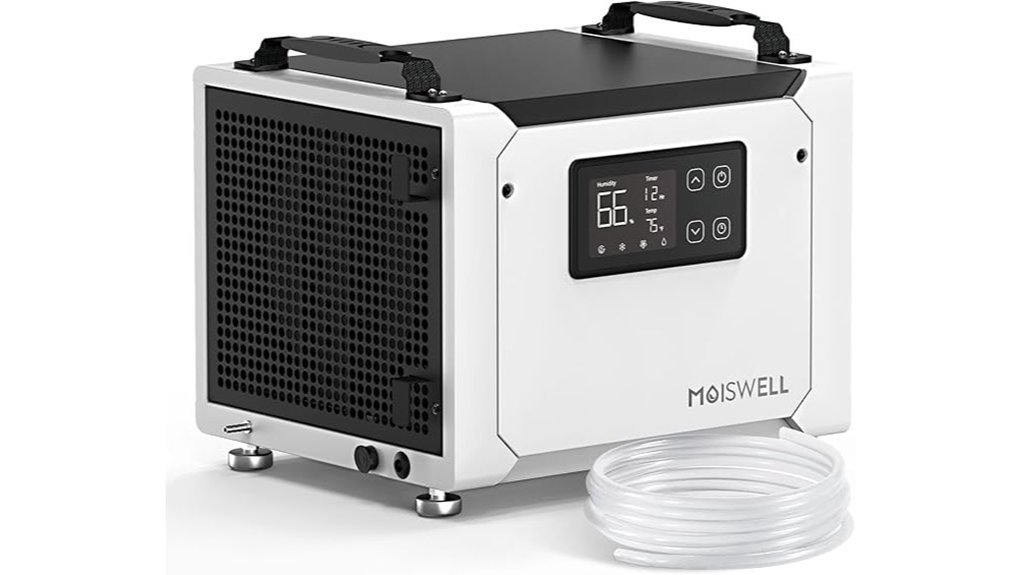
The MOISWELL Defender ME-7S is a low-profile, commercial-style dehumidifier engineered for tight basements, crawl spaces, utility rooms, and storage areas where an upright plastic residential tower will not fit. Importantly, the manufacturer clearly separates its 70-pint-per-day saturation rating from its 35-pint-per-day AHAM rating (80°F and 60% RH), giving buyers a realistic benchmark for standard operating conditions.
Because commercial crawl-space units omit an internal water bucket, the built-in condensate pump handles drainage automatically, pumping collected water upward or across the space to a sump basin or drain line. Automatic coil defrost supports operation in cooler subterranean spaces, while the horizontal metal-and-molded housing is built to withstand tougher environments than household units.
Key Specifications:
- Published Capacity: 70 pints/day at saturation; 35 pints/day under AHAM conditions (80°F / 60% RH)
- Advertised Coverage: Up to 1,000 sq. ft.
- Cabinet Style: Low-clearance horizontal commercial housing (approx. 40 lbs.)
- Drainage Methods: Built-in condensate pump for continuous upward or horizontal discharge (no internal bucket)
- Core Controls: Digital humidistat, auto defrost, auto restart
Best For: Crawl spaces, cellars, and compact basements up to roughly 1,000 square feet where low vertical clearance and rugged housing matter more than a decorative residential cabinet.
Why You’ll Like It:
- Clearly discloses both its 70-pint saturation rating and its 35-pint AHAM rating.
- Compact horizontal footprint fits easily inside low-ceiling crawl spaces and under stairs.
- Internal condensate pump operates continuously without an overflow tank to empty.
Consider Before Buying:
- Its AHAM moisture-removal rate is 35 pints per day, which is sized for compact spaces rather than sprawling basements.
- Because there is no internal collection bucket, you must route the drain hose before running the unit.
- At roughly 40 pounds, it is sturdy and portable via carry handles, but heavier than small plastic units.
Bottom-Line Verdict: When ceiling height is tight or you need a dedicated crawl-space and cellar unit with honest AHAM ratings, the MOISWELL Defender ME-7S is far more practical than a tall household dehumidifier.
Airzentti 155 Pints Commercial Dehumidifier
Best Commercial Pick
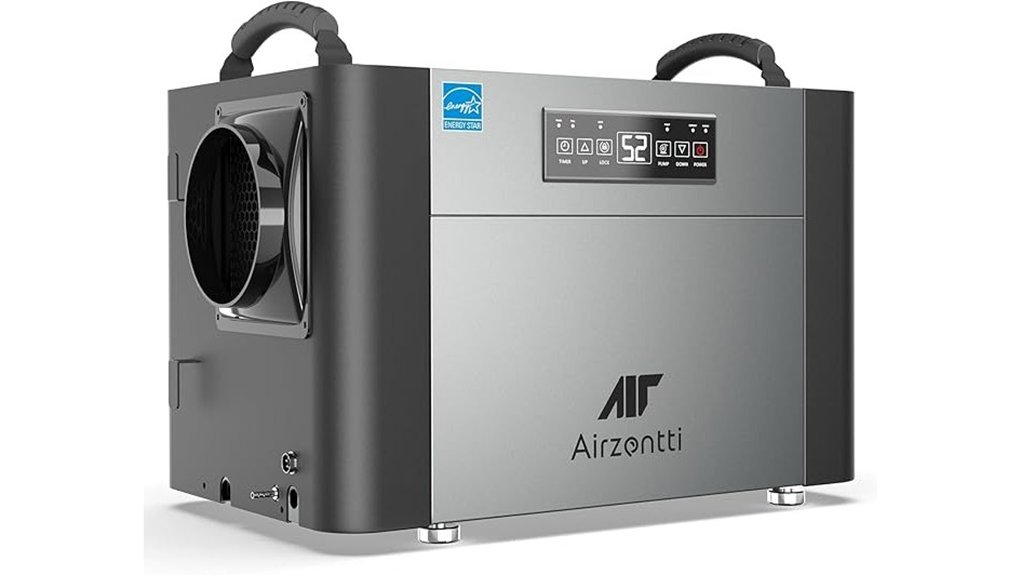
The Airzentti 155 Pints Commercial Dehumidifier is built for large unfinished basements, expansive crawl spaces, workshops, warehouses, and water-damage drying projects. It is rated to extract up to 155 pints per day in near-saturated conditions and a true 70 pints per day under standard AHAM test conditions—twice the AHAM output of compact 35-pint crawl-space models.
Housed in a horizontal commercial cabinet, it pairs a built-in condensate pump with automatic defrost, power-off restart memory, and a published airflow rate of 220 CFM (cubic feet per minute). Its integrated outlet duct collar also allows you to attach flexible ducting, making it possible to dehumidify an adjacent room or partitioned basement zone.
Key Specifications:
- Published Capacity: 155 pints/day near saturation; 70 pints/day under AHAM conditions
- Advertised Coverage: Up to 7,500 sq. ft.
- Airflow Rate: 220 CFM with duct collar support
- Drainage Methods: Built-in condensate pump for continuous hose drainage
- Cabinet Weight: Approx. 60 lbs. commercial horizontal chassis
Best For: Very large, persistently wet basements, crawl spaces, or light-commercial areas that require a true 70-pint AHAM extraction rate and optional ducting.
Why You’ll Like It:
- Discloses a strong 70-pint-per-day AHAM rating alongside its 155-pint saturation figure.
- Horizontal commercial cabinet with a 220 CFM blower supports crawl-space and ducted installations.
- Built-in pump and automatic defrost handle continuous moisture removal in demanding environments.
Consider Before Buying:
- The 155-pint headline number reflects near-saturation conditions rather than normal indoor humidity.
- At roughly 60 pounds, require two people or a clear path when carrying it down basement stairs.
- Its industrial appearance and stronger 220 CFM airflow are louder and less refined than finished-basement tower units.
Bottom-Line Verdict: For chronically wet unfinished basements, large crawl spaces, or minor flood recovery, the Airzentti 155 Pints provides true commercial airflow and verified 70-pint AHAM drying power.
Waykar 150 Pints Energy Star Dehumidifier with Pump
Best for Large Residential Basements
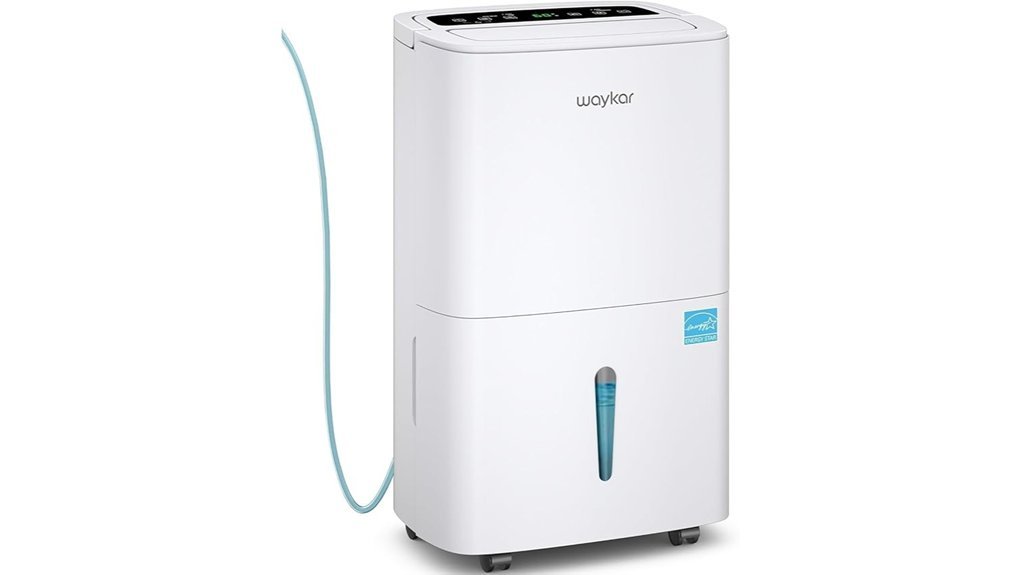
The Waykar 150 Pints Energy Star Dehumidifier with Pump brings high-capacity moisture removal into a clean, rolling residential tower format suited for finished or semi-finished basements. Keep in mind that its 150-pint rating is a maximum saturation figure measured under hot, very humid conditions, so it sits a tier below industrial 70-pint AHAM commercial machines while offering more capacity than standard 50- or 80-pint max residential units.
Its built-in condensate pump lifts water vertically up to 9.84 feet (3 meters), and the unit also supports standard gravity hose drainage and manual collection via a 1.85-gallon (7-liter) internal bucket. An adjustable digital humidistat, 24-hour timer, auto defrost, power-off restart, washable air filter, and smooth casters make daily operation simple.
Key Specifications:
- Published Capacity: Up to 150 pints/day max (under hot, very humid conditions)
- Advertised Coverage: Up to 7,000 sq. ft.
- Vertical Pump Lift: Up to 9.84 ft. (3 m)
- Water Tank Volume: 1.85 gallons (7 liters)
- Drainage Methods: Built-in pump, continuous gravity hose, removable tank
Best For: Expansive finished or open-plan residential basements where homeowners want high residential extraction capacity, Energy Star efficiency, and three drainage modes.
Why You’ll Like It:
- High residential capacity designed for open, multi-room basement layouts.
- Supports built-in pump discharge, gravity drainage, and a generous 1.85-gallon bucket backup.
- Intuitive digital controls, timer, and caster wheels blend easily into finished living spaces.
Consider Before Buying:
- The 150-pint rating is a maximum saturation figure, not an AHAM or U.S. DOE rating.
- Its 9.84-foot (3-meter) vertical pump lift is shorter than the 16.4-foot (5-meter) lift on the AEOCKY, DECIUU, and Sijipt models—measure your drain height carefully if pumping to a high basement window or ceiling line.
- The taller cabinet footprint takes up more floor space than mid-size 75- or 80-pint units.
Bottom-Line Verdict: As long as your drain inlet sits within 9.84 feet (3 meters) vertically of the unit, the Waykar 150 Pints is an excellent high-capacity residential tower for large finished basements.
Uhome 150 Pints Dehumidifier with Pump for Large Rooms
Best Flexible High-Capacity Option
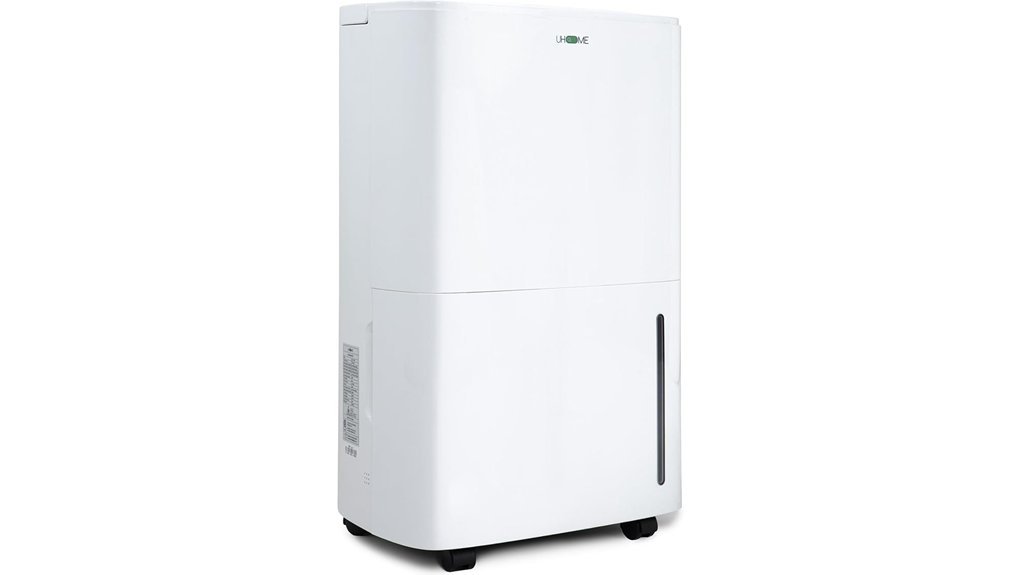
The Uhome 150 Pints Dehumidifier with Pump is tailored for large basements, recreation rooms, and storage areas where frequent bucket emptying would be a chore. Advertised for spaces up to 7,000 square feet with a 150-pint maximum saturation rating, it allows you to customize target humidity between 30% and 80% RH in precise 5% increments.
Homeowners can switch between active pump drainage, passive gravity drainage, or the removable 1.85-gallon (7-liter) water tank with full-tank auto shutoff. Having all three drainage paths makes it easy to move the dehumidifier between a basement standpipe setup and a garage or upstairs room where only gravity or bucket collection is used.
Key Specifications:
- Published Capacity: Up to 150 pints/day max (under hot, very humid conditions)
- Advertised Coverage: Up to 7,000 sq. ft.
- Humidistat Range: 30% to 80% RH in 5% increments
- Water Tank Volume: 1.85 gallons (7 liters)
- Drainage Methods: Built-in condensate pump, gravity hose, removable tank
Best For: Large basements and multi-use spaces where flexible 3-in-1 drainage and fine-tuned humidity control are priorities.
Why You’ll Like It:
- Three drainage options (pump, gravity hose, and 1.85-gallon bucket) adapt to changing room layouts.
- Wide 30%–80% RH adjustment range in 5% steps prevents over-drying or short-cycling.
- High residential extraction capacity handles damp summer air across large floor plans.
Consider Before Buying:
- Like other residential towers in this class, the 150-pint figure is measured at high temperature and humidity saturation.
- In a very damp basement, the 1.85-gallon tank can fill several times a day if pump or gravity drainage is not active.
- Check the product manual for exact vertical pump lift height and hose fitting requirements prior to installation.
Bottom-Line Verdict: The Uhome 150 Pints is a solid alternative to the Waykar 150 Pints for buyers who want a high-capacity residential unit with flexible 3-way drainage and wide humidistat settings.
Gasbye Energy Star Dehumidifier for Basement
Best Serviceable Pump Design
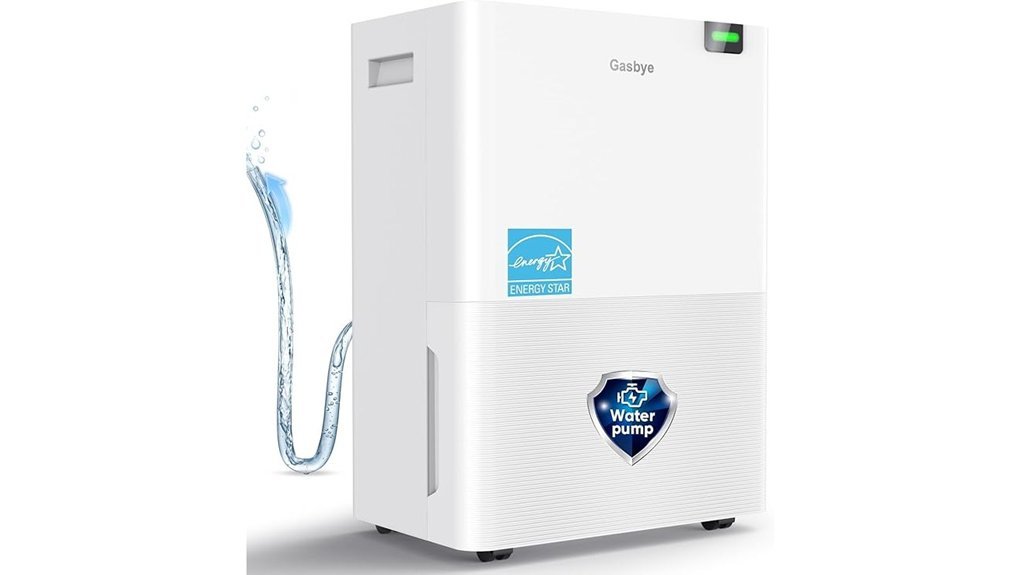
The Gasbye DryPrime Energy Star Dehumidifier with Pump addresses one of the most common long-term failure points in pump-equipped dehumidifiers: internal pump clogs. Unlike sealed units that require disassembling the entire cabinet to clean slime or dust out of the condensate reservoir, the Gasbye DryPrime features a removable, serviceable pump module.
Rated for a maximum capacity of 75 pints per day and advertised for areas up to 4,500 square feet, it includes a 1.45-gallon (5.5-liter) tank, automatic shutoff, power-off restart, a published 44 dB low-speed noise rating, and a 16.5-foot drain hose. Keep in mind that a 16.5-foot hose length represents the tubing provided, so always verify the maximum vertical rise allowed in the user manual.
Key Specifications:
- Model Name: Gasbye DryPrime
- Published Capacity: Up to 75 pints/day max
- Advertised Coverage: Up to 4,500 sq. ft.
- Pump & Hose Detail: Removable cleanable pump assembly; 16.5 ft. pump hose included
- Water Tank & Noise: 1.45-gallon (5.5-liter) tank; published 44 dB quiet operation claim
Best For: Homeowners who want easier access to the condensate pump for periodic cleaning, descaling, or maintenance in dusty basements.
Why You’ll Like It:
- Removable pump assembly makes it much easier to clean out biofilm, dust, and mineral buildup.
- Energy Star efficiency paired with a quiet 44 dB published noise rating suits finished basement living areas.
- Includes a 16.5-foot pump hose while retaining manual bucket collection as a backup.
Consider Before Buying:
- The 75-pint capacity is a maximum saturation rating rather than a disclosed AHAM or DOE figure.
- Do not confuse the 16.5-foot hose length with pure vertical pump lift; allow extra slack for horizontal routing.
- Even with a removable design, the pump filter and tubing still require routine seasonal cleaning.
Bottom-Line Verdict: If you have ever had a built-in dehumidifier pump clog from basement dust or biofilm, the Gasbye DryPrime’s removable pump design makes long-term upkeep significantly easier.
Sijipt 80 Pints Dehumidifier with Pump
Best Straightforward Pump Option
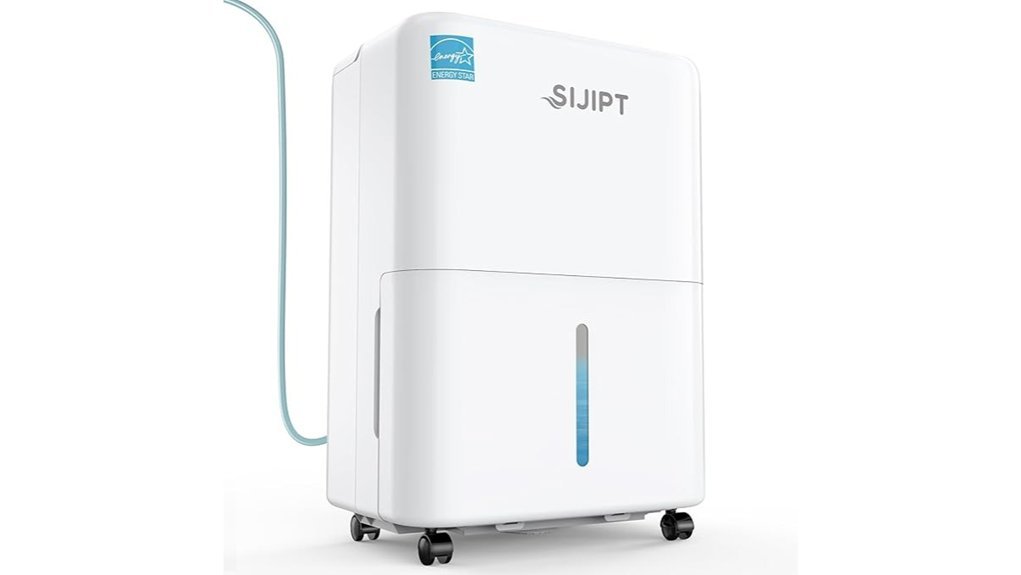
The Sijipt 80 Pints Dehumidifier combines a compact residential tower footprint with a built-in condensate pump capable of lifting water vertically or horizontally up to 16.4 feet (5 meters). Its maximum 80-pint-per-day moisture-removal rating is measured at 95°F and 90% relative humidity, placing it in the standard mid-to-large residential basement category.
Advertised for spaces up to 5,000 square feet, the unit features an adjustable digital humidistat, automatic defrost, power-off restart memory, a 24-hour timer, two fan speeds, and a 1.32-gallon (5-liter) removable water tank. It also supports passive gravity drainage when placed near a floor-level drain.
Key Specifications:
- Published Capacity: Up to 80 pints/day max (95°F / 90% RH)
- Advertised Coverage: Up to 5,000 sq. ft.
- Vertical Pump Lift: Up to 16.4 ft. (5 m)
- Water Tank Volume: 1.32 gallons (5 liters)
- Core Controls: 2 fan speeds, 24-hour timer, digital humidistat, auto defrost, power-off memory
Best For: Buyers looking for a simple, no-frills residential dehumidifier with a clearly specified 16.4-foot vertical pump lift.
Why You’ll Like It:
- Built-in pump supports a full 16.4 feet (5 meters) of vertical lift for elevated utility sinks or standpipes.
- Power-off memory and automatic defrost allow unattended continuous operation.
- Retains both a 1.32-gallon (5-liter) tank and a gravity-drain port as backup drainage methods.
Consider Before Buying:
- The 80-pint capacity is measured at 95°F and 90% RH without a separately published AHAM or DOE figure.
- Offers two fan speeds rather than three or more variable airflow levels.
- Check the included hose diameters upon arrival if you plan to use the passive gravity port alongside the pump hose.
Bottom-Line Verdict: The Sijipt 80 Pints is a straightforward, easy-to-use residential option when your primary requirement is a 16.4-foot vertical lift pump and simple digital controls.
Factors to Consider When Choosing a Basement Dehumidifier With a Pump
A built-in condensate pump eliminates the daily chore of hauling heavy water buckets upstairs, but the pump alone does not guarantee that a dehumidifier will keep your basement dry. Evaluate the following technical factors before choosing a model.
Compare Capacity Under the Same Test Standards (DOE vs. AHAM vs. Saturation)
Never compare a “Max/Saturation” pint rating on one model directly against an AHAM or U.S. Department of Energy (DOE) rating on another. Because warm air holds far more moisture than cool air, a compressor dehumidifier collects roughly two to three times as much water in a hot 95°F test chamber at 90% relative humidity as it does in a cool 65°F basement at 60% relative humidity.
Use the reference table below to translate how different testing standards compare for roughly equivalent hardware:
| Rating Standard | Test Temperature & Humidity | Mid-Size Unit Equivalent | Large Unit Equivalent | What It Represents |
|---|---|---|---|---|
| U.S. DOE (Current Standard) | 65°F and 60% RH | ~30–35 pints/day | ~50 pints/day | Realistic cool subterranean basement conditions |
| AHAM (Legacy Standard) | 80°F and 60% RH | ~45–50 pints/day | ~70 pints/day | Warm room or standard commercial comparison benchmark |
| High-Humidity Condition | 86°F and 80% RH | ~50–60 pints/day | ~70–90 pints/day | Warm, muggy summer air in unconditioned spaces |
| Max / Near-Saturation | 95°F and 90% RH | ~75–80 pints/day | ~100–155 pints/day | Peak laboratory output under extreme heat and humidity |
Match Basement Size and Dampness Level to Real Capacity
Advertised square-foot figures assume standard ceiling heights, minimal air infiltration, and moderate humidity. In practice, a 1,200-square-foot unfinished basement with stone or cinder-block walls, damp concrete floors, or laundry appliances requires far more moisture-removal power than a well-sealed 2,500-square-foot finished basement.
| Basement Condition | Signs You See | 500–1,500 Sq. Ft. | 1,500–3,000+ Sq. Ft. |
|---|---|---|---|
| Moderately Damp | Clammy air or slight musty odor only during humid summer weather | 35-pint AHAM / 75–80-pint Max | 50-pint AHAM / 80–100-pint Max |
| Very Damp | Persistent musty smell, damp spots on concrete, RH regularly above 65% | 50-pint AHAM / 80–100-pint Max | 70-pint AHAM / 100–150-pint Max |
| Wet / Seepage | Sweating walls, visible moisture seepage, RH above 75% | 70-pint AHAM / 120–150-pint Max | 70-pint AHAM Commercial (or two units) |
Check Vertical Pump Lift and Hose Routing
Vertical pump lift (head height) is the maximum vertical distance the internal condensate pump can push water straight up against gravity. Hose length is simply the total length of plastic tubing included in the box. These two measurements are not interchangeable.
For example, many residential dehumidifier pumps use either a 3-meter (9.84-foot) or 5-meter (16.4-foot) micro-pump. Always measure the vertical height from the bottom of the dehumidifier to the highest point of your hose path (such as the rim of a utility sink, a laundry standpipe, or floor joists). Keep the total hose run as short and direct as possible, avoid loops or kinks that trap air bubbles, and never route a pump hose outside where winter temperatures can freeze the line solid.
Understand Gravity vs. Condensate Pump Drainage
Passive gravity drainage relies solely on a continuous downward slope from the dehumidifier’s drain port to a floor drain or open sump pit. Because gravity drainage uses no electric pump, it consumes zero extra power and cannot fail mechanically.
Pump drainage is essential whenever the drain sits higher than the dehumidifier outlet or across a walkway where a downward-sloping hose is impractical. Choosing a model that supports both pump drainage and gravity/bucket collection gives you an immediate backup if the internal pump ever requires cleaning or service.
How to Set Up and Route a Basement Dehumidifier Pump Hose
- Position and level the cabinet: Place the dehumidifier on a flat, level surface with at least 12 to 18 inches of clearance around the air intake and exhaust grilles.
- Connect the dedicated pump tubing: Attach the supplied narrow-diameter pump hose firmly to the quick-connect or threaded pump outlet (do not attach the thin pump hose to the wider passive gravity port unless instructed by the manual).
- Verify vertical rise limits: Route the hose upward toward your utility sink, washing-machine standpipe, or sump pump basin without exceeding the unit’s maximum vertical lift (typically 9.84 ft. or 16.4 ft.).
- Prevent back-siphoning (leave an air gap): Secure the discharge end of the hose with a clamp or zip tie above the high-water mark of the sink, standpipe, or sump pit. Never submerge the end of the drain hose underwater, which can cause water to siphon back into the unit or trigger sewage odors.
- Activate Pump Mode on the control panel: Press the dedicated Pump button on the control panel and verify that the pump indicator light illuminates. Many units will not run the condensate pump unless Pump Mode is explicitly enabled.
Consider Basement Temperature and Auto Defrost
Standard refrigerant compressor dehumidifiers lose extraction efficiency as ambient air temperatures drop below 65°F. In basements that fall below 60°F during fall and winter, moisture condensing on the cold evaporator coils can freeze into ice, blocking airflow and halting water collection.
An automatic defrost sensor periodically shuts off the compressor while keeping the fan running to melt frost off the coils. However, if your basement or crawl space regularly stays below 50°F in winter, verify the manufacturer’s minimum operating temperature (often 41°F) before buying.
Consider Noise and Placement
A pump-equipped dehumidifier generates sound from three sources: the circulation fan, the refrigerant compressor, and the intermittent humming or gurgling of the condensate pump when it purges water every 15 to 45 minutes. Published decibel numbers (such as 44 dB to 52 dB) are typically measured on low fan speed. To minimize noise in a finished basement, place the unit on a level floor or rubber anti-vibration mat away from hollow drywall partitions and seating areas.
Look for Useful Humidistat Controls
A built-in digital humidistat allows the dehumidifier to cycle on when humidity rises above your target and shut off once the air is dry. Maintaining basement relative humidity between 45% and 55% RH prevents mold spores, dust mites, and musty odors without wasting electricity.
Look for auto-restart (power-off memory) so the unit automatically resumes both your target RH percentage and active Pump Mode after a power flicker—without that feature, a brief outage could leave your basement unprotected until you manually press the power button.
Plan for Routine Filter and Pump Maintenance
Every two to four weeks during peak summer operation, vacuum or rinse the washable air filter so dust does not coat the wet evaporator coils. In addition, inspect the internal pump reservoir, float switch, and clear plastic drain hose every few months for algae, slime (biofilm), or sediment. Flushing the pump reservoir per the manufacturer’s instructions helps prevent float-switch sticking and hose blockages.
Troubleshooting Common Dehumidifier Pump Problems
- Water fills the bucket even though Pump Mode is on: Confirm that the Pump indicator light is active on the display, check that the hose is connected to the pressurized pump outlet rather than the passive gravity port, and inspect the hose for kinks or a vertical lift exceeding the pump’s rated head height.
- Pump hums loudly or runs continuously without moving water: The internal pump may have an airlock, a stuck float switch, or a clogged intake screen. Unplug the unit, drain the internal reservoir using the bottom drain plug, and clean any slime or lint from the pump intake.
- Pump error code (such as E4, P2, or flashing Pump alarm): Disconnect power, inspect the discharge hose for blockages or frozen sections, verify the bucket is seated flush against the safety micro-switch, and clean the internal pump reservoir.
Review Warranty and Support Terms
Before purchasing, check whether the manufacturer’s warranty covers the internal condensate pump and sealed refrigerant system separately from general parts, and confirm whether return shipping is covered after the standard 30-day retail return window. Save a copy of your order invoice, model number, and serial number for warranty claims.
Before you buy checklist
- Measure your basement square footage and check current temperature and relative humidity with a hygrometer.
- Identify your drain discharge point (utility sink, laundry standpipe, floor drain, or sump pump basin).
- Measure the exact vertical rise (upward lift) separately from total horizontal hose distance.
- Compare moisture-removal capacity under matching test conditions (DOE, AHAM, or 86°F / 80% RH).
- Confirm the unit includes automatic defrost and power-off restart memory for unattended basement use.
- Verify that the required pump hose and quick-connect fittings are included in the box.
- Check warranty coverage terms for both the compressor and the internal condensate pump.
Moisture and electrical safety note
A dehumidifier removes water vapor from the air, but it cannot fix active plumbing leaks, foundation cracks, groundwater hydrostatic seepage, a failed sump pump, or clogged gutters. Never operate a dehumidifier or place its power cord in standing water. Plug the unit directly into a properly grounded outlet (avoid extension cords or power strips) and follow all clearances and routing instructions in the owner’s manual.
Frequently Asked Questions
Do I Have to Empty a Dehumidifier With a Pump?
Normally, no. When the pump hose is properly connected and Pump Mode is enabled, the unit collects condensate in an internal reservoir and automatically pumps it out through the discharge tube whenever the float switch rises. You only need to empty the removable bucket if you run the unit in manual tank mode, disable the pump, or experience a kinked or clogged drain hose.
How High Can a Dehumidifier Pump Water?
Most residential dehumidifiers with built-in pumps can lift water vertically between 9.84 feet (3 meters) and 16.4 feet (5 meters), depending on the internal pump rating. Always measure the vertical rise from the base of the unit to the highest point of the hose path separately from total hose length, and stay within the limits specified in the owner’s manual.
Is a 150-Pint Dehumidifier Always Stronger Than an 80-Pint Model?
Not necessarily. A dehumidifier advertised at 150 pints per day under near-saturated conditions (95°F and 90% RH) may have the exact same real-world cooling capacity as a unit rated at 70 pints under AHAM conditions (80°F and 60% RH) or 50 pints under U.S. DOE conditions (65°F and 60% RH). Always compare pint ratings tested at the same temperature and relative humidity.
What Humidity Should I Set in My Basement?
Set your basement dehumidifier between 45% and 55% relative humidity. This range keeps the air dry enough to inhibit mold growth, mildew, dust mites, and musty odors without forcing the compressor to run nonstop. Setting the humidistat to 30% or 35% in a typical basement rarely provides extra protection and dramatically increases electricity usage.
Can I Drain the Pump Into a Sink or Standpipe?
Yes, draining into a utility sink or washing-machine standpipe is one of the most common basement setups, provided your vertical rise and hose route comply with the product manual and local plumbing codes. Secure the hose with a clamp or tie so water pressure cannot whip the tubing out of the drain, and leave an air gap above the water line to prevent back-siphoning.
Can I Drain a Dehumidifier Pump Into a Sump Pump Pit?
Yes, routing a dehumidifier drain hose into a working sump pump basin is an effective way to dispose of condensate in an unfinished basement. Make sure the end of the dehumidifier hose stays above the high-water level inside the sump pit so sump water cannot siphon back into the dehumidifier, and ensure your main sump pump is functioning properly.
Why Is My Basement Dehumidifier Running but Not Collecting Water?
The two most common causes are low basement temperature and restricted airflow. If your basement temperature drops below 60°F–65°F, frost can build up on the internal coils and reduce moisture condensation. Also check that the air filter is clean, the target humidity is set lower than the room’s current humidity level, and the room is closed off from outdoor air.
How Much Electricity Does a Basement Dehumidifier With a Pump Use?
Most large residential basement dehumidifiers draw between 350 and 700 watts while the compressor is actively running, while the tiny internal condensate pump uses only a few watts for brief seconds when purging water. Using an Energy Star model and setting the humidistat to 50% RH—so the unit cycles off once the basement is dry—significantly lowers monthly power bills compared to continuous mode.
Can I Use a Basement Dehumidifier Outdoors?
No. Standard residential and commercial indoor dehumidifiers are designed strictly for enclosed indoor spaces. Running one outdoors exposes electrical components to rain, extreme temperatures, dust, and insects, and attempting to dehumidify unenclosed outdoor air will cause the compressor to overheat without lowering humidity.
How Often Should I Clean the Filter and Pump?
Check and rinse or vacuum the reusable air filter every two to four weeks during heavy seasonal use. Inspect the condensate pump intake, internal reservoir, and clear drain hose every few months—or before storing the unit for winter—to clear out dust, algae, or mineral buildup before a blockage occurs.
Final Recommendation
For most medium-to-large residential basements, the AEOCKY 4500 Sq.Ft Dehumidifier with Pump delivers the best overall balance of 16.4-foot (5-meter) vertical pump drainage, multi-condition capacity disclosure (80 pints max; 56 pints at 86°F / 80% RH), and automatic humidity controls.
Choose the MOISWELL Defender ME-7S if you need a low-clearance unit for a crawl space or cellar, the DECIUU Max 100 Pint or Waykar 150 Pints for larger open basements, the Gasbye DryPrime if easy pump cleaning is your top priority, or the Airzentti 155 Pints for demanding commercial or water-damage drying with a 70-pint AHAM rating.
Before ordering, compare moisture-removal ratings under matching temperature and humidity conditions, and measure both the vertical rise and total hose route to your basement drain.