If a standard room dehumidifier cannot keep up with a damp basement, crawl space, garage, or restoration project, a commercial-style model can provide higher airflow, continuous drainage, and more durable construction. The best commercial dehumidifiers for home use are not simply the models with the largest square-foot claim. The right choice depends on comparable moisture-removal capacity, drainage route, room temperature, airflow, noise, portability, and the severity of the moisture source.
For most large residential rooms, the Waykar 150 Pints Dehumidifier with Pump offers the easiest portable setup because it supports tank, gravity, and pump drainage. The ALORAIR Sentinel HDi65S Wi-Fi is a better fit for a sealed crawl space that benefits from remote monitoring, while the ALORAIR Storm LGR Extreme 180 PPD is the strongest restoration-focused option for water damage and severe drying work.
Quick Verdict
Choose the Waykar 150 Pints for portable large-room moisture control, the ALORAIR Sentinel HDi65S Wi-Fi for remote crawl-space monitoring, the HBN 125 Pints for flexible pump and gravity drainage, the Airzentti 155 Pints for higher published airflow, or the ALORAIR Storm LGR Extreme 180 PPD for restoration and demanding drying jobs.
Quick Comparison of Commercial Dehumidifiers
| Product | Best For | Headline Capacity | Comparable Rating | Stated Coverage | Drainage | Product Details |
|---|---|---|---|---|---|---|
| Waykar 150 Pints Best Portable Large-Room Pick |
Large basements, garages, storage rooms, and open utility areas | 150 PPD at 95°F and 90% RH | A directly comparable AHAM or current DOE figure was not confirmed for this exact ASIN | Manufacturer states up to 7,000 sq. ft. | Built-in pump, gravity drain, or tank | Check Product Details |
| ALORAIR Sentinel HDi65S Wi-Fi Best Smart Crawl-Space Pick |
Crawl spaces and basements needing app monitoring | 120 PPD at saturation | 55 PPD at AHAM conditions | Manufacturer states up to 1,300 sq. ft. | Pump and gravity drainage | Check Product Details |
| HBN 125 Pints Best Flexible Drainage |
Basements, crawl spaces, workshops, garages, and utility areas | 125 PPD at 95°F and 90% RH | 60 PPD at AHAM conditions | Manufacturer states up to 5,900 sq. ft. | 6.6-ft gravity hose and pump lift up to 16.4 ft | Check Product Details |
| Airzentti 155 Pints Best High-Airflow Pick |
Large crawl spaces, attics, garages, and commercial-style home areas | 155 PPD at saturation | 70 PPD at AHAM conditions | Manufacturer states up to 7,500 sq. ft. | Gravity drainage and pump lift up to 16.4 ft | Check Product Details |
| ALORAIR Storm LGR Extreme 180 PPD Best for Restoration |
Flood cleanup, water damage, job sites, and severe moisture loads | 180 PPD at saturation | 85 PPD at AHAM conditions | Manufacturer states up to 2,300 sq. ft. | Built-in heavy-duty condensate pump | Check Product Details |
Important: Headline ratings measured at saturation or at 95°F and 90% RH are not directly comparable with AHAM or current DOE capacity figures. Use the AHAM or DOE column when it is available, and treat manufacturer coverage claims as planning estimates rather than guarantees.
How We Compared These Dehumidifiers
We compared published product information rather than claiming hands-on testing. The main factors were moisture-removal capacity under stated test conditions, pump and gravity drainage, airflow, suitability for basements or crawl spaces, automatic humidity control, low-temperature operation, portability, service access, warranty terms, and honest limitations. We gave preference to products that can support continuous drainage without frequent bucket emptying.
Selection Note: A commercial-style dehumidifier does not replace leak repair, exterior drainage work, ventilation correction, or professional mold remediation. Fix the moisture source whenever possible before relying on equipment alone.
Waykar 150 Pints Energy Star Dehumidifier with Pump
Best Portable Large-Room Pick
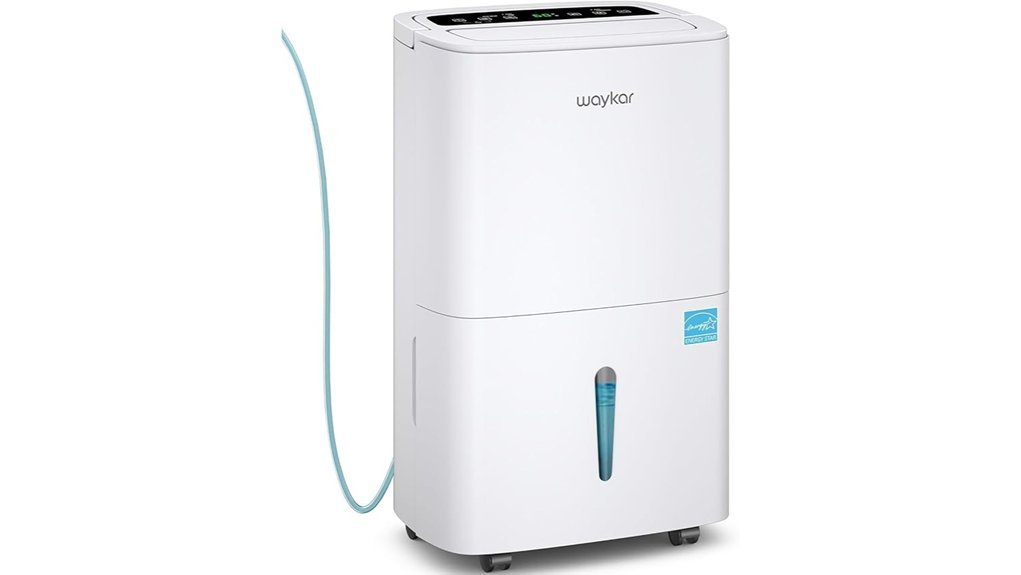
The Waykar 150 Pints Dehumidifier with Pump is the most familiar home-appliance-style option in this comparison. It is designed for large basements, garages, storage rooms, laundry areas, and other open utility spaces where a wheeled unit with a collection tank is easier to use than a low-profile crawl-space machine.
The listing publishes moisture removal of up to 150 pints per day at 95°F and 90% relative humidity and states coverage of up to 7,000 square feet. Those figures describe favorable high-temperature, high-humidity conditions, so do not compare the 150-pint headline directly with an AHAM rating from another product. The built-in pump, gravity drain connection, and water tank provide useful flexibility when the drain location is uncertain.
Why You’ll Like It
- Three drainage choices: Use the tank, a gravity hose, or the built-in pump based on the room layout.
- Automatic humidity control: The humidistat cycles operation around your selected target.
- Portable design: It is easier to reposition across finished floors than a heavy restoration unit.
- Useful home controls: The digital panel, timer, automatic defrost, and restart functions support everyday use.
Who Should Buy It
Choose the Waykar if you want a powerful portable unit for a large residential area and value the convenience of tank, gravity, and pump drainage in one machine.
Who Should Avoid It
Skip it for a low crawl space, frequent job-site use, or a small bedroom. Buyers who need a verified AHAM figure for side-by-side sizing should also compare the exact current model documentation before ordering.
Pros:
- Multiple drainage methods for different home layouts
- Built-in pump for upward condensate removal
- Automatic defrost and adjustable humidity control
- Portable format with a collection tank
Cons:
- The 150-pint figure is based on hot, highly humid test conditions
- A directly comparable AHAM or current DOE figure was not confirmed for this exact ASIN
- Larger and more noticeable than a compact room dehumidifier
ALORAIR Sentinel HDi65S Wi-Fi 120 PPD Dehumidifier with Pump
Best Smart Crawl-Space Pick
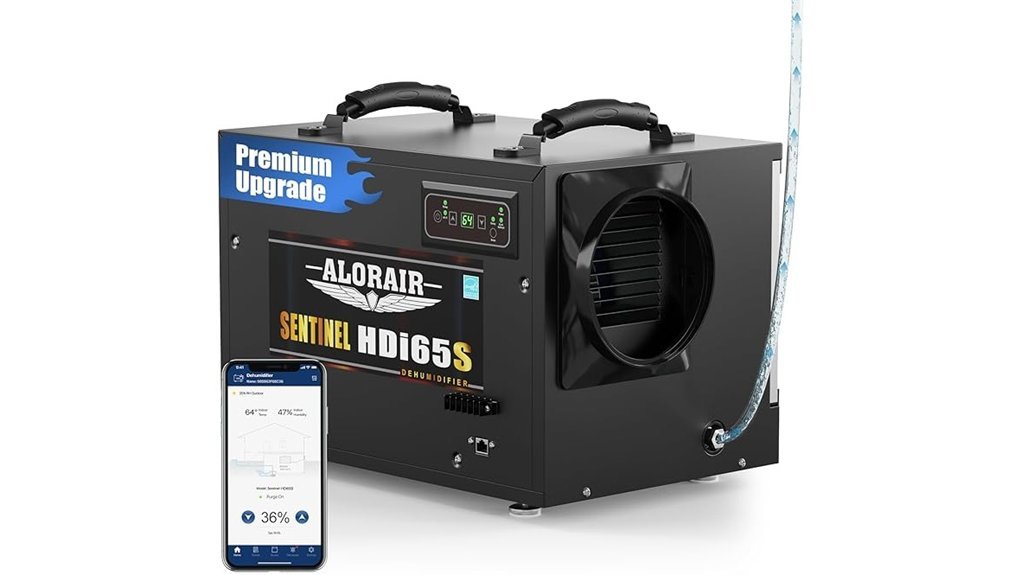
The ALORAIR Sentinel HDi65S Wi-Fi Dehumidifier with Pump is designed for crawl spaces and basements where checking the machine in person is inconvenient. Its published performance is 120 pints per day at saturation and 55 pints per day under AHAM conditions, with stated coverage of up to 1,300 square feet.
Wi-Fi monitoring is the main advantage. The compatible app can help you view humidity and adjust settings without entering a cramped crawl space. The low-profile body fits beneath floor framing, and the built-in pump supports continuous drainage when gravity alone cannot carry water to the drain point.
Why You’ll Like It
- Remote monitoring: Check humidity and operating settings through the compatible app.
- Low-profile housing: The shape is better suited to crawl spaces than an upright portable model.
- Pump and gravity drainage: Use the drainage method that best matches the installation.
- Automatic defrost: Helps the unit manage coil frost in cooler spaces.
Who Should Buy It
This model makes sense for homeowners who want a permanently positioned crawl-space or basement dehumidifier with smart monitoring and automatic condensate removal.
Who Should Avoid It
Skip it if you frequently move the unit between rooms, do not have reliable Wi-Fi near the installation area, or prefer controls that do not depend on an app. A wheeled portable dehumidifier may be more convenient for temporary use.
Pros:
- 55-pint AHAM rating supports more useful capacity comparison
- Wi-Fi controls reduce trips into difficult crawl spaces
- Pump and gravity drainage support unattended operation
- Compact commercial-style metal housing
Cons:
- Full smart functionality depends on app and network compatibility
- Smaller stated coverage than the larger units in this comparison
- Not intended to blend into a bedroom or finished living area
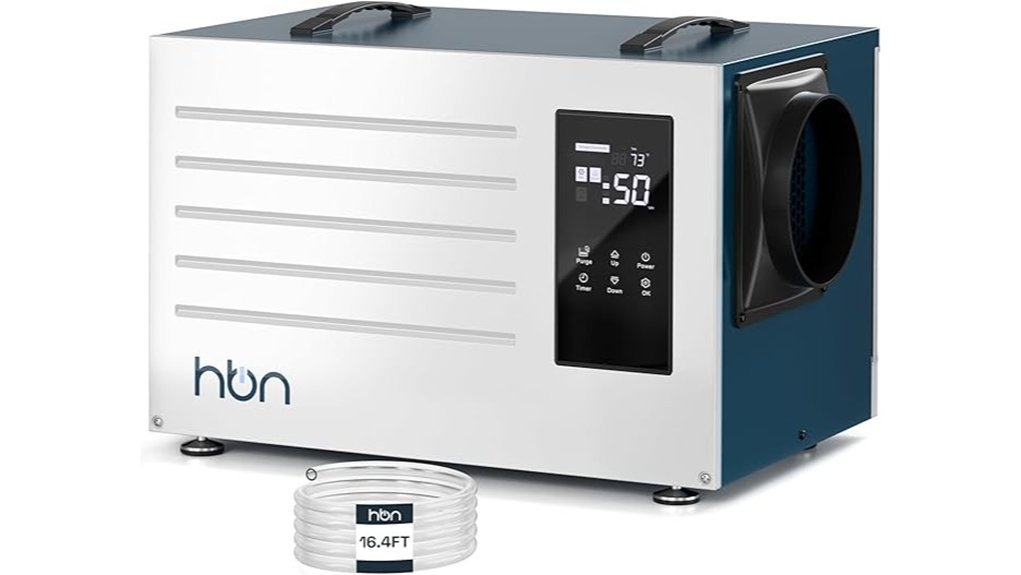
HBN 125 Pints Crawl Space Dehumidifier with Pump and Timer
Best Flexible Drainage
The HBN 125 Pints Crawl Space Dehumidifier publishes moisture removal of up to 125 pints per day at 95°F and 90% RH and 60 pints per day under AHAM conditions. The manufacturer states coverage of up to 5,900 square feet, although actual results depend on moisture load, temperature, airflow, ceiling height, and how well the space is sealed.
Its strongest feature is the dual drainage setup. You can use the included 6.6-foot gravity hose when a floor drain is available or the built-in pump when water must travel upward, with a published lift of up to 16.4 feet. Touchscreen controls, a timer, automatic defrost, and power-outage memory make it suitable for a basement, workshop, garage, or crawl space.
Why You’ll Like It
- Two drainage methods: Switch between gravity drainage and pump-assisted drainage.
- Power-outage memory: Helps the unit resume its previous settings after power is restored.
- Automatic defrost: Supports operation in cooler utility areas where coil frost may develop.
- Touchscreen controls: Provides direct access to humidity, pump, and timer settings.
Who Should Buy It
It is a useful option for homeowners who need a compact commercial-style unit and are not yet sure whether gravity drainage or pump drainage will work best.
Who Should Avoid It
Buyers who prioritize a long-established restoration-equipment platform, integrated Wi-Fi, or widely documented service support may prefer one of the ALORAIR models.
Pros:
- 60 PPD at AHAM conditions
- Gravity hose and built-in pump
- Timer, touchscreen, and automatic restart memory
- Designed for basements, crawl spaces, garages, and workshops
Cons:
- Manufacturer square-foot coverage should not be treated as a guarantee
- Optional remote accessories may not be included
- Warranty terms and included accessories should be confirmed with the current seller
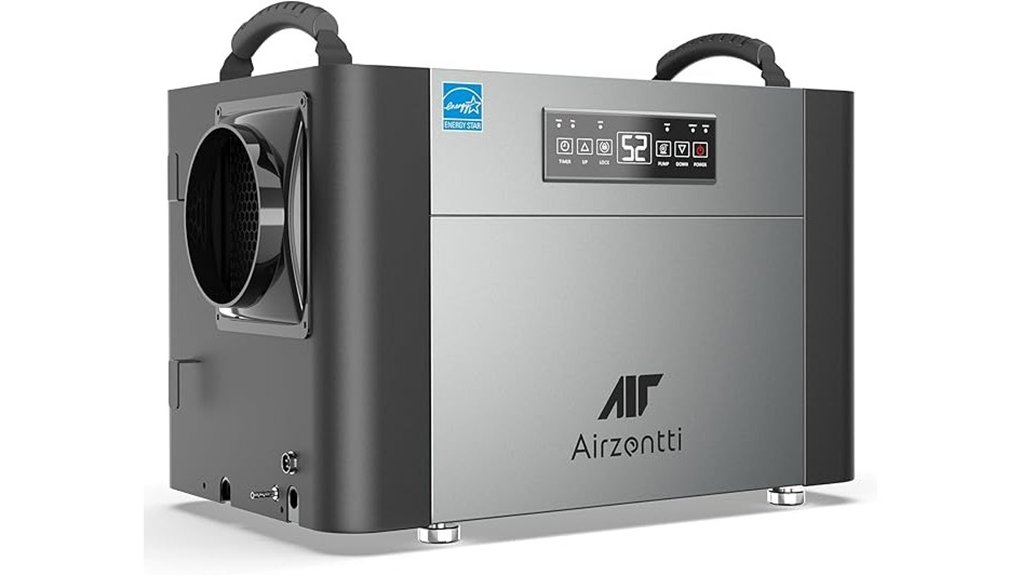
Airzentti 155 Pints Commercial Dehumidifier with Pump and Hose
Best High-Airflow Pick
The Airzentti 155 Pints Commercial Dehumidifier is designed for large crawl spaces, attics, garages, basements, and demanding moisture-control projects. Its published output is 155 pints per day under nearly saturated conditions and 70 pints per day at AHAM conditions, with airflow of approximately 220 CFM.
The built-in pump can move condensate upward by as much as 16.4 feet according to the listing, while the gravity drain provides a simpler option when a nearby floor drain is available. A digital control panel, timer, automatic defrost, and tankless continuous-drain design support long-duration installation.
Why You’ll Like It
- Higher published airflow: Approximately 220 CFM helps circulate damp air through the unit.
- 70 PPD at AHAM: Provides a more useful comparison than the 155-pint saturation headline alone.
- Pump and gravity drainage: Works with several basement and crawl-space layouts.
- Duct collar: The published design includes a 6-inch duct collar for installations that need directed airflow.
Who Should Buy It
Choose the Airzentti if you need more airflow than a small crawl-space unit and want a pump-equipped machine for a large basement, attic, garage, or sealed crawl space.
Who Should Avoid It
It is not the best fit for a bedroom, small bathroom, or lightly humid room. Its roughly 60-pound weight and commercial format also make frequent room-to-room movement inconvenient.
Pros:
- 70-pint AHAM and 155-pint saturation ratings are both published
- Approximately 220 CFM airflow
- Built-in pump with published lift up to 16.4 feet
- Automatic defrost, timer controls, and ducting option
Cons:
- Large coverage figure depends on favorable installation conditions
- Commercial styling may not suit finished living rooms
- Heavier and less convenient to move than a small portable unit
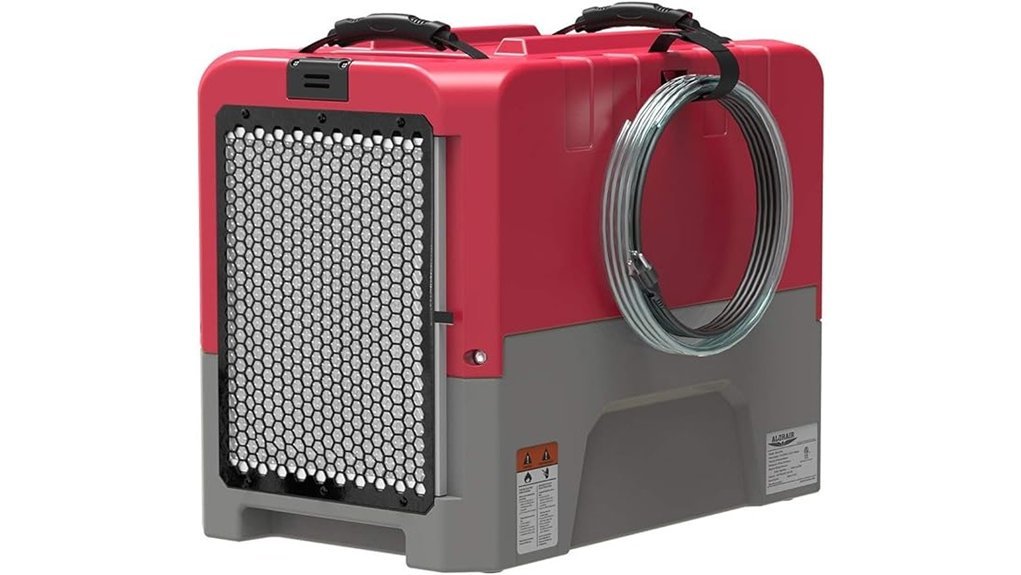
ALORAIR Storm LGR Extreme 180 PPD Commercial Dehumidifier with Pump
Best for Restoration
The ALORAIR Storm LGR Extreme 180 PPD Commercial Dehumidifier is the most appropriate option here for water-damage restoration, carpet drying, construction work, and severe basement dampness. Its published output is 180 pints per day at saturation and 85 pints per day under AHAM conditions.
This is a restoration-style machine rather than a typical home appliance. It uses a rugged molded housing, dual carrying handles, approximately 210 CFM airflow, automatic humidistat control, automatic defrost, and a built-in condensate pump. Its stated coverage is up to 2,300 square feet, but its main advantage is durable, high-output drying in difficult conditions rather than the largest floor-area claim.
Why You’ll Like It
- Restoration-focused design: Built for flood cleanup, job sites, garages, and severe basement drying.
- 85 PPD at AHAM: The highest AHAM-condition rating among the products in this comparison.
- Compact rugged housing: Easier to transport and position than a tall upright restoration unit.
- Low-temperature capability: The published operating range starts near 33.8°F, with automatic defrost.
Who Should Buy It
Buy this model for active water damage, renovation work, repeated job-site use, or a basement with a severe and persistent moisture load.
Who Should Avoid It
It is excessive for ordinary seasonal humidity in a small or moderately damp room. Its commercial airflow and published sound level around 58 dBA may also be intrusive near bedrooms, offices, or television areas.
Pros:
- 180 PPD at saturation and 85 PPD at AHAM conditions
- Approximately 210 CFM airflow
- Heavy-duty built-in condensate pump
- Rugged housing, handles, automatic humidistat, and automatic defrost
Cons:
- More specialized than a normal home dehumidifier
- Weighs roughly 64 pounds
- Commercial airflow and noise may be disruptive in occupied rooms
Factors to Consider When Choosing a Commercial Dehumidifier for Home Use
A commercial dehumidifier can solve moisture problems that overwhelm smaller portable units, but only when its capacity, drainage system, airflow, and operating conditions match your home. Use the following factors to compare models without being misled by headline numbers.
Compare Capacity Under the Same Test Conditions
Do not compare a saturation rating directly with an AHAM or current DOE rating. A machine can remove much more water in very hot, humid air than it can in a cooler basement. Look for wording such as AHAM capacity, DOE capacity, or the temperature and humidity used for the published measurement.
For example, a model marketed as 180 PPD at saturation may be rated at 85 PPD under AHAM conditions. Both figures can be accurate, but the AHAM figure is more useful when comparing it with another commercial dehumidifier tested under similar conditions.
Treat Coverage as an Estimate
Square-foot coverage is a starting point, not a guarantee. A sealed 2,000-square-foot basement with mild seasonal humidity requires less drying power than a smaller basement with seepage, wet masonry, open sump pits, or frequent laundry drying.
Also consider ceiling height, doors, divided rooms, air circulation, outside-air leakage, temperature, and whether the source of moisture has been repaired. For complex whole-home or structural moisture problems, an HVAC or building professional can calculate the moisture load more accurately.
Plan the Drainage Route First
Commercial dehumidifiers can collect a large amount of water, so continuous drainage is usually more practical than emptying a bucket.
- Gravity drainage is simple and reliable, but the hose must slope continuously downward to a suitable drain or sump.
- Pump drainage can move water upward or across a longer route to an approved drain point.
- Tank collection provides flexibility but requires regular emptying and is uncommon on restoration-style units.
Measure the vertical lift and total hose route before buying. A long hose does not automatically mean the pump can lift water through its full length vertically.
Match Airflow to the Room Layout
High moisture-removal capacity will not help if damp air cannot reach the unit. Open rooms are easier to dry than several closed rooms with limited air movement. In divided basements or long crawl spaces, you may need better air circulation, strategic placement, or manufacturer-approved ducting.
Check the published CFM rating and the direction of the intake and exhaust. Leave the clearance required by the manual so the machine does not recirculate its own dry exhaust air.
Check Operating Temperature and Auto Defrost
Cool basement and crawl-space air can cause frost to form on a dehumidifier’s coils. Automatic defrost helps the machine pause or redirect operation until the frost clears, but it does not mean every model performs equally well in extreme cold.
Check the manufacturer’s minimum operating temperature and place the unit where airflow around the intake and exhaust will not be blocked.
Compare Energy Efficiency Carefully
Look for ENERGY STAR certification for the exact model and compare its Integrated Energy Factor when available. A larger unit is not automatically less efficient, and a smaller unit is not automatically cheaper to run. An undersized dehumidifier that operates continuously may consume more electricity than a correctly sized model that reaches the target humidity and cycles off.
Avoid choosing solely from projected dollar savings. Your actual cost depends on local electricity rates, runtime, humidity load, temperature, airflow, and the humidity setting.
Consider Noise and Placement
Commercial units move more air than many bedroom dehumidifiers, so fan and compressor noise can be noticeable. Restoration equipment may also produce pump noise when discharging water.
Check the published decibel rating for the exact model. When possible, place the machine in a basement utility area, sealed crawl space, garage, or mechanical room rather than beside a bed, desk, or television.
Review Portability and Installation
An upright model with casters is easier to move across a finished floor. A low-profile crawl-space unit fits beneath floor joists but may require lifting and careful hose routing. Compact restoration units use rugged housings and handles but can still weigh around 60 pounds.
Measure doorways, crawl-space openings, shelf clearances, intake clearance, exhaust clearance, and the distance to a suitable electrical outlet before ordering.
Follow Electrical and Safety Requirements
Use the voltage, circuit protection, grounding method, and outlet type specified in the product manual. Do not place a plug, connection, or unsuitable extension cord in standing water. A damp basement or restoration area may require a properly protected outlet and professional electrical advice.
A dehumidifier controls airborne moisture. It does not repair plumbing leaks, foundation seepage, roof leaks, drainage failures, or existing structural mold damage.
Verify Warranty and Support
Commercial equipment may be expensive to repair, so review the current warranty before purchasing. Check:
- Whether registration is required
- How long full-unit coverage lasts
- Whether the compressor and pump have different coverage periods
- Who pays shipping or labor
- Whether purchases from third-party marketplace sellers qualify
- Availability of replacement filters, pumps, hoses, and other parts
Before You Buy
- Measure the area and identify the moisture source.
- Compare AHAM or DOE ratings rather than headline saturation figures.
- Choose a safe drainage point and measure the required pump lift.
- Confirm the minimum operating temperature.
- Check airflow, noise, weight, dimensions, and electrical requirements.
- Verify the exact model number, current warranty, and included hoses on the Amazon listing.
Frequently Asked Questions
How Do I Maintain a Commercial Dehumidifier?
Inspect and clean the air filter on the schedule stated in the manual. Check the intake and exhaust for blockage, inspect hoses for kinks or leaks, clean the pump reservoir when instructed, and make sure gravity hoses maintain a downward slope. Disconnect power before opening or servicing the housing.
What Are the Signs I Need a Dehumidifier?
Common warning signs include persistent high humidity, condensation, musty odors, damp walls or floors, slow-drying laundry, rust, peeling finishes, and recurring mold growth. A separate digital hygrometer can help confirm the actual relative humidity.
Before relying on a dehumidifier, repair active leaks, improve exterior drainage, vent moisture-producing appliances, and address standing water.
What Humidity Level Should I Use?
A common indoor target is between 30% and 50% relative humidity. Keeping humidity below 60% can help reduce conditions that support mold and dust mites. Avoid setting the unit unnecessarily low because that can increase runtime and energy use without providing a meaningful benefit.
Can a Dehumidifier Help With Allergies?
A dehumidifier may make the environment less favorable for mold and dust mites by controlling excess moisture. It does not treat allergies, remove every allergen, or replace medical care, cleaning, ventilation, air filtration, leak repair, or professional mold remediation.
How Much Noise Do Commercial Dehumidifiers Make?
Noise varies by model, fan speed, airflow, compressor design, installation surface, and pump operation. Commercial and restoration units are generally more noticeable than compact bedroom models. The ALORAIR Storm LGR Extreme reviewed here publishes a sound level around 58 dBA, while other models may not provide a directly comparable rating.
Are Commercial Dehumidifiers Energy-Efficient for Home Use?
They can be efficient when correctly sized and controlled by an accurate humidistat. However, a commercial unit is not automatically the most economical choice for a small room. Compare ENERGY STAR status for the exact model, Integrated Energy Factor, AHAM or DOE capacity, expected runtime, and your electricity rate.
Can I Run a Commercial Dehumidifier Continuously?
Many commercial and crawl-space models are designed for continuous drainage and automatic humidity control. They should still cycle according to the selected humidity level rather than run without need. Follow the manual, maintain the filter and drainage system, and inspect the installation regularly.
Do I Need a Built-In Pump?
You need a pump when the water must travel upward or when a suitable drain is not available below the dehumidifier. If you have a nearby floor drain and can maintain a continuous downward hose slope, gravity drainage is usually simpler and has fewer mechanical parts.
Is a Commercial Dehumidifier the Same as a Whole-Home Dehumidifier?
No. A portable commercial or restoration dehumidifier normally dries the room or zone where it is placed. A whole-home dehumidifier is typically designed for ducted installation and may require HVAC planning. Do not assume a high square-foot claim means one portable unit will evenly control several closed rooms.
Final Recommendation
Best Choice by Use Case
Choose the Waykar 150 Pints for a portable large-room setup, the ALORAIR Sentinel HDi65S Wi-Fi for a monitored crawl space, or the ALORAIR Storm LGR Extreme 180 PPD for restoration and severe moisture loads.
The Waykar 150 Pints Dehumidifier with Pump is the most convenient all-around option for homeowners who need strong moisture control in a large basement, garage, or open utility area and want tank, gravity, and pump drainage.
For a sealed crawl space, the ALORAIR Sentinel HDi65S Wi-Fi offers a more installation-focused shape and remote monitoring. The HBN 125 Pints is another flexible crawl-space option with both gravity and pump drainage, while the Airzentti 155 Pints stands out for its 70-pint AHAM rating and approximately 220 CFM airflow.
Choose the ALORAIR Storm LGR Extreme 180 PPD when you are dealing with water damage, restoration work, or a severe moisture load that justifies professional-style equipment. Whichever model you select, compare ratings under the same test conditions, plan the drainage route before installation, and correct the underlying source of moisture whenever possible.