
The best dehumidifier for home use depends on the moisture load, not only the advertised square footage. A 50-pint portable model is usually the most practical starting point for a very damp basement, while a smaller 22-pint unit can suit a bedroom, bathroom, or moderately damp room. Drainage matters just as much: choose gravity drainage when a lower floor drain is available, a built-in pump when water must move upward, or a whole-house system when humidity affects several rooms.
Affiliate disclosure: As an Amazon Associate, we may earn from qualifying purchases made through links on this page. This does not affect the price you pay.
Last reviewed: August 2026. Product specifications, certifications, included accessories, and marketplace variations can change. Confirm the exact model number and current listing before ordering.
- Best overall portable option: Frigidaire 50-Pint Wi-Fi Dehumidifier
- Best for upward drainage: AEOCKY 4,500 Sq. Ft. Dehumidifier with Pump
- Best compact Energy Star option: Waykar 34-Pint Energy Star Dehumidifier
- Best large-space gravity-drain option: Yaufey 80-Pint Maximum-Capacity Dehumidifier
- Best large-tank pump alternative: Avylo ADC018 Dehumidifier with Pump
- Best simple 22-pint option: Midea EasyDry 22-Pint Dehumidifier
- Best whole-house option: AprilAire E100
Quick Comparison of the Best Dehumidifiers for Home Use
| Product | Best For | Capacity Guidance | Coverage Guidance | Drainage | Standout Feature | Details |
|---|---|---|---|---|---|---|
| Frigidaire FHDD5034Y1 | Most large rooms and basements | 50 pints/day | Large-room use | 2.7-gallon bucket or gravity drain | Wi-Fi, voice control, and large bucket | Check on Amazon |
| AEOCKY LEO-001 | Basements needing upward drainage | Up to 80 pints/day at hot, humid test conditions | Up to 4,500 sq. ft. | Bucket, gravity hose, or pump | Built-in condensate pump | Check on Amazon |
| Waykar PD160B | Bedrooms and mildly to moderately damp rooms | 9.81 pints/day ENERGY STAR; up to 34 pints/day at 95°F and 90% RH | Up to 2,000 sq. ft. | 0.66-gallon bucket or gravity hose | Energy Star certification | Check on Amazon |
| Midea MAD22C1AWS | Bedrooms, bathrooms, and medium rooms | 22 pints/day | Up to 1,500 sq. ft. | 0.8-gallon tank or gravity hose | Clear current-standard capacity rating | Check on Amazon |
| Yaufey JD025Q-80 | Large spaces with a lower drain | Up to 80 pints/day at 95°F and 90% RH | Up to 5,000 sq. ft. | 1.06-gallon bucket or gravity hose | Large-space gravity-drain design | Check on Amazon |
| Avylo ADC018 | Large basements needing a pump and large tank | 24.5 pints/day DOE; up to 90 pints/day at hotter conditions | Up to 4,500 sq. ft. | 2.11-gallon tank, gravity hose, or pump | Top-mounted tank | Check on Amazon |
| AprilAire E100 | Whole-home, basement, or sealed crawl-space control | 100 pints/day | Up to 5,500 sq. ft. | Permanent drain connection | Standalone or ducted installation | Check on Amazon |
AEOCKY 4,500 Sq. Ft. Smart Dehumidifier with Pump
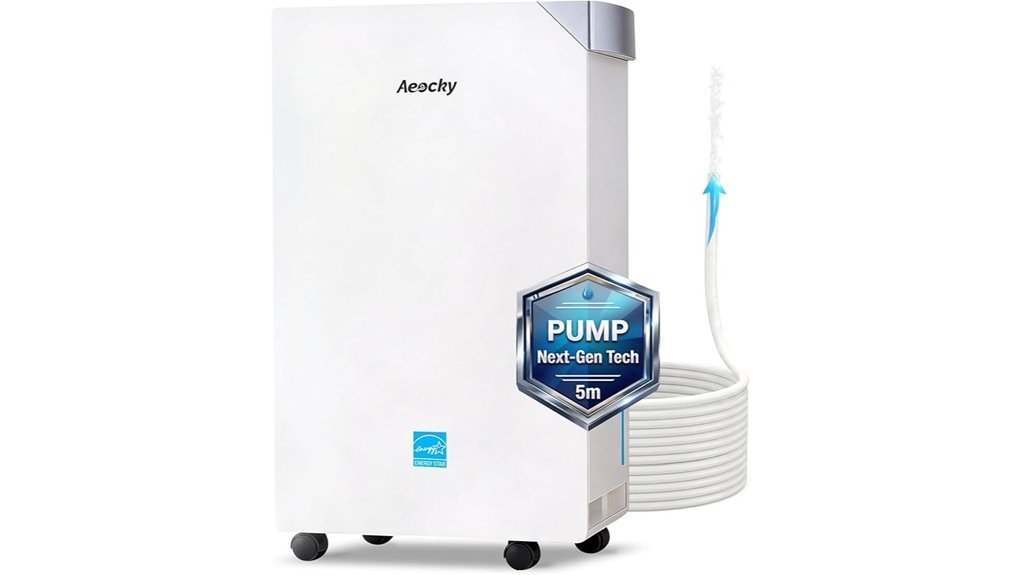
The AEOCKY LEO-001 combines large-space moisture control with a built-in pump. Its manufacturer lists coverage up to 4,500 square feet and a maximum extraction rate of 80 pints per day under hot, highly humid conditions. The pump is the main reason to choose it: condensate can be routed to a drain that is higher than the appliance instead of relying only on a downward-sloping hose.
Why You’ll Like It: Three drainage choices let you use the bucket, a gravity hose, or the pump according to the room layout. The unit also offers automatic humidity control, a timer, auto restart, auto defrost, and a washable filter.
Best For: Large basements, garages, and laundry areas where the available sink or drain is above the dehumidifier.
Who Should Avoid It: Small rooms and homes with an easy floor-drain route that do not need the extra cost or complexity of a pump.
Pros:
- Built-in pump solves difficult drain layouts.
- Large 1.45-gallon collection tank reduces emptying frequency.
- Manufacturer-backed product line and published warranty support.
Cons:
- The 80-pint figure is a hot-condition maximum, not a direct DOE comparison.
- The pump adds another mechanical component that may need maintenance.
- Confirm the pump lift limit, hose length, and warranty registration requirements before installation.
Waykar 34-Pint Energy Star Dehumidifier
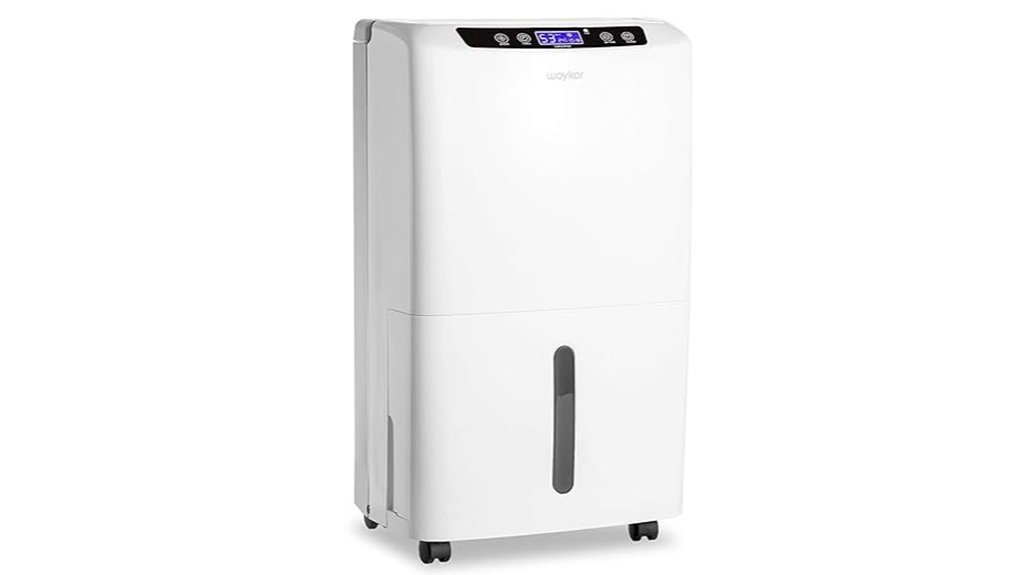
The Waykar PD160B is a compact portable compressor dehumidifier for mildly to moderately damp rooms. ENERGY STAR lists a standardized water-removal capacity of 9.81 pints per day, while Waykar advertises a maximum of 34 pints per day at 95°F and 90% relative humidity. That large difference shows why test conditions must be checked before comparing models. The manufacturer gives coverage guidance up to 2,000 square feet, but moisture severity should guide sizing.
Why You’ll Like It: The target humidity can be adjusted from 30% to 80%. Two fan speeds, a 24-hour timer, auto defrost, auto restart, a washable filter, rolling casters, and an included drain hose cover the main everyday needs.
Best For: Bedrooms, living areas, offices, and mildly to moderately damp rooms with a suitable lower drain.
Who Should Avoid It: Very wet large basements or installations that require condensate to move upward.
Pros:
- Energy Star certification provides a meaningful efficiency benchmark.
- Included hose supports continuous gravity drainage.
- Simple controls reduce setup complexity.
Cons:
- The 0.66-gallon bucket can fill quickly in damp weather.
- No built-in pump.
- The large gap between the 9.81-pint standardized rating and the 34-pint hot-condition maximum can confuse comparisons.
Yaufey 80-Pint Energy Star Dehumidifier
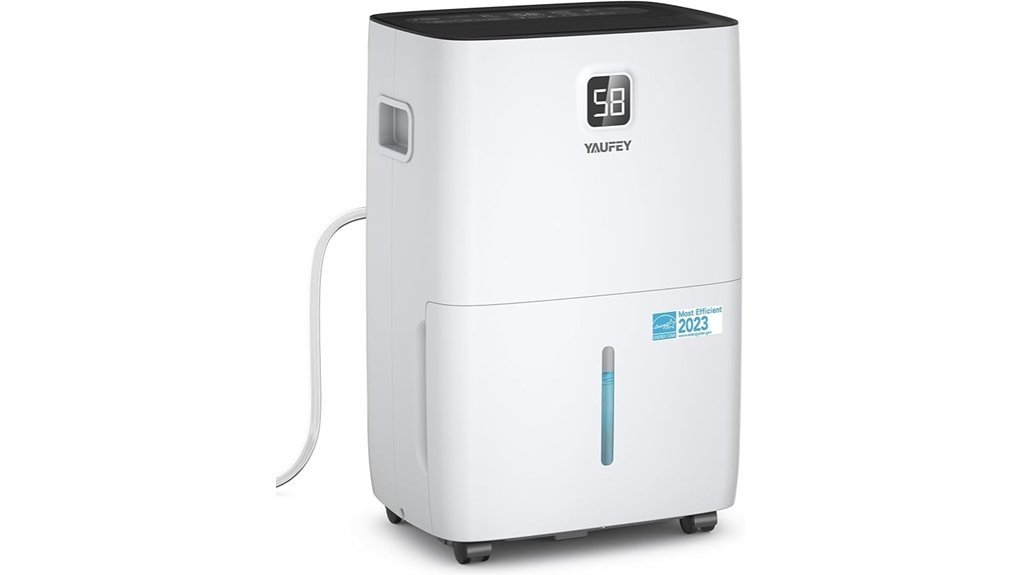
The Yaufey JD025Q-80 is designed for large rooms and basements with an accessible lower drain. The manufacturer lists a maximum extraction rate of 80 pints per day at 95°F and 90% relative humidity and coverage guidance up to 5,000 square feet. Those are favorable-condition figures, so actual collection will be lower in a cool basement.
Why You’ll Like It: The unit offers four preset operating choices, adjustable humidity from 30% to 80%, automatic shutoff, a timer, auto defrost, and continuous gravity drainage. Its 1.06-gallon tank is also larger than the tanks in many mid-size portable models.
Best For: Large basements, open living areas, garages, and laundry rooms with a floor drain or sump below the unit.
Who Should Avoid It: Buyers who need condensate pumped upward to a sink or window.
Pros:
- Large-space capacity and multiple humidity presets.
- Energy Star positioning supports efficiency-conscious shopping.
- Larger bucket reduces emptying compared with many compact models.
Cons:
- No built-in pump.
- The cabinet may be bulky in a bedroom or small apartment.
- The 80-pint maximum uses hot, humid test conditions.
AprilAire E100 Whole-House Dehumidifier
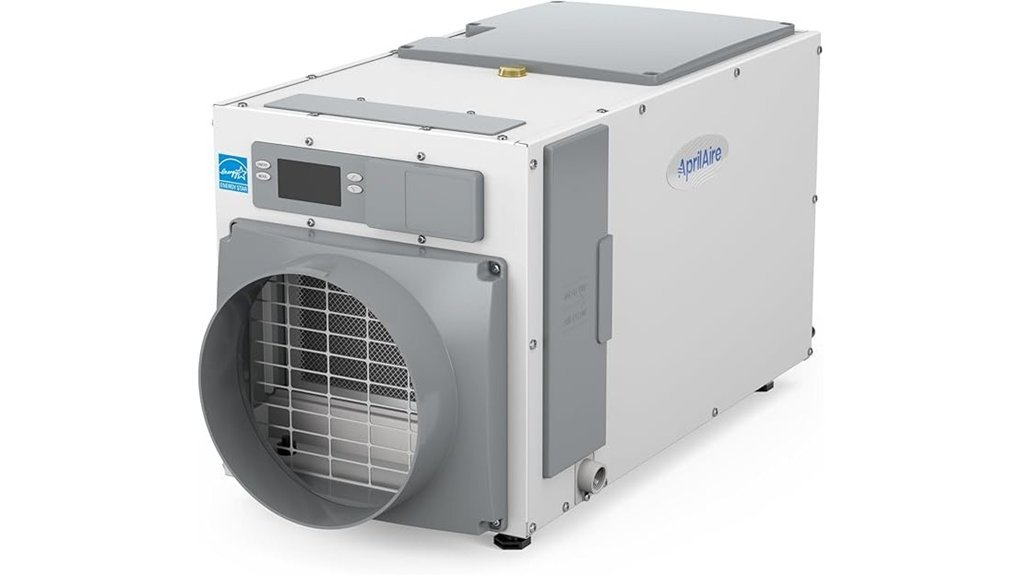
The AprilAire E100 is a professional-grade 100-pint dehumidifier for whole homes, basements, and sealed crawl spaces up to a manufacturer-listed 5,500 square feet. It can operate as a standalone unit near a drain or be connected to ductwork for broader humidity control, depending on the installation plan.
Why You’ll Like It: The E100 has a built-in digital humidistat, continuous drainage, corrosion-resistant coils, a washable MERV 8 filter, and flexible inlet and outlet orientation. There is no portable collection bucket to carry through the house.
Best For: Homes with persistent humidity across several rooms, large basements, and sealed crawl spaces where a permanent system makes sense.
Who Should Avoid It: Renters, small apartments, and anyone who only needs occasional room-by-room moisture control.
Pros:
- 100-pint capacity for large and persistent moisture loads.
- Can serve a basement, crawl space, or ducted whole-home system.
- No collection bucket to empty.
Cons:
- Higher equipment and installation cost than a portable unit.
- Not designed for easy room-to-room movement.
- Ducted performance depends heavily on correct installation.
Frigidaire 50-Pint Wi-Fi Dehumidifier
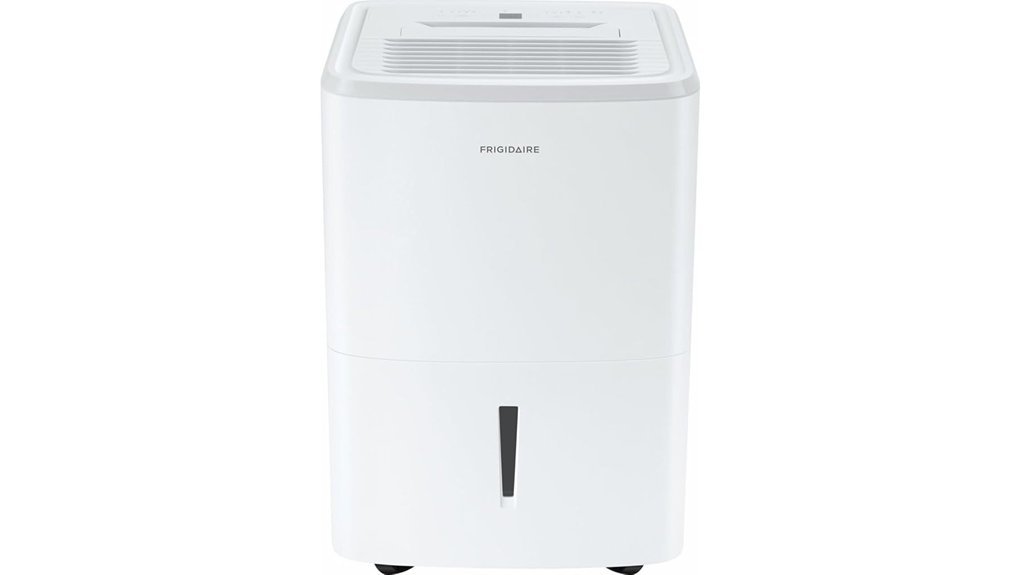
The Frigidaire FHDD5034Y1 is the strongest all-around portable choice in this shortlist. It uses a current 50-pint daily rating, has a large 2.7-gallon bucket, and supports continuous gravity drainage. It is suited to demanding rooms and basements where reliable capacity, established support, and smart controls matter.
Why You’ll Like It: The Frigidaire app lets you adjust humidity, schedules, fan speed, and power remotely. Alexa and Google Home support add voice control. The unit also offers three fan speeds, automatic shutoff, a washable filter, caster wheels, and low-temperature operation down to a manufacturer-listed 41°F.
Best For: Large rooms, basements, and laundry areas where you want a current 50-pint rating and remote control.
Who Should Avoid It: Buyers who need a built-in pump or want the smallest and lightest possible appliance.
Pros:
- Current 50-pint capacity is easier to compare with other DOE-rated models.
- Large 2.7-gallon bucket reduces emptying frequency.
- Wi-Fi, schedules, and voice-assistant support improve convenience.
Cons:
- No built-in pump for upward drainage.
- At 41 pounds, it is heavier than many mid-size models.
- Smart features require app setup and a compatible network.
Avylo ADC018 Dehumidifier with Pump
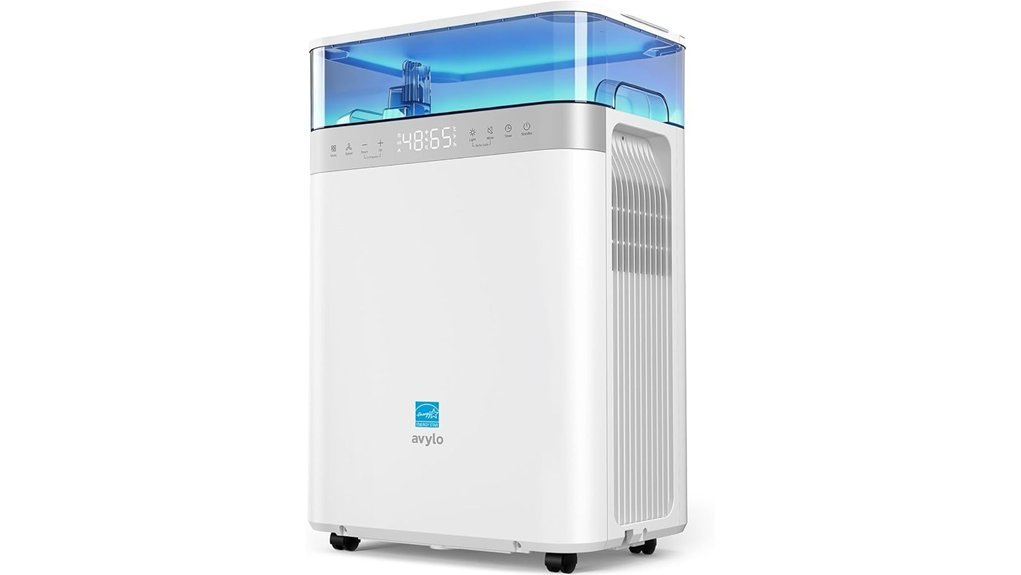
The Avylo ADC018 pairs a built-in pump with a top-mounted 2.11-gallon tank. Its ENERGY STAR record lists a DOE water-removal capacity of 24.5 pints per day, while the manufacturer also advertises a maximum of up to 90 pints per day under much hotter and more humid conditions. Showing both figures makes the test-standard difference clear.
Why You’ll Like It: The top tank is easier to reach than a low front bucket, and three drainage methods support manual collection, gravity drainage, or pumped drainage. The unit also includes automatic humidity control, a timer, auto defrost, sleep mode, and a filter reminder.
Best For: Basements where upward drainage and a large, easy-access tank are more important than having the highest current DOE capacity.
Who Should Avoid It: Buyers who expect the 90-pint hot-condition maximum to equal a current 90-pint DOE rating.
Pros:
- Built-in pump expands drain-placement options.
- Large top-mounted tank is convenient to access.
- ENERGY STAR data provides a standardized efficiency and capacity reference.
Cons:
- The DOE rating is much lower than the advertised hot-condition maximum.
- The pump increases mechanical complexity.
- Confirm pump lift, included hose length, and warranty terms before purchase.
Midea EasyDry 1,500 Sq. Ft. 22-Pint Dehumidifier
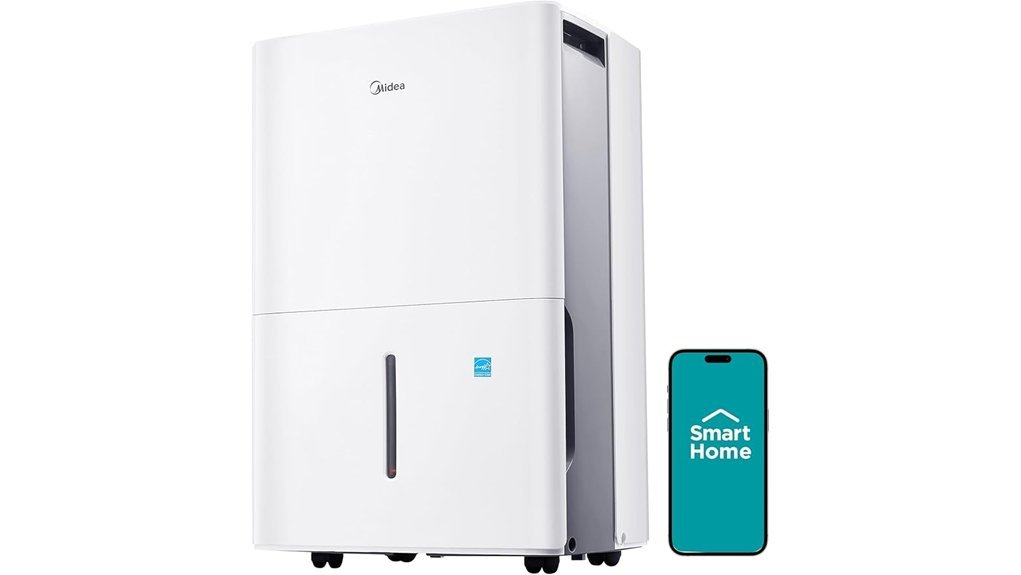
The Midea MAD22C1AWS is a straightforward 22-pint dehumidifier for spaces up to a manufacturer-listed 1,500 square feet. Its current-standard capacity makes it easier to compare with other DOE-rated portable models. It is best suited to bedrooms, bathrooms, offices, and moderately damp rooms rather than severe basement moisture.
Why You’ll Like It: The unit includes a timer, auto restart, auto defrost, a reusable filter, a 0.8-gallon tank, caster wheels, and gravity-drain compatibility. Midea also publishes model-specific manuals and support information.
Best For: Medium rooms with moderate humidity and buyers who prefer simple controls from an established appliance brand.
Who Should Avoid It: Large wet basements, upward-drain installations, and buyers who specifically require app control.
Pros:
- Clear current-standard 22-pint capacity rating.
- Reusable filter and gravity-drain compatibility simplify maintenance.
- Published manufacturer support and one-year warranty.
Cons:
- No built-in pump.
- The 0.8-gallon tank may need regular emptying.
- The manufacturer page for this model does not list smart control.
Factors to Consider When Choosing a Dehumidifier for Home Use
The best dehumidifier is not necessarily the model with the largest coverage claim. Start with the actual moisture problem, then compare capacity under the same test standard, drainage, tank size, operating temperature, efficiency, noise, controls, and installation requirements.
1. Room Size and Moisture Severity
Measure the space and decide whether it is slightly damp, very damp, or wet. A mildly musty bedroom needs far less capacity than a basement with condensation, damp floors, laundry drying, or seepage. Open doors, high ceilings, and air leakage increase the load.
Use square-foot coverage as broad guidance, not a guarantee. A cool, wet 800-square-foot basement can require more capacity than a warm 1,500-square-foot living area with only seasonal humidity.
2. Capacity and Test Conditions
Capacity is measured in pints removed during 24 hours, but listings do not always use the same conditions. Current DOE ratings use cooler conditions that better resemble a basement. Some marketplace listings emphasize a much larger maximum measured around 90°F to 95°F and 90% relative humidity.
Compare current DOE ratings with other DOE ratings. Treat hot-condition maximum figures as secondary marketing guidance rather than a direct equivalent.
3. Bucket, Gravity Drain, or Pump
A bucket is simple but may require daily emptying. Gravity drainage is low-maintenance when a drain, sump, or sink is below the outlet. The hose must slope downward without loops or kinks.
Choose a pump when water must travel upward or across a room. Check the pump’s lift limit, hose length, hose diameter, and required routing before buying.
4. Tank Capacity and Access
A small tank is lighter but fills more often. A large tank runs longer but becomes heavier when full. Also check whether the bucket has a handle, splash guard, clear water-level window, and a shape that is easy to remove and reinstall.
5. Energy Efficiency
Energy Star certification is more useful than an unsupported promise of a fixed dollar saving. A properly sized unit with an accurate humidistat can cycle off after reaching the target instead of running continuously.
6. Low-Temperature Operation
Compressor dehumidifiers remove less water as temperature falls, and frost may form on the coils. For a cool basement, garage, or crawl space, confirm the minimum operating temperature and look for automatic defrost. A standard residential model is not suitable for a near-freezing room unless the manufacturer specifically approves that use.
7. Noise and Placement
For bedrooms and offices, compare the low-fan noise rating, sleep mode, display-light controls, and compressor cycling. Published noise figures may be measured under ideal conditions; hard floors, wall clearance, and a loose bucket can make a unit sound louder.
8. Smart Controls
Wi-Fi is useful for a basement or vacation property, but verify the exact model number. Marketplace pages sometimes group smart and non-smart variations under one listing. Check which settings and alerts the app actually supports and what happens after a power or internet outage.
9. Portable vs. Whole-House Installation
A portable unit mainly treats the room where it operates. A whole-house model can serve a basement, crawl space, or duct system and may control several rooms more evenly. Ducted installations need sizing, airflow planning, electrical clearance, and permanent drainage.
Before You Buy: Quick Checklist
- Measure the room and classify it as slightly damp, very damp, or wet.
- Compare capacities that use the same DOE or manufacturer test conditions.
- Choose bucket collection, gravity drainage, or pumped drainage before selecting a model.
- Confirm the drain-hose size, included hose length, and pump lift limit.
- Check the minimum operating temperature for a cool basement or garage.
- Compare tank size, bucket access, filter access, weight, and caster quality.
- Confirm the exact model number when Wi-Fi, voice control, or a pump is essential.
- For whole-house use, obtain professional sizing and installation advice.
Frequently Asked Questions
What Humidity Level Should I Set?
A target between 40% and 50% relative humidity works well for many homes. Keep indoor humidity below 60%, and lower it further during cold weather if condensation forms on windows or pipes. A separate hygrometer can help confirm whether the dehumidifier’s sensor is accurate.
What Size Dehumidifier Do I Need?
Use both room size and moisture severity. A current 20- to 30-pint model can suit a moderately damp small or medium room. A very damp or wet basement may need a current 40- to 50-pint model or a properly sized whole-house unit. Do not compare a hot-condition “80-pint maximum” directly with a current DOE 50-pint rating.
Is a Built-In Pump Worth It?
A pump is worth considering when no drain is below the dehumidifier. It can move water to an elevated sink, window, or drain line. If a floor drain is already available, gravity drainage is simpler and has fewer moving parts.
How Do I Maintain a Dehumidifier?
Clean the reusable filter on the schedule in the manual, keep the intake and exhaust clear, wash and dry the bucket, inspect the hose for algae or kinks, and keep the unit level. Unplug the appliance before cleaning or moving it. Do not open the sealed refrigeration system.
Can a Dehumidifier Help With Allergies or Asthma?
Reducing excess humidity can make the home less favorable for mold and dust mites, which are triggers for some people. A dehumidifier is not a medical treatment and does not replace an air cleaner, source control, or advice from a qualified healthcare professional.
How Noisy Are Dehumidifiers?
Compressor models produce fan noise and an audible change when the compressor starts or stops. Low-fan or sleep modes may help in bedrooms, but published decibel ratings do not account for every floor, wall, and room layout.
Will a Dehumidifier Fix a Wet Basement?
No. It can remove moisture from the air after the water source is controlled, but it cannot stop groundwater intrusion, foundation cracks, plumbing failures, or flooding. Repair the source and remove or dry damaged materials as quickly as practical.
How Long Does a Dehumidifier Last?
Service life varies with runtime, room temperature, maintenance, drainage, build quality, and access to replacement parts. Clean airflow, correct drainage, and operation within the approved temperature range can reduce unnecessary wear.
Final Recommendations
Choose the Frigidaire FHDD5034Y1 for the best overall balance of current 50-pint capacity, large bucket, continuous drainage, and smart control.
Choose the AEOCKY LEO-001 when a large basement needs a built-in pump for upward drainage.
Choose the Waykar PD160B for compact Energy Star-certified moisture control in a mildly to moderately damp room.
Choose the Yaufey JD025Q-80 for a large room with an easy gravity-drain route.
Choose the Avylo ADC018 when a large top-mounted tank and built-in pump are priorities, but compare its standardized 24.5-pint rating rather than relying only on the 90-pint maximum claim.
Choose the Midea MAD22C1AWS for a simpler current-standard 22-pint unit in a bedroom, bathroom, or moderately damp room.
Choose the AprilAire E100 when humidity affects a large basement, sealed crawl space, or several rooms and a permanent system is appropriate.
The right dehumidifier should reach the selected humidity without overflowing its bucket, running at maximum speed all day, or forcing an unsafe drain route. Match the unit to the actual moisture load, compare capacities under the same test standard, and fix leaks before relying on any appliance. Correct sizing, drainage, and maintenance matter more than the biggest square-foot claim.

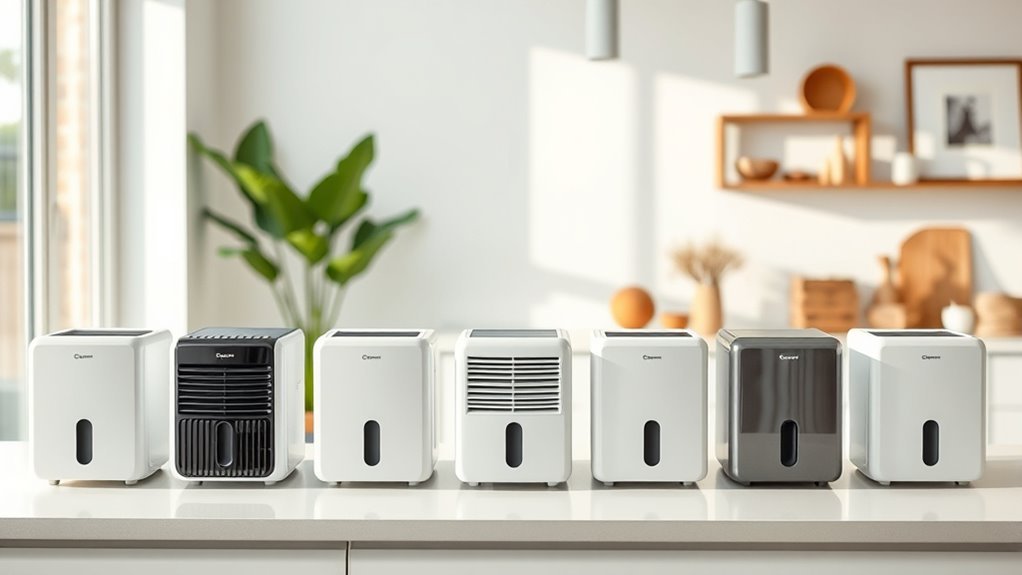


[…] Best Dehumidifier for Home Use: 7 Top Picks 2026 […]