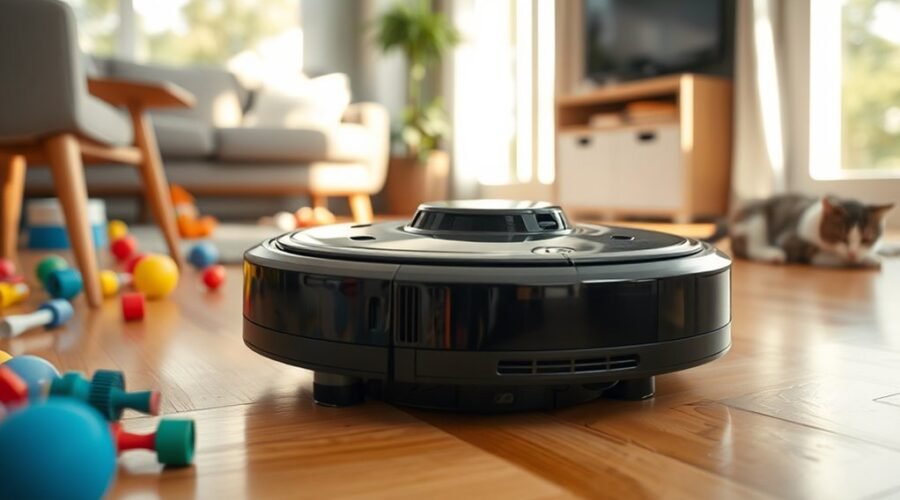
Obstacle avoidance on a robot vacuum is the system that helps it detect objects, judge their position, and steer around them without contact. It relies on sensors such as infrared, LiDAR, and cameras, then combines that data with onboard mapping and path planning. The result is a machine that can adapt in real time, although some objects still challenge even advanced models. The key difference lies in how these systems interpret what they see.
What Is Robot Vacuum Obstacle Avoidance?
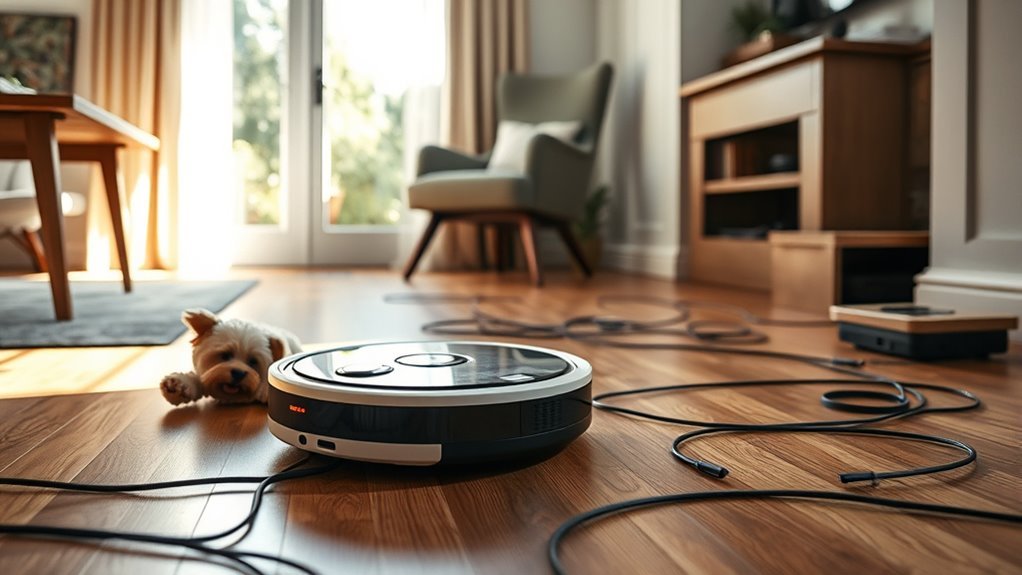
Robot vacuum obstacle avoidance refers to the use of sensors and AI-driven navigation to detect objects and route around them without collisions, improving cleaning efficiency.
In practice, this capability lets a Robot vacuum move with greater autonomy across constrained domestic environments, reducing dependence on manual intervention. The obstacle avoidance system may combine cameras, infrared sensors, and LiDAR to detect furniture, cords, pet items, and other hazards, then classify them for responsive routing.
Advanced navigation improves real-time recognition of low-lying objects that often trap lesser machines. From an analytical perspective, the feature is evaluated by how consistently a vacuum traverses standardized obstacle courses with minimal human assistance.
Advanced navigation improves recognition of low-lying obstacles, and success is measured by consistent, low-assistance traversal of standardized courses.
Strong performance indicates a machine that can avoid contact, preserve its path, and maintain operational continuity. For users seeking liberation from repetitive cleanup, effective obstacle avoidance represents a practical transfer of labor from person to device, while preserving control through accurate, adaptive sensing and AI-guided motion.
How Robot Vacuum Obstacle Avoidance Works
Robot vacuum obstacle avoidance begins with detection hardware such as infrared, ultrasonic, LiDAR, and Time-of-Flight sensors that measure nearby objects in real time.
Cameras and sensor fusion refine object recognition by identifying size, shape, and class, enabling the system to distinguish obstacles more reliably.
When an obstruction is confirmed, the control system replans the route immediately to maintain coverage while reducing collisions and user intervention.
Detection Hardware
Obstacle avoidance in robot vacuums depends on a layered detection stack that combines infrared sensors, ultrasonic sensors, LiDAR, and time-of-flight modules to identify objects and map their position relative to the chassis.
This detection hardware supports obstacle avoidance by measuring proximity, surface response, and spatial contours without requiring constant human intervention. Time-of-Flight (ToF) sensors time reflected light pulses to estimate distance and size with precision.
Sensor fusion then merges inputs from infrared sensors, ultrasonic sensors, LiDAR, and cameras, improving reliability in cluttered environments. Some platforms add structured light and AI-driven recognition for object classification, allowing the system to separate low-lying hazards from furniture.
Such architectures reduce dependence on manual cleanup and reinforce autonomous movement through constrained domestic spaces, extending operational freedom.
Object Recognition
Object recognition in robot vacuums uses camera-based systems, depth-sensing sensors, and AI-driven object libraries to identify and classify obstacles in real time. This object recognition layer converts raw sensor data into labels, enabling obstacle detection for items such as cords, bowls, and furniture legs.
Advanced models fuse inputs from LiDAR, infrared, and Time-of-Flight sensors to estimate distance and object shape with higher precision. The resulting classifications support obstacle avoidance by distinguishing passable floor areas from hazards that constrain navigation.
In practice, this reduces collisions, preserves cleaning efficiency, and allows the machine to move with disciplined autonomy through cluttered spaces. By integrating AI with multiple sensors, modern vacuums gain a practical form of perception that limits dependence on human intervention and expands operational freedom.
Path Replanning
Once an obstacle has been recognized and classified, the navigation system must convert that perception into a new movement decision.
In path replanning, the robot vacuum uses an obstacle avoidance sensor and advanced sensors, including LiDAR, infrared, and cameras, to maintain continuous assessment of the environment. When these systems detect obstacles, the machine pauses briefly, computes real-time adjustments, and generates a bypass route that preserves coverage of the cleaning area.
AI-driven algorithms improve obstacle recognition by predicting likely interference before contact, allowing earlier rerouting. This adaptive logic supports efficient navigation through congested rooms, reducing collisions and limiting interruptions.
The result is a cleaner, more autonomous operation in which the vacuum can move with greater independence, responding to changing conditions while keeping the full cleaning area within its operational plan.
How Cameras and Sensors Detect Obstacles
Robot vacuums detect obstacles by combining optical, acoustic, and ranging data to estimate distance, shape, and position in the cleaning path.
Sensors and cameras detect obstacles through reflected light, infrared illumination, and laser returns, enabling obstacle avoidance without dependence on a fixed map.
LiDAR and depth sensing, including Time-of-Flight (ToF), measure range with high precision and estimate object size, supporting safer navigation around furniture, cords, and irregular edges.
AI-driven object classification lets cameras distinguish shoes, cables, and pet waste from walls or open floor, which improves response selection.
Structured light systems and ToF modules extend detection in dim rooms, where reflected light alone is insufficient.
Why Sensor Fusion Improves Avoidance
Sensor fusion strengthens obstacle avoidance by combining LiDAR, infrared, camera, and Time-of-Flight data into a single real-time model of the environment. This integrated sensing approach improves object detection by cross-validating distance, shape, and reflectivity cues, reducing ambiguity in cluttered spaces.
LiDAR supplies broad spatial structure, while Time-of-Flight sensors refine depth estimates for precise obstacle boundaries. Infrared data adds stability when visual contrast drops, supporting reliable operation in dim conditions. Cameras contribute classification detail, allowing the system to distinguish furniture, cables, and other obstacles with greater confidence.
The resulting sensor fusion supports real-time navigation and tighter path planning, so the vacuum can move with fewer interruptions and less wasteful backtracking. By interpreting the environment as a coordinated dataset rather than isolated signals, the machine improves obstacle avoidance, preserves cleaning efficiency, and expands coverage across confined domestic layouts.
What Robot Vacuums Still Struggle to Avoid
Robot vacuums still show consistent weakness against low-profile cords and other thin obstacles, which can evade both optical and depth-based detection.
Dark, narrow objects and certain pet waste hazards remain problematic because their shape, reflectance, and height often fall below sensor thresholds.
As a result, even advanced systems can misclassify these targets, leading to collisions, entanglement, or contamination events.
Low-Profile Cords
Low-profile cords, sometimes only a few millimeters high, remain difficult for robot vacuums to detect because their obstacle-recognition systems are typically optimized for larger, more three-dimensional objects.
In obstacle avoidance, robot vacuums often miss low-profile cords because obstacle detection depends on sensor technology that favors visible contours. Even models with advanced AI and object recognition may misclassify these flat targets, increasing entanglement risk.
Performance tests repeatedly show weaker scores on cord-like obstacles, indicating a persistent gap between advertised intelligence and actual navigation precision.
Lighting conditions can further reduce reliability, especially when contrast is limited.
For users seeking liberated, low-intervention cleaning, this limitation matters: continuous improvements in sensor technology are still needed before low-profile cords are handled consistently and safely in routine use.
Dark, Thin Obstacles
Dark, thin obstacles remain a persistent weak point in robot vacuum navigation, especially when items such as black cables or shoes present little contrast against the floor. In obstacle avoidance, robot vacuums often fail to detect thin obstacles because infrared sensors can miss low-profile objects under 1 inch. Lighting conditions further reduce performance: dim scenes degrade camera and depth sensing. | Sensor | Strength | Limitation |
| — | — | — |
|---|---|---|
| Infrared | Simple detection | Low contrast loss |
| Camera | Visual mapping | Poor lighting |
| LiDAR | Range accuracy | Glossy reflection |
| ToF | Depth data | Thin edges |
| Fusion | Better coverage | Still imperfect |
Advanced models using LiDAR sensors improve detection, yet liberation from collisions is incomplete when surfaces are transparent or reflective. Consistent testing shows these low-profile objects score poorly, indicating ongoing limits in robot vacuums.
Pet Waste Hazards
Pet waste remains one of the most difficult hazards for robot vacuums to avoid, largely because its shape, size, and color vary too widely for consistent sensor classification.
Even sophisticated obstacle avoidance systems that can detect and avoid obstacles in real time often classify over 120 objects accurately while still underperforming on this advanced obstacle. High-end AI models may exceed 90% success with common household obstacles, yet they can fall to 70-80% with pet waste.
Low-profile or irregular forms can defeat recognition systems before contact, causing messy outcomes during a cleaning session. The result is avoidable clogs and malfunctions, plus additional maintenance burdens.
Continued improvement in obstacle detection is consequently necessary, with better recognition systems needed to secure safer, more autonomous operation and greater freedom from manual intervention.
How Obstacle Avoidance Is Tested
Obstacle avoidance is typically assessed through standardized course testing that presents a robot vacuum with 24 distinct objects to measure recognition and avoidance performance. In obstacle avoidance testing, evaluators quantify recognition and avoidance capabilities across varied navigation scenarios, with lighting conditions closely controlled to isolate sensor performance.
Thin objects and other low-profile hazards are included because they expose detection limits that can compromise successful obstacle avoidance.
- Standardized assessments use repeatable layouts.
- Multiple simultaneous obstacles probe navigation under pressure.
- Lighting conditions reveal sensor performance shifts.
- Thin objects test edge-case detection.
- Interventions needed are counted alongside avoidance rate.
A torture test adds clustered barriers to assess whether navigation remains stable when the machine confronts multiple simultaneous obstacles. Results are reported as the percentage of successful obstacle avoidance plus interventions needed, giving a precise measure of autonomy.
Such testing supports liberation from constant supervision by identifying where avoidance logic remains robust and where it fails.
How to Choose the Best Robot Vacuum
Selecting the best robot vacuum requires matching sensor architecture, cleaning performance, and maintenance features to the home environment.
To choose a robot vacuum, assess how robot vacuums navigate through LiDAR, infrared, and camera fusion; advanced models usually improve obstacle detection and route planning. Effective obstacle avoidance technology should recognize common household objects, including cables, shoes, and pet items, without repeated contact.
Performance matters as well: suction power and cleaning capabilities determine whether the unit can lift debris from carpets, edges, and hard floors. In homes with children or pets, stronger obstacle avoidance technology reduces interruption and supports more autonomous cleaning.
Features like self-cleaning docks, advanced mopping systems, and automated debris handling lower manual labor and preserve operational freedom. Comparative testing can help identify models that score highly against obstacles, such as systems achieving near-perfect avoidance.
The ideal unit balances navigation, deep cleaning, and low-maintenance operation for complex domestic layouts.
Frequently Asked Questions
What Robot Vacuum Has the Best Obstacle Avoidance?
Eufy Omni S2 appears best, with 24/24 obstacle avoidance. Its robot vacuum technology, advanced sensors, navigation systems, mapping capabilities, and collision detection outperform rivals; performance comparison, user reviews, feature analysis, brand reliability, maintenance tips support that assessment.
What Are the Disadvantages of Robot Vacuums?
They can disappoint. Reduced cleaning efficiency, limited floor compatibility, weaker navigation accuracy, short battery life, higher maintenance costs, louder noise levels, and imperfect mapping technology may shorten robot lifespan; smart features improve user experience, yet leave constraints.
How Often Should You Run a Robot Vacuum and Mop?
Daily cleaning suits pet hair, while low-traffic homes may require every 2–3 days, depending on floor types, battery life, smart features, maintenance tips, scheduling options, noise levels, navigation systems, and user reviews.
How Much Does an Obstacle Avoidance Robot Cost?
Obstacle-avoidance robot vacuums cost under $300 to $1,600+. Cost comparison reveals budget options versus premium features; brand differences and technology advancements shape performance analysis. Consumer reviews, warranty details, maintenance expenses, and long-term savings matter.
Conclusion
To sum up, obstacle avoidance in a robot vacuum is the coordinated use of sensors, mapping, and real-time path planning to reduce collisions and improve cleaning efficiency. Cameras, LiDAR, and infrared systems act as the machine’s eyes, while software serves as its navigator. Yet, like a careful driver on a cluttered road, the vacuum still struggles with cables, reflective surfaces, and low-profile objects. Effective avoidance remains a key indicator of overall robotic performance.