
The best small dehumidifier depends on the size of the space, the amount of moisture, and whether you need a powered unit or a cordless moisture absorber. For light humidity in a bathroom, RV, bedroom, or other compact room, the BREEZOME 60 OZ offers the best overall balance of tank size, timer controls, and listed moisture removal. The TENKER 77 OZ has the highest listed daily output in this group, while the ToLife 95 OZ provides the largest tank. The quieter, lower-output AlohaAir suits localized bedroom or closet moisture, and the Eva-Dry E-333 is the best cordless option for enclosed spaces such as safes and cabinets.
These compact models are designed for mild to moderate humidity. They are not substitutes for a properly sized compressor dehumidifier when a room has seepage, wet walls, standing water, widespread condensation, or a persistent mold problem.
Quick Verdict
Best overall plug-in pick: BREEZOME 60 OZ, thanks to its 1.8-liter tank, four timer settings, sleep mode, and listed removal rate of up to 700 ml per day at 86°F and 80% relative humidity.
Best for higher listed output: TENKER 77 OZ, which is listed to collect up to 35 ounces per day under the same warm, humid test conditions.
Best large-tank compact pick: ToLife 95 OZ, for buyers who want quieter operation and less frequent tank emptying.
Best for closets and safes: Eva-Dry E-333, because it works silently and cordlessly between renewal cycles.
Important: Advertised square-foot ratings do not guarantee real-world performance. Compare the daily moisture-removal rate, test conditions, room temperature, tank size, and moisture source before buying.
The rankings prioritize listed daily extraction, tank capacity, operating modes, noise claims, portability, overflow protection, and realistic use cases. Manufacturer coverage claims are treated as guidelines rather than guaranteed room-size performance.
Quick Comparison of the Best Small Dehumidifiers
| Product | Best For | Type / Tank | Listed Maximum Removal | Noise / Mode | Amazon |
|---|---|---|---|---|---|
| BREEZOME 60 OZ | Bathrooms, RVs, and timed operation | Thermoelectric; 1.8 liters / 60 oz | Up to 700 ml/day at 86°F and 80% RH | About 35 dB in sleep mode | Check Price |
| TENKER 77 OZ | Higher listed output in warm, humid rooms | Thermoelectric; 77 oz / 2.2 liters | Up to 35 oz/day at 86°F and 80% RH | Under 30 dB in sleep mode | Check Price |
| ToLife 95 OZ | A larger tank and quiet sleep mode | Thermoelectric; 95 oz | Up to about 1 liter/day | Under 30 dB in sleep mode | Check Price |
| AlohaAir | Bedrooms, closets, and RVs with light moisture | Thermoelectric; 1,000 ml | Up to 280 ml/day | About 35 dB | Check Price |
| Eva-Dry E-333 | Closets, safes, cars, and cabinets | Renewable silica gel; up to 333 cu. ft. | Passive absorption | Silent during use | Check Price |
BREEZOME 60 OZ Quiet Portable Dehumidifier with Timer
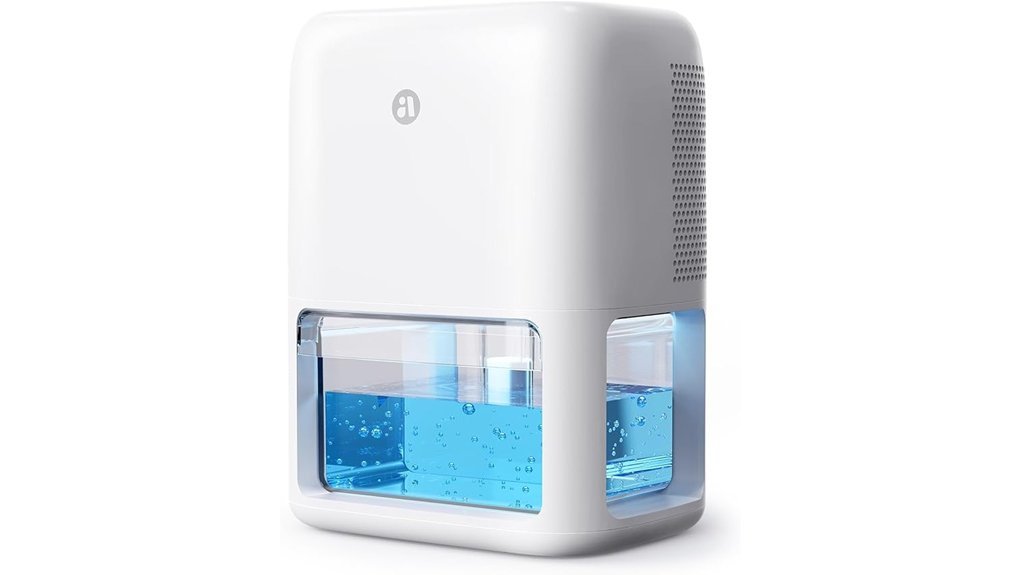
Best Overall Plug-In Pick
BREEZOME’s 60-ounce quiet portable dehumidifier offers the most balanced feature set in this compact group. Its dual semiconductor condensers are listed to remove up to 700 ml of moisture per day at 86°F and 80% relative humidity, while the 1.8-liter tank provides more storage than many mini models. Sleep mode is listed at about 35 dB, and the 12, 24, 36, or 48-hour timer lets you limit runtime. Automatic shut-off, a full-tank light, a defrost function, a carrying handle, and an optional night light add everyday convenience.
Best For: Bathrooms, RVs, cloakrooms, kitchens, and small bedrooms where a timer and larger tank are useful.
Why You’ll Like It: It combines a larger tank, useful timer settings, quiet operation, and stronger listed extraction than entry-level mini models.
Who Should Avoid It: Buyers who need a drain hose, adjustable humidity set point, verified cold-room capacity, or compressor-level performance.
Pros:
- 1.8-liter tank and listed removal rate up to 700 ml per day
- Four timer settings and a quieter sleep mode
- Automatic shut-off, defrost function, handle, and optional light
Cons:
- Maximum extraction depends on warm, very humid test conditions
- No built-in humidistat or continuous drainage is listed
- Not powerful enough for seepage, wet walls, or severe basement dampness
TENKER Dehumidifier for Home, 77oz Tank
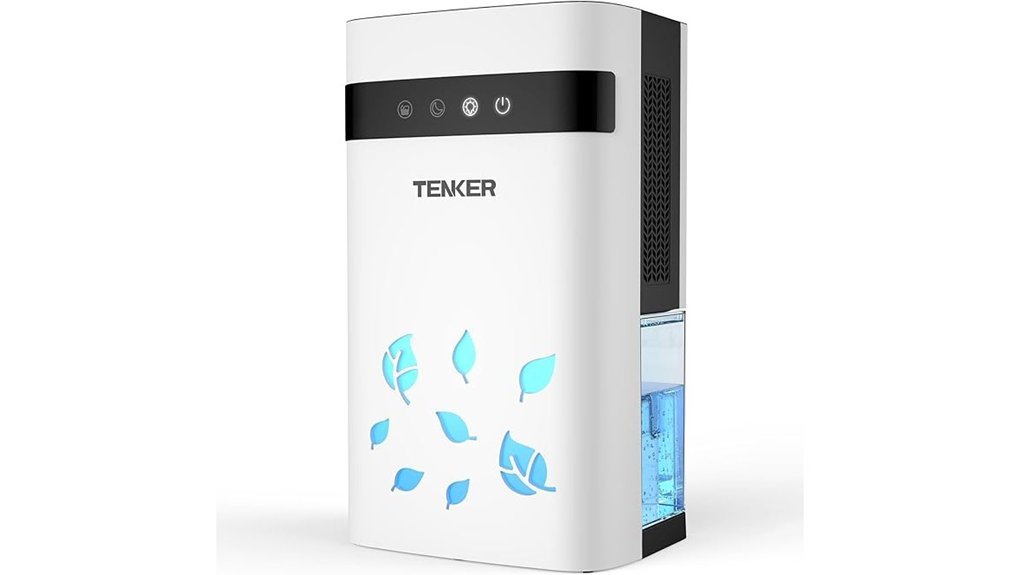
Best for Higher Listed Output
TENKER’s compact dehumidifier pairs a 77-ounce, 2.2-liter tank with dual fans and dual semiconductor condensers. The listed maximum removal rate is up to 35 ounces per day in a closed room at 86°F and 80% relative humidity. It also offers high and sleep modes, automatic shut-off, a recessed handle, and a 7-color LED light. Although the listing advertises coverage up to 1,000 square feet, the daily extraction rate and actual room conditions are more useful sizing measures.
Best For: Warm, humid small-to-medium spaces where a larger tank and higher listed daily output are priorities.
Why You’ll Like It: The combination of dual condensers, a 77-ounce tank, sleep mode, and portable design makes it flexible for localized moisture control.
Who Should Avoid It: Buyers who need a built-in humidistat, continuous drainage, cold-basement performance, or a unit sized for structural drying.
Pros:
- Listed to remove up to 35 ounces per day at 86°F and 80% RH
- Quiet sleep mode listed below 30 dB
- Automatic shut-off, recessed handle, and optional LED light
Cons:
- Real-world output can be much lower in cooler or less humid rooms
- The 1,000-square-foot claim should not be treated as a capacity guarantee
- No continuous drain or adjustable humidity target is listed
ToLife Dehumidifier for Home, 1000 sq.ft, 95 OZ Tank
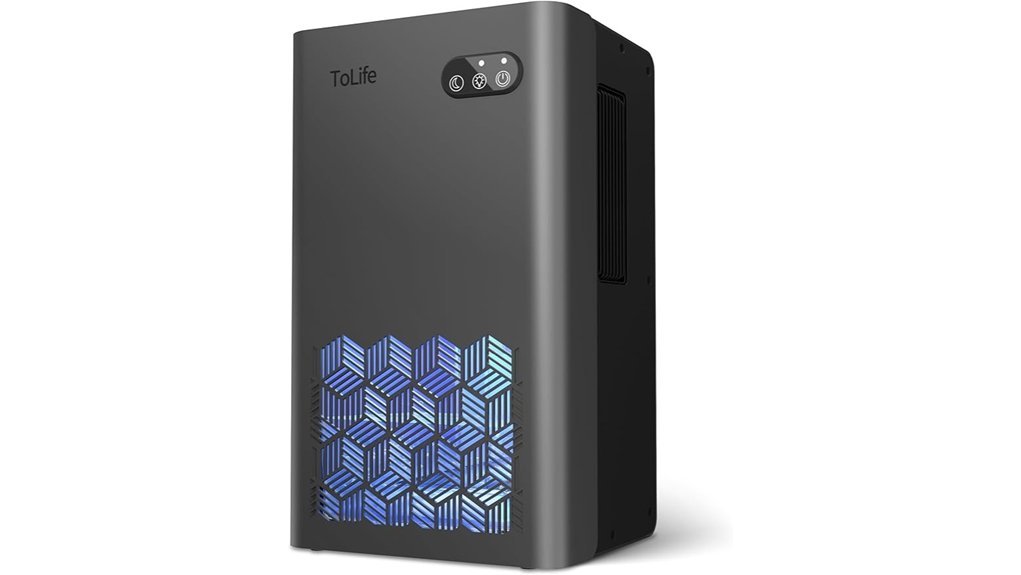
Best Large-Tank Compact Pick
The ToLife Dehumidifier offers a 95-ounce tank, two operating modes, automatic shut-off, and a listed removal rate of about 1 liter per day. The product listing advertises coverage up to 1,000 square feet, but the daily extraction rate is the more useful number for sizing. In real homes, this compact thermoelectric unit is a better fit for mild to moderate humidity in a bedroom, bathroom, closet, RV, or limited basement area than for a wet 1,000-square-foot basement. Sleep mode is listed below 30 dB, and the unit stops when the tank is full or incorrectly seated.
Best For: Buyers who want a larger tank, quiet sleep mode, and portable moisture control for a small or medium room.
Why You’ll Like It: The 95-ounce tank can reduce emptying frequency, while the built-in handle makes room-to-room use easier.
Who Should Avoid It: Anyone dealing with standing water, seepage, persistent condensation across a large basement, or humidity that requires a compressor dehumidifier.
Pros:
- Large 95-ounce tank for a compact thermoelectric model
- Quiet sleep mode listed below 30 dB
- Automatic shut-off and portable design
Cons:
- The 1,000-square-foot claim should not be treated as a performance guarantee
- About 1 liter per day is far below the output of a full-size compressor unit
- No continuous-drain option or adjustable humidistat is listed
AlohaAir Small Dehumidifier with 7-Color Night Light
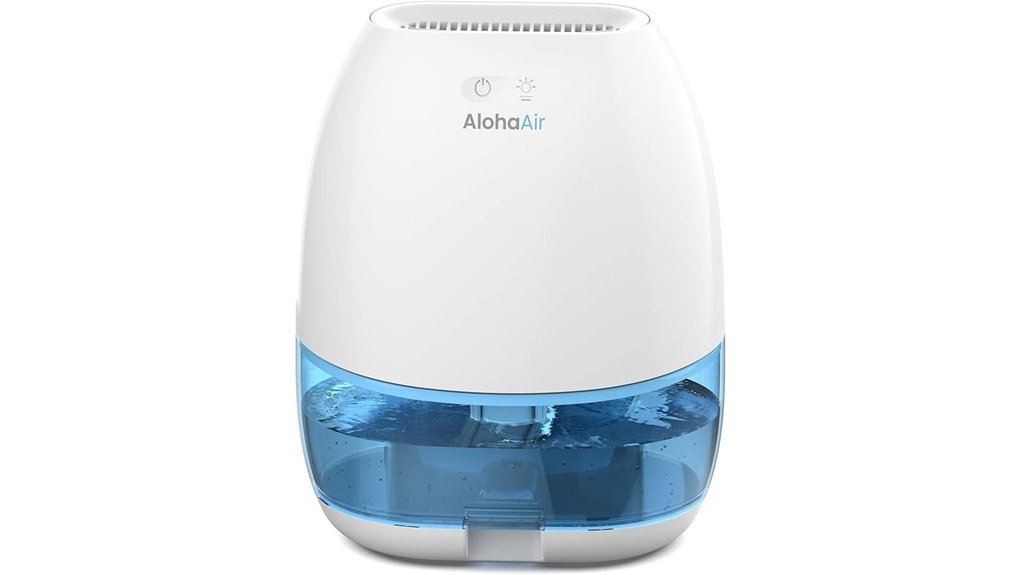
Best for Light Bedroom Moisture
AlohaAir’s compact dehumidifier is a practical choice for localized moisture in a bedroom, closet, small bathroom, or RV. Its compact 7.87 x 4.72 x 10.83-inch frame includes a built-in handle, while the transparent 1,000 ml tank makes the water level easy to check. The listed moisture-removal rate is up to 280 ml per day, so it is best for light dampness and musty air rather than heavy humidity. Automatic shut-off helps prevent tank overflow, and the listed 35 dB operating level suits spaces where lower noise matters.
Best For: Bedrooms, closets, compact bathrooms, and RVs with light humidity or musty air.
Why You’ll Like It: It combines quiet operation, a visible tank, easy portability, automatic shut-off, and a separate 7-color night light.
Who Should Avoid It: Buyers who need rapid drying, continuous drainage, or strong performance in a cold or very damp room.
Pros:
- Compact design with a built-in handle and visible 1,000 ml tank
- Automatic shut-off with a full-tank indicator
- Quiet operation and optional ambient light
Cons:
- Up to 280 ml per day is modest for serious humidity
- Tank must be emptied by hand
- Performance drops in cooler or less humid conditions
Eva-Dry Wireless Mini Dehumidifier, White (E-333)
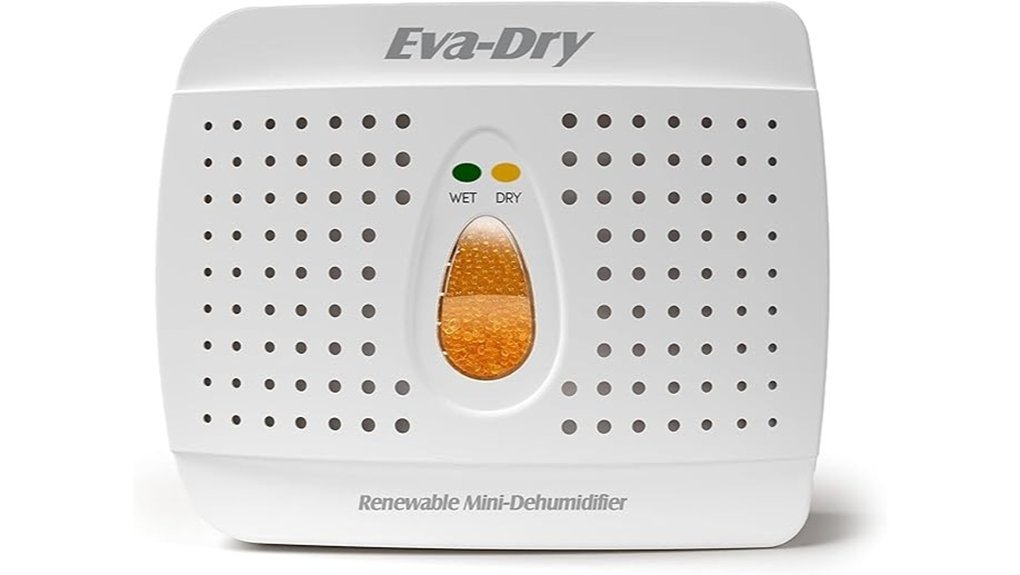
Best Cordless Pick for Enclosed Spaces
The Eva-Dry Wireless Mini Dehumidifier (E-333) is a passive silica-gel moisture absorber designed for small enclosed spaces where a powered fan would be inconvenient. It absorbs moisture silently and works without a cord between renewal cycles. The manufacturer lists coverage up to 333 cubic feet, making it better suited to closets, cabinets, cars, boats, and safes than open bedrooms or bathrooms. When the indicator beads change color, plug the unit into an outlet to dry and renew the silica gel, then return it to the enclosed space.
Best For: People who need silent, cordless moisture control in a closet, safe, cabinet, car, boat, or other enclosed area.
Why You’ll Like It: There is no tank to empty, no disposable refill, and no fan noise during normal use.
Who Should Avoid It: Anyone trying to lower humidity across an open room or solve an active leak, wet wall, or serious mold problem.
Pros:
- Cordless and silent during normal use
- Renewable silica gel avoids disposable refill packets
- Compact enough for cabinets, safes, vehicles, and storage spaces
Cons:
- Designed only for small enclosed spaces
- Needs periodic plug-in renewal
- Does not provide fast room-level moisture removal
Factors to Consider When Choosing a Small Dehumidifier
Choose a small dehumidifier by looking beyond the advertised room size. The most useful comparison points are the daily moisture-removal rate, room temperature, relative humidity, tank capacity, noise level, drainage method, and shut-off controls. Compact thermoelectric models are convenient and quiet, but they are not substitutes for full-size compressor dehumidifiers in wet basements or spaces with leaks.
Coverage Area and Moisture-Removal Rate
Square-foot ratings can help identify the manufacturer’s intended use, but they do not tell the whole story. A compact unit may be advertised for a large area while removing about 1 liter or less per day. Check the listed milliliters, liters, ounces, or pints removed per 24 hours, and note the temperature and humidity used for that claim. A small thermoelectric dehumidifier works best in a warm room with mild or localized dampness. For a very damp basement, laundry area, or room with wet walls, choose a properly sized compressor model.
Target Indoor Humidity
A separate hygrometer can help you judge whether the unit is making a meaningful difference. A practical indoor target is generally around 30% to 50% relative humidity. If humidity remains above 60%, condensation continues, or the room smells persistently damp, investigate the moisture source and consider a higher-capacity dehumidifier.
Water Tank Size
Tank size determines how much water the unit can hold, not how quickly it removes moisture. A 95-ounce tank may reduce emptying frequency, but a unit with a lower extraction rate can still take several days to fill it. Compare tank size with the listed daily removal rate. Automatic shut-off is important because it stops the unit when the tank is full, but you should still check the tank daily during the first week to learn how quickly it fills in your room.
Temperature and Humidity
Thermoelectric or Peltier dehumidifiers usually collect the most water in warm, humid conditions. Output can fall sharply in cooler rooms or when relative humidity is already moderate. This is why a product’s maximum daily rate should not be treated as a guaranteed result. Look for the test conditions beside the extraction claim whenever they are available.
Noise Level
Most powered models in this guide list sleep-mode noise between about 30 and 35 dB. That can work well in bedrooms, offices, and RVs, but sound ratings are measured under controlled conditions. Fan tone, vibration, placement, and room acoustics can change what you hear. Place the unit on a stable, level surface and leave open space around the air inlet and outlet.
Energy Use
Use the correct units when comparing energy use. Watts describe the power the unit draws at a moment in time, while kilowatt-hours describe the electricity used over time. Timers and lower-speed modes can reduce runtime, but they may also reduce moisture removal. Compare both energy use and water collected rather than choosing on wattage alone.
Auto Shut-Off and Drainage
Automatic shut-off is a key convenience and overflow-protection feature. It should stop the dehumidifier when the tank is full or not installed correctly. A visible full-tank alert makes maintenance easier. None of the powered models in this comparison lists continuous drainage, so buyers must be comfortable emptying the tank by hand.
Bathroom Placement and Safety
A small dehumidifier can help with leftover moisture after showers, but ventilation should come first. Run the bathroom exhaust fan and fix leaks. Place the dehumidifier on a stable surface away from the tub, shower, sink, and splashing water. Keep the power adapter dry, leave clearance around the vents, and follow the manufacturer’s electrical and placement instructions.
Passive vs. Powered Models
A renewable silica-gel model such as Eva-Dry is useful in a closet, safe, cabinet, or vehicle because it is silent and cordless during use. A powered thermoelectric model moves more air and collects water in a tank, making it more suitable for a small bedroom, bathroom, or RV. Neither type is the right solution for plumbing leaks, flooding, or major structural dampness.
When to Choose a Compressor Dehumidifier
Move up to a compressor dehumidifier when the space stays above 60% relative humidity, has visible condensation across multiple surfaces, smells persistently musty, or contains wet walls, seepage, or laundry-related moisture. Full-size models are rated in pints per day and often include a humidistat and continuous-drain option, making them more suitable for sustained moisture loads.
- Measure the room and identify where the moisture comes from.
- Compare daily extraction, not only advertised square footage.
- Check the temperature and humidity used for the maximum removal claim.
- Choose auto shut-off for overnight or unattended use.
- Confirm whether you are comfortable emptying the tank manually.
- Use a compressor dehumidifier if the room is very damp, cold, or larger than a compact unit can realistically handle.
Frequently Asked Questions
Which Small Dehumidifier Works Best in a Bathroom?
BREEZOME is the strongest bathroom-oriented option in this group because it combines a 1.8-liter tank, timer, automatic shut-off, and a listed rate of up to 700 ml per day under warm, humid test conditions. It should still be placed away from direct water, and an exhaust fan should handle most shower steam first.
Which Small Dehumidifier Is Best for a Bedroom?
AlohaAir is a good choice for light bedroom moisture because it is compact, listed at about 35 dB, and includes automatic shut-off. ToLife and TENKER offer larger tanks and sleep modes below 30 dB, making them better choices when you want greater listed extraction and less frequent emptying.
How Often Should I Empty the Water Tank?
Check the tank every day when you first start using the unit. How often it needs emptying depends on the tank size, extraction rate, room temperature, and humidity. A compact model may need emptying daily in favorable high-humidity conditions, or only every few days when the air is less damp.
Are Small Dehumidifiers Safe to Run Overnight?
They can usually run overnight when the manufacturer allows it and the unit has automatic shut-off. Place it on a flat, stable surface, keep the vents clear, keep the cord and adapter dry, and stop using it if the plug, cord, adapter, or housing becomes unusually hot or damaged.
Does the Eva-Dry E-333 Need Electricity?
It does not need electricity while absorbing moisture. You plug it into an outlet only when the indicator shows that the silica gel needs to be dried and renewed. After the renewal cycle, unplug it and return it to the enclosed space.
Can a Small Dehumidifier Help Reduce Mildew Smells?
It may help by lowering excess humidity, but it will not remove existing mold or fix the source of the moisture. Clean affected surfaces safely, repair leaks, improve ventilation, and use a dehumidifier only as part of the moisture-control plan.
Is a 1,000-Square-Foot Rating Realistic for a Mini Dehumidifier?
Treat that number as a manufacturer guideline, not a guarantee. A compact thermoelectric unit that removes about 1 liter per day may help with mild humidity in a closed space, but it is not comparable to a compressor dehumidifier rated in many pints per day. Daily extraction and actual room conditions are more useful than square footage alone.
What Humidity Level Should I Aim For?
A practical target for most homes is about 30% to 50% relative humidity. Use a hygrometer to monitor the room. If the level stays above 60% despite continuous operation, investigate leaks or ventilation problems and consider a higher-capacity unit.
Conclusion
For the best balance of tank size, controls, and listed performance, the BREEZOME 60 OZ is the strongest all-around plug-in choice in this group. Choose the TENKER 77 OZ when higher listed extraction is the priority, or the ToLife 95 OZ when you want the largest tank. AlohaAir is a better fit for light bedroom or RV moisture, while the Eva-Dry E-333 suits closets, safes, vehicles, and cabinets where silent cordless use matters.

This means that if our security system flags unusual activity, or if you are withdrawing significantly large sums,
we may request a standard KYC (Know Your Customer) check.
Here is my blog :: Online Glücksspiel mit Kryptowährungen