
Figuring out what should a dehumidifier be set to in winter comes down to balancing personal comfort with window condensation. While winter heating naturally dries out upper floors, everyday moisture from showers, cooking, and cool basement walls can still push indoor air past healthy limits. Setting your humidistat to the right winter target stops glass from sweating and prevents mold without leaving your skin and throat parched.
Before relying on the number shown on your dehumidifier, place a separate digital hygrometer a few feet away and check your room temperature so the coils do not freeze.
Quick Answer
Set your dehumidifier to 30% to 40% relative humidity (RH) in winter to prevent window condensation. If your windows stay completely dry and the air feels harsh, 40% to 45% is safe. Only run the unit when humidity stays above 50% or dampness appears, and keep standard compressor models in rooms above 41°F (5°C).
At a Glance
| Item | Winter guidance |
|---|---|
| Best winter setting | 30% to 40% RH in cold weather; 40% to 45% RH if windows stay dry (within the 30% to 50% healthy range) |
| Use a dehumidifier when | Humidity stays above 50% RH, or window condensation, damp walls, and musty odors appear |
| Use a humidifier when | Humidity drops below 30% RH and you notice static electricity, dry skin, or a scratchy throat |
| Tools needed | Standalone hygrometer, room thermometer, dehumidifier with clean filter, and gravity drain hose or pump if needed |
| Temperature check | Keep rooms above 41°F (5°C) minimum; standard compressor coils work best above 65°F (18°C) |
What Should a Dehumidifier Be Set to in Winter?
For most homes, 30% to 40% relative humidity is the ideal winter dehumidifier setting. ENERGY STAR notes that while the optimum year-round humidity for a building is 30% to 50%, dropping to 30% to 40% during the heating season in colder climates prevents window condensation. The EPA likewise recommends keeping indoor relative humidity below 60% and ideally between 30% and 50% to stop mold growth.
Cold window glass is the main limiting factor in winter. When warm indoor air touches a cold windowpane, its temperature drops to the dew point and water droplets form on the glass and sill. The colder the outdoor forecast, the lower your indoor humidity target needs to be to keep windows dry. If your windows have double or triple panes and stay completely clear at 40% to 45%, you do not need to push the setting lower.
Warning: Do not treat a dehumidifier setting as medical care. If damp air, mold spores, dust mites, or overly dry winter air trigger asthma or breathing trouble, use humidity control alongside advice from a qualified clinician.
Recommended Products

Wellness Indicator: This humidity meter with humidity level icon indicates air conditions - DRY/COMFORT/WET, allowing this humidity sensor to ensure you’re always aware of changes to your home/household with just a quick glance

Face Icon Comfort Indicator: Humidity temperature gauge features face icons to indicate DRY/COMFORT/WET air conditions, quickly informs you how to adjust your humidifier or dehumidifier to achieve optimal comfort.
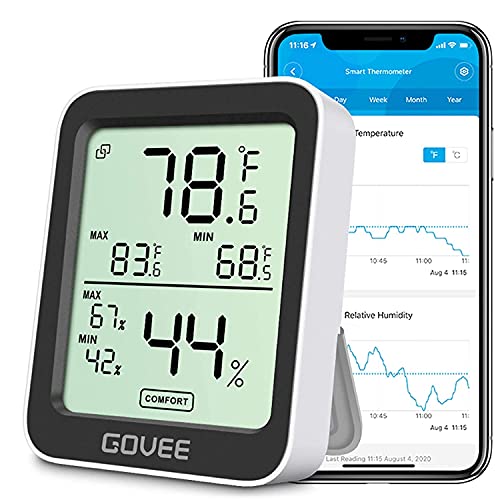
Smart Features: The Govee Wireless Thermometer Hygrometer supports all basic functions as well as smart functions such as remote monitoring and temp humidity graphs. Our humidity meters are reliable and easy to use for homes, greenhouses and more.(Only supports 164ft Bluetooth connection)
What Is the Right Winter Humidity Range?
The healthy winter indoor range is 30% to 50% RH, with 30% to 40% serving as the safest band during freezing weather. Building science researchers at the University of Minnesota Extension recommend keeping winter indoor humidity between 25% and 40% so moisture does not condense on cold glass or inside exterior walls. Use the table below to match your setting to your room conditions and outdoor temperatures.
| Situation or outdoor temperature | Suggested setting | Why it works |
|---|---|---|
| Severe cold (0°F to 10°F / -18°C to -12°C) or dripping windows | 30% to 35% | Lowers the indoor dew point so warm air does not condense or frost on cold glass. |
| Cold weather (20°F to 40°F / -7°C to 4°C), windows stay dry | 35% to 40% | Balances respiratory comfort with condensation control during typical winter weather. |
| Living areas or bedrooms that feel dry (mild winter days) | 40% to 45% | Prevents dry airways and static shocks while staying safely below the 50% dust-mite threshold. |
| Basement with musty smell or damp walls | 40% to 50% (lower if condensation appears) | Keeps subterranean walls and stored items dry while you inspect for leaks or drainage issues. |
Signs Humidity Is Off
Indoor humidity is too high when you notice persistent window fog, damp curtains, musty odors, soft cardboard boxes, peeling paint, or visible mold spots on sills and corners. Lower your dehumidifier setting by 5%, run kitchen and bath exhaust fans, and check for plumbing leaks or blocked gutters.
Humidity is too low when you experience dry skin, chapped lips, and irritated nasal passages, along with frequent static shocks or shrinking gaps in hardwood floors and wood trim. Raise your target toward 40% or unplug the dehumidifier until readings climb.
When Should You Use a Dehumidifier or a Humidifier?
Use a dehumidifier only when winter indoor humidity stays above 50% RH, and switch to a humidifier if readings drop below 30% RH. Because central heating dries out upper living spaces while basements trap ground moisture, some homes need a humidifier upstairs and a dehumidifier in the basement during the same month.
| Hygrometer reading | What to do |
|---|---|
| Above 50% RH | Run a dehumidifier set to 35% to 40% and track down the moisture source. |
| 30% to 50% RH (no window fog) | Leave the dehumidifier off or on standby; your air is in the healthy range. |
| 35% to 50% RH (windows fogging in deep cold) | Run the dehumidifier briefly at 30% to 35% and open curtains so warm air reaches the glass. |
| Below 30% RH with a dry feel | Turn off the dehumidifier and consider running a humidifier to return to 35% to 40%. |
In living rooms and bedrooms, you typically need a dehumidifier in winter only if you hang wet laundry indoors, cook or shower without externally vented exhaust fans, live in a mild, rainy winter climate (such as the Pacific Northwest), or live in a tightly sealed home where moisture cannot escape. Our guide on whether a dehumidifier stops window condensation in winter covers how to clear sweating glass step by step.
Check Room Temperature Before You Run It
Always check the room thermometer before turning on a dehumidifier in winter, because standard refrigerant compressor models lose efficiency below 65°F (18°C) and can ice over completely below 41°F (5°C). When room air is too cold, condensation freezes onto the internal evaporator coils instead of dripping into the bucket.
| Room temperature | What to do | Result |
|---|---|---|
| Below 41°F (5°C) | Do not run a standard compressor unit; use a desiccant model (rated down to 34°F / 1°C) | Compressor coils freeze solid, moisture removal stops, and the compressor can suffer damage. |
| 41°F to 65°F (5°C to 18°C) | Use a low-temperature compressor unit with auto-defrost, or a desiccant unit | Cool air holds less water vapor, and defrost cycles pause drying periodically. |
| Above 65°F (18°C) | Run any standard compressor dehumidifier normally | Coils stay frost-free and extract water at peak energy efficiency. |
If you need to dry an unheated garage, crawl space, or chilly cellar that stays between 34°F and 60°F (1°C to 16°C), consider a desiccant dehumidifier. Instead of cooling air over refrigerant coils, a desiccant unit passes air through a moisture-absorbing silica rotor and releases air that is 10°F to 18°F warmer. If your current machine keeps icing up, read our troubleshooting guide on why a dehumidifier freezes up.
Why Heating Changes Indoor Humidity
Heating a room lowers its relative humidity because warm air can hold significantly more water vapor than cold air, even when the actual amount of moisture stays the same. When outdoor winter air at 20°F (-7°C) and 70% RH leaks into your house and gets heated to 70°F (21°C), its relative humidity plunges to roughly 10% to 15%.
Despite that drying effect, everyday household habits constantly add water vapor back into the air. A family of four releases several gallons of moisture per week through breathing, hot showers, boiling pots, dishwashing, indoor clothes drying, watered houseplants, and snow melting off coats and boots. Running bathroom and range exhaust fans that vent directly outdoors—and checking your hygrometer at the same time each day for a week—shows whether your home has a net moisture surplus or deficit.
Is 55% Humidity Okay in Winter?
No, 55% relative humidity is too high for most homes in winter. Although 55% sits just below the EPA’s 60% maximum ceiling, it exceeds the recommended 30% to 50% comfort band, and the CDC advises keeping indoor humidity no higher than 50% all day long to prevent mold growth.
At 55% indoor humidity, air in a 68°F (20°C) room has a dew point of about 51°F (10.5°C). Any window frame, exterior wall stud, or cold-water pipe cooler than 51°F will collect condensation, feeding hidden mildew and dust mites. Treat 55% only as a temporary reading in a damp basement while you bring it down toward 40% to 45%.
What Are the Best Basement Settings in Winter?
Set a basement dehumidifier to 40% to 50% RH in winter, or dial it down to 35% to 40% if you see sweating on foundation walls, rim joists, or basement windows. Because basements sit against cool, damp earth and have limited airflow, they often stay 10% to 15% more humid than the living rooms upstairs.
Even in freezing weather, moisture enters basements through three pathways: capillary suction, vapor diffusion, and the stack effect. As warm air rises to upper floors in winter, it creates slight negative pressure in the basement that draws damp soil air through floor cracks and unsealed sump pits. To reduce how hard your basement dehumidifier works:
- Fit an airtight lid over your sump pump pit.
- Check that outdoor soil slopes away from the foundation at least 1 inch per foot for 6 feet.
- Extend gutter downspouts so snowmelt drains well away from basement walls.
- Warm the basement above 41°F (or ideally 60°F+) before running a standard compressor unit, or check our guide on whether to turn off a basement dehumidifier in winter when temperatures drop.
Where Should You Place a Dehumidifier?
Place your dehumidifier on a level, water-resistant surface in the center of the dampest room, or against a wall only if the machine discharges air from the top. Good airflow ensures the humidistat reads the room accurately instead of sampling stagnant air in a corner.
ENERGY STAR notes that while top-discharge portable units can sit near a wall, models with side or rear grilles need 6 to 12 inches (15 to 30 cm) of clearance on all sides so intake and exhaust vents stay unobstructed. Keep curtains, cardboard boxes, furniture, and dusty workshop tools away from the grilles. Plug the cord directly into a grounded wall outlet (never an extension cord), keep drain hoses clear of electrical connections, and close doors to humid rooms like bathrooms so the machine dries the target area efficiently.
How to Adjust Your Dehumidifier Setting Step by Step
Dialing in your winter dehumidifier takes 24 to 48 hours of observation using a separate hygrometer. Follow these seven steps in order so you remove excess dampness without over-drying your living space or wasting electricity.
- Place a standalone hygrometer at chest height in the room. Keep it at least 6 feet away from heating vents, cold windows, sinks, and the dehumidifier exhaust so you get a true room average.
- Measure the room temperature first. Confirm the space stays above 41°F (5°C)—and ideally above 60°F (16°C) for standard compressor units—before powering the machine on.
- Set the dehumidifier to 40% RH on Auto mode. A 40% setpoint is the safest starting target for most winter rooms and allows the compressor to shut off automatically once the target is reached.
- Monitor the room and windows for 24 hours. Check whether morning condensation clears from the bottom corners of your windows and compare your standalone hygrometer against the unit’s display.
- Lower the setting to 35% if condensation persists. If windows still drip during a cold snap or the room feels clammy, step the setting down by 5% increments.
- Raise the setting to 45% or turn the unit off if the air feels dry. If your hygrometer drops near 30% and you notice dry eyes, static shocks, or a scratchy throat, pause the unit and let indoor humidity recover toward 40% to 45%.
- Re-check after major weather shifts. Rainstorms, rapid snowmelt, and sub-zero cold snaps change indoor moisture loads and window glass temperatures overnight.
Pro Tip: Built-in dehumidifier sensors often read 5% to 10% off because they sit right next to the warm motor. If your standalone hygrometer reads 40% when the dehumidifier says 45%, adjust the machine’s setpoint to match the standalone hygrometer. For year-round targets, see our guide on what a dehumidifier should be set at in every season.
Winter Dehumidifier Maintenance Tips
Cold winter air and household dust make regular maintenance essential to prevent frozen coils and wasted power. Check your unit every two to four weeks during winter operation:
- Wash or vacuum the air filter every 2 to 4 weeks: A dust-clogged filter restricts warm airflow across the coils, which is a leading cause of winter coil icing even in 60°F rooms.
- Empty the bucket early or set up a drain hose: Connect a gravity drain hose to a floor drain or sump pit—making sure the hose slopes downward with no kinks and stays in a heated area above 32°F (0°C) so the water line cannot freeze.
- Inspect the coils for frost buildup: If you spot ice on the rear coils, turn the unit off, unplug it, and let the ice melt completely before restarting.
- Clean and dry the water tank monthly: Wash the bucket with warm water and mild dish soap, rinse well, and let it air-dry to prevent slimy biofilm and musty odors.
- Store it dry if you shut it down for winter: If your home stays below 45% RH on its own, run the fan mode to dry the interior, empty the reservoir and internal drain tray, clean the filter, and store the machine upright.
Common Winter Dehumidifier Mistakes
Avoiding a few common operating mistakes keeps your winter electricity bill low and protects both your home and your appliance:
- Running the unit on “Continuous” mode: Continuous mode ignores the humidity sensor and can drive winter indoor air below 25% RH, drying out wood furniture, floors, and your sinuses.
- Operating a standard unit in an unheated space: Running a refrigerant dehumidifier below 41°F (5°C) freezes the coils and wears out the compressor without pulling water from the air.
- Trusting the built-in humidistat blindly: Always verify room humidity with an independent hygrometer placed across the room.
- Leaving heavy curtains closed over wet windows: Closed drapes trap moist air against freezing glass and make window condensation worse even when a dehumidifier is running.
- Skipping exhaust ventilation: A dehumidifier should never replace kitchen and bathroom exhaust fans, which vent steam straight outdoors at the source.
- Blocking the intake or exhaust grilles: Pushing a rear-venting unit flush against a wall or stacking storage bins beside it starves the coils of airflow.
Key Takeaways
- Aim for 30% to 40% relative humidity in cold weather to stop window fog, or 40% to 45% if windows stay dry—staying inside the healthy 30% to 50% range.
- Turn the dehumidifier on only when a separate hygrometer stays above 50% RH or you spot window condensation, musty odors, damp walls, or mold.
- Never over-dry winter air below 30% RH, which triggers dry skin, scratchy throats, static shocks, and shrinking wood trim.
- Check the room temperature before starting: compressor coils can begin frosting below 65°F (18°C) and should not run below 41°F (5°C) unless rated for cold spaces.
- Basements absorb soil moisture year-round and usually need a 40% to 50% setting even when heated upstairs rooms are dry.
Frequently Asked Questions
What setting should I put my dehumidifier on in winter?
Set your dehumidifier to 30% to 40% relative humidity in winter, which matches ENERGY STAR guidance for preventing window condensation in cold climates. If your windows stay completely dry and the air feels harsh, raising the setpoint to 40% to 45% is safe and comfortable. Always confirm the reading with a separate room hygrometer.
Do I need a dehumidifier in winter?
Most heated upstairs living areas do not need a dehumidifier in winter because furnace heat naturally lowers relative humidity. You only need to run one when a hygrometer stays above 50% RH, or when you see window condensation, musty odors, or damp basement walls.
Is 30% humidity too low in winter?
No, 30% relative humidity is the bottom edge of the EPA-recommended 30% to 50% healthy indoor range and is often necessary during freezing weather to keep windows dry. However, if 30% leaves you with dry skin, a scratchy throat, or static shocks, pause the dehumidifier or let humidity rise toward 40%.
Can I run a dehumidifier in a cold basement?
You can run a standard compressor dehumidifier in a cool basement only if the air stays above 41°F (5°C), and it will extract water much faster above 65°F (18°C). If your basement drops below 41°F to 50°F, warm the room first or use a desiccant dehumidifier designed for low temperatures.
Why do my windows still fog with the dehumidifier running?
Windows still fog when indoor humidity remains too high for the outdoor temperature or when curtains trap air against cold glass. Lower your dehumidifier target to 30% to 35%, open blinds and drapes so warm room air reaches the glass, run bath and kitchen exhaust fans, and clean the dehumidifier filter.
Should I run a dehumidifier all winter?
Do not run a dehumidifier nonstop all winter unless a damp basement or rainy climate keeps indoor humidity above 50%. Set the unit on Auto mode between 35% and 40% so it cycles off automatically, and unplug it whenever your home holds 30% to 45% RH on its own.
What is the difference between a compressor and a desiccant dehumidifier in winter?
A compressor dehumidifier pulls moisture over cold refrigerant coils and works best in heated rooms above 65°F (18°C), losing efficiency in cold spaces as coils frost. A desiccant dehumidifier absorbs moisture with a heated silica rotor, working reliably down to 34°F (1°C) while warming the room air slightly.
Does running a dehumidifier in winter use a lot of electricity?
Most portable dehumidifiers draw between 200 and 500 watts, so running one continuously adds noticeable cost to your winter electric bill. Using Auto mode at a 40% RH setpoint, cleaning the filter monthly, and keeping the room above 65°F reduces runtime and energy use significantly.
Conclusion
Set your dehumidifier to 30% to 40% relative humidity during winter cold snaps to keep windows clear of condensation, or up to 45% when glass stays dry and the air feels harsh. Run the machine only when a standalone hygrometer climbs above 50% RH or damp spots appear, and make sure the room stays above 41°F (5°C) so the coils do not freeze.
Start today by placing an inexpensive digital hygrometer in your dampest room for 24 hours—then set your dehumidifier to 40% on Auto mode, clean the air filter, and let the humidistat do the work.
Sources
- ENERGY STAR – Dehumidifiers: Optimal 30% to 50% building relative humidity, 30% to 40% winter setting for colder climates, 65°F coil frost threshold, and wall placement guidelines.
- U.S. Environmental Protection Agency (EPA) – A Brief Guide to Mold, Moisture and Your Home: Indoor humidity ceiling below 60% RH and ideal 30% to 50% RH range to prevent mold growth.
- University of Minnesota Extension – Controlling Moisture Problems in Your Home: Winter indoor relative humidity guidelines (25% to 40%) to prevent window condensation and control indoor moisture sources.
- Mayo Clinic – Humidifiers: Ease Skin, Breathing Symptoms: Health effects of low winter humidity below 30% RH on skin and nasal passages.
- Centers for Disease Control and Prevention (CDC) – Mold: Guidance on keeping indoor home humidity no higher than 50% all day long and venting exhaust fans outdoors.
- University of Minnesota Extension – Moisture in Basements: Causes and Solutions: Capillary suction, vapor diffusion, stack effect, and foundation grading specifications.



[…] Winter Dehumidifier Setting: 35–40% Humidity Guide […]