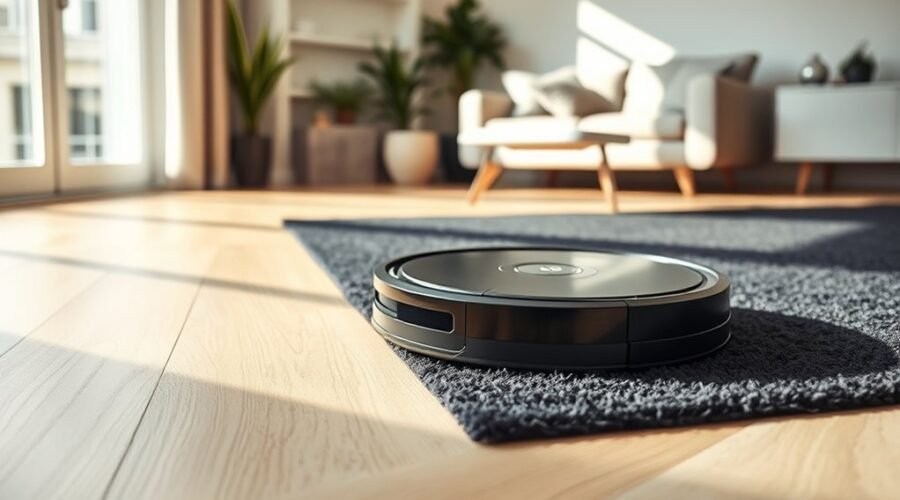
Robot vacuums often hesitate on dark carpet because their cliff sensors can misread low-reflective surfaces as drop-offs or obstacles. The issue may also involve dirty sensors, worn wheels, tangled brushes, or outdated navigation data. In some cases, app settings and firmware updates make a measurable difference. When those checks fail, the problem usually points to the machine’s mapping limits—and that is where the real fix begins.
Reasons Robot Vacuums Avoid Dark Carpet
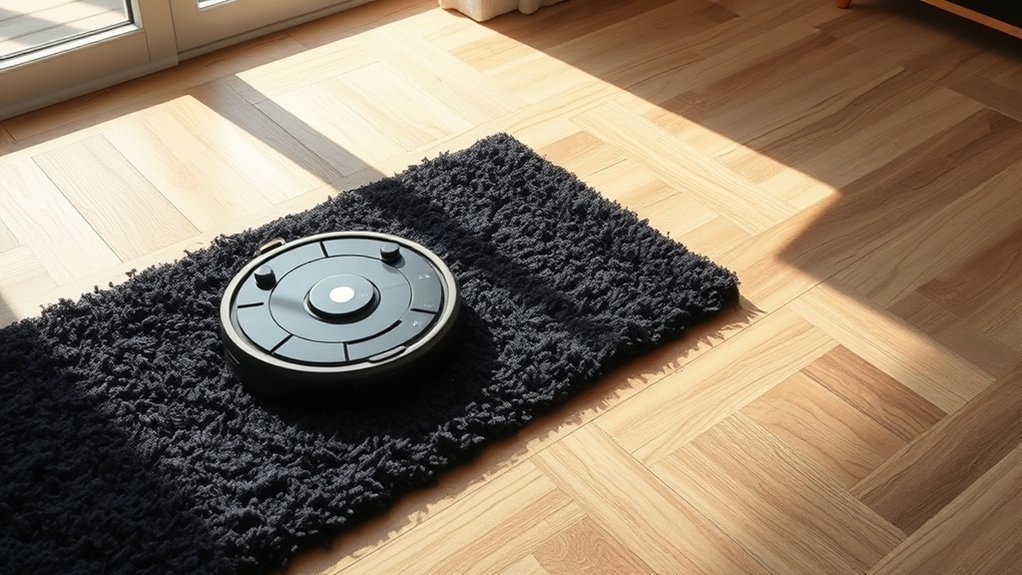
Robot vacuums often avoid dark carpet because their cliff sensors use infrared light to detect drops and changes in surface height. Dark rugs can absorb that light enough to trigger a false cliff reading.
In practice, robot vacuums avoid these areas because the navigation system treats the surface as unsafe, even when the floor is level. This affects obstacle detection and can produce performance issues when a unit moves from hard flooring onto a dark carpet or rug.
The problem is more visible in smart models with multiple cliff sensors, since each sensor adds another chance for misread data. For users seeking liberated, low-effort cleaning, this behavior can feel like a hardware restriction rather than a true safety feature.
Multiple cliff sensors can turn a dark rug into a recurring false alarm, making convenience feel oddly constrained.
Common workarounds include reflective tape over the sensors, though results vary and some manufacturers do not provide an option to disable the sensing logic.
Check Sensors, Wheels, and Brushes First
Before assuming the dark carpet itself is the only issue, the vacuum’s hardware should be checked for simpler faults that can produce the same behavior. A robot vacuum often misreads surfaces when cliff sensors are dusty, so obstacle avoidance may trigger on ordinary rugs.
Wheels should rotate freely, and brushes should be clear of hair and debris; otherwise the unit may slow, slip, or get stuck before reaching the carpet.
- Clean sensors with a dry cloth and verify they read the floor correctly.
- Inspect brushes, wheels, and axles for wrapped fibers or hidden buildup.
- Look for blockages in the dustbin, filter, and air path, since reduced suction power weakens cleaning across textured surfaces.
If mobility tests on other rugs show the same hesitation, the limitation may be mechanical rather than cosmetic. A careful inspection restores operational freedom and prevents unnecessary troubleshooting later.
Fix Robot Vacuum Dark Carpet Settings
When a robot vacuum still refuses to cross a dark rug, its settings and sensor behavior are often the next variables to examine. Many robot vacuum sensors rely on infrared readings, and dark carpets can trigger cliff sensors, making the vacuum cleaner interpret the surface as a drop-off.
A practical fix is to open the app and check whether sensor sensitivity can be lowered or adjusted for floor recognition. If the platform permits, reduce the avoidance response until navigation problems ease.
Another field-tested option is to cover the cliff sensors with white tape or other reflective material, which can prevent the misread. Keeping the sensor window clean also matters, because dust can intensify errors on dark carpets.
If these measures fail, advanced navigation features in newer models may offer better surface discrimination and more reliable movement across mixed flooring.
Update Firmware and Remap the Floor
If sensor adjustments and physical tweaks still do not stop the unit from hesitating on dark carpet, the next step is to examine the software and mapping data.
Experts recommend to update firmware first, since newer code can refine navigation algorithms and improve obstacle recognition on dark carpets.
Experts recommend updating firmware first, as newer code can refine navigation and improve obstacle recognition on dark carpets.
Then review the app for remapping the floor so the robot can rebuild a cleaner digital map. Clean sensors before starting, because dust can distort readings and weaken practical fixes.
- Install the latest firmware and reboot the robot.
- Launch a fresh mapping cycle after the update.
- If needed, place the vacuum in different rooms or locations to guide the map.
This process helps the machine interpret surfaces with more freedom and fewer false warnings.
A refreshed map, paired with calibrated sensors, gives the cleaner a better chance to move confidently across dark carpets without hesitation.
Clear Obstacles, Glare, and Floor Transitions
A few small environmental details can make a robot vacuum hesitate on dark carpet, especially when cliff sensors misread the surface as a drop-off. To improve freedom of movement, the area should be cleared of loose cords, chair legs, and reflective objects that can create glare or trigger navigation errors.
Dark carpets near glossy furniture or high-contrast trim are especially problematic because the vacuum’s sensors may struggle to separate edges from shadows. Floor changes also matter: smooth to textured surfaces, such as a hard floor meeting a thick rug, can introduce height variations that limit crossing.
Keeping the sensors clean and unobstructed supports more accurate detection across varied flooring. A practical testing vacuum routine on different carpet types and colors can reveal which layouts allow better performance and which ones cause hesitation.
That information helps users place rugs and obstacles in ways that reduce dependence on trial and error and preserve autonomous coverage.
Best Robot Vacuums for Dark Carpet
Dark carpet can trigger sensor misreads in some robot vacuums, especially when cliff detection or surface recognition is tuned for lighter flooring.
Models with LiDAR mapping, adaptive obstacle detection, and adjustable suction tend to navigate these surfaces more reliably while maintaining cleaning performance.
Units such as the iRobot Roomba i7+ and Roborock S7 are often cited for stronger results in mixed-floor environments with darker rugs.
Dark Carpet Sensor Issues
Robot vacuums can misread dark carpets as drop-offs because many rely on cliff sensors, often infrared, that are not always able to distinguish a black rug from an actual stair edge. This is central to dark carpet sensor issues, shaping how robot vacuums navigate and when they retreat.
- Entry-level units with cliff sensors may halt, reverse, or avoid the area entirely.
- Some users report that white tape or reflective material over sensors can help the robot cross dark rugs.
- Advanced robot vacuums with navigation systems, including LiDAR mapping, plus adjustable suction power and smart sensors, tend to interpret surfaces more accurately.
For users seeking frictionless, liberated floor care, selecting hardware designed for mixed floor types reduces false drop-off reads and keeps coverage consistent.
Vacuums With Better Navigation
Several robot vacuums stand out for dark-carpet performance because their navigation systems can distinguish low-light floor textures from actual obstacles or drop-offs. For owners seeking autonomy, these models reduce false avoidance and keep cleaning moving.
| Robot | Key tech | Dark carpet result |
|---|---|---|
| Dyson 360 Heurist | visual mapping | precise routes |
| Roomba s9+ | powerful suction | steady cleaning |
| Roborock S7 | LiDAR, obstacle detection | smooth shifts |
| Deebot Ozmo T8 AIVI | smart mapping | accurate floor ID |
| Neato D8 | D-shape, strong suction | tight coverage |
Dyson’s navigation technology reads surfaces well. Roomba s9+ adapts to dark carpet without hesitation. Roborock S7 and Ecovacs use smart mapping to preserve cleaning freedom. Neato’s layout helps obstacle detection and edge access. Each Robot vacuum pairs control with powerful suction.
Frequently Asked Questions
What Is the Average Lifespan of a Robot Vacuum?
The average robot vacuum lifespan is 3 to 5 years. Robot vacuum maintenance, battery lifespan, smart features, cleaning efficiency, navigation technology, noise levels, brand comparisons, and user reviews all shape long-term performance.
Do Robot Vacuums Do Well on Carpet?
Yes—robot vacuums can do well on carpet when carpet height and carpet texture match the model’s suction power, navigation systems, and sensor accuracy; effective cleaning modes, maintenance tips, and brand comparisons improve results.
What Are the Downsides of Using a Robotic Vacuum Cleaner?
Downsides include Battery life limits, Maintenance costs, Limited suction, Navigation issues, Noise levels, reduced Cleaning efficiency, Sensor malfunctions, and frequent Replacement parts. These constraints can reduce autonomy, require oversight, and complicate liberated, hands-off floor care.
What Are Some Common Problems With Robot Vacuums?
Like a cautious scout, robot vacuums often face Battery issues, Sensor malfunctions, Navigation problems, Dustbin capacity limits, App connectivity failures, Programming errors, reduced Cleaning efficiency, and ongoing Maintenance requirements, restricting autonomous freedom for users.
Conclusion
To sum up, a robot vacuum that avoids dark carpet is usually reacting to misleading cliff-sensor data, not a faulty floor. Cleaning sensors, checking wheels and brushes, adjusting app settings, and updating firmware often restore normal behavior. Remapping the home can also improve navigation across high-contrast surfaces. In many cases, the problem is a small signal issue with outsized effects, like a false alarm in an otherwise reliable system. Choosing a better-mapped model can prevent repeat failures.