Affiliate disclosure: This article contains Amazon affiliate links. As an Amazon Associate, we may earn from qualifying purchases at no extra cost to you.
If you are comparing the best small dehumidifiers for home use in 2026, match the unit to the enclosed room and the severity of the moisture problem rather than relying only on a headline square-foot claim. The NeedDuck 44 oz is the easiest to move, the NovaLivin 68 oz balances tank size with a quiet sleep mode, the TENKER offers a larger 77 oz reservoir, and the UBBO adds a 95 oz tank with continuous-drain support. These compact semiconductor dehumidifiers are designed for mild humidity and localized dampness. They are not substitutes for a properly sized compressor dehumidifier in a cold or wet basement, an area with active water intrusion, or a large open floor plan.
Quick Verdict
- Best for Continuous Drainage: UBBO 95 oz Dehumidifier, because the included hose and timer can reduce daily tank handling.
- Best Compact Pick: NeedDuck 44 oz Dehumidifier, for desks, closets, bedrooms, and other small spaces.
- Best Quiet Bedroom Pick: NovaLivin 68 oz Dehumidifier, with a seller-listed 30 dB sleep mode and automatic controls.
- Best Larger-Tank Portable Pick: TENKER 77 oz Dehumidifier, for buyers who want more tank capacity without moving to a full-size compressor model.
How these picks were compared: We reviewed tank size, seller-listed coverage, noise modes, drainage options, portability, controls, and important limitations. We did not independently laboratory-test these products. Coverage, noise, and extraction figures are seller-stated, and moisture-removal claims may be measured under warm, highly humid conditions that do not match a typical bedroom, bathroom, closet, or RV.
Quick Comparison of Small Dehumidifiers
| Product | Best For | Tank | Seller-Listed Coverage* | Drainage | Key Advantage | Main Limitation | Amazon |
|---|---|---|---|---|---|---|---|
| NeedDuck 44 oz | Very small rooms and portability | 44 oz | Up to 215 sq. ft. | Manual tank | Lightweight, timer, auto defrost | No advertised continuous drain | Check Amazon Details |
| NovaLivin 68 oz | Bedrooms and small living spaces | 68 oz | Up to 320 sq. ft. | Manual tank | 30 dB sleep mode and automatic controls | Listing gives inconsistent extraction figures | Check Amazon Details |
| TENKER 77 oz | Bedrooms, bathrooms, and RVs | 77 oz | Title: 1,000 sq. ft.; details: 800 sq. ft. | Manual tank | Larger tank and sub-30 dB sleep mode | No advertised continuous drain and conflicting coverage claims | Check Amazon Details |
| UBBO 95 oz | Lower-maintenance continuous drainage | 95 oz | Advertised up to 1,000 sq. ft. | Tank or included hose | Continuous drainage and 8/16/24-hour timer | Coverage is ambitious for a compact semiconductor unit | Check Amazon Details |
*Coverage note: These are seller-listed figures, not directly comparable laboratory results. For compact semiconductor models, room temperature, starting humidity, airflow, open doors, and incoming moisture can have a large effect on real-world performance.
NeedDuck Dehumidifier for Home with 44 oz Water Tank
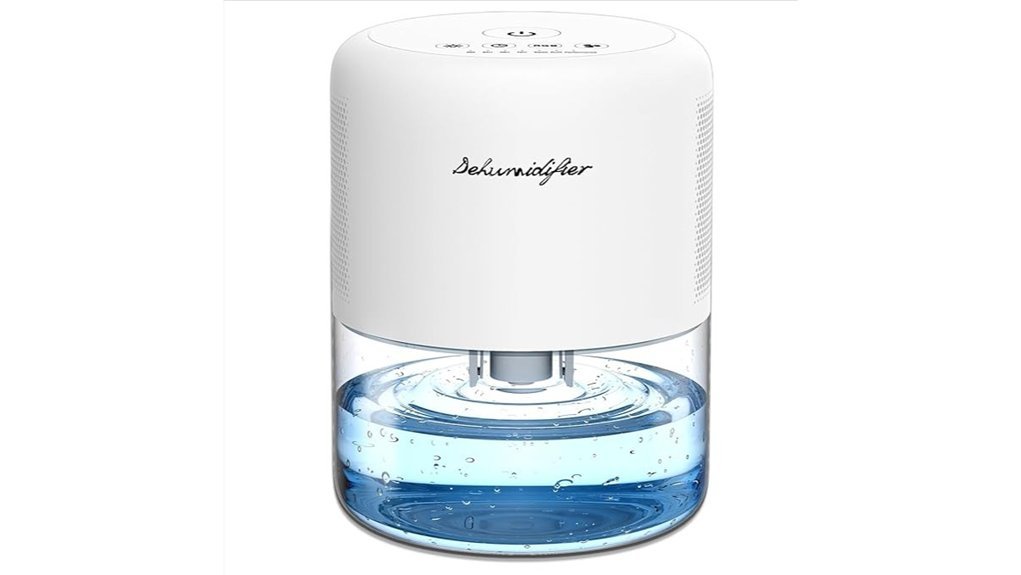
Best Compact Pick: The NeedDuck 44 oz model is the easiest option here to move between a bedroom, bathroom, closet, office, or RV. The seller listing describes a compact 2.6-pound design, three operating modes, four timer choices, auto defrost, auto shutoff, and decorative lighting.
Its main advantage is convenience in genuinely small spaces. The 44 oz tank is easy to remove, and the low-profile body takes up less room than the larger models in this guide. However, the seller-listed coverage is only up to 215 square feet, and the listing does not advertise a continuous-drain hose. It is better for mild humidity and localized dampness than persistent moisture across a large room.
Why You’ll Like It: It combines portability, simple controls, and automatic protection features in the smallest package in this roundup.
Best For: Small bedrooms, closets, bathrooms, desks, campers, and buyers who value portability.
Who Should Avoid This: Anyone dealing with a wet basement, visible water intrusion, a large open-plan area, or a setup that requires continuous drainage.
Pros:
- Compact 44 oz tank and lightweight body are easy to move.
- Auto defrost and full-tank shutoff reduce routine monitoring.
- Timer choices and multiple operating modes provide more control than a basic one-button unit.
Cons:
- The seller-listed 215-square-foot figure should be treated as a maximum claim, not a guaranteed effective room size.
- The listing does not advertise continuous drainage, so the tank must be emptied manually.
- The listing does not provide a clear standardized daily extraction rating for direct comparison.
NovaLivin Dehumidifier for Home with 68 oz Water Tank
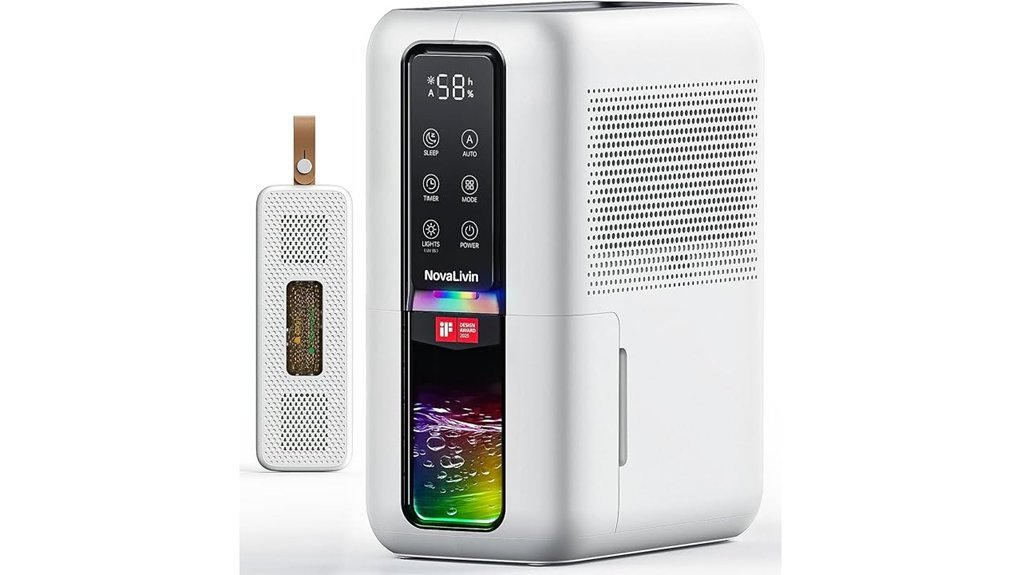
Best Quiet Bedroom Pick: The NovaLivin 68 oz dehumidifier is a balanced choice for buyers who want more tank capacity than the smallest model without moving to the largest unit. The listing includes dual semiconductor cooling, automatic humidity control, full-tank shutoff, two speeds, and a seller-listed 30 dB sleep mode.
The product details list coverage up to 320 square feet and 65-watt operation. The seller also advertises daily moisture removal under hot, highly humid test conditions, but different parts of the listing show different extraction figures. Treat those numbers as ideal-condition estimates rather than guaranteed everyday performance, and verify results with a separate hygrometer.
Why You’ll Like It: It offers a useful middle ground between portability, tank size, quieter operation, and automatic controls.
Best For: Bedrooms, small living rooms, bathrooms, closets, and buyers who want a quieter sleep mode.
Who Should Avoid This: Buyers who need advertised continuous drainage, a clearly standardized capacity rating, or dependable control of a very damp room.
Pros:
- 68 oz tank reduces emptying compared with smaller desktop models.
- Seller-listed 30 dB sleep mode suits noise-sensitive rooms.
- Automatic humidity control and full-tank shutoff simplify operation.
Cons:
- The supplied listing does not advertise an included drain hose for continuous operation.
- The listing presents inconsistent daily extraction figures.
- The broad coverage claim should not be treated as equivalent to a standardized compressor-dehumidifier capacity rating.
TENKER Dehumidifier for Home with 77 oz Water Tank
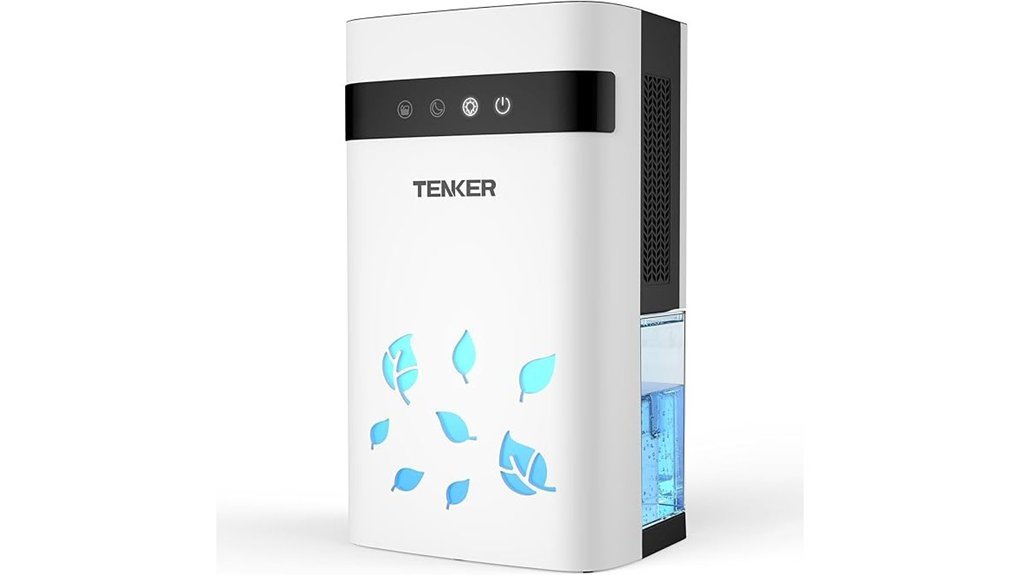
Best Larger-Tank Portable Pick: The TENKER model steps up to a 77 oz tank while remaining portable enough for bedrooms, bathrooms, closets, and RVs. The listing includes two operating speeds, a low-noise sleep mode, full-tank shutoff, a removable tank, and seven-color lighting.
The product title advertises coverage up to 1,000 square feet, while the product-detail field lists 800 square feet. Because those figures conflict and no standardized pints-per-day rating is provided in the article, treat TENKER as a compact unit for enclosed rooms and judge performance with a separate hygrometer after installation.
Why You’ll Like It: The larger tank and quiet mode reduce two common annoyances: frequent emptying and nighttime noise.
Best For: Bedrooms, bathrooms, RVs, and buyers who want a bigger manual tank than the 44 oz or 68 oz options.
Who Should Avoid This: Buyers who need advertised continuous drainage, verified large-room performance, or a high-capacity basement dehumidifier.
Pros:
- 77 oz tank offers more runtime between manual emptying.
- Sleep mode is advertised below 30 dB.
- Auto shutoff helps prevent tank overflow.
Cons:
- The listing does not advertise a continuous-drain option.
- The 1,000-square-foot title claim conflicts with the 800-square-foot product-detail field.
- The taller body takes more space than the 44 oz compact model.
UBBO 95 oz Dehumidifier with Drain Hose and Timer
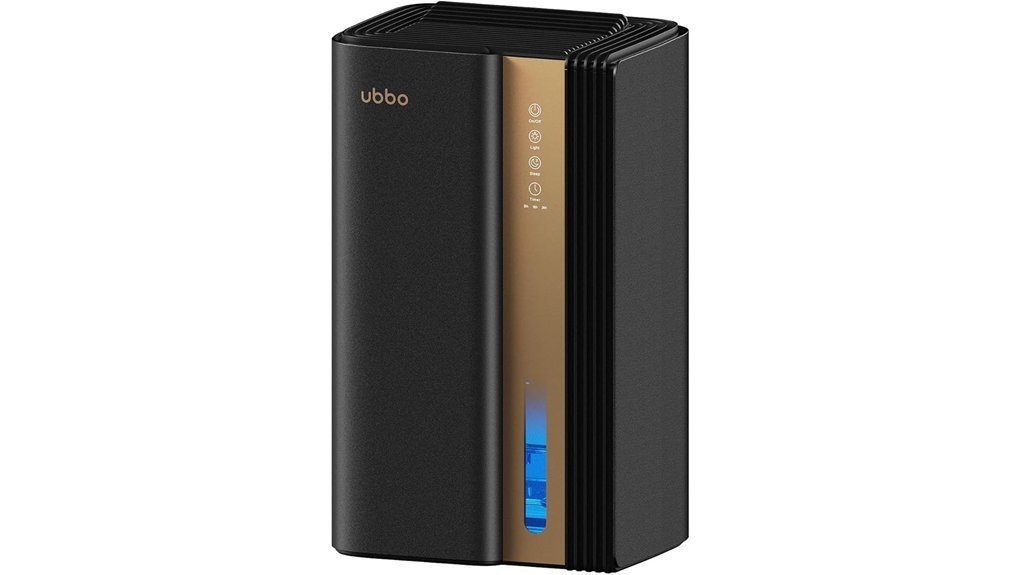
Best for Continuous Drainage: The UBBO 95 oz dehumidifier is the most convenient option in this group for buyers who want less manual tank handling. Its standout feature is the included drain hose, which allows continuous drainage when the unit is positioned above a suitable drain. It also offers 8-, 16-, and 24-hour timer choices, auto shutoff, a filter, sleep mode, and a seller-listed 35 dB operating level.
The seller advertises up to 1.2 liters of moisture removal per day under warm, highly humid test conditions and coverage up to 1,000 square feet. Those figures are ambitious for a compact semiconductor design, so real-world performance should be evaluated by room temperature, humidity, airflow, and the amount of moisture entering the space. The aromatherapy box is a scent feature, not an air-purification system.
Why You’ll Like It: Continuous drainage, the largest tank in this roundup, and flexible timer settings make it the easiest model here to run with less daily attention.
Best For: Bedrooms, bathrooms, RVs, closets, and other enclosed spaces where a suitable gravity drain connection is available.
Who Should Avoid This: Buyers expecting a compact unit to solve flooding, structural dampness, or severe basement moisture.
Pros:
- 95 oz tank is the largest among the four retained products.
- Included drain hose supports continuous drainage.
- Timer, sleep mode, auto shutoff, and a filter improve convenience.
Cons:
- Advertised coverage may overstate performance in cooler or very damp rooms.
- Continuous drainage requires correct placement, a secure hose connection, and an uninterrupted downward path to a drain.
- The aromatherapy feature adds scent but should not be treated as air cleaning.
Factors to Consider When Choosing Small Dehumidifiers for Home
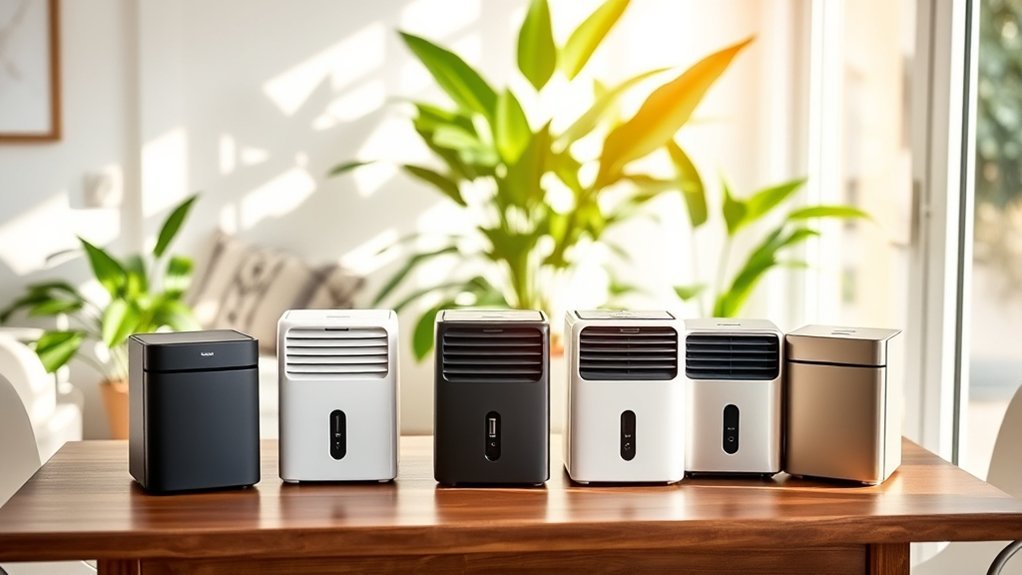
A compact dehumidifier can help with mild moisture in a closed room, but the right choice depends on more than tank size. Compare the extraction method, room temperature, starting humidity, drainage, controls, and maintenance needs before relying on a large square-foot claim. Fix leaks, improve bathroom or laundry ventilation, and reduce incoming moisture whenever possible because a small appliance cannot correct a building or drainage problem at the source.
Size and Portability
Choose a compact model when floor or shelf space is limited. The 44 oz unit is the easiest to move, while the 77 oz and 95 oz models trade some portability for longer runtime between tank checks. Check the current product dimensions before buying and leave the manufacturer-recommended clearance around the air intake and exhaust.
Water Tank Capacity and Drainage
Tank capacity affects how often you need to empty the unit, but it does not show how quickly the machine removes moisture. A 95 oz tank can run longer before filling than a 44 oz tank, yet actual emptying frequency depends on humidity, temperature, and extraction rate. For lower-maintenance operation, a properly installed continuous drain hose is more useful than tank size alone.
Dehumidification Capacity and Room Coverage
Daily water-removal capacity is a better comparison metric than a broad square-foot claim. Seller figures are often measured in warm, highly humid test conditions, so performance may drop in cooler rooms. If the room has persistent condensation, musty odors, visible damp patches, or water seepage, consider a compressor dehumidifier with a standardized pints-per-day rating instead of a small semiconductor unit.
Power Use and Energy Efficiency
Do not assume every small dehumidifier is independently certified as energy efficient. Compare stated wattage with seller-listed moisture removal, timer controls, and automatic cycling. None of the supplied product sections provides a verified ENERGY STAR Integrated Energy Factor rating, so these models should not be presented as ENERGY STAR-certified or compared by wattage alone.
Noise Level Considerations
For bedrooms and offices, look for a clearly stated sleep-mode noise level. The 68 oz model is advertised at 30 dB, TENKER lists below 30 dB in sleep mode, and UBBO lists 35 dB. These are seller-stated figures, and perceived noise can vary with surface vibration, fan speed, and room acoustics.
Controls and Safety Features
Full-tank auto shutoff is important because it stops collection when the reservoir is full. Auto defrost can help a unit continue operating in cooler conditions, while timers limit runtime. These features reduce monitoring but do not replace correct placement, regular cleaning, leak checks, or the manufacturer’s instructions.
Humidity Control Settings
A user-selectable humidistat is more useful than decorative lighting because it can cycle the unit around a chosen humidity target. However, a listing that says “automatic humidity control” may not always provide a clearly selectable percentage. Use a separate hygrometer to confirm the actual room humidity, especially when coverage or extraction figures are inconsistent. A common indoor target is roughly 30% to 50% relative humidity, adjusted for climate, comfort, and condensation.
Design and Aesthetics
Lighting and modern styling can make a small unit easier to place in a bedroom, but they should remain secondary to drainage, tank access, noise, and extraction performance. Choose a model with controls you can read easily and lights that can be turned off or locked for nighttime use.
Maintenance and Cleaning Requirements
Empty and rinse the tank regularly, clean washable filters as directed, wipe dust from the air vents, and inspect the drain hose for kinks or buildup. Let the tank dry before storage. Regular maintenance helps reduce odors and keeps airflow from dropping over time.
Before You Buy Checklist
- Measure the enclosed room rather than the entire floor.
- Check whether the problem is mild humidity or active water intrusion.
- Fix leaks and improve ventilation before relying on a compact unit.
- Confirm tank size, drain-hose support, and an available gravity-drain location.
- Compare sleep-mode noise if the unit will run near a bed or desk.
- Use a hygrometer to verify that humidity is actually falling toward your target.
- Choose a larger compressor model when dampness is severe or persistent.
Frequently Asked Questions
How Often Should I Empty the Dehumidifier’s Water Tank?
Check the tank at least once a day during the first week of use. The actual schedule may range from several times a day to every few days depending on tank size, room humidity, temperature, and how long the unit runs. Do not rely only on a fixed schedule; use the full-tank indicator and inspect the reservoir regularly.
Are Small Dehumidifiers Energy-Efficient?
They often use less power than large compressor models, but lower wattage does not automatically mean better efficiency. True efficiency compares the amount of water removed with the electricity consumed. Check wattage, extraction capacity, runtime controls, and any verified efficiency certification before comparing operating costs.
Can I Use a Small Dehumidifier in a Basement?
You can use one in a small, mildly damp basement area, but compact semiconductor models are usually not the best choice for a cold, wet, or large basement. For persistent dampness, visible water, or a musty smell across the room, use a properly sized compressor dehumidifier and fix leaks, grading, gutters, or drainage problems at the source.
What Maintenance Do Small Dehumidifiers Require?
Empty and rinse the reservoir, clean or replace the filter according to the manual, remove dust from vents, check the power cord, and inspect any drain hose. Unplug the unit before cleaning and allow wet parts to dry before reassembly or storage.
How Loud Are Small Dehumidifiers During Operation?
The models in this guide advertise sleep-mode levels from below 30 dB to about 35 dB. Actual sound can be higher on faster settings or when the unit vibrates against a hard surface. Place it on a stable, level surface and keep the air openings clear.
Do Small Dehumidifiers Clean the Air?
Their main job is moisture removal. A basic filter may catch some larger dust particles, but these units should not be presented as substitutes for a dedicated air purifier. Aromatherapy features add scent and do not remove fine particles, smoke, gases, or allergens.
Can I Trust a 1,000-Square-Foot Coverage Claim on a Compact Dehumidifier?
Treat it as a seller-stated maximum, not a promise that the unit will control humidity throughout a 1,000-square-foot home. A compact semiconductor dehumidifier may help in a smaller enclosed zone within that area, but open doors, cool temperatures, high moisture loads, and poor airflow can reduce performance. Compare daily extraction information when available and confirm the result with a hygrometer.
Which Small Dehumidifier Is Best for Continuous Use?
The UBBO is the most convenient option in this roundup when you can connect its included hose to a suitable drain. For manual tank use, choose the largest tank that still fits your space and check it regularly until you understand how quickly it fills.
Conclusion
The best small dehumidifier depends on the enclosed room, the moisture load, and how much maintenance you want. Choose the NeedDuck 44 oz for maximum portability, the NovaLivin 68 oz for a seller-listed quiet sleep mode, the TENKER 77 oz for a larger manual tank, or the UBBO 95 oz when continuous drainage matters most. Treat seller coverage numbers as rough guidance, verify results with a hygrometer, and move to a higher-capacity compressor unit when moisture is severe or persistent.
Final Recommendation: Choose the UBBO 95 oz when a suitable drain is available and minimizing manual tank emptying is the priority. Choose the NeedDuck 44 oz when compact size and easy portability matter most, the NovaLivin 68 oz for bedroom-focused quiet operation, or the TENKER 77 oz when you prefer a larger manual tank.