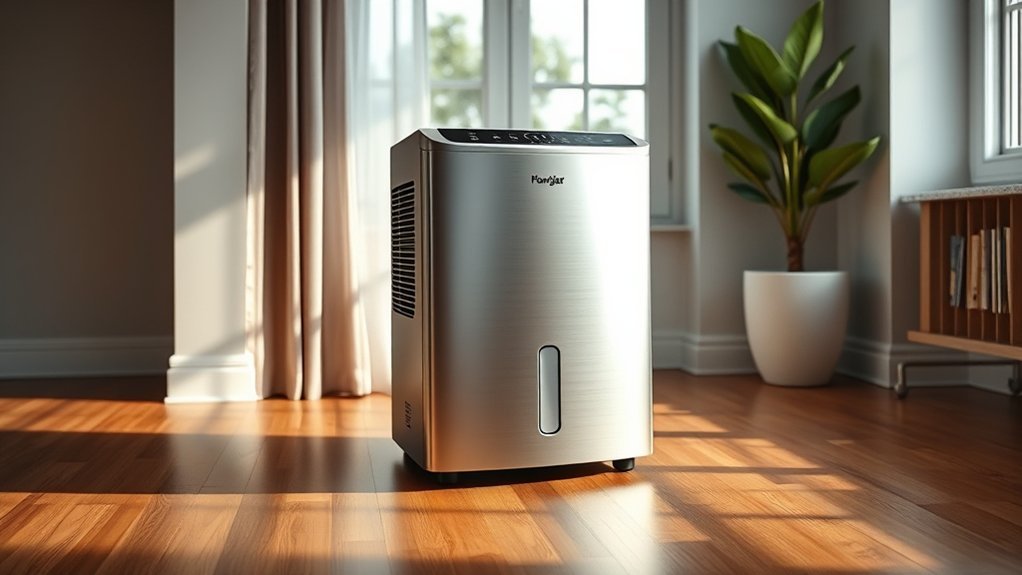
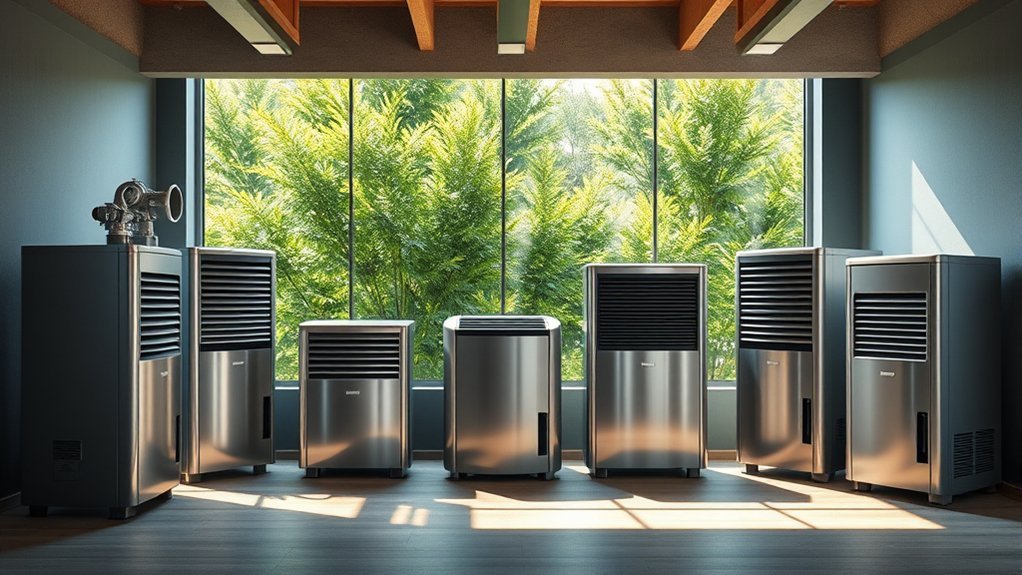
If you need dependable humidity control for a crawl space, basement, storage area, restoration job, or other light commercial setting, focus on a dehumidifier’s AHAM-rated capacity, drainage setup, airflow, operating temperature range, and installation needs—not only the largest advertised pint number. The four models below match this buyer intent, but they serve different space sizes and drainage requirements.
Affiliate disclosure: As an Amazon Associate, we may earn from qualifying purchases. Product specifications, sellers, and availability can change, so confirm the current Amazon listing and manufacturer instructions before buying.
Quick Answer
Best overall for flexible drainage: The HBN 125-Pint model combines a built-in pump, gravity drainage, automatic defrost, a timer, and broad humidity settings. Best compact option: The ALORAIR Sentinel HD55 is easier to position in crawl spaces and smaller commercial areas. Best for high airflow: The Dkenicor 145-Pint model lists 265 CFM airflow and caster mobility. Best for smaller areas: The VEVOR 70-Pint model is designed for spaces up to 1,000 square feet and includes pump drainage.
Key Takeaways
- Compare AHAM capacity when possible. Saturation ratings are measured in hotter, wetter conditions and usually look much higher.
- A pump is useful when water must travel upward or across a longer distance; gravity drainage needs a continuously downward-sloping hose.
- Coverage claims are estimates. Temperature, starting humidity, air leakage, ceiling height, and the moisture source can change real-world performance.
- These are commercial-style refrigerant dehumidifiers for basements, crawl spaces, storage rooms, restoration work, and light industrial areas—not engineered process-drying systems for every factory application.
Quick Comparison
| Model | Stated Capacity | Listed Coverage | Drainage | Best For | Check Details |
|---|---|---|---|---|---|
| HBN 125-Pint | 125 PPD saturation; 60 PPD AHAM | Up to 5,900 sq. ft. | Built-in pump or gravity hose | Large spaces needing flexible drainage | Check Availability |
| Dkenicor 145-Pint | 145 PPD saturation; 70 PPD AHAM | Up to 6,000 sq. ft. | Continuous drain hose | High airflow and movable floor use | Check Availability |
| ALORAIR Sentinel HD55 | 113 PPD saturation; 53 PPD AHAM | Up to 1,200 sq. ft. | Gravity drain hose | Compact crawl spaces and basements | Check Availability |
| VEVOR 70-Pint | 70 PPD saturation; 35 PPD AHAM | Up to 1,000 sq. ft. | Built-in pump with two hoses | Smaller crawl spaces and storage rooms | Check Availability |
ALORAIR 113 Pint Commercial Dehumidifier (Sentinel HD55)
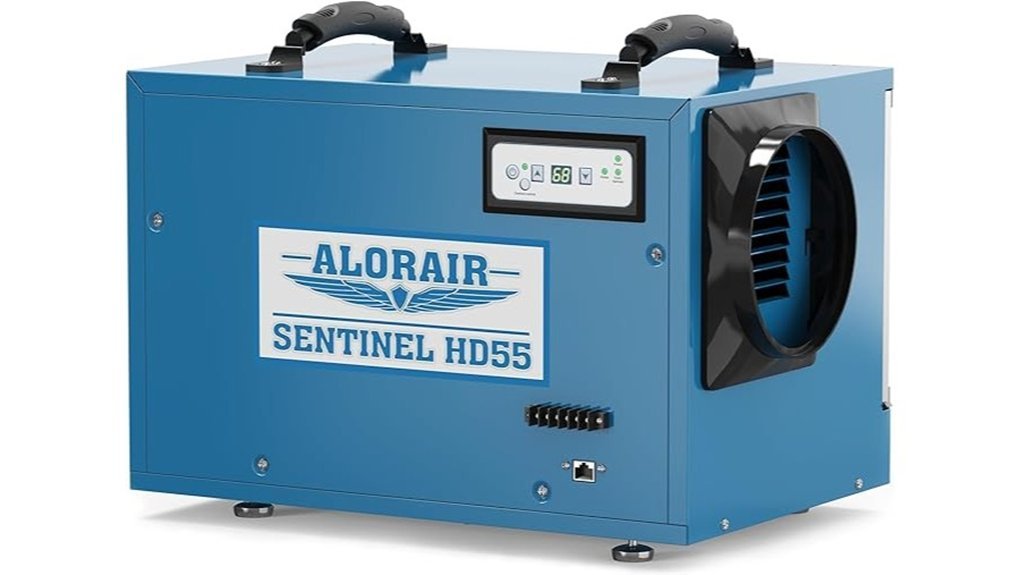
Best Compact Pick: The ALORAIR Sentinel HD55 is a practical choice for crawl spaces, basements, storage areas, and smaller commercial rooms where a low-profile metal unit is easier to install than a wheeled restoration machine. It is rated for 113 pints per day at saturation and 53 pints per day under AHAM conditions, with listed coverage up to 1,200 square feet.
Its 120 CFM airflow, automatic defrost, restart memory, washable filter protection, and continuous gravity drainage support unattended humidity control. Because this version relies on gravity drainage rather than a built-in pump, the hose must run downhill to a suitable drain.
Who Should Buy This: Buyers who need a compact commercial-style dehumidifier for a crawl space, basement, office, shop, or storage room with access to a low drain.
Who Should Avoid This: Buyers who need upward pump drainage, restoration-class mobility, or substantially more AHAM capacity.
Pros:
- Compact footprint and carrying handle suit low-clearance spaces.
- Automatic defrost and restart memory support continuous operation.
- Gravity drainage removes the need to empty a collection tank.
- Long limited warranty is a useful trust factor, subject to the manufacturer’s terms.
Cons:
- No built-in condensate pump on this version.
- Lower AHAM capacity than the larger models in this guide.
- Coverage depends on site conditions and should not be treated as a guarantee.
Dkenicor 145 Pints Commercial Dehumidifier
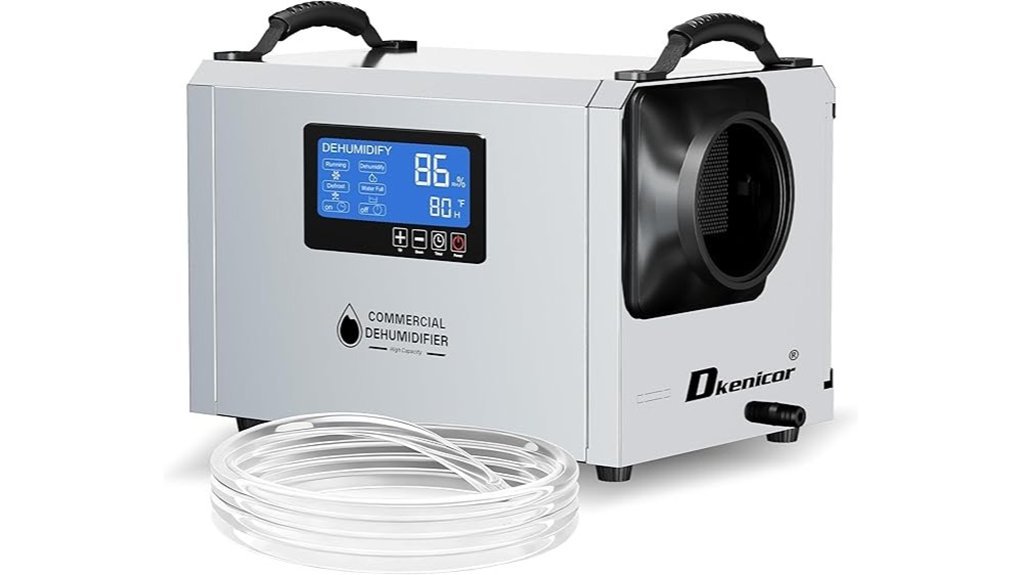
Best High-Airflow Pick: This Dkenicor commercial dehumidifier is listed at 145 pints per day under saturation conditions and 70 pints per day under AHAM conditions. Its stated 265 CFM airflow is useful when faster air movement matters in a large basement, crawl space, restoration area, or other open commercial setting.
The listing describes automatic humidity control, a 24-hour timer, auto defrost, continuous drainage, a 50-pound weight, and four casters. Those features make it easier to move across a floor than a fixed crawl-space unit. The advertised coverage is up to 6,000 square feet, but real performance will depend heavily on temperature, humidity, air leakage, and the moisture source.
Who Should Buy This: Buyers prioritizing airflow, high AHAM capacity, and caster mobility with access to a suitable continuous drain.
Who Should Avoid This: Buyers who require a verified built-in pump or need a small unit for a tight joist bay.
Pros:
- Highest listed AHAM capacity among the retained models.
- 265 CFM airflow supports quicker air circulation.
- Casters and a 50-pound listed weight improve floor-level mobility.
- Timer, auto defrost, and humidity control reduce routine supervision.
Cons:
- The listing’s large coverage claim should be treated as an estimate, not a guaranteed result.
- Continuous drainage requires correct hose routing and a suitable drain.
- At 650 watts, operating cost may be higher than with lower-capacity units.
HBN 125-Pint Crawl Space Dehumidifier with Pump
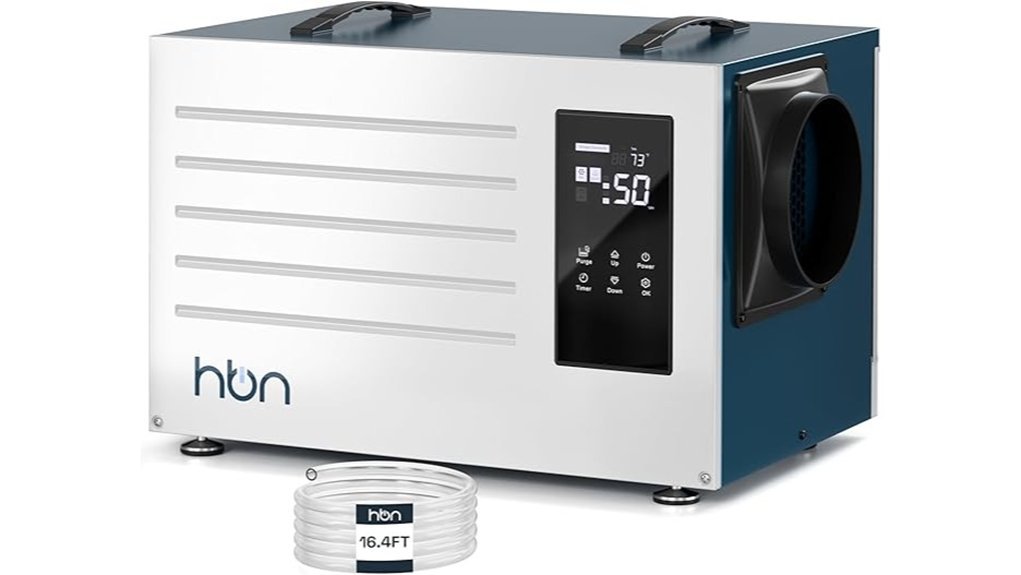
Best Overall for Flexible Drainage: The HBN 125-Pint model combines 60 pints per day under AHAM conditions with a built-in pump, gravity drainage, automatic defrost, restart memory, a touchscreen, and a 24-hour timer. The listing states a maximum capacity of 125 pints per day at 95°F and 90% relative humidity and coverage up to 5,900 square feet.
The built-in pump can move condensate upward when a floor drain is not nearby, while the gravity hose provides a simpler option when the drain is below the unit. Adjustable humidity control from 10% to 90% RH gives the operator a broad setting range, although most occupied spaces should generally be managed within a practical, building-appropriate humidity target.
Who Should Buy This: Buyers managing a large crawl space, basement, warehouse, garage, or workshop where pump drainage and automated controls are valuable.
Who Should Avoid This: Buyers who only need light moisture control in a small room or who do not have a safe route for the drain hose.
Pros:
- Built-in pump and gravity hose provide flexible drainage.
- 60-pint AHAM rating offers a more useful comparison than the maximum rating alone.
- Touchscreen, timer, auto defrost, and restart memory simplify operation.
- Compact listed dimensions suit many crawl-space installations.
Cons:
- The 530-watt rating is power consumption, not product weight.
- Large-space coverage depends on the building and moisture load.
- Pump and drain lines still need regular inspection to prevent clogs or leaks.
VEVOR 70 Pints Commercial Dehumidifier with Pump
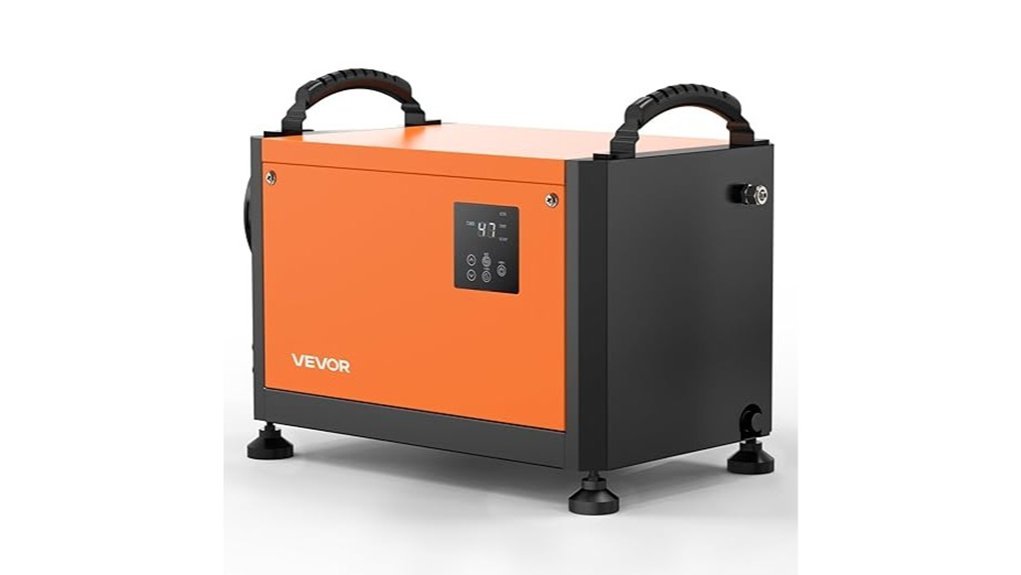
Best for Smaller Commercial Areas: The VEVOR 70-Pint model is sized for crawl spaces, basements, storage rooms, laundry areas, and light industrial spaces up to a listed 1,000 square feet. Its more comparable AHAM capacity is 35 pints per day; the 70-pint figure is measured under saturation conditions.
The unit includes a built-in pump, two drain hoses, automatic defrost, multiple operating modes, 162 CFM airflow, and a galvanized-steel housing. The listing states a 19.69-foot pump hose and a maximum lift of about 14.76 feet, which can help when the nearest drain is above the unit.
Who Should Buy This: Buyers who need pump drainage and commercial-style construction for a smaller crawl space, storage room, or basement zone.
Who Should Avoid This: Buyers drying a large open warehouse, severe flood-loss site, or space that needs more than 35 pints per day at AHAM conditions.
Pros:
- Built-in pump supports upward or longer-distance drainage.
- Compact dimensions fit many crawl-space and basement layouts.
- Auto, Dry, Sleep, and defrost modes provide flexible control.
- Lower rated power than the larger retained models.
Cons:
- 35-pint AHAM capacity may be too low for severe moisture loads.
- At about 56.6 pounds, it is not a lightweight room dehumidifier.
- Ceiling installation requires secure mounting and strict use of the supplied instructions.
Factors to Consider When Choosing a Commercial or Light-Industrial Dehumidifier
Choosing the right unit requires more than matching a pint number to square footage. Use the following factors to compare dehumidifiers for crawl spaces, basements, warehouses, storage areas, workshops, and restoration jobs.
Compare AHAM and Saturation Capacity
Maximum or saturation capacity is measured in hot, extremely humid air, so it can make a dehumidifier appear much stronger than it will be in normal conditions. When available, compare the AHAM-rated pints per day because that figure uses a standardized temperature and humidity condition. Do not directly compare one model’s saturation rating with another model’s AHAM rating.
Estimate the Real Moisture Load
Square footage is only a starting point. Consider ceiling height, current relative humidity, outdoor air leakage, groundwater vapor, standing water, wet materials, laundry or process moisture, and how quickly the area must dry. A flood-restoration job may require more capacity and airflow than routine humidity maintenance in a sealed crawl space of the same size.
Check Airflow and Layout
Airflow, measured in CFM, affects how quickly moist air reaches the coil. Higher airflow can help in open areas, while a compact low-profile unit may work better between joists or in narrow crawl spaces. Long rooms, divided areas, closed doors, and blocked return paths may require ducting, air movers, or more than one unit.
Choose the Right Drainage System
Gravity drainage is simple and dependable when the hose can slope downward to a floor drain or sump. A built-in pump is more flexible when water must move upward, through a window, or across a longer route. In either case, secure the hose, prevent kinks, check the lift limit, and inspect the line regularly.
Review Operating Temperature
Refrigerant dehumidifiers lose capacity as temperatures fall and may need automatic defrost to prevent coil icing. Check the manufacturer’s operating range before installing a unit in a cold crawl space, unheated warehouse, or winter job site. Very cold process spaces may need a desiccant dehumidifier instead.
Compare Efficiency Correctly
Rated wattage alone does not show efficiency. A larger machine may use more power but remove more moisture per hour. Compare liters per kilowatt-hour, pints per kilowatt-hour, or another published efficiency metric under the same test conditions. Do not assume a product is ENERGY STAR certified unless the exact model is listed as certified.
Plan Installation and Maintenance
Confirm the unit’s dimensions, weight, electrical requirements, clearances, filter access, drain route, and service access before buying. Clean or replace filters as directed, keep coils and air openings clear, inspect hoses and pump components, and follow the manual for shutdown, storage, and low-temperature use.
Before You Buy Checklist
- Measure the installation opening, not only the room.
- Identify whether the drain is below or above the unit.
- Compare AHAM capacity and airflow.
- Confirm voltage, circuit requirements, and operating temperature.
- Check filter, hose, pump, and warranty terms.
- Verify the current seller and exact model on Amazon before ordering.
Frequently Asked Questions
What Is the Difference Between AHAM and Saturation Pints?
AHAM capacity is measured under a standardized moderate temperature and humidity condition. Saturation capacity is measured in much hotter and wetter air. The saturation number is usually higher, so use AHAM figures when comparing models whenever possible.
How Do I Calculate the Required Dehumidification Capacity for My Space?
Start with the space size, temperature, current humidity, desired humidity, ceiling height, air leakage, and moisture source. Then consider whether you are maintaining humidity or drying wet materials. For severe water intrusion or process moisture, a restoration professional or HVAC engineer can perform a more reliable load calculation.
What Maintenance Is Needed for Commercial Dehumidifiers?
Inspect and clean the filter, air intake, coil area, drain hose, and pump system at the intervals in the manual. Check for kinks, leaks, dust buildup, unusual noise, or reduced water output. Disconnect power before maintenance and use only approved replacement parts.
Can Refrigerant Dehumidifiers Operate in Low Temperatures?
Many can operate in cooler spaces when they have automatic defrost, but moisture-removal capacity usually falls as temperature drops. Confirm the exact operating range. For consistently cold environments, a desiccant system may be more suitable.
How Long Do Commercial Dehumidifiers Typically Last?
Service life varies with runtime, temperature, dust, maintenance, drainage problems, electrical conditions, and parts support. Regular filter and drain maintenance can reduce avoidable wear, but no fixed lifespan applies to every installation.
Are Dehumidifiers Energy-Efficient for Large Spaces?
They can be efficient when correctly sized and compared under the same test conditions. An undersized unit may run constantly without reaching the target humidity, while an oversized unit may cost more than necessary. Compare AHAM output, airflow, and moisture removed per kilowatt-hour when those figures are available.
Conclusion
For most buyers, the best choice depends on AHAM capacity, drainage, airflow, and installation space. The HBN is the most flexible option when pump drainage is important, the Dkenicor emphasizes airflow and caster mobility, the ALORAIR fits tighter crawl-space installations, and the VEVOR suits smaller commercial areas. Verify the current listing, test conditions, electrical requirements, and drain route before ordering so the selected unit matches the actual moisture load rather than only the advertised maximum pint rating.