
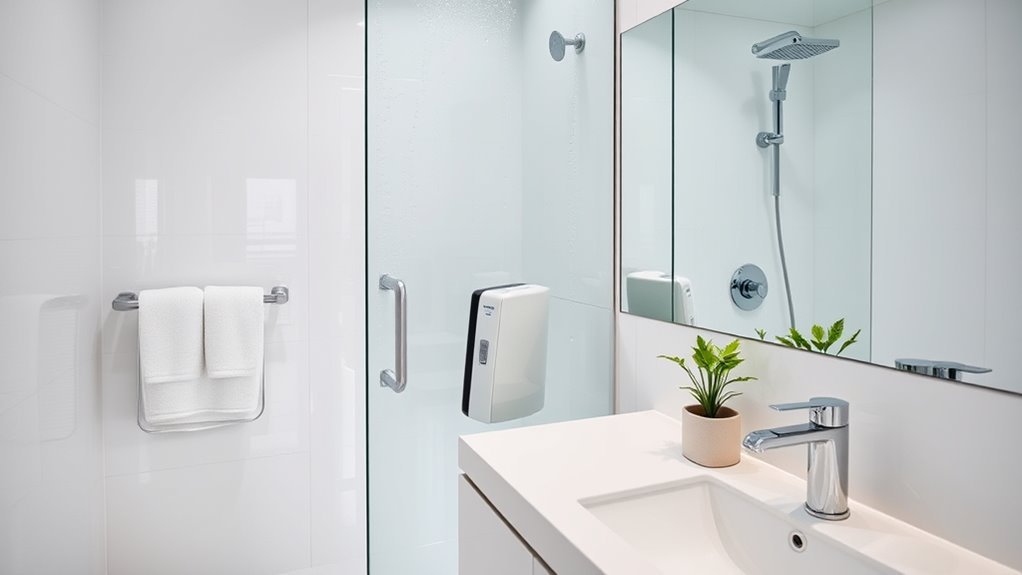
Choosing the right bathroom dehumidifier size starts with sustained humidity and moisture load, not square footage alone. ENERGY STAR’s current portable-dehumidifier guide recommends 20–30 pints per day for a small-to-medium space that is slightly to moderately damp at about 50–75% relative humidity, 25–40 pints per day for very damp conditions around 75–90% RH, and 30–50 pints per day for wet conditions around 90–100% RH. Those are general room-sizing ranges, not bathroom-specific rules. If an outdoor-vented bathroom fan clears the room and humidity returns toward the normal indoor range after use, you may not need a dehumidifier at all.
By [VERIFY: add real author/byline] · Last updated August 19, 2026 · Reviewed against EPA, ENERGY STAR, HVI, CPSC, NIEHS, and manufacturer guidance.
Quick Answer
If your bathroom stays damp between uses, size the dehumidifier by its sustained relative humidity. ENERGY STAR’s current small-to-medium-room guidance starts at 20–30 pints/day for 50–75% RH, 25–40 pints/day for 75–90% RH, and 30–50 pints/day for 90–100% RH. A short humidity spike during a shower does not automatically mean you need a larger unit. Check the exhaust fan first, and only use a portable dehumidifier in a bathroom location permitted by its manufacturer.
Key Takeaways
- EPA guidance says indoor relative humidity should stay below 60% and ideally around 30–50% when possible.
- A bathroom exhaust fan that vents outdoors is the first line of moisture control; HVI recommends running it during use and for about 20 minutes afterward.
- Size a dehumidifier from sustained humidity between bathroom uses, not the temporary RH spike that occurs during a hot shower.
- For a small-to-medium space, ENERGY STAR recommends 20–30 pints/day at 50–75% RH, 25–40 pints/day at 75–90% RH, and 30–50 pints/day at 90–100% RH.
- A GFCI helps reduce shock risk but does not override the appliance manual. Use the dehumidifier only where the manufacturer permits it, away from splash and pooling-water hazards.
At a Glance
| Time Required | 10 minutes to measure and record humidity; several normal bathroom uses to confirm whether dampness persists between showers |
| Difficulty | Easy |
| Tools Needed | Tape measure, hygrometer, appliance manual, and a manufacturer-approved power and drainage setup |
| Main Sizing Inputs | Sustained RH, lingering condensation, ventilation performance, shower frequency, room size, temperature, and drainage needs |
What Size Dehumidifier Does Your Bathroom Need?
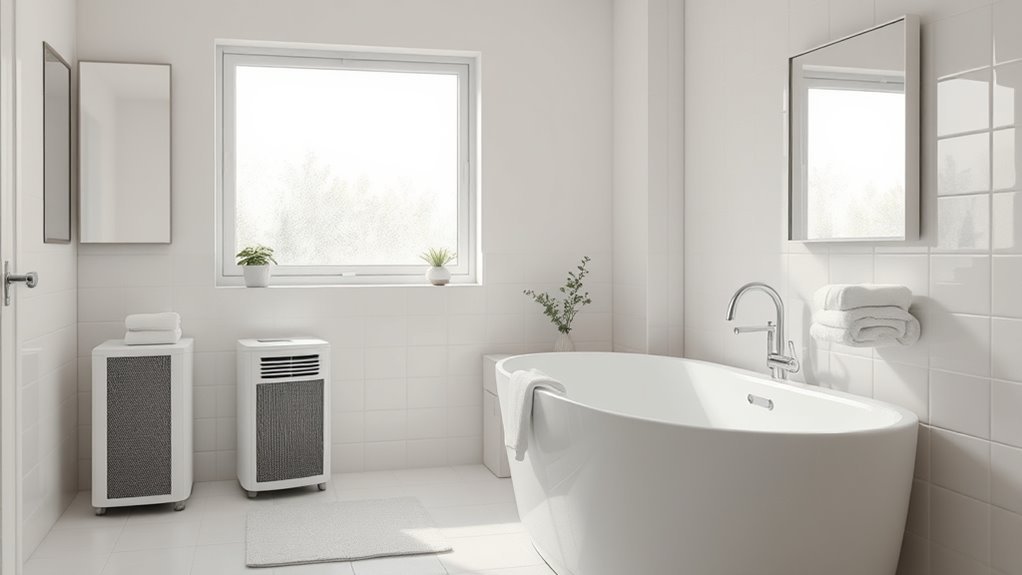
For a bathroom that remains damp between uses, start with the room’s actual humidity rather than an arbitrary bathroom square-footage rule. According to ENERGY STAR, dehumidifier capacity is measured in pints of water removed per 24 hours, and the required capacity depends on both the size of the space and how damp it is. For a small-to-medium space under its current sizing chart, ENERGY STAR recommends 20–30 pints/day for slightly to moderately damp conditions, 25–40 pints/day for very damp conditions, and 30–50 pints/day for wet conditions.
Pint capacity is not tank size. A 30-pint dehumidifier is rated to remove up to a specified amount of moisture over 24 hours under test conditions; its collection bucket may hold far less water before it must be emptied.
The goal is not to make the bathroom bone dry. The EPA recommends keeping indoor relative humidity below 60% and ideally between 30% and 50% when possible. A temporary rise during a shower is expected. The more useful warning sign is humidity, condensation, or musty air that remains after ventilation has run or returns between bathroom uses.
Note: Newer dehumidifiers may show lower pint ratings than older models because the U.S. Department of Energy changed portable dehumidifier testing conditions in 2019. The current procedure tests portable units at 65°F instead of 80°F. ENERGY STAR gives rough old-to-new comparisons, but the exact change varies by model.
Quick Bathroom Dehumidifier Sizing Method
Use this method before you buy. Measure the bathroom, record its humidity before and after a normal shower, run the outdoor-vented exhaust fan during the shower and for about 20 minutes afterward, then check whether humidity and wet surfaces continue to linger. If the bathroom stays damp between uses, match its sustained RH to the capacity ranges in the next section. Also check the dehumidifier manual before planning to operate the appliance inside the bathroom.
| If you see this | What it means | Sizing move |
|---|---|---|
| Humidity is trending back toward the normal indoor range after the fan’s post-shower runtime and wet surfaces are drying | Source ventilation may already be controlling the shower moisture | Keep monitoring; a dedicated bathroom dehumidifier may not be necessary |
| Humidity remains elevated between bathroom uses | The room has a sustained moisture load rather than only a temporary shower spike | Match the sustained RH to the ENERGY STAR capacity ranges below |
| Musty odor, recurring mildew, active leaks, water pooling, or persistently wet walls or ceilings | The bathroom may have a ventilation, plumbing, condensation, or building-moisture problem | Fix the moisture source first, then size supplemental dehumidification if it is still needed |
Check Bathroom Size and Humidity First
Start by measuring the bathroom. Multiply length by width to get square footage, but treat that number as only one input. In a bathroom, shower frequency, ventilation, temperature, wet towels, and how long moisture remains after use can matter more than the difference between two small floor areas.
- Measure the room’s square footage.
- Place a hygrometer away from direct shower spray.
- Record the humidity before a normal shower.
- Run the outdoor-vented exhaust fan during the shower and for about 20 minutes afterward, then record the RH again.
- Check the humidity later, before the next bathroom use, to see whether damp conditions persist between showers.
If the room steadily returns toward the rest of the home’s normal humidity and surfaces dry, ventilation may already be enough. If the bathroom remains above the desired indoor range between uses, feels damp for much of the day, or repeatedly develops musty odors, supplemental dehumidification becomes more useful.
Match Pint Capacity to Bathroom Size
Most residential bathrooms fall well inside ENERGY STAR’s broad “small-to-medium room” category, so room square footage alone does not create a reliable bathroom-specific pint rating. Use sustained RH to choose the initial capacity range, then size toward the higher end when the bathroom is larger, shared by several people, poorly ventilated, windowless, or used for frequent long showers.
| Condition without dehumidification | ENERGY STAR small-to-medium-room range | Bathroom interpretation |
|---|---|---|
| Slightly to moderately damp, about 50–75% RH | 20–30 pints/day | Good starting range when dampness persists between uses but there is no active water problem |
| Very damp, about 75–90% RH | 25–40 pints/day | Consider the upper part of the range for frequent showers, weak ventilation, or a larger bathroom |
| Wet conditions, about 90–100% RH | 30–50 pints/day | Investigate leaks, ventilation, drainage, or persistent condensation before relying on a larger portable unit |
These are general portable-dehumidifier sizing ranges, not a special bathroom standard. A small bathroom with a strong exhaust fan may need no dehumidifier, while another bathroom of the same size may need supplemental moisture removal because its humidity remains high between uses.
Ventilation Matters Before Dehumidification
A bathroom dehumidifier works best as supplemental moisture control, not as a replacement for correctly installed exhaust ventilation. A bathroom fan removes humid air at the source before that moisture spreads into walls, ceilings, cabinets, and nearby rooms.
The Home Ventilating Institute recommends at least 50 CFM for bathrooms 50 square feet and smaller, about 1 CFM per square foot for bathrooms from 50 to 100 square feet, and fixture-based sizing for larger bathrooms. The fan should vent outdoors, not into an attic, crawlspace, garage, or wall cavity.
A dehumidifier removes moisture that remains in the room. A properly vented exhaust fan attacks shower moisture at the source.
Run the fan during bathing and keep it on for about 20 minutes afterward. A timer switch or humidity-sensing fan can make that easier, especially in a shared bathroom.
Choose the Best Bathroom Dehumidifier Type
Most normally heated rooms use compressor or refrigerant dehumidifiers. If the bathroom or nearby area is routinely cool, check the appliance’s minimum operating temperature rather than assuming every compressor model will perform the same. ENERGY STAR advises shoppers to look for a unit specified for lower temperatures when the space regularly falls below 65°F.
A desiccant dehumidifier can be an option for cooler spaces because its moisture-removal process does not depend on a refrigerated coil in the same way. However, energy use, heat output, capacity ratings, and manufacturer instructions differ, so compare the specific model rather than choosing by technology alone.
| Type | Best for | Watch out for |
|---|---|---|
| Compressor / refrigerant | Most normally heated indoor spaces | Check minimum operating temperature and defrost capability in cool rooms |
| Desiccant | Cooler spaces where a specific model is approved and suitable | Energy use, heat output, and different capacity specifications |
| Mini thermo-electric | Very light moisture loads in tiny spaces | Much lower moisture-removal rate than a full-size compressor unit |
Recommended Products

Semiconductor dehumidifiers use thermoelectric cooling to remove moisture from the air. They create a drier, more comfortable environment by reducing humidity and improving air quality.

Quiet & High-Efficiency Dehumidifier: Adopting next-generation semiconductor cooling technology, efficient moisture removal while maintaining ultra-low noise operation. Stable humidity levels are maintained, making your home environment more comfortable and pleasantly dry.

2500 Sq. Ft High-Efficiency Dehumidifier – The KNKA basement dehumidifier features a quiet, high-performance compressor that removes up to 34 pints of moisture per day (at 95°F, 90% RH). Ideal for basements, offices, bathrooms, bedrooms, kitchens, stockrooms, living rooms, laundry rooms, garages, crawlspaces, or RVs. It helps maintain optimal humidity between 50%–70% for healthier, more comfortable living
Bathroom Dehumidifier Features That Matter
The right pint rating matters, but location approval, moisture control, drainage, and airflow matter just as much. Check these features before buying:
- Manufacturer-approved placement: Confirm that the manual permits the location where you intend to operate the unit.
- Built-in humidistat: Lets you set a target humidity level. ENERGY STAR certified portable models include a humidistat.
- Auto shut-off: Stops the unit when its collection bucket is full.
- Continuous drain option: Useful when sustained humidity makes frequent tank emptying impractical.
- Washable or serviceable filter: Helps maintain airflow when cleaned according to the manual.
- Low noise rating: Helpful in small bathrooms, en suites, and nearby hallways.
- Compact footprint: Makes safe clearance and walking space easier to maintain.
- Low-temperature operation: Important when the bathroom or adjacent space regularly gets cool.
- Auto restart: Useful if the manufacturer provides it and you want normal operation to resume after a power interruption.
Pro Tip: A humidistat is more useful than simply running the appliance on a timer. It lets the unit cycle according to the actual RH instead of running longer than the room needs.
Recommended Products

【The Undisputed Champion — Industry-Leading Dehumidifier Brand】When you choose AEOCKY, you get double market validation. According to data independently verified by Stackline, a leading third-party data analytics company, AEOCKY was an industry‑leading dehumidifier brand on Amazon U.S. in 2025. This means you’re not just choosing a flagship product from a market leader, but a top-performing brand backed by independent market data and trusted by millions of real users, delivering the ultimate combination of performance, quality and trust.
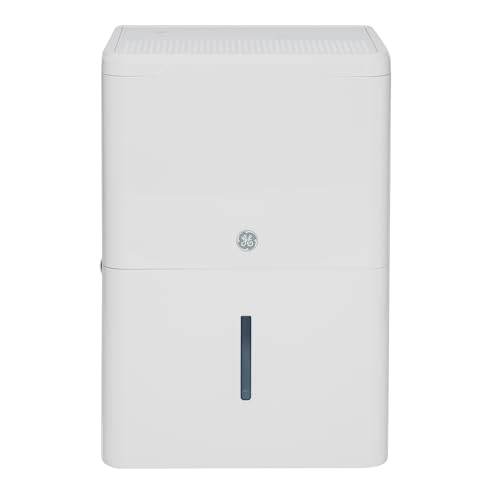
This small dehumidifier for bedroom, bathroom, basement use removes up to 25 pints of moisture per day. Perfect as a room dehumidifier for humid spaces up to 1,500 sq ft.

【High Efficient Dehumidifiers】 With dual-semiconductor technology, this dehumidifier remove up to 20 fl oz (600ml) of moisture daily in areas up to 323 sq ft.
Place the Dehumidifier Safely
Do not assume that a GFCI-protected outlet makes every portable dehumidifier suitable for use inside a bathroom. Read the appliance manual first and follow its location restrictions. If the manufacturer does not permit bathroom use, do not operate the unit inside the wet room. A practical alternative is to place it in a dry adjacent hallway or landing and leave the bathroom door open after bathing so humid air can move toward the unit.
If the manufacturer does permit the intended bathroom location, place the dehumidifier on a flat, dry, stable surface with the required clearance around the intake and exhaust. Keep it away from the tub, shower, sink splash zone, wet floors, and any location where water could reach the appliance, plug, cord, or controls.
Warning: A GFCI reduces the risk of severe electrical shock, but it is not permission to ignore the appliance manual or expose the unit to water. Never operate electrical controls with wet hands, place the dehumidifier in a shower or sink, or run cords where water can pool around them.
The U.S. Consumer Product Safety Commission explains that GFCI protection is designed to reduce the risk of severe or fatal electrical shock in vulnerable areas near water. Manufacturer restrictions remain the final authority for the dehumidifier itself. For example, the Midea Cube Dehumidifier user manual warns against placing the unit in a sink or shower and includes additional installation and electrical-safety requirements.
Humidity and Drainage
If the dehumidifier runs often, continuous drainage can reduce tank-emptying. Use continuous drainage only when the appliance manual permits it and the unit can remain in an approved, dry location with a safe hose route.
For gravity drainage, the hose generally needs a continuous downward path from the unit to the approved drain point. Follow the manufacturer’s instructions for hose diameter, length, height, fittings, and pump use. Keep drainage hoses away from electrical cords and connections, and do not route a hose or power cord where it creates a doorway or walking hazard.
For tank-only use, empty the bucket when required, clean it according to the manual, and let it dry when the unit is out of service. A dirty bucket or drain path can develop odors or buildup.
Small Bathroom Dehumidifier Sizes
A small bathroom does not automatically need a 10-pint or other miniature dehumidifier. If its exhaust fan removes shower moisture and the room dries normally, it may need no dedicated unit. If sustained humidity remains around 50–75% between uses, ENERGY STAR’s current small-to-medium-room guidance begins at 20–30 pints/day. A sub-20-pint or thermo-electric unit is better treated as a light-moisture option whose actual extraction rate must be compared with the problem you are trying to solve.
Do not assume that a tiny thermo-electric dehumidifier is equivalent to a 20- or 30-pint compressor model. Mini units can be useful for light dampness in very small spaces, but their moisture-removal rates are much lower than full-size portable units.
Recommended Products

1,500 Sq.Ft. OF COVERAGE - Midea dehumidifier with drain hose is able to collect 20 pint (Similar to 30 PT-2012 DOE) of water a day and adjust humidity from 35% to 85%, perfect for use for basement, bathroom, bedroom, or crawlspace.

Upgrade High Efficient Dehumidification: Dehumidifier utilize semi conductor condensation technology, ensuring quiet operation while effectively extracting moisture from the air. This advanced feature helps keep humidity levels below 45%

REUSABLE, ECO-FRIENDLY DESIGN: The Osmo Moisture Absorber features a refillable water tank, removing up to 44 fl oz of moisture from the air. Unlike disposable moisture absorbers such as hanging bags or crystals, our Moisture Absorber can be used over and over again, helping to reduce waste and improve your carbon footprint.
Medium Bathroom Dehumidifier Sizes
For a typical full bathroom, sustained humidity is more useful than a fixed square-footage rule. If the bathroom remains around 50–75% RH between uses, 20–30 pints/day is the current ENERGY STAR starting range for a small-to-medium room. Move toward the higher end when the bathroom has more frequent use, weaker ventilation, slower surface drying, or a larger connected air volume.
If sustained RH is closer to 75–90%, the ENERGY STAR range increases to 25–40 pints/day. Before buying a larger unit, confirm that the exhaust fan works and actually vents outdoors.
Large Bathroom Dehumidifier Sizes
Large primary bathrooms, spa-style bathrooms, wet rooms, soaking-tub areas, and bathrooms used by several people can create a heavier moisture load. If sustained humidity is 75–90%, use the 25–40-pint ENERGY STAR range as the starting point. Conditions around 90–100% RH fall in the 30–50-pint range, but persistently wet walls, floors, or ceilings also justify checking for leaks, weak ventilation, cold-surface condensation, or drainage problems.
For a very large or chronically damp bathroom, a portable unit may not be the complete solution. A stronger or correctly ducted exhaust fan, adequate makeup air, duct repair, plumbing repair, insulation improvements, or whole-home humidity control may be more appropriate.
When Not to Use a Bathroom Dehumidifier as the Main Fix
A dehumidifier should not be the first fix for active plumbing leaks, missing exterior venting, water pooling around the toilet or shower, roof or wall leaks, or an exhaust fan that dumps humid air into an attic. Those problems continuously add or trap moisture. Repair the source, confirm that the bath fan exhausts outdoors, and then decide whether supplemental dehumidification is still needed.
You should also avoid operating a portable unit inside the bathroom when its manual prohibits that location or when safe dry placement is impossible. In that situation, improve ventilation or use the dehumidifier from a manufacturer-approved dry location outside the bathroom.
Lower Bathroom Humidity Without a Dehumidifier
A dehumidifier is not the only way to lower bathroom humidity. In many bathrooms, source control and better airflow reduce the problem before another appliance is needed.
- Run an outdoor-vented exhaust fan during bathing and for about 20 minutes afterward.
- Open the bathroom door after showering when privacy is no longer needed, if doing so helps the room exchange air with a drier part of the home.
- Use a squeegee on shower glass, tile, and walls.
- Hang towels where air can circulate around them.
- Fix dripping faucets, leaking traps, loose seals, and other water sources.
- Leave the shower enclosure open enough to promote drying after use when appropriate.
- Use shorter or cooler showers when heavy steam is a recurring problem.
- Clean dust from the exhaust grille and make sure clutter does not block airflow.
These steps reduce moisture at the source. They can also reduce how long the dehumidifier needs to run when supplemental dehumidification is still necessary.
Avoid Common Bathroom Sizing Mistakes
The most common mistake is treating bathroom square footage as the only sizing input. Shower habits, number of users, ventilation, temperature, towel drying, open or closed doors, and sustained RH can all change the actual moisture load.
| Mistake | Why it hurts performance | Better choice |
|---|---|---|
| Buying only by bathroom square footage | Two bathrooms of the same size can have very different moisture loads. | Use sustained RH and dampness level first, then adjust for room size and use. |
| Ignoring ventilation | The dehumidifier must handle moisture that could have been exhausted outdoors at the source. | Check the bath fan, duct, grille, and outdoor termination first. |
| Assuming GFCI protection makes every unit bathroom-safe | The appliance may still have manufacturer restrictions on wet-room or splash-zone use. | Follow the dehumidifier manual and use only a permitted dry location. |
| Skipping the hygrometer | You cannot distinguish a normal shower spike from persistent humidity. | Measure RH before, after, and between normal bathroom uses. |
Troubleshooting Bathroom Humidity Problems
If the dehumidifier appears adequately sized but the bathroom still feels damp, check the complete moisture path before assuming the appliance is defective.
Humidity Stays Above 50%
Check whether the exhaust fan runs, whether its grille is blocked, and whether its duct actually terminates outdoors. Clean the dehumidifier filter as directed by the manufacturer, maintain the required airflow clearance, and compare the bathroom RH with the rest of the home. Persistent humidity throughout the house may require a broader humidity-control strategy.
Tank Fills Too Fast
A fast-filling tank generally means the unit is removing a meaningful amount of water, but it can also indicate a heavy or continuing moisture source. Check shower habits, wet towels, plumbing leaks, condensation, and ventilation. Use continuous drainage only when the manufacturer permits it and the hose can be routed safely.
Musty Smell Continues
Clean the tank, filter, drain path, shower curtain, grout, bath mats, and other damp surfaces according to their care instructions. Lowering humidity can make conditions less favorable for new growth, but a dehumidifier does not remove existing mildew, dirt, or contaminated material.
Condensation Appears on Walls or Ceiling
Condensation can result from high humidity, cold surfaces, weak ventilation, or a combination of those factors. Improve exhaust-fan operation and surface drying first. If condensation repeatedly returns despite adequate ventilation, investigate insulation, air leakage, duct performance, or other building-moisture causes.
Frequently Asked Questions
How big of a dehumidifier do I need for my bathroom?
Use sustained humidity rather than bathroom square footage alone. ENERGY STAR’s current small-to-medium-room guidance recommends 20–30 pints/day for 50–75% RH, 25–40 pints/day for 75–90% RH, and 30–50 pints/day for 90–100% RH. If the bathroom dries normally with its exhaust fan, you may not need a dedicated dehumidifier.
Can I leave a dehumidifier running in a bathroom?
Only if the manufacturer permits that location and the unit can remain in a dry, stable area away from splashes and pooling water. A GFCI-protected outlet reduces shock risk but does not override the appliance manual. If bathroom use is prohibited, operate the unit from an approved dry location outside the room.
Where should I place a bathroom dehumidifier?
Follow the manufacturer’s location instructions first. If bathroom use is permitted, use a flat, dry surface with the required clearance and keep the appliance away from tubs, showers, sinks, wet floors, and splash zones. If the manual does not permit bathroom use, place the unit in a dry adjacent area and leave the bathroom door open after bathing.
Is a 20-pint dehumidifier enough for a bathroom?
It can be a reasonable starting capacity when the bathroom or connected space remains only slightly to moderately damp. ENERGY STAR’s current small-to-medium-room range is 20–30 pints/day at about 50–75% RH. If sustained humidity is higher, move into the larger capacity range rather than relying on square footage alone.
Can a dehumidifier help with dust mites?
Yes. The National Institute of Environmental Health Sciences recommends using a dehumidifier or air conditioner to maintain humidity at or below 50% as one dust mite prevention strategy. Humidity control works alongside cleaning, fabric care, and other allergen-reduction measures.
Should I put a small dehumidifier in my bathroom?
Do not choose a mini unit only because the bathroom is small. First check whether the room remains humid between uses. If moisture is only light and temporary, a small unit may be enough or may not be needed at all. Persistent 50–75% RH falls within ENERGY STAR’s 20–30-pint small-to-medium-room range.
Is a bathroom fan better than a dehumidifier?
For shower moisture, a properly ducted bathroom fan is normally the first control because it exhausts humid air outdoors at the source. A dehumidifier is supplemental when humidity remains high after ventilation or stays elevated between bathroom uses.
What humidity should a bathroom be?
Humidity can rise temporarily during bathing. EPA guidance says indoor RH should remain below 60% and ideally around 30–50% when possible. Focus on whether the bathroom returns toward that normal indoor range after ventilation and whether damp conditions persist between uses.
Conclusion
Choose a bathroom dehumidifier by sustained RH and moisture load rather than a square-footage rule alone. For a small-to-medium space, ENERGY STAR’s current baseline is 20–30 pints/day at 50–75% RH, 25–40 pints/day at 75–90% RH, and 30–50 pints/day at 90–100% RH. First make sure the bathroom exhaust fan vents outdoors and runs during bathing and for about 20 minutes afterward. If humidity still remains high between uses, use the appropriate dehumidifier range and follow the appliance manufacturer’s placement, electrical, clearance, and drainage instructions. That approach avoids both undersizing the moisture problem and using a portable electrical appliance in a location it was not designed for.
Sources
- U.S. EPA — Mold Course, Chapter 2 — supports indoor relative-humidity guidance and mold-risk context.
- ENERGY STAR — Dehumidifiers — supports pint-per-day capacity, current dampness-based sizing ranges, humidistat guidance, operating temperature, placement, and drainage considerations.
- ENERGY STAR — Dehumidifier Testing and Capacity — supports the 2019 DOE test-procedure change and approximate old-to-new capacity comparisons.
- Home Ventilating Institute — Bathroom Exhaust Fans — supports bathroom fan CFM sizing guidance.
- Home Ventilating Institute — Bathroom Ventilation — supports running the bathroom fan for about 20 minutes after use.
- U.S. Consumer Product Safety Commission — GFCI Fact Sheet — supports GFCI shock-protection guidance near water.
- National Institute of Environmental Health Sciences — Dust Mites and Cockroaches — supports maintaining humidity at or below 50% as a dust mite prevention strategy.
- U.S. EPA — Main Ways to Control Moisture in Your Home — supports venting bathroom moisture outdoors and fixing moisture sources.
- Midea — Cube Dehumidifier User Manual — illustrates manufacturer-specific placement and electrical-safety restrictions, including sink and shower placement warnings.

[…] Bathroom Dehumidifier Size Guide: 20–30 Pint Rule 2026 — nordicdesignblog.com […]