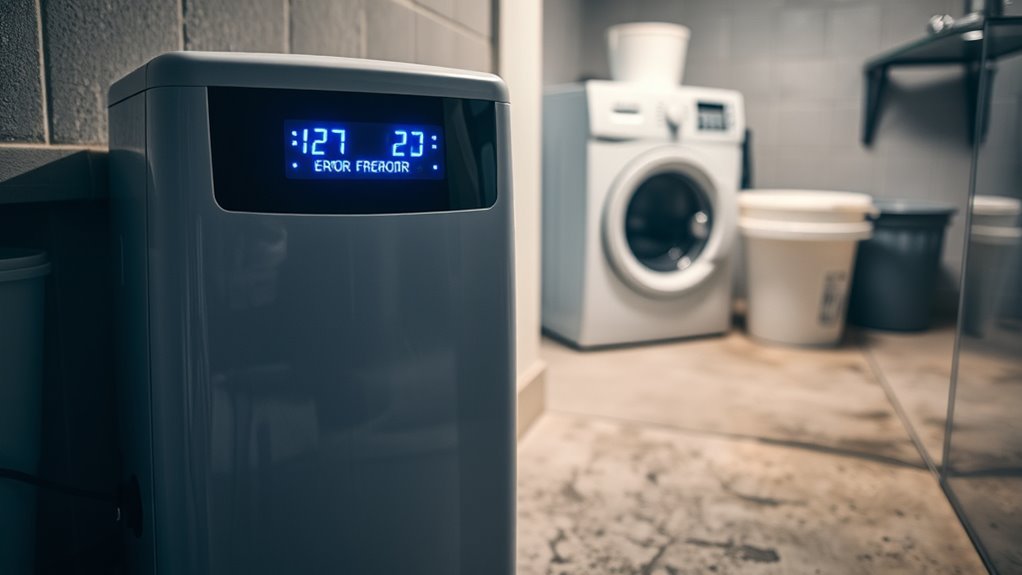
When a Frigidaire dehumidifier EC code flashes on the control panel, the appliance has detected a cooling problem inside its sealed refrigeration circuit. Although Frigidaire’s official dehumidifier error-code guide groups EC and F0 together as sealed-system failure codes that require customer support, certain model manuals allow one safe round of external checks first. On the FFAD5034W1, for example, you should verify normal household voltage and a room temperature between 41°F and 89°F before unplugging and restarting the unit once. If the code comes back after those basic checks, stop power-cycling the machine and move straight to warranty service or replacement.
Quick Answer
The Frigidaire dehumidifier EC code indicates a sealed-system failure involving the compressor, coils, or refrigerant circuit. Never open or recharge the sealed system yourself. Verify that room temperature is between 41°F and 89°F, clean the air filter, check outlet power, and perform one power restart. If EC returns, contact Frigidaire support or replace the unit.
Last checked: October 16, 2026. Dates and figures were verified against official sources.
At a Glance
| Time Required | 15–20 minutes for filter cleaning and power restart; up to 60 minutes if visible coil frost must melt |
| Difficulty | Easy for external airflow and temperature checks; EPA-certified professional only for sealed-system work |
| Tools Needed | Vacuum with soft brush attachment, warm water, clean cloth, room thermometer, model and serial number, proof of purchase |
| Cost | Free for external troubleshooting and in-warranty claims (1-year limited warranty); out-of-warranty failures usually require unit replacement |
What Does the Frigidaire Dehumidifier EC Code Mean?
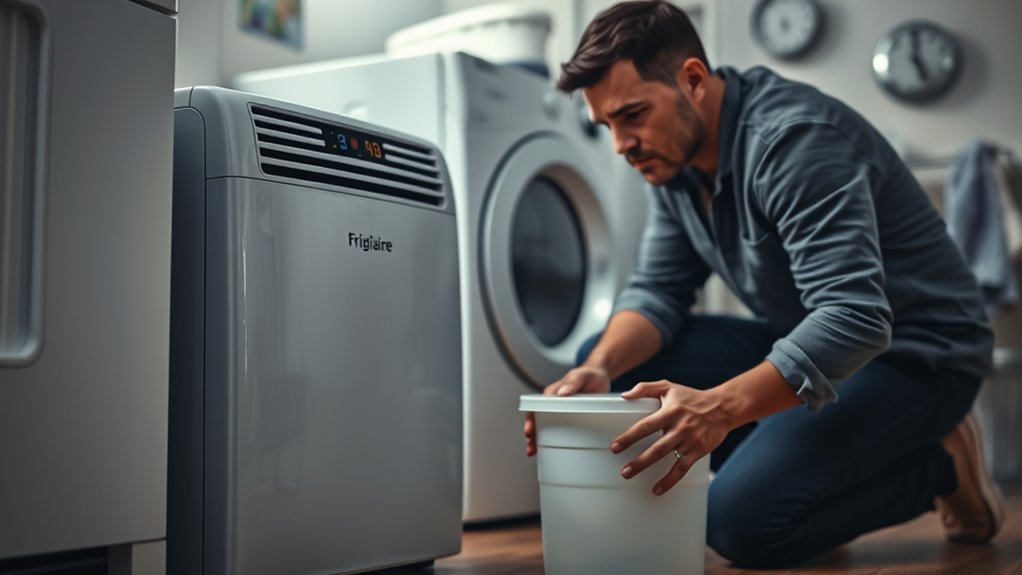
The Frigidaire dehumidifier EC code means the control board has detected a failure in the sealed refrigeration system. That closed loop includes the hermetic compressor, evaporator coil, condenser coil, capillary tubing, and factory refrigerant charge. When the evaporator coil fails to reach the expected cooling temperature during compressor operation, the unit triggers EC and stops dehumidifying.
Because the display only reports the outcome—insufficient coil cooling—the two-letter code cannot tell you whether the root cause is a refrigerant leak, a restricted tube, or a failing compressor. Frigidaire’s current owner support guide for dehumidifier error codes places EC and F0 (often misread on seven-segment screens as “FO”) in the exact same sealed-system failure category and instructs owners to contact support. However, individual manuals add a basic environmental check before booking a technician. According to the FFAD5034W1 owner’s manual, seeing EC should prompt you to confirm a 115V±10% electrical supply and an ambient room temperature of 41°F to 89°F (5°C to 32°C), then unplug and reconnect the appliance under normal operating conditions.
| Official Frigidaire Source | How It Defines the Error Code | Required Owner Action |
|---|---|---|
| Frigidaire Dehumidifiers Error Code Guide (EC, F0) | Groups EC and F0 together as sealed-system failure codes. | Refer to the installer if installed within the past 30 days; otherwise contact Frigidaire support. |
| FFAD5034W1 Owner’s Guide (EC) | Instructs users to check 115V±10% outlet voltage and 41°F–89°F surrounding temperature. | Unplug and reconnect under normal conditions; if EC persists, contact an Authorized Frigidaire Service Center. |
| Frigidaire Error Code Guide (H3, E5) | Compressor overload protection due to high heat, blocked airflow, or excessive current draw. | Check clearance, clean the filter, verify 41°F–89°F room temperature, unplug, and let the unit cool. |
| Frigidaire Error Code Guide (AS, ES, F1, F2, L1, F5) | Temperature thermistor or relative humidity sensor failure. | Contact Frigidaire support for sensor or control service. |
| Frigidaire Error Code Guide (E4, C5 / PU) | E4/C5 indicates electronic control board failure; PU indicates condensate pump-out failure. | For PU, inspect the pump drain hose and bucket pickup for kinks or algae, then restart; for E4/C5, contact support. |
Note: Do not confuse the EC fault code with the filter maintenance light. On the FFAD5034W1, the filter-reset indicator illuminates after 250 hours of fan operation, and pressing the Filter Reset button only clears that reminder timer after washing the screen—it will not clear or reset an EC sealed-system fault.
Why the Frigidaire EC Code Happens
An EC code appears either because an internal sealed-system component has failed or because extreme room conditions prevent the evaporator coil from cooling normally. When refrigerant charge drops due to a pinhole leak, or when the compressor stops pumping efficiently, the coil temperature sensor notices that the evaporator is staying warm while the compressor is supposed to be running.
External factors can sometimes mimic or accelerate this condition. A cold basement below 41°F, heavy dust blocking the rear intake grille, or voltage drops from an extension cord can keep the compressor and evaporator from operating within their normal window. Because you cannot inspect the pressurized refrigerant circuit yourself, the safest approach is to rule out the permitted external causes once and treat any returning EC message as a verified hardware failure.
| Condition to Rule Out | What to Check | Can You Fix It Yourself? |
|---|---|---|
| Room outside the operating temperature range | Verify that surrounding air is between 41°F and 89°F (5°C to 32°C) using a separate room thermometer. | Yes. Warm or cool the space into the permitted range and retest once. |
| Improper power supply or voltage drop | Confirm the unit is plugged directly into a grounded 115V±10% wall receptacle without extension cords or adapter plugs. | Yes, if removing an extension cord or switching outlets; hire a licensed electrician for wiring faults. |
| Restricted airflow across the coils | Inspect the washable mesh filter, rear intake grille, air discharge vents, and surrounding clearance. | Yes. Wash and dry the filter, vacuum the grille, and move obstructions away from the cabinet. |
| Frost buildup behind the air filter | Light startup frost normally clears within 60 minutes on the FFAD5034W1, while cold rooms or low refrigerant cause heavy icing. | Unplug and let all frost melt completely, then warm the room. If ice and EC return, request service. |
| Internal sealed-system failure | The fan runs without collecting water, coils stay warm or ice only on one loop, and EC returns after a normal restart. | No. Contact Frigidaire under warranty or replace the dehumidifier. |
What to Do When the EC Code Appears
Work through these six external checks once from start to finish. Following this exact sequence protects the compressor from short-cycling and keeps you away from hazardous refrigerant components. If the EC code reappears after Step 6, stop troubleshooting and move to warranty support.
Recommended Products

CLEAR LCD READOUT: GFCI Receptacle Tester features a large backlit LCD readout for easy voltage reading and clear indication of wiring conditions

CLEAR LIGHT SEQUENCE: Outlet tester's light sequence indicates correct/incorrect wiring, ensuring easy identification of wiring issues
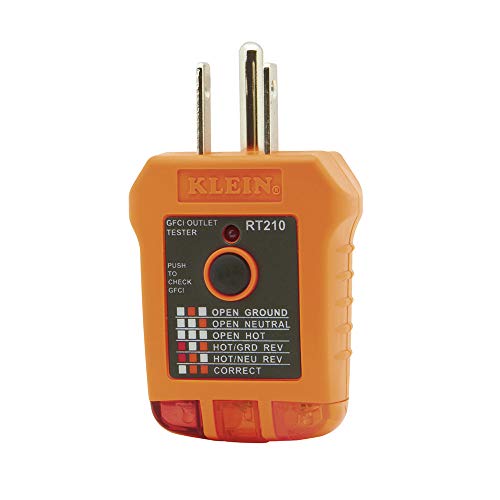
EFFECTIVE GFCI WIRING PROBLEM DETECTION: GFCI Tester detects common wiring problems in standard and GFCI receptacles, ensuring electrical safety
1. Stop and Unplug the Unit
Press the power button on the control panel to turn the dehumidifier off, then unplug the power cord by gripping the plug body firmly. Never yank the cord or repeatedly unplug and replug the appliance in quick succession, which can trip the compressor’s internal thermal overload protector.
Warning: Never open the outer cabinet to access refrigerant tubing, install a piercing valve, add DIY refrigerant cans, solder copper lines, or use an open flame to check for leaks. Newer units like the FFAD5034W1 use R-32 (difluoromethane), an A2L mildly flammable refrigerant, and federal Section 608 refrigerant regulations prohibit venting refrigerants into the air and require certified recovery equipment.
2. Check the Room Temperature
Measure the air temperature near the dehumidifier with an independent thermometer rather than relying on the unit display. The FFAD5034W1 manual specifies an operating window of 41°F to 89°F (5°C to 32°C) and directs owners seeing EC to verify that range before reconnecting power. Operating in an unheated basement or garage below 41°F causes evaporator frost and stops normal moisture removal, while spaces above 89°F can overheat the compressor.
3. Check the Power Supply
Confirm that the power cord is plugged directly into a dedicated, properly grounded three-prong wall outlet supplying 115V±10% (approximately 103.5V to 126.5V). Remove any extension cords, surge strips, or two-prong adapter plugs, as voltage drop under compressor startup load can trigger control and cooling faults. Do not probe live outlets yourself unless you are qualified; if household lights dim when the compressor starts, breakers trip, or the receptacle feels loose or warm, stop using the outlet and call an electrician.
4. Clean the Filter and Grille
Inspect the air filter and rear intake grille for lint buildup that chokes airflow across the evaporator coil. Frigidaire’s FFAD5034W1 manual instructs owners to clean the filter every two weeks under normal operating conditions. Open the back grille, pull out the mesh screen, wash it with clean warm water and mild detergent, let it dry completely out of direct heat, and vacuum the plastic grille louvers with a soft brush attachment before reinstalling.
5. Check Clearance and Airflow
Pull the dehumidifier away from walls, curtains, storage bins, and furniture so air can enter the rear intake and exit the discharge louver without recirculating. Leave at least 12 to 18 inches of open space around the air vents and verify that the cabinet sits level on a flat floor. If you see ice on the coils behind the filter, leave the unit unplugged until all frost has melted into the bucket and empty the water.
6. Restart Under Normal Conditions
Once the filter is dry, any coil frost has melted, and the room sits between 41°F and 89°F, plug the cord directly into the wall outlet and press power. Set the humidistat 5% to 10% lower than the current room humidity so the unit calls for cooling. On models like the FFAD5034W1, an internal protective timer automatically delays compressor startup for about 3 minutes after power is restored—wait at least 5 to 10 minutes to see if the compressor engages and water begins dripping into the bucket.
Pro Tip: Before you unplug the dehumidifier or call customer service, snap a clear smartphone photo of the illuminated EC code on the display alongside a second photo of the model and serial number sticker. Having visual proof of the error code and serial label speeds up warranty replacement approval.
How to Check for a Possible Refrigerant or Sealed-System Problem
You can evaluate whether your dehumidifier has a genuine sealed-system failure using four safe external observations, without ever opening the cabinet. Because the fan motor runs on a separate electrical circuit from the compressor, a dehumidifier with a failed sealed system will often blow room-temperature air continuously while producing zero condensation in the bucket.
| Safe External Observation | What It Indicates | Recommended Next Step |
|---|---|---|
| EC returns after one clean restart in a 41°F–89°F room | External operating conditions are normal, confirming an internal sealed-system or sensor/control fault. | Stop resetting the unit; initiate a warranty claim or authorized service check. |
| Fan runs steadily, exhaust air feels room-temperature, and the unit removes little or no water | The evaporator coil is not getting cold because of refrigerant loss, a restriction, or a non-pumping compressor. | Verify the target humidity setting is below room RH; if unchanged, book service or replace. |
| Heavy frost forms on only part of the coil and stays past 60 minutes in a warm room | Low refrigerant pressure often causes localized freezing near the evaporator inlet before triggering EC or F0. | Unplug to defrost, verify filter cleanliness once, and contact support if frost and EC recur. |
| Acrid burning odor, visible sparks, frayed cord, or a hot wall plug | Immediate electrical or fire hazard. | Unplug immediately, stop using the appliance, and check CPSC recall status. |
Ignore online rumors claiming that you can diagnose a dehumidifier refrigerant leak by sniffing for a sweet smell or listening for a hiss. The FFAD5034W1 manual explicitly warns that its R-32 refrigerant may not contain an odor, and it notes that a gentle gurgling or hissing sound is normal as liquid refrigerant flows through the evaporator tubing during operation. Because R-32 is classified as mildly flammable, never attempt to locate leaks with matches, lighters, or unrated electronic tools.
Recommended Products

1600 Sq.Ft High Capacity Dehumidifier- The GoGuess basement dehumidifier is equipped with a quiet yet powerful compressor that efficiently extracts up to 21 pints of moisture per day (tested at 95°F and 90% RH). Perfect for use in basements, offices, bathrooms, bedrooms, kitchens, storage areas, living rooms, laundry spaces, garages, crawl spaces, and RVs. It helps maintain a healthy humidity level between 30% and 70%, promoting a more comfortable and healthier indoor environment
How to Reset a Frigidaire Dehumidifier
To reset a Frigidaire dehumidifier showing EC, perform a full power cycle by unplugging the power cord from the wall outlet and reconnecting it under normal room conditions. Unlike third-party blogs that prescribe arbitrary 15- or 30-minute button holds, Frigidaire’s FFAD5034W1 manual simply directs you to unplug and plug the unit back in after confirming 115V±10% power and a 41°F–89°F room temperature.
- Press the Power button on the control pad to shut the dehumidifier down.
- Unplug the power cord directly from the wall receptacle.
- Leave the unit unplugged for at least 5 to 10 minutes so the compressor pressure equalizes—or up to 60 minutes if visible frost on the evaporator coil needs to melt.
- While unplugged, wash and thoroughly dry the air filter and confirm the room temperature is between 41°F and 89°F.
- Plug the power cord directly into a grounded 115V wall outlet without an extension cord.
- Press Power and wait at least 3 minutes for the built-in compressor restart delay to finish.
remember that pressing the Filter Reset button on the touchpad only resets the 250-hour filter reminder light—it does not clear sealed-system diagnostic codes. If the EC error clears after your power cycle and the bucket collects water steadily over the next 24 hours, a temporary voltage dip or cold-room condition likely triggered the alert. If EC returns within hours or days, stop power-cycling the machine; repeated resets will not restore lost refrigerant or heal a failing compressor.
What to Tell Frigidaire Support
Having your appliance data and troubleshooting notes ready before contacting Frigidaire cuts down diagnostic time and helps support confirm warranty eligibility on your first call. According to Frigidaire’s official error-code guide, if your dehumidifier was installed within the past 30 days, you should contact your retailer or installer first for a direct exchange or resolution. For units older than 30 days, reach out to Frigidaire Customer Support at 1-800-374-4432 (Monday through Friday, 8:30 a.m. to 8:00 p.m. ET) or via live chat.
- Model number and full serial number from the rating sticker (usually located on the rear cabinet or behind the water collection bucket).
- Proof of purchase showing the exact purchase or delivery date (store receipt, online invoice, or order confirmation email).
- Ambient room temperature and relative humidity setting at the time the EC code appeared.
- Confirmation of completed manual checks: state that you verified a grounded 115V outlet (no extension cord), cleaned and dried the filter, and performed one power restart inside the 41°F–89°F window.
- Operating symptoms before the fault: note whether the fan still spins, whether coils frosted over, and when the bucket last collected water.
- Clear photos of the control panel showing the EC code and the rating plate label.
When to Use Warranty or Replace It
Always check your warranty status before paying a technician to inspect a dehumidifier with an EC fault. Frigidaire’s official warranty information page covers residential dehumidifiers under a 1-year standard limited warranty for parts and labor from the original date of delivery or purchase. Credit card extended warranty benefits or third-party protection plans (which often extend coverage up to 5 additional years) may also cover a sealed-system failure after the first year expires.
Recommended Products

Premium Quality Material:This dehumidifier hose is made of durable and thick PVC, which has moderate flexibility and is easy to bend without breaking; Ripple design can prevent tangling, ensure smooth water flow, and make it easy to move in small spaces
Premium Quality Material:This dehumidifier hose is made of durable and thick PVC, which has moderate flexibility and is easy to bend without breaking; Ripple design can prevent tangling, ensure smooth water flow, and make it easy to move in small spaces

Compatibility: There are 2 types of hose connector size design, the larger one is suitable for tubes ranging from 0.79in to 0.98in, and it can also cut to smaller one is suitable for tubes ranging from 0.59in to 0.79in. Beyond dehumidifiers, this versatile hose is ideal for draining portable air conditioners, dishwashers, and washing machines, making it a complete drainage solution
Check Your Exact Warranty
- Locate the model and serial number on the appliance rating label.
- Pull your dated sales receipt, delivery confirmation, or extended service contract.
- Verify the exact warranty coverage terms in your model’s PDF owner’s manual.
- Contact Frigidaire customer support or use the Frigidaire Service and Repair page to book an authorized technician or arrange a warranty replacement.
Check for a Safety Recall
Before paying for an out-of-warranty repair or discarding an older machine, check your exact model number and date code against the U.S. Consumer Product Safety Commission dehumidifier recall database. In the CPSC Gree dehumidifier recall notice (which was reannounced on August 16, 2023), 13 specific older Frigidaire-branded dehumidifier models manufactured with date codes 01/07 through 09/08 were recalled due to overheating and fire hazards:
- 25-pint model: FDD25S1 (date codes 01/07–09/08)
- 30-pint models: FDB30R1, FDL30R1, FDM30R1, FDR30S1 (date codes 01/07–09/08)
- 50-pint models: FDB50R1, FDF50S1, FDL50R1, FDL50S1 (date codes 01/07–09/08)
- 70-pint models: FDB70R1, FDF70S1, FDL70R1, FDL70S1 (date codes 01/07–09/08)
Newer Energy Star units such as the FFAD5034W1 are not part of that 2007–2008 production run, but you should always match your exact model and manufacturing date code against the current CPSC listings. If your unit matches a recall, unplug it immediately and contact the recall hotline (1-866-853-2802 for the Gree recall) instead of attempting any troubleshooting.
Compare Repair Cost With Replacement
Portable residential dehumidifiers are built with factory-brazed sealed systems that lack service ports, meaning an out-of-warranty refrigerant leak or compressor replacement requires specialized recovery equipment, brazing, evacuation, and recharging. Because a professional diagnostic fee plus sealed-system labor and parts routinely exceeds the $200 to $350 price of a brand-new 35- to 50-pint Energy Star dehumidifier, out-of-warranty sealed-system repairs are rarely cost-effective.
Replacing the dehumidifier is almost always the smarter financial choice when:
- The EC or F0 code persists after verifying room temperature, clean airflow, and a direct 115V outlet.
- The 1-year manufacturer warranty and any credit card or extended protection plans have expired.
- The authorized technician’s diagnostic and repair estimate approaches or exceeds 50% of the cost of a new unit.
- The appliance has suffered repeated coil icing, noisy compressor starts, or declining water extraction over several seasons.
How to Prevent EC Error Codes
While you cannot prevent a manufacturing defect in a brazed copper joint, routine maintenance reduces heat and pressure stress on the compressor and coils. Keeping air moving freely across the evaporator and avoiding extreme temperature swings helps prevent avoidable thermal strain and false operating-condition faults.
- Wash the air filter every two weeks: Follow the FFAD5034W1 manual’s two-week cleaning schedule during active use so dust never insulates the evaporator fins.
- Vacuum the intake and discharge grilles: Use a soft brush attachment monthly to clear lint before it gets pulled inside the cabinet.
- Respect the 41°F to 89°F operating range: Shut the unit off during winter cold snaps if your basement drops below 41°F (5°C).
- Maintain 12 to 18 inches of clearance: Keep boxes, laundry, drapes, and walls clear of the rear intake and top or side exhaust louvers.
- Target a realistic indoor humidity level: The U.S. EPA advises keeping indoor relative humidity below 60%—ideally between 30% and 50% relative humidity—to inhibit mold growth without forcing the compressor to run nonstop.
- Use Continuous mode sparingly: Once dampness is under control, switch from Continuous (CO) to a 45% or 50% target setting so the compressor can cycle off and cool down.
- Store the unit clean and upright: Empty and rinse the bucket, dry the interior, and keep the cabinet upright when moving or storing it so compressor oil stays in the sump.
If your dehumidifier keeps showing EC despite clean filters, proper clearance, and a warm room, your maintenance habits are not to blame. A recurring EC display points to an internal sealed-system fault that requires warranty replacement or a new unit.
Key Takeaways
- Frigidaire’s official dehumidifier error-code guide classifies both EC and F0 as sealed-system failures, distinct from H3/E5 compressor overload codes and AS/ES sensor faults.
- Before calling for service on models like the FFAD5034W1, confirm a grounded 115V±10% wall outlet and a 41°F–89°F room temperature, then unplug and reconnect the unit once.
- Pressing the Filter Reset button only clears the 250-hour filter reminder light—it is not an EC reset button.
- Never attempt DIY refrigerant recharges or leak checks; many Frigidaire units use odorless, mildly flammable R-32 refrigerant that requires EPA Section 608 recovery equipment.
- If EC returns after one clean restart, use Frigidaire’s 1-year limited warranty (or your installer within the first 30 days) rather than paying for expensive out-of-warranty sealed-system repairs.
Frequently Asked Questions
How do I fix the EC code on a Frigidaire dehumidifier?
You can only fix an EC code yourself if it was triggered by an external operating condition. Confirm that the room temperature is between 41°F and 89°F, verify the unit is plugged directly into a 115V±10% grounded wall outlet, clean the air filter, and unplug the dehumidifier for 5 to 10 minutes before restarting. If the EC code returns, the sealed refrigeration system has failed and requires warranty service or unit replacement.
Can I reset a Frigidaire dehumidifier EC code?
Yes, you can perform a power reset by turning the unit off, unplugging it from the wall outlet, and plugging it back in under normal operating conditions (41°F to 89°F). Do not use the Filter Reset button on the control panel, as that button only clears the 250-hour filter cleaning reminder and does not reset sealed-system error codes.
Is the EC code the same as F0?
Yes, Frigidaire’s official dehumidifier error-code guide groups EC and F0 (sometimes read as FO) together as sealed-system failure codes. Both indicate that the evaporator coil is not cooling properly due to a refrigerant leak, tubing restriction, or compressor fault, and both require the same operating-condition check followed by customer support if the code persists.
Can I add refrigerant to fix the EC code?
No, you should never open the sealed system or attempt to add refrigerant yourself. Many newer Frigidaire dehumidifiers use R-32, a mildly flammable refrigerant that may be odorless, and U.S. EPA Section 608 rules require certified technicians and recovery equipment for any refrigerant service.
Should I repair or replace a dehumidifier with an EC code?
If your dehumidifier is within its 1-year limited manufacturer warranty or covered by an extended protection plan, contact Frigidaire for an authorized repair or replacement. If the unit is out of warranty and EC persists after a clean power cycle, replacing the dehumidifier is almost always cheaper than paying for professional sealed-system labor and parts.
Could my Frigidaire dehumidifier be recalled?
Certain older Gree-manufactured Frigidaire dehumidifiers (13 models including FDB30R1, FDB50R1, FDB70R1, FDD25S1, FDF50S1, FDF70S1, FDL30R1, FDL50R1, FDL50S1, FDL70R1, FDL70S1, FDM30R1, and FDR30S1 with date codes 01/07 through 09/08) are under a CPSC fire-hazard recall. Check your exact model number and date code against the CPSC recall list before attempting any repair, and unplug the unit immediately if it is listed.
Why does my Frigidaire dehumidifier show EC while the fan is still running?
The fan motor operates on an electrical circuit separate from the sealed refrigeration system. Even when the compressor stops pumping or the system loses its refrigerant charge and triggers the EC code, the fan may continue blowing room-temperature air without condensing any moisture into the bucket.
Conclusion
Treat a Frigidaire dehumidifier EC code as a serious cooling alert rather than a routine maintenance reminder. Run through one complete check of your model’s operating requirements—confirming a 41°F to 89°F room temperature, a direct 115V±10% wall outlet, a clean filter, and melted frost—then perform a single power restart. If the EC code returns, leave the sealed refrigerant system closed, verify your 1-year warranty and CPSC recall status, and contact Frigidaire at 1-800-374-4432 or replace the unit.
Sources
- Frigidaire Dehumidifiers Error Code Guide: Official classification of EC/F0 as sealed-system failure codes, plus definitions for H3/E5, AS/ES/F1/F2/L1/F5, E4/C5, PU, and the 30-day installer rule.
- Frigidaire FFAD5034W1 Complete Owner’s Guide: Model-specific EC operating-condition check (115V±10% and 41°F–89°F), 3-minute compressor restart delay, 250-hour filter reminder, two-week filter cleaning interval, R-32 safety warnings, and 60-minute frost guidance.
- Frigidaire Warranty Information: Standard 1-year limited manufacturer warranty coverage for Frigidaire dehumidifiers.
- Frigidaire Contact Us: Official customer support phone number (1-800-374-4432), operating hours, and live chat support channels.
- Frigidaire Service and Repair: Official repair scheduling and 1-year manufacturer warranty service guidelines.
- U.S. EPA Prohibition on Venting Refrigerants: Clean Air Act Section 608 rules prohibiting refrigerant venting and requiring certified recovery practices.
- U.S. CPSC Dehumidifier Recalls: Federal recall database and safety alerts for recalled dehumidifier brands.
- U.S. CPSC Gree Dehumidifier Recall Notice: Exact model numbers (FDB30R1 through FDR30S1), pint capacities, and 01/07–09/08 date codes for recalled Frigidaire dehumidifiers.
- U.S. EPA Mold Course: Humidity: Recommended indoor relative humidity target range (below 60%, ideally 30% to 50%).